Hebraization of names

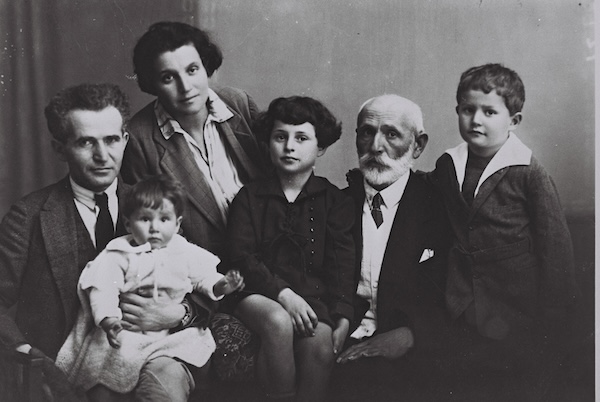
The Ben-Gurion family in their Tel Aviv home, 1929. From left: David and Paula with youngest daughter Renana on Ben-Gurion’s lap, daughter Geula, father Avigdor Grün and son Amos. (photo from National Photo Collection of Israel / Government Press Office)

David Ben-Gurion, who died 50 years ago, insisted Israelis needed Hebrew names. The process was controversial – but the outcome is clear.

The 50th anniversary of the death of David Ben-Gurion will be marked Dec. 1. The first prime minister of Israel is generally remembered in noble terms, though we live in an era when heroes are being toppled from their plinths. His actions in times of war and peace have been parsed by historians – fairly and unfairly, as seems inevitable – but Ben-Gurion’s legacy among Zionists appears generally secure. Those with ideological axes to grind will grind, but the esteem in which most Israelis and overseas Jews view “the Old Man” remains largely favourable. However, an aspect of his policy that affected people in a very personal way has come in for a reconsideration in the past couple of decades, though it is hardly the stuff that will make or break a reputation. It is the Hebraization of names.

Ben-Gurion was a fierce advocate of Israelis (or, before 1948, Palestinian Jews) adopting names that reflect their new reality and that, by extension, turn their backs on the past and the diaspora. Ben-Gurion himself was born David Grün (or Gruen), changing his name to the Hebrew Ben-Gurion (son a lion cub) in 1910. By 1920, at the latest, he had become an evangelist for Hebraizing names and, when he was in power, he insisted that leading military and political figures adopt Hebrew names.

Ben-Gurion did not start this trend – though he is perhaps most closely associated with it because he was in a position to make it the force of law and custom. He instituted an administrative order that senior military figures and diplomatic officials representing Israel abroad must have Hebrew names. Others, like Golda Meir, he browbeat into the change.

Of course, Jews – and others – have been changing their names since the dawn of migration. People have frequently altered their names when moving to a new society, in order to fit in. Iberian Jews migrating en masse to the Low Countries after the expulsions of the 1490s are an early, well-documented example. Jews arriving on North American shores routinely changed their names, but so did non-Jewish migrants. It was not necessarily (or only) antisemitism that name-changers sought to outrun, but differentness in general. There are stories of French newcomers changing from Boisvert to Greenwood. 

Dara Horn, in her book People Love Dead Jews, emphatically debunks the long-held belief passed down by generations that their family names had been changed at Ellis Island (or whatever entry point was appropriate to the story). No, she argues, that didn’t happen. The changing of names by Jewish new Canadians and Americans was, she contends, done by the migrants themselves and represents a sad realization that the Goldene Medina might not be the refuge from antisemitism they had hoped.

But changing one’s name to fit into a society already in progress, like America’s, was different than the situation of arriving in the pre-state Yishuv. This was not a matter of looking around for a local-sounding name and changing Moses to Murray or Lipschitz to Lipson. This required inventing a whole new lexicon of names. It was not the act of taking a common name in the new place, but of inventing entirely fresh first and last names.

The process was a legacy, ultimately, of Eliezer Ben-Yehuda (né Perlman), who was the driving force behind the revival of Hebrew as a vernacular language. After making aliyah in 1881, he came to believe that the redemption of both the people and the land of Israel required a new language to replace Yiddish. This represented a rejection of the diaspora reality and mentality, and served to create a medium through which an eventual (hoped-for) ingathering of exiles from around the world, including places where Yiddish was not the Jewish lingua franca, could communicate. The revival of an ancient land would coincide with the revival of an ancient language, both modernized to meet the needs of a new type of Jew. Ben-Yehuda raised his son and daughter exclusively in Hebrew, which must have made for a somewhat lonely childhood, being effectively the only two people in the world to speak the language as a mother tongue.
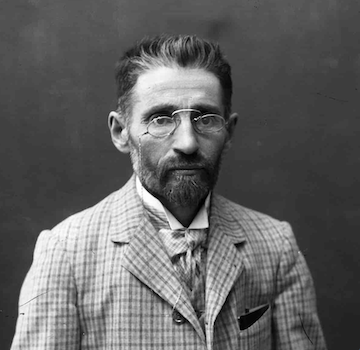
photo - Eliezer Ben-Yehuda (né Perlman) was the driving force behind the revival of Hebrew as a vernacular language
Eliezer Ben-Yehuda (né Perlman) was the driving force behind the revival of Hebrew as a vernacular language. (photo by Av Yaacov Ben Dov / Widener Library, Cambridge)

As the language spread – in large part thanks to Ben-Yehuda’s continued perseverance in promoting it and inventing modern words where the ancient language lacked them – the application of the new tongue to family and given names likewise grew.

The repudiation of the diaspora took on an entirely new relevance after the Holocaust. Some who made aliyah resisted changing their names, being attached, as is understandable, to one’s family name. Even so, no Jewish surnames were particularly long-established in the first place, since the practice of Jews adopting inheritable family names was only a century old, or a little more, at that time. The Austro-Hungarian Empire required Jews to take surnames in 1789 and in the Russian Empire and the German principalities not until the following century. At that time, choosing a name followed predictable patterns for Jews and non-Jews: a variation on “son of,” (Aronoff, son of Aron; Mendelsohn, son of Mendel), a reference to a profession (Becker for a baker; Melamed for a teacher), or a connection to the town or region (Frankel, from Franconia; Warshavski, from Warsaw; Wiener, from Vienna).

The adoption of Hebraized names in Palestine and Israel took four primary approaches. 

The first was the traditional use of patronyms or matronyms, which is probably the oldest form of naming. Yiddish names, but also names that were German, Polish, Russian, English or French patronyms could be Hebraized: Davidson to Ben-David, Mendelson to Ben-Menachem, Simmons to Shimoni.

A second approach was to choose a Hebrew name that sounded like the original name. In some cases, the new name had a (sometimes remote) connotation with the original, as in the case of Lempel (little lamp) becoming Lapid (torch). Levi Shkolnik would become Israel’s third prime minister as Levi Eshkol. This was more than simply a near-homophone. It reflected another trend in the process, which was to adopt a name that spoke to the commitment of the chalutzim, the pioneers, whose Zionism was deeply informed by a back-to-the-land ethos. Eshkol means “cluster of fruit,” so it did double duty, sounding something like the original and also having a kinship with the blooming desert.

A third strategy was basic translation. Goldberg might become Har-Zahav (mountain of gold); Silver or Silverman might become Kaspi; Herbst, which in German and Yiddish means autumn, could be changed to a Hebrew equivalent, Stav or Stavi.

The fourth approach took the pioneer spirit and connection with the land to greater depths (with or without the homophonic advantage of Shkolnik/Eshkol). Flora, fauna and geography of the new homeland were attractive new names that situated the migrants linguistically and geographically. The writer Carrie-Anne Brownian cites such examples as Rotem (desert broom), Nitzan (flower bud), Yarden (Jordan), Alon (oak tree) and Tomer (palm tree). Simply adopting a place name gives us Hermoni, Eilat, Golani, Kineret and many others.

Those whose names already had a nature theme were at an advantage. The Haganah commander Moshe Klaynboym changed his family name, which meant “little tree” in Yiddish, to Sneh, Hebrew for “bush.”

Not necessarily related to nature, but to the idealization of the Zionist spirit, some took names like Amichai (my people live), Maor (light), Eyal (strength), Cherut (freedom) and Bat Or (daughter of light).

Golda Meyerson, after prodding from Ben-Gurion, became Golda Meir. Interestingly, her rather emphatically Yiddish given name she kept, presumably making Ben-Gurion half-satisfied.
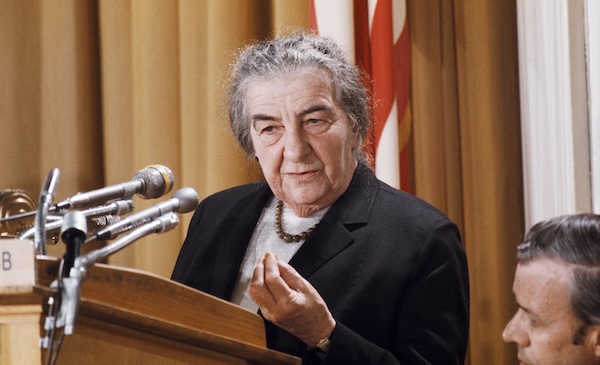
photo - Golda Meyerson, with prodding from David Ben-Gurion, became Golda Meir
Golda Meyerson, with prodding from David Ben-Gurion, became Golda Meir. (photo from mosaicmagazine.com)

As refugees from the Middle East and North Africa began pouring into Israel in the 1950s and ’60s, the Hebraization of names came to be seen as Ashkenormative, the taking of one’s ancestral name being another indignity (alongside inadequate housing and social stigmatization, among other things) that different-looking newcomers faced in their presumed Promised Land.

It seems, for example, that teachers encountering “strange” Mizrachi and Sephardi given names took it upon themselves, in some cases, to assign kids new names based not on any Zionist ideological imperative but for the same reason Canadian teachers in the early to mid-20th century dubbed kids with “foreign” names new ones the teachers could more easily pronounce. In retrospect, some have complained that this phenomenon was an insidious part of a larger (conscious, unconscious or some of both) effort to force Mizrahim and Sephardim to comport to Ashkenazi expectations even in things as intimate as a given name.

Sami Shalom Chetrit, a professor at Queens College in New York, who is of Moroccan-Israeli origin, recalled in a Forward article by Naomi Zeveloff, feeling outraged when an Israeli elementary school teacher nonchalantly renamed him, along with other non-Hebrew-named kids.

“Alif, your name from now on will be Aliza,” Chetrit recalled the teacher declaring. “Jackie, your name is Jacob, and Michele, your name is Michal. She kept going alphabetically. Then she said, ‘Sami, your name will be Shmuel Shalom.’

“I went to my father, crying.… I really felt like something was stolen from me, something precious. I said: ‘They changed my name! They changed it!’”

Chetrit’s father taught the teacher something the next day, according to the story. In Arabic, “Sami” comes from the root “samar,” the father said, meaning “heavenly superior,” and that, the father declared, is “international.”

The tendency eventually faded out. When a million migrants from the former Soviet Union arrived in Israel, after 1991, almost none chose to, or were pressured to, change their names.

There are contemporary exceptions even to this, though. Anatoly Shcharansky, one of the most famous of the Soviet “refuseniks,” became Natan Sharansky on arrival in Israel in 1986. The American historian Michael Bornstein became the Israeli politician-cum-diplomat Michael Oren, having changed his name when he made aliyah in 1979.

Newcomers to Israel today are free to change their names – and free to keep their “galut” (“exile”) names. Israel, today, is an overwhelmingly Hebrew society, though. New arrivals do not present a risk of swamping the place with Yiddish, Arabic, German, Polish or English, as might have seemed a danger 75 years ago, creating a Babel where cultural unity was desperately needed.

In addition to the psychological impacts of adopting Hebrew names (and language) as a refutation of the diaspora that had so recently been the locus of calamity, there was the practical reality of finding commonality among wildly diverse new citizens. That has been achieved. Even sorbing a million Russian-speaking new Israelis after 1990 did not dilute the ascendency of the Hebrew language. For whatever criticisms the forced (or vigorously encouraged) adoption of Hebrew names might invite, there is no doubt the intended outcome has been realized. Ben-Gurion’s dream not only of a Jewish state, but a Hebrew one, is firmly in place. 
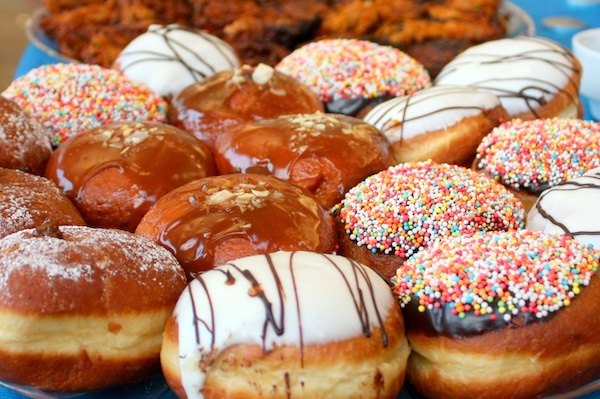
Exploring sufganiyot’s origins

Sufganiyot (jelly doughnuts) for Hanukkah have come a long way, and now come in countless variations. (photo by Avital Pinnick / Flickr)

In Israel, sufganiyot (jelly doughnuts) have gone through a major revolution. For years, they were injected with strawberry jelly and dusted with confectioners’ sugar. In a recent ad by a well-known Israeli bakery, there were 14 variations of sufganiyot, including the “classic strawberry jam.” Twelve are dairy and two are pareve (can be eaten with milk or meat dishes).

For the pareve offerings, there are colourful sprinkles, dairy-free chocolate and ganache (filling made from chopped chocolate and heavy cream). Among the dairy choices are “Raspberry Pavlova,” filled with sweet cream and topped with raspberry ganache, pavlova (a meringue named after the Russian ballerina, Anna Pavlova), sweet cream and Amarena cherries; “Curly,” filled with cream and topped with Belgian chocolate and milk, dark and white chocolate curls; “Mozart,” filled with nougat-flavoured sweet cream, frosted with white chocolate strips and topped with Mozart cream (a chocolate liqueur) and chocolate curls; “Cheese Crumbs,” filled with cheese mixed with white chocolate and butter cookie crumb frosting and topped with cream cheese; and “Pistachio,” filled with pistachios, frosted with white chocolate ganache, and topped with pistachio cream and pistachio shavings.

Jewish law does not prescribe any special feasting or elaborate meal for Hanukkah as it does for other holidays. Maybe this is because the origin of Hanukkah is not in the Torah but in the Apocrypha, the books of literature written between the second century BCE and the second century CE, which were not incorporated into the Hebrew Bible.

The Books of Maccabees, of which there are four separate books, only say that the hero, Judah, “ordained that the days of dedication of the altar should be kept in their season from year to year by the space of eight days from the first and 20th day of the month Kislev, with mirth and gladness.”

So, where do we get all the food we eat? It is in the Talmud, where the so-called miracle of the oil burning for eight days is written. This myth was inserted to de-emphasize the miracle of military triumph and replace it with a more palatable idea, that of the intervention of G-d, which somehow would seem more a miracle than a fight of man against man, according to the sages of the time. (By the way, it is only within the past few years that children’s books about Hanukkah dare say the oil story is a legend or a myth.)

Practically every Jewish ethnic group has the custom of making and eating a form of food prepared in oil as a reminder of the “miracle” of the jar of oil.

The late Gil Marks wrote, in The World of Jewish Desserts, that doughnuts fried in oil, ponchikot, were adopted by Polish Jews for Hanukkah. The name is taken from the Polish word paczki, which led to the nickname ponchiks, the Polish name for jelly doughnuts. Ponchiks are similar to jelly doughnuts, only larger and more rich tasting, and were traditionally served on Shrove Tuesday, the day before Lent. They were made to use up shortening and eggs, which were prohibited during Lent.

Sufganiyot have a different history. In The Jewish Holiday Kitchen, Joan Nathan, an acquaintance of mine from our Jerusalem days and noted cookbook author and maven of American Jewish cooking, noted that she learned the origins of sufganiyot from Dov Noy (z”l), former dean of Israel folklorists.

Noy related a Bukhharian fable to Nathan, which says that the first sufganiya was a sweet given to Adam and Eve as compensation after their expulsion from the Garden of Eden. Noy said the word sufganiya came from the Hebrew word sof, meaning end; gan, meaning garden; and Ya, meaning G-d. Thus, the word means, “the end of G-d’s garden.”

According to Noy, this fable was created at the beginning of the 20th century, as sufganiya is a new Hebrew word coined by pioneers. Some say sufganiyot means sponge-like and that the doughnuts are reminiscent of the sweet, spongy cookie popular along the Mediterranean since the time of the Maccabees. Hebrew dictionaries say the word actually comes from the Greek word sufgan, meaning puffed and fried.

John Cooper, author of Eat and Be Satisfied: A Social History of Jewish Food, has another theory. He says Christians in Europe ate deep-fried pastries on New Year’s Eve, and Christians in Berlin ate jelly doughnuts. In that context, German Jews started eating apricot-filled doughnuts. When they immigrated to Palestine in the 1930s, they encouraged the population to eat the jelly doughnuts for Hanukkah.

One of my favourite pieces of research is the characteristics that sufganiyot are said to have: 

• they are round like the wheel of fortune; 

• they have to be looked at for what is inside, not for their external qualities; and

• they cannot be enjoyed the same way twice.

My research on the internet shows the calories for one sufganiya vary from 93 to 276, and gluten-free versions with rice flour are about 165 calories.

Whatever their origin – or number of calories – sample the real thing and you won’t forget it! 

Sybil Kaplan, z”l, was a Jerusalem-based journalist and author. She edited/compiled nine kosher cookbooks and was a food writer for North American Jewish publications, including the Jewish Independent. We communicated regularly, but mostly in the leadup to a holiday issue. Not having heard from her in advance of this Hanukkah paper, we reached out, getting the sad news that Sybil recently passed away. It was a pleasure working with her for these past 20+ years and we will miss her. She always provided more stories than we could use, so, in this issue, we run a few we had yet to publish, honouring her in our way. May her memory be for a blessing.

Apple latkes a sweet change

There is no particular history associated with apple latkes that I can find, but they make a great accompaniment to any Hanukkah meal. Here are a few of my favourite recipes.

DAIRY APPLE LATKES
(makes 12)

2 large tart, unpeeled, cored apples cut into 1/2-inch chunks
1/4 cup brown sugar
1/4 tsp cinnamon
1 1/2 cups flour
1 tbsp sugar
1 tsp baking powder
1 beaten egg
1 cup milk*
1 tbsp melted butter*

1. In a bowl, combine apples, brown sugar and cinnamon.

2. In another bowl, mix flour, sugar and baking powder.

3. In another bowl, combine egg, milk or non-dairy creamer and butter or margarine. Stir into flour mixture to form a thin batter. Fold in apple mixture.

4. Heat oil in a large frying pan. Pour 1/4 cup batter for each latke. Flatten with a spatula and fry until lightly brown. Turn.

5. Drain on paper towels.

6. Serve with sour cream, or a bowl filled with one tablespoon of cinnamon combined with half a cup of sugar.

(*To make this pareve, substitute with non-dairy creamer and pareve margarine.)

APPLE PANCAKE
(This recipe came from Aliza Begin, the wife of Menachem Begin, with the compliments of the Prime Minister’s Bureau in the 1970s.)

2 large tart apples
2 eggs
2 tbsp flour
dash sugar
dash cinnamon
oil

1. Peel and grate apples coarsely into a bowl.

2. Beat eggs slightly in another bowl and add to apples with eggs, flour, sugar and cinnamon. Mix well.

3. Heat oil in a frying pan. Pour batter into pan. Fry until golden on both sides.

4. Sprinkle powdered sugar on top and serve warm.

APPLE LATKES
(This recipe came from Light Jewish Holiday Desserts by Penny Wantuck Eisenberg and appeared in the Kansas City Jewish Chronicle many years ago. It makes 24 pancakes.)

1 large apple, peeled, cored and cut into large hunks
1 lemon, halved
1 cup flour
4 tbsp sugar
4 large egg whites
1/2 cup skim milk
1 tbsp canola oil

1. Place apple pieces in a shallow bowl and squeeze lemon juice over.

2. Finely chop apples in a food processor. Measure 2 cups, and place in a bowl.

3. Place flour and three tablespoons sugar in processor and pulse to blend. Add two egg whites, milk and oil and process until smooth. Stir in apples.

4. Beat the other two egg whites in a mixer bowl until foamy. Add one tablespoon sugar and beat until stiff peaks form. Fold batter into egg whites.

5. Spray a frying pan with cooking spray and heat. Make two-inch pancakes from batter by tablespoon. Cook 40 seconds, turn, press down and cook until pancakes are cooked through.

6. Drain on paper towels. Sprinkle with sugar and serve. 

Sybil Kaplan, z”l, was a Jerusalem-based journalist and author. She edited/compiled nine kosher cookbooks and was a food writer for North American Jewish publications, including the Jewish Independent. We communicated regularly, but mostly in the leadup to a holiday issue. Not having heard from her in advance of this Hanukkah paper, we reached out, getting the sad news that Sybil recently passed away. It was a pleasure working with her for these past 20+ years and we will miss her. She always provided more stories than we could use, so, in this issue, we run a few we had yet to publish, honouring her in our way. May her memory be for a blessing.

Appetizers for the holidays

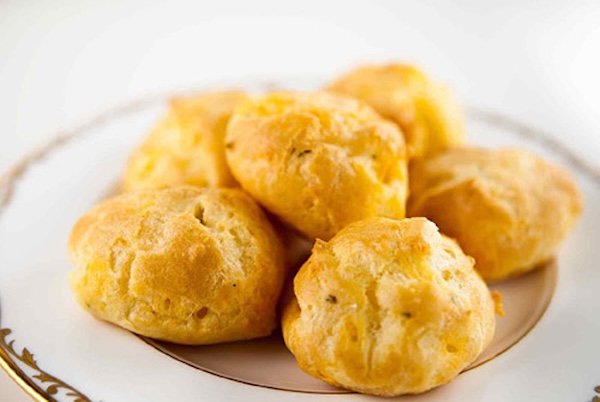
Cheese puffs (photo from jewishlink.news)

For a Hanukkah night gathering or on Dec. 31, as we move into a new secular year with a celebration, small or large, appetizers are a wonderful addition to any party. Here are some quick and easy recipes for appetizers when you’re hosting – or contributing to a potluck.

CHEESE PUFFS
(makes 40)

1 cup water
6 tbsp butter, cut into small pieces
salt and pepper to taste
1/2 cup flour
1 tbsp Dijon mustard
4 large eggs
1 cup coarsely grated kosher Swiss cheese

1.  Preheat oven to 425°F. Prepare several large cookie sheets with vegetable spray and flour.

2. In a saucepan, combine water, butter pieces, salt and pepper. Bring to a boil, add flour and stir vigorously about two minutes with a wooden spoon until mixture forms a ball and is firm. Remove from heat.

3. Beat in mustard, eggs and cheese.

4. Drop by heaping teaspoons onto cookie sheets one-and-a-half inches apart.

5. Place one sheet in top third of oven and one in bottom third of oven. Bake for 15 minutes.

6. Reverse position of sheets and bake five minutes more or until puffs are golden brown. Serve hot.

ARTICHOKE CHEESE SQUARES
(makes 8 servings)

2 six-ounce jars marinated artichoke hearts
1 small finely chopped onion
4 eggs
6 crushed crackers
2 cups kosher shredded sharp cheddar cheese

1. Preheat oven to 325°F and grease a large baking dish.

2. Drain artichoke hearts, reserving two tablespoons of marinade. Place in a bowl.

3. Place reserved marinade in a frying pan and sauté onions.

4. Remove from heat and add artichokes. Add eggs, crackers, cheese. 

5. Pour into baking dish and bake 35-40 minutes.

6. Cut into one-inch squares. Serve immediately or reheat before serving.

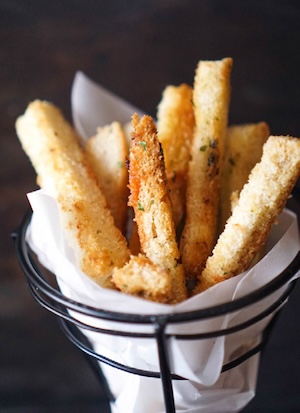
photo - Garlic bread “fries”
Garlic bread “fries” (photo from jewishlink.news)

GARLIC BREAD “FRIES”
(Grace Parisi is a well-known chef, and she created this party snack for Food & Wine. It makes 8-10 servings)

4 tbsp unsalted butter
1/2 cup olive oil
3 large minced garlic cloves
1/2 cup chopped flat leaf parsley
1 large split and halved baguette
1/2 cup freshly grated Pecorino-Romano or a sheep’s cheese

1. Preheat oven to 350°F.

2. In a frying pan, melt butter in olive oil. Add garlic and cook one minute.

3. Remove from heat and add parsley.

4. Place bread on baking sheet cut sides up. Spoon garlic butter on top, sprinkle with cheese and bake 10 minutes.

5. Turn on broiler and broil one minute.

6. Cut bread into half-inch “fries” so they look like bread sticks.

MARINARA “KETCHUP”

1/4 cup olive oil
3 peeled, halved garlic cloves
1 tbsp tomato paste
35 ounces canned, whole, peeled Italian tomatoes
salt and pepper to taste
pinch of sugar
2 sprigs basil

1. Heat olive oil in a saucepan. Add garlic and cook, stirring, five minutes.

2. Add tomato paste and cook one minute. 

3. Add tomatoes, crushing them with the back of a spoon. 

4. Add salt and pepper.

5. Stir in sugar and basil and bring to a boil. Simmer until sauce is reduced to three cups and thick. Discard basil and garlic. 

Sybil Kaplan, z”l, was a Jerusalem-based journalist and author. She edited/compiled nine kosher cookbooks and was a food writer for North American Jewish publications, including the Jewish Independent. We communicated regularly, but mostly in the leadup to a holiday issue. Not having heard from her in advance of this Hanukkah paper, we reached out, getting the sad news that Sybil recently passed away. It was a pleasure working with her for these past 20+ years and we will miss her. She always provided more stories than we could use, so, in this issue, we run a few we had yet to publish, honouring her in our way. May her memory be for a blessing.