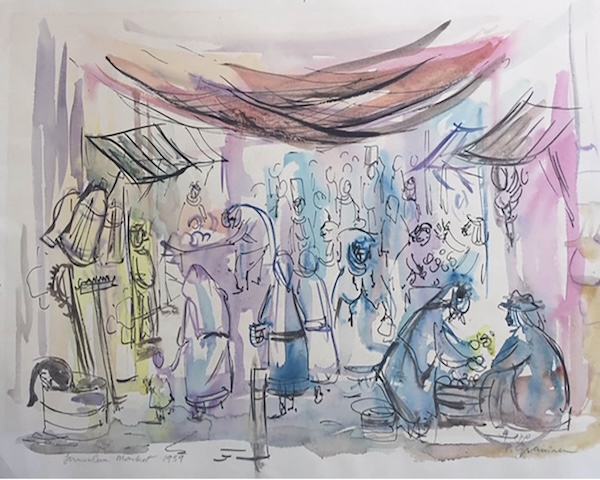
“Jerusalem Market, 1959,” watercolour and pencil, by artist Pnina Granirer, a graduate of Bezalel Academy of Art and Design in Jerusalem. Granirer will have a table of her artwork for sale in the atrium of the Jewish Community Centre of Greater Vancouver on Dec. 3, 10 a.m.-3 p.m., as part of the Chanukah Around the World party marketplace. The works will be unframed, priced from $100 to $500, with all proceeds being donated to Israel, in the hope that the donation will help it in its hour of need. For more on Granirer, go to pninagranirer.com.
The party is a joint event with multiple community partners: King David High School, Vancouver Talmud Torah, Richmond Jewish Day School, PJ Library, Camp Miriam, Jewish Museum and Archives of British Columbia, and the Kollel. In addition to the marketplace, it will feature games, iSTEAM activities, food, arts & crafts, museum displays, entertainment throughout, a community singalong and a JCC membership sale. Visit jccgv.com/jcc-chanukah-carnival.
Joshua Greenstein, vice-president of the Israeli Wine Producers Association, showcases the array of wines produced in Israel. (photo from IWPA)
The world of wine in Israel, perhaps the oldest wine-producing region in the world, has become collateral damage of the atrocities that occurred on Oct. 7. To raise awareness, and in support of Israel and Israeli wineries, the Israeli Wine Producers Association (IWPA) is asking consumers to “Sip for Solidarity.”
The massacre has had an immediate, concrete impact, particularly on picking, sorting and winemaking teams. Harvest had begun shortly before the attacks, which meant that the sorting, crushing and fermentation processes were, in many cases, done under the constant threat of attack and bombardment. For many wineries, production teams have been hollowed out, as the young men and women who normally would be shepherding the crucial winemaking process have been called up to help defend the nation.
“Winemaking has its own schedule, unlike other industries, where you can pause production or run with limited staff. Grapes grow and ripen when they do. The winemaking process is very hands-on. Without staff, many wineries face an impending crisis,” said Joshua Greenstein, vice-president of the IWPA, a trade organization promoting 30-plus Israeli wineries through wine education and events.
“Additionally, wine is usually something enjoyed when you go out to eat or to a party, and people in Israel aren’t feeling particularly celebratory these days,” Greenstein added. “It’s catastrophic not just for this year’s sales, but for the vintages harvesting now that won’t be ready for sale for years to come.”
To help the situation, Greenstein suggested, “Buy a bottle of Israeli wine. Not only will the purchase help the wineries, but we’re donating 10% of every case shipped from Nov. 1, 2023, to Dec. 31, 2023, to Israeli relief efforts. With the wine-consuming public’s support, these challenges are surmountable, and wineries will still craft wines that accurately and deliciously reflect the character of the vintage and of Israel, just as they always have.”
Left to right: Kara Mintzberg, Maurice Moses, Cyndi Mintzberg, Sheila Gordon (a friend of Haber’s), Gyda Chud, Grace Hann and Tammi Belfer, with Marilyn Berger in front. (photo from JSA)
On Nov. 19, Jewish Seniors Alliance held their Fall Symposium at the Peretz Centre for Secular Jewish Culture. The event honoured Serge Haber, JSA’s founder.
Haber passed away in October of this year at the age of 95. Throughout his life, he never lost his vision of there being in the community an organization that would see seniors helping seniors. He worked tirelessly to achieve this goal. Many of the speakers that Sunday afternoon mentioned that Haber would never take no for an answer. He managed by the force of his personality to involve people in the alliance and to find donors and foundations to support its work.
Gyda Chud, a former co-president of JSA, was the symposium’s emcee. She introduced Tammi Belfer, the current president, who welcomed the 50 people in the audience and the 22 watching online. Former JSA presidents Ken Levitt and Marilyn Berger spoke about what they had gained from working with the organization and what they had learned from Haber. Cyndi Mintzberg and her daughter Kara Mintzberg, cousins of Haber, representing the family, spoke of how much they enjoyed spending time with Haber. They particularly mentioned Shabbat dinners. Haber’s children, in Toronto and Washington, were watching on Zoom.
Two videos of Haber were shown. The first had been prepared for his 90th birthday, and featured a collage of photos from different periods and events in his life. Some showed him in Romania before the war; others in Montreal, where he married; and some from Vancouver, where he lived for many years. The second video was of a speech that Haber gave to the Fraser Health Authority in which he explained the importance of dealing with the loneliness that afflicts many seniors, and how the Peer Support Program of JSA can help with these issues by providing emotional support.
Rabbi Adam Stein of Congregation Beth Israel, who is a JSA board member, offered remarks on behalf of the synagogue, where Haber was an active member for many years. Stein described visiting him in hospice. Instead of talking about himself, Haber wanted to know how the rabbi and his family were doing.
Marie Doduck, another member of the JSA board, brought greetings from the Vancouver Holocaust Education Centre, where Haber was active with the survivors group.
Grace Hann, the trainer for the Peer Support Program, described her first interactions with Haber, saying she was frightened of him until he took the training and easily fit into the group. She felt the force of his dedication and said she learned a lot from him.
Maurice Moses, a long-time friend, sang a moving rendition of “Eli, Eli.” He also led the group in the singing of the Partisans’ Hymn, which Marilyn Berger had suggested as a reminder of the Holocaust and the Oct. 7 attacks in Israel.
Belfer shared some of the JSA’s plans, including the possible hiring of an executive director and the organization’s 20th anniversary gala, to be held in February at Temple Sholom. She spoke again of Haber’s vision and of the three pillars of JSA – education, advocacy and peer support – and noted that there were donor cards on the tables, which people could use to donate to the Serge Haber Fund at the Jewish Community Foundation of Greater Vancouver. The formal part of the event closed with the singing of Hatikvah.
Shanie Levinis a Jewish Seniors Alliance Life Governor. She is also on the editorial committee of Senior Line magazine.
“Dear Hostages, as the world rallies to celebrate your desecration I will not forsake you,” begins the poem written by Seattle-based multimedia artist and educator Loolwa Khazzoom. Posted on her Facebook page, with a #BringThemHomeNow poster featuring photos of Israelis kidnapped on Oct. 7, it continues, “My instinct is to deprive myself of oxygen / Because you are underground / And I will not forget you // But I know that you would dance / In the sun / If given the chance / So I now rise up / And dance for you.”
Many of Khazzoom’s songs begin as poems. In this case, she told the Independent, “I felt as if I could not breathe and as if I did not even want to breathe, out of solidarity with the hostages and with all of Israel, in particular, all the victims of the Oct. 7 massacre. It’s like I wanted to physically feel their pain and suffering, as a way of physically demonstrating that I would not forsake them or forget them.”
In a traumatized mental state, Khazzoom returned to the “healing tools of poetry and music,” which was another way she could show her solidarity and do her part in keeping the issue of the hostages in frontof people.
Similarly, Khazzoom and her band, Iraqis in Pajamas, recently released another poem-turned-song, “#MahsaAmini.” They did so this past Sept. 16, the first anniversary of the death of 22-year-old Mahsa Amini at the hands of Iranian “morality police.”
Finding out about Amini’s murder soon after it took place, from TikTok videos posted by Iranian women, Khazzoom “jumped into action.” She wrote to her political representatives, raised funds for United 4 Iran and reposted Iranian women’s videos on her feed constantly, to help boost the content’s views. “In addition,” she said, “a day after I found out about what happened, a poem with my feelings poured out of me, and I posted it on social media. Months later, I put that poem to a melody, and the band developed it into a full band song, which we released on the [anniversary of the] day of Amini’s murder.”
The death affected Khazzoom deeply for many reasons.
“First, the women in my family wore the abaya, the Iraqi equivalent of the hijab – Jewish women throughout the region were subject to Muslim dress codes, so it’s a Jewish issue, too,” she said. “Second, so many people assume that Islam is indigenous throughout the Middle East and North Africa, but it’s not. Arab Muslims rose up from the Arabian Peninsula and conquered the entire region, forcibly converting masses under the threat of death. So many indigenous ethnicities and religions predated the Muslim conquest, including Jews, Persians, Berbers and Kurds. The Iranian women protesting and burning their hijabs felt to me like challenging that Muslim conquest and awakening the ancient Persian warriors. Third, Persia is central to Jewish history and the origins of the Mizrahi community, dating back nearly three millennia ago…. And, lastly, the fire of these women, and the men who joined them, and their willingness to risk their lives for their dignity and freedom was just breathtaking and profoundly inspirational.”
Another of Iraqis in Pajamas’ releases this year was also intensely personal for Khazzoom.
“I wrote ‘The Convert’s Quest’ in response to some friends on social media sharing how hurt they were, coming under attack during the process of their conversion to Judaism. I had ample experience witnessing variations on this theme throughout my life – both first-person, seeing it happen to friends, and through my research as a Jewish multicultural educator. For decades, I felt very disturbed by this seemingly growing trend.
“I am the daughter of a Jew by choice, as my mother called herself, so the matter of conversion to Judaism is very personal for me,” she said. “I remember understanding very clearly as an Orthodox Jewish child that, according to halachah (Jewish law), once you convert, you are no longer to be called ‘a convert,’ but rather, a Jew, period. So, even from a religious Jewish perspective itself, I was very distraught by the ways that Jewish leaders and communities were rejecting or harassing converts, or even all-out forbidding people from converting. It all flies in the face of Jewish history, theology and practice.”
The band released “The Convert’s Quest” on May 24, on the harvest holiday of Shavuot, which celebrates the giving of the Torah to the Jewish people and on which the Book of Ruth is read. It tells the story of Ruth, a Moabite woman who converted to Judaism, whom Jewish tradition teaches will be the ancestor of the Messiah.
“To me, Jewish converts are the lifeblood of the Jewish people,” said Khazzoom. “I have a provocative line in my song, saying that converts are ‘the most Jewish Jews of all,’ because they are intentionally and consciously practising the foundational precepts of Judaism, which so many either take for granted or do rote, as is often the case in the Orthodox Jewish world where I was raised. In addition, amidst life-threatening levels of racism and violence against Jews, converts choose Judaism…. Why would we reject, in any way, from subtle to blatant, someone with such a heroic Jewish soul?”
Even when delivered in a playful manner, Khazzoom’s song are serious to the core. The campy “Kitchen Pirate,” for example, “emerged from my choice to reject the conventional option of surgery, in the wake of a cancer diagnosis in 2010,” she said. “Instead, I chose to radically alter my diet and lifestyle. Simply by overhauling my diet, I cold-stopped the growth of the nodules, which remained stable for the next five years – neither growing nor shrinking – until I returned to my lost-love of music, following which they began shrinking.”
Khazzoom said her songs “are always questioning, always challenging, always defiant. Sometimes, it’s more explicit, other times it’s embedded in silliness, which, parenthetically, I also see as defiant. I am and forever will be a curious, playful and awe-inspired child. I think that, if and when we ‘outgrow’ that, we die inside. And I refuse to capitulate to that norm of expected behaviour once we enter adulthood. By way of example, to this day, at age 54, when I am flying in a plane, if there is nobody sitting next to me, I will stretch out my arms and pretend I’m a bird, during takeoff.”
Not everyone has appreciated this aspect of her personality. “I have constantly gotten into trouble for it and have been at odds with my family, my community and society at large,” said Khazzoom. “I have endured terrible loneliness and often even self-doubt as a result. But I always come back to my core. And all of my songs emerge from that place – that raw, gut-wrenching place of being fiercely alive and allowing the clash with everything around me, and then writing about it.”
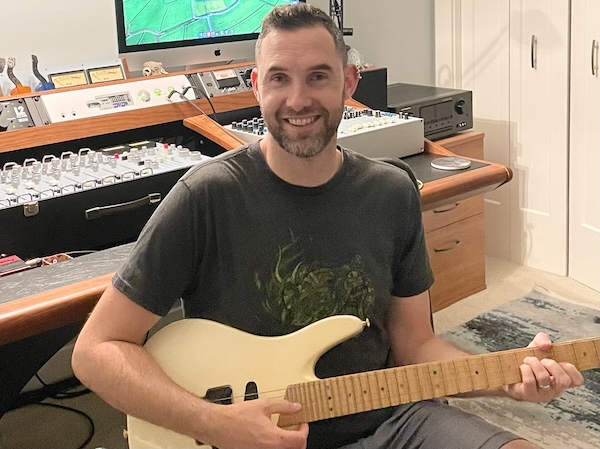
It is this enthusiasm that Victoria-based band member Mike Deeth enjoys about being in Iraqis in Pajamas, whose third member is Chris Belin.
“Loolwa and Chris are both easy-going, creative people. The energy is very positive, which makes collaborating with them fun and organic,” Deeth told the Independent. “Further, I appreciate the passion Loolwa has for the subject matter she writes about. One thing I always struggled with as a musician is ‘What do I have to say?’ At the end of the day, I’m a privileged guy who has never had to face oppression, hate, war or genocide. I have a lot of respect for artists who have experienced darker parts of humanity and have the courage to bring that perspective into their art.”
Born in Toronto, Deeth, who is not Jewish, spent most of his adolescence in Calgary, and moved to Vancouver Island when he was 18. He first picked up a guitar a few years earlier and has been playing ever since. “I was in my first band at 18 and played in bands throughout my 20s. For the past several years, I have been mainly focused on recording,” he said.
Mike Deeth (photo from Mike Deeth)
Deeth got hooked on music production in his teens, getting his first digital recorder at age 16. “I still remember pulling all-nighters with friends trying to write songs and get ideas down on tape. Production was always fascinating to me, as I could layer parts together into something bigger than I could ever play on my own.”
Deeth and Khazzoom met a couple of years ago through a Craigslist posting. “She was looking for a guitarist to contribute to an early version of her track ‘The Convert’s Quest,’” he explained, complimenting Khazzoom on the fact that she “puts her full heart into her songs.”
“I recorded some initial guitar demos and, about a year later, we reconnected and worked up the current releases,” he said.
Deeth adds guitar to the songs and completes the mix and master of the songs when they are ready for those steps. Khazzoom sings, writes and plays bass, while Belin – who lives in Pennsylvania – composes the drum parts and performs them.
Among his other music ventures, Deeth has “played the guitar with Bryce Allan, a country musician here on the island, and recorded a few tracks with him. I also work closely with Jennie Tuttle, another musician from Victoria. We have been recording together for seven or eight years now.”
For Deeth, “recording is such an interesting combination of art and science. I get to be musically creative, but I also get to play with cool machines, solve problems and think about gain staging, compression ratios and other technical aspects. I thoroughly enjoy both the artistic and scientific parts of the process – they work my mind in different ways.
“I also love how each project starts as a blank canvas and ends with a new piece of music out in the world. There are an almost infinite number of possibilities when recording a track (all the possible settings on the equipment, the subtleties of different instruments) and it always fascinates me how each song takes shape during the process.”
“Mike has an exquisite sensitivity in his musical composition, performance and recording,” said Khazzoom. “He’s not only super-talented and -skilled, but he’s warm, upbeat, enthusiastic and professional. It’s a joy to create music with him. As is the case with our drummer Chris Belin, Mike has an uncanny ability to capture the essence of the songs I write, to the point that I feel he is playing back to me the sound of my soul. I have literally sat and cried after hearing the mixes.”
For more on Khazzoom, visit khazzoom.com. For more on Deeth’s production and sound services, visit glowingwires.com.
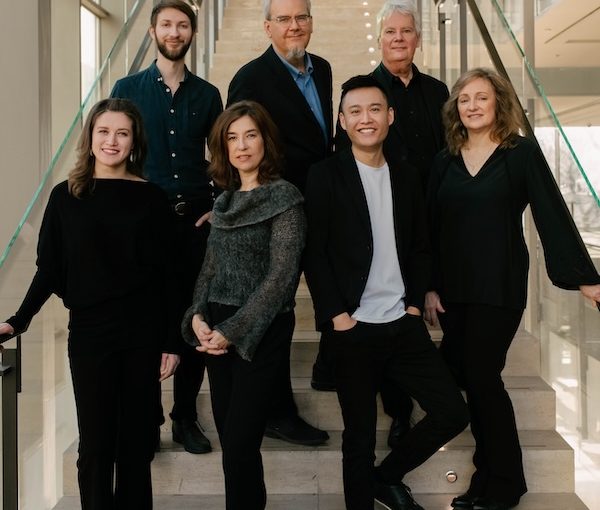
ARC Ensemble (photo from Royal Conservatory of Music)
Over the span of three decades, the ARC Ensemble (artists of the Royal Conservatory) has provided a voice for exiled composers who had graduated from Europe’s finest conservatories and enjoyed successful careers, but were subsequently forced into exile by antisemitism and bigotry, their works forgotten. As it marks its 20th anniversary, the ARC Ensemble remains dedicated to the research, recovery and recording of the music produced by these extraordinarily gifted exiles.
It was Dr. Peter Simon, president and chief executive officer the Royal Conservatory of Music, who envisioned creating an ensemble showcasing faculty musicians as part of the RCM’s overarching mission to develop human potential. The conservatory is one of the largest music education institutions in the world. More than 500,000 students study its RCM Certificate Program through a network of 30,000 independent music teachers and its more than five million alumni include Glenn Gould, Oscar Peterson, Shania Twain, Sarah McLachlan and David Foster.
Comprised mainly of the senior faculty of the Royal Conservatory’s Glenn Gould School, with special guests drawn from its most accomplished students and alumni, the ARC Ensemble has become one of Canada’s cultural ambassadors. Its concerts and recordings have garnered multiple Grammy and Juno nominations.
“Over the past 20 years, the ARC Ensemble has done important work in ensuring that the contributions of composers who were marginalized under the 20th century’s repressive regimes are heard and given their due,” said Simon.
ARC has released nine recordings (on RCA Red Seal and, more recently, on Chandos Records), including six in its Music in Exile series. Through its quest to uncover neglected and forgotten 20th century composers, a growing roster of works is now entering the classical canon.
ARC Ensemble artistic director Simon Wynberg’s musical detective work might begin with a footnote in a biography, an old concert program, an email from a composer’s relative, or a suggestion from the network of musicologists active in the area of suppressed music. “Fortunately, many scores have survived and are hiding in plain sight in large library collections and archives,” he said.
Wynberg tracks down potential treasures scattered across the globe, from Israel to India, from Austria to Argentina, and resources closer-to-home in Bloomington, Ind., and Winnipeg, Man.
In recognition of his work with the ARC Ensemble, Wynberg was inducted into CBC Radio’s In Concert Hall of Fame and featured on a special broadcast on Sept. 24.
In resurrecting music forgotten from the boxes of library archives, the ARC Ensemble has created renewed appreciation for a growing list of gifted composers: for example, Ukrainian nationalist Dmitri Klebanov, who was suppressed under Stalin; Sephardi composer and musicologist Alberto Hemsi, who fled Turkey and Egypt to settle in Paris; and Walter Kaufmann, who found sanctuary in Bombay (Mumbai) and created a uniquely personal language by fusing Indian and Western traditions. As a directresult of ARC’s research and recording, Kaufmann’s works are now published by Viennese publisher Doblinger, and both European and American orchestras are now programming his works. Kaufmann’s Indian Symphony will be reintroduced to an audience at Carnegie Hall in 2024.
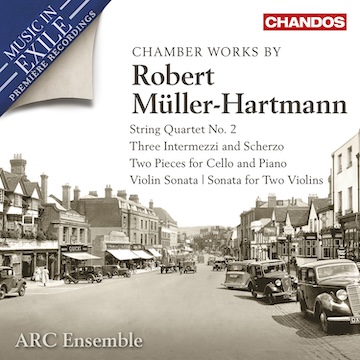
ARC’s Music in Exile series continued with the Nov. 17 release of a recording of premières by Robert Müller-Hartmann (1884-1950), who fled Hamburg with his wife in 1937 to escape rising Nazism, and settled in England.
“He was an émigré people knew about because of his relationship with [Ralph] Vaughan Williams, but whose music no one had explored,” said Wynberg. “When I met the composer’s grandson in Israel, he arrived with a huge sports bag and a backpack crammed with manuscripts and early editions of Müller-Hartmann’s scores, but the family had never heard a note of his music.”
Like so many of his contemporaries, in addition to his professional work as a composer, teacher, administrator and musicologist, Müller-Hartmann had a broad range of intellectual interests. He enjoyed considerable success in Germany with major conductors like Richard Strauss, Fritz Busch and Otto Klemperer performing his works. Fired from his post at Hamburg University in 1933, he taught at a Jewish girls’ school before fleeing to England.
In England, Müller-Hartmann spent much of his time in Dorking, some 25 miles south of London, living with Eugenia and Jacob (Yanya) Hornstein, friends from Hamburg. Through Gustav Horst’s daughter Imogen, he met Vaughan Williams, who became a valuable friend and colleague, and who intervened in Müller-Hartmann’s internment on the Isle of Man, where Jewish internees were obliged to live alongside Nazi sympathizers. Despite his connections to influential British musicians, Müller-Hartmann’s career stalled, and his music fell into obscurity. This was partly the result of the war and the economic privations that followed, his sudden death in 1950, and his modest and rather retiring personality.
The pieces performed on Arc Ensemble’s Chamber Works by Robert Müller-Hartmann, likely written in the early 1920s and mid-1930s, are examples of why Müller-Hartmann’s music deserves a place in today’s classical repertoire. Among Wynberg’s favourites are Two Pieces for Cello and Piano, and the Sonata for Violin and Piano, op. 5, which is dedicated to Müller-Hartmann’s friend and legendary pianist Artur Schnabel. The recording also features Sonata for Two Violins, op. 32, characterized by the duet’s dramatic contrapuntal interplay; the Three Intermezzi and Scherzo for Piano, op. 22, short but technically demanding works for piano; and String Quartet No. 2, op. 38.
Every one of the exiled composers that ARC has introduced has both a compelling story of flight and exile, and a body of music of extraordinary range and quality. Twenty years on, with an alarming rise in antisemitism and new waves of cultural repression, the ARC Ensemble’s mission is a reminder of how easily lives and careers can be devastated by political and social oppression.
“My hope,” said Wynberg, “is that our introductions to these chamber works will encourage further research, exploration and adoption of music that has been unjustifiably ignored.”
According to the Babylonian Talmud (Eruvin 53b), the Hebrew-speakers of ancient Judea were so precise in their speech that they would never describe a cloak they were trying to sell as merely green, but would tell you instead that it was the colour of newly sprouted beet greens trailing along the ground. Galileans, on the other hand, were less punctilious:
“What do you mean when you say that Galileans are not careful in speaking? It is taught: There was a Galilean who used to go about [the marketplace] asking, ‘Who has amar? Who has amar?’ They said to him, ‘Stupid Galilean, do you mean khamor [donkey] to ride or khamar [wine] to drink? Amar [wool] to wear or imar [a lamb] to slaughter?’ And don’t forget the woman who wanted to say to her friend, ‘to-i de-okhlikh khalovo, come, I’ll give you some milk,’ only to have it come out as ‘tokhlikh lovya, may you be eaten by a lioness?’”
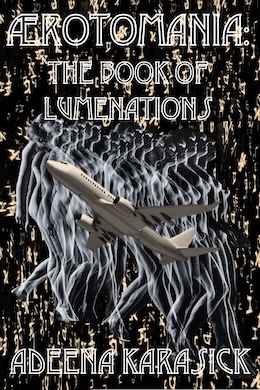
Where the ancient Galileans seem to have had no choice but to sound like themselves, Adeena Karasick has elaborated, over 14 volumes of poetry, a sort of deliberate neo-Galileanism that sometimes bridges, sometimes leaps and, on occasion, just fills the talmudic chasm between utterance and meaning in a way guaranteed to drive any artificial intelligence program out of its simulated mind. As she says in the poem “Talmudy Blues II” that is dedicated to me in her new collection, Aerotomania: The Book of Lumenations (Lavender Ink): “… sometimes the letters rule over her / and sometimes she rules over the letters / cleaving to the light of infinite possibility.” (p.31)
Is Karasick cleaving to the light as she rules over the letters? Or do the letters ruling her do the cleaving? Have her consonants been endowed with the naissances latentes of Rimbaud’s “Voyelles”? Or, less goyishly, is Karasick turning Galilean imprecision into an aesthetic approach rooted in the modalities of elementary-level reading instruction – reading silently and reading aloud, the absorption and subsequent re-citation of a written text – as enacted in the traditional East European Hebrew school known as kheyder?
The basic level of instruction had three phases:
1. Alef-beys, literally, alphabet, in which students learn to recognize the consonants that make up the Hebrew alphabet, along with the sundry diacritical marks that take the place of alphabetic vowels. There are 11 of the latter, representing five vowel sounds.
2. Halb-traf leyenen, reading half syllables. Each diacritic is run, as it were, through all 22 of the consonants. So, for example, syllables formed with the vowel komets would be learned by reciting, “Komets alef, o; komets beys, bo; komets giml, go” … and so on, to the end of the alphabet, when the student would go on to the next vowel: “Pasekh alef, a; pasekh beys, ba; pasekh giml, ga.”
3. Gants-traf leyenen, reading whole syllables, i.e., combining the individual letters or syllabograms into words.
Karasick’s traffic is with the last two, the kheyder basics supplemented by the graphemically focused mysticism of Sefer Yetsira and Abraham Abulafia as refracted through a contemporary sensibility and range of reference: “The letter is matter which moves matter … these words are closer than theyappear.” (p.31)
We see halb-traf in full flight in, say, the coda to “Eicha,” the long poem with which Lumenations opens: “In the eros of aching ethos / The caesura screams – / Through cirque’elatory sequiturs, resistances” and continues: “Here, her / in mired err / whose scar is clear // Hear her/here/whose heir / wears err’s // shared prayer / where // care is rare….” (pp.26-27)
All you have to do is imagine a phrase like “hear her/here/” in unvocalized Hebrew, רה רה רה, and then read it as “hair hare hoar,” to realize that Karasick’s poetry, like the airplane she anatomizes in Aerotomania, constitutes “a hybridized syncretic space between cultures and idioms / where that interlingual complexity doesn’t close down but builds dialogue” (p.83), a dialogue rooted in, but quickly soaring beyond, quotidian phonemic reality.
There is an upward thrust to the book, from the dust and cracked earth of “Eicha,” the recasting of the biblical Lamentations (eicha means how, as in, “How sits the city solitary”), through the rising rabbinic commentary of “Talmudy Blues II,” a romp through ways of thought – words, that is – that now stand in place of the things destroyed: Jerusalem and the Temple (known in Hebrew as the Holy House).
An excursus on the idea of house follows, then “Checking In II,” i.e., checking into the Aerotomania flight by stowing readers’ cultural baggage for the duration of their stay on the plane. Having shaken off our dust (Isaiah 52:2), we emerge from the fog of our associations. Our lumen is come (Isaiah 60:1); we rise through the ether to embrace The Shining.
As the dedicatee of “Talmudy Blues II,” it behooves me to say something about the poem. A continuation of “Here Today Gone Gemara” from Karasick’s 2018 collection Checking In (Talonbooks), “Talmudy Blues II” consists in large part of elaborations of dialogue (and dialect) culled from our ongoing conversations about the ways in which the Talmud is reflected and refracted in Yiddish. “Carpe verbum,” reads the epigraph to “Here Today” – pluck that word like it’s a Sabbath chicken, clear away the excrescences and bite into the thing itself, ever mindful that the Hebrew davar means both word and thing, utterance and entity; my honeyed words solidified into raw material, ore for Adeena’s gold, one davar turned into another. But, as it says in the Talmud (Megillah 15), “Whoever credits a davar to the person who said it brings redemption to the world.”
Amen. Thou hast conquered, O neo-Galilean.
Michael Wexis author of three books on Yiddish, including Born to Kvetch. His songs have been recorded by such bands as the Klezmatics, and he has translated The Threepenny Opera from German into Yiddish. His one-person shows include Sex in Yiddish, Wie Gott in Paris and Gut Yontef, Yoko. I Just Wanna Jewify: The Yiddish Revenge on Wagner was recently revived (on Zoom) by the Ashkenaz Festival. His most recent major project, Baym Kabaret Yitesh, a recreation of a 1938 Warsaw Yiddish cabaret, was the surprise hit of Ashkenaz 2022 in Toronto. Bas Sheve, the long-lost Yiddish opera restored by Wex and composer Joshua Horowitz, was the not-so-surprising hit of the same festival. This book review was originally published in New Explorations: Studies in Culture & Communication, Vol. 3, no. 2 (2023).
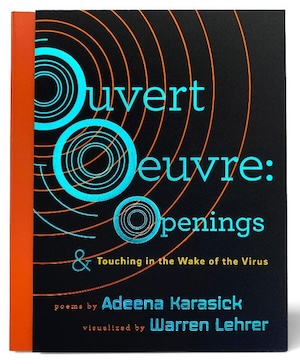
Inscribing what the philosopher Emmanuel Levinas might call espace vital (the space we can survive), Ouvert Oeuvre: Openings (2023) is an exploration of openings in a (never quite) post-COVID world. Written by poet, performer and cultural theorist Adeena Karasick and visualized by designer/author and vis lit creator Warren Lehrer, both the title poem and “Touching in the Wake of the Virus” track the trepidations and celebrations of openings read through socioeconomic, geographic and bodily space.
Both poems explore a range of intralingual etymologies laced with post-consumerist and erotic language, theoretical discourse, philosophical and kabbalistic aphorisms. They foreground language and book-space as organisms of hope – highlighting the concept of opening and touching as an ever-swirling palimpsest of spectral voices, textures, whispers and codes transported through passion, politics and pleasure as we negotiate loss and light.
In this first collaborative book, Lehrer choreographs Karasick’s words on the stage of the page through typographic compositions that give form to the emotional, metaphorical, historical and sonic underpinnings of the texts. Together, the writing and visuals engage the reader to become an active participant in the experience/performance of the work. The book also comes with a soundtrack recording (via QR code) of Karasick reading the poems with music composed and performed by Grammy award-winning composer and trumpet player, Sir Frank London.
Produced in a smyth-sewn, three-colour foil stamped, three-piece hardcover binding, printed on acid-free paper, Ouvert Oeuvre: Openings bridges the gap between art book and trade publication that will speak to lovers of poetry, philosophy, art, design, new media, performance, and anyone trying to navigate opening and touching in the wake of pandemics and other mass maladies.
Ouvert Oeuvre: Openings can be purchased from most online booksellers.
The past can consume you if you let it. And reality isn’t as easy to discern as you might think. Two recently published thrillers from Simon & Schuster share these themes in common, but their authors address them in completely different ways.
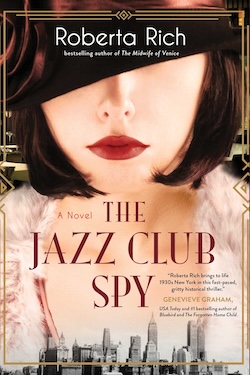
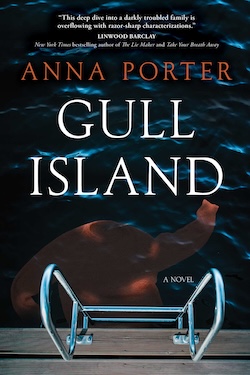
Anna Porter’s Gull Island takes readers on an unsettling, at-times gory, modern-day journey through the protagonist’s thoughts and memories as she visits alone her family’s isolated island cottage and a ferocious storm hits, unmooring her boat and rendering her cellphone ineffective. Roberta Rich’s The Jazz Club Spy begins with a brutal pogrom in 1920 Ukraine and then jumps to 1939 Manhattan, where the protagonist, now a young woman, sees in passing one of the Cossacks who rampaged her village – as she starts looking for him to exact her revenge, she is enlisted by the US government to help find him for them, as he is a possible conspirator in an assassination plot.
Neither genre – psychological thriller or espionage novel – is the type of fiction I’d generally pick up, but I enjoyed both. They provided an escape, I learned a few things, I wanted to know how they would end.
While The Jazz Club Spy started off gritty and harsh, by the second chapter it read more like a young adult novel. Given the state of the world at the moment, I didn’t find that necessarily a negative thing. I rooted for Giddy Brodsky, who survived that traumatic pogrom and was now helping her family pay the rent and feed themselves, her dad having left for reasons we eventually find out.
As a cigarette girl in a club, Giddy uses her natural sleuthing skills – looking through customers’ pockets, listening to conversations for clues, etc. – to help her friend Hattie’s clairvoyant act. After Giddy sees the Cossack on a tram, but loses him in the crowd, she puts those skills to personal use, and then uses them to help the government. This happens after she asks a club regular who works in the immigration department for assistance, and he shares with her that the Cossack is an “undesirable” and could she help the government track him down.
Giddy is not only a competent detective but an aspiring entrepreneur, who creates her own makeups and lotions. The money she earns from spying goes to help her set up her own beauty store. But, to achieve success, she must first complete her mission, one that is complicated by love and the dangerous situations she must place herself in to root out the Cossack and try to prevent the assassination and a potential global political crisis.
The Jazz Club Spy is all about external threats and heroic acts. There is no doubt about Giddy’s strength, purpose and whether she’s a good person. Gull Island, on the other hand, is all about internal threats and acts that cause harm (even if that isn’t the intent). Jude’s a great unknown, even to herself, and she gets progressively more disoriented as the storm hits the island and she struggles to get the water pump working, hurts herself in various accidents, and drinks we’re not quite sure how much alcohol while she’s there.
Jude has come to the island at her mother’s request. Jude’s father has gone missing and a copy of his will is apparently at the cottage. She is also there for personal reasons, to rummage about, to figure something out, to look through old photographs; there are many of her sister, not so many of her. Jude has grown up in a dysfunctional family and the cottage was not generally a happy place. As the storms intensify – the rain and wind outside, the memories barraging Jude and the physical cuts and bruises she receives along the way, dealing with broken glass, wild animals and things not so clear – the tension ratchets up. When the sun returns and Jude surveys the damage left behind, a key piece of the mystery is understood.
Porter isn’t afraid to explore dark places, and she masterfully leads readers through Jude’s turmoil. I found it noteworthy that the book Jude finds at the cottage to read is Sapiens: A Brief History of Humankind by Yuval Noah Harari. “I had abandoned it years ago because I didn’t want to feel as insignificant as the author had made me feel,” thinks Jude. “But tonight, being alone in the cottage, with something digging under the bedroom window, feeling insignificant would be useful.” Spoiler alert: by the end of the novel, she is set to finish the book.
In 2019, NASA astronaut and scientist Jessica Meir was part of the first all-woman spacewalk. According to : Jewish Women who Rocked the World, she “celebrated Hanukkah in space by wearing festive holiday socks and sending a Happy Hanukkah message to earth on social media.”
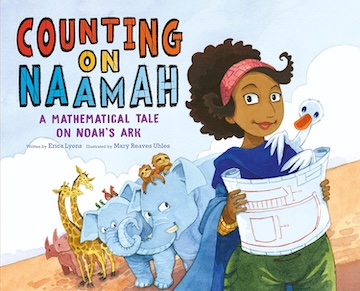
This is just one of the many “Fun Fact[s] to Mench’n” in this enlightening book written by the mother-daughter team of Rachelle Burk and Alana Barouch, and illustrated by Arielle Trenk. She’s a Mensch! is one of two books the JI received from Seattle’s Intergalactic Afikoman to review. The other is the perfect antidote to the “girl math” phenomenon popularized on social media, though hopefully kids under 9 aren’t engaging with that. Counting on Naamah: A Mathematical Tale on Noah’s Ark by writer Erica Lyons and illustrator Mary Reaves Uhles imagines Noah’s wife as being a genius in math and engineering.
Using the basics of the Noah story, Counting on Naamah offers a midrash of sorts. “A midrash is a tale that begins with a story from the Torah. Then it fills in the missing pieces to imagine the rest,” explain Lyons and Reaves Uhles at the back of the book. “The story of Noah leaves a lot to the imagination. What was it actually like to live on that ark? How did they take care of all those animals? And who was the generally unnamed ‘Mrs. Noah’? Counting on Naamah tries to answer these questions.”
The story begins when Naamah is a child, and uses her talents to help each of her three brothers – with market transactions, estimated herd transport times and archery angles. She has her own projects, as well, drafting plans for a desert sand scooter, for example.
When she meets and falls in love with Noah, the two become “impossible to divide,” but Naamah retains her agency and is a crucial help in building the ark, housing and feeding the animals, and more. And Noah knows just what to do to thank her.
Counting on Naamah is a charming story, creatively and colourfully illustrated. As is She’s a Mensch!, which is a nonfiction work that highlights 20 women who “rock!”
“Jewish women ‘round the world have talent, strength and smarts,” the book starts. “They shine like stars in every field from science to the arts.
“Jewish women through the ages have helped shape history. These mensches are authors and activists, athletes and adventurers, and everything in between.”
Indeed, the women featured range from writer Emma Lazarus in 1883 to Meir, in 2019. They include familiar – Golda Meir, Barbra Streisand, Ruth Bader Ginsburg – and less familiar names, like Marthe Cohn, who was a spy for France during the Second World War; Vera Rubin, who provided proof of dark matter in the 1970s; Nalini Nadkarni, who performed the first survey of rainforest treetops in 1981; and Judit Polgár, who became a chess grandmaster at age 15, in 1991. There’s a list of 18 honourable mentions.
Each entry in She’s a Mensch! has something different: unique drawings that connect the mensch to their chosen pursuit, a four-line poem and a short blurb about the mensch, often a fun fact, and always a mensch-related question to ponder, such as, How can you help others? (Henrietta Szold) What kinds of stories can you tell? (Judy Blume) and What great adventures do you dream of going on? (Cheryl and Nikki Bart)
Both of these books would make great Hanukkah gifts for kids of any gender. As would this year’s Hanukkah addition to Intergalactic Afikoman publisher Brianna Caplan Sayres’ and illustrator Christian Slade’s Diggers series, which has more than 10 books, and counting.
Where Do Diggers Celebrate Hanukkah? (published by Penguin Random House) would be a happy addition to a kid’s Diggers collection, or a fun introduction to the series. For the diggers, cranes, mixers, armoured trucks, tankers, dump trucks and food trucks, we’re asked to wonder what each does for an aspect of the holiday. For example, “Does Mom dig up the ancient jar that held the precious oil?” And the cranes, “Do they decorate their construction site with ‘Happy Hanukkah’ all around?” After a day of serving meals outside, do food trucks “serve sufganiyot and other food that’s fried?” Inquiring minds will want to know.
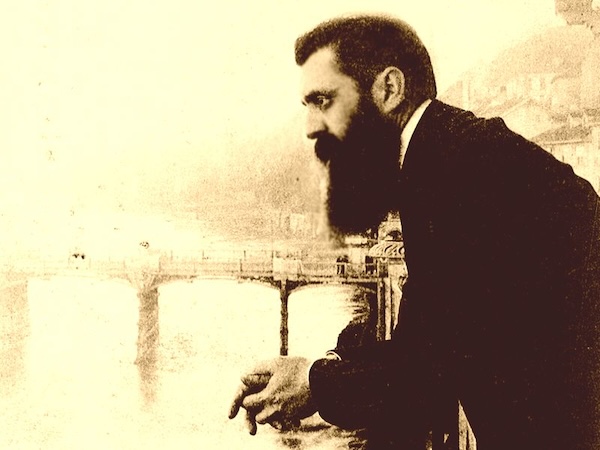
Theodor Herzl, during the First Zionist Congress, in Basel, Switzerland, 1897. (photo from mfa.gov.il)
Sometime before 1223, the first bridge spanning the Rhine River at Basel was constructed, funded through a loan to the town’s bishop by a Jewish moneylender. The bridge was a significant factor in the development of trade in the strategically located city, which is in northern Switzerland, near what are now the German and French borders.
The bridge lasted almost 800 years and was replaced between 1903 and 1905. There may be only one photograph in existence in which the original bridge can be seen – a photograph with another very significant Jewish connection. It is believed that the only place one can see the original Middle Bridge, or Mittlere Rheinbrücke, is in the famous shot of Theodor Herzl in a moment of contemplation outside the First Zionist Congress in 1897.
The bridge provides a sort of bookend to the Jewish story in Switzerland. While the bridge stood eight centuries, the history of Jews in Switzerland proved far less stable than the stone Mittlere Rheinbrücke.
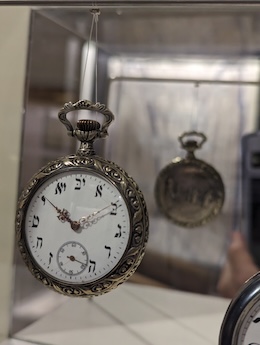
A pocketwatch with Hebrew characters and an engraving of the Western Wall on the reverse. (photo by Pat Johnson)
Switzerland has a rightful reputation for natural magnificence – rolling green meadows, massive snowcapped mountains, glacial streams and rivers – as well as political stability and neutrality that have made it home to a host of international nongovernmental organizations and United Nations agencies. The prevalence of cheese and chocolate also give it a delicious reputation. History is not so agreeable.
Some of that history is told in Basel’s small but impressive Jewish Museum of Switzerland. When the institution opened in 1966, it was the first new Jewish museum in the German-speaking world since the Holocaust.
Basel itself holds a special place in Jewish history – for better and for far worse. Herzl, credited as the founder of political Zionism, was not one for false modesty. After his debut as convenor of the 1897 conference, he declared: “At Basel, I created the Jewish state. In five years, perhaps, and certainly in 50, everyone will see it.”
Herzl himself did not see it. He died in 1904. But, indeed, 50 years on, the United Nations passed the Partition Resolution and, a year after that, the state of Israel was created.
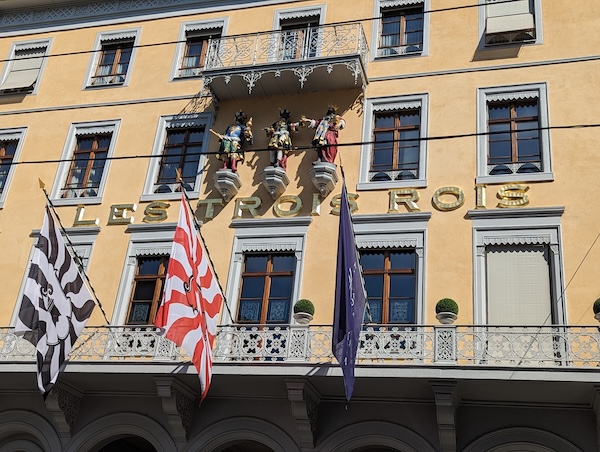
The Three Kings Hotel, Basel, site of the First Zionist Congress, 1897. (photo by Pat Johnson)
There are probably only about 1,000 Jews in Basel – there are around 20,000 in all of Switzerland – yet Basel stands out not only as the birthplace of the modern Zionist movement and home to the national museum of Jewish life and culture, but also has hosted the Zionist Congress 10 times, more than any other place.
Sadly, Basel is also on the Jewish historical map for far less rosy reasons. In 1349, an estimated 600 Jews were burned at the stake in Basel and 140 children were forcibly converted. This was just part of a series of pogroms in the 12th and 13th centuries across Switzerland, some based on blood libels or motivated by allegations of well poisonings at the time of the Black Plague.
Switzerland may have a reputation as being exceptional in Europe – neutral in foreign relations, and not a part of the European Union or most other multilateral bodies – but human-made borders and the majestic Alps seem to have done little to protect Swiss Jews from the horrors that have befallen coreligionists elsewhere on the continent across centuries.
As in other places, Swiss Jews were limited by law as to the professions they could pursue. A range of deliberately demeaning regulations were in place, including homes built with separate doors for Jews to enter. Jews were forced to pay what amounted to protection money to authorities.
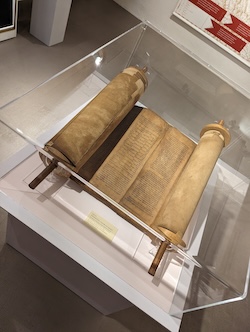
A Swiss Torah scroll at Jewish Museum of Switzerland, Basel. (photo by Pat Johnson)
Early in the 17th century, almost all Jews were expelled from Switzerland. Physicians were a professional exception and Jews were allowed to remain in just two villages.
After Napoleon invaded Switzerland, a series of political reforms began, some better and some worse for Jews.
Jews were formally permitted to settle anywhere in Switzerland after a referendum in 1866 resulted in a slight majority of Swiss endorsing equal rights for Jews. (The Swiss have a mania for referendums, even on issues of basic human rights.)
Migrants then came from middle and eastern Europe, especially after pogroms in Russia in the 1880s. More came from Germany after Hitler came to power, in 1933, but Switzerland, like the rest of the world, eventually slammed the doors shut, in 1938.
Swiss banks, with their uniquely secretive policies that protect the illegal and immoral, have been forced to reconcile, to an extent, with their complicity with the Nazis, as well as their profiteering from the assets of Jews who, because of the Holocaust, never reclaimed assets they had deposited for safekeeping as turmoil roiled their homelands.
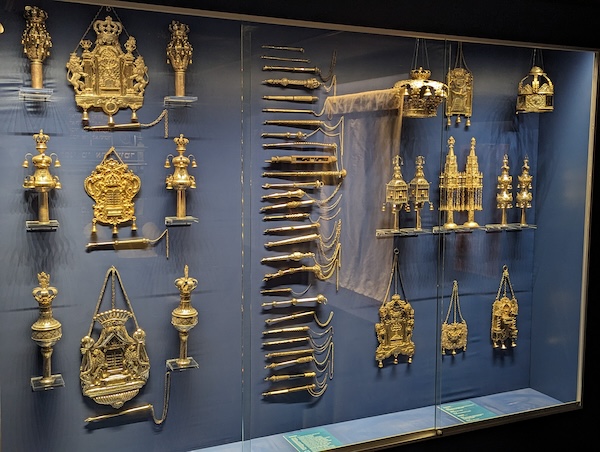
The Jewish Museum of Switzerland’s display of Torah crowns and breastplates, and yads (pointers used to help read the text). (photo by Pat Johnson)
Seemingly an oasis of stability and reason in a continent aflame in fascism, Switzerland nevertheless was steadfastly determined to prevent Jews from finding haven there. After the Anschluss, when Hitler’s army invaded and absorbed Austria, Jews from that country desperately tried to enter Switzerland, but mostly were met with rejection. Likewise, after the Nazis swamped France and the Low Countries, refugees from those places were similarly spurned.
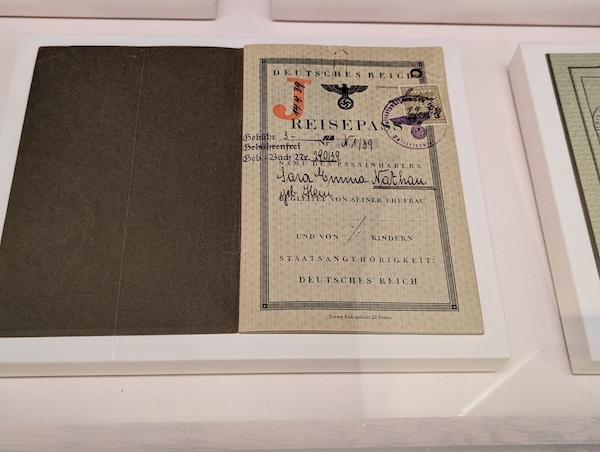
In all, about 23,000 Jews were admitted to Switzerland – but only as a country of transit. The Swiss authorities even prevailed upon the Third Reich – successfully – to stamp German passports issued to Jews with an unmistakable scarlet letter “J” to make it easier to identify and reject potential Jewish border-crossers.
Swiss authorities prevailed upon the Third Reich – successfully – to stamp German passports issued to Jews with a “J” to make it easier to identify and reject Jewish refugees. (photo by Pat Johnson)
In the 1990s, as Swiss actions during the Second World War and the Holocaust were the subject of international attention, a backlash to this critical historical assessment led to an upsurge in antisemitic rhetoric and what a study indicated was a substantial reduction in inhibitions against racist expressions toward Jews. More recent public opinion polls suggest the Swiss are among Europe’s most antisemitic populations.
An old and unresolved sticking point for Swiss Jews has been the banning of kosher slaughter, which was outlawed in 1874 and remains prohibited to this day. Since 2002, the Swiss government has allowed the importation of kosher meat, but ritual slaughter remains illegal.
For all its significance in Zionist history, Basel appears to have no commemorative plaque or similar tribute marking either its centrality in the birth of the modern Zionist movement or of Herzl’s association with it, although the museum celebrates the connection.
The Jewish Museum of Switzerland is located in a nondescript side street about a 20-minute walk from the Basel train station. It is open Monday to Thursday, 1-4 p.m., and Sundays, 11 a.m.-5 p.m. The permanent exhibition explores Jewish culture, religion and history through an impressive assemblage of ritual objects, documents, household items and testimonies. The current exhibition, Literally Jewish, which runs into next year, explores how Jews have been perceived depending on the time, language and attitude, including, as the introductory material says, “from derogatory to valourizing, ideological to idealizing.” Adult admission is 10 Swiss francs – about $15.50 Canadian – making it one of the more affordable attractions in a country where everything is gobsmackingly expensive.