Skip to content
  • Home
  • Subscribe / donate
  • Events calendar
  • News
    • Local
    • National
    • Israel
    • World
    • עניין בחדשות
      A roundup of news in Canada and further afield, in Hebrew.
  • Opinion
    • From the JI
    • Op-Ed
  • Arts & Culture
    • Performing Arts
    • Music
    • Books
    • Visual Arts
    • TV & Film
  • Life
    • Celebrating the Holidays
    • Travel
    • The Daily Snooze
      Cartoons by Jacob Samuel
    • Mystery Photo
      Help the JI and JMABC fill in the gaps in our archives.
  • Community Links
    • Organizations, Etc.
    • Other News Sources & Blogs
    • Business Directory
  • FAQ
  • JI Chai Celebration
  • JI@88! video

Recent Posts

  • האלימות בישראל מורגשת בהרבה מגזרים
  • טראמפ עוזר דווקא לנושא הפלסטיני
  • New rabbi settles into post
  • A light for the nations
  • Killed for being Jewish 
  • The complexities of identity
  • Jews in time of trauma
  • What should governments do?
  • Annie will warm your heart
  • Best of the film fest online
  • Guitar Night at Massey
  • Partners in the telling of stories
  • Four Peretz pillars honoured
  • History as a foundation
  • Music can comfort us
  • New chapter for JFS
  • The value(s) of Jewish camp
  • Chance led to great decision
  • From the JI archives … camp
  • עשרים ואחת שנים להגעתי לונקובר
  • Eby touts government record
  • Keep lighting candles
  • Facing a complex situation
  • Unique interview show a hit
  • See Annie at Gateway
  • Explorations of light
  • Help with the legal aspects
  • Stories create impact
  • Different faiths gather
  • Advocating for girls’ rights
  • An oral song tradition
  • Genealogy tools and tips
  • Jew-hatred is centuries old
  • Aiding medical research
  • Connecting Jews to Judaism
  • Beacon of light in heart of city

Archives

Follow @JewishIndie
image - The CJN - Visit Us Banner - 300x600 - 101625

Tag: Aerotomania

Community milestones … Jewish Medical Association, Freilich & Karasick

Community milestones … Jewish Medical Association, Freilich & Karasick

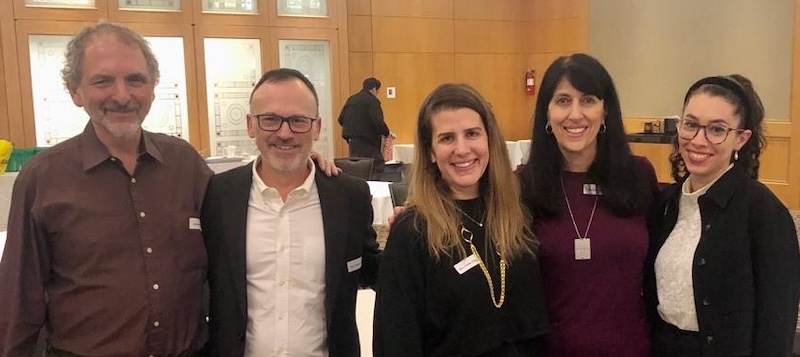
Left to right: Drs. Larry Barzelai, Ran Goldman, Mor Cohen-Eilig, Marla Gordon and Maya Rosenkrantz. (photo from Dr. Marla Gordon)

The Jewish Medical Association of British Columbia held its inaugural event Monday evening, Feb. 12, at Schara Tzedeck Synagogue, with 100 attendees in person and 20 via Zoom. Three speakers presented and all were inspiring, relaying hopeful words, with the broad message being to unite and stand together.

Dr. Dynai Eilig, an Israeli-born and -trained orthopedic surgeon who works and lives in Vancouver, traveled to Israel on Oct. 9 to work in Soroka Medical Centre’s trauma centre. He shared heartbreaking stories, but also stories of resiliency. He spoke about the 150,000 reservist army volunteers from outside Israel who came in the early days after Oct. 7.
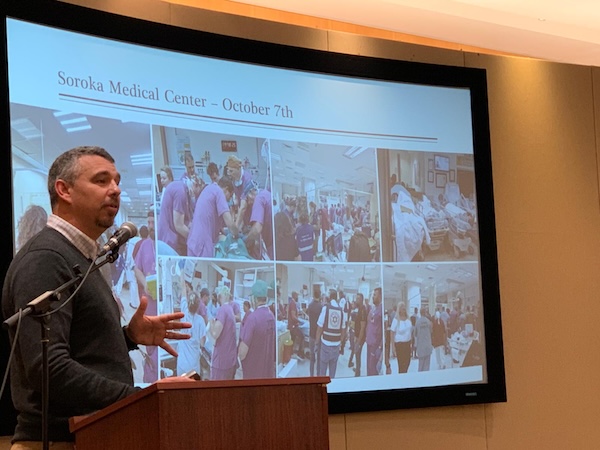
photo - Dr. Dynai Eilig presenting at the inaugural event Feb. 12. (photo from Dr. Marla
Dr. Dynai Eilig presenting at the inaugural event Feb. 12. (photo from Dr. Marla Gordon)

Dr. Robert Krell, a retired child psychiatrist and Holocaust survivor, explained the correlation between the rise of antisemitism now and that in Europe in the 1930s. He said Holocaust education is needed in all universities and all faculties and that medical and other educators must not resign from their teaching posts.

Dr. Yael Glassberg, an Israel-based pediatric gastroenterologist, joined via Zoom. She spoke on the child hostages who were released and her assessment and involvement with these children.

Planning for the JMA community-building event took place over a two-month period, led by pediatric emergency room physician Dr. Ran Goldman and elder-care physician Dr. Marla Gordon.

The Jewish Medical Association of British Columbia was started by Gordon and family physician Dr. Larry Barzelai in November 2023 as an attempt to get Jewish physicians together to support one another, especially in the current situation of increased antisemitism. The group has almost 300 members.

– Courtesy Dr. Marla Gordon

***
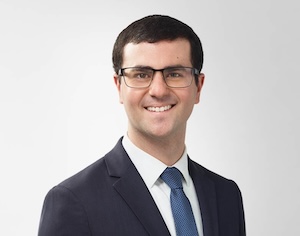
photo - Eric Freilich
Eric Freilich

Eric Freilich was recently promoted to director of legal, private equity and M&A (mergers and acquisitions) at BMS Group and heads the Canadian legal team for the multinational insurance broker.

Eric grew up in Vancouver and is a graduate of the University of British Columbia, where he was a proud and active member of Hillel and of the Jewish fraternity, Alpha Epsilon Pi. Following graduation from UBC, Eric moved to Toronto to work in the film industry. He then went back to school and received his doctor of law and a master of business administration from York University. He worked at two prominent Toronto law firms prior to going in-house, focusing on corporate/commercial work and mergers and acquisitions.

Eric has recently found his way back into academia, contributing to teaching courses on mergers and acquisitions and risk management techniques in transactions at the Schulich School of Business.

Outside of work, Eric’s strongest sense of identity comes from being the best father and husband he can be.

***

photo - Adina Karasick
Adina Karasick (photo from poets.ca)
photo - Ian Keteku
Ian Keteku (photo from poets.ca)

Adeena Karasick and Ian Keteku are the inaugural winners of the League of Canadian Poets Spoken Word Award, which consists of two $1,000 awards, presented annually to two poets for a single poem or suite of poems up to 10 minutes in length.

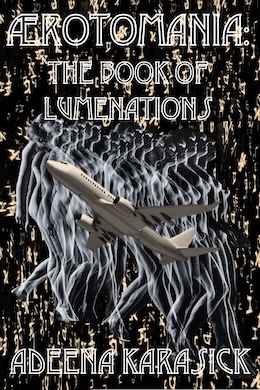
Karasick won for the poem “Eicha,” featured in Aerotomania: The Book of Lumenations (bit.ly/aerotomania).

“Attuned to sound poetry’s domain, Adeena Karasick’s homophonic translation ‘Eicha: The Book of Lumenations’ unfolds as a dynamic interplay of acoustic and material expressions,” wrote LCP Spoken Word Award juror Eric Schmaltz. “Immersed in the intricacies of language’s auditory, textural and tonal dimensions, Karasick engages the original text, the Book of Lamentations, and brings it into dialogue with the multifaceted layers of our present. A simultaneous act of lamentation and ecstatic intertextual exploration, Karasick’s performance traverses sonic texture and electroacoustic manipulation to resound with a symphony of hope and sorrow.” 

Keteku was honoured for the triptych: “Mr. Tally Man,” “the space between” and “The Light.” LCP Spoken Word Award juror Andrea Thompson called him “a master of spoken word,” noting: “With impeccable comedic timing and understated affect, Keteku’s performances are a triumph of wordplay and musicality, driven by wisdom and humanity – alive as a heartbeat.”

For more about the League of Canadian Poets, visit poets.ca.
Format ImagePosted on February 23, 2024February 22, 2024Author Community members/organizationsCategories LocalTags Adeena Karasick, Aerotomania, British Columbia, business, Dynai Eilig, Eric Freilich, Ian Keteku, Jewish Medical Association, Larry Barzelai, League of Canadian Poets Spoken Word Award, Marla Gordon, poetry, Ran Goldman, Robert Krell, Yael Glassberg

Galilee goes free, or the tetragrammaton only knows why a poem in Adeena Karasick’s Aerotomania: The Book of Lumenations is dedicated to me

According to the Babylonian Talmud (Eruvin 53b), the Hebrew-speakers of ancient Judea were so precise in their speech that they would never describe a cloak they were trying to sell as merely green, but would tell you instead that it was the colour of newly sprouted beet greens trailing along the ground. Galileans, on the other hand, were less punctilious:

“What do you mean when you say that Galileans are not careful in speaking? It is taught: There was a Galilean who used to go about [the marketplace] asking, ‘Who has amar? Who has amar?’ They said to him, ‘Stupid Galilean, do you mean khamor [donkey] to ride or khamar [wine] to drink? Amar [wool] to wear or imar [a lamb] to slaughter?’ And don’t forget the woman who wanted to say to her friend, ‘to-i de-okhlikh khalovo, come, I’ll give you some milk,’ only to have it come out as ‘tokhlikh lovya, may you be eaten by a lioness?’”

Where the ancient Galileans seem to have had no choice but to sound like themselves, Adeena Karasick has elaborated, over 14 volumes of poetry, a sort of deliberate neo-Galileanism that sometimes bridges, sometimes leaps and, on occasion, just fills the talmudic chasm between utterance and meaning in a way guaranteed to drive any artificial intelligence program out of its simulated mind. As she says in the poem “Talmudy Blues II” that is dedicated to me in her new collection, Aerotomania: The Book of Lumenations (Lavender Ink): “… sometimes the letters rule over her / and sometimes she rules over the letters / cleaving to the light of infinite possibility.” (p.31)

image - Aerotomania book coverIs Karasick cleaving to the light as she rules over the letters? Or do the letters ruling her do the cleaving? Have her consonants been endowed with the naissances latentes of Rimbaud’s “Voyelles”? Or, less goyishly, is Karasick turning Galilean imprecision into an aesthetic approach rooted in the modalities of elementary-level reading instruction – reading silently and reading aloud, the absorption and subsequent re-citation of a written text – as enacted in the traditional East European Hebrew school known as kheyder?

The basic level of instruction had three phases:

1. Alef-beys, literally, alphabet, in which students learn to recognize the consonants that make up the Hebrew alphabet, along with the sundry diacritical marks that take the place of alphabetic vowels. There are 11 of the latter, representing five vowel sounds.

2. Halb-traf leyenen, reading half syllables. Each diacritic is run, as it were, through all 22 of the consonants. So, for example, syllables formed with the vowel komets would be learned by reciting, “Komets alef, o; komets beys, bo; komets giml, go” … and so on, to the end of the alphabet, when the student would go on to the next vowel: “Pasekh alef, a; pasekh beys, ba; pasekh giml, ga.”

3. Gants-traf leyenen, reading whole syllables, i.e., combining the individual letters or syllabograms into words.

Karasick’s traffic is with the last two, the kheyder basics supplemented by the graphemically focused mysticism of Sefer Yetsira and Abraham Abulafia as refracted through a contemporary sensibility and range of reference: “The letter is matter which moves matter … these words are closer than they appear.” (p.31)

We see halb-traf in full flight in, say, the coda to “Eicha,” the long poem with which Lumenations opens: “In the eros of aching ethos / The caesura screams – / Through cirque’elatory sequiturs, resistances” and continues: “Here, her / in mired err / whose scar is clear // Hear her/here/whose heir / wears err’s // shared prayer / where // care is rare….” (pp.26-27)

All you have to do is imagine a phrase like “hear her/here/” in unvocalized Hebrew, רה רה רה, and then read it as “hair hare hoar,” to realize that Karasick’s poetry, like the airplane she anatomizes in Aerotomania, constitutes “a hybridized syncretic space between cultures and idioms / where that interlingual complexity doesn’t close down but builds dialogue” (p.83), a dialogue rooted in, but quickly soaring beyond, quotidian phonemic reality.

There is an upward thrust to the book, from the dust and cracked earth of “Eicha,” the recasting of the biblical Lamentations (eicha means how, as in, “How sits the city solitary”), through the rising rabbinic commentary of “Talmudy Blues II,” a romp through ways of thought – words, that is – that now stand in place of the things destroyed: Jerusalem and the Temple (known in Hebrew as the Holy House).

An excursus on the idea of house follows, then “Checking In II,” i.e., checking into the Aerotomania flight by stowing readers’ cultural baggage for the duration of their stay on the plane. Having shaken off our dust (Isaiah 52:2), we emerge from the fog of our associations. Our lumen is come (Isaiah 60:1); we rise through the ether to embrace The Shining.

As the dedicatee of “Talmudy Blues II,” it behooves me to say something about the poem. A continuation of “Here Today Gone Gemara” from Karasick’s 2018 collection Checking In (Talonbooks), “Talmudy Blues II” consists in large part of elaborations of dialogue (and dialect) culled from our ongoing conversations about the ways in which the Talmud is reflected and refracted in Yiddish. “Carpe verbum,” reads the epigraph to “Here Today” – pluck that word like it’s a Sabbath chicken, clear away the excrescences and bite into the thing itself, ever mindful that the Hebrew davar means both word and thing, utterance and entity; my honeyed words solidified into raw material, ore for Adeena’s gold, one davar turned into another. But, as it says in the Talmud (Megillah 15), “Whoever credits a davar to the person who said it brings redemption to the world.”

Amen. Thou hast conquered, O neo-Galilean. 

Michael Wex is author of three books on Yiddish, including Born to Kvetch. His songs have been recorded by such bands as the Klezmatics, and he has translated The Threepenny Opera from German into Yiddish. His one-person shows include Sex in Yiddish, Wie Gott in Paris and Gut Yontef, Yoko. I Just Wanna Jewify: The Yiddish Revenge on Wagner was recently revived (on Zoom) by the Ashkenaz Festival. His most recent major project, Baym Kabaret Yitesh, a recreation of a 1938 Warsaw Yiddish cabaret, was the surprise hit of Ashkenaz 2022 in Toronto. Bas Sheve, the long-lost Yiddish opera restored by Wex and composer Joshua Horowitz, was the not-so-surprising hit of the same festival. This book review was originally published in New Explorations: Studies in Culture & Communication, Vol. 3, no. 2 (2023).

Posted on December 1, 2023November 30, 2023Author Michael WexCategories BooksTags Adeena Karasick, Aerotomania, language, poetry, wordplay, Yiddish
Proudly powered by WordPress