Housing as a human right

A tent city in Vancouver’s Oppenheimer Park, 2019. Canada has some of the lowest stock of social housing – about 3.5% of total housing stock, compared with 16% or 17% in the United Kingdom, and 7.5% across the European Union. (photo by Ted McGrath / flickr.com)

Recent federal legislation promises to revolutionize the way Canada confronts housing and homelessness – but the paper promises depend on tangible actions, according to expert panelists assembled last month at an annual human rights dialogue convened by two leaders in Vancouver’s Jewish community. 

Housing as a Human Right was presented online Nov. 29 by the Simces & Rabkin Family Dialogue for Human Rights, in partnership with the Canadian Museum for Human Rights and Equitas, a centre for human rights education.

Zena Simces and Simon Rabkin, founders of the dialogue, now in its fifth year, set the terms of the discussion by outlining the scope of the problem.

“We established this dialogue to enhance understanding and create an opportunity for conversation on current human rights issues that are impacting us as a community and as a society, with the hope of generating positive actions,” said Simces, who has decades of experience in human rights issues, including as a leader in the now-defunct Canadian Jewish Congress.

A recent poll in Vancouver, Simces noted, indicates that 48% of respondents identify housing as a top priority. 

“We have legislation in Canada, the National Housing Strategy Act, that enshrines housing as a human right,” said Simces. “But what does this actually mean? Why is housing being treated as a commodity and not as a social good and a legal right? What can be done to make a difference?”

Rabkin, a medical doctor who has provided healthcare in underserviced areas in Canada’s north and in Africa, explained the health outcomes of homelessness and inadequate housing.

“There is good evidence that people dealing with inadequate housing confront a wide range of adverse health consequences such as poor mental health, lung disease and various infectious diseases, to name a few,” he said. “As a physician, I see these health consequences, specifically poor cardiometabolic health, including higher prevalence and poor control of conditions such as hypertension, diabetes and heart failure.

“Death rates of the homeless in North America are three to five times greater than in the general population,” he added. “Cardiovascular diseases are a major cause of death in homeless adults between 25 and 64 years of age and are three times more common in the homeless than in an age-matched general population.”

The event was moderated by homelessness and anti-poverty activist Michael Redhead Champagne, a community leader in North Winnipeg, where Simces and Rabkin both grew up.

The National Housing Strategy Act, passed by Parliament in 2019, has the potential to shift housing from a charity model to a justice model approach, according to the event’s panelists. It applies international law to the Canadian context and created a federal housing advocate. 

“It’s led to more data because we have terrible data about housing need and information around unhoused populations,” said panelist Alexandra Flynn, a University of British Columbia law professor and director of the Housing Research Collaborative, which focuses on Canada’s housing crisis. She is a data evangelist who helped create the Housing Assessment Resource Tools project. These federally funded tools allow anyone to enter their municipality and see how much housing is needed, based on available data, she said.

“Having that information is a necessary foundation for the right to housing,” she said. “How can we know what we need to do as a community, as governments, if we don’t know how different people are impacted?”

Some of the foremost work in the field is being done at the municipal level, said Flynn, whose academic work centres on local governance. For example, she said the city of Toronto has forced the three levels of government to the table and, in London, Ont., community activists have forced officials to adopt a “human rights lens” for how people in tent cities are treated.

The 2019 legislation is so revolutionary it led panelist Kaitlin Schwan to leave a job at the United Nations in New York to return to Canada. Schwan is now executive director of the Women’s National Housing & Homelessness Network and a senior researcher at the Canadian Observatory on Homelessness. She teaches social policy at the University of Toronto’s Faculty of Social Work and is a former senior researcher for the United Nations Special Rapporteur for the Right to Adequate Housing.

“It was absolutely historic,” she said of the National Housing Strategy Act. “It creates a new legal path for advancing housing affordability and adequacy in Canada.”

The act sets out guidelines for how government is accountable to rights-holders. 

“It’s based in international human rights law and these laws dare to insist on a society that holds everyone equal in dignity and worth,” said Schwan, whose work emphasizes the impacts of gender on the housing issue.

“We don’t often think of the housing crisis as a gendered crisis, but it really, really is,” she said. “When you look at the research, we know that women and gender-diverse folks, especially racialized folks, indigenous folks, LGBTQ2S folks, are more likely to be in core housing need, live in poor housing, have poor income, struggle with security tenure. There is a huge range of data in this area.”

A group of individuals and agencies has made a human rights claim under the new legislation and the federal housing advocate is undertaking an inquiry. After that report is delivered to Parliament, said Schwan, the federal housing minister will have 120 days to respond.

Schwan criticized existing patterns of presumed solutions which, she said, see a majority of funding going into housing that is not going to meet the needs of those with low, or very low, incomes.

“A majority of where we’re spending federal dollars in terms of the development of housing is in middle class or slightly lower housing development,” she said.

Compared to other developed countries, Schwan said, Canada has some of the lowest stock of social housing – about 3.5% of total housing stock, compared with 16% or 17% in the United Kingdom, and 7.5% across the European Union.

“Do not believe the narrative that this problem is not solvable, that it’s too complex, that we can’t get there,” she said. “It is not true. There are countries, like Finland, like others around the world, who have eradicated homelessness – not through tremendously complex initiatives that we can never understand. There are roadmaps around the world that we can be drawing on as a nation. We have the resources and we have the capacity to build a really dignified world for us to live in.”

The third panelist, Lavern Kelly, runs the Youth Excelling & Attaining Housing (YEAH!) Parenting Program at Watari Counseling and Support Services. She works with youth, especially single women and young mothers, in Vancouver’s Downtown Eastside. As a youth, she was a ward of child services.

Canada’s federal system, she said, allows the three levels of government to point fingers at one another and avoid addressing the problem.

Public opinion is another barrier, she added. Many have the belief that all youth in need have housing and that there are many supports in place to protect them. 

“This is not the case,” said Kelly. “We know housing is difficult for even the average person. Can you imagine how hard it is for youth to find housing, with all the barriers that they face just by being a youth? We need to support our youth by advocating for the right to housing.”

Adequate housing is critical to young people’s success, she said.

“When basic needs are met, one can succeed,” said Kelly. “When a youth is housed, they have a stronger sense of safety and belonging. They can build roots, networks, friends and neighbours.” 

The recorded event can be accessed at the Canadian Museum for Human Rights website or YouTube channel. 
More funds to Israel

The Jewish Federation of Greater Vancouver has made its third transfer of funds – just under $1.6 million – to Israel since the Oct. 7 Hamas attack.

The latest transfer brings the total transferred from Federation’s Israel Emergency Campaign to just under $6.5 million. To date, Jewish Federation has raised more than $17.3 million through the campaign.

Israel and its citizens are transitioning from emergency mode to emergency routine. To meet the current circumstances and provide impactful assistance, the Israel Emergency Campaign allocations committee has developed a framework for allocations and includes support in the following areas:

• Addressing the basic needs of survivors, evacuees and all Israelis during the war, including emergency assistance to those directly impacted by the Oct. 7 attack.

• Addressing the immediate needs of people from evacuated communities who have been displaced for an unknown duration of time, so they can regain a semblance of normalcy and build resilience, through educational programs, respite and related supports.

• Providing emergency care to survivors and evacuees who have experienced traumatic events and require immediate support. Supporting medical centres on the frontline to increase their ability to address emergency situations along the country’s borders.

 • Supporting strategic approaches to minimizing the drastic negative effect of societal challenges such as divisions between groups of the population, destruction of community life, loss of livelihood and a significantly decreased sense of resilience and security, all of which are sources of concern and anxiety for many Israelis.

 • Supporting vulnerable groups with unique, disadvantaged circumstances.

The recent $1.6 million has been allocated as follows:

Sha’ar HaNegev: young adult retreat for a second group of attack survivors.

Pitachon Lev: emergency humanitarian aid.

Shahaf Foundation with Kiryat Shmona Community Centre: capacity-building for evacuated municipalities.

Summer Camps Israel, Morris and Rosalind Goodman Family Foundation: winter camps for evacuated children.

Yozmot Atid: mentorship for women small business owners.

Elem: safe spaces for at-risk youth.

Kishorit: support community of adults with disabilities on the northern frontline.

Beit Halochem: therapeutic services for veterans and newly wounded.

Leket Israel: supporting food distribution from farms in the south to vulnerable populations.

Israeli Hostages Advocacy Fund: supporting frontline work and international advocacy to release the hostages.

Shalva: emergency housing for evacuees.

Magen David Adom: ambulance purchase.

Dror Israel: youth programs and respite.

To donate to the Israel Emergency Campaign, go to jewishvancouver.com. 

– Courtesy Jewish Federation of Greater Vancouver

Dialogue to empower women

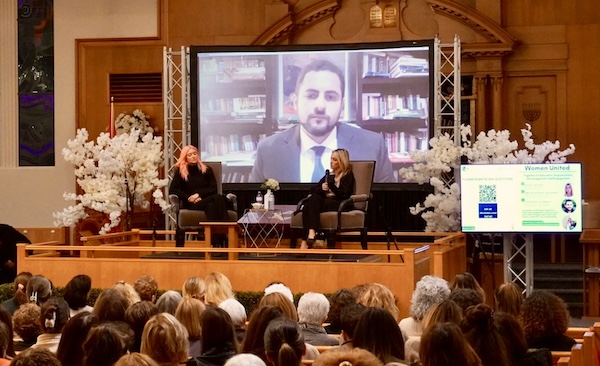
Caroline D’Amore, left, Hussein Aboubakr Mansour and Emily Austin spoke to an audience of more than 550 at Congregation Schara Tzedeck Nov. 26 for the event Women United. (photo by Kyle Berger)

Some 550 Vancouver women packed the sanctuary at Congregation Schara Tzedeck Nov. 26 for Women United, a talk arranged by Jewish National Fund, Jewish Federation of Greater Vancouver, Stand With Us Canada and Schara Tzedeck, and sponsored by the Diamond Foundation. Jewish women were encouraged to bring their non-Jewish friends, and Federation reported that 40% of attendants were non-Jewish.

“The idea was to bring together a diverse range of women from all faiths, to engage in dialogue and empower us to speak up with bravery,” said Megan Laskin, who initiated the concept for the event. She noted that there are just 15 million Jews worldwide “but we are the victims of half of the hate crimes that occur. Our pain, our fear and our loneliness are very real and very deep.” 

Emily Austin, 22, an American social media influencer who is the host of a National Basketball Association podcast called The Hoop Chat w/ Emily Austin, was the first speaker. She described how she took a deep dive into Jewish history to understand it better. “One thing Israel will always have on its side is facts,” she noted. “The Palestinians have truly sad videos with no facts, but people tend to overlook the facts because of the emotional nature of the narrative.”

Austin delivered some of those facts to the audience, refuting the Palestinians’ claims of genocide. “Go to UN.org and you’ll see that their population has quadrupled in the last 20 years,” she said.

In discussing land claims, she said, “this is not about land. It’s about Jew hatred.” She argued that, when Israel left Gaza in 2005, the Gaza Strip was a prosperous area filled with resorts, cafés and nightclubs. “They turned it into a terrorist capital,” she said of Hamas. 

Austin urged members of the audience to educate themselves so they can address false claims with confidence. “There are no excuses to not be a voice when we have the facts. If you’ve not been vocal, please be vocal now,” she said. “Silence is compliance, and those people who want Jews dead are not being silent.”

Austin warned that this conflict is not just about Israel, or even just about Jews. “When they say kill the infidels, the West is next. The common denominator is hatred, and it’s a disease,” said Austin.

Caroline D’Amore, 39, a single mom, social media influencer and the entrepreneur behind Pizza Girl pizza sauce, was the second speaker. She described herself as “a not-so-subtle, pink-haired, Malibu Italian chick” and a high school dropout. She said learning about the Holocaust and reading Anne Frank’s diary made a deep impression on her, but that she was unaware of antisemitism until Oct. 7, after which she started seeing it everywhere, and felt compelled to speak out.

D’Amore said she published a video expressing her dismay and a fact that was obvious to her. “The terrorists are the bad guys. There is no context on this earth that could justify rape and murder,” she told the audience.

The video went viral and D’Amore received hundreds of messages from mothers who were so relieved that a non-Jew could see what was going on.

“I could feel their pain, sadness and fear,” D’Amore said. “So many people are saying nothing, or shaming Jewish people for feeling this fear right now. Jews are being told to ‘stop playing the victim,’ and even I get accused of playing ‘the Zionist victim card.’ What I want to say to my accusers is ‘how dare you?’

“It’s very clear to me that this is about good versus evil,” she continued. “I dove right in and started screaming about this at the top of my lungs, and though I’ve been attacked online for over a month now, I’m still here, proudly showing my face. I plan on being on the right side of history, which means standing up against terror in the Middle East and against those who are justifying what happened on Oct. 7. My promise is that I’ll continue to use my voice to stand up against evil, to stand up for humans who are suffering, to speak up against terrorism, and to encourage and empower others to use their voices.”

D’Amore said the Jewish community was her inspiration. “You guys find the light and it shines so damn bright,” she said. “You come together in the most beautiful ways, and it’s inspired me in ways I’ve never known possible.”

Hussein Aboubakr Mansour, the third speaker, addressed the audience by Zoom from his home in Washington, DC. Now the director of the Endowment for Middle East Truth’s Program for Emerging Democratic Voices from the Middle East, he was born in Cairo, into an environment that he said inspired him and his peers to hate Jews and become jihadists. 

“From an early age, there was a story I heard everywhere, that there are people who epitomize wickedness, want to destroy Arabs and Muslims and steal our land, and want to destroy everything that is good and sacred. Those people are the Jews and Zionism is the embodiment of that ideal,” he said. 

Curious, he started teaching himself Hebrew and learning about Jewish history. That led him on a long journey that transformed his relationship with the world and turned him into an ardent Zionist and supporter of the Jewish people. 

His metamorphosis and his insistence on publishing, blogging and talking about what he learned, has cost him dearly. He was disowned by his family, was arrested on suspicion of being a Zionist spy, and was tortured in Egyptian jails before receiving political asylum in the United States in 2012. 

“I spend every day of my life thinking about how to help end this epidemic of antisemitism that’s been going on for so long,” he said. While the massacres on Oct. 7 destroyed much of his optimism, Mansour said he still believes a change for the better is possible.

He ended his remarks by saying that he is proud to be a friend of the Jewish people and of the state of Israel. “And I have no doubt that I’m not the only Arab who feels this way – I’m just ahead of the curve,” he said. “There will be more who will see this truth.” 

Lauren Kramer, an award-winning writer and editor, lives in Richmond.

Stories of resilience shared

A family fleeing war, aided by acquaintances from a lifetime of hospitality. A person’s choice to be the light in a dark world after a loved one was murdered. The creation of a vital medical resource as a tribute to a father who died too young. These three stories were shared at the event A Night of Hope, which was held at the Jewish Community Centre of Greater Vancouver Nov. 30. The three stories of resilience were intended to give hope in response to the trauma Jews worldwide have experienced since Oct. 7.

Rabbi Susan Tendler, spiritual leader of Beth Tikvah Congregation in Richmond, shared “the unlikely story” of how she became a rabbi, in part because of the trauma of having experienced the murder of a loved one.

In the year 2000, she recalled, “I was living my best life.” She thought she knew who she would marry, she had a dream job as a teacher in Israel and was planning on making aliyah.

photo - Rabbi Susan Tendler
Rabbi Susan Tendler (photo by Pat Johnson)

“I returned to the United States to get my affairs in order before making the big move as the Second Intifada broke out,” she said. Global conflict was compounded in the personal realm when her engagement was broken off. With foreign students avoiding Israel, her job was suddenly eliminated. Things began looking up, though, when she met Mike, “who showed me what partnership might look like.”

“And then, one night, he was brutally murdered,” she said. Five young men, joyriding, had crashed a car and needed another vehicle.

“They came upon Mike and murdered him, not even for his wallet. Just for fun,” Tendler said. “Just to take his car a few miles down the road before they ditched it.”

The murder plummeted her into depths of darkness.

“I couldn’t understand how such palpable evil could exist in the world,” she recalled. “How could a human being, created in the image of the divine, not understand life as sacred? What were the lives of those individuals that they didn’t hold this basic value as truth? And, by doing so, those five young men took the sanctity out of this world for me, for Mike’s family and his friends. I really didn’t care to live in a world with such sheer evil. It wasn’t that I was suicidal – I knew the difference and I wasn’t – I just really didn’t care to live or to die.”

She cited the Israeli poet Yehuda Amichai, who wrote that the Jewish people are “infected with hope.”

“We are taught to love others, to embrace others and to share our burdens with others,” Tendler said. “We need not struggle alone…. So, as I held on, people rallied, surrounded me and guided me through the darkness.”

Overcoming this and other personal and geopolitical traumas led her to an important insight.

“I came to realize that, if I didn’t like living in a world full of darkness and evil, then I needed to be the light,” she said. “I needed to choose life. I needed to choose hope and spread kindness, goodness and godliness to others.

“The world needs us right now,” she continued. “We all have hope coursing through our veins. Certainly, it has been weakened and doubted [since Oct. 7], but that is exactly what they want. We won’t let them win. Let the light created by our hope and optimism join forces, knowing indeed that we are not alone and that this positive energy be magnified as it draws others in. May our light be a beacon for the world.”

Tanja Demajo, chief executive officer of Jewish Family Services, shared her family’s history of survival in the Holocaust and the personal story of her family’s escape from the post-Yugoslavia war in Bosnia, where she was born. She had not shared any of this publicly before.

As a child in Mostar, young Tanja would often come home from school to find strangers at the table. Anyone passing through or needing hospitality was received in their house and welcomed with food.

photo - Tanja Demajo
Tanja Demajo (photo by Pat Johnson)

“My family always kept the door open,” she said. This openness, she believes, helped save her family when war exploded.

In 1992, when she was 11-and-a-half, everything changed, seemingly in a day.

“There were explosions everywhere, there was shooting everywhere, the army was everywhere,” she said. “The city emptied.”

Getting away from the fighting was not easy. Roadblocks were set up by different militias and Demajo could see the fear in her father’s expression as they confronted each successive barrier. 

“We had to stop at three different points and at three different points we came across some people that my parents knew through their life,” she recalled. Keeping an open door meant there were people who knew the family and remembered their hospitality. “In each of these three situations, these friends came forward and put their lives on the line so they could let my family pass through.”

After the war ended, the family reconnected with her grandfather, who they had not seen in years.

“That was the first time actually that my grandfather shared with us his own story,” she said. From a community of 300, the grandfather and an uncle were the only survivors of the Holocaust. 

She asked him why he was so cheerful, despite all he had gone through.

“He had this beautiful way of just hugging people and he would hug me and say, what are the things you remember as a child?” She recalled spending weekends with her grandfather, the meals and stories they shared. “And he said, well that’s how you survive. Because those are the things that matter. The people you have in your life, the friendships that you share with them and the food you share with them.”

The connections she saw her parents forge at the table – which proved potentially lifesaving as the family fled war – are a lesson she has always carried. It is something that Jews worldwide can remember now, she said.

“We need allies and we need to have these conversations to bring people together,” she said.

Jaime Stein shared the story of how the death his father, Howard Stein, in 2006, from acute leukemia, inspired him to help create Canada’s first public

photo - Jaime Stein
Jaime Stein (photo by Pat Johnson)

Early in the last decade, when Stein helped launch the $12.5 million campaign to create the facility, Canada was one of only two G-20 nations that did not have such a service. Umbilical cord blood contains blood-forming stem cells, which can renew themselves and differentiate into other types of cells.

Working with Canadian Blood Services, Stein and the fundraising team for the project decided on a big focal point for the campaign – climbing Tanzania’s Mount Kilimanjaro, the highest peak in Africa.

“We got 25 people to sign up [to climb] and everybody had to raise a minimum of $10,000,” Stein explained.

Stein, in his 30s at the time, when $10,000 was a daunting sum, organized weekly 9 a.m. hikes with friends and strangers, at which he would offer career advice, listen to his hiking mates or otherwise engage, then write a blog post. 

“People started donating and people started telling their friends as well,” he said. 

In the end, he raised $27,000, second only to the chief executive officer of Canadian Blood Services among the 25 climbers. Of course, the money turned out to be the easy part. They still had to ascend the mountain. 

Like many others who climb tall mountains, Stein experienced altitude sickness – so severely he almost had to turn back.

“I could barely make it to camp,” Stein recalls of the onset of the crisis. “I just remember thinking about my dad, thinking of my family, thinking of the training, thinking of everything I did as I tried to get to camp.”

Slowly, his oxygen levels climbed and he was able to complete the trek.

The trip itself raised $350,000 and, eventually, the team raised all the funds necessary. Canada now has a fully functioning umbilical cord blood bank, with four collection sites, including one in Vancouver.

Alan Stamp, Jewish Family Services clinical director, and Ezra Shanken, chief executive officer of the Jewish Federation of Greater Vancouver, contextualized the stories as lessons in resilience community members can use to confront trauma. 

Jewish comedy history

“Jews have always turned and continue to turn to humour as a cultural touchstone and a way to make meaning,” said Dr. Jennifer Caplan, author of Funny, You Don’t Look Funny: Judaism and Humor from the Silent Generation to Millennials, which was published earlier this year.

photo - Dr. Jennifer Caplan spoke Dec. 3, as part of the L’dor V’dor lecture series organized by Victoria’s Kolot Mayim Reform Temple
Dr. Jennifer Caplan spoke Dec. 3, as part of the L’dor V’dor lecture series organized by Victoria’s Kolot Mayim Reform Temple. (photo from Kolot Mayim)

Caplan, who is an associate professor and the Jewish Foundation Chair in Judaic Studies at the University of Cincinnati, was the second presenter of the 2023-24 L’dor V’dor (Generation to Generation) Zoom lecture series organized by Victoria’s Kolot Mayim Reform Temple. On Dec. 3, she spoke about the past several decades of Jewish humour. Similar to the approach she took for her book, her presentation explored the changing relationship to Judaism of four generations of Jewish funny people.

According to a 2013 report by the Pew Foundation, called A Portrait of American Jews, 42% of American Jews thought that having a sense of humour was integral to their Jewish identity, said Caplan. In the survey, in terms of what American Jews deemed important to their identity, a sense of humour came out far behind Holocaust remembrance and intellectual curiosity, just under support of Israel, and well ahead of belonging to a Jewish community or eating traditional Jewish food.

“The report set off little bells in my brain which pushed me to say that there’s something here and that there’s something I want to think about,” she said.

There were Jewish commentators who pointed to the Pew survey as an alarm bell for the dangers of the rise of cultural Judaism. To Caplan, the TV show Seinfeld, which premièred in 1989, encapsulated what worried some about the culturally Jewish experience.

“It was this group of people who seemed Jewish, even though Jerry (the title character) is the only character on the show who is actually Jewish,” she said. “They all sort of felt Jewish, but they never did anything Jewish and nobody ever went to synagogue and they didn’t even have a menorah like Rachel and Monica did in their apartment on Friends.”

In Caplan’s view, this fear of cultural Judaism aligned with the way that Jews were being portrayed in popular comedy and media, as Seinfeld led to a boom in Jewish sitcom characters – in shows like Mad About You and Anything but Love, for example. She thought there was something important in the way Jewish comedians were using Judaism in their humour to think about themselves and their Jewish identity, and what it means for them to be Jewish.

Moving forward to the present and, according to Caplan, one finds that the younger generation, the millennials, are even more culturally tied to their American generational cohort and less so to being the grandchild or great-grandchild of Jewish immigrants.

“It’s a story about comedy and it’s a story about the way that Jewish comedians have related to Judaism in their comedy, but it’s also a story about Americanization. It is a story about the way that Jews in the United States became more and more embedded within their broader cultural milieu,” Caplan said, explaining the thought process that led her to write her book.

Caplan pointed out that counterculture, in Jewish comedy, was represented in the 1950s – a time generally associated in the popular sense with Leave It To Beaver and The Adventures of Ozzie and Harriet – by books like those by Philip Roth. His works, well before the broader 1960s counterculture movement, were critical of institutions but defensive of the Jewish community – viewing organized religion as something that was hurting Jews, but seeing the need for Jews to be protected.

What intrigued Caplan was that the pendulum had swung in the other direction for Generation X. “What I found was a fascinating reincorporation of Jewish ritual into the writing and the movies and the comedy of Generation X comedians. Jews themselves are being made fun of, but their engagement with Judaism is actually the thing that humanizes them,” she said.

In the 2001 film Kissing Jessica Stein, for example, the characters can be perceived as stilted, neurotic, self-absorbed Jewish caricatures, yet scenes at a Shabbat dinner and a wedding ground the characters and are not the subject of ridicule.

“It’s not that Generation X suddenly believes in God more than the previous generations did. It’s that they believe more in the power of ritual and tradition because it binds you. You’re not doing it necessarily because you have some sort of theological belief,” Caplan said.

As for millennials, among whom the oldest in the cohort is presently 42 years old, their story is still being written, she said. 

“It seems as though they are willing to ridicule both Jewish identity and Jewish religious interaction at various times, depending on what suits the comedy,” she said. “They neither have a sense of oppression about their Judaism, nor do they have a sense of embarrassment about their Judaism.”

Caplan is currently researching and writing her next book, Unmasked: Jewish Identity in Comic Books.

The next speaker in the L’dor V’dor series is psychotherapist and author, and member of the second generation, Rabbi Dr. Tirzah Firestone on Jan. 14. Firestone will talk on the topic Healing Intergenerational Jewish Trauma. For more information, visit kolotmayimreformtemple.com. 

Sam Margolis has written for the Globe and Mail, the National Post, UPI and MSNBC.

Local camper grants

The Jewish Independent briefly spoke with the Jewish Federation of Greater Vancouver about what support local campers could receive, if they needed it.

JI: Does Federation work with the Foundation for Jewish Camp at all?

JF: One Happy Camper is a grant program run through the FJC and federations to provide a $1,000 grant to first-time campers. In communities such as ours, where Federation does not sponsor OHC, PJ Library families are able to apply and receive this grant through PJ Library.

JI: To what camps does Federation give grants and why?

JF: Camp Miriam, Camp Hatikvah, JCC Camp Shalom and Camp Gan Israel. Through our Connect Me In program, we have provided grants to run camps in the regional communities or to pay for transportation for children to attend the day camps in Vancouver.

The Jewish Community Foundation has designated funds established by fundholders to support Jewish summer camps and camperships, and fundholders with donor advised [funds] also make distributions to camps.

Camps can apply for funding through the [Jewish Community] Foundation’s Unrestricted Grant Program for qualifying projects. Recently, the foundation supported Camp Miriam’s Water Security Project through this grant program.

JI: Do they support any individual campers, or how do families with lower incomes access camp for their kids?

JF: Approximately one-third of families receive camperships to send their children to Jewish summer camp. Odds are that if your family did not receive a campership, your child made friends at camp with someone who did. Families can apply for camperships funded by Jewish Federation directly through the summer camp of their choice. The camps then review the applications and make the decisions.

Sam Margolis has written for the Globe and Mail, the National Post, UPI and MSNBC.

More important than ever

“This summer, the grounds of Camp Hatikvah will echo with laughter, song, and the spirited expressions of Jewish and Israel pride”: Liza Rozen-Delman, camp executive director. (photo from Camp Hatikvah)

For decades, Camp Hatikvah has been a cornerstone of the Jewish community, serving as a summer haven where traditions are cherished, friendships blossom and identities are proudly embraced. It has always been more than just a recreational retreat; it has been a powerful catalyst in shaping the future leaders of the Jewish community.

Developed in the aftermath of the Holocaust, Hatikvah was created to produce proud, happy Jewish youth who were committed to the rebuilding of the Jewish people and a homeland in Israel. As a 1949 article in the Jewish Western Bulletin (the predecessor of the Jewish Independent) stated, Camp Hatikvah provided early participants with a “place where they could live and express themselves as Jews, unhampered with fear of others and free from the out-of-place feeling that is so often a part of North American Jewishness.”

Today, as we witness a disheartening resurgence of antisemitism, the original mission of Camp Hatikvah seems to be as important as it was at the time of the camp’s creation.

“The need for a space where children can feel safe, embrace their heritage and express their identity without reservation is, once again, vital” said Liza Rozen-Delman, the camp’s executive director. “I am devastated by the current state of the world, but we are dedicated to rising above it and playing a critical role in combating hate.”

The camp’s leadership recognizes the need to renew its dedication to its original mandate, emphasizing that, in the face of external threats, the camp becomes not only a refuge but a dynamic force in cultivating resilience and unity.

“In response to the current crisis, this summer promises to be a rallying point for Jewish pride, a resolute stand against the hate we have seen, and a celebration of every aspect of who we are as a people,” said Joanna Wasel, board president.

As they begin preparing for summer, Rozen-Delman explained that the camp staff are gearing up to create an immersive experience that fosters a sense of pride, belonging, and love for all things Jewish. Through carefully curated activities and the camaraderie that comes from being part of a supportive community, campers will leave with not just memories of a fun-filled summer but also a strengthened sense of identity.

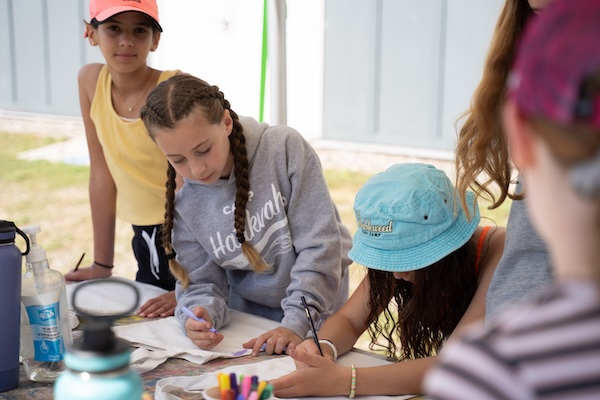
photo - Kids working on a project at summer camp
Kids working on a project at summer camp. (photo from Camp Hatikvah)

Camp Hatikvah also plans to intensify its Israel programming this summer in an effort to empower its campers with a more profound understanding of the Jewish state’s history and culture but, most importantly, its necessity. In a world where misinformation and delegitimization about Israel is rampant, Camp Hatikvah is determined to ensure that its campers and staff are equipped to advocate for the right of the Jewish people to live in peace and security in a homeland of their own.

“This summer, the grounds of Camp Hatikvah will echo with laughter, song, and the spirited expressions of Jewish and Israel pride,” said Rozen-Delman. “From the youngest to the oldest, everyone will be encouraged to stand tall, speak loud, and embrace every aspect of who they are.”

The importance of Camp Hatikvah extends beyond the traditional camp experience; it is a cornerstone for fostering resilience, unity, and an unapologetic celebration of one’s identity. Camp Hatikvah continues to play a pivotal role in creating a space where yet another generation of Jewish youth feel not only safe but truly at home. 

– Courtesy Camp Hatikvah

Encouraged to be oneself

Lifelong friends can be made at summer camp. (photo from Camp Kalsman)

Fun is in all that we do,” Rabbi Ilana Mills, director of URJ Camp Kalsman, told the Independent. “Our staff creates dynamic programming that lets campers laugh and play in a way that doesn’t happen anywhere else. Where else can you spend a day with your friends and your evening doing messy night with a slip-n-slide, water balloons, shaving cream, and more?”

Summer camp is a unique experience for children and young people, for campers and counselors. While fun is at the forefront of programming, so is learning. In the case of Jewish camps, there is the added element of Shabbat observance and other elements of Judaic practise and values.

Looking at the example of Camp Kalsman, which is located north of Seattle, one can see the breadth of activities summer camp can offer. A typical day at Kalsman includes singing, pool time, prayers, and activities that range from canoeing and kayaking on the lake, to climbing the camp’s tower and/or high ropes, to farming or gardening, to painting or having a cook-out.

The camp has chugim (electives), which usually run three to four days, and campers do a project during them, said Mills. “Campers will get to rank their choice from a list of options and we do our best to give campers their choices,” she said. Chugim includes such things as pottery, embroidery, hiking, water aerobics, yoga or soccer.

And older campers have “Sababa Time,” said Mill. “Sababa Time is an hour each day where older campers get to choose their own activities from a number of creative options that changes each day. Those might include volleyball, board games, outdoor cooking, or spa days.”

The camp schedule also carves out free time for campers.

“Life is so busy and camp is as well. Free time enables campers to choose what they need on any given day,” said Mills. “Whenever we have free time, we have options for campers to choose which option best fits their needs.  Some campers need to get energy out, so they play basketball or go to the pool. Others may need down time, so they may read a book in the trees. Campers use free time to relax, recharge and have fun in a manner that best suits them. Recreation can be a time to re-create, to rejuvenate.”

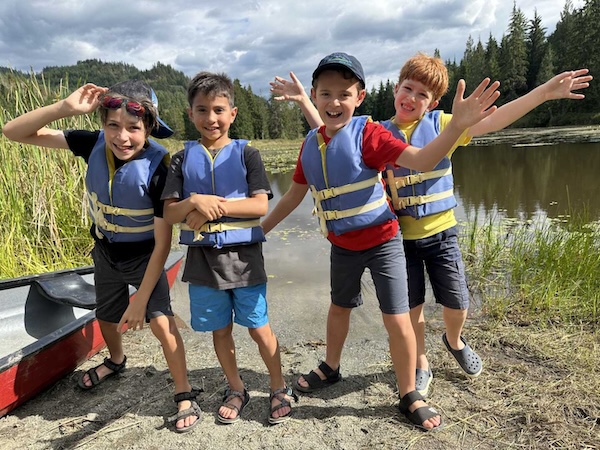
photo - Kids at Camp Kalsman get ready to take a canoe out onto the lake
Kids at Camp Kalsman get ready to take a canoe out onto the lake. (photo from Camp Kalsman)

In addition to obvious practices, such as the celebration of Shabbat and group tefillah (prayer), Kalsman tries to impart Jewish values and culture throughout activities.

“We design our programs to foster a holy community through connection between campers, between campers and staff and between campers and the larger community,” said Mills. “We believe connection is important on every level, so our cabins do cabin time every night to form connections and, every week, we have all-camp programs, where campers of different ages can get to know one another. When we eat, pray and sing together, we connect to the larger community.”

Camp Kalsman ends each night in siyum, “a special closing prayer where we pray Hashkiveinu and Shema using a special tune written just for Camp Kalsman,” said Mills.

When asked what summer camps in general – and Jewish camps specifically – can give kids that schools can’t, Mills shared a quote from a 10-year-old camper, who said, “Kalsman lets me take off all the masks I have to wear at school and really be me.”

“At Kalsman, our campers know that they are valued, honoured and supported for who they are,” said Mills. “Camp enables kids to be kids, to be free, and to have fun in a way that they don’t get anywhere else. It frees them of the burdens of school and competition and allows them an outlet to be part of a great community. Kalsman campers disconnect from their devices and connect to a larger, holy community. Campers learn independence and problem solving, they learn they can make mistakes and how to manage mistakes in a safe environment. Camp is the place where kids can explore who they want to be in the world.” 

Writing in praise of neoteny

Campers being silly at Rockbrook Camp for Girls. (photo from rockbrookcamp.com)

Today, the word of the day is neoteny. It’s really a term from evolutionary biology, but it describes the retention of childlike attributes in adults. You might think of a grown-up who has a “baby face,” or is generally “cute.” When you are talking about these kinds of physical features, we tend to think it’s a good thing to have “young looking skin” or the “energy of youth,” for example. Neotenic people are usually attractive. Being neotenous is mostly considered a good thing.

But what about personality traits, attitudes or approaches to the world? What about these ways of being childlike? Think about what life is like as a child. The world is magical, full of curiosities, almost always kind and wondrous. As kids, we spend so much time being creative and playing. We feel so many more things – joy, excitement, anticipation, and the broad sensuous world around us. All of this probably makes it so easy to make friends (“Come on! Let’s play!”).

You’ve also noticed what usually happens when we grow up. We get serious, we latch on to patterns of behaviour, we get scared, we feel the need to protect what we believe, we accept responsibilities and feel pressure to perform and “be” someone in particular. As adults, we spend almost all of our time, mostly alone, working to stay organized and fighting opposing forces. We’re all too consumed by those adult things we’ve grown to accept as important, and it ain’t easy.

photo - Kids at Rockbrook Camp for Girls with soapy hair
(photo from rockbrookcamp.com)

It’s no surprise to see that being an adult overpowers those childlike traits. Sadly, to grow up often means losing touch with what we used to be, those aspects of being human we loved as kids. As adults, we have a harder time feeling what makes the world wonderful, a harder time making friends, and a much harder time playing and having fun. Of course, there are exceptions to this, but that’s the point. They are exceptions. And that’s too bad.

Let’s remember the value of being childlike even as adults.

Let’s be joyful as we’re responsible.

Let’s be curious when encountering opposing beliefs.

Let’s be friendly and playful, cooperative and excited about learning new things.

Let’s strive to foster our innate neotenous instincts.

Bringing this back to camp.… Summer camp is a place where kids can really be kids. It’s a special time when they are encouraged to play, make friends, be creative and explore the world around them. Separate from the forces of home and school (which are fundamentally about forming “adults”), camp provides a wonderful opportunity to strengthen our “kid selves.” It celebrates and fosters the neotenous traits. Camp is a joyful break from all that training, and that’s a big part of why it’s so fun.

Maybe we could say…. Camp helps you learn how to be a really great kid so that, later in life, you’ll be a really great (happy, satisfied, remarkable) adult.

Camp’s power to strengthen these “kid traits,” I suspect, will be a big part of that success. 

Jeff Carter is director of Rockbrook Camp for Girls, which is in the western part of North Carolina. For more information, visit rockbrookcamp.com.

Getting more kids into camp

The Foundation for Jewish Camp serves more than 155 Jewish summer camps, close to 80,000 campers and 11,000 counselors across North America every summer. Among its initiatives is the One Happy Camper program, which is run in partnership with Jewish federations – including in Montreal, Toronto and Calgary – foundations, PJ Library, and camps across North America. The program provides incentive grants of up to $1,000 to children attending nonprofit, Jewish overnight camp for the first time, with the intention of introducing more children to the magic of Jewish camp.

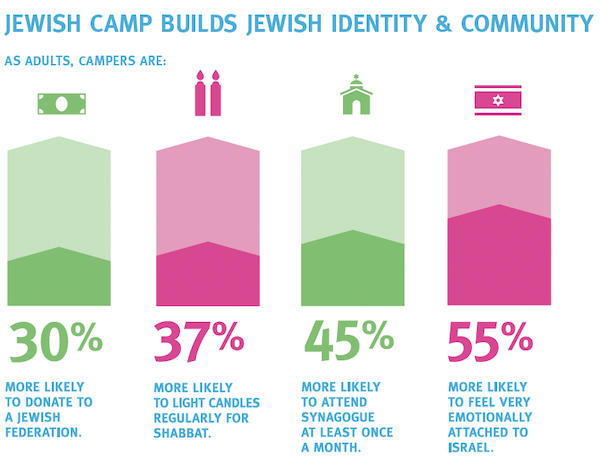
Based on the 2010 study by the FJC, Camp Works: The Long Term Impact of Jewish Overnight Camp, there is evidence that overnight Jewish camp is a proven means of building Jewish identity, community and leadership. As adults, campers are 30% more likely to donate to a Jewish federation, 37% more likely to light candles regularly on Shabbat, 45% more likely to attend synagogue at least once a month, and 55% more likely to feel emotionally attached to Israel. As well, one of three Jewish professionals (rabbis, cantors, teachers) started out as counselors at Jewish camp; one of five Jewish educators cited Jewish camp as a key experience that caused them to enter the field; and seven of 10 young Jewish leaders in their 20s and 30s attended Jewish summer camp.

North American Jewish overnight summer camps reach 77,000+ camp-aged children every summer, but this represents only 10% of eligible camp-age kids. In the FJC’s efforts to grow enrolment and increase awareness, FJC created the One Happy Camper program, thanks to the generosity of an anonymous donor. The program’s singular mission is to increase the number of children benefiting from the transformative experience of Jewish summer camp. Aimed at attracting new campers who do not have daily, immersive exposure to Judaism, the program provides financial incentives to encourage parents to choose nonprofit overnight Jewish summer camp over other summer options.

image - Communities Investing in the Future One Happy Camper at a Time report coverSince the success of the 2006 pilot, the One Happy Camper program has expanded across North America. To date, 64,000 campers have experienced Jewish overnight camp as a result of FJC’s partnership with 40 community-based organizations (federations/foundations), four national camp movements, 30 individual camps, the Harold Grinspoon Foundation’s PJ Goes to Camp program and the Jim Joseph Foundation-funded JWest program.

Of One Happy Camper grant recipients, six out of 10 would have stayed home or attended  a non-Jewish summer experience, and one out of three OHC recipients’ parents had not attended Jewish camp – FJC knows that parents who attended Jewish camp are more likely to send their own kids, so the grants are instilling a new legacy of Jewish camping for families.

Surveys show that OHC recipients enjoy their summers at camp as much as their peers, in that they say they found the experience of value and would likely recommend it. As well, they are as likely to return to camp. In fact, 82% of OHC recipients return to camp for a second summer. And their experience is infused with Jewish education, identity and connections: 97% feel that camps create an atmosphere where children are proud to be Jewish and 36% of recipients increased their participation in Jewish activities after their first summer at camp.

The majority of OHC families (63%) are not members or donors of their sponsoring organization but, as a result of the OHC grant, 78% of OHC parents feel more positive about their family’s connection to the Jewish community and 72% of OHC parents feel that they are more likely to support their sponsoring organization.

These are just some of the results found in the Foundation for Jewish Camp publication Communities Investing in the Future One Happy Camper at a Time. To read more, go to jewishcamp.org/community-partners and click on “Download ‘Communities Investing in the Future’ (PDF).” 

– Courtesy Foundation for Jewish Camp