

Month: December 2014

Look up to art
Sharon Tenenbaum’s work can be seen on billboards above highways in Vancouver, Toronto and Montreal. (photo by Sharon Tenenbaum)
Sharon Tenenbaum discovered her love of photography in 2006 on a trip to South East Asia. In 2014, only eight years later, she is a nationally recognized photographer. From Dec. 15 to Jan. 15, four of her photographs will be displayed on billboards along Canadian highways and bridges as part of Paint the City (paintthecity.org), an international initiative to promote arts in unexpected places.
Tenenbaum talked to the Independent about her transformation from an engineer dissatisfied with her career to a successful artist.
“Last year, I participated in a RAW Artists (rawartists.org) competition,” she said, explaining how her images found their way to the billboards. “RAW is an art organization supporting artists in the first 10 years of their career. I became a finalist, together with another artist. Then, the organizer called me and said she nominated us for the Paint the City project. I didn’t even know about them.”
According to Tenenbaum, Paint the City selected the winner through social media. They stipulated that the one who got more “Likes” on Facebook and Twitter would win. “I had to recruit all my friends and even my family in Israel, and my family and friends in turn incited everyone they knew to login and vote for me. I won. I guess I have more friends,” she joked.
In reality, it was a long road from her first travel photos to her sophisticated billboard images displayed on the highways of Vancouver, Toronto and Montreal.
“At first, many people discouraged me. They would say: ‘She discovered a camera, so what?’ But I can’t see myself doing anything else. I didn’t care what anyone said. I have confidence in myself.”
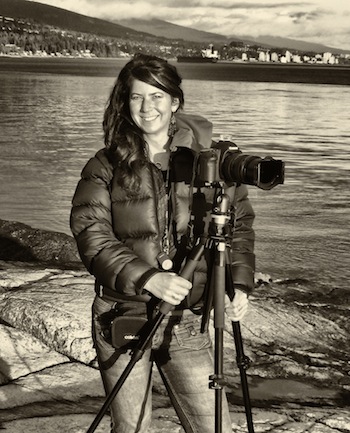
In the beginning, what she did was photojournalism, documenting everyday life, she said. “In Asia, I took photos of buildings and people, but when I returned to Vancouver, I couldn’t photograph people here. It requires legal permissions, so I started photographing architecture, rediscovering Vancouver. I wasn’t just documenting anymore; it was my interpretation of what I saw.”
Out of her engineering background sprouted her passion for photographing things constructed by human beings. “I have a talent to see how elements of the whole work in harmony, how shapes and lines come together. I like modern architecture with its clean lines. The approach is artistic. The image has to speak to the heart.”
Her stark black and white images that won their places on billboards speak to people’s hearts. They show the artist’s unerring sense of light and shadows, her flair for the dramatic. Her quest for visual tension resulted in her unique series of bridges, all of them spectacular black and white instants in time and space. Some of them are Vancouver bridges, others she took during her travels.
“When you travel,” she explained, “you see everything with new eyes. It’s harder to achieve at home. I traveled a lot at first. Now I only travel to specific locations. If I want to photograph a certain bridge, I research it, then go there to take pictures.”
Most of her photographs are black and white. “When you use color in a photo, it steals the show,” she said. “A color photo doesn’t have to be as good as black and white. Sometimes, if you take color out of the image, it has no merit otherwise. Black and white photos are more challenging. The image must stand on its own. In many cases, color feels like cheating. I use color in my photos only when it’s essential, when color is what it’s all about. Color is an emotion. When I need to convey that emotion, I leave the colors intact. The same image seems to tell different stories when it’s in color or in black and white.”
Recently, she turned to a new technique, new stories infused with color. She started painting on top of her photographs. She applied this development not to the man-made structures but to something created by nature: trees.
“I started with one image of a tree, a photo from Portugal. There is a maple tree outside my window; it’s gorgeous in the fall. It inspired me. I wanted to convey such beauty with my image too, so I painted on top. Then I participated in Culture Crawl, and this painting was very successful. I started doing more.”
Like every artist, she strives to evolve, constantly finding fresh dimensions in her art. “I want to keep changing. I don’t want to have one style associated with me. Every artist needs to grow. After awhile, you get bored with the old stuff. Look at Picasso. He had five distinctive stages, each one unrecognizable from the others. Same with me. I have to keep reinventing myself.”
She also helps others reinvent themselves: she teaches, offering workshops in photo skills, as well as creativity. “I love teaching, love sharing what I know. Sometimes, when I teach, it clarifies the concept for me as well. I teach people how to be artists. Creativity has different phases. I teach my students how to get into each one, how to recognize and be receptive to new ideas. But then, each idea needs a follow up, lots of hard work. That’s also part of creativity.”
For more on her work, visit sharontenenbaum.com.
Olga Livshin is a Vancouver freelance writer. She can be reached at olgagodim@gmail.com.
UNRWA needs reform
Bassem Eid, a Palestinian human rights activist, has launched a campaign against the United Nations Relief and Works Agency (UNRWA), tasked with providing “assistance and protection” for five million Palestinian refugees around the world. In Palestinian refugee camps in the West Bank, Gaza Strip, Lebanon, Syria and Jordan, UNRWA provides food, other aid and runs schools.
Eid said a recent study by well-known Palestinian pollster Khalil Shikaki shows that 70 percent of Palestinian refugees are seeking financial compensation rather than the “right of return” to their former homes in what is today Israel. He said that UNRWA, however, has an interest in perpetuating the right of return, in part, to justify its large budgets. These assertions are part of Eid’s blistering attack on UNRWA, which operates with a $1.2 billion budget from donor countries, including the United States.
“Palestinians in refugee camps are suffering, while UNRWA is gaining power and money,” Eid, who grew up in the Shuafat refugee camp in Jerusalem, told a small group of journalists. “In Gaza, you hear more and more voices saying that UNRWA is responsible for delaying the reconstruction of Gaza” after the heavy fighting between Israel and Hamas in Gaza last summer.
In an article in the Jerusalem Post earlier this month, Eid called for a five-point program to reform UNRWA including a call for an audit of all funds allocated to UNRWA and a demand that the organization dismiss employees affiliated with Hamas, which controls Gaza.
“Hamas has never denied that the majority of UNRWA employees are affiliated with Hamas and coordinate with the organization,” Eid said.
During the past summer’s fighting in Gaza, Israel accused UNRWA of allowing Hamas to use its schools to fire rockets at southern Israel, a charge UNRWA denied. Later, UNRWA found rockets in two empty schools and issued a strong condemnation.
Read more at themedialine.org.
Providing an all-access pass
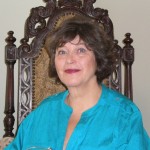
Elka Yarlowe is president and CEO of Access to Music Foundation. (photo by Olga Livshin)
Elka Yarlowe’s love affair with music started when she was very young. “I always listened to music or sang,” she remembered. “When I was four or five, I had my tonsils taken out in a hospital. My mom told me I was a very brave girl and asked me what I wanted as a reward. I said I wanted a piano.”
She got her piano, and her childhood in New York was steeped in notes and melodies. Her mother took her to see musical shows. Her relatives sang in a Yiddish theatre. She studied piano with a private teacher and participated in a school choir. “I was lucky. We had an exceptional musical program in my public school. In Grade 8, I knew I wanted to pursue music professionally,” she told the Independent.
She fulfilled her childhood dream and had a decades-long, successful career as an opera singer. Now, she wants to give an equal opportunity to local children, so they also can pursue a musical career if they choose. As president and chief executive officer of Access to Music Foundation, Yarlowe does what she can to make opportunities available to as many children as possible.
Since 2006, she has been a board member of the Music B.C. Industry Association. “In 2007, the Vancouver School Board made the first of many subsequent budget cuts to music programs,” she said. “In response, we started a charity and funded a music program in one Vancouver school. It wasn’t enough. More cuts followed in 2009. In 2010, I decided to leave the board and concentrate on the charity for music only. We called it Music B.C. Charitable Foundation. Last year, we changed the name to Access to Music.”
Currently, Access to Music funds programs in 20 provincial public schools and three aboriginal schools. “Our main goal is to fund instrument purchases for schools,” said Yarlowe. “Most instruments in the school system are over 20 years old, not fit for proper learning. If you start a hockey team at a school, you can’t have the children play hockey in 25-year-old skates. The same goes for musical instruments.”
According to Yarlowe, music education is a necessity: “Statistics show that children who play a musical instrument usually score 25 percent higher in any other discipline than children who don’t. Music is integral to our understanding of math and science. Any child in a school orchestra gets a fundamental sense of communication and cooperation, discipline and self-respect. Music develops both left and right sides of the brain. It is both science and art.”
Yarlowe lamented the fact that in this province, music programs often get cut first. “Last April, the school board wanted to cut all elementary school music programs. We fought that decision and won. The cut was postponed for one more year. We have a new battle ahead of us,” she said.
She explained that schools in the least economically advantaged areas of the province are affected most by these cuts. “Wealthier schools will continue to fund music through the parents’ efforts. That will create a disparity between poor and rich; deepen the divide. That’s why we fund the poor schools. We’re trying to level the playing field for all schoolchildren, to give all students equal access to musical education. Music is a catalyst for personal and social change. It’s part of organic education. Everyone needs it.”
Access to Music also offers mentorship programs, scholarships and intensive music clinics, and works with LGBTQ, at-risk and street-involved youth. “We offered our songwriting program to kids who face multiple barriers,” she said. “Some of them struggle with addiction. Others were victims of abuse or ran away from home. Many told me that music keeps them together, away from crime or suicide…. One gay boy wrote on his Facebook that participating in our song competition changed his life. Another street kid entered the Capilano jazz program, even though he still lives on the street. We try to provide barrier-free access to music for as many as we can. Today, about 8,000 children benefit from our programs. In the last several years, we purchased instruments for over $100,000. The need in this province is great.”
Many local organizations support the foundation with monetary donations or time, including Vancouver Symphony Orchestra. Next April, 100 music students from Surrey and Burnaby will have “a day of play” with the VSO. “All day long, the kids will have intensive sessions with the VSO musicians,” Yarlowe explained. “Then they will meet Maestro [Bramwell] Tovey. And, in the evening, they will have a treat – they will see a live show at the Orpheum. For many of them, it will be their first live classical music performance and the first visit to the Orpheum. When I was at school, our music teacher arranged for us to go to the Lincoln Centre once a year for a music show or an opera. We want to give such an opportunity to [more] local students. We want to be able to reproduce the event with the VSO every year, and maybe have similar events in Victoria, Okanagan [and] Prince George.”
Passionate about the foundation, Yarlowe insisted, “Music is not a frill or icing on a cake. It’s a necessity. Everyone who ever played an instrument or sang a song enjoyed it. Everyone has a personal connection to his music, no matter if it’s classical, rock or jazz. If you put an instrument into someone’s hands, chances are high those hands would never pick up a gun.”
The recent city initiative Keys to the Streets, which encountered an enthusiastic response in the majority of Vancouverites, disappointed her. “I went crazy when I learned about it. I know it’s good to give anyone a chance to play on the street, but to think of all these pianos [potentially] ruined in the rain. I’d put them in schools around the province instead. For the cost of just moving those pianos to and from locations, I could probably buy 20 clarinets for 20 school orchestras.”
One of her duties as foundation president is asking for money. “People spend lots of dollars so their kids could learn hockey. Why not to learn music? There is a much better chance that a child could make music his profession, make a living from it than from hockey. Much lower chance of injuries or concussions, too.”
Access to Music has become Yarlowe’s personal crusade, her tikkun olam. “There is a proverb: ‘You’re not required to finish the work but you’re not allowed to turn your back on it.’ That’s my guideline. I have three great passions in my life: my family, my faith and my music. I may not be able to fund all the schools for all the music programs they need, but it doesn’t give me, any of us, permission to stop the efforts. I feel like all my life was a build up for my work with the foundation.”
To learn more about the foundation, visit accesstomusic.ca.
Olga Livshin is a Vancouver freelance writer. She can be reached at olgagodim@gmail.com.
Exodus reinvents Moses saga
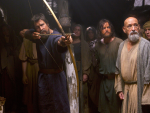
Moses (Christian Bale) and Nun (Ben Kingsley) star in Exodus. (photo from exodusgodsandkings.com/#)
Moses, as best I recall from Hebrew school and The Ten Commandments, was a reluctant prophet with a speech impediment who was ultimately persuaded by the unspeakable, unceasing suffering of his people – and God’s fearsome support – to confront Pharaoh and lead the Hebrews out of slavery.
My, how (biblical) times have changed. The much-anticipated Hollywood epic Exodus: Gods and Kings reinvents the saga of a people’s miraculous liberation as one rugged individualist’s journey of self-discovery, identity and profound purpose.
The fundamental matter of spirituality, which might be defined in this context as the courage and power of faith, comes up in conversation a few times but not in ways that impact the movie-goer’s experience. Your post-film repartee is more likely to centre on the curious and disconcerting form in which God (or is it an angel acting as his emissary?) appears.
Exodus: Gods and Kings, which opened everywhere Dec. 12, is a sun-blistered chunk of glowering, male-centric mythmaking. Aside from its oddly anti-climactic ending – recognizing that it’s a tough call how many desert miles and years to continue the tale after the Red Sea – this is a well-paced, continuously engaging piece of mainstream entertainment with the requisite amount of impressive visual effects (in 3D). Just don’t go expecting to be awed, or to have a religious encounter.
Title cards inform us at the outset that the year is 1300 BCE and the Hebrews have been slaves in Egypt for four centuries. However, “God has not forgotten them.”
Omitting the standard baby, basket and bullrushes, director Ridley Scott and screenwriter Steven Zailian (Schindler’s List) introduce Moses (Christian Bale) as a general and Ramses II (Joel Edgerton) as his best friend since childhood and heir to Pharaoh’s throne.
Exodus immediately launches into a full-scale, screen-filling battle scene – a preemptive attack that might be construed as a comment on the Iraq War – in which the seed of Ramses II’s paranoia and jealousy of Moses is planted. This section is designed to excite male viewers but also to inoculate them against the ensuing hours of banter, revelation, wilderness wandering and domesticity before the warrior hero returns to Egypt to blow things up real good. (You think I’m kidding, but Exodus boasts fiery explosions like any other self-respecting, would-be action movie.)
Even if he was raised as a prince of Egypt, the portrayal of Moses as self-confident and militarily adept takes some getting used to. It does explain, however, his disbelief when the gutsy Jewish elder Nun (Ben Kingsley) informs him that he was a lowly Hebrew infant smuggled upriver toward the Pharaoh’s palace.
The biblical story is quite familiar to us, of course, even if creative licence is employed via verbal flashbacks and narrative compression. Consequently, Exodus is most intriguing from a Jewish perspective for the ways it alternately evokes and evades the dominant events in the modern Jewish world – the Holocaust and Israel (its founding, existence and current relationship vis-a-vis the Palestinians).
The 20th-century genocide of Jews is alluded to in myriad ways, from the burning of the corpses of slaves to the Egyptians lined up to insult the Hebrews as they leave. (The Exodus is presented as complying with Ramses II’s order to get out, so it is a deportation.)
An earlier sequence, in which Ramses’ soldiers knock down doors and brutalize Hebrew families in an effort to find (and kill) Moses, inevitably, recalls the Nazis.
When The Ten Commandments opened in 1956, the Holocaust was so recent, and raw, that it didn’t need to be referenced. The horrific genocide did inform the movie, however, in that the general public needed no help rooting unequivocally for the Hebrews’ freedom.
Another key factor was the new state of Israel’s status as a universal symbol of hope and rebirth. That image no longer holds sway, and the filmmakers acknowledge the contemporary perception that the oppressed have become oppressors.
While Moses and Joshua strategize how to cross the Red Sea, and Ramses’ chariots thunder in pursuit, they take a moment to ponder the Hebrews’ eventual return to Canaan. Now numbering 400,000, Moses points out, “We would be seen as invaders.”
This is an unexpected acknowledgement of power, one that Arab audiences (in Jordan, Lebanon, Iraq, Kuwait, United Arab Emirates, Oman, Qatar and Egypt, where Exodus: Gods and Kings opens Dec. 25 or shortly thereafter) will welcome. Evangelical Christians in the United States, another large target market, will have the opposite response, presumably.
Jews, of course, will interpret and respond to the film from yet another perspective. The Torah does lend itself to various readings, after all. So does this robust movie, even if it is unlikely to inspire study groups.
Michael Fox is a writer and film critic living in San Francisco.
Precursors to menorah are many
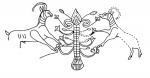
A menorah-like drawing from Kuntillet Ajrud. Source: “The Asherah, the Menorah and the Sacred Tree” by J. E. Taylor, Journal for the Study of the Old Testament (1995).
Though the religious symbolism of the menorah is consistent with Jewish mythology and ideology, the archeological record suggests that the significance of this symbol was influenced by surrounding religions of the region, which would have been preceded the conception of the menorah. For instance, lamps from the Middle Bronze Age composed of a bowl with seven sprouts for wicks on the rim have been found in Israel at Ta’anach and Nahariya. Such findings suggest that the precedent for a seven-branched oil lamp would have existed in the region.
Tree worship is common in religions throughout the world, and may have held particular significance in the Middle East due to their limited distribution. It’s not difficult to imagine, in a region constrained by water resources, the presence of a tree would indicate the presence of water and food, and would thus come to symbolize life. Furthermore, the generation-spanning longevity of trees, and their seasonal “rebirth” would perhaps lead some to associate trees with immortality. In fact, there is evidence to suggest that the Tree of Life, which Jews are familiar with from the story of the Garden of Eden, is based on a Mesopotamian religious myth.
Mesopotamian depictions of the Tree of Life resemble the menorah, leading many scholars to speculate that the design of the menorah was influenced by Mesopotamian iconography. The Mesopotamians believed that the Tree of Life grew on a cosmic mountain; similarly, the branching menorah arises from a clearly defined base. The image of a tree on a mountain is also featured in the Hebrew flood myth (which may borrow heavily from Sumerian mythology), in which Noah’s dove retrieved an olive branch from a tree on a sacred mountain. We grant special significance to the central lamp on the menorah, which we call the shamash. Interestingly, Shamash is also the name of the Mesopotamian sun god. These are more than mere coincidences; these are evidence of cultural influence.
Ancient Semitic peoples, who lived in what is now modern-day Israel, Syria and Iraq, had a pantheon that included a goddess called Asherah, or sometimes called Athirat or Elat. Asherah was a fertility goddess, and believed to be the mother of the gods. Asherah is described in cuneiform documents from the first Babylonian dynasty as the bride of the king of heaven, and a mistress of sexual vigor and rejoicing. An Ugaritic text found at Ras Shamra, Syria, describes Asherah as the bride of El, creator of the world. Asherah was often depicted as a tree, usually with an ibex on either side. For example, a pitcher dated to the 13th century BC found at the archeological site of Tel Lachish in Israel bears a stylized depiction of a tree reminiscent of the menorah, with an inscription dedicated to the goddess Asherah. At an archeological site in the Sinai called Kuntillet Ajrud, a drawing was found of a lion with a menorah-like tree with ibexes on either side of it, bearing the inscription “Yahweh of Samaria and his asherah.”
An asherah is something described in both the mishnah and Babylonian Talmud as a sacred tree. Some scholars speculate that an asherah was a living, pruned sacred tree used during Canaanite cultic practices. Recall that the original description of the menorah used the term almond. The biblical name for almond was luz, which is also the name of the site in the Tanach in last week’s parashah, where Jacob had a dream in which a ladder reached toward heaven (like the branches of a tree/menorah), and afterward he erected an altar and renamed the site “the House of God,” Beit El, now thought to be the site Bethel. Archeological excavations at Bethel reveal it was a Canaanite centre for worship of the goddess Asherah. Scholars speculate that there may have been a pruned almond tree used in cultic practices dedicated to the goddess, and the menorah is a symbol of that specific tree. The Latin name for almond trees, Amygdalus, is likely derived from a Semitic root word for “great mother”; Asherah was considered by the Canaanites to be the great mother of the gods. The blooming of almond trees precedes spring, and Asherah was a fertility goddess. Tu b’Shevat, which once involved the lighting of the menorah, celebrates the blooming of the almond trees.
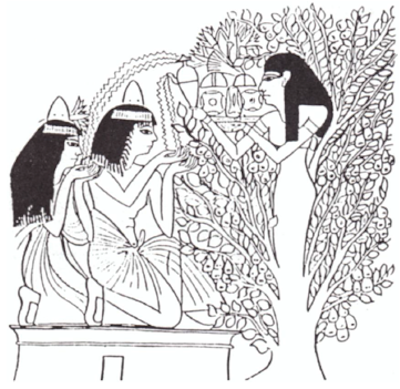
Sacred trees are important in Egyptian mythology, too. The Egyptians also believed in a Tree of Life, the acacia tree, which was also associated with the goddess Iusaset, the grandmother of the gods. Iusaset wore a solar disk on her crown, which harkens the shamash as the crown of the menorah. There was also an Egyptian goddess called Hathor, who was often interchangeably represented as a sycamore tree. Hathor was a mother goddess, the “living soul of trees,” and could take the form of a lion. In Egyptian art, the Hathor tree would often be depicted giving life and food to humans. When Egypt occupied Canaan, the cult of Hathor became entrenched in the region, and Hathor began to be correlated with the goddess Asherah. Another name used to describe a Canaanite/Egyptian tree mother goddess was Qetesh. Plaques recovered at archeological sites in Israel and Egypt depict Qetesh with ibexes by her side, above a lion, wearing a Hathor wig. Perhaps it is no coincidence, either, that the Hebrew word for holy is kadosh.
At some point in history, the ancient Jews took the deeply religious symbolism that was already present in the region and amalgamated it into the abstracted form of the menorah. Do these pre-Judaic influences somehow invalidate our culture? To the contrary, the archeological record only confirms that the symbolism and mythology of our culture are truly ancient. More importantly, the ancient Israelites did not live in a vacuum. They lived in a complex and cosmopolitan world, much like today. We were not alone, we coexisted with other diverse peoples and ideologies. And, after Sumer and Babylon fell into ruin, when the Sphinx and Ozymandias lay buried in the sand, and the library of Alexandria burned to the ground, we continued to tell our stories. When we light the candles of our chanukiyot this holiday, we continue a legacy that is thousands of years old. And that is cause to celebrate.
Ben Leyland is an Israeli-Canadian writer, and resident of Vancouver. This article is the second of a short series examining the menorah.
Call to genocide (yawn)
Sheik Omar Abu Sara gave a rousing call to genocide on Nov. 28, during a sermon at Al-Aqsa Mosque on the Temple Mount in Jerusalem. “I say to the Jews loud and clear: The time for your slaughter has come. The time to fight you has come. The time to kill you has come…. Please do not leave in our hearts a single grain of mercy towards you, oh Jews, because when the day of your slaughter arrives, we shall slaughter you without mercy.” His audience is heard responding with amens.
At the same spot a few days earlier, another speaker called for the elimination of “the Jews, the most vile of creatures.”
The Abu Sara video was translated and made available by MEMRI, the Middle East Media Research Institute, an organization that works to bring to light many of the worst things being said about Jews and Israel in the region – including, in this case, in the heart of Jerusalem. The people at MEMRI must wonder sometimes what the point is, though, for all the work they do in shining a torch into these moral recesses, most of the world responds with a yawn. Reactions to this sort of rhetoric among many Jews in Israel and the Diaspora, however, are founded on the knowledge of where this sort of talk can lead, a cultural and historical reality that is dismissed as just more of the persecution complex for which we are stereotyped.
Still, the fact that this sort of exhortation even makes the news is news of a sort. Warnings of an impending mass murder of Jews are so common on the internet, in certain sectors of Arab societies, among extremist Islamists and even among “mainstream” leaders of Palestinian society that it has become just a sort of white noise.
But there are plenty of people who are very capable of following through. This sort of rhetoric undoubtedly motivates people like those who have used vehicles, screwdrivers and knives to attack and kill civilians in Israel recently and, earlier this month, at the Chabad headquarters in New York.
Leaders of the anti-Israel movement might be expected to tsk-tsk these words, if only to preserve some political legitimacy for their BDS campaign. But they can’t even be depended on to do that. While some in that movement might draw the line at calling Jews “the most vile of creatures,” that is precisely the message they direct toward Israelis.
Those who strive for any sort of mainstream political relevance are careful to distinguish between Israelis and Jews. In most of the world, such niceties are quaintly unnecessary. While rose-tinted observers like to imagine the undeniable growth of antisemitism simply as a temporary, possibly unfortunate mutation of anti-Zionism, the reality in most of the world – where the language is most violent and the violence is most real – is exactly the opposite.
Ten years of chanting
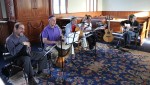
The Chanting and Chocolate band, from left: Charles Cohen, Lorne Mallin, Charles Kaplan, John Federico and Martin Gotfrit. (photo from Dave Kauffman)
On the last Sunday of every month, you can find a group of people gathered around a band of musicians, chanting Hebrew text to the rhythm of beautiful, rich melodies of the likes of Rabbi Shefa Gold and Rabbi Andrew Hahn (also known as the Kirtan Rabbi). It is a deceptively simple concept with surprisingly diverse results.
These harmonies of chant, through the repetition of just a few words, seem to have the power to carry you away from the daily hustle and bustle into a realm of music and spirit. This is Chanting and Chocolate, Lorne Mallin’s creation, which just celebrated its 10-year anniversary.
“In the summer of 2004, I began a two-year training called Kol Zimra (Voice of Praise) with Rabbi Shefa Gold of Jemez Springs, N.M.,” said Mallin about how Chanting and Chocolate came to be. “During our first gathering, Shefa encouraged us to create chant circles where we live and so, on Nov. 28th of that year, I began offering monthly evenings of sacred Hebrew chanting in Vancouver, initially called Evenings of Jewish Chant, which were then held at Sourcepoint shiatsu centre on Heather Street.”
This became a monthly tradition until Mallin moved to Uganda to live with the Abayudaya Jews in 2009. Not one to let geography, language or architectural challenges stand in his way, he was intent on sharing his passion for Jewish chant with the Abayudaya.
“At the mud-brick synagogue in the village of Nabugoye Hill, I led Shefa’s Nishmat Kol Chai, using the Luganda translation of ‘The breath of all life blesses you,’ ‘Okuusa kwebilamu kukutendereza.’ I tried to start a chant circle but, at the first announced session in the shul, I drummed and chanted alone until there was one arrival – a clucking hen skittered into the room.”
Fifteen months later, and back in Vancouver, Mallin and his band started the monthly evenings again.
“One regular participant brought tea and some baking to celebrate,” he recalled. “I noticed people enjoyed the opportunity to linger and get to know each other, so I began baking triple-chocolate brownies and rebranded the evenings Chanting and Chocolate. Two years ago, we moved to Or Shalom Synagogue at Fraser Street and East 10th Avenue.”
Beyond the good it does to its participants (naches to the soul and an uplifting of the spirit), Chanting and Chocolate is also a tikkun olam project on another level: the musicians perform for love, with the proceeds from admissions going to support the education of four Abayudaya orphans.
So, after a decade, what is it about Chanting and Chocolate that keeps Mallin going?
“For me, nothing creates a space for connecting with the Divine like chanting. The chants combine short sacred texts, beautiful melodies and deep spiritual intention. They often last 10 minutes, which strengthens the intention and clears the mind. After each chant, we give time for inner silence and connection, which is the most profound experience of the practice of chanting.”
Although Mallin has been the driving force behind this monthly undertaking, bringing it together and making it happen is very much a group effort.
“I am very grateful to my beloved teacher Shefa, the holy Kol Zimra community, Or Shalom, our band – Charles Cohen, John Federico, Martin Gotfrit and Charles Kaplan – and the lovely people who come to chant with us.”
While Mallin and the band have recorded little so far, they are planning to record their first CD in February, so stay tuned. In the meantime, to experience a unique kind of musical Yiddishkeit, attend the next Chanting and Chocolate, which will be held at its regular venue on Sunday, Dec. 28, at 7:30 p.m., with Rabbi Laura Duhan Kaplan as a special guest. Since no previous singing or chanting experience is needed, all you need to bring is some kavanah and yourself. And maybe a friend.
For more information, visit chantingandchocolate.com.

Gold Plate celebration
This year’s Gold Plate Dinner marks 40 years that Lubavitch B.C., led by Rabbi Yitzchak Wineberg, third from the right, has been in Vancouver. (photos from facebook.com/LubavitchBC)
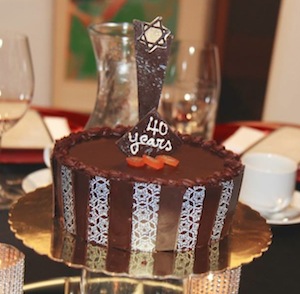 Chabad Lubavitch BC held its 39th Annual Gold Plate Dinner, paying tribute to the Rebbe, his vision and 40 years in British Columbia on Dec. 2, at Schara Tzedeck Synagogue. Guests enjoyed a reception, followed by a five-course meal, during which several speakers shared how Chabad Lubavitch has impacted their lives. Throughout the evening, several prizes were raffled, including hockey tickets, vacation packages, 40-year-old scotch and the grand prize of a 2014 BMW i3. The evening concluded with an entertaining performance by comedian Marc Schiff.
For more photos of the event, visit facebook.com/LubavitchBC; for a video, youtube.com/watch?v=gzWVr9iVY-g.

Inclusivity is a priority at Camp Shalom
Working side by side with the inclusion services department at the Jewish Community Centre of Greater Vancouver, the Camp Shalom team is looking at a modified version of its counselor-in-training program, as several of the campers have stated they would be interested in participating. Camp Shalom is determined to keep committed Jewish youth engaged, and help them develop and grow in the community.
Camp Shalom has been providing a unique and memorable experience for all campers that come through its doors, including those campers living with special needs. As Camp Shalom has grown in size over the last few years, so has its inclusion program, now serving approximately 10 families. The Camp Shalom inclusive program integrates campers with special needs into the general camp program alongside other campers each week. This would not be able to happen without the dedication of the staff members.
“I was fortunate enough to work with three girls over the summer. From sharing our stories to sharing laughs, they taught me a lot of things about life. They taught me to be patient and to live my life to the fullest. The bond we created is a bond that can never be broken,” said one staff member after her first summer with Camp Shalom.
Ensuring that all campers get to participate in activities fully and receive a robust camp experience is the goal of the inclusivity program. Before each camp session begins, the camp director team and specific counselors meet with families so that children with special needs have a chance to meet their counselors and familiarize themselves with the JCCGV prior to the first day at camp.
The program has an effect not just on the campers, but the counselors, as well.
“Working with Tal this summer was one of the most rewarding experiences of my life,” said Mischa Smolkin. “His positive energy and joy made every single day at camp special. Tal made a hugely positive impact on my life and has changed my perspective. Overall, working with him so closely created a bond that I have yet to experience in a summer camp setting and will treasure for years to come.”
The Camp Shalom inclusive program is possible thanks to the contributions of the Snider Foundation, Diamond Foundation, Lohn Foundation and Jewish Federation of Greater Vancouver.