
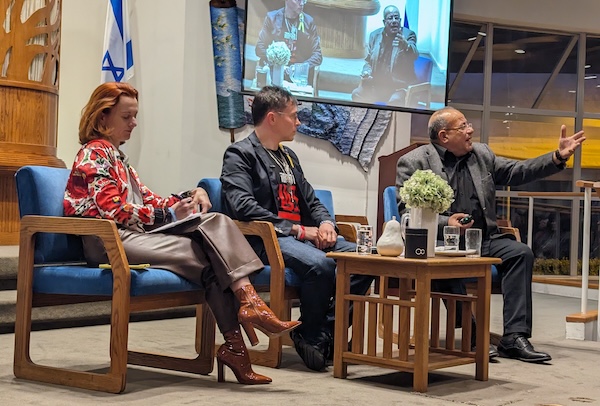
Bassem Eid, right, addresses those who gathered Feb. 4 for the event United, as fellow speakers Virág Gulyás, left, and Yuval David listen. (photo by Pat Johnson)
Yuval David knew 32 people who were murdered on Oct. 7. Among them were 10 friends who gathered to celebrate a birthday and headed to the Nova music festival.
“All 10 …” he said, struggling to maintain his composure. “Not one made it out of that celebration.”
David was speaking Sunday night at United, one of the largest community gatherings since the events of Oct. 7 and probably since before the pandemic. About 800 people gathered at Temple Sholom, where three diverse speakers brought their perspectives to an audience of Jews and non-Jewish allies.
The Feb. 4 afternoon event was the brainchild of Megan Laskin, a community leader who organized a similar event last November geared to women, who were asked to bring their non-Jewish friends; hundreds attended. Sunday’s gathering was presented by Jewish Federation of Greater Vancouver, Jewish National Fund of Canada, StandWithUs and Temple Sholom. David, an American actor, filmmaker and activist, who is gay, was joined by Palestinian advocate and media commentator Bassem Eid, and Virág Gulyás, a Hungarian-born former diplomat who grew up with what she described as typical antisemitic stereotypes and has become a leading voice for the Jewish people and Israel. The audience alternated from rapt silence to thunderous ovations.
Since Oct. 7, David has been thinking about his grandparents, Holocaust survivors who saved others in the camps. His grandfather was known as the “Magic Man” for somehow obtaining desperately necessary medications and helping others out of life-threatening scenarios.
“When I was a little child in Israel, I couldn’t walk more than a few steps with them in public without somebody rushing up not only to them but to me, to say, ‘Do you know who your grandfather is? Do you know who your grandmother is?’ And they would lean down to me and they would say, ‘If it wasn’t for what your grandparents did, I would not be here today,’” he said. “As a little child, holding their hand, walking in the street, I knew that I was walking with heroes. I knew that I was walking in the footsteps that I must walk someday.”
His grandparents instilled chutzpah in him, he said, for precisely this moment in history.
“I was raised to understand what it means to have chutzpah because I was raised to understand what it means to not have chutzpah,” he said. “I was raised to understand what ‘never again’ actually means.”
His worldview and his Zionism were reframed by Oct. 7, he said.
“But it was also reframed by Oct. 8,” he said, referring to global reaction to the events of the day before. Not only did he lose friends on Oct. 7 and others who have died in battle during the war, but another friend, who survived the Nova festival, recently committed suicide because she could not live with the memories. Closer to home, in a different way, he says he has lost most of his friends in the United States.
“I also lost two-thirds of my friends in my life in America who revealed themselves,” he said. “Revealed that they were not my true friends, revealed that even though they came to my Shabbat dinners and they came to my film screenings and they were plus-ones at fabulous events, especially if they were gift bags … crickets. Where are they?”
Some even sent him photographs of themselves protesting against Israel.
“These aren’t pro-Palestinian marches,” he said. “Whoever calls them pro-Palestinian marches is a liar. These are pro-Hamas, pro-terrorism, anti-Palestinian, anti-Jewish and anti-democratic events, he said.
“I used to be woke,” he said of his years as a progressive activist. “Now I’m awake.” He calls his former allies who condemn Israel and side with Hamas “fauxgressives.”
“If you are going to be ‘pro,’” he said, “then do something good for the people. If you are pro-Palestinian, help create businesses, help create schools, help refugees – do something that helps somebody’s life. But, if all of your fake ‘pro’ activity is to be ‘anti,’ is attacking, is subjugating, is belittling, then you are a racist bigot. Shame. We must name and shame.”
Gulyás is an academic and former European Union diplomat who devotes much of her time contesting anti-Israel and antisemitic narratives. She spoke of how she confronted the anti-Jewish biases she was raised with in Hungary. She noted that anti-Israel street eruptions began on Oct. 8, before Israel’s military had responded to the pogrom – worldwide, she said, activists were prepared.
“They had all the slogans, all the flyers, all the social media posts, all the hashtags ready,” she said. On the other hand, most Canadians and others in the West do not subscribe to the hatred and anti-Israel vehemence seen on the streets, yet remain silent.
Would large numbers of people have reacted as street activists and social media keyboard warriors have if any other sovereign country were invaded by terrorists with the intention to mass murder, she asked.
“Unless you’re a psychopath, you wouldn’t,” she said. “But, somehow, when it comes to Jews and Israel, we remain silent, we look at the other side and with this we normalize Jew-hatred.”
Eid is a rare Palestinian voice in international media against the defamation of Israel and the corruption and ideology of the Palestinian regimes. He shared a story of a friend who lives in the northern Gaza Strip, who told Eid that Hamas representatives knocked on his door at night. They told him they wanted to pay him $50 a month – a windfall – to build tunnels under his home. Eid asked him how he replied to the request.
“He said, ‘My answer was, “Please try to build four tunnels and give me $200 a month,’” Eid recounted. This is how Hamas exploits the poverty of its people to meet its objectives, he said.
The high Palestinian death toll, Eid told the audience, is due partly to Hamas officers forcing civilians back into the homes and neighbourhoods the Israel Defence Forces has warned them to evacuate.
At the expense of millions of dollars in foreign aid, Hamas has built hundreds of kilometres of terror tunnels, he said. “But, in the meantime, Hamas didn’t build one shelter for their own people.”
When you ask Hamas why they don’t protect their people, Eid said, they reply that keeping Palestinians safe is the responsibility of the United Nations and the Israelis.
Eid blamed the United Nations Relief and Works Agency for Palestine Refugees in the Near East (UNRWA), which has recently been under fire for its employees’ involvement in terrorism, for holding Palestinians hostage for more than 75 years.
“Peace is possible between the Israelis and the Palestinians,” said Eid. “But it is impossible while Hamas is still ruling the Gaza Strip. This is the first thing that we should have to get rid of. The day after the war, the first thing is how to trash UNRWA from Gaza.”
Temple Sholom’s Rabbi Dan Moskovitz opened the event. Laskin, who conceived the event, spoke of the grief of this time.
“As the war goes on and more innocent lives are lost on both sides, it is hard,” she said. “But let me be clear. We can strongly support Israel and the Jewish people and also express sympathy for the innocent Palestinians who are suffering. They are not mutually exclusive. We are mourning for all innocent lives lost. You can take a side though, and that side is against Hamas.”