אני כמו רבים אחרים נדבקתי בוירוס הקוביד ואחרי פחות מיומיים חזרתי אל עצמי. אינני יודע איך נדבקתי וממי אך בעצם זה לא משנה. באוקטובר אשתקד קיבלתי את החיסון השלישי של פייזר וידעתי שהוא לא מונע לחלוטין את האופציה להידבק בקוביד. אבל הוא יכול לעזור במניעת אשפוז או במניעת סיבוכים קשים
מכל מקום בשבת בערב עת חזרנו מאירועי פסיבטל הג’אז הבינלאומי של ונקובר הרגשתי עייף. לא הבנתי עדיין מה הבעייה. בראשון הייתה לי אפס אנרגיה ובילית את רוב הזמן במיטה, בניגוד לאופי האנרגטי שלי. הרגשתי גם שיש לי קצת חום. החלטתי לבצע בדיקת קוביד עצמית והיא יצאה שלילית. ביום שני הרגשתי כבר יותר טוב אף הפעם הבדיקה הייתה חיובית – כך שגם אני נדבקתי בוירוס הקוביד
ההרגשה הכללית היא שהקוביד משבש את כל מערכות הגוף. מתקיף בעיקר את כל המקומות הרגישים כמו הגרון ומערכת העיכול, ואת המקומות החלשים אצל כל חולה ובמקרה שלי הגב והרגליים
ביום שלישי הרגשתי כבר מצויין ורק התאבון שלי לא חזר למצבו הטבעי, כך שאני אכלתי פחות בימים האחרונים
אני שומע כמעט כל יום על חברים, מכרים או בני משפחה שנדבקים בקוביד וזה הפך כמעט להרגל בימים אלה
ישראל מתרחקת מקנדה: אל על תפסיק לטוס מתל אביב לטורונטו
חברת התעופה הישראלית אל על החליטה על ביטול שלושה קווים לערים מרכזיות בעולם החל מסוף חודש אוקטובר הקרוב: טורונטו, ורשה ולבריסל. זאת, במסגרת רה-ארגון בחברה והתאמת לוח הטיסות לביקושים שאחרי מגיפת הקוביד. בחברה הגיעו למסקנה שלטורונטו, וורשה ובריסל יש ביקושים נמוכים כך שאין כדאיות כלכלית בהפעלתם. ייתכן שבעתיד הקרוב תבטל חברת אל על קווים נוספים, או שתכריז על שינויים בתדירות של חלק מהקווים הפעילים כיום
ישראלים ויהודים רבים גרים בטורונטו והטיסה הישירה במטוסי בואינג שבע שמונה שבע, הייתה מאוד נוח העבורם. עתה עליהם להסתפק רק בטיסות של חברת התעופה הקנדית אייר קנדה
לפי נתוני רשות שדות התעופה של ישראל (רש”ת) בחודש מאי האחרון, טסו בקו בין תל אביב לטורונטו בטיסות הלוך ושוב עשרים ושלושה אלף נוסעים
באתר של אל על מופיע עדיין מידע בדבר הטיסות לטורונטו, למרות שכאמור החברה הישראלית לא תטוס לשם מנובמבר, במסגרת קמפיין השיווק, “ברוכים הבאים לטורונטו. למרות שאתם בקנדה, בטורונטו תרגישו לגמרי ‘אמריקה’, עם אפשרויות בילוי אינסופיות ואינספור אטרקציות מרתקות לגדולים ולקטנים שלא ישאירו לכם סיכוי לשעמום: פארקי שעשועים, גני חיות, מתחמי מדע ושלל מוזיאונים, קניונים ענקיים, מרכזי מסחר אינסופיים, שווקים ובוטיקים, בתי מלון ברמה הגבוהה ביותר, היצע קולינרי מגוון, המגדל הגבוה בעולם שאם תעלו לפסגתו תוכלו להעיף את החלומות שלכם הכי גבוה שרק אפשר וזוהי רק רשימה חלקית ביותר”
בקהילה היהודית הגדולה בטורונטו מוחים על צעדה זה של אל על. רבים חתמו כבר על פטיציה הקוראת לאל על לחזור בה מהחלטתה, ולא להפסיק את הטיסות הישירות בין תל אביב לטורונטו. שתי הסיבות העיקריות שעולות מן הפטיציה: הרגשה של ביטחון כאשר טסים עם אל על, זה נוח יותר שיש עוד חברה תעופה פעילה בקו תל אביב לטורונטו. גם במשרד התיירות בישראל מוחים על החלטת אל על, ומציינים כי דווקא מדי שנה יש גידול במספר הקנדים שמגיעים לביקור בישראל. לפני פרוץ מגפת הקוביד כמאה אלף קנדים ביקרו בישראל (בשנת אלפיים ותשעה עשרה)
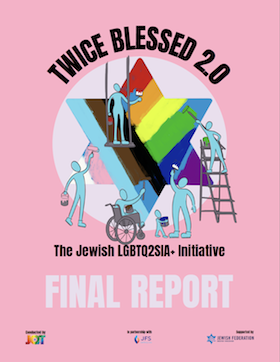
The recently released report, Twice Blessed 2.0: The Jewish LGBTQ2SIA+ Initiative, offers a hint of just how diverse the Metro Vancouver Jewish community is. In that diversity lies challenges and opportunities.
“Embarking on Twice Blessed 2.0: The Jewish LGBTQ2SIA+ Initiative has been an important step in acknowledging our gaps and our commitment to learn and work towards diversity and inclusion in the Jewish community,” write Carmel Tanaka, founder and executive director of JQT Vancouver, and Tanja Demajo, chief executive officer of Jewish Family Services Vancouver, in the final report’s preamble. “It is important to identify the work that has and has not been done. Taking pause and asking ourselves: Where are we today? What prevents us from engaging deeper into these conversations about diversity and inclusion? And where do we want to go?”
“The word diversity is used so often these days, but it is not easy to define what it means on a day-to-day basis in an environment such as JFS,” Demajo told the Independent. “This process started simply by acknowledging ‘we don’t know what we don’t know’ but we are willing to learn. Carmel and I started conversations about the LGBTQ2SIA+ community and how open JFS is to their members. Saying everyone is welcome is not enough, it takes much more commitment and work. There could have been other ways to engage in that conversation, but we started with the training and learning about the work done in 2004.”
“We are honoured to have collaborated with Dr. Jacqueline Walters, who did the 2004 survey that never saw the day of light,” said Tanaka. “It is so rare to be able to include those who have come before us in ways that help with continuity and give the opportunity for healing. A lot has changed since 2004, not just in the Jewish community on LGBTQ2SIA+ inclusion, but also more broadly, especially surrounding language and terminology. So, we paid homage to the 2004 questions and updated how these questions were asked in 2022.”
Developed from the 2004 community needs assessment conducted by JFS, many of the 2022 questions were the same, but others were added or reworded to reflect changing times or for clearer results. The survey was distributed over a two-month period this past spring, and 111 people responded, compared to 56 responses in 2004; there were three people who responded to both surveys.
The majority of respondents to the 2022 survey were in the 30-39 age bracket (or older) and ethnically self-identified as Jewish, in addition to being Canadian and of varying European identities. Of the 111 respondents, 31.8% identified as disabled (mental health, chronic pain, etc.) and 24.1% as neurodivergent (ADHD, autism, anxiety, PTSD). In 2022, half of respondents identified themselves as cultural Jews, with one-third practising other religions or ways of life; 50% were in multi-faith/racial/ethnic/cultural relationships.
These were just some of the findings indicating that there is broad diversity within the Jewish community. The findings, in part, were generated by the open-endedness of many of the questions.
“JQT approached the creation of the 2022 survey with great care and intention – a love letter to the Jewish queer and trans community,” said Tanaka. “It was and remains extremely important to JQT that the experience of filling out this survey was not triggering for those who are on the spectrum of Jewish and LGBTQ2SIA+ identities. All too often, these types of surveys, which ‘study’ our communities, don’t allow for self-identification (are not asking open-ended questions), instead forcing those being surveyed into checking boxes – boxes that either don’t fully encompass who we are and/or other us and/or are hurtful to us.”
When she saw the results, Demajo said, “I had this moment of realization that there is much social justice work that we need to do in order to reach out to those who need the support. One of the questions we ask ourselves often is ‘who are we missing and why?’ This survey and the answers we received made it clear that the community we are supposed to serve is very diverse and requires us to wrestle with questions of gender, race and religion. Some may argue that these are political questions but, for us, these are questions that impact our service delivery. If someone doesn’t feel welcomed in our space, no matter how dire their needs are, they will not accept the support.”
“The finding that most resonated with my personal experience is that, today, so many of us in the JQT community are mixed like me and/or are in mixed relationships like my family – mixed racially, culturally, ethnically, religiously, etc.,” said Tanaka, who self-describes as queer, neurodivergent and Jewpanese. “Growing up in Vancouver’s Jewish community as a mixed kid was pretty isolating. It’s great to see that the future of the Jewish community is mixed!
“The finding that surprised me the most was how many Jewish queer and trans people identify as white or Caucasian when asked about their ethnicity and race,” she added. “It wasn’t too long ago when Jews were not considered white, so it’s sobering to learn of this shift in identity.
“The finding that made me the most sad,” she said, “was how the JQT community, especially our seniors, feel about aging and entering long-term care. Honestly, it’s terrifying.”
Some of the comments made by seniors who responded to the survey were: “As a transgendered Jew long-term care is a frightening prospect as transgendered seniors are often abused in long-term care”; “Worry that my relationship will not be seen as real”; and “I fear that it will be primarily heterosexual and that I will have to go back into the closet.”
Among the 13 calls for actions made in the report are: “Develop inclusive care services for Jewish LGBTQ2SIA+ seniors” and “Ensure that senior care home intake adequately assesses the needs of LGBTQ2SIA+ residents.”
Jewish Federation of Greater Vancouver supported the survey, and one of the other recommendations is to allocate some of the annual campaign funds to the “operational costs of providing year-round Jewish LGBTQ2SIA+ programming for all ages and community outreach in both Jewish and LGBTQ2SIA+ communities.” More education is recommended, including diversity, equity, inclusion (DEI) training, and more “open discussion with rabbis, synagogues and boards to adopt an ‘open tent’ policy regarding intermarriage.” To see the full set of recommendations, visit jqtvancouver.ca/twice-blessed-2.
That all four of the 2004 recommendations still apply – more education of community leaders, a larger Jewish presence at LGBT activities, inclusion of LGBT Jewish community members on Jewish committees and boards, and increased LGBT presence at Jewish events – indicates the challenges of change, the report notes. However, Twice Blessed 2.0 also highlights some progress, including JQT’s recent partnering with the Vancouver Jewish Film Festival on a queer Jewish film, with the Zack Gallery on the first Jewish LGBTQ2SIA+ art exhibit and with the Jewish Museum and Archives of British Columbia on the first B.C. Jewish Queer and Trans Oral History.
As for JFS, Demajo said the agency’s priorities for the next year are “allocating funds for further training and awareness building” and to “partner on initiatives with LGBTQ2SIA+ agencies, ensure LGBTQ2SIA+ friendly Jewish mental health support, [and] adjust our policies to include DEI.”
She said, “JFS is in a unique position in the community to touch lives of a diverse community. At the same time, those we support don’t always reach out to us, we need to reach out to them. And, in order to do that, sensitivity, understanding of social justice and intersection of culture, gender, race and religion is essential for our ability to do the work in a sensitive and uplifting way.”
Another of the calls for action is for the adoption of a “Nothing about us without us” approach and Tanaka thanked Demajo and JFS for doing just that.
“Building trust between the JQT community and JFS, learning from one another, is the key to building a healthier Jewish community,” said Tanaka, noting that JQT is a volunteer-run group and “the only homegrown Jewish LGBTQ2SIA+ nonprofit in Canada in operation today,” funded solely by donations and grants.
JQT has presented the findings to the JFS board and in staff training, and would like the opportunity to present them to other local Jewish organizations. However, response to the report has been quiet, said Tanaka, who postulated that there is a “fear of airing dirty laundry.”
“The truth is that we’re not here to point fingers,” she said. “We’re here so that queer and trans Jews – and, in general, marginalized Jews on the periphery of the Jewish community, whether they be Jews of Colour, patrilineal Jews, disabled Jews, queer and/or trans Jews, etc. – can also benefit and have access to the same infrastructure as the mainstream Jewish community.”
Cynthia Ramsay is a member of the JQT Vancouver board.
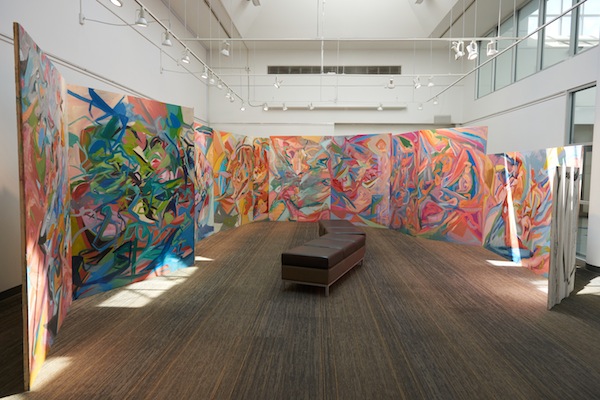
Marty Katzoff’s The Light Within the Shell was created specifically for the Zack Gallery. (photo by Lauren Zbarsky)
The Light Within the Shell exhibit opened at the Zack Gallery on July 4. There is a sign beside the door: “This space is meant to be explored. Wander, sit, experience, enjoy.” The show was created specifically for the gallery.
Created by artist Marty Katzoff, it doesn’t involve traditional paintings hanging on the walls. Instead, it looks like a huge folding screen comprised of a dozen panels. They encircle the room, leaving only a narrow passageway along the walls. Each panel has a colourful abstract painting on its inside surface and a black and white image on its outside. A few small copper sculptures scattered outside the enclosed space complete the installation. Viewers are invited to sit down and meditate on the benches inside the vibrant shell of the exhibit or wander along the outer passageway.
Born in Rhode Island, Katzoff grew up playing sports. “I didn’t do much art until my teenage years,” he told the Independent. “I was going through difficult times in high school. My friend was an artist. She introduced me to the arts. I started making collages and found it therapeutic.”
He never completed high school and worked a variety of jobs. “For the next 10 years, I worked in construction, in restaurants,” he recalled. “And, all that time, I made art. I taught myself to paint. Then I went back to school and completed my BA at Bard College in New York.”
For years, Katzoff worked as an artist in New York, created large murals in indoor and outdoor spaces. He graduated from the University of British Columbia’s master of fine arts program in 2021.
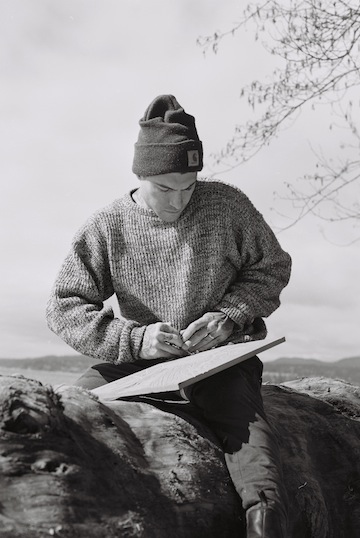
Artist Marty Katzoff at work. (photo by Lauren Zbarsky)
His artistic education vaguely coincided with his newly found fascination with kabbalah, specifically the Tanya, which he has been studying for the past few years. “Before, I had separate ideas about art and spirituality. Now, I’m exploring how Jewish learning is connected to my art, how mythology and tradition transform my spiritual life into my paintings,” he said.
As a child, Katzoff went to a Jewish day school, but kabbalah offered him a different perspective. “I started with a book by Gershom Sholem. Before, I always painted with music in the background. This project is the first I’ve ever done without listening to music. I listened to kabbalah lectures online while I painted. I wanted to discover what I could create while listening to something complex and different … [by the late] Rabbi Yehoshua B. Gordon.”
The idea for the current installation came to him when he was finishing his graduate program at UBC. “One of our family friends lives in Vancouver,” Katzoff explained. “She is Jewish and she told me about the Zack Gallery. I submitted the proposal, and it was accepted. I wanted to create an installation specifically for the gallery, an interactive space, a visualization of light. This show took me 11 months to complete.”
Katzoff sees this exhibit as an amalgam of dreams, painting, architecture, Jewish learning and personal symbolism. Vancouver artist Rosamunde Bordos’s essay about the show, which is available in the gallery, expresses her visual composition in words.
Katzoff’s media, the plywood panels, are all recycled materials. “I have a friend who works in art shipping,” he said. “They ship large pieces in plywood crates. That was where the panels came from. Some of them have holes, so customs could look inside the crates to see the art. I painted around the holes. It was like a collaboration with someone else.”
The size of the panels, some of them taller than a person, left him undaunted. “I always liked to work on a large scale,” he said. “That’s why I did murals in New York.”
His oil paints are also recycled. “I use lots of recycled materials in my art,” he said. “My grandmother was an artist. She gave me her entire collection of pigments for the oil paints I use. I’ll probably work with her paints for the next decade.”
In addition to painting, Katzoff also works as a printmaker. Currently, he teaches printmaking at UBC as a sessional instructor. “For me, printmaking provides the connection with literature, with storytelling and history,” he said. “My brain seems to process that connection better while I’m drawing and etching. My drawings are illustrations, while my painting remains more like a therapeutic activity.”
His abstract copper sculptures, several of which are included in the exhibit, grew organically out of his printmaking. “I make my sculptures reusing the copperplates from my prints,” he said. “I have lots of copper plates. Copper was an important part of Judaism and, after I use the plates for prints, I want to share the metal, recycle it. I make sculptures from it. I also make bracelets and amulets. You can see the remains of the etching if you look closely.”
To learn more, check out martinkatzoff.com. The Light Within the Shell is on display until Aug. 22.
Olga Livshin is a Vancouver freelance writer. She can be reached at olgagodim@gmail.com.
Team Canada’s 600-strong contingent marched into the opening ceremonies of the quadrennial Maccabiah Games July 14 at Jerusalem’s Teddy Coliseum. They were led by a trio of flagbearers – Toronto’s Molly Tissenbaum, a hockey goalie who has overcome serious health challenges to return to the ice, and Calgary twins Conaire and Nick Taub, volleyball players who are slated to enrol at the University of British Columbia in the fall. Canada sent the fourth largest team to the 21st “Jewish Olympics,” after Israel, the United States and Argentina.
The flag-bearing trio, their 600 teammates and about 10,000 others streamed into the stadium at the start of the largest-ever Maccabiah Games. Also on hand was an American visitor, President Joe Biden, who was the first U.S. leader to attend the event, flanked by Israel’s President Isaac Herzog and Prime Minister Yair Lapid.
The trio of leaders appeared jubilant, and no doubt there is a natural bond between Biden and Lapid that neither shares with either the former U.S. president Donald Trump or the once and possibly future Israeli prime minister Binyamin Netanyahu, who had a legendary bromance together.
While athletes began their friendly skirmishing for medals, the politicians began skirmishing themselves, around issues more existential than soccer scores.
Whatever personal affinity Biden and Lapid might share is at least partly restrained by reality. Lapid took over from Naftali Bennett as a sort of caretaker during the election campaign. Whether he remains leader after the votes are counted in November looks, at this point, less than likely.
Far more importantly, the two leaders disagree on the approach to Iran’s nuclear threat.
“Words will not stop them, Mr. President,” Lapid told Biden in their joint public remarks. “Diplomacy will not stop them. The only thing that will stop Iran is knowing that … if they continue to develop their nuclear program, the free world will use force. The only way to stop them is to put a credible military threat on the table.”
Biden has returned the United States to the Obama administration’s approach, aiming to revive the 2015 agreement between Iran and the West, which was supposed to slow that country’s march to nuclear capability. Trump withdrew the United States from the deal.
After Biden left Israel and headed to Saudi Arabia, words heated up dramatically Sunday. A top aide to the Iranian leader asserted that Iran already has the capability of creating a nuclear bomb but has chosen not to do so. In response, Aviv Kochavi, head of the Israel Defence Forces, responded with uninhibited forewarning.
“The IDF continues to prepare vigorously for an attack on Iran and must prepare for every development and every scenario,” Kochavi said, adding that, “preparing a military option against the Iranian nuclear program is a moral obligation and a national security order.” At the centre of the IDF’s preparations, he added, are “a variety of operational plans, the allocation of many resources, the acquisition of appropriate weapons, intelligence and training.”
Meanwhile, the inevitable moving pieces of Middle East politics continued shifting.
Biden walked a fine line, visually demonstrated by his choice to fist-bump rather than embrace the Saudi leader Mohammed bin Salman, who has on his hands the blood of dismembered journalist, author and Washington Post columnist Jamal Khashoggi, whose grisly murder at a Saudi consulate in Turkey shocked the world. Rumours of warming relations between Saudia Arabia and Israel – the rumours go from the opening of Saudi airspace to Israeli planes, to the full-on recognition of Israel – remain mostly that. Saudis reiterated the old orthodoxy that relations would never develop until there is a Palestinian state.
The United Arab Emirates, meanwhile, is openly mooting returning to diplomatic relations with Iran after six years. The UAE has sided with the Saudis against Iran in the ongoing proxy war in Yemen, but the Emiratis are making noises about “deescalating” tensions.
Back in Israel, meanwhile, divergent approaches to issues foreign and domestic are very much on the front burner. With the diplomatic niceties of welcoming the leader of Israel’s most important ally now in the past, parties are holding their primaries to select their leaders and lists for the Nov. 1 vote – the fifth since April 2019 – and forming new partnerships that reshape the landscape in advance of the nitty-gritty campaigning to come.
Much closer in time, the Maccabiah Games close Tuesday, with final results expected to be more definitive than the national election, which will almost inevitably end up with weeks of negotiations leading to a tenuous coalition government.
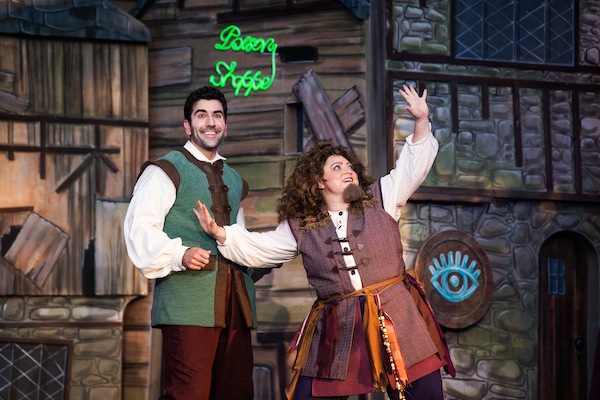
Much of the humour in Something Rotten! comes from Nostradamus (Jyla Robinson), right, leading Nick (Kamyar Pazandeh) astray with incorrect visions of the future. (photo by Emily Cooper)
Theatre Under the Stars is a fun, relaxing way to ease yourself back into theatre after the COVID hiatus. Its two productions, Something Rotten! and We Will Rock You, are happy fare that alternate nights through Aug. 27, outdoors at Stanley Park’s Malkin Bowl.
The Independent saw Something Rotten! on opening night, hoping to see Jewish community member Daniel Cardoso, who plays Jewish moneylender Shylock in the TUTS productions. However, it was understudy Simon Abraham who took on the role of the moneylender that night. He and the entire cast put on a great show.
In this comedy, set in 1595, Shakespeare is monopolizing the theatre industry and playwright siblings Nick and Nigel Bottom are trying to write a hit. They face several challenges, including being in debt to Shylock, who is willing to forgive that debt if they permit him to produce their new production. However, they initially refuse because he and they could be put to death, as Jews at the time were permitted few professions, one of which was moneylender.
Something Rotten! takes on – in very light manner – antisemitism, the treatment of the poor and the place of women in Shakespeare’s time. It also takes on these issues as they are depicted in Shakespeare’s plays and poetry.
“Shylock has been a very interesting character to explore and I extremely grateful to our director, Rachel Peake, for giving me the chance to do so,” Cardoso told the Independent in an interview before the show opened. “In researching for this part, I certainly took a cursory look at Merchant of Venice, but only so I could have an idea of who Shakespeare’s Shylock is. Because of how much Something Rotten! subverts the audience’s expectations of these well-known Shakespearean characters, there are only a few similarities between what I’m doing and what we see in Merchant of Venice. I don’t think that antisemitism is a central theme of this show, but we certainly get a view of it through Shylock.
“I also dove into what antisemitism looked like during the time of the Renaissance,” he continued, noting that Jews were “expelled from England in the late 13th century and only officially allowed to return in the mid-17th. However, it does appear that there were indeed Jewish people living in England during Shakespeare’s time and that some even fled to England from Spain and Portugal, due to the Inquisition.”
Cardoso sees parallels between Shakespeare’s time and today’s undocumented immigrants in both Canada and the United States and the refugee crises around the world. “In trying to find a way into the Shylock ofSomething Rotten!,” he said, “I found myself drawing on these modern-day examples, as well as trying to imagine what it must have been like for Jewish people in the time of the Renaissance or various other points in history. I found that, given my own connection to the community, this hit quite close to home for me. At the end of the day, he’s a smart guy who works hard and, despite the obstacles in front of him, he is able to be an equal and a friend to many of the characters in the show.”
Not such a smart guy is Nick Bottom (Kamyar Pazandeh) who, in trying to skip the hard work and best Shakespeare (Daniel Curalli), seeks out a soothsayer, Nostradamus (Jyla Robinson), who tells him that musicals are the popular theatre of the future. Nick sinks the last pennies he and his wife Bea (Katie-Rose Connors) have into a musical production with a reluctant Nigel (Vicente Sandoval), who has Shakespeare’s talent but lives in his brother’s shadow. It is only after Nigel meets Portia (Cassandra Consiglio), the daughter of Puritans, that he becomes to his own self true.
The homage to and satire of both musicals and Shakespeare makes for a lot of laughs and reference guessing – is that line or musical snippet from Annie, Evita, Rent, A Chorus Line, or more than a dozen other shows? Standout songs are “God, I Hate Shakespeare,” with the Bottom brothers’ differing views of their main competitor; “The Black Death,” a cheery ditty about the plague, the Bottoms’ first musical attempt; “Will Power,” Shakespeare enjoying his rockstar status, amid fawning, crying, screaming, fainting fans; and “Make an Omelette,” the title song of the Bottoms’ new musical. Foreseeing Omelette instead of Hamlet as Shakespeare’s best-ever play is only one of the soothsayer’s many slightly incorrect visions.
“It’s been a privilege to get to work on Something Rotten!” said Cardoso, who has been in four other TUTS productions. “It’s an extremely funny show and, if you’re a fan of either musical theatre or Shakespeare, then you’ll have a fun time at this show. And, if you like both, even better!”
For tickets to either of this season’s productions, visit tuts.ca.
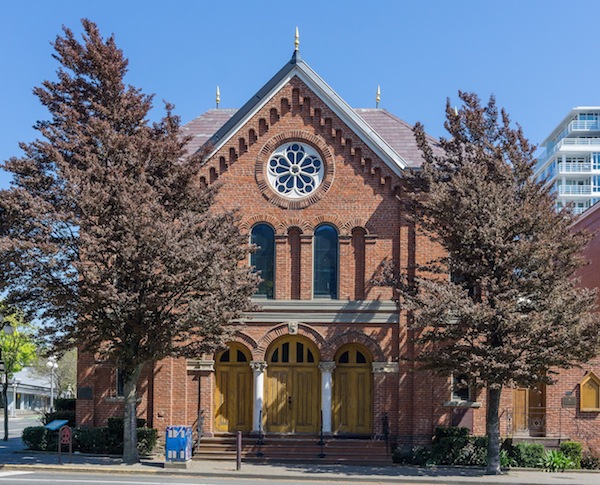
Congregation Emanu-El Synagogue (photo from Bema Productions)
Bema Productions, directed by Zelda Dean, is bringing the play Peace Talks to the Victoria Fringe Festival, Aug. 25-Sept. 4. Performances will take place at Congregation Emanu-El Synagogue’s Black Box Theatre, 1461 Blanshard St., pictured above.
Written and performed by Izzy Salant and Ryan Dunn, this run will be a world première of the work that saw a virtual staged reading in early 2021. Since that time, the playwrights continued to develop their play and raise the necessary funds to meet their goal of touring the show to university and college campuses in both Canada and the United States.
Peace Talks addresses the Israeli/Palestinian conflict. Noam watches helplessly as his best friend Andrew dies in an explosion right in front of him in a hookah bar in Israel. Noam believes he was responsible. After the catastrophe, Andrew’s bereaved American brother James sets out on a revenge plot against Israel and against Noam, as he also believes Noam is responsible for Andrew’s death. He puts his plan into action, actively sabotaging Israeli advocacy and promoting anti-Zionism to anyone who will listen, ultimately attempting to attain his true goal: to kill Noam.
James and Noam find themselves in a bitter internal and external struggle with Israel, Zionism, death, human rights, and Andrew’s memory. As they clash, they both discover some harsh realities of the Israeli/Palestinian conflict and that it is a world that isn’t as clear-cut as they thought.
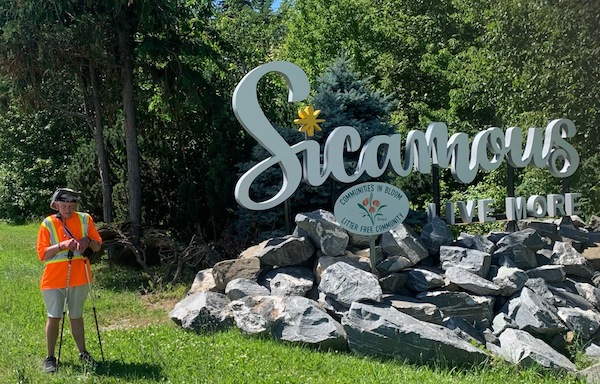
Day 17: Gary Averbach at Sicamous, a resort town about halfway between Calgary and Vancouver.
At press time, Gary Averbach had reached Kamloops, completing 23 days of his walk to raise money for cancer research, which started in Calgary on June 25. Averbach is doing the fundraising walk in memory of Robert (Bob) Golden, Ronnie Onkin, Darlene Spevakow and Angelita Tica.
In a June email, he wrote, “’Some years ago, as part of my ‘bucket list,’ I decided that, in my 80th year, I was going to walk from Calgary to Vancouver. But, early in 2021, my dear cousin, business partner and lifelong friend, Robert (Bob) Golden, was diagnosed with a rare and almost always fatal bone cancer, chondrosarcoma. On the eve of his passing, on Aug. 26,, 2021, Bob asked that I do my walk in his memory, to raise funds for cancer research, especially the insidious one that was killing him.
“Of course, I couldn’t refuse. And so I changed the focus from just being a personal bucket list item to cross off my list and instead started planning Bob’s Walk for Cancer Research.
“Then, sadly <\a> in the span of a little under seven weeks <\a> starting early in April, I lost two more cousins, Ronnie Onkin and Darlene Spevakow, and a treasured housekeeper, Angelita Tica, to lung, liver and pancreatic cancer, respectively.
“Because of those tragedies, I have since decided to do this walk in memory not just of Bob, but also in memory of Ronnie, Angelita and Darlene.”
At the end of Day 23, Averbach blogged, “So the challenge facing us today and the weeks ahead is not the ‘walk’ but making sure that we achieve our goal of $500,000, hopefully before I end the walk in August but most definitely by my 80th birthday on Oct. 10. My current projections – depending on the size of the outstanding gifts – has me as high as $425,000 to as low as $385,000.”
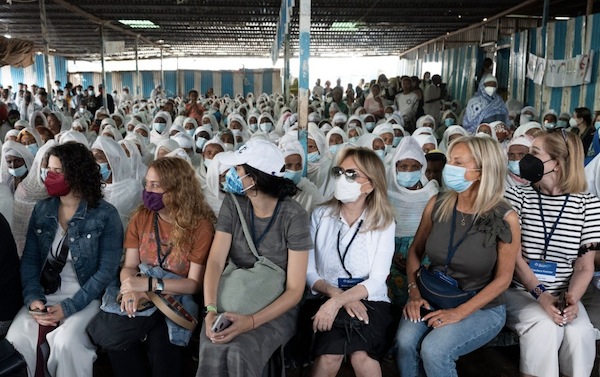
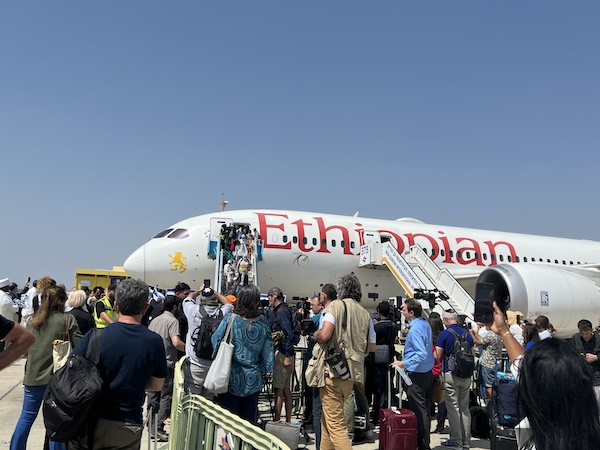
Candance Kwinter, far right, and other members of a foreign delegation to Ethiopia, take in a synagogue service in Gondar. (photo from Candace Kwinter)
The latest airlift from the Horn of Africa is underway – and a Vancouver community leader was on the plane from Addis Ababa recently with 179 Ethiopian Jews making aliyah.
Candace Kwinter flew to Ethiopia at the end of May, where she met up with three other Canadians, a group from North and South America and a team of Israelis. In addition to being chair of the Jewish Federation of Greater Vancouver, Kwinter is on the board of the Jewish Agency for Israel and sits on numerous JAFI committees.
Pnina Tamano-Shata, Israel’s minister of immigrant absorption, who was born in Ethiopia in 1981 and is the first Ethiopian-Israeli cabinet minister, was also on the trip. So was Micah Feldman, author of the book On Wings of Eagles: The Secret Operation of the Ethiopian Exodus, who was able to contextualize what first-timers were witnessing.
A trickle of Jewish refugees has traveled from eastern Africa to Israel (and pre-state Palestine) since the 1930s, at least. From the beginning of the Ethiopian civil war, in 1974, through the catastrophic famine on the Horn of Africa in the early 1980s, rescue missions ramped up. Operation Moses, in 1984/85, brought about 8,000 Ethiopian Jews to Israel, primarily from refugee camps in Sudan. Operation Solomon, in 1991, brought more than 14,000 Ethiopians.
The current airlift, called Operation Tzur Israel (Rock of Israel), is expected to bring more than 2,000 olim over six months. The Ethiopian Airlines flight that Kwinter was on was the first of several. When this mission is complete, there will be an estimated 10,000 Jews left in Ethiopia.
The Jewish identity of the olim is, in some cases, contested. The Ethiopians have included Beta Israel, people who follow Jewish traditions that would be recognizable to most observant Jews worldwide. They also include Falash Mura, members of Beta Israel communities who, since the advent of Christian missionizing in the area, have been converted, sometimes forcibly.
The first plane of Operation Tzur Israel to land in Israel was met with fanfare. It brought 179 Ethiopian Jews to their new home. (photo from Candace Kwinter)
The current project is entirely based on family reunification. Kwinter noted that, since the airlifts began 40 years ago, Ethiopian Jews have migrated primarily from the more rural Gondar area to cities, mostly the capital Addis Ababa. This migration has several corollaries, said Kwinter. Unlike the first olim of decades ago, these new Israelis are familiar with electricity and plumbing, although they may not have access to them at home. They may also have intermarried. So, while siblings who have been separated for decades are reunited, in some cases the nieces and nephews (and the Ethiopian spouses) may not be halachically Jewish. In these cases, they will undergo conversions.
Kwinter and the other foreign representatives flew to Gondar to see how Jews had lived for centuries and where some still reside.
“We went to an ancient synagogue, then we went to an ancient Jewish cemetery,” she said. “It’s very primitive, it’s nothing like we can imagine. It’s like they’re still living the way people did three, four or five hundred years ago.”
The villages, which have typically 100 or 200 Jews, were always located on rivers or streams, Kwinter said, “because they still believed in the mikvah. Women had menstrual tents, like from ancient days. In their time, they had to be put in their tents and they needed the freshwater to provide for these old rituals.”
The synagogue services were, at once, unlike anything Kwinter had seen before and yet entirely familiar. The dirt-floor synagogue was filled with several hundred men and women, sitting separately, the women all in white shawls, men wearing tallit and many laying tefillin.
Kwinter was saying Kaddish for her mother, who passed away just weeks before the trip, and she had no problem following the service.
Next door, a 10-foot-by-10-foot tin shack made up the Talmud Torah, with an open fire pit that served hundreds of meals to children and pregnant women in the community.
Although the transition facing these migrants will certainly not be easy, the latest newcomers have it smoother than some of the earlier ones, who fled during times of war and famine, many losing family members and being terrorized by thugs while walking across mountains to Sudanese refugee camps.
The delegation also met with Israel’s ambassador to Ethiopia, Aleligne Admasu, who was born in Ethiopia and made aliyah in 1983.
The operation will cost about $10 million US and is funded by Jewish federations and JAFI. Once the olim arrive in Israel, they will receive the services offered to immigrants, including Hebrew-language ulpan. Unlike native-born Israelis, most of whom do their military service before university, Ethiopian-Israelis generally complete their schooling first to ensure language proficiency, Kwinter said.
There were 179 Ethiopians on Kwinter’s flight – one was held back after testing positive for COVID. Few Ethiopians have received the COVID vaccine and most of the olim will receive them on arrival, along with the sort of routine vaccines that Israelis and Canadians receive in childhood.
Time flew on the five-hour flight, Kwinter said.
“We had lots of things for the kids to do, like sticker books, candies and all that kind of thing,” she said. “We got to know them all, even though we didn’t speak the same language.”
Ethiopian-born Jewish Agency officials were on board to translate, if necessary, but it wasn’t necessary, Kwinter said.
“You didn’t need to translate,” she said. “The kids were crawling all over us. It was the best plane ride ever. For five hours, it felt like five minutes. I wouldn’t have wanted to be a flight attendant because I don’t know how they got up and down the aisles because it was chaotic. It wasn’t like a regular plane ride.”
When the plane landed, there was a major ceremony marking the beginning of the new operation, with plenty of media coverage. Then the Ethiopians were transported to another part of the airport, where their family members were waiting to be reunited, some of them having not seen one another in decades.
“The very elderly would kiss the ground,” said Kwinter. “Everybody got an Israeli flag, and there was lots of singing and dancing and music.… It was really quite remarkable.”
While the Ethiopians were on a life-altering journey, Kwinter’s travels were hectic in a different way. She was on a plane every day for seven days and, a couple of days after returning home, she tested positive for COVID, as did many of the Americans.
Reflecting on the experience, Kwinter is filled with gratitude.
“Thank God for Israel that we can do this,” she said. “Thank God for world Jewry. Thank God for federations that collect money, and we can save all these lives. I come from a family of survivors and my husband as well. If we didn’t have Israel, we wouldn’t be able to do this and we’d be living another Holocaust again, I believe, all over the world.”
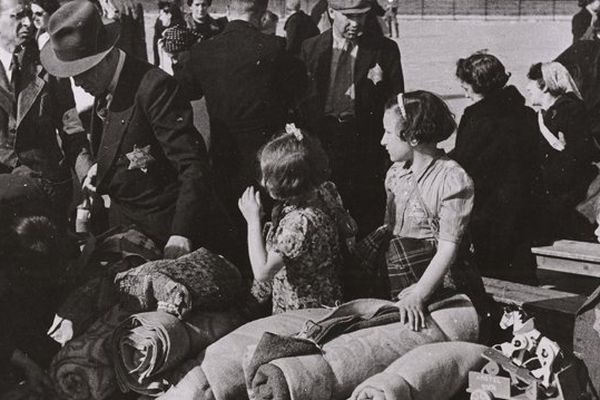
Entire Jewish families were rounded up and interned in the Vel d’Hiv and other places in France, when La Grande Rafle began on July 16, 1942. (unattributed image)
It is 80 years this summer since La Grande Rafle (the Great Roundup) took place in France. It is not only a significant, tragic anniversary for the Jewish people, but one that impacted me directly.
“Happy like God in France” was a saying sometimes heard among Yiddish-speaking Jews of Eastern Europe a century ago, even though antisemitism was fairly widespread in France and few years had passed since the Dreyfus Affair. Falsely accused of selling military secrets to Germany, Capt. Alfred Dreyfus was publicly humiliated and sentenced to Devil’s Island in French Guiana. However, in the end, justice prevailed: Dreyfus was proven innocent and restored to his rank. Jewish loyalty to France remained unshaken. In 1939, as in 1914, Jewish men, citizens and immigrants alike, volunteered to fight in the defence of France, but the country for which they spilled blood betrayed their trust.
The humiliating defeat of 1940 led to the division of the country into two main zones, a Germany-occupied zone in the north and a so-called “free zone” in the south. It also led to the collapse of democracy and a replacement of the republic with a fascist regime, called Etat Français, in Vichy, headed by Marshall Philippe Petain. That regime enacted the sweeping antisemitic Statute des Juifs, the most racist legislation in occupied Europe. Its application was entrusted to a special commissariat for Jewish affairs, of which the first incumbent was Xavier Vallat, who declared to the younger hauptsturmführer (captain) in the SS, Theodor Dannecker, in Paris, “ I am an older antisemite than you are: I could be your father in these matters.”
Vallat was soon replaced by the more vicious Louis Darquier de Pellepoix, a gutter journalist, who, as early as 1937, proposed in one of his screeds to “solve the Jewish problem in France” by wholesale extermination.
At the time, there were 300,000 Jews living in France, who represented less than one percent of the population. Their origins were diverse; Ashkenazim, Sephardim, immigrants from a variety of European and Mediterranean countries, religious and non-practising, etc. That population was composed of native and naturalized citizens. The Census of 1940 placed French Jews under the protection of the Vichy government, while at the same time expelling them from the professions, civil and military. Non-naturalized Jews were liable to internment at the discretion of regional police prefects. Instinctively respectful of the laws of France, even Jews who bore French surnames and spoke fluent French obeyed the order to register.
The regime created a Gulag-type network of internment camps that covered both major zones of the country. Beginning in 1941, Jewish men were summoned by groups, depending on their nationality, to present themselves at the police commissariat nearest to their places of residence (there were no ghettos in France). They were sent to hard labour in camps, of which the most notorious were Pithiviers and Beaune-la-Rolande, northeast of Orléans, and Drancy, a transit camp in a suburb of Paris, from where departed the deportation cattle car trains bound for Auschwitz. Naturalizations granted after 1927 were ordered rolled back.
Beginning on July 16, 1942, a dramatic change in the deportation policy was initiated: La Grande Rafle. Entire families were now targeted, regardless of age or sex. Beginning at 4 a.m., police squads bearing lists of the names and addresses of about 27,000 Jewish immigrants fanned across Paris in vans and requisitioned urban buses, knocking at countless apartment doors. About half of the targeted victims, warned by the Jewish communist underground, were able to escape arrest and find shelter among gentiles, mainly in rural areas. Arrested during that roundup were 3,118 men, 5,019 women and 4,115 children (3,000 of them born in France and, therefore, French citizens).
The Grande Rafle, codenamed by the police Vent Printanier (Spring Wind), was the greatest mass persecution in the city of Paris since 1572, when thousands of Protestants were murdered on the night of St. Bartholomew by Catholic mobs unleashed by Queen Catherine of Medici.
The 1942 military-style operation against the Jews in Paris was carried out from start to finish by French policemen, with no German participation, as they did not have sufficient resources. In fact, the Germans had ordered the French not to arrest children below the age of 16 for the time being, since, as stated, 3,000 of them were born in France. However, then-prime minister of France Pierre Laval averred that it would be “inhuman” to separate children from their parents. On his own initiative, he declared that he assumed the burden of “ridding France of its Jews.”
Laval ordered that entire families be rounded up and, pending deportation to the east, interned in the Winter Circus (Vel d’Hiv), Drancy, Pithiviers and Beaune-la-Rolande. Conditions of interment in the Vel d’Hiv were hellish: suffocating heat, the stench of public latrines, next to no medical attention, and scant distribution of food and drink. Many people went mad, some died. In the end, families were split all the same: adults were transported from Drancy to Auschwitz, while children initially sent to Pithiviers were next carried in the cattle car trains, along the same harrowing itinerary of death, with almost no adult supervision. Many of those children were brutalized by French policeman, who even robbed them of what their parents gave them.
One month after the Grande Rafle, similar atrocities were perpetrated in the free zone of the south, where there was no German occupation and the French government retained complete sovereignty over internal affairs, bearing no obligation other than supplying the Nazis with the products and produce that they demanded.
Caught when we illegally crossed the demarcation line, which divided France’s two major zones, my parents and I were among those “assigned to residence” in a requisitioned hotel of the small town of Lons-le-Saunier, near the Swiss border.
On the morning of Aug. 26, a rafle collected hundreds of Jews across the city, including my mother and me; happening to be on an errand, my father escaped. A pitiful column, we were marched across the city – hurried along by policeman who brutalized and insulted us, calling us “dirty Jews” – to the railway station, where a train awaited to transport us to the gruesome concentration camp of Rivesaltes, near the Spanish border.
The railway station became a scene of unrestrained police brutality, which spared neither adults nor children. I was seized by the hair and the seat of my pants by a brute who was about to throw me on the train, when I was saved by my maternal aunt, a French citizen, who, through personal contacts, obtained my release thanks to the timely intervention of a gendarmerie officer. I last saw my mother as she was being violently dragged along the floor of the station, then waved to me from a window, as the train departed for Rivesaltes. From there, with fellow victims of the rafle, she was transported several days later in a train that traveled north, this time to Drancy. And, there, she was squeezed into a cattle car train bound for Auschwitz. At least two-thirds of the women who left in that convoy either perished along the way, or were gassed following the selection on arrival.
Few of the Vichy regime organizers, policemen and other perpetrators of the summer 1942 and subsequent rafles paid for their crimes. Laval was tried and sentenced to death by firing squad in 1946; Petain was sentenced to life exile on a small island in the Atlantic Ocean; René Bousquet, chief of the national police, was briefly deprived of citizenship rights by General Charles de Gaulle and then resumed his functions, until he was mysteriously assassinated in his Paris apartment shortly before he was to be tried for crimes against humanity in 1980.
Obsessed by his wish for national reconciliation of the French, de Gaulle put a stop to any prosecution of persons who had collaborated with the Nazis. Throughout the postwar decades, the French deluded themselves with the myth that most of them supported or joined the resistance.
It was not until 1995 that then-president Jacques Chirac publicly declared that the opposite was the case – that “France had committed the irreparable,” that at least some financial compensation should be awarded to the survivors of the Holocaust, who had suffered or lost relatives to French collaboration with the Nazi action.
It should be noted, however, that nearly 75% of the Jewish population of France survived the Holocaust, thanks to the assistance offered by French citizens, both urban and rural, who sympathized with the Jewish people. Also, unlike Holland or Belgium, small, crowded countries, the French countryside offered vast areas of wilderness in which many Jews found shelter or joined the resistance.
René Goldmanis professor emeritus at the University of British Columbia.
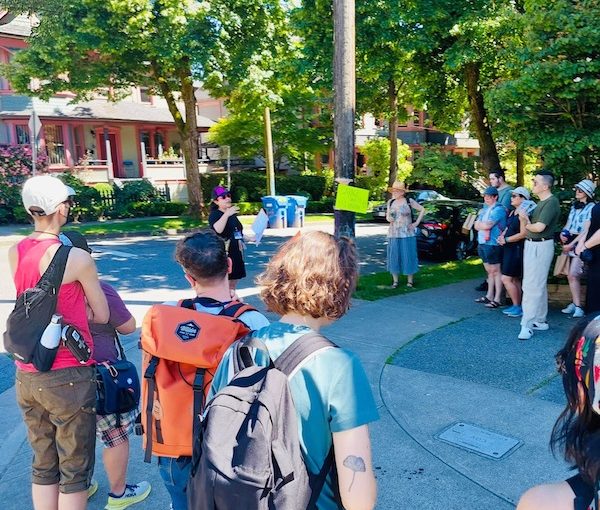
Carmel Tanaka in front of the house on Jackson Street from which National Council of Jewish Women once offered social services. (photo by Ari Fremder)
A series of Vancouver walking tours with a Jewish connection took a queer twist recently. Cross Cultural Walking Tours, which held its first tours in 2019, recently invited participants to explore the multicultural history of the city through an LGBTQ+ lens.
Two Sunday tours took place during June, international Pride Month. These included the exploration of aspects of the city’s ethnic heritages with an added layer of queer and trans history.
Carmel Tanaka is the founder and program coordinator of Cross Cultural Walking Tours (CCWT), as well as founder and executive director of JQT Vancouver, a volunteer-run Jewish queer and trans nonprofit. She is the prime mover behind the walking tours, though she has mobilized more than 40 individuals and organizations to make the series happen, including the Vancouver Heritage Foundation and the Canadian Race Relations Foundation.
“Sharing our history and stories together in one tour in Vancouver’s Downtown Eastside offers participants a tangible understanding of the importance of neighbourhood, of diversity, of our similarities and our differences, and how we live together,” Tanaka said. “The tours celebrate our cultures, but do not shy away from difficult social justice issues, and the impact of discriminatory laws at city, provincial and federal levels on our communities.”
For instance, she said, the tours address the ongoing genocide of Indigenous communities by noting the collaboration between government and churches in the residential school system, specifically the eradication of culture and language, which is one of the historical factors affecting the housing crisis in the DTES today and the opioid crisis.
At the beginning of the tour, Tanaka discussed how the Second World War brought more women into the workforce, including as cab drivers, shipbuilders and fireboat workers. A lesbian bar, called the Vanport, popped up at Main and Prior streets and lasted until 1979.
Nearby was Hogan’s Alley, Vancouver’s traditionally Black neighbourhood, which was destroyed to create the Georgia Viaduct in the 1970s. Many of the Black residents were farm labourers who came from Oklahoma via Alberta, while others were railroad porters whose jobs were tied to the nearby railway stations. The community was vibrant for six decades, producing world-class athletes, musicians, entertainers, restaurant and nightclub owners, entrepreneurs, community builders and political activists, Tanaka said.
The tour continued through the Strathcona neighbourhood, the traditional immigrant reception area for the city, and where Black, Jewish and almost every other cultural group at one point was centred. The legendary musician Jimmy Hendrix lived with his grandmother here. In the same area, the National Council of Jewish Women had a house, where they provided English literacy courses and the Well-Baby Clinic.
In the 1920s, Tanaka said, a Jewish gay man known as Uncle Max opened a shoe store on Main at Broadway before moving to South Granville. This was one of the only places in town for drag queens to purchase large-fitting shoes.
Harmony Bongat, a Filipino-Canadian, spoke of a building that housed a group of Filipino women in the early 2000s.
“It was a safe haven, a place where Filipino migrant workers (mostly working as nannies) could come if they were mistreated by their employers,” she said. “It was also a place where us Filipino queers could gather, share stories and enjoy each other’s company. Some of the people I met here would go on to create Pinoy Pride Vancouver.” Pinoy is slang for Filipino. She also discussed the history of LGBTQ+ organizing in the broader Asian-Canadian communities.
The tour included the Vancouver Japanese Language School and Japanese Hall, on Alexander Street.
“The school first opened in 1906 in a wooden building to the left of what is here now,” Tanaka explained. “Initially, the schoolchildren attended school fulltime here, in a Japanese immersion environment. After 1919, this school became an afterschool learning program for Japanese children after they came back from a day at Lord Strathcona elementary. In 1928, funds were raised from Japanese-Canadians from all over British Columbia to build the Japanese Hall, a place for the community and to celebrate Japanese culture.”
In the spring of 1942, the Canadian government forcibly relocated Japanese Canadians at least 100 miles from the coast by enacting the War Measures Act.
“This act uprooted, displaced and dispossessed approximately 22,000 Japanese-Canadians,” said Tanaka. “My great-grandmother and her two sons were interned in Minto, and my great-grandfather, grandmother and grandfather were interned at New Denver, in the Slocan Valley. They all lived in Port Essington, near Prince Rupert, across from Haida Gwaii. Before going to the camps, they were detained in the animal livestock building of Hastings Park, aka the PNE/Playland.”
The Japanese community was able to keep the Powell Street building because it was owned by the Japanese-Canadian community, rather than an individual. The building was leased during the war and the school reopened in 1952. It has been designated heritage status, said Tanaka. “Today, the school operates a childcare centre, continues with language courses, offers rental spaces, and holds Japanese-related programs and events.”
The tour moved on to the Aoki Rooms, which was a tenement house for Japanese workers and is now known as Ross House, a residence for trans and gender-diverse people.
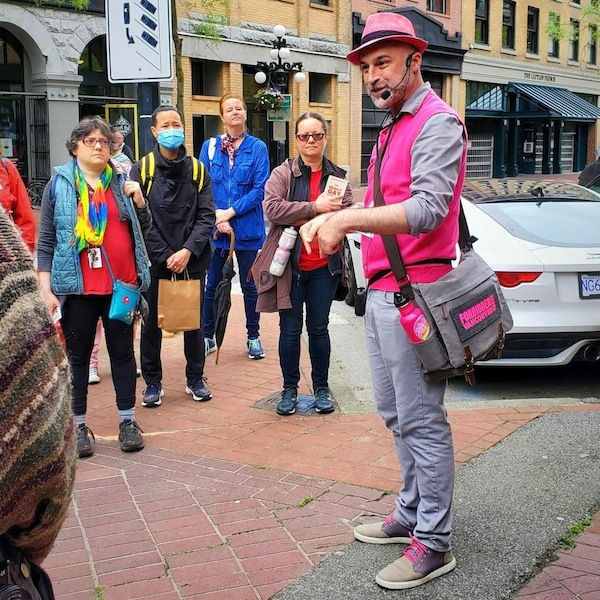
In Gastown, the tour touched upon the history of the Europe Hotel, with presenter Glenn Tkach of Forbidden Vancouver and creator of the Really Gay History Tour.
Glenn Tkach explains some of Gastown’s lesser-known history to tour participants. (photo by Ari Fremder)
Tkach explained how the neighbourhood was a magnet for men from all over who were seeking work. But, while Gastown was the hub for employment, the actual work was often far away.
“Men moved from job to job and trade to trade, as fishermen, lumberjacks, sailors, rail workers,” he said. “Thousands of men, living on the road, following the work. Without a lady in sight.”
Men often paired up, in part for safety and in part for companionship, he said.
“Outside the limits of the city, and outside the limits of normal Canadian society, a unique subculture evolved around these pairings,” said Tkach. “It was unlike anything we would recognize as queer culture today.”
The jobs lasted from spring through fall, then places like Gastown’s Europe Hotel would fill with men returning to the city with money to spend and leisure time. A bathhouse in the hotel’s basement was popular.
“City officials did not consider it a priority to police the private habits of these working-class men,” Tkach said. “There was a huge demand for their labour. So it was best for everyone, if their activities just went unnoticed. And, for the most part, they did.”
Nearby, on the Burrard Inlet waterfront, was where a shameful part of Canadian history took place.
Karn Singh Sahota and Viplav Bhaskar from Sher Vancouver, a nonprofit society for LGBTQ+ South Asians, shared the story of the Komagata Maru. In 1914, this ship, carrying 376 passengers from India, was denied disembarkation due to racist immigration policies. After holding the passengers effectively hostage in the inlet for two months, all but 24 were forced to return to India, where 22 of them were killed.
They also shared a story of a case in which two Indo-Canadian men were entrapped by Vancouver police and beaten for alleged “sodomy,” one of many such charges of the time, especially targeting racialized working men.
The tour continued past 63 East Hastings, site of the city’s first real gay bar, the Montreal Club, which ran from the 1950s to 1969.
There is a great deal of hidden history in the city, much of which was unearthed and shared for this tour. Tanaka noted the challenges in telling the stories of marginalized communities, including Black, Indigenous and People of Colour (BIPOC).
“It’s hard enough as it is to amplify the voices of marginalized BIPOC/minority communities, let alone queer and trans voices who also belong to marginalized BIPOC/minority communities,” she said. “Due to the compounded marginalization, it’s not like there are 2SLGBTQIA+ groups for every racial/ethnic/religious minority in town. That requires resources, capacity and support from their respective communities, which not everyone has.”
As a self-described “Jewpanese” person, Tanaka has a unique perspective.
“I often see antisemitism forgotten in the discussion on racism, as it’s not considered a BIPOC issue,” she said. “Not too long ago, Jews were not considered white and, as a Jew of Colour, I’m living proof that not all Jews are white. So, whether it be on the walking tours or on panels, I weave in my family’s lived experiences of antisemitism and anti-Asian racism to raise awareness.”
CCWT is looking for energetic voices from the Jewish community to cover the Jewish portion of their tours. To discuss that or for more information, Tanaka can be reached at crossculturalwalkingtours@gmail.com. The group is on Facebook and Instagram.