Challenges improve life

Israeli judo master Arik Zeevi will speak at FEDtalks Sept. 16. (photo from JFGV)

When we’re faced with a challenge, most of us are naturally cautious. But, says Israeli judo master Arik Zeevi, if you have a passion for something, go for it, explore it and, even if you fail, “you will always be proud that you took the challenge.”

Zeevi, who will be one of four keynote speakers at this year’s FEDtalks Sept. 16, advises in a 2014 TED Talk, “Go for the challenge because, I personally think that, by taking a challenge, that is the best way to grow, to improve your life.”

In that TED Talk, Zeevi shares the story of his experience at the 2001 World Judo Championship. Having trained intensely for two years and becoming a national hero in Israel – and with his journey to the championship being filmed by a team of videographers – Zeevi was “knocked out” (in judo terms, his opponent “threw [him] by ippon”) two minutes after setting foot in the ring.

Undaunted by losing the world championship match, Zeevi, a lightweight, registered to fight in the open match in which fighters of any weight could spar. Friends and colleagues warned him to back out, and the Israeli media fretted over what injuries he might sustain. But, Zeevi beat one opponent, a second, then a third; the fourth knocked him down. Though he failed to win the gold medal, he took the silver – and set a precedent. In the years that followed, having witnessed Zeevi’s success, more and more lightweights competed in the open category, and also won medals. The match morphed into its own championship event.

Zeevi won many judo medals in his time, and he is the 2000, 2003, 2004 and 2012 European champion. He is currently ranked eighth in the world, though he retired from fighting in 2012. Today, Zeevi is an inspirational speaker whose main income comes from talking to companies about what he calls “the similar worlds of sports and business.”

“It is all related,” he told the Jewish Independent, “excellence in sport and excellence in life.”

Zeevi also heads the nonprofit Israeli Foundation for Olympic Excellence (IFOE), which hires and funds Olympic coaches who identify, support and train Israeli children and youth they hope have Olympic potential.

“We scout kids who have talent, we try to nurture them and connect them to the sport that is right for them,” said Zeevi. “You could be Michael Phelps, but unless you’re living next to a swimming pool, you’ll never know.

“The biggest problem in Israeli sport,” he said, “is that all sports are coached by amateurs in private clubs. The coaches are getting income according to the numbers of kids, putting quantity over quality. Professional coaching is rare.”

Zeevi grew up in a tough neighbourhood in Bnei Brak and knows what it is like to have few opportunities.

“My coach was very young, and he was like an older brother to me,” said Zeevi. The coach played a role for Zeevi that he is now trying to play for others. “He pushed me to discover myself,” explained Zeevi. “Around 12, I became very serious. Before that, I was just trying to be part of something. At 12, I got my first invitation to train on the national team. My coach was a Soviet Georgian guy – they are fighters, warriors. By 13 or 14, I was already very big, and he pushed me to fight bigger guys. When 15, I won the championship against seniors over 21. He did a great thing for me, pushing me like that. When you find an athlete, you have to challenge them.”

It is the appreciation for what sports did for him that motivates Zeevi to make high-level training available to more young people. “I really believe in sports as education,” he said. “It is the best way to stimulate mental skills, and it teaches you how to deal with stress, failure, difficulty.”

Zeevi himself has three children. His daughter won the Israeli championship in gymnastics, and his middle son is into basketball and judo. Zeevi said his son has also taught him the lesson that sometimes pushing is not what brings success. “The more I push him forward, the more he goes backward,” he said, “so I have to take a gentler approach. The most important thing is just to be there for them. Then they will succeed.”

While in Canada, Zeevi will also be visiting a judo club in Toronto, which is run by an Israeli friend from his training days. There, he will be giving a master class for advanced fighters before he returns to Israel for Yom Kippur.

FEDtalks, which launches the Jewish Federation of Greater Vancouver’s annual campaign, is being held this year on Sept. 16, 7 p.m., at the Vancouver Playhouse. For tickets and more information, visit jewishvancouver.com.

Matthew Gindin is a freelance journalist, writer and lecturer. He is Pacific correspondent for the CJN, writes regularly for the Forward, Tricycle and the Wisdom Daily, and has been published in Sojourners, Religion Dispatches and elsewhere. He can be found on Medium and Twitter.


Opening Pandora’s box

Maxime Bernier quit the Conservative party last week, at the precise moment that Conservatives from across the country were gathering in Halifax for their national convention, preparing for the federal election that is 13 months away.

Canadian political history would suggest that the former cabinet minister’s departure and his promise to form a new federal political party will be little more than a footnote in the history books when all is written.

The ostensible point of division between Bernier, who came a very close second to Andrew Scheer in last year’s Conservative leadership contest, is supply management. Supply management is an agricultural policy that limits supply in an attempt to stabilize prices so that Canadian farmers can make a decent living. It’s the reason we pay what we do for cheese, milk and poultry and it is prefaced on the understanding that the few extra dollars we pay weekly keeps the agricultural sector viable.

Bernier, who lambasted his former party over the issue, is correct. Support for such meddling in the economy is antithetical to conservative economic values. But it is an oddly Canadian consensus by which parties across the spectrum essentially accede to the status quo for political, if not policy, reasons. Opponents of Bernier in last year’s leadership race expressed fears that his opposition to supply management would undermine the Conservatives precisely where they are most popular: in rural Canada.

If less interventionist economic policies become the basis for Bernier’s new political party, it is hard to imagine how it will catch fire among Canadian voters. From a political standpoint, such a platform seems like a loser from the gate.

But there is a potential wild card in this scenario. Though he skirted the subject during his news conference last week, Bernier’s recent social media statements play to xenophobic, anti-immigrant sentiments. This, far more than economics, has the potential to get the attention of Canadian voters.

The Liberal government under Prime Minister Justin Trudeau likes to be associated with openness and a welcoming diversity, which contrasts nicely with developments to the south. But a recent poll suggests Canadians may not be as settled on this approach as some of us would like to believe.

The poll asked whether Canadians believed that there are too few, too many or the right number of immigrants to Canada. Overall, 18% of Canadians said there are too few immigrants coming to Canada, while 38% said there were too many and another 38% said the numbers were about right. The poll’s breakdown by party label indicates just how divisive this discussion could become. Only 12% of self-declared Liberals said that Canada has too many immigrants, while 73% of Conservatives hold that position.

Canadians, to an extent, have avoided opening a Pandora’s box in the form of a national discussion about immigration, perhaps happy in our complacency and self-image as a welcoming place. If Bernier’s new party – or, indeed, if the Conservatives – see an opening, we may be about to lift the lid somewhat on this issue.

If Bernier decides that he has nothing to lose and something to gain from upsetting accepted wisdom, it won’t necessarily prove a winning formula for his new party. However, if, by raising these topics, he forces other parties to articulate more specifically the generalized approach to multiculturalism and diversity that we take for granted, we may be headed for a reckoning on immigration, diversity and openness.

The election of Doug Ford as premier of Ontario suggests that populist messages are not anathema to Canadian voters. The Quebec provincial election, now underway, may very well provide a test case for some of these ideas that challenge our cherished notions of diversity.

When voter turnout hovers around the 50% mark, mobilizing one’s political base can be as crucial as convincing the undecided. If suspicion of outsiders appears likely to excite an identifiable core of the electorate, ambitious politicians will certainly consider how they might benefit by exploiting it.

Confronted by a heckler in Quebec last week, the prime minister shut her down by dismissing her as racist. It turns out, she may well be. But she also may not be the voice in the wilderness that some, including the prime minister, would like to believe. These people, too, will demand to be represented in Parliament and in the national discussion.

The rest of us, then, will need to have more than happy axioms and comforting self-satisfaction if we are to successfully defend diversity, inclusiveness and the social and economic value of new Canadians.

The benefits from repetition

Repetition is good for us. (I may have said this before!) If you exercise, you’re in touch with “reps” or, if you walk your dog, you’ve been down this block with someone sniffing at the end of the leash before. If you’re rolling your eyes in boredom as you stand in a line, way too much of life seems to be about waiting patiently and repetition.

Jewish tradition has lots of “rinse and repeat” kinds of moments in it. If you read the Torah portion regularly, phrases like, “And Moses said,” pop out frequently. If you’re already preparing meals or family gatherings for upcoming holidays, you may reflect on how often you’ve done this before. It would be wrong to ignore the feeling of drudgery that sometimes accompanies all this. There are definitely times, as I try to figure out how to fit in all the prep, when I wonder if it’s so meaningful to do it again. And again.

Two recent experiences reminded me that we get something out of this repetition thing.

The first was one of those ubiquitous parenting articles that mention the value of self-care and meditation. Sometimes it’s easier to dismiss such suggestions. Yes, I’ve thought, but who will watch the kids, make dinner and earn the money while we’re doing all this trendy stuff?

However, I happened to hear a tidbit at services recently about Rosh Chodesh. Bill Weissman was leading a Sunday minyan at the start of the month of Elul. He reminded everyone about the association of women with the beginning of the month, mentioning that, aside from tending small babies, women were supposed to have a day off. In some Jewish communities, women don’t do certain kinds of work on the holiday, perhaps avoiding laundry or other tedious jobs. In fact, Jewish tradition teaches us that we need breaks. Scheduled activities, like a learning group, a meditation circle or even a standing coffee date, enable us to take better care of ourselves, whether it’s scheduled for Rosh Chodesh or every Tuesday.

The second experience that brought this all together occurred on the same weekend but the day before. One of my twins was feeling sick and was on antibiotics, so he stayed home with Daddy. I took the other twin on a Shabbat date. We went to family services together. Usually, while this kid dances and participates, he doesn’t read or engage with every prayer. My other twin sings along to everything, but makes up his own words. That’s fine. I figure they both enjoy themselves and get something out of being there. (For me, attending services is all part of that repetitive self-care thing, but it’s hard to get the most out of it with twins along for the ride.)

To my surprise, this Shabbat, a switch flipped in my kid’s 7-year-old brain. He sang and davened every prayer. He engaged completely. He wanted to be involved and responded to everything at the service – he even heard something interesting during the announcements. During the month of Elul, we blow the shofar during morning minyan.

Later, when I said how proud I was to hear him sing and say all the prayers, I asked what had happened. He explained that he likes to be quiet until he knows something perfectly. He decided he knew things well enough, so now he can say them all. It was as if buzzers were going off in my “educator” brain. Bing! This kid is an introvert. This is how introverts often process and learn new material. It’s about quiet introspection and repetition.

The next morning, I still had one sick twin and one healthy one. The healthy introvert announced that he wanted to attend that morning’s minyan. He cheerfully got through the hour-long service on Rosh Chodesh. He joked with many of the minyan regulars, participated, and he heard the shofar. It was a meaningful experience for him. I am still feeling celebratory about it many days later!

How did we get to this point? It wasn’t a one-time experience. I didn’t create a high-pressure event where I brought my children to one service, asked them to tell me if they enjoyed it and expected them to make a decision about their religious observance as a result. When we learn at school or while doing a sport, there are a lot of drills involved. It can be boring or reflective, but maybe it doesn’t matter.

We need to keep repeating things – Jewish content, CPR training, swimming lessons, whatever – until it sticks. You can’t give yourself a chance to make or eat a good holiday meal or have a meaningful religious experience if you haven’t practised. Recipes, prayers, exercise and meditation, among other things, don’t generally come out right the first time. Is it sometimes boring to do one’s exercise, cooking or other life tasks? Oh, you bet. However, nobody ever said that taking care of yourself, your household, relationships and work would be easy.

Some things aren’t fascinating. Even so, all that repetition can be good for us. Repetition teaches life skills. Learning the discipline needed to stick to something and practise it? That’s well worth taking time to learn. Repetition offers our bodies and minds a lot of healthy habits. Jewish communities and activities offer these skills. Just keep going. (It’s about showing up.)

Joanne Seiff writes regularly for CBC Manitoba and various Jewish publications. She is the author of three books, including From the Outside In: Jewish Post Columns 2015-2016, a collection of essays available for digital download or as a paperback from Amazon. See more about her at joanneseiff.blogspot.com.

Public hearing on JCC

On Sept. 5, Vancouver City Council will hold a public hearing to help determine the next steps of the planned redevelopment of the Jewish Community Centre of Greater Vancouver (JCC).

Serving more than 40,000 community members each year, the JCC has been bursting at the seams for years and needs a significant upgrade. “Our community centre, which is Jewish at heart and, therefore, open to and used by everyone, is aging,” said JCC executive director Eldad Goldfarb. “We’re a not-for-profit that’s been serving the Oakridge area and beyond for 60 years and we are determined to continue this tradition.”

The new facility, planned to be built over two phases, will feature expanded aquatic, gymnasium, fitness and studio space, new cultural arts facilities, a theatre, the Vancouver Holocaust Education Centre, office space for more than 15 other nonprofit community organizations, expanded licensed early childhood education facilities and significantly enhanced outdoor spaces.

“We just don’t have enough room for all of our activities, so I would love to see the JCC expand and continue to be inclusive for everyone,” said JCC Seniors committee member Cori Friedman.

The City of Vancouver anticipates the population of the Cambie Corridor will double by 2041.

“With all the growth and changes occurring to the community around our centre, it is important for the JCC to grow and change as well – to be prepared for the future and all that it is bringing to our surroundings,” said JCC board president Salomon Casseres.

When the project is complete, the JCC site will also include 299 family-oriented rental homes. “We are going to put the land into a community land trust, so we can create long-term affordable housing and community amenities,” Goldfarb explained.

The proposal has undergone an extensive rezoning process, including a number of different designs, three community open houses and outreach to partner organizations within the Jewish community. For more information on the project, contact Susan Tonn (susan@jccgv.bc.ca). For details on how to share your thoughts directly with city council, visit rezoning.vancouver.ca/applications/950w41stave/feedback.htm.

Coping with a legacy of loss

Claire Sicherman began writing Imprint: A Memoir of Trauma in the Third Generation after her grandmother passed away. (photo from VHEC)

Claire Sicherman’s grandmother didn’t share much about her experiences in the Holocaust. There were three stories – one about bread in Auschwitz, another about her tattoo, a third about washing – none of them overly traumatizing. It was in the silences, though, in what her grandmother did not share, that Sicherman sensed the deep trauma permeating her family.

“When I grew up, there was a constant heaviness that I couldn’t name,” Sicherman told the Independent. “I grew up knowing about the Holocaust but not really knowing too much about my family’s personal struggle with it, the stories.”

Her understanding of the Shoah came more from reading Anne Frank and watching Schindler’s List than hearing firsthand accounts from her grandmother.

These unspoken traumas, conveyed across generations, are what Sicherman will speak about at the High Holidays Cemetery Service, an annual commemoration presented by the Vancouver Holocaust Education Centre, Schara Tzedeck Congregation and Jewish War Veterans. The event takes place this year on Sept. 16, 11 a.m., at Schara Tzedeck Cemetery, in New Westminster. Her presentation is titled Honour and Remember: Breaking the Silence in the Third Generation.

Sicherman explored the topic in her book Imprint: A Memoir of Trauma in the Third Generation, which she began writing after her grandmother passed away. (See jewishindependent.ca/long-enduring-trauma.)

“After my grandmother died, it was safer to start uncovering the silences,” she said. “I think it’s much safer for the third generation to explore the stories of their families. For the second generation, especially for my mom, for example, there was this not wanting to hurt her parents.

“I experienced a bit of that when my grandmother was alive in that we just knew automatically not to ask certain questions, not to go there. For some of the second generation, the silence was a normal part of life. For others, the opposite is true. It was constantly talked about to the point that it became unhealthy that way. But, for my family, the silence was the norm. I think, in third generations, now you’re seeing more people wanting to talk about it, wanting to get back and explore the roots and figure out what they are carrying.”

Sicherman cites the relatively new science of epigenetics to suggest the weight of family history. As a response to that possibly inescapable legacy, Sicherman practises forms of yoga that release stresses in the body, journaling as a form of therapy and an Ayurvedic diet, which incorporates healthy foods and mindful eating rituals, all of which can potentially ameliorate the effects of inherited trauma.

Sicherman’s grandparents, who were from Prague, were the sole survivors in their respective families. They escaped communist Czechoslovakia in 1968 and settled in the Vancouver area. When Sicherman was 4 years old, her grandfather passed away. The cause of death, she was told, was a heart attack. In her 30s, Sicherman learned that her grandfather had committed suicide. This was another of the family’s secrets.

Despite the hidden past, Sicherman thought her family was entirely ordinary.

“For me, growing up, it was really normal,” she said. “I didn’t know that what my family went through, what I was carrying, what everyone was carrying and not talking about, was not quite normal. For me, I thought I came from a Leave it to Beaver kind of family.”

Sicherman’s dawning realizations of her family’s story and the weight of that history represent a sort of metamorphosis, she said. The cover of her book features a caterpillar, a cocoon and a butterfly.

“This sort of represents being third generation,” she said. “The symbolism around the butterfly is one of transformation and I feel, in writing this book, I was able to carry the story of my ancestors in a different way, and that’s where the transformation comes from.”

Reaching for new audiences

Michael Schwartz speaks at the launch of East End Stories on June 24. (photo from JMABC)

When Louis and Emma Gold arrived in Granville, precursor to Vancouver, the merchant family from Kentucky became the first members of what would grow into the booming Jewish community in the Lower Mainland.

Like most of the first Jewish immigrants to British Columbia, the Golds moved to the eastern end of downtown, where they opened a general store. Two waves of European Jews would come to Vancouver in the late 19th century and the Strathcona neighbourhood would become their home. It was an era during which new Jewish arrivals to North America largely found employment as merchants or doing various trades and Vancouver’s East End provided affordable and accessible housing for the working class.

“So many immigrant communities passed through there,” said Michael Schwartz, director of community engagement for the Jewish Museum and Archives of British Columbia.

The Jewish history of Strathcona is no secret, and the museum has offered walking tours of the neighbourhood for decades, beginning with a self-guided one in 1986, which grew into the current monthly guided tour. But, while those familiar with Jewish Vancouver may already know about the community’s past, Schwartz is hoping that a new school curriculum and video series created by the JMABC will make that history significantly more accessible.

East End Stories, completed in June, includes six short online videos and a 43-page study guide intended for use with students in grades 7 through 9. In addition to making some of the information offered on the walking tour available to those who can’t attend in person, Schwartz said the project also unveiled new information about early Vancouver Jews.

“It gave us the opportunity to do more research, to dig deeper, to find stuff we hadn’t before,” he told the Independent.

The result is the six videos, covering the first arrivals, the early community institutions and history of philanthropy, as well as Vancouver’s second mayor – David Oppenheimer – entrepreneur and philanthropist Jack Diamond, and the Grossman family. (Among other things, Max Grossman started this community newspaper.) Each running just under five minutes and offering encyclopedia-style capsule histories, the videos feature narrators from the local community. Schwartz said the photographs used were drawn from 17 archives across the world, including ones in California, Jerusalem and Poland.

The study guide covers the material in each video but is structured slightly more broadly, wrapping the Oppenheimer and Diamond biographies into a single lesson focused on how Jews shaped Vancouver, for example.

Schwartz said the impetus for creating the educational resources came after a vice-principal in the city asked whether there was a way to bring the information from the walking tour to classrooms at his school, as the logistics of bringing dozens of students to the neighbourhood itself was too complex. The museum offered the school replicas of wall panels that appear along the tour, but the study guide goes further, and meets current provincial guidelines for social studies curricula. Schwartz said museum staff will attend the B.C. Teachers Federation Conference in October to publicize the project, which was made possible by a $50,000 grant from the Canada 150 grant program.

“That provided the anchor funding and we were able to build the rest of the budget with smaller grants,” Schwartz explained. “It had always been a wish list thing and, when this funding opportunity arose, I thought, ‘Let’s give it a shot.’”

The lesson plans are intended to be used in conjunction with other Vancouver ethnic histories and video series created by Orbit Films, the company that produced East End Stories. The other histories are Black Strathcona, Nikkei Stories, which focuses on Japanese Canadians in Vancouver and Steveston, and South Asian Stories.

“All these different communities … faced struggle, rose to the occasion and relied on each other to be able to do that,” said Schwartz.

Highlighting the Jewish community’s roots in Vancouver and the similarities that the community shares with other immigrant groups is one of the goals of East End Stories, Schwartz said, adding that it could help combat certain stereotypes about Canadian Jews.

“Jews are assumed to have always been successful and that’s just not true,” he said. As can be seen in East End Stories, “many of us are stable or in some cases successful today [but] that’s new history.”

The videos and study guide also highlight a period of Jewish history in the Lower Mainland that was different for the way in which Jews were geographically concentrated in a certain quarter of the city, a phenomenon that remained true even after Jews largely left Strathcona but which has changed in recent decades.

Schwartz said that, during the 1950s, the community left Strathcona and clustered around Oakridge and Kerrisdale. The Baby Boomer generation dispersed but would return to the community to visit parents and attend community functions. But, while community institutions like the Jewish Community Centre of Greater Vancouver remain along the Oak Street corridor, fewer Vancouver Jews are calling the area home.

“We’re in a moment of transition,” Schwartz said. “We’re seeing a decline in gathering places and institutions where people come together.”

While online resources like the East End Stories videos, which are available on the Jewish Museum’s website, jewishmuseum.ca, can help bring people together figuratively and in shared knowledge and history, Schwartz said that in-person activities like those enabled by the walking tours and the classroom guide remain essential.

“There’s Jewish history in all corners of the city and it’s important for us to be present in not particularly Jewish areas to share the history of our community and spark dialogue about diverse histories of the city,” Schwartz said.

Arno Rosenfeld is a freelance journalist based in Vancouver. He has covered Canadian Jewish issues for JTA and the Times of Israel.

Best Pride presence to date

B.C. Lt.-Gov. Janet Austin addresses the July 27 Shabbat Dinner with Pride Colours event. (photo by Matt Hanns Schroeter)

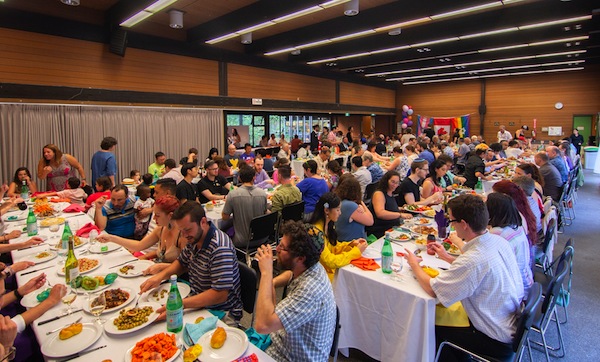
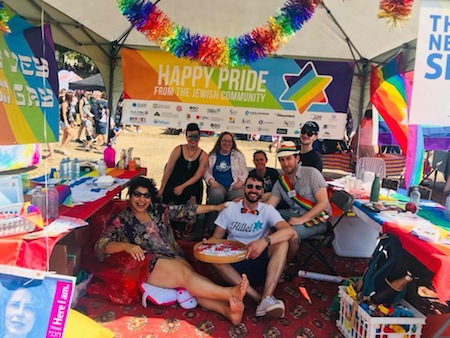
On July 27, the Metro Vancouver Jewish community celebrated Jewish Pride with guests ranging from B.C. Lt.-Gov. Janet Austin, to government officials and representatives of faith-based and nonprofit organizations, as well as Jewish community leaders, LGBTQ+ Jews and friends in a sold-out, community-wide, family-friendly, gender-inclusive Shabbat dinner at VanDusen Botanical Garden. The festivities continued on Aug. 5, when the Jewish community hosted its annual booth on Sunset Beach during the Pride Parade and Festival.

These events were organized by the Jewish Pride planning committee and made possible by the support of a record 31 Jewish participating organizations, led by the Centre for Israel and Jewish Affairs, Pacific Region, and the work of numerous volunteers and community members. Funds raised at the Shabbat dinner will go towards supporting future Jewish LGBTQ+ events over the coming year.

photo - The July 27 Shabbat Dinner with Pride Colours was a sold-out event
The July 27 Shabbat Dinner with Pride Colours was a sold-out event. (photo by Matt Hanns Schroeter)

While B.C. Premier John Horgan could not attend the July 27 Shabbat Dinner with Pride Colours, he sent his “warmest greetings,” noting, “For some, tonight may be their first introduction to observing Shabbat, and it is through sharing our lives and traditions with others that understanding and acceptance grows. Events like this are essential in ensuring that B.C. is a vibrant, diverse and welcoming place to live.”

Selina Robinson, minister of municipal affairs and housing, commented in a post on Facebook, “While I was proud to be there to bring greetings on behalf of our government … I was most proud to be there as a member of the Jewish community. I am grateful to see just how much has changed over the past number of years to create and facilitate space in our community … space for everyone regardless of gender identity or gender expression.”

“This was a really powerful moment for me last week,” said attendee Aaron Robinson, also on Facebook. “My mom spoke about being the Jewish parent of a gay Jewish man and how wonderful it was to see that there was space being made in the Jewish community for queer Jews. She spoke of the struggle and fear about making sure that your children have the space to be who they are in all of the ways they identify, and this Friday gave both of us so much hope. I’m so very grateful to the people that put on this Shabbat Pride dinner and all the organizations that were represented there for taking a huge step forward in creating a space for Jewish LGBTQ+ folks.”

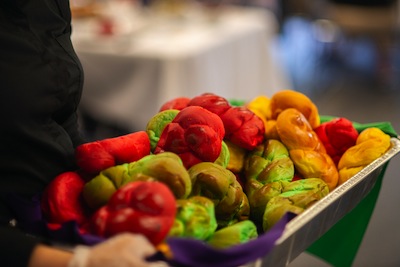
photo - Twenty-five rainbow round challahs by Chef Menajem will be for sale ($10) at the JCC on Sept. 6 until supplies last
Twenty-five rainbow round challahs by Chef Menajem will be for sale ($10) at the JCC on Sept. 6, 10 a.m.-2 p.m., until supplies last. Monies raised will go to LGBTQ+ programming. (photo by Matt Hanns Schroeter)

Attendee Jill Beamish especially enjoyed talking with other women there “about parenting, queering and Judaism.”

“I loved the gathering, and send heartfelt thanks to the organizers,” said Beamish. “In 30 years of being out – and only four of being Jewish – I never thought I’d feel this welcomed and celebrated.”

Dr. Aaron Devor was another invitee who could not attend the Shabbat dinner, but who sent his remarks to be read at the event. Devor is, among other things, founder and inaugural chair in transgender studies at the University of Victoria, as well as a past president of the Jewish Federation of Victoria and Vancouver Island and a former board member of Hillel BC.

“I’d like to express my sincere appreciation to all who participated in making this fine event happen,” said Devor in his speech, “and especially to [CIJA’s] Carmel Tanaka, who I know from her years of dedicated service to the Jewish communities of Vancouver and Vancouver Island. Yasher koach to all of you!

photo - The festivities continued on Aug. 5, when the Jewish community hosted its annual booth on Sunset Beach during the Pride Parade and Festival
The festivities continued on Aug. 5, when the Jewish community hosted its annual booth on Sunset Beach during the Pride Parade and Festival. (photo by Matt Hanns Schroeter)

“I, personally, have been attending Pride celebrations since 1971, when I was there for the second-ever Pride march, which took place down New York City’s Fifth Avenue. It was a breathtaking and exhilarating experience to see 10,000 lesbian, gay, bisexual and trans people marching together in the bright sunlight…. To be out and proud was something new and bold back then. And, I want to remind you that many of the people who took the risks to fight back against shame and oppression in those early days – and in all the days since – were gender diverse people: trans people, non-binary people, two-spirit people, genderqueer people, transsexuals, transvestites, drag queens and drag kings, and queers, many of whom were also Jews.

“We’ve seen huge progress since then,” said Devor. “It would be easy to get comfortable and enjoy the benefits of all that LGBTQ2+ people have accomplished in the decades since the birth of Pride. The fact that all of you are here tonight is a beautiful testament to the progressive thread that runs through much of Jewish life and culture…. I thank you for all that you have already done to bring us to this moment, and I look forward to continuing the work. There is much still to be done to make the world truly inclusive of gender and sexual diversity in all its glory.”

Celebrating a colleague

Left to right, are Sally Berry, Debby Altow, Judy Stern, Linda Arato and Shirley Hyman. (photo by Sharon Stern)

Judy Stern was honoured at a luncheon July 31 for her long service to National Council of Jewish Women of Canada, Vancouver section.

Stern was the office manager for NCJWC for more than 12 years. During that time, she fielded phone calls about the organization’s programs, organized callers for its annual fundraiser Friends and Angels, sent out thousands of tribute cards, edited the newsletter, connected with various communal agencies, shepherded the Books for Kids materials, communicated with NCJWC members old and new, and supported the longstanding program Operation Dressup. She was a valuable and cherished colleague and we wish her well.

The lunch at Shaughnessy Restaurant was attended by several past presidents of Vancouver section and other volunteers, including Debby Altow, Linda Arato, Sally Berry, Annette Chernin, Shirley Hyman, Anne Melul, Linda Shulman, Shelagh Stoller and current president Catherine Stoller.

Mystery photo … Aug. 31/18

B’nai B’rith, circa 1970. (photo from JWB fonds, JMABC L.09504)

If you know someone in this photo, please help the JI fill the gaps of its predecessor’s (the Jewish Western Bulletin’s) collection at the Jewish Museum and Archives of B.C. by contacting archives@jewishmuseum.ca or 604-257-5199. To find out who has been identified in the photos, visit jewishmuseum.ca/blog.

A history of Jewish Montreal

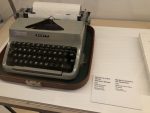
Mordecai Richler’s typewriter is among the many items on display in the exhibit Shalom Montreal, which is at Montreal’s McCord Museum until Nov. 11. (photo by Arthur Wolak)

Shalom Montreal: Stories and Contributions of the Jewish Community is at Montreal’s McCord Museum, across from McGill University, until Nov. 11.

The exhibition showcases how Montreal’s diverse Jewish communities have participated in the city’s growth and development, including the remarkable Jewish achievements in various sectors, from arts and culture, health and science, legal and community groups, and business and real estate. It does an excellent job telling the story – through videos, photos, audio recordings, as well as numerous visual displays – of how the Jewish community grew and benefited not only Jews but also continues benefiting all Montrealers.

Montreal now boasts a Jewish population of 90,000. Jewish immigrants began settling there as far back as the 18th century. Between 1904 and 1914, Montreal saw the largest wave of Jewish immigration, with many Jews arriving to the city from Eastern Europe fleeing from antisemitism and violent pogroms. Yiddish culture flourished. More Jews settled in Montreal after the First World War, but far fewer due to Canada’s restrictive policy against Jewish immigrants. Then, after the Second World War, and with new policies in place, several thousand Holocaust survivors immigrated to Montreal, making Yiddish the third most commonly spoken language in the city after French and English.

At the same time, Sephardi Jews from Arab-Muslim countries, also fleeing persecution, arrived in Montreal, including some 10,000 Moroccan Jews who spoke French. This helped them find their place in Quebec, as they set up new institutions featuring their own cultural practices, which differed from those of the Ashkenazim, who had dominated for decades.

Jews of Montreal faced antisemitic policies in the predominantly Catholic and Protestant population, which prohibited Jews from attending Catholic schools, placed barriers for Jews in Protestant schools and even saw a Jewish quota placed in various faculties of McGill University between the 1930s and 1950s. Nonetheless, Jewish contributions to the larger community are recognized today for their positive impact on society in general.

These contributions are highlighted in the exhibition. Jewish architects – Max Kalman, Max Wolfe Roth, David Fred Lebensold and Moshe Safdie, among others – and artists became prominent through their design of important city buildings. Jewish philanthropists, such as the Azrielis, Bronfmans, Cummingses, Hornsteins, Pollacks, Segals and Steinbergs, paid for well-known Montreal educational, cultural, medical and other buildings benefiting all Montrealers. Jewish lawyers, such as Alan B. Gold, Anne-France Goldwater and Irwin Cotler, have promoted social equity, evident in many controversial cases. In 1919, the Canadian Jewish Congress was founded in Montreal – in 2009, the Quebec wing branched off as the Quebec Jewish Congress – providing support to human rights groups.

Jewish contributions to healthcare are particularly noteworthy, with research that has gone beyond the confines of Montreal to benefit the international community. Within the city, Jewish doctors, wanting to counter systemic Catholic and Protestant antisemitic policies, established the Jewish General Hospital in the 1930s. Considered one of the great hospitals in Quebec, it had Canada’s first non-discrimination policy, accepting patients and employees from all communities, and it still thrives today.

Montreal’s clothing industry flourished due to the influence of Jewish immigrants. In the 1930s, the industry employed 35% of Montreal Jewish workers, who were known for their garment skills. Later on, clothing companies founded in Montreal by Jewish families include Reitmans, Le Château, Canadelle, Peerless, Aldo, and clothing brands like Joseph Ribkoff and Parachute.

Shalom Montreal is well worth a visit. It uses entertaining and informative multimedia, along with many visual artifacts, to prove there is far more to Jewish Montreal than its legendary bagels and smoked meat.

Arthur Wolak, PhD, is a business consultant, writer and member of the board of governors of Gratz College. His most recent books are The Development of Managerial Culture (Palgrave Macmillan) and Religion and Contemporary Management (Anthem Press), available in hardcover and ebook formats from all online retailers. He lives with his wife and three children in Vancouver.