Tikkun olam through photos

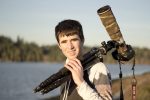
With his photos, Liron Gertsman hopes to raise awareness of environmental issues. (photo by Liron Gertsman)

Recent Vancouver high school graduate and award-winning photographer Liron Gertsman is heading to the University of British Columbia to study biology. His main passion is taking photos of nature, particularly birds, in the hope of sparking in viewers feelings of love and awe for the environment, leading to improved conservation.

“I believe people need to see the natural world if they want to protect it, so I try to do that through my photos,” Gertsman told the Independent in an interview.

From as young as 5 or 6 years old, Gertsman spent a great deal of his spare time walking around his neighbourhood, keeping an open eye.

“Around that time, my parents gave me a blue miniature camera,” he recalled. “Right from the start, I began taking pictures of birds and nature … and it grew and grew until, when I was 12, I bought my first personal DSLR camera equipment. And, since the very start, I’ve loved birds and have been fascinated by their behaviours … and have done my best to photograph them.”

Gertsman’s love of nature does not seem to have come from his parents, who are both businesspeople. His dad is a real estate tax consultant and his mom is an accountant.

“It was a big combination of things,” said Gertsman. “A lot of it was self-learning things – reading on the internet, reading books, and there were [other] influences because the bird-watching community is very large…. I would go attend bird walks and meet people that way. My Grade 2 teacher was a really big environmentalist and created an environmental conservation club at school.”
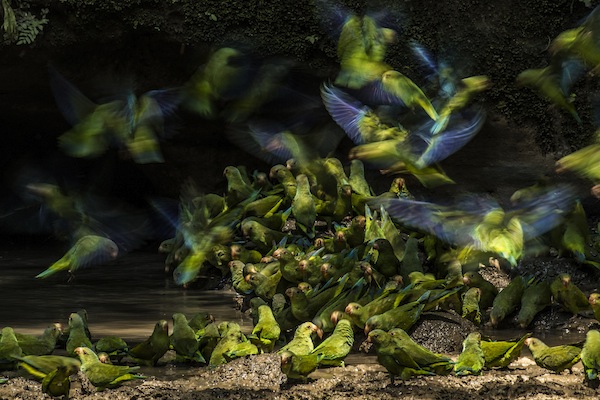
photo - Cobalt-winged parakeets. “To get this photo,” said Liron Gertsman, “I waited for hours three days in a row in a blind in the hot and humid rainforest of Yasuni National Park in Ecuador”
Cobalt-winged parakeets. “To get this photo,” said Liron Gertsman, “I waited for hours three days in a row in a blind in the hot and humid rainforest of Yasuni National Park in Ecuador.” (photo by Liron Gertsman)

Now that he is heading to UBC, Gertsman is not sure if he will integrate photography with research on birds, or if he will become a professional nature photographer.

“There are a lot of biologists who use photography to document their work,” he said. “They’re doing work that is hopefully going to benefit conservation and they need photographers, or they, themselves, will document their own work … to put it into a format that is easier for people to comprehend. Hopefully, I’ll get involved in some research projects – maybe over the summers – that will allow me to do things like that…. But, I’ll see what calls me more in the years to come and make a decision in a few years.”

Gertsman posts his photos on his website and social media accounts, and some have won contests. Most recently, three of his photos were recognized by the Audubon Photography Awards, winning the youth category prize and honourable mentions.

“It’s a great way to show more people your work, show them the beauty of nature,” said Gertsman. “Some of my photos have been featured, in the past, in magazines and in web articles.

“We are at a point now in the world where, if we don’t change something big … we’re going to be heading into some dark times. The environment is at a very unstable point right now. Our actions in the next little while are going to have a big impact on whether there’s going to be nature and a natural environment to live in, in the years to come.

“Everything we have as people comes from nature,” he continued. “Without nature, we can’t survive. But, it can be hard for people to understand that. It’s not a direct link. If you cut down a tree, it’s not going to have an impact on most people’s lives.”

But, on a larger scale, it matters. “So,” he said, “what I’m trying to do is, by photographing the natural world in the most beautiful way I possibly can and showing it to as many people I possibly can, I’m trying to educate the world the best I can on how incredible the environment is and how worth protecting it is.”
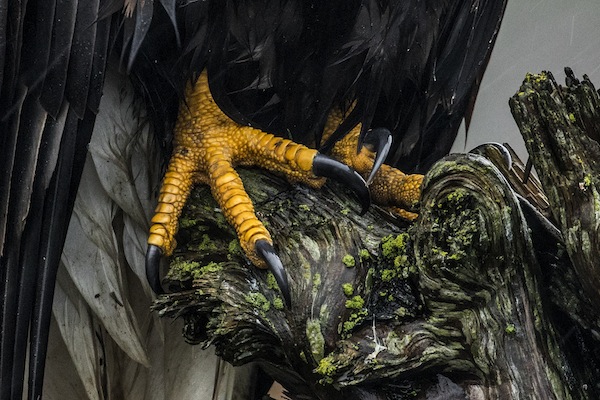
photo - The talons of a wild bald eagle, photographed on the southwest coast of British Columbia. “It was sitting near a popular walking trail, so perhaps it was used to attention from its human admirers,” said Liron Gertsman
The talons of a wild bald eagle, photographed on the southwest coast of British Columbia. “It was sitting near a popular walking trail, so perhaps it was used to attention from its human admirers,” said Liron Gertsman. (photo by Liron Gertsman)

This past spring, Gertsman was in Israel, one of the most amazing places in the world for birdwatching, as “all the birds migrating from Africa to Europe pass through in Israel,” he said.

There are many ways people can help promote the environment, he added. “You can help me spread my message – tell your friends, share my website, follow me on social media, my Instagram. I post, almost every day, my latest pictures on Instagram. Hopefully, through that, I’ll be able to reach more people.

“It’s increasingly difficult to motivate people to do things individually, but individual action can have wide affect. When a government adds a regulation, it has an impact and, when regulations are taken away, that too has a huge impact. So, in the way we think about our political leaders, there’s something we can do as a nation there.

“But also, just on an individual scale, cutting down on driving, not using plastic straws … little things, like carpooling, things you do every day can make a big difference. And, just spreading the message of how amazing nature is, and getting out and enjoying nature yourself.”

For more information, visit lirongertsman.com or @liron_gertsman_photography on Instagram.

Rebeca Kuropatwa is a Winnipeg freelance writer.

Kakagi comes to B.C.

Kakagi is, left to right, Jacob Brodovsky, Jesse Popeski, Jonathan Corobow and Max Brodovsky. (photo by Jen Doerksen)

The band Kakagi (pronounced ke-KA-gi) is coming to Vancouver next month as part of a tour that includes several B.C. stops.

Officially formed in September 2015, Kakagi is Jacob Brodovsky (guitar and vocals), his brother, Max Brodovsky (drums), Jonathan Corobow (bass) and Jesse Popeski (guitar). The four Winnipeg-area musicians met and first started jamming together when they were campers at B’nai Brith Camp in Kenora, Ont. Lake Kakagi is 100-plus kilometres south of Kenora.

“When me, Max and Jonathan were all staff (at BB), we all started playing together,” said Jacob Brodovsky. “We’ve been playing now for two-and-a-half years. Jesse and I played in the band in high school, from around ages 12 to 18. And then, Max and John always jammed together in high school, so it worked out nicely.”

The four each went their own way in university, but, once they finished school, they came back together to form the band.

“We are all either done with school or are taking a break, to be able to focus on this full-time … so the timing was good to do some heavier touring,” said Brodovsky.

Kakagi’s music is reminiscent of Neil Young, on the folk rock or indie rock spectrum.

Being a young band, Kakagi has so far been playing mainly locally, but they headed east on tour in July – Toronto, Ottawa, Peterborough and Sault Ste. Marie – and will head out west in September. The tour is called Staying Up Late, and is in support of their first EP, which they recorded in Winnipeg over the winter.

“I think we’re getting a better hang of being an actual touring band, figuring out how to make that sustainable, how much forward planning is needed to make that possible,” Brodovsky said.

After the western leg of the tour, he said, “we’ll probably head back to Winnipeg to do some song writing. We’ll be putting out another EP in January 2019, called High Hopes. That’s pretty much in the can. We just have to do a little fixing on it. Then, we’ll head to Montreal in the spring to record our first full-length album.”

Kakagi has wanted to play in Vancouver for some time now and are happy to have created enough of a buzz with their music to warrant the trip.

“We know a bunch of people in Vancouver, and it’s also one of the bigger markets in the country, so it’s a good city to get our footing,” said Brodovsky. “There is a lot of (music) industry in Vancouver. Also, we just love B.C., so we’re making the tour as long as possible to be in Vancouver and to the island.”

Kakagi will be at the Roxy in Vancouver on Sept. 5 and at Wheelies in Victoria on Sept. 8. They are also playing in Kelowna, Nelson and other B.C. communities. For more information, visit kakagimusic.com.

Rebeca Kuropatwa is a Winnipeg freelance writer.
JFS launches new program

Jewish Family Services has launched a new program to provide short-term financial assistance to Jewish community members living in the Tri-Cities area, including Maple Ridge and Mission. This program is funded by a grant from a private donor through Jewish Federation of Greater Vancouver.

Called the Chesed (or Compassion) Program, the project responds to recommendations made by the Jewish Food Security Task Force, a joint collaboration between JFS and Jewish Federation, that identified the lack of regionally based Jewish food options as one of the top priorities to address.

According to a report from the Jewish Federation, 4,200 Jews in the Lower Mainland earn less than $30,000 annually and live below the low-income cut-off. Approximately 20% of these households live in the Tri-Cities, Mission, Langley and Maple Ridge. Another five percent of households in these areas earn less than $50,000. This means there are approximately 1,000 people living in these communities, many of whom are single-parent working families, who are considered food insecure.

Richard Fruchter, chief executive officer of JFS, said that, for those living in this situation, their day-to-day reality is dire. “Many do not have enough food to last the whole month without accessing a food bank,” he explained, and “some parents go without so that their children have enough to eat. Still others have poor diets, lacking sufficient income to purchase fresh fruit and vegetables.”

Nearly all Jewish programs and services are located in Vancouver and, despite the number of low-income Jewish households in these geographic areas, there are no Jewish-run social services available to them. Many are families that have requested assistance from JFS but, because of the distance to Vancouver or the Jewish Food Bank’s limited hours of operation, they are not getting the help they need. In addition, a significant number of these households are new immigrants, the majority of whom are Russians or Russian-Israelis. They would benefit from being connected to the Jewish community and having access to social and educational programs offered closer to their homes. The Chesed Program is a small but significant step in creating access to these social services.

The program is designed to offer up to six months’ short-term assistance for people in crisis where no other source of funding is available. Eligible are Jewish community members 18 to 65 years old who are residents of the Tri-Cities, Maple Ridge or Mission and can demonstrate financial need (i.e. bank statement, rent receipt, income tax statement, social assistance cheque, proof of income) and are willing to develop a long-term plan for addressing their financial needs, where possible. Individuals or families who meet the eligibility criteria will receive a loaded credit card that can be used for purchasing basic needs items.

For more information about the Chesed Program, contact Tanja Demajo, director of family and adult resources at JFS, at tdemajo@jfsvancouver.ca or 604-637-3316.

It hurts and it ain’t at all fair

Families sometimes just have a bad run when it comes to health in the household. From December onwards, it seems like somebody has been sick at our house … but, in between, there were brief periods when most of us functioned OK. It’s been challenging.

Like many folks, I’m also signed up for an exercise class, but I have had to miss it a lot because of all these illnesses. I’m usually game for a long walk with the dog, but not a big fan of exercise – I do it because I should. We need regular exercise to strengthen and care for the body. However, when a kid is home sick, or I am, I have to skip that class, too. Exercising is, in the long run, good for me, but, in the short term, there are days when I just have to sit on the couch.

Figuring out how to care for our bodies is a balancing act. On the one hand, sometimes things hurt, but, on the other, there’s no one else inside each of our bodies, telling us what to do about it.

Some people have a high pain tolerance and, more, we’ve been taught to “walk it off,” “suck it up” or cope with what comes without complaining. Is this choice, to learn to cope with discomfort without complaint, a Jewish thing?

Some might say it is the opposite. If you read the Torah portions about the Exodus from Egypt, you get multiple examples of when the Israelites complained. They wanted meat. They wanted water. They wanted better food. In Numbers 20:5, it says, “Why did you make us leave Egypt to bring us to this wretched place, a place with no grain or figs or vines or pomegranates? There is not even water to drink!”

On more than one occasion, G-d does provide for the Israelites, but there’s also punishment. People get sick, or are bitten by serpents. Complaining isn’t rewarded. It might be natural for some to complain of their lot – even the most strong among us need to let out our frustrations after awhile. However, some of us were taught that complaining too much isn’t OK; that, unless you’re dying, you need to get on with things, and save the cries of pain and complaints for when something actually really matters.

Unfortunately, if you hold the pain in and don’t act like you’re dying, sometimes you don’t get taken care of promptly. In some cases, the squeaky wheel gets the grease. Also, if you’re not a big complainer, people may forget that there might be anything wrong, though being stoic, understated and self-controlled can make life less complicated, too.

I’d like to say that folks remembered that some in our family weren’t 100% healthy, but that wasn’t always the case. Sometimes I felt a lot of pressure for us to be joiners and attempt something that I knew just wouldn’t work out – as I recovered from pneumonia, for instance. I’d have to say things like, “Well, we’re really not up to that, but thanks for inviting us.” I feel like maybe we’ve missed out, but good health is really important. It has to come first.

Jewish tradition teaches us that the body is a temple. We have to take care of it. We wish people “refuah shlemah,” or “complete healing.” We say “la bruit” (“to your health”) when someone sneezes. Midrash teaches us that we wish health to someone when they sneeze because, in the past, some saw sneezing as dangerous and deadly – the soul could leave through the nostrils. It’s a mitzvah (commandment) to do bikur cholim (visiting the sick), and many congregations have committees in place to make food and visit those who are unwell.

We have contradictions here. In our oldest stories, there are complainers and punishments for complaining. In our ritual traditions, we wish people health, help them get well, and have an obligation to take care of others and visit them. We’re also not to abandon those who are sick – when Miriam got sick, the Israelites waited for her to get well before traveling on. Yet, we’re also part of a 24/7, on-the-go culture. It’s hard to reconcile the need for good, old-fashioned rest with our modern lives, but both are necessary. When it hurts, it’s OK to say so, within reason, and to expect others to care and wish you better health.

Here’s a funny story of “it hurts.” While I was in labour with my twins, another expectant mother came in. She came with two people (family members? friends?) and made a lot of noise. It turned out that, when the people with her had to leave the room, she stopped making noise. It felt like we were listening to a performance! This lady felt that part of delivering the baby required making noise about it – and we all heard it, on cue.

It’s traditional to be supportive of someone in their time of discomfort – to support and help – but perhaps Hashem would prefer it if we saved the hysterical screaming for when it really hurts rather than just for when someone can hear us. Complaining for its own sake, it would seem, warrants punishment but, when it really hurts, we’re commanded to visit, bring food and help.

Sickness happens to the best of us, and it sure isn’t fair. But, there’s no point in making it worse for everyone by screaming louder than anyone else.

Joanne Seiff writes regularly for CBC Manitoba and various Jewish publications. She is the author of three books, including From the Outside In: Jewish Post Columns 2015-2016, a collection of essays available for digital download or as a paperback from Amazon. See more about her at joanneseiff.blogspot.com.

Hesse driven to be an artist

Eva Hesse is the subject of an Aug. 31 episode of PBS’s American Masters series. (photo by Herman Landshoff)

Eva Hesse’s childhood was a rollercoaster of displacement, reunion, destabilization and trauma. In the journals she kept as a teenager and adult, the German-born, New York-based artist recognized the source of her chronic insecurity. Yet, paradoxically, and remarkably, her work evinces no anguish or suffering, and no need to expose or extinguish demons from the past. From her early, brightly coloured drawings and paintings, through the textured, abstract sculptures and installations that made her reputation, her art comprises a series of experiments in forward-looking forms of expression.

Eva Hesse screens Aug. 31 (check local listings) in PBS’s American Masters series. A palpable labour of love, Marcie Begleiter’s densely detailed 2016 documentary is a soup-to-nuts portrait that encompasses the artist’s personal life and times – New York in the 1960s – along with her professional development and impact.

Begleiter’s diligence notwithstanding, Eva Hesse never delivers the aha moment, where the person and her work snap together, and we understand exactly how Hesse’s defining childhood experiences informed her work. I’ll venture, though, that Holocaust survivors, and children of survivors, will identify with Hesse’s internalized struggles, and read between the lines of her journals and the recollections of her older sister, Helen.

In 1962, the art-school grad fell in love with and married a hard-partying Irish-American sculptor named Tom Doyle. Because her father insisted that she marry a Jew, Doyle willingly converted to Judaism.

Doyle, who was the more advanced and accomplished artist at the time, was offered a residency in Germany a couple years later, and the couple ended up living there for more than a year. Their relationship fractured abroad, in part because of his drinking and flirting, but Hesse made a major leap in her art practice from painting to sculpture.

Eva Hesse, which generally unfolds chronologically, uses this period to flash back to Hesse’s chaotic childhood. Born in Hamburg in 1936, she and Helen were sent on a Kindertransport to the Netherlands in 1938. When their parents left Germany several months later, the family reunited and fled Europe for England and, in short order, New York. They were the only members of the family to escape the Holocaust.

When Hesse’s mother, who suffered from depression and mental illness, learned in 1946 that her parents had died in the camps, she jumped from a roof to her death. (Hesse’s father had separated and remarried by this time.)

While the documentary is continually interested in its subject’s mental state, neither the filmmaker nor Hesse’s devoted artist friends are especially keen to psychoanalyze her. Perhaps she was scarred by the abandonment of her parents as a toddler, though one could also understand her self-doubt, given the establishment of male gallery owners, museum curators and critics.

Which brings us to another fundamental paradox of Hesse, namely that the insecurities she voiced in her journals, and in letters to artist, mentor and close friend Sol LeWitt, were matched by an unwavering drive to be an artist, an adherence to her muse (wherever it took her) and the awareness that she was pretty darn good at her work.

In fact, Hesse was an extrovert and a lot of fun, by most accounts. From the outset, Eva Hesse is plainly not a study of a tortured artist. Nor was she unrecognized and unappreciated in her own lifetime, for she had a major solo show and made the cover of Artforum before she died of a brain tumour in 1970. She was 34 years old.

Michael Fox is a writer and film critic living in San Francisco.

Benefits from being bilingual

Dr. Carmit Altman of Bar-Ilan University. (photo by Carmit Altman)

“Anna,” a preschooler in the Israeli city of Bat Yam, was thought to be cognitively impaired because testing her in Hebrew showed her cognitive skills lagging behind her classmates. But, when retested in her home language, Russian, she was found to be normal. About half of all Israeli children speak a different language at home than in school, making Israel possibly the world’s best “laboratory” for researching the still little-understood phenomenon of growing up with two or more spoken languages.

One important Israeli discovery is that comparing bilingual kids like Anna to monolingual children is like comparing apples to pears, according to Bar-Ilan University Prof. Sharon Armon-Lotem. For two decades, her lab has studied language-acquisition processes of Israeli preschoolers from English-, Russian- and Amharic-speaking homes.

Roughly 20% of children entering first grade in Israeli secular public schools come from immigrant homes in which the dominant language is not Hebrew. The largest cohort is Russian-speakers, numbering about 1.2 million out of an overall Israeli population of 8.7 million.

Adding more than a million Israeli households where Arabic, Yiddish or African languages are spoken, the percentage of bilingual children climbs to as high as 50% of the general population, Armon-Lotem told Israel21c.

To evaluate bilingualism properly, one must understand that children who grow up speaking two or more languages in everyday life are not using the same brain processes as do monolingual children learning a second language in school, note Armon-Lotem and other Israeli experts. And, if bilingual children like Anna initially have a smaller Hebrew vocabulary, they have better syntax and concept-generation skills in both languages. Overall, they develop language no differently than monolingual peers, unless they have developmental language disorder (DLD).

DLD, estimated to affect five to seven percent of both monolingual and bilingual children, causes dramatic delays in language acquisition not related to other impairments. DLD might manifest differently in each of a child’s two languages, but usually shows up as difficulty with word retrieval and grammar. Since these same phenomena can happen in typically developing bilingual children as they learn the majority language, bilingual children with and without DLD are often misdiagnosed.

Armon-Lotem emphasized that bilingualism does not lead to impairment. From 2009 to 2013, she led a network of researchers from 26 European and five non-European countries in formulating standards for characterizing typical bilingual development and identifying atypical bilingual development in more than 30 language pairs. Research by Natalia Meir in Armon-Lotem’s lab was the first to show that it is possible to disentangle typical and impaired language development, and with 90% accuracy.

“We’ve made a lot of progress in this area in Israel,” said Prof. Joel Walters, professor emeritus of linguistics at Bar-Ilan and now chair of the department of communication disorders at Hadassah Academic College in Jerusalem, which hosts hundreds of specialists at its annual conference on communication disorders in multilingual and multicultural populations.

Walters’ study of the processes underlying how the brain merges two or more languages into a single utterance is informed by recent brain imaging of bilinguals. One of his focuses is “codeswitching,” when a bilingual speaker starts a sentence or word in one language and switches to the other.

“Codeswitching was once thought of as a random phenomenon but actually it’s very systematic and occurs in sentences, phrases and even within words,” Walters told Israel21c. An English-Hebrew bilingual child might tell her sister “muzi,” merging the English word “move” with the Hebrew “zuzi,” for example.

Walters and two co-authors recently published in the International Journal of Bilingualism about their study of Russian-Hebrew bilingual 6-year-olds asked to retell a Russian story to a Hebrew-speaking puppet, a Hebrew story to a Russian-speaking puppet and a codeswitched story to a bilingual puppet. The children were also asked to respond to conversational questions asked in Russian, Hebrew and codeswitched speech about holidays and activities at home and in preschool. In both tasks, the children did more codeswitching from Russian to Hebrew, “because that’s the language of school and street and that’s the language that will help them integrate socially.” However, in children with impaired language development, the directionality is not as predictable, said Walters.

As Israeli researchers formulate better ways of evaluating and treating bilingual children with DLD, Armon-Lotem is planning to establish a global database of voice files sent from clinicians and preschool teachers who work with bilingual children in different language pairs. Data scientists at Bar-Ilan will use new methods in machine learning and big data to better identify existing markers of DLD and possibly find new markers.

Am I Russian or Israeli?

Carmit Altman of Bar-Ilan’s School Counseling and Child Development Programs studies the social impact of growing up bilingual, looking at family language policy – what language parents want their child to speak and how they enforce that preference.

One of her group’s frequently cited studies, published in 2014, examined the language policy of 65 Israeli families raising their children in Russian. They found three main approaches: parents with a strict policy of speaking only Russian at home; parents who don’t forbid Hebrew at home and sometimes encourage it; and those who actively promote both Hebrew and Russian at home for speaking and reading. They predicted that the strictest language policy would result in the best performance in Russian but the middle group performed just as well. Children from this group also showed an advantage in Hebrew in tasks predictive of future Hebrew literacy skills. “In syntax, all the kids did better in Hebrew than in Russian, with no group differences,” Altman said.

Altman’s lab also studies how bilingual children and their parents perceive their children’s language abilities, and their sociolinguistic identity and preferences. They invented a “magic ladder” scale on which preschoolers can attach happy and sad magnet faces to rate their agreement with statements such as “I speak Hebrew well.”

Parents of both English-Hebrew and Russian-Hebrew bilingual children think their children prefer Hebrew, but the kids say they prefer their home language, Altman found. And, while the kids consider themselves hyphenated Israelis, their parents consider them totally Israeli.

There were also differences in performance perception. “In Russian-Hebrew families, both children and parents think the children perform similarly in Russian and Hebrew. In English-Hebrew families, children feel they perform better in English, while parents think the children have similar abilities in both languages,” said Altman.

In collaboration with Armon-Lotem, Altman’s group is developing tools to help researchers understand these differences and to help preschool teachers detect which bilingual children may need a DLD evaluation.

Advantages of bilingualism

The ability to speak more than one language is widely accepted as beneficial in ways from the practical (business, academics, travel) to the medical (possibly delaying symptoms of dementia). When Altman was doing a post-doc in New York, she and her husband spoke Hebrew to their children at home. She feels that raising kids bilingually “is a gift you can give your child for life” and that cross-generational communication is one strong motivation for doing so.

“Having more than one language and more than one culture is definitely a huge advantage in life,” agreed Armon-Lotem.

It is less clear whether bilingualism sharpens “executive functions,” such as shifting attention and inhibiting instructions, as was believed in past decades.

“In one study, we found that English-Hebrew bilingual children with DLD show an advantage in executive function over monolingual children with DLD,” said Armon-Lotem. “But we didn’t find the same in Russian-Hebrew bilinguals. We might be able to find cognitive advantages for certain populations at certain age ranges and within certain tasks.”

Armon-Lotem and her colleagues are beginning to study bilingualism in children with autism and Down syndrome, and will provide tools to help bilingual preschool children, including Eritrean asylum-seekers in Jerusalem, tell coherent stories in Hebrew and their home language.

Israel21c is a nonprofit educational foundation with a mission to focus media and public attention on the 21st-century Israel that exists beyond the conflict. For more, or to donate, visit israel21c.org.

Golden discovery

A Hellenistic-era golden earring, discovered in the Givati Parking Lot in the City of David National Park. (photo from IAA courtesy Ashernet)

A Hellenistic-era golden earring, featuring ornamentation of a horned animal, was discovered in the Givati Parking Lot in the City of David National Park encircling the Old City walls. The discovery was made during archeological digs carried out by the Israel Antiquities Authority and Tel Aviv University. According to the researchers, “It is unclear whether the gold earring was worn by a man or a woman, nor do we know their cultural or religious identity, but we can say for certain that whoever wore this earring definitely belonged to Jerusalem’s upper class. This can be determined by the proximity to the Temple Mount and the Temple, which was functional at the time, as well as the quality of the gold piece of jewelry.”


אייר קנדה במקום השלושים

(צילום: abdallahh from Montreal)

כמדי שנה חברת סקייטרקס מפרסמת את מדד מאה חברות התעופה הטובות בעולם. במדד של השנה: סינגפור איירליינס הגיעה למקום הראשון ואילו אייר קנדה הגיעה למקום השלושים.

להלן עשר חברות התעופה הטובות ביותר בעולם לשנת 2018: סינגפור איירליינס במקום הראשון (עלייה של מקום לעומת אשתקד), קטאר אירוויס במקום השני (ירידה של מקום לעומת אשתקד), אול ניפון איירוויס מיפאן במקום השלישי (אשתקד גם כן במקום השלישי), אמירייטס מאיחוד האמרויות במקום הרביעי (אשתקד גם כן במקום הרביעי), אווה אייר מטייוואן במקום החמישי (עלייה של מקום לעומת אשתקד), קתאי פסיפיק מהונג קונג במקום השישי (ירידה של מקום לעומת אשתקד), לופטהנזה מגרמניה במקום השביעי (אשתקד גם כן במקום השביעי), היינאן מסין במקום השמיני (עלייה של מקום לעומת אשתקד), גארודה מאינדונסיה במקום התשיעי (עלייה של מקום לעומת אשתקד) ותאי איירוויס במקום העשירי (עלייה של מקום לעומת אשתקד). אייר קנדה היא חברת התעופה הקנדית היחידה שנכנסה למדד מאה הטובות בעולם. אייר קנדה תופסת את המקום השלושים כאשר אשתקד היא הגיעה למקום העשרים ותשעה.

אייר קנדה תפסה את המקום הראשון בקרב סקר חברות התעופה הטובות ביותר בצפון אמריקה ב-2018. החברה שנוסדה ב-137 מחזיקה כיום ב-185 מטוסים בגדלים שונים. לחברה יש חמש חברות-בנות: אייר קנדה ג’אז – המתמחה בעיקר בטיסות פנים במטוסים קלים, אייר קנדה טאנגו – המתמחה בעיקר בטיסות למקסיקו וארה”ב, זיפ – המתמחה בעיקר בטיסות לחוף המערבי של ארה”ב’, אייר קנדה רוג’ – המתמחה בעיקר בטיסות לואו-קוסט לדרום אמריקה, אירופה וישראל וכן אייר קנדה אקספרס.

אייר קנדה טסה ל-222 שדות תעופה שונים ברחבי העולם (64 בקנדה, 60 בארה”ב ו-98 בשאר רחבי העולם), בהן 7 טיסות שבועיות בקו טורונטו – תל אביב במטוסי הדרימליינר, וכן 2 טיסות שבועיות עונתיות בקו מונטריאול – תל אביב במטוסי הדרימליינר. אייר קנדה הסיעה אשתקד 48 מיליון נוסעים.

החברה הקנדית מנסה להפעיל מחדש את תוכנית הנוסע המתמיד “ארופלן”, בשותפות עם הבנקים הקנדים טי.די וסי.איי.בי.סי וחברת ויזה. רכישת “ארופלן” נאמדת בכ-2.25 מיליארד דולר קנדי אך לא ברור אם תצא אל הפועל.

האדסון ביי העיפו את המוצרי איוונקה טראמפ מהמדפים ומעתה הברנד לא קיים עוד

רשת בתי הכלבו הקנדית הוותיקה האדסון ביי החליטו בחודש שעבר שלא למכור עוד את קו מוצרי האופנה של איוונקה טראמפ, בתו של הנשיא האמריקני הבעייתי, דונלד טראמפ. המוצרים של טראמפ הבת כמעט ולא נמכרו בקנדה, ויש שיאמרו כי החרם על קו האופנה של מי שמזוהה כל כך עם אביה – עשה את שלו.

מכל מקום החלטת האדסון ביי היוותה סממן שלילי נוסף לעתיד הברנד של טראמפ הבת, שלא הצליח להתרומם לאור התנהגותו השערורייתית של טראמפ האב. עד שלבסוף החליטה הבת בסוף יולי להפסיק לחלוטין את קו האופנה הכושל.

איוונקה טראמפ (36) הקימה את קו מוצרי האופנה שלה ב-2014. בעת הקמפיין הפוליטי המלוכלך של אביה המכירות זינקו. לאחר מכן החלו להישמע טענות שהבת מקדמת את מוצריה בדרך לא הוגנת, ופעילותה בבית הלבן ליד אביה יוצרת בעצם ניגוד אינטרסים. כן נטען שהועסקו עובדים זרים תוך ניצולם במפעלי הברנד בחו”ל.

רבים בארה”ב ומחוצה לה קראו להחרים את המוצרים של טראמפ, ורשתות שיווק שונות החליטו להפסיק ולמכור אותם. האחרונה הייתה כאמור האדסון ביי הקנדית ומעתה מוצרי איוונקה טראמפ לא קיימים עוד.