Skip to content
  • Home
  • Subscribe / donate
  • Events calendar
  • News
    • Local
    • National
    • Israel
    • World
    • עניין בחדשות
      A roundup of news in Canada and further afield, in Hebrew.
  • Opinion
    • From the JI
    • Op-Ed
  • Arts & Culture
    • Performing Arts
    • Music
    • Books
    • Visual Arts
    • TV & Film
  • Life
    • Celebrating the Holidays
    • Travel
    • The Daily Snooze
      Cartoons by Jacob Samuel
    • Mystery Photo
      Help the JI and JMABC fill in the gaps in our archives.
  • Community Links
    • Organizations, Etc.
    • Other News Sources & Blogs
    • Business Directory
  • FAQ
  • JI Chai Celebration
  • JI@88! video

Recent Posts

  • Eby touts government record
  • Keep lighting candles
  • Facing a complex situation
  • Unique interview show a hit
  • See Annie at Gateway
  • Explorations of light
  • Help with the legal aspects
  • Stories create impact
  • Different faiths gather
  • Advocating for girls’ rights
  • An oral song tradition
  • Genealogy tools and tips
  • Jew-hatred is centuries old
  • Aiding medical research
  • Connecting Jews to Judaism
  • Beacon of light in heart of city
  • Drag & Dreidel: A Queer Jewish Hanukkah Celebration
  • An emotional reunion
  • Post-tumble, lights still shine
  • Visit to cradle of Ashkenaz
  • Unique, memorable travels
  • Family memoir a work of art
  • A little holiday romance
  • The Maccabees, old and new
  • My Hanukkah miracle
  • After the rededication … a Hanukkah cartoon
  • Improving the holiday table
  • Vive la différence!
  • Fresh, healthy comfort foods
  • From the archives … Hanukkah
  • תגובתי לכתבה על ישראלים שרצו להגר לקנדה ולא קיבלו אותם עם שטיח אדום
  • Lessons in Mamdani’s win
  • West Van Story at the York
  • Words hold much power
  • Plenty of hopefulness
  • Lessons from past for today

Archives

Follow @JewishIndie
image - The CJN - Visit Us Banner - 300x600 - 101625

Tag: Bar-Ilan University

Jew-hatred is centuries old

Jew-hatred is centuries old

Bar-Ilan University’s Dr. Mordechai Kedar spoke in Vancouver Nov. 17 at Temple Sholom on root causes of Jew-hatred. (from idsf.org.il)

The Enlightenment of the 18th century carried hopes for Jews that their long history of persecution would end, but the ideas of that period carried the seeds of a new form of Jew-hatred. Communism was intended to erase class and national differences, which might have eliminated discrimination toward Jews, but this ideology too carried a poisonous element. Zionism was intended as the answer to systemic discrimination against Jews. It too, though, merely sparked a variation on the ancient bigotry.

In a survey spanning centuries, one of Israel’s leading scholars of the Middle East explained the seemingly limitless justifications for Jew-hatred in Christian and Islamic civilizations.

Dr. Mordechai Kedar spoke in Vancouver Nov. 17 at Temple Sholom on root causes of Jew-hatred. Kedar is a senior lecturer in Arabic and Middle Eastern studies at Bar-Ilan University, where he has taught for more than 30 years. Kedar served for 25 years in Israeli military intelligence, specializing in Syria and regional Arab affairs.

Kedar said he prefers the term “Jew-hatred” to antisemitism because it subverts the rhetorical claim that Arabs, who are semitic, can therefore not be antisemites. 

“We don’t find anti-Jewish sentiments in India, in China, Japan and Korea,” said Kedar. “One reason is the religion. Both Christianity and Islam are religions which are derivatives of Judaism. Therefore, in order to establish their validity and their legitimacy, they must undermine the validity and the legitimacy of Judaism.”

Another reason, he said, is that there have historically been few or no Jews in those places. In addition to being theological, Kedar argues, Jew-hatred has been a xenophobic reaction to the “other.” In the absence of Jews in India or Japan, this role was filled by other others.

Traits of Jews themselves also spark antisemitism, he said. Illiteracy in Jewish communities has been almost nonexistent, said Kedar, and this has created jealousy. More recently, the disproportionate number of Jewish Nobel Prize recipients may be a point of pride for Jews, but it can serve as a red flag for those seeking reasons for resentment. Jewish success in a range of fields spurs bitterness among some who are less successful or struggle to compete.

The historical trajectory of Jew-hatred is long and winding. 

“Two hundred years ago, more or less, some countries, especially after the Enlightenment in Europe, started to give emancipation to Jews,” said Kedar. “Instead of erasing the differences between Jews and others, [this freedom] actually increased the hatred because now the Jew, the ‘other,’ invades our circles, he becomes a lawyer, he becomes an accountant, he competes with us in our court.”

When Jews in Germany abandoned traditional distinctive clothing choices, this caused a backlash among non-Jews.

“This is frightening for them because, all of a sudden, the Jew looks like us,” Kedar summarized. “Is he like me or not? All of a sudden, he wants to look like a German, sound like a German, act like a German.”

With the French Revolution, and gaining steam after 1848, the Age of Nationalism was another turning point. The collapse of empires, notably the Austro-Hungarian Empire, where as many as one-third of Europe’s Jews lived, brought unanticipated challenges for Jews. As Hungarians, Romanians and others gained both national sovereignty and greater ethnic identity, Jews were again isolated as outsiders.

“If we are Romanians, we are Christians,” Kedar said. “We speak Romanian.… We dance to the same music. We eat the same food. Who doesn’t? The Jew. He eats different food. He speaks a different language. So, he’s not one of us.”

Socialism and communism were meant to erase the differences between peoples, Kedar said, including the very concept of separate nationalities. 

“And who is leading this erasing of nationalism? The Jew Trotsky and Lenin, with his [Jewish] roots,” said Kedar. The Jew is blamed when nationalism is ascendant and when communism is pushing nationalism to the margin, he noted.

Envy and othering even undermined Zionism, which was conceived as the ultimate answer to the inescapable antisemitism experienced by the stateless Jew.

“The Zionist movement was another reason to hate the Jew,” Kedar said. “Let’s imagine that we have a little town in Romania with problems of employment, problems of poverty, problems of alcoholism as well. The Jews are starting this new theology of Zionism, to leave the country and to go to eretz Israel. ‘What, you’re going to leave us and go to a better place? We hate you.’”

Kedar spoke extensively about Islamic theological and political antisemitism, which he described as like a “layer cake.”

“Judaism was canceled 2,000 years ago by Christianity,” he said. “And Christianity was canceled 14 centuries ago by Islam. So, Judaism was canceled twice.… Since Judaism is null and void, why do we need a Jewish state if there is no Jewish religion?”

Another layer rests on the Islamic concept of dar al-Islam, the domain of Islam, he said, which holds that no land controlled by Muslims must ever fall into the hands of the infidel.

Under the Ottomans, he said, eretz Israel was under Islamic rule and should forever remain so because, “according to the belief, according to Sharia, any land in the world has only a one-way ticket to enter the House of Islam, not to get out.”

A third layer is a widespread rejection of Jews as a people or as a nation. By reducing Jews to a religious group, he said, this idea subordinates Jewish identity to national affiliation, so a Jewish Canadian is Canadian first and that is their nation. This argument succeeds in justifying dozens of Muslim states while rejecting one Jewish state based on the premise that these are not Muslim states, but Turkish, Uzbeki or other states that happen to share a religion.

A fourth layer, said Kedar, is that some Islamic thought denies Jewish connections to the land and maintains that the people who today call themselves Jews are descended from central Asian Khazars who converted to the Jewish religion.

These concepts negate a core intention of Zionism, which was to resolve the problems created by Jewish statelessness. Muslim opposition to Israel, founded on these layers of theological justification, and Western opposition to Israel, mainly taking the form of political criticisms that extend into existential rejection, have prevented the Jewish state from serving the role Zionism intended, which was in part to make Jews a people like any other. 

Rabbi Dan Moskovitz welcomed Kedar, who is associated with the right-wing in Israel, and said his congregation is a “big tent.”

“I did hear from some of you here,” said Moskovitz, “or in the community, [asking] why is Temple Sholom hosting Dr. Kedar?… As the senior rabbi of this congregation, it is my intention and mission to bring in voices, within the boundaries of the tent of the Jewish people, that represent the spectrum of Jewish thought. I tell my children all the time, you only learn when you listen to people that you don’t already agree with.”

Aron Csaplaros, BC regional manager for B’nai Brith Canada, which co-sponsored the event, introduced Kedar. He also highlighted his organization’s most recent audit of antisemitic incidents, noting they recorded 6,219 incidents of hate against the Jewish community in Canada in 2024. 

“That’s the highest number we’ve ever recorded in the more than 40 years that we’ve been tracking this data,” he said. “That comes out to an average of 17 antisemitic incidents every single day.” 

Incidents range from online harassment, threatening behaviour and vandalism targeting Jewish institutions to direct attacks against Jewish individuals, Csaplaros said. 

“It is hostility directed at people simply because they’re Jewish,” he said. “Many in our community feel less safe today than at any point in their lifetimes. Parents hesitate sending their kids to school. University students are increasingly targeted and isolated. And Jewish Canadians who have always lived openly and proudly now find themselves looking over their shoulders or questioning whether this is still the country that can offer the sense of security that they once felt.” 

Format ImagePosted on December 5, 2025December 3, 2025Author Pat JohnsonCategories LocalTags antisemitism, Aron Csaplaros, Bar-Ilan University, B’nai Brith Canada, Dan Moskovitz, history, Jew-hatred, Mordechai Kedar, speakers, Temple Sholom
Genocide claims examined

Genocide claims examined

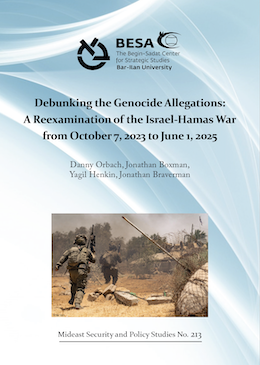
The authors of Debunking the Genocide Allegations: A Reexamination of the Israel-Hamas War from October 7, 2023 to June 1, 2025 sought to do two things in their research: assess the factual basis of war crime and genocide allegations, and examine how information is gathered and transmitted in conflict zones. Among the claims examined is whether enough aid was getting into Gaza from Israel. (IDF Spokesperson via besacenter.org)

A new study conducted by a team of researchers critically examines accusations that Israel committed crimes against humanity, such as planned starvation, deliberate massacres and even “genocide,” during the Israel-Gaza War, between Oct. 7, 2023, and June 1, 2025. Using a blend of quantitative-statistical analysis, forensic documentation, primary sources and comparative military history, the study aims to distinguish propaganda from fact and highlight systemic failures in major international information bodies. Its authors emphasize that their objective is not legal or moral exoneration, but a factual analysis of the methodologies and evidence behind genocide claims.

Research for the 311-page study – Debunking the Genocide Allegations: A Reexamination of the Israel-Hamas War from October 7, 2023 to June 1, 2025 – was led by Prof. Danny Orbach, a military historian from the department of history at the Hebrew University of Jerusalem, in collaboration with Dr. Jonathan Boxman, an expert in quantitative research; Dr. Yagil Henkin, a military historian at the Shalem Centre and the Jerusalem Institute for Strategy and Security; and attorney Jonathan Braverman, a member of the Israeli bar and a lawyer for International Humanitarian Law. It is published by the Begin-Sadat Centre for Strategic Studies at Bar-Ilan University in collaboration with the aforementioned institutions.

The researchers sought to do two things: assess the factual basis of war crime and genocide allegations, and examine how information is gathered and transmitted in conflict zones, particularly in regions ruled by oppressive regimes and/or populated by closed societies with a strong “resistance” ethos. Special emphasis was placed on cross-referencing Israeli, Palestinian and international sources, while actively avoiding ideological bias and preconceived assumptions. The authors highlight that subordinating factual analysis to advocacy narratives can undermine public policy and distort ethical and legal discourse.

image - Debunking the Genocide Allegation report coverThe study’s key findings are:

No basis for starvation claims prior to March 2025

• More food entered Gaza during the war than before Oct. 7, 2023. The claim that 500 aid trucks are required daily stems from a misrepresentation by United Nations bodies, one that was left unchallenged and unchecked. Prewar UN records cite an average of 73 food trucks per day in 2022. During the fighting (until Jan. 17, 2025), the Coordination of Government Activities in the Territories (COGAT) recorded an average of 101 food trucks daily whereas retroactively corrected but still incomplete UN Relief and Works Agency for Palestine Refugees (UNRWA) data indicated 83 food trucks per day. Food that entered the Gaza Strip during the ceasefire should have sufficed until late July 2025, according to World Food Programme projections, even absent any aid following the resumption in the fighting. It is hard to explain this gap without considering extensive looting by Hamas, for which the study’s authors provide ample evidence.

• Although UNRWA initially reported a 70% drop in aid after May 2024 and the Rafah operation, it later retroactively corrected these reports. This correction was effectively unannounced and hence the supposed aid drop continues to be cited broadly.

• Contrary to the claim that 44% of Gaza’s food comes from local agriculture, the study finds this number was baseless even before the Hamas takeover. It is likely that, even in 2005, Gazan agriculture accounted for no more than 12% of Gazan caloric consumption and the number is almost certainly much lower today. The study further finds that even if every ton of crops produced in Gaza in 2011 (the last year in which an analysis was published) was substituted, the number of trucks entering Gaza per capita throughout the war would still be 58% higher per capita than it was in 2011.

• Notwithstanding the above, the authors strongly criticize the decision to stop aid to Gaza between March and May 2025.

No evidence of a systematic civilian targeting policy

While isolated incidents may point to negligence or localized misconduct and suspicion of individual war crimes, no evidence was found of overarching directives aimed at harming civilians. The authors did, however, try to map the patterns of Israel Defence Forces misconduct and possible crimes, and examine which crimes were probably more prevalent and which ones were relatively absent from this conflict.

Data manipulation by Hamas

The Gaza Health Ministry, per Hamas directives, categorizes all deaths as civilian. This manipulation has significantly skewed international reporting. Indications have been found for the inclusion of age-related natural deaths, particularly of women, in the ministry of health’s lists and exclusion of combat-aged men.

IDF’s exceptional precautionary measures

The IDF has implemented unprecedented steps, such as early warnings, precision targeting and mission aborts to avoid civilian harm. These actions, while costly to the IDF, have reduced non-combatant casualties.

Evacuation zones were significantly safer

According to partial data, less than 4% of deaths occurred in Mawasi and the central camps – areas marked as evacuation zones by the IDF – undermining claims of deliberate attacks on safe areas. The failure of the UN to cooperate with the establishment of such zones resulted in considerable loss of civilian life.

Systematic failures in UN and NGO reporting

Numerous claims were based on circular citation, opaque assessments and unannounced retroactive corrections. For instance, UNRWA’s truck count discrepancies were corrected without sufficient publicity. Updated UN data confirms Israel’s consistent assertion of increased aid after May 2024.

A precedent for this kind of flawed reporting can be found in the aftermath of the 2009 Gaza War. Former UN jurist Richard Goldstone, who led the United Nations Fact-Finding Mission on the Gaza Conflict, later expressed regret over some of the report’s conclusions. In a 2011 Washington Post op-ed, he wrote: “If I had known then what I know now, the Goldstone Report would have been a different document.” 

The suffering of civilians in Gaza is both tragic and undeniable. However, this research calls on the international community to ensure that humanitarian discourse remains anchored in verifiable facts. Without accurate data, advocacy loses credibility – and future atrocities may be overlooked due to inflated or politicized claims.

While the suffering of civilians in Gaza is indisputable, the authors caution against humanitarian advocacy narratives built on unverified or manipulated data. Their study does not aim to exonerate or diminish the suffering experienced, but rather to protect the integrity of academic discourse and, by implication, humanitarian and public discourse. When advocacy eclipses accuracy, policy decisions become distorted and genuine accountability is compromised, the authors warn. They urge the international community to uphold higher evidentiary standards in conflict reporting – regardless of the actors involved.

Broader methodological analysis

This study is not unique to the Israel-Gaza conflict. Similar patterns of humanitarian data distortion were identified in Iraq under sanctions, raising broader questions about the methodologies employed in closed or authoritarian environments.

The study also examined other conflict zones, such as Iraq in the 1990s. During that period, it was widely claimed – based on Iraqi government data and a UN Food and Agriculture Organization survey – that hundreds of thousands of children died due to sanctions. The survey reported a rise in infant mortality from 40.7 to 198.2 per 1,000 children. These findings were later revealed to be fabricated by Iraqi authorities. Even when the researcher who conducted the survey acknowledged being misled, the correction failed to impact the wider humanitarian discourse.

Likewise, inflated assessments of violent and nonviolent Iraqi deaths during the Iraq War were widely disseminated and accepted during the conflict – only being laid to rest definitively in 2023.

“Humanitarian bias”

The authors introduce the term “humanitarian bias” to describe a tendency among aid organizations to accept alarming claims from stakeholders in order to mobilize urgent action. In this context, factual corrections are often met with hostility or ignored altogether – undermining accuracy in humanitarian reporting. Even when myths are disproven, corrections are rarely incorporated into public or academic understanding.

The study proposes a new methodological framework for analyzing violent conflicts – one that prioritizes cross-referencing multiple sources, systematic scrutiny and transparency, and resistance to political and media-driven narratives.

The authors emphasize that credible allegations of war crimes demand serious legal and ethical investigation – not only due to their consequences but also in adherence to international law, Israeli law and moral standards.

Orbach warns: “If every severe urban war were defined as genocide, it would ultimately dilute the legal and moral power of the term. ‘Genocide’ would become an empty political slogan, rather than a tool to prevent atrocities.”

This study builds on that call for greater evidentiary caution, particularly in war zones governed by authoritarian regimes.

Debunking the Genocide Allegations can be downloaded at besacenter.org. Following the publication of the Hebrew edition on July 4, 2025, there was extensive feedback from readers, critics, experts and commentators. In some cases,  there was valid criticism that warranted corrections and revisions. Consequently, the English edition is not a mere translation of the Hebrew version but a thoroughly revised, corrected and updated work. 

– Courtesy Hebrew University of Jerusalem

Format ImagePosted on September 12, 2025September 11, 2025Author Hebrew University of JerusalemCategories Israel, WorldTags Bar-Ilan University, Begin-Sadat Centre for Strategic Studies, countering disinformation, Debunking the Genocide Allegations, food aid, genocide, global politics, Hebrew University of Jerusalem, humanitarian bias, International Humanitarian Law., Iraq War, Israel-Hamas war, research, Shalem Centre, war
Benefits from being bilingual

Benefits from being bilingual

Dr. Carmit Altman of Bar-Ilan University. (photo by Carmit Altman)

“Anna,” a preschooler in the Israeli city of Bat Yam, was thought to be cognitively impaired because testing her in Hebrew showed her cognitive skills lagging behind her classmates. But, when retested in her home language, Russian, she was found to be normal. About half of all Israeli children speak a different language at home than in school, making Israel possibly the world’s best “laboratory” for researching the still little-understood phenomenon of growing up with two or more spoken languages.

One important Israeli discovery is that comparing bilingual kids like Anna to monolingual children is like comparing apples to pears, according to Bar-Ilan University Prof. Sharon Armon-Lotem. For two decades, her lab has studied language-acquisition processes of Israeli preschoolers from English-, Russian- and Amharic-speaking homes.

Roughly 20% of children entering first grade in Israeli secular public schools come from immigrant homes in which the dominant language is not Hebrew. The largest cohort is Russian-speakers, numbering about 1.2 million out of an overall Israeli population of 8.7 million.

Adding more than a million Israeli households where Arabic, Yiddish or African languages are spoken, the percentage of bilingual children climbs to as high as 50% of the general population, Armon-Lotem told Israel21c.

To evaluate bilingualism properly, one must understand that children who grow up speaking two or more languages in everyday life are not using the same brain processes as do monolingual children learning a second language in school, note Armon-Lotem and other Israeli experts. And, if bilingual children like Anna initially have a smaller Hebrew vocabulary, they have better syntax and concept-generation skills in both languages. Overall, they develop language no differently than monolingual peers, unless they have developmental language disorder (DLD).

DLD, estimated to affect five to seven percent of both monolingual and bilingual children, causes dramatic delays in language acquisition not related to other impairments. DLD might manifest differently in each of a child’s two languages, but usually shows up as difficulty with word retrieval and grammar. Since these same phenomena can happen in typically developing bilingual children as they learn the majority language, bilingual children with and without DLD are often misdiagnosed.

Armon-Lotem emphasized that bilingualism does not lead to impairment. From 2009 to 2013, she led a network of researchers from 26 European and five non-European countries in formulating standards for characterizing typical bilingual development and identifying atypical bilingual development in more than 30 language pairs. Research by Natalia Meir in Armon-Lotem’s lab was the first to show that it is possible to disentangle typical and impaired language development, and with 90% accuracy.

“We’ve made a lot of progress in this area in Israel,” said Prof. Joel Walters, professor emeritus of linguistics at Bar-Ilan and now chair of the department of communication disorders at Hadassah Academic College in Jerusalem, which hosts hundreds of specialists at its annual conference on communication disorders in multilingual and multicultural populations.

Walters’ study of the processes underlying how the brain merges two or more languages into a single utterance is informed by recent brain imaging of bilinguals. One of his focuses is “codeswitching,” when a bilingual speaker starts a sentence or word in one language and switches to the other.

“Codeswitching was once thought of as a random phenomenon but actually it’s very systematic and occurs in sentences, phrases and even within words,” Walters told Israel21c. An English-Hebrew bilingual child might tell her sister “muzi,” merging the English word “move” with the Hebrew “zuzi,” for example.

Walters and two co-authors recently published in the International Journal of Bilingualism about their study of Russian-Hebrew bilingual 6-year-olds asked to retell a Russian story to a Hebrew-speaking puppet, a Hebrew story to a Russian-speaking puppet and a codeswitched story to a bilingual puppet. The children were also asked to respond to conversational questions asked in Russian, Hebrew and codeswitched speech about holidays and activities at home and in preschool. In both tasks, the children did more codeswitching from Russian to Hebrew, “because that’s the language of school and street and that’s the language that will help them integrate socially.” However, in children with impaired language development, the directionality is not as predictable, said Walters.

As Israeli researchers formulate better ways of evaluating and treating bilingual children with DLD, Armon-Lotem is planning to establish a global database of voice files sent from clinicians and preschool teachers who work with bilingual children in different language pairs. Data scientists at Bar-Ilan will use new methods in machine learning and big data to better identify existing markers of DLD and possibly find new markers.

Am I Russian or Israeli?

Carmit Altman of Bar-Ilan’s School Counseling and Child Development Programs studies the social impact of growing up bilingual, looking at family language policy – what language parents want their child to speak and how they enforce that preference.

One of her group’s frequently cited studies, published in 2014, examined the language policy of 65 Israeli families raising their children in Russian. They found three main approaches: parents with a strict policy of speaking only Russian at home; parents who don’t forbid Hebrew at home and sometimes encourage it; and those who actively promote both Hebrew and Russian at home for speaking and reading. They predicted that the strictest language policy would result in the best performance in Russian but the middle group performed just as well. Children from this group also showed an advantage in Hebrew in tasks predictive of future Hebrew literacy skills. “In syntax, all the kids did better in Hebrew than in Russian, with no group differences,” Altman said.

Altman’s lab also studies how bilingual children and their parents perceive their children’s language abilities, and their sociolinguistic identity and preferences. They invented a “magic ladder” scale on which preschoolers can attach happy and sad magnet faces to rate their agreement with statements such as “I speak Hebrew well.”

Parents of both English-Hebrew and Russian-Hebrew bilingual children think their children prefer Hebrew, but the kids say they prefer their home language, Altman found. And, while the kids consider themselves hyphenated Israelis, their parents consider them totally Israeli.

There were also differences in performance perception. “In Russian-Hebrew families, both children and parents think the children perform similarly in Russian and Hebrew. In English-Hebrew families, children feel they perform better in English, while parents think the children have similar abilities in both languages,” said Altman.

In collaboration with Armon-Lotem, Altman’s group is developing tools to help researchers understand these differences and to help preschool teachers detect which bilingual children may need a DLD evaluation.

Advantages of bilingualism

The ability to speak more than one language is widely accepted as beneficial in ways from the practical (business, academics, travel) to the medical (possibly delaying symptoms of dementia). When Altman was doing a post-doc in New York, she and her husband spoke Hebrew to their children at home. She feels that raising kids bilingually “is a gift you can give your child for life” and that cross-generational communication is one strong motivation for doing so.

“Having more than one language and more than one culture is definitely a huge advantage in life,” agreed Armon-Lotem.

It is less clear whether bilingualism sharpens “executive functions,” such as shifting attention and inhibiting instructions, as was believed in past decades.

“In one study, we found that English-Hebrew bilingual children with DLD show an advantage in executive function over monolingual children with DLD,” said Armon-Lotem. “But we didn’t find the same in Russian-Hebrew bilinguals. We might be able to find cognitive advantages for certain populations at certain age ranges and within certain tasks.”

Armon-Lotem and her colleagues are beginning to study bilingualism in children with autism and Down syndrome, and will provide tools to help bilingual preschool children, including Eritrean asylum-seekers in Jerusalem, tell coherent stories in Hebrew and their home language.

Israel21c is a nonprofit educational foundation with a mission to focus media and public attention on the 21st-century Israel that exists beyond the conflict. For more, or to donate, visit israel21c.org.

Format ImagePosted on August 24, 2018August 22, 2018Author Abigail Klein Leichman ISRAEL21CCategories IsraelTags Bar-Ilan University, bilingualism, DLD, Hadassah Academic College, immigration, Israel, language
Ancient donkey leads to new discoveries

Ancient donkey leads to new discoveries

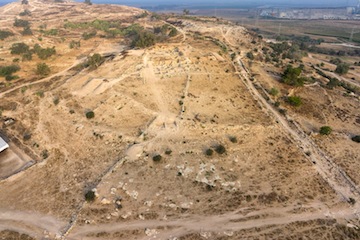
In the ancient city of Gath, now Tell es-Safi, an international team of archeologists has uncovered the earliest example of the use of a bridle bit with an equid in the Near East. (photo from Ashernet)

photo - An aerial view of Tell es-Safi
An aerial view of Tell es-Safi. (photo from Ashernet)

“The use of a bridle bit on a donkey during this period is surprising, since it was commonly assumed that donkeys were controlled with nose rings, as depicted in Mesopotamian art,” said Bar-Ilan University’s Prof. Aren Maeir, who has led the Tell es-Safi/Gath Archeological Project since its inception more than 20 years ago. Evidence of the bit was derived from the skeleton of an ancient donkey dating to the Early Bronze Age III (approximately 2700 BCE). The donkey is one of four that were found buried under neighbourhood houses, indicating the importance of the donkey in this society. Studies of the dental isotopes from this particular donkey (with the bit) demonstrate that it was born and raised in Egypt and brought to the site only in the last few months of its life, before it was sacrificed and buried beneath the floor of the house as it was being rebuilt. The research has been funded by the Canadian Social Science and Humanities Research Council, with additional funds from BIU and the University of Manitoba; the researchers come from BIU, U of M, University of Saskatchewan, Ariel University and Grand Valley State University; their findings were published in the May 16 edition of the journal PLOS ONE.

Format ImagePosted on June 1, 2018May 30, 2018Author Edgar AsherCategories IsraelTags archeology, Aren Maeir, Bar-Ilan University, history, Israel, Tell es-Safi
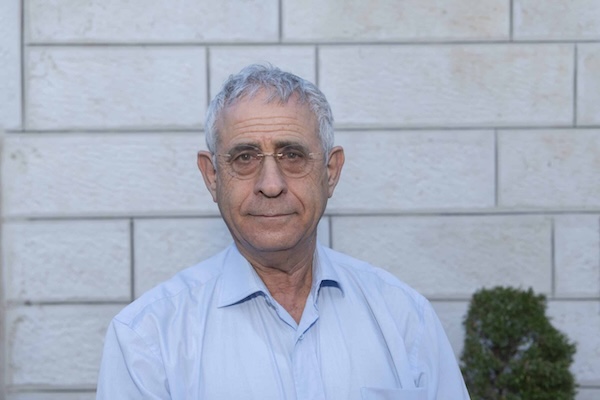
מרדכי קידר מגיע לוונקובר

מרדכי קידר מגיע לוונקובר

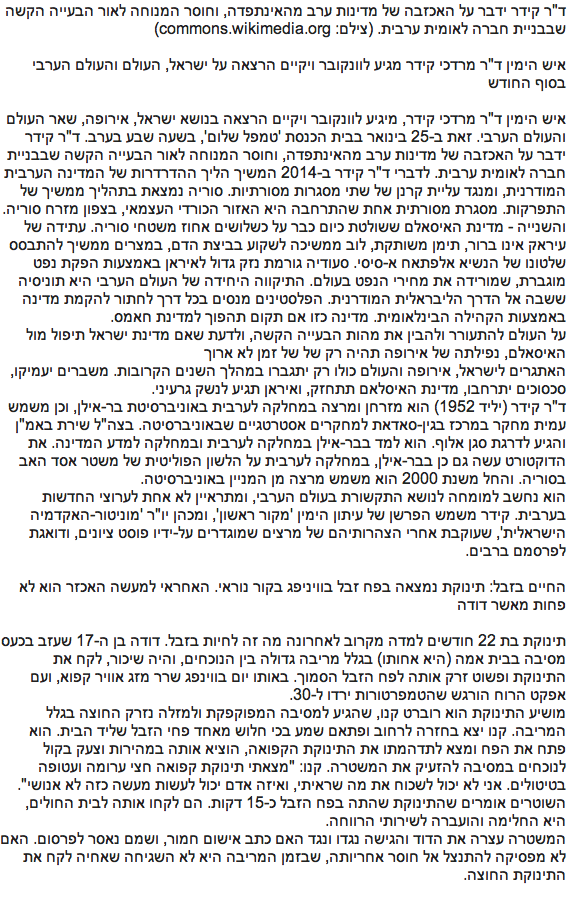
image - interesting in news 13 - Kedar lecture, baby left for dead in Winnipeg

Format ImagePosted on January 14, 2015Author Roni RachmaniCategories עניין בחדשותTags Bar-Ilan University, Middle East, Mordechai Kedar, Robert Keno, Temple Sholom, בבר-אילן, טמפל שלום, מזרחן, מרדכי קידר, רוברט קנו
Proudly powered by WordPress