Skip to content
  • Home
  • Subscribe / donate
  • Events calendar
  • News
    • Local
    • National
    • Israel
    • World
    • עניין בחדשות
      A roundup of news in Canada and further afield, in Hebrew.
  • Opinion
    • From the JI
    • Op-Ed
  • Arts & Culture
    • Performing Arts
    • Music
    • Books
    • Visual Arts
    • TV & Film
  • Life
    • Celebrating the Holidays
    • Travel
    • The Daily Snooze
      Cartoons by Jacob Samuel
    • Mystery Photo
      Help the JI and JMABC fill in the gaps in our archives.
  • Community Links
    • Organizations, Etc.
    • Other News Sources & Blogs
    • Business Directory
  • FAQ
  • JI Chai Celebration
  • JI@88! video

Recent Posts

  • האלימות בישראל מורגשת בהרבה מגזרים
  • טראמפ עוזר דווקא לנושא הפלסטיני
  • New rabbi settles into post
  • A light for the nations
  • Killed for being Jewish 
  • The complexities of identity
  • Jews in time of trauma
  • What should governments do?
  • Annie will warm your heart
  • Best of the film fest online
  • Guitar Night at Massey
  • Partners in the telling of stories
  • Four Peretz pillars honoured
  • History as a foundation
  • Music can comfort us
  • New chapter for JFS
  • The value(s) of Jewish camp
  • Chance led to great decision
  • From the JI archives … camp
  • עשרים ואחת שנים להגעתי לונקובר
  • Eby touts government record
  • Keep lighting candles
  • Facing a complex situation
  • Unique interview show a hit
  • See Annie at Gateway
  • Explorations of light
  • Help with the legal aspects
  • Stories create impact
  • Different faiths gather
  • Advocating for girls’ rights
  • An oral song tradition
  • Genealogy tools and tips
  • Jew-hatred is centuries old
  • Aiding medical research
  • Connecting Jews to Judaism
  • Beacon of light in heart of city

Archives

Follow @JewishIndie
image - The CJN - Visit Us Banner - 300x600 - 101625

Tag: global politics

Hope for a good year

We begin the cycle of a new year in the coming days. We are all reflecting on our lives, our actions and our place in the world at this time of year. Perhaps, in the past two years, we are doing this more than ever before, even without the catalyst of the month of Elul or the impending holy days as motivation.

One of the things many of us are certainly pondering is how we move through life, and whether we approach the world with the balance tilted towards wonder and hope or towards cynicism and pessimism. These choices are challenging no matter where or under what conditions you live. For Jews in Israel and the diaspora right now, they are especially poignant.

A strength of Jewish life and practice is the capacity to hold sadness and joy in the same moments – life is rarely all one or the other. We mourn that there are still people being held hostage, the deaths in Israel and Gaza and in other conflicts, loved ones facing illness and confronting mortality, natural disasters, climate change, creeping 

authoritarianism in many countries, and all the big and small sadnesses of being human, but these are, above all, a part of being alive. In Judaism, it is a mitzvah to choose life through our actions and choices. This commandment appears in a Torah portion we read prior to Rosh Hashanah, reminding us that we can choose hope over despair, that we can choose a different reality.  

This duality will be on full display in the coming days as we move through the holy days, including navigating the joys and now sorrows of Simchat Torah, which will forever be equated in our memories with the atrocities of 10/7. 

Along with holding joy and sadness in the same moment is holding more than one truth, that being strong is being able to experience things that sadden or madden us and not permit their presence to destroy what happiness or equanimity we have.

Pirkei Avot asks and answers: “Who is mighty? One who conquers his impulse.” 

If our impulse is to be angry, vengeful, depressed or miserable, we might conclude that we have no control over these responses. We do. It’s not easy, but it is within our capability.

Without minimizing the challenges, neither should we dwell on them exclusively.

In the context of Jewish history, victory of a sort in our era comes from being physically safe, with the opportunity to live a contented, meaningful life.

As you hopefully gather as a community in prayer spaces and around holiday tables in the coming days, may you find a greater sense of ease in the balancing of the sweet and the sorrowful, and may you grant yourself and those you love the consent to live well, with hope for a truly good year. 

Posted on September 12, 2025September 11, 2025Author The Editorial BoardCategories From the JITags global politics, holidays, Judaism, lifestyle, Oct. 7, Rosh Hashanah, Simchat Torah
Problematic work in exhibit

Problematic work in exhibit

“Delible (poppy, watermelon, wheat, walnut, blackberry)” is on display at the Art Gallery of Greater Victoria until Oct. 26, as part of the Architectures of Protection exhibition. (photo by Toni Hafkenscheid, courtesy Susan Hobbs Gallery)

Beth Stuart’s “Delible (poppy, watermelon, wheat, walnut, blackberry)” is part of the Architectures of Protection exhibition, which opened at the Art Gallery of Greater Victoria (AGGV) on May 24 and ends Oct. 26.

In each of the five “Delible” pieces, a black ledge has replicas of food items on top of it and a length of black mesh suspended below. Stuart used plaster, iron oxide pigment, dyed silk, steel and Sumi ink to create the works. The replicas are casts of halved walnuts, pizza crusts, poppy hulls, blackberries and watermelon seeds. According to the artist, each original mold was made from the source itself, except for the watermelon seeds, which were cast from clay originals.

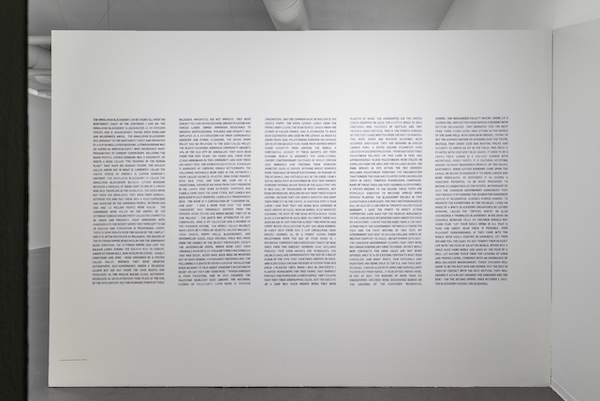
On a wall leading to the five pieces, there is a several-square-foot textual display featuring more than 1,600 words, written entirely in capital letters, with the thoughts seeming to randomly jump from one topic to another; there are no paragraphs, but the words cover five columns. The text, an integral element of the overall artwork, was hand-stenciled by Stuart and relates to the physical pieces. 

photo - Beth Stuart’s “Delible (poppy, watermelon, wheat, walnut, blackberry)” installation comprises a wall of text and five structures
Beth Stuart’s “Delible (poppy, watermelon, wheat, walnut, blackberry)” installation comprises a wall of text and five structures. (photo by Mike Andrew McLean, courtesy Art Gallery of Greater Victoria)

The text begins with mention of the Himalayan blackberry, an invasive species in British Columbia, and then moves to Luther Burbank, an American botanist, horticulturist and eugenicist, before discussing the Armenian Genocide (1915-16) and Canada’s residential schools.

In the middle portion of the textual display, Stuart describes what she sees as the plight of Gazans and the attitudes of certain Israelis.

“AS I WRITE, THERE HAS BEEN NO AID OF ANY KIND FOR ALMOST TWO MONTHS AND EVERY WATER DESALINATION PLANT HAS BEEN BOMBED,” Stuart writes. “IN EARLY 2024 THERE WAS A CLIP CIRCULATING FROM ISRAELI CHANNEL 14, OF A PUNDIT SAYING EVERY PALESTINIAN OVER THE AGE OF FOUR YEARS IS A POTENTIAL TERRORIST AND A NECESSARY TARGET OF WAR. SINCE THEN TWO KNESSET MEMBERS HAVE DECLARED PUBLICLY THAT EVEN INFANTS ARE TERRORISTS. THE DELIBLES BAGS ARE APPROXIMATELY THE SIZE OF A BAG OF FLOUR OF THE TYPE THAT SOMETIMES ARRIVES IN GAZA, AND ALSO COULD CONTAIN THE BODY OF A FOUR-YEAR-OLD CHILD.”

Stuart then talks about tree-planting, which she apparently did in university, then writes: “THIS IS THE FOURTH VERSION OF THIS TEXT I HAVE WRITTEN OVER THE PAST 20 MONTHS. THIS WEEK THERE ARE MASSIVE WILDFIRES NEAR OCCUPIED JERUSALEM. THEY ARE BURNING IN AYALON CANADA PARK, A SEVEN SQUARE KILOMETER PARK LOCATED IN OCCUPIED PALESTINE. THERE HAD BEEN THREE PALESTINIAN VILLAGES ON THIS LAND IN 1948. AND APPROXIMATELY 10,000 PALESTINIANS WERE KILLED OR EXPELLED FROM THE AREA AND THE VILLAGES RAZED.”

She talks more about “THE ORGANIZATION THAT FUNDED THE PARK” without naming it and then raises the issue of the Canadian government’s involvement with Israel and, specifically, its military.

“BETWEEN OCTOBER 7TH 2023 AND THE FIRST WRITING OF THIS TEXT, MY GOVERNMENT HAD SENT 30 MILLION DOLLARS WORTH OF MILITARY SUPPORT TO ISRAEL,” she writes. “ON SEPTEMBER 10TH 2024 THE CANADIAN GOVERNMENT CLAIMED THAT THEY WERE NO LONGER SENDING ANY ARMS TO ISRAEL. IN FACT, WHILE CONTRACTS FOR ARMS SALES ARE NOT BEING OFFERED, ONLY 12% OF EXISTING CONTRACTS HAVE BEEN CANCELLED, AND MANY PARTS, RAW MATERIALS AND MUNITIONS ARE BEING SOLD TO THE U.S. AND THEN SENT TO ISRAEL. CANADA ALSO BUYS ARMS AND SURVEILLANCE TECHNOLOGY FROM ISRAEL.”

The text moves into Stuart’s comments on residential schools before she concludes with the sentence: “FOR THE SECOND SPRING SINCE OCTOBER 7, 2023 THE BLACKBERRY HEDGES ARE BLOOMING.”

To at least one member of the Victoria Jewish community, Stuart’s work is an example of “artfully coded antisemitism – all the more reprehensible for its coyness.”

“In itself, ‘Delibles’ are very beautiful, evocative works,” Maurice Yacowar, a professor emeritus (English and film studies) of the University of Calgary, wrote in a letter to the art gallery that was also sent to the Independent.

“What renders the work problematic is the full-wall text – in spectral grey – that accompanies the sculptures,” Yacowar said. 

He said,“As a whole, the work contrasts the self-renewal of nature’s produce with humans’ murderousness. Unfortunately, the art is undermined by the artist’s ignorance and prejudice in its Palestinian references.”

He said Stuart misrepresents Israel and its media by choosing to reference a news outlet “that even in Israel is considered extremist.” And, he argues,“She omits the Oct. 7 context. A Hamas spokesman flatly stated, ‘There are no civilians in Israel’ – ie., only targets in war.”

Stuart’s exhibit does not include the word “Hamas.”

In a statement to the Independent, the AGGV said:

“The gallery is aware that some members of the community disagree with the subject matter of a current work of art on display. We are always interested to hear how the public, and our members, respond to our exhibitions. We also embrace learning, new ideas and critical perspectives.

“At the AGGV, we respect the artists and curators who work with us to create exceptional exhibitions. As an arts institution, our role is to amplify artists’ voices and create space for conversation and learning. We encourage an exchange of ideas that results in meaningful dialogue and understanding through art.”

The Architectures of Protection exhibition, in the synopsis posted by the AGGV, is supposed to reflect “on ideas and modes of protection and refuge – with regards to oneself, to community, knowledge, culture, identity and land. What are these spaces and practices? What is protection for some and not for others? 

Together, in the wake of the COVID-19 pandemic and in the current global social and political climate, the artworks in Architectures of Protection direct critical attention towards systems and structures that shape and impact everyday and sacred environments and encounters, alongside individual and collective relationships with the land.”

The exhibit also features the artwork of Dana Claxton, Jessica Karuhanga, Emilio Rojas and France Trépanier. 

Sam Margolis has written for the Globe and Mail, the National Post, UPI and MSNBC.

Format ImagePosted on September 12, 2025September 11, 2025Author Sam MargolisCategories Visual ArtsTags AGGV, antisemitism, Art Gallery of Greater Victoria, artwork, Beth Stuart, Canada, First Nations, Gaza, genocide, global politics, Israel, sculpture
Genocide claims examined

Genocide claims examined

The authors of Debunking the Genocide Allegations: A Reexamination of the Israel-Hamas War from October 7, 2023 to June 1, 2025 sought to do two things in their research: assess the factual basis of war crime and genocide allegations, and examine how information is gathered and transmitted in conflict zones. Among the claims examined is whether enough aid was getting into Gaza from Israel. (IDF Spokesperson via besacenter.org)

A new study conducted by a team of researchers critically examines accusations that Israel committed crimes against humanity, such as planned starvation, deliberate massacres and even “genocide,” during the Israel-Gaza War, between Oct. 7, 2023, and June 1, 2025. Using a blend of quantitative-statistical analysis, forensic documentation, primary sources and comparative military history, the study aims to distinguish propaganda from fact and highlight systemic failures in major international information bodies. Its authors emphasize that their objective is not legal or moral exoneration, but a factual analysis of the methodologies and evidence behind genocide claims.

Research for the 311-page study – Debunking the Genocide Allegations: A Reexamination of the Israel-Hamas War from October 7, 2023 to June 1, 2025 – was led by Prof. Danny Orbach, a military historian from the department of history at the Hebrew University of Jerusalem, in collaboration with Dr. Jonathan Boxman, an expert in quantitative research; Dr. Yagil Henkin, a military historian at the Shalem Centre and the Jerusalem Institute for Strategy and Security; and attorney Jonathan Braverman, a member of the Israeli bar and a lawyer for International Humanitarian Law. It is published by the Begin-Sadat Centre for Strategic Studies at Bar-Ilan University in collaboration with the aforementioned institutions.

The researchers sought to do two things: assess the factual basis of war crime and genocide allegations, and examine how information is gathered and transmitted in conflict zones, particularly in regions ruled by oppressive regimes and/or populated by closed societies with a strong “resistance” ethos. Special emphasis was placed on cross-referencing Israeli, Palestinian and international sources, while actively avoiding ideological bias and preconceived assumptions. The authors highlight that subordinating factual analysis to advocacy narratives can undermine public policy and distort ethical and legal discourse.
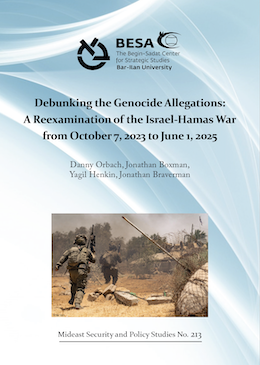
image - Debunking the Genocide Allegation report coverThe study’s key findings are:

No basis for starvation claims prior to March 2025

• More food entered Gaza during the war than before Oct. 7, 2023. The claim that 500 aid trucks are required daily stems from a misrepresentation by United Nations bodies, one that was left unchallenged and unchecked. Prewar UN records cite an average of 73 food trucks per day in 2022. During the fighting (until Jan. 17, 2025), the Coordination of Government Activities in the Territories (COGAT) recorded an average of 101 food trucks daily whereas retroactively corrected but still incomplete UN Relief and Works Agency for Palestine Refugees (UNRWA) data indicated 83 food trucks per day. Food that entered the Gaza Strip during the ceasefire should have sufficed until late July 2025, according to World Food Programme projections, even absent any aid following the resumption in the fighting. It is hard to explain this gap without considering extensive looting by Hamas, for which the study’s authors provide ample evidence.

• Although UNRWA initially reported a 70% drop in aid after May 2024 and the Rafah operation, it later retroactively corrected these reports. This correction was effectively unannounced and hence the supposed aid drop continues to be cited broadly.

• Contrary to the claim that 44% of Gaza’s food comes from local agriculture, the study finds this number was baseless even before the Hamas takeover. It is likely that, even in 2005, Gazan agriculture accounted for no more than 12% of Gazan caloric consumption and the number is almost certainly much lower today. The study further finds that even if every ton of crops produced in Gaza in 2011 (the last year in which an analysis was published) was substituted, the number of trucks entering Gaza per capita throughout the war would still be 58% higher per capita than it was in 2011.

• Notwithstanding the above, the authors strongly criticize the decision to stop aid to Gaza between March and May 2025.

No evidence of a systematic civilian targeting policy

While isolated incidents may point to negligence or localized misconduct and suspicion of individual war crimes, no evidence was found of overarching directives aimed at harming civilians. The authors did, however, try to map the patterns of Israel Defence Forces misconduct and possible crimes, and examine which crimes were probably more prevalent and which ones were relatively absent from this conflict.

Data manipulation by Hamas

The Gaza Health Ministry, per Hamas directives, categorizes all deaths as civilian. This manipulation has significantly skewed international reporting. Indications have been found for the inclusion of age-related natural deaths, particularly of women, in the ministry of health’s lists and exclusion of combat-aged men.

IDF’s exceptional precautionary measures

The IDF has implemented unprecedented steps, such as early warnings, precision targeting and mission aborts to avoid civilian harm. These actions, while costly to the IDF, have reduced non-combatant casualties.

Evacuation zones were significantly safer

According to partial data, less than 4% of deaths occurred in Mawasi and the central camps – areas marked as evacuation zones by the IDF – undermining claims of deliberate attacks on safe areas. The failure of the UN to cooperate with the establishment of such zones resulted in considerable loss of civilian life.

Systematic failures in UN and NGO reporting

Numerous claims were based on circular citation, opaque assessments and unannounced retroactive corrections. For instance, UNRWA’s truck count discrepancies were corrected without sufficient publicity. Updated UN data confirms Israel’s consistent assertion of increased aid after May 2024.

A precedent for this kind of flawed reporting can be found in the aftermath of the 2009 Gaza War. Former UN jurist Richard Goldstone, who led the United Nations Fact-Finding Mission on the Gaza Conflict, later expressed regret over some of the report’s conclusions. In a 2011 Washington Post op-ed, he wrote: “If I had known then what I know now, the Goldstone Report would have been a different document.” 

The suffering of civilians in Gaza is both tragic and undeniable. However, this research calls on the international community to ensure that humanitarian discourse remains anchored in verifiable facts. Without accurate data, advocacy loses credibility – and future atrocities may be overlooked due to inflated or politicized claims.

While the suffering of civilians in Gaza is indisputable, the authors caution against humanitarian advocacy narratives built on unverified or manipulated data. Their study does not aim to exonerate or diminish the suffering experienced, but rather to protect the integrity of academic discourse and, by implication, humanitarian and public discourse. When advocacy eclipses accuracy, policy decisions become distorted and genuine accountability is compromised, the authors warn. They urge the international community to uphold higher evidentiary standards in conflict reporting – regardless of the actors involved.

Broader methodological analysis

This study is not unique to the Israel-Gaza conflict. Similar patterns of humanitarian data distortion were identified in Iraq under sanctions, raising broader questions about the methodologies employed in closed or authoritarian environments.

The study also examined other conflict zones, such as Iraq in the 1990s. During that period, it was widely claimed – based on Iraqi government data and a UN Food and Agriculture Organization survey – that hundreds of thousands of children died due to sanctions. The survey reported a rise in infant mortality from 40.7 to 198.2 per 1,000 children. These findings were later revealed to be fabricated by Iraqi authorities. Even when the researcher who conducted the survey acknowledged being misled, the correction failed to impact the wider humanitarian discourse.

Likewise, inflated assessments of violent and nonviolent Iraqi deaths during the Iraq War were widely disseminated and accepted during the conflict – only being laid to rest definitively in 2023.

“Humanitarian bias”

The authors introduce the term “humanitarian bias” to describe a tendency among aid organizations to accept alarming claims from stakeholders in order to mobilize urgent action. In this context, factual corrections are often met with hostility or ignored altogether – undermining accuracy in humanitarian reporting. Even when myths are disproven, corrections are rarely incorporated into public or academic understanding.

The study proposes a new methodological framework for analyzing violent conflicts – one that prioritizes cross-referencing multiple sources, systematic scrutiny and transparency, and resistance to political and media-driven narratives.

The authors emphasize that credible allegations of war crimes demand serious legal and ethical investigation – not only due to their consequences but also in adherence to international law, Israeli law and moral standards.

Orbach warns: “If every severe urban war were defined as genocide, it would ultimately dilute the legal and moral power of the term. ‘Genocide’ would become an empty political slogan, rather than a tool to prevent atrocities.”

This study builds on that call for greater evidentiary caution, particularly in war zones governed by authoritarian regimes.

Debunking the Genocide Allegations can be downloaded at besacenter.org. Following the publication of the Hebrew edition on July 4, 2025, there was extensive feedback from readers, critics, experts and commentators. In some cases,  there was valid criticism that warranted corrections and revisions. Consequently, the English edition is not a mere translation of the Hebrew version but a thoroughly revised, corrected and updated work. 

– Courtesy Hebrew University of Jerusalem

Format ImagePosted on September 12, 2025September 11, 2025Author Hebrew University of JerusalemCategories Israel, WorldTags Bar-Ilan University, Begin-Sadat Centre for Strategic Studies, countering disinformation, Debunking the Genocide Allegations, food aid, genocide, global politics, Hebrew University of Jerusalem, humanitarian bias, International Humanitarian Law., Iraq War, Israel-Hamas war, research, Shalem Centre, war
Israeli envoy hopeful

Israeli envoy hopeful

Iddo Moed, Israel’s ambassador to Canada, was in British Columbia to promote partnerships. (photo by Pat Johnson)

Iddo Moed, Israel’s ambassador to Canada, was in Vancouver last week, meeting with businesspeople, university administrators and the Jewish community. It was his second visit to Vancouver since his appointment as ambassador a year ago.

Moed hopes to establish and expand collaborations between Israeli and Canadian academic institutions in the fields of medicine, agriculture, artificial intelligence, cybersecurity and applied research in many disciplines, as well as introduce business leaders from both countries to one another to encourage possible partnerships. He plans to bring some of the leading figures in various Israeli sectors on a cross-Canada road show, possibly early in 2025.

In a discussion with the Jewish Independent and three other media outlets, the ambassador focused on antisemitism in Canada and especially the climate on campuses. 

“Most disturbing me at this time is the rise of antisemitism in Canada,” he said. “It’s something that is beyond what has happened in the past.… I am concerned because I see that Jewish communities feel less protected. Jewish students at universities feel intimidated. They don’t want to go to campus or they want to hide their identity and I think this is wrong.”

He has met with university administrators – he took heart in the resounding rejection of an anti-Israel motion by the University of British Columbia senate earlier this year – and discussed with them the need to balance academic freedom with security for Jewish, Israeli and all students.

Moed urges Canadian students to make a more thorough investigation of the roots of the current conflict and not mistake the current war as a battle between Israelis and Palestinians.

“At this point in time, we’re fighting against something else, against Hamas, against hatred,” he said. “I would challenge students to look at … both sides and try to understand.”

When speaking with students, Moed said, he emphasizes stories of coexistence in Israel.

On Oct. 7, he noted, many of the ambulances that day were driven by Arab first responders, because it was a Jewish holiday. 

“Those Arab drivers that were caught by the Hamas terrorists were executed because [the terrorists] felt – just like they killed Israeli Jewish [people] – these are Israelis,” he said. “The solidarity in Israel is something that passes much of media’s attention.”

The ambassador also urges students and anyone who is engaging in discussion of the conflict to understand what the combatants represent.

“Hamas doesn’t want any deviance from their core concept of how religions should be practised,” he said. “So, there is no room for LGBTQ and there is no Queers for Palestine among Palestinians. It doesn’t exist because they don’t let them. It’s forbidden to be gay there.”

Overseas activists would do well to speak to people in the region, Moed said.

“I wish that people here would communicate with peers in the Middle East, Jews and non-Jews, hear from them, to educate themselves. That’s very, very important at this time.”

The ambassador acknowledged that relations between Israel and Canada have always been strong, but that the current conflict is causing diplomatic friction.

“The relations have always been very good and strong because they are based on a very solid foundation of shared values between Canada and Israel and that has been the case since Canada officially recognized Israel 75 years ago,” he said. “What we have today … is a growing distance between how both our countries see the conflict in the Middle East. Israel is fighting for its survival. Canada has become more and more critical of, and concerned about, the situation when it comes to the Palestinians.

“We have very good channels of communication and those are very solid and strong,” he said. “Right now, a year from the massacres [of Oct. 7] and when there are still 101 hostages being held in Gaza for which we will continue to fight until they will all come back home, dead or alive, the relations are strained by the fact that both our countries don’t always see eye-to-eye on how Israel is defending itself against a concerted effort by Iran, directly through its proxies, to annihilate the state of Israel.”

Moed, who was born in Amsterdam, has had diplomatic postings in the Netherlands, the Dominican Republic, Singapore and the People’s Republic of China, and he has held senior positions in the foreign ministry in Israel.

These are unprecedented times, he said, but he is confident that the situation will improve for Israelis and Jews.

“It will take time, but I’m very hopeful,” he said. “Humanity always prevails. It takes more time, but it does prevail. So, I’m hopeful. Yes, I’m an optimist.”

Format ImagePosted on September 20, 2024September 18, 2024Author Pat JohnsonCategories LocalTags ambassador, antisemitism, campuses, diplomacy, global politics, Iddo Moed, Israel, Israel-Hamas war, Oct. 7
Proudly powered by WordPress