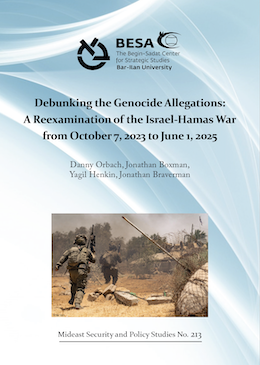
The authors of Debunking the Genocide Allegations: A Reexamination of the Israel-Hamas War from October 7, 2023 to June 1, 2025 sought to do two things in their research: assess the factual basis of war crime and genocide allegations, and examine how information is gathered and transmitted in conflict zones. Among the claims examined is whether enough aid was getting into Gaza from Israel. (IDF Spokesperson via besacenter.org)
A new study conducted by a team of researchers critically examines accusations that Israel committed crimes against humanity, such as planned starvation, deliberate massacres and even “genocide,” during the Israel-Gaza War, between Oct. 7, 2023, and June 1, 2025. Using a blend of quantitative-statistical analysis, forensic documentation, primary sources and comparative military history, the study aims to distinguish propaganda from fact and highlight systemic failures in major international information bodies. Its authors emphasize that their objective is not legal or moral exoneration, but a factual analysis of the methodologies and evidence behind genocide claims.
Research for the 311-page study – Debunking the Genocide Allegations: A Reexamination of the Israel-Hamas War from October 7, 2023 to June 1, 2025 – was led by Prof. Danny Orbach, a military historian from the department of history at the Hebrew University of Jerusalem, in collaboration with Dr. Jonathan Boxman, an expert in quantitative research; Dr. Yagil Henkin, a military historian at the Shalem Centre and the Jerusalem Institute for Strategy and Security; and attorney Jonathan Braverman, a member of the Israeli bar and a lawyer for International Humanitarian Law. It is published by the Begin-Sadat Centre for Strategic Studies at Bar-Ilan University in collaboration with the aforementioned institutions.
The researchers sought to do two things: assess the factual basis of war crime and genocide allegations, and examine how information is gathered and transmitted in conflict zones, particularly in regions ruled by oppressive regimes and/or populated by closed societies with a strong “resistance” ethos. Special emphasis was placed on cross-referencing Israeli, Palestinian and international sources, while actively avoiding ideological bias and preconceived assumptions. The authors highlight that subordinating factual analysis to advocacy narratives can undermine public policy and distort ethical and legal discourse.
 The study’s key findings are:
No basis for starvation claims prior to March 2025
• More food entered Gaza during the war than before Oct. 7, 2023. The claim that 500 aid trucks are required daily stems from a misrepresentation by United Nations bodies, one that was left unchallenged and unchecked. Prewar UN records cite an average of 73 food trucks per day in 2022. During the fighting (until Jan. 17, 2025), the Coordination of Government Activities in the Territories (COGAT) recorded an average of 101 food trucks daily whereas retroactively corrected but still incomplete UN Relief and Works Agency for Palestine Refugees (UNRWA) data indicated 83 food trucks per day. Food that entered the Gaza Strip during the ceasefire should have sufficed until late July 2025, according to World Food Programme projections, even absent any aid following the resumption in the fighting. It is hard to explain this gap without considering extensive looting by Hamas, for which the study’s authors provide ample evidence.
• Although UNRWA initially reported a 70% drop in aid after May 2024 and the Rafah operation, it later retroactively corrected these reports. This correction was effectively unannounced and hence the supposed aid drop continues to be cited broadly.
• Contrary to the claim that 44% of Gaza’s food comes from local agriculture, the study finds this number was baseless even before the Hamas takeover. It is likely that, even in 2005, Gazan agriculture accounted for no more than 12% of Gazan caloric consumption and the number is almost certainly much lower today. The study further finds that even if every ton of crops produced in Gaza in 2011 (the last year in which an analysis was published) was substituted, the number of trucks entering Gaza per capita throughout the war would still be 58% higher per capita than it was in 2011.
• Notwithstanding the above, the authors strongly criticize the decision to stop aid to Gaza between March and May 2025.
No evidence of a systematic civilian targeting policy
While isolated incidents may point to negligence or localized misconduct and suspicion of individual war crimes, no evidence was found of overarching directives aimed at harming civilians. The authors did, however, try to map the patterns of Israel Defence Forces misconduct and possible crimes, and examine which crimes were probably more prevalent and which ones were relatively absent from this conflict.
Data manipulation by Hamas
The Gaza Health Ministry, per Hamas directives, categorizes all deaths as civilian. This manipulation has significantly skewed international reporting. Indications have been found for the inclusion of age-related natural deaths, particularly of women, in the ministry of health’s lists and exclusion of combat-aged men.
IDF’s exceptional precautionary measures
The IDF has implemented unprecedented steps, such as early warnings, precision targeting and mission aborts to avoid civilian harm. These actions, while costly to the IDF, have reduced non-combatant casualties.
Evacuation zones were significantly safer
According to partial data, less than 4% of deaths occurred in Mawasi and the central camps – areas marked as evacuation zones by the IDF – undermining claims of deliberate attacks on safe areas. The failure of the UN to cooperate with the establishment of such zones resulted in considerable loss of civilian life.
Systematic failures in UN and NGO reporting
Numerous claims were based on circular citation, opaque assessments and unannounced retroactive corrections. For instance, UNRWA’s truck count discrepancies were corrected without sufficient publicity. Updated UN data confirms Israel’s consistent assertion of increased aid after May 2024.
A precedent for this kind of flawed reporting can be found in the aftermath of the 2009 Gaza War. Former UN jurist Richard Goldstone, who led the United Nations Fact-Finding Mission on the Gaza Conflict, later expressed regret over some of the report’s conclusions. In a 2011 Washington Post op-ed, he wrote: “If I had known then what I know now, the Goldstone Report would have been a different document.”
The suffering of civilians in Gaza is both tragic and undeniable. However, this research calls on the international community to ensure that humanitarian discourse remains anchored in verifiable facts. Without accurate data, advocacy loses credibility – and future atrocities may be overlooked due to inflated or politicized claims.
While the suffering of civilians in Gaza is indisputable, the authors caution against humanitarian advocacy narratives built on unverified or manipulated data. Their study does not aim to exonerate or diminish the suffering experienced, but rather to protect the integrity of academic discourse and, by implication, humanitarian and public discourse. When advocacy eclipses accuracy, policy decisions become distorted and genuine accountability is compromised, the authors warn. They urge the international community to uphold higher evidentiary standards in conflict reporting – regardless of the actors involved.
Broader methodological analysis
This study is not unique to the Israel-Gaza conflict. Similar patterns of humanitarian data distortion were identified in Iraq under sanctions, raising broader questions about the methodologies employed in closed or authoritarian environments.
The study also examined other conflict zones, such as Iraq in the 1990s. During that period, it was widely claimed – based on Iraqi government data and a UN Food and Agriculture Organization survey – that hundreds of thousands of children died due to sanctions. The survey reported a rise in infant mortality from 40.7 to 198.2 per 1,000 children. These findings were later revealed to be fabricated by Iraqi authorities. Even when the researcher who conducted the survey acknowledged being misled, the correction failed to impact the wider humanitarian discourse.
Likewise, inflated assessments of violent and nonviolent Iraqi deaths during the Iraq War were widely disseminated and accepted during the conflict – only being laid to rest definitively in 2023.
“Humanitarian bias”
The authors introduce the term “humanitarian bias” to describe a tendency among aid organizations to accept alarming claims from stakeholders in order to mobilize urgent action. In this context, factual corrections are often met with hostility or ignored altogether – undermining accuracy in humanitarian reporting. Even when myths are disproven, corrections are rarely incorporated into public or academic understanding.
The study proposes a new methodological framework for analyzing violent conflicts – one that prioritizes cross-referencing multiple sources, systematic scrutiny and transparency, and resistance to political and media-driven narratives.
The authors emphasize that credible allegations of war crimes demand serious legal and ethical investigation – not only due to their consequences but also in adherence to international law, Israeli law and moral standards.
Orbach warns: “If every severe urban war were defined as genocide, it would ultimately dilute the legal and moral power of the term. ‘Genocide’ would become an empty political slogan, rather than a tool to prevent atrocities.”
This study builds on that call for greater evidentiary caution, particularly in war zones governed by authoritarian regimes.
Debunking the Genocide Allegations can be downloaded at besacenter.org. Following the publication of the Hebrew edition on July 4, 2025, there was extensive feedback from readers, critics, experts and commentators. In some cases, there was valid criticism that warranted corrections and revisions. Consequently, the English edition is not a mere translation of the Hebrew version but a thoroughly revised, corrected and updated work.
– Courtesy Hebrew University of Jerusalem