At the age of 80, after 40 years of researching and collecting material on the Jewish farming colonies of Saskatchewan, scholar Anna Feldman donated the entire body of research to the Canadian Museum of History in Gatineau, Que. Among the materials are audiocassettes with songs, interviews and oral narratives, personal memoirs and other textual documents. It’s a rich contribution that sheds light on those small colonies and the hopes and dreams of their Jewish inhabitants, said Judith Klassen, music curator at the museum.
“It really makes sense for it to be here,” Klassen said. “The breadth of Anna’s work is really exciting. For example, she didn’t record only one particular genre of song as she looked at Yiddish song and culture. Rather, she recorded different types of music from a broad spectrum of people, including cantorial training, ornamentation, traditional song and storytelling.”
How Jews ended up in Saskatchewan
Jews arrived in Saskatchewan in the 1880s, many fleeing from persecution in Europe. They established farming colonies with names like New Jerusalem, Sonnenfeld and Edenbridge and, by 1930, those colonies were populated by thousands of Jewish farmers and their families. The Jewish colonies’ decline started in the 1930s with the Depression and drought. By the 1960s, most of the farm colonists had left the land for larger cities. Today, all that remains is open prairie where homes and settlements once were, small cemeteries marking the graves of the original settlers. In Edenbridge, the Beth Israel Synagogue, constructed in Carpenter Gothic style in 1906 and used until the 1960s, is now a municipal heritage site. But for any kind of context about the lives lived here, you have to go to the museum.
Fortunately, material like Feldman’s, which is being processed for the public archives, is accessible. To immerse yourself in the collection you have to travel to Gatineau, but for those who are looking for specific documents, those can be ordered, copied, scanned or mailed. “We’ve already had inquiries from people interested in this collection, even from outside of Canada, which shows it’s of interest beyond our borders,” Klassen said.
The origins of the research
Feldman’s interest in the Jewish pioneers was sparked when she married the son of a pioneer family from the Sonnenfeld homestead. Her late spouse was attached to Sonnenfeld all his life and Feldman’s first interview was in 1978, with his mother.
An accomplished scholar, Feldman returned to university as a mature student and obtained an ARCT in singing, a bachelor of music and a master’s degree in Canadian studies from Carleton University. In 1983, she received the Norman Pollock Award in Canadian Jewish Studies. Today, she lives in a seniors residence in Toronto.
Feldman began donating her collection of music to the Museum of History’s Centre for Folk Culture Studies in early 2000. The first 188 audio cassettes containing interviews with Jewish musicians, homesteaders, merchants and professionals who were part of the rural farming communities in Saskatchewan have been processed and are available in the catalogue. Part two of her collection is still being processed.
“In terms of Jewish cultural expression and settlement in Saskatchewan, this collection is foundational,” Klassen noted. Partly, that’s due to Feldman’s skill as an interviewer. “She’s very pointed in her questioning and very thoughtful in how she asks questions. She allows her subjects to talk about their background and interests, but guides them so she covers the key areas she is interested in. In the breadth of her fieldwork and interviews, you get a nuanced perspective on the experiences people had; for example, on antisemitism, but also on mutual respect. You see there’s a broad spectrum of opinions even within the particular settlement. That’s one of the really unique things about this collection.”
The importance of Feldman’s work
“I don’t want the people of Canada, especially the Jews, to be unaware that we had pioneers in Canada who came here when there was no one else in the land. Jews don’t know about this and neither does the general public, and I think people should know about it,” Feldman has reflected.
After her first interview, she traversed Canada twice looking for Jewish pioneers and their children. “I remember visiting one family in Winnipeg whose elderly mother was a descendent of a Jewish pioneer family,” she recalled. “She was blind and unwell, but when she heard about my interest she met me and we had a wonderful time. She was reminiscing and we sang songs together until 2 a.m.!”
What she learned from those interviews is that the early Jewish pioneers in Canada suffered a great deal. “They had the economic depression, problems with weather, land and soil, and all sorts of plagues, but they had the strength to survive,” Feldman said. “They weren’t farmers when they came, and Canada didn’t want Jews, but the Canadian government was afraid the Americans would take over the Prairie provinces, so because of that they allowed the Jews to come.”
She continued, “I think people should have pride in all [that] those Jewish pioneers accomplished. They survived in spite of all the difficulties they had and they made a tremendous contribution to Canada – them, their children and their children’s children.”
A list of the material catalogued thus far is available on the museum’s website at historymuseum.ca. Search the archives by author Anna Feldman to find a description of the material in each box.
Lauren Kramer, an award-winning writer and editor, lives in Richmond, B.C. To read her work online, visit laurenkramer.net.
In collaboration with the Isaac Waldman Jewish Public Library, the Jewish Independent will be reprinting a series of book reviews by Robert Matas, formerly with the Globe and Mail. He has chosen My Promised Land: The Triumph and Tragedy of Israel (Speigel & Grau, New York) by Haaretz journalist Ari Shavit as the first in the series. My Promised Land has been listed as number one on the Economist’s best books of 2013, is a winner of a National Jewish Book Award and is included on the New York Times’ list of 100 notable books of 2013.
Israel is an incredibly strong country. Its high-tech start-ups spur economic growth while most of the world is trying to sidestep a financial meltdown. Its democratic institutions remain vibrant, while its neighbors disintegrate. Its military, backed up by nuclear power, effectively has stopped any attack on the state over several decades despite virulent opposition to its existence.
My Promised Land offers a fascinating window into the country at a crucial time in Israel’s history.
Yet the fault lines in Israeli society steadily widen. Internal divisions that threaten the country spread out in all directions. The rumblings of unrest are becoming louder and more frequent, from the occupied territories, the Arab Israeli communities, the ultra-Orthodox enclaves and the non-Ashkenazi underclass.
Ari Shavit, in My Promised Land: The Triumph and Tragedy of Israel, offers a fascinating window into the country at a crucial time in Israel’s history. Based on family diaries, private letters and interviews and discussions with hundreds of Jews and Arabs over a period of five years, Shavit, a leading Israeli journalist and television commentator, has written a book with the potential to change understanding of the seemingly intractable problems confronting Israel.
This book is not for those who believe Israel requires the unquestioning support of Diaspora Jews. With brutal honesty, Shavit describes episodes in Israel’s history that many would like to remain untold, or at least to be discussed only in hushed whispers within the family. But his account of the life stories of numerous people including Aryeh Deri, Yossi Sarid and others who played pivotal roles in the development of the country is essential reading for anyone who is concerned about Israel.
In a nutshell, Shavit concludes that Israel is vulnerable and will remain vulnerable as long as Israeli cities and farms exist where Palestinians once lived. He argues that ending the West Bank occupation will make Israel stronger and is the right thing to do, but evacuating the settlements will not bring peace. The crux of the matter is that all Palestinians who were expelled – not just those in the West Bank – want to return home and will settle for nothing less.
He is pessimistic about the future. Israel can defend itself now, but he anticipates eventually the hand holding the sword must loosen its grip. Eventually, the sword will rust.
“I have learned that there are no simple answers in the Middle East and no quick fix solutions to the Israeli Palestinian conflict. I have realized that the Israeli condition is extremely complex, perhaps even tragic.”
Despite his critical eye on events of the past century, it is difficult to label Shavit’s politics. He was an active member of Peace Now and a vocal critic of the settler movement. But he praises Prime Minister Binyamin Netanyahu for confronting Iran. “I have learned that there are no simple answers in the Middle East and no quick fix solutions to the Israeli Palestinian conflict,” he writes. “I have realized that the Israeli condition is extremely complex, perhaps even tragic.”
***
Shavit explores 120 years of Zionism through vividly written profiles of numerous people beginning with his great-grandfather, Herbert Bentwich, who came to Jaffa on April 15, 1897, on a 12-day trek to explore the land as a home for the Jews. At that time, Palestine was part of the Ottoman Empire, populated mostly by Bedouin nomads and Palestinians serfs with no property rights, no self-rule or national identity.
“It’s quite understandable that one would see the land as a no-man’s land,” Shavit writes. Bentwich would have to turn back if he saw the land as occupied, Shavit adds. “But my great-grandfather cannot turn back. So that he can carry on, my great-grandfather chooses not to see.”
Israel was settled and continues to be populated by people who do not see others who are right in front of them. The early Zionists bought land, often from absentee landlords, and ignored those who had worked the land for generations. Herzl’s Zionism rejected the use of force. But as the number of Jews escaping European antisemitism, a new breed of Jew arrived.
Shavit describes how kibbutz socialism, with its sense of justice and legitimacy, displaced indigenous Palestinians. Jews who were godless, homeless and, in many cases parentless, colonized the land with a sense of moral superiority. “By working the land with their bare hands and by living in poverty, and undertaking a daring unprecedented social experiment, they refute any charge that they are about to seize a land that is not theirs.”
Tracing the development of the state, he identifies in painful detail the Palestinian villages that were wiped out and replaced with Jewish settlements. Transferring the Arab population became part of mainstream Zionism thinking during the riots of 1937, as Zionists confronted a rival national movement. David Ben-Gurion at that time endorsed the compulsory transfer of population to clear vast territories.
“I do not see anything immoral in it,” Ben-Gurion said. By the time of the War of Independence in 1947/48, Palestinians who did not leave voluntarily were, as a matter of routine, forcibly expelled from their homes and the buildings demolished.
Shavit delves deeply into the sad history of the Lydda Valley, where Jewish settlements began in idealism but evolved into what Shavit describes as a human catastrophe. “Forty-five years after Zionism came into the valley in the name of the homeless, it sends out of the Lydda Valley a column of homeless.”
In the new state’s first decade, Israel was on steroids, absorbing nearly one million new immigrants, creating 250,000 new jobs and building 400 new Israeli villages, 20 new cities and 200,000 new apartments. The new Israelis had little time for Palestinians, the Jewish Diaspora or even survivors of the Holocaust. As it marched toward the future, Israel tried to erase the past. The miracle was based on denial, Shavit writes.
“The denial is astonishing. The fact that 700,000 human beings have lost their homes and their homeland is simply dismissed.”
“Ten-year-old Israel has expunged Palestine from its memory and soul, as if the other people have never existed, as if they were never driven out,” he writes. “The denial is astonishing. The fact that 700,000 human beings have lost their homes and their homeland is simply dismissed.”
Yet the denial was essential. Without it, the success of Zionism would have been impossible. Similar to his great-grandfather, if Israel had acknowledged what had happened, it would not have survived, he writes.
He recounts how the settlements in the West Bank have changed the course of Zionism. They began as a response to a fear of annihilation but evolved into an aggressive movement to dislocate Palestinians and prevent peace agreements. Shavit is convinced the settlements will eventually lead to another war. The settlements are an untenable demographic, political, moral and judicial reality that harms the entire country, he writes. He believes occupation must cease for Israel’s sake, even if peace with Palestinians cannot be reached.
With similar intensity, Shavit offers insight into the Masada myth of martyrdom and reports on how Israel developed nuclear power. He maintains that nuclear deterrence has given Israel decades of peace. He exposes the cracks in Israeli society with thought-provoking portraits of prominent figures from the ultra-Orthodox and Sephardi communities.
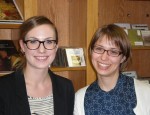
Shannon McLeod, left, and Rachel Yaroshuk. (photo by Olga Livshin)
Unlike academic and institutional libraries, most small public libraries in North America don’t offer ebooks to their readers. Setting up a digital borrowing system requires hours of research and special computer knowledge. It is an expensive endeavor, too, besides presenting several legal wrinkles. Isaac Waldman Jewish Public Library at the Jewish Community Centre of Greater Vancouver is the first Jewish public library in Canada to do so.
In September 2013, the Waldman Library hired two digital content managers, Rachel Yaroshuk and Shannon McLeod, to organize the library’s digital portal. Both have master’s degrees in library and information studies from the University of British Columbia.
In an interview with the Independent, Yaroshuk and McLeod explained that the project grew out of the endowment to the library from the Sonner family, which was established 10 years ago. Eric Sonner, a Holocaust survivor and a local businessman, initiated the endowment.
McLeod said: “Eric was an avid reader. He established a fund with the Jewish Federation of Greater Vancouver for the benefit of the library. The fund was to sit for 10 years, and the interest would finance the library needs. Eric passed away in 2009. After the 10-year term ended in 2013, Eric’s daughter, Eve, approached the library with the idea to launch a unique Jewish ebook collection at the library, using the principle capital. She thought that such a project would be a fitting way to use the money, as her father liked to be cutting edge in his thinking and actions. He also had a strong commitment to the Jewish community and highly valued the library’s contribution.”
Of course, the library embraced the Sonner Family eBook Project, one that would honor the life and values of Eric Sonner. “We want to keep up with the rest of the world,” said librarian Karen Corrin about the new collection. “Everybody is excited about ebooks.” To take this idea from intentions to execution wasn’t easy, however: it took two dedicated professionals and a lot of hard work.
Yaroshuk recalled: “I was working as an on-call librarian at the New Westminster Library when Karen contacted me. We met, and I knew it’s too much for one person. We needed a team of two, so they hired my friend, Shannon. We both studied at the same program at UBC and worked together. Having a good partner is important for such a complex project.”
They started out by looking at possible digital content providers. “We had limited options,” said Yaroshuk. “Only a few suppliers offer ebooks to libraries in Canada. There are legal restrictions. And we needed to find Jewish content. Not all the books are available in e-format. We ended up with OverDrive, one of the leading ebook suppliers for libraries in Canada. The format offered is ePub. Many devices can read it: tablets, Kobo reader, iPhone. The library signed a four-year contract with OverDrive.”
“We’re still building the collection. For now, it includes about 50-50 fiction and non-fiction, children’s and adult books. We’d like some feedback from the community before proceeding.”
At first, 50 books will be available to library patrons, but Yaroshuk noted that it’s only a start. “We’re still building the collection. For now, it includes about 50-50 fiction and non-fiction, children’s and adult books. We’d like some feedback from the community before proceeding.”
McLeod also outlined some technical considerations they faced. “There was a problem of online integration,” she explained. “The digital content doesn’t sit at the library – it’s on the OverDrive servers, but the users will be able to access it from the library catalogue.”
Users will be able to link to it from the library catalogue and download ebooks. They will be able to do so from the library or from anywhere in the world, even from home, as long as they have an internet connection and a library card.
According to McLeod, OverDrive has built a special website for Waldman. It looks similar to the library website and uses the same color scheme. Users will be able to link to it from the library catalogue and download ebooks. They will be able to do so from the library or from anywhere in the world, even from home, as long as they have an internet connection and a library card. After three weeks – a standard library borrowing time – the file will disappear from their reading devices.
The computer aspects, as well as the finding and cataloguing of all the books, took time, but now the system is almost ready. It goes live at the end of February.
“It’s a soft launch,” said Yaroshuk. “The official launch is in the beginning of March, but now the next phase of the project starts – to train everyone to use the new system. We’ll have posters, video instructions and printed handouts, color coordinated for different devices. We’ll have demonstrations and one-on-one sessions for the JCC staff, library volunteers, seniors groups, school kids. We are preparing promotional materials to let everyone know about the new service.”
Of course, an ebook needs an e-reader, and not everyone is comfortable with the idea of digitized books just yet, or even owns an electronic reader, especially older adults. “We’d love to offer some e-readers, too, so people could borrow them as well as ebooks, as the VPL is doing, but it’s expensive,” Corrin said.
As representatives of a younger generation, both McLeod and Yaroshuk own e-readers, but “… I love physical books,” said McLeod. “I don’t think ebooks will replace print; they are just a convenient supplement. When you commute or travel, you can have a few ebooks on your device and not worry that you’ll have nothing to read when you finish a book. And the devices are light.”
For information about the ebook collection, call 604-257-5111, ext. 252, or email ebooks@jccgv.bc.ca.
Olga Livshin is a Vancouver freelance writer. She can be reached at olgagodim@gmail.com.
An architectural design rendering of the Leo Wertman Residence at 611 West 41st Ave. (photo from Gomberoff Bell Lyon Architects Group Inc.)
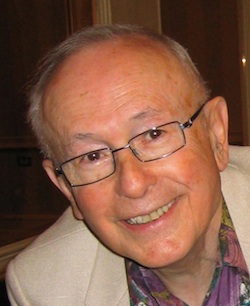
When Legacy Senior Living opens in the Oakridge neighborhood in July 2014, the 91-suite, independent-living seniors residence will pay tribute to a man who believed in building community. Built by the Wertman Group of Companies, it was created in honor of Leo Wertman, who founded the company back in 1962.
According to material provided by the company, Leo Wertman came of age in Ruzaniec, Poland, and was the only survivor of his family during the German occupation. As a teen, he became a Polish partisan, participating in missions to defy the occupation and emancipate Poland. In the process, he became a protector to many Jewish women and children, as well as the sick and elderly who sought shelter in the forest outside the city limits of Lublin and Ruzaniec. By night, he would venture into town, returning with food and medical supplies that helped keep some 200 displaced, hidden Jews alive during the occupation. Later in his life, he moved to Canada with his wife Regina and children Joseph and Rochelle. His business origins were manual labor and a small scrap-metal endeavor that he built up until he had the funds to invest in residential real estate in the 1960s. In a fast-growing city like Vancouver, he believed people would always need somewhere to live. According to the family, he became known as the “Provider” for the role he played during the war, and it was one he lived up to until his passing in the 1980s.
Meanwhile, the business was expanding and Wertman’s son became actively involved, helping it grow from a few apartment buildings to a large development company and real estate management group. Today, this private company includes grandson Jason Wertman, who serves as vice-president of Legacy Senior Living.
The Wertman Group has built several higher-end residential/condominium buildings on the west side of Vancouver, and it manages rental properties on the North Shore from its headquarters at 1199 West Pender.
The Wertman Group has made its mark on the Lower Mainland in a variety of ways. The company’s portfolio includes the Hycroft Medical Centre and the Guildford Medical Centre, two landmark medical buildings that were overhauled, renovated and re-tenanted. It has built several higher-end residential/condominium buildings on the west side of Vancouver, and it manages rental properties on the North Shore from its headquarters at 1199 West Pender.
Beyond business, the Wertmans have a legacy of donating to causes in Israel as well as to organizations serving the local Jewish community, including the Vancouver Holocaust Education Centre, Vancouver Talmud Torah, Lubavitch B.C., Jewish Federation of Greater Vancouver and Schara Tzedeck Synagogue.
“With Legacy Senior Living, our goal was to create an outstanding senior living residence in Leo’s honor, right here in the heart of Vancouver,” said Jason Wertman by telephone. “We want it to be a place where seniors can stay active and involved, living creative and fulfilling lives – a place where great food, friendships, culture and thoughtful living spaces will combine as the ideal lifestyle community.” The residence was designed to promote a healthy, independent way of life that highlights personal choice, convenience and exceptional service. “People who have some gas in their tanks can come here to reclaim quality of life and focus on being active and healthy,” he added.
Wertman describes Legacy Senior Living as being comparable to a Four Seasons Hotel. “It’s truly luxury living, with high-end finishes and a boutique style. The suites, which will be available exclusively for rental and will range in price from $3,750 to $7,700 per month, feature video-monitored entrances, automatic keyless entry, three elevators and remote-controlled blinds.”
“We’re right in the heart of the Jewish community, with easy access to shops, physicians, services, parks and familiar neighborhoods, and the availability of a town car transportation service will help residents move around their local catchment area.”
The location is a big draw, noted Carol Omstead, managing director. “We’re right in the heart of the Jewish community, with easy access to shops, physicians, services, parks and familiar neighborhoods, and the availability of a town car transportation service will help residents move around their local catchment area.”
Life at Legacy includes a selection of dining choices, a concierge service and a wellness navigator, who can give advice and information to residents when and if needed. Jewish residents will have ample opportunities to continue their traditions, including Oneg Shabbat with a special musical performance by Annette Wertman on Friday afternoons, kosher-style meals (with strictly kosher meals available for those who require them) and the town car service, which can help them commute to the synagogue of their choice. “Our goal is to keep all cultural groups connected to their traditions,” Omstead said.
“We’re gearing towards the Jewish community,” added Wertman. “Our target market is the same as that of the Jewish Community Centre and the Richmond Country Club. The Jewish community is not enough to support us entirely, so we’re open to everyone. But the residence is geared towards and was inspired by the Jewish community.”
Omstead said Legacy was designed for seniors who want their golden years to be a time of growth and development. “It’s about living life your way, preserving and enhancing your activity level and independence” she said. “When you’re in a positive environment like Legacy, you can achieve great things.”
The seniors residence that most closely resembles Legacy is Tapestry, which has locations in Kitsilano and on the south campus of the University of British Columbia. What sets Legacy apart is that more meals are included, there is transportation available to residents seven days a week and its central location in Oakridge. Also, its ownership. Omstead added that the company is particularly suited to serve the local population. “Because we’re right here, we’re really attuned to the community we serve,” she said.
Wertman said his family is excited about the development, one of their biggest projects to date. “It’s consuming all our time and energy, and the suites are being rented out quickly,” he said. “Everything we have now is from the foundations that my grandfather Leo built, so, in a sense, this is his legacy project.”
The presentation centre, now open at 2827 Arbutus, at 12th Avenue, is open Monday to Friday, 9:30 a.m.-3 p.m, and all day Saturday and Sunday. A courtesy shuttle service in a dedicated Legacy Senior Living 2013 Bentley is available for those who don’t drive. Call 604-240-8550 to arrange for a ride during the show suite hours.
Lauren Kramer, an award-winning writer and editor, lives in Richmond, B.C. To read her work online, visit laurenkramer.net.
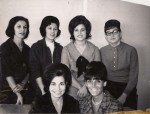
National Council of Jewish Women Israeli brunch, Vancouver, B.C., 1965. (JWB fonds, JMABC L.13972)
If you know someone in this photo, please help the JI fill the gaps of its predecessor’s (the Jewish Western Bulletin’s) collection at the Jewish Museum and Archives of B.C. by contacting archives@jewishmuseum.ca.
In the early 1980s, Alberta teacher James Keegstra was charged with wilful promotion of hatred for teaching high school students that the Holocaust was a myth and that Jewish people were responsible for much of the world’s evil.
For Robbie Waisman, a Vancouver businessman, news of Keegstra’s teachings revived an exchange from decades earlier that he had repressed. Waisman – at the time he was Romek Wajsman – was one of the youngest prisoners in Buchenwald concentration camp, in eastern Germany. While trying to get to sleep in the crowded barracks one night, young Romek had an interaction that would resonate decades later in the lives of tens of thousands of young North Americans.
Robbie Waisman (photo from Robbie Waisman)
As Waisman recalled: “This one voice said, ‘Hey kid,’ addressing me, ‘if this is over and you survive, remember to tell the world what you have witnessed.’ I didn’t answer. Again, a second time. And then another voice says, ‘Leave the kid alone. Let’s all go to sleep. None of us are going to survive.’ I’m trying to fall asleep. Again: ‘Hey kid, I haven’t heard you promise.’ I wanted him to leave me alone so I said, ‘OK, I promise.’”
Yet, for 36 years, as Waisman rebuilt his life in the aftermath of the Shoah that destroyed nearly his entire family, everything he knew and most of European Jewish civilization, he remained publicly silent about what had happened to him and what he had seen. As it was for most survivors, the pain of the past was unbearable. The motivation to move ahead, to make good on the promise of survival, consumed Waisman and other survivors. Those who had spoken out in the first years after liberation were often hushed up, accused of being macabre, of living in the past, of not moving forward. Many adopted silence.
For Waisman, and some other survivors who had kept their stories private, it was the Holocaust denial that sprang up in the 1970s and ’80s that ended their silence.
Now, after speaking hundreds of times to audiences, most often of high school students, but also to churches and First Nations communities, Waisman is being honored for contributing to understanding and tolerance in Canada. He is to receive the Governor General’s Caring Canadian Award, which recognizes volunteers who help others and build a “smarter and more caring nation.” He was nominated for the honor by his longtime friend, Derek Glazer.
Waisman cannot estimate the number of times he has spoken or the accumulated number of individuals who have heard his story. But he has thousands of letters – most of them from young people – telling him how the experience of meeting him has changed their lives and caused them to commit themselves to humanitarianism and social justice. And, as much as he is pleased to receive the commendation from Gov.-Gen. David Johnston, it is these letters, and the hugs and words he receives from young people, that he says are the real compensation for what he does.
“These kinds of letters are my reward. Never mind the award that I’m going to be getting. This is the reward. This is what keeps us going. If I can inoculate young people against hatred and discrimination, I honor the memory and I give back for my survival,” he said.
“In most cases, when I go to speak, I get hugs from people, and I get tears, and they come and they are so grateful. I always hear this: ‘You’ve changed my life. Thank you.’”
“We encourage them. We empower them. And we make them appreciate life and what they have around them. I feel we are doing noble work. We are changing some of the kids’ lives,” said Waisman, referring to himself and other survivors who speak.
He added, “Some people think that we sadden the children,” referring to himself and other survivors who speak. “No. We encourage them. We empower them. And we make them appreciate life and what they have around them. I feel we are doing noble work. We are changing some of the kids’ lives.”
Yet, even as he is being recognized for speaking to thousands, Waisman recalled that the first time he publicly spoke of his experiences, he vowed it would be his last. Motivated by the Keegstra affair, Waisman contacted Robert Krell, a founder of the Vancouver Holocaust Education Centre, to say he was ready to speak. A school visit was arranged and Waisman told the students of his experiences. The reaction was poor. Some students fell asleep – though Waisman thinks it was not because the narrative was boring, but the opposite: it was too graphic. The students tuned it out as a sort of emotional defence.
“I came home and I was completely out of it,” Waisman said. “I had to lock myself in a room because it was so painful.”
Krell talked him into trying it once again and, this time, Krell, a psychiatrist, was in the audience. On Krell’s advice, Waisman developed a different approach. “I tell my story, but I don’t go into details,” he said. “I tell them about my life at home [before the Holocaust], with my family, and I tell them about my life afterwards.” He usually shows a video clip that provides a graphic depiction of the Holocaust, but his own presentations put a face to the Shoah but do not dwell on the atrocities he personally witnessed and experienced.
“All in all, as you can see from the letters, I seem to connect, telling the importance of being a decent human being and the responsibility they have toward humanity to make this place a better world,” said Waisman.
It is estimated that between 89 and 94 percent of Jewish children who were alive in Europe in 1939 had been murdered by 1945.
Waisman’s survival is an example of how many extraordinary incidents, fortunate coincidences and unlikely near-misses were required for a Jewish child to endure that era. In the dystopia of Nazism, children were deemed non-productive “useless eaters.” They also represented the future of the Jewish people, so the Nazis took special steps to ensure the deaths of as many children as possible. It is estimated that between 89 and 94 percent of Jewish children who were alive in Europe in 1939 had been murdered by 1945.
The Wajsman family were stalwarts of the community in Skarzysko, Poland. After the Sabbath candles were lit, neighbors would pour into the Wajsman home to listen to the wisdom of Romek’s father, Chil, a haberdasher and an admired leader in the synagogue and community. Romek was the youngest, aged eight when the Nazis invaded Poland, with four brothers and a sister.
Romek’s first break came when the ghetto in Skarzysko was about to be liquidated, in 1942. One of Romek’s older brothers had been forced into labor at a munitions factory. At four in the morning on the day the ghetto was to be liquidated, Romek’s brother appeared and took him to the factory, where he would survive as a useful – if extremely young – munitions worker.
When the Russians advanced on Poland in 1944-45, the Germans moved the munitions workers into the German heartland – and Romek was taken to Buchenwald. There, he met another boy, Abe Chapnick.
“We sort of supported one another,” Waisman said. “We had numbers that we were called by in Buchenwald, but we called each other by name and kept our humanity intact.”
Buchenwald was not primarily an extermination camp, yet Waisman was well aware that if they were not useful to the Germans, they would not survive. What helped the two boys live was the fact that Buchenwald was a camp originally intended for political prisoners, not necessarily Jews, and while the Nazis ran the overall affairs of Buchenwald, many internal matters were left to a committee of prisoners. “They protected us,” said Waisman.
He remembers a particularly fateful moment.
“We were marched out in line and an SS comes up and screamed at the top of his voice ‘All Jews step out!’” Romek and Abe looked at one another. “I thought, ‘What are we going to do?’” Waisman said. “Before we could make up our minds, Willie [Wilhelm Hammann, the German prisoner who was in charge of the barrack] stood in front of us and screamed at the top of his voice at the SS: ‘I have no Jews!’”
The same process unfolded in other barracks and when the Jewish inmates stepped out, they were shot. “That was two or three days before liberation,” Waisman said.
When liberation finally came – at 3:45 p.m. on April 11, 1945, the day Waisman counts as his “birthday” – their troubles were not yet over. They were moved to better quarters but remained at Buchenwald for two months, while authorities attempted to determine what to do with millions of displaced persons across Europe.
Romek had looked forward to going home, to being reunited with his family. “After liberation, we couldn’t grasp the enormity of the Holocaust,” he said. “I saw people around me die, but I didn’t see the whole picture. I wanted to go home because I thought everybody would be at home.”
Eventually, 426 of them, all boys, would be taken to France, to a makeshift orphanage where they were expected to resume their lives and studies as if their experiences had been merely some sort of routine disruption.
While Waisman and Chapnick had been the youngest in their barrack, at liberation they would discover there were hundreds more children, from 8 to 18, in the camp. Eventually, 426 of them, all boys, would be taken to France, to a makeshift orphanage where they were expected to resume their lives and studies as if their experiences had been merely some sort of routine disruption. They acted out in ways that made their new caretakers fear them as animalistic and potentially dangerous.
“We were angry and full of rage when we couldn’t go home after liberation,” Waisman said. “We came to France and there were all these people that wanted to help us out and came to deal with us. Professionals and volunteers to help us out, people that spoke our language [but] when we wanted to speak and share some of the pain, they weren’t interested. It was too soon. Psychiatry wasn’t as advanced as it is now. They’d say, ‘We are not interested. Just never mind. Forget about it. Move on. Go back to school. Continue your schooling.’
“I can’t repeat what we told them what to do,” Waisman said, laughing. “After all, we knew best.”
Waisman would discover decades later that a report commissioned by the French government declared that these “boys of Buchenwald” would never rehabilitate, they had seen too much, been too damaged and would not live beyond 40. The report recommended that the government find a Jewish organization to look after them.
In fact, in addition to the most notable boys of Buchenwald – Elie Wiesel, the renowned author and humanitarian, and Yisrael Meir Lau, who would become a chief rabbi of Israel – almost every one went on to succeed in life beyond all expectations. For Waisman, who is still active in the hotel industry, this was a direct result of a single determined man.
“Manfred Reingwitz, a professor at the Sorbonne – he wouldn’t give up on us. He used to always give us these wonderful discussions and spoke to us about the importance of moving on. It didn’t register. He took a lot of abuse, but I remember the one crucial time. There were four of us, including myself, and he sort of said, ‘I give up’ and then he turned around … ‘By the way, Romek, if your parents stood where I am standing right now, what do you think they would want for you?’ he said in an angry voice. And, of course, we don’t answer anything and he walks away. We looked at one another and it resonated. We didn’t say anything. But we sort of began a different attitude, a different way of looking at things.”
This was the moment when Waisman and most of the others, like so many survivors, began a process of throwing themselves into careers, family and community work.
He and his sister Leah were the only survivors from their family of eight. (Leah married in a DP camp, moved to Israel and Waisman sponsored them to come to Canada in the 1950s.)
Slowly, Romek’s life took on a form of normalcy. Under the auspices of Canadian Jewish Congress, he would arrive in Halifax and travel by train to Calgary, where he would begin Canadian life with the help of a local family, start his career and meet his wife, Gloria. The couple would move to Gloria’s native Saskatchewan for two decades before coming to Vancouver.
“For, I think, close to 36 years I went on with my life,” Waisman said. The other boys of Buchenwald progressed similarly, many settling in Australia, as well as in Israel, the United States and elsewhere. “I made a life … my Holocaust experience was there, but I put it aside…,” Waisman said. “And then Keegstra came along teaching his students that the Holocaust was a myth, that it didn’t happen.” And Waisman became one of the most active survivor speakers, putting a face to history for thousands of young people.
“One and a half million Jewish children were not as lucky as I was, and the other boys of Buchenwald [were], and so I sort of began to think about it and said, ‘I made it. I have a sacred duty and obligation to [share my experiences with younger generations] and when I’m doing this I honor the memory of the one and a half million.’
“Our survival meant something,” he said. “After all these years, I felt that I had to do it, that it’s a sacred duty.”
There is no stipulated time in life when we start “forgetting.” We all forget. As we increase our knowledge, so also we begin to forget: an item here, an occurrence there, a dangling thread that goes nowhere. Sometimes retrieval is simple: a particular smell, sight, sound or touch may jog the memory and most of what we have forgotten comes flooding back and we recall so much. Sometimes, it is not, and the memories fail to come.
Spending time with old (i.e. longtime) friends, one often takes a walk down memory lane. Soon, we are recreating an entire evening, for example, of an event that happened some 25 years ago and pictures flood in helter-skelter – we cannot wait to recall this or that person, how we looked and felt, what we ate or where it all took place.
There is much nostalgia that we recall with wistful and loving good feelings. When we think about a close chum who was special, we remember our times together; when we open a drawer and our eyes spot a long-forgotten photo or trinket lodged at the back, we relive a past moment.
Not everything is pleasant to remember or rehash, of course. Sometimes in the remembering, we re-feel the pain of long ago, and the sadness that often accompanied the ache. Even though time has passed and healed so many wounds, there are some memories that time does not allow us the forgetting.
Remembering is not heartbreaking per se; it is simply that we are looking through the other end of the telescope. The past is not as sharp or as large as the present and, in that moment of reflection, it appears so far away.
Looking through boxes of family photos is only meaningful if you know at whom or what you are looking.
How do we remember? A touch on the arm, a particular look in someone’s eyes, a suit or a dress found in the closet.
When we start on a journey into the past, we are often off and running, breathlessly gulping down gobs of stuff that hasn’t crossed our mind in ages. We wonder how So-and-so is. Is she still around? How many kids did she and her “no-goodnik” husband end up having? Well, he was a character of the first waters, that’s for sure!
At another time, we might think to ourselves, I remember that handsome guy who used to come to the club; for the life of me I can’t recall his name … but I remember he was a damn good dancer and I loved being held and gently beguiled around the floor. Wonder if my friend in Australia would remember him? There was something about him having more than a drop or two of royal blood – from his father’s side, because his mother must have been Jewish … and, horror of horrors, we heard he was a bastard! (We didn’t use words like “illegitimate” back in those days where I came from.) Somehow, my friends and I didn’t seem to mind.
I could go on. One mental image leads to another so swiftly and a part of one’s life is relived in sizzling rapidity. We sometimes stop to examine a nugget, turning it this way and that, enjoying the feelings, the movements, the music. Not only do we not miss a beat, but we recall the tiniest details sometimes: faces, antics, what we ate, even the weather. Remember how it rained that night? I had to throw away my shoes! And so it goes. Or so it goes for us on such journeys in time.
Is this traveling safe? Of course it is! However, we are not meant to sit and brood for too long on the past. A dip here and there into something is quantum sufficit, and we do our best not to dwell unduly.
Is it time well spent? Should we be doing something more worthwhile? Somehow I get the feeling that we all need to connect with the past; with our pasts. It is like connecting the dots of our personal history and, in that way, somehow legitimizing who we are; not only who we are today but who we were then. Hence, these rememberings are very special, very important.
You can find your genetic makeup but that won’t tell you about your grandfather’s first suit, or how fast he outgrew it! Or how nerdy he felt wearing it for his bar mitzvah.
How much do you, dear reader, know about your parents’ rememberings? What do you know about your grandparents’ memories? Do you have a sense of who you are in that way? You can find your genetic makeup but that won’t tell you about your grandfather’s first suit, or how fast he outgrew it! Or how nerdy he felt wearing it for his bar mitzvah.
Events usually are recorded and can be recalled. However, it is being able to sit down comfortably next to your parent or grandparent and “chew the fat,” so to speak, that is truly meaningful. The plum in the pudding is the rare offering of a safta’s or a bubbe’s feelings, a saba’s or a zayde’s memory, and the contemplation today about how it was in the yesterdays of their lives. When a parent or a grandparent begins, “Oy, I must tell you,” it is in that moment that you start to get a sense, a brief glimpse, not so much of how it must have been, but rather how it felt.
Engaging in this sort of companionship is a win-win situation. A safta, for example, feels tremendously good, almost like she’s making you a meal, feeding you once again. It is that sense of giving, sharing, depositing for safekeeping. And, really, it is so much less exhausting and stressful compared to making another batch of komish broit, another bowl of matzah ball soup; never mind the washing up after! And you feel strengthened and joyful receiving the precious gift of a part of your heritage, which is unique to you and your family. It’s a little bit of your history, as well as a piece or two of the fabric of the community in which you live.
It is never too soon to have this type of interaction. It is sometimes too late – I never had the good fortune to know my grandparents, who came from Baghdad in Iraq and Persia (Iran today). My mother died when I was 12. My knowledge of my forebears would fill less than a page. This is my tragedy. Researching the history of these Jewish communities is akin to a starving person scratching for food from a parched earth: too much desert with nary a signpost to sustenance.
So, how do we remember? You can look through a box of photographs but if no one is there to tell you at whom or what you are looking, or if you didn’t experience those moments yourself with your loved ones, you might as well add the pictures to your recycling pile and take them to the curb. As an elder, I say to you: we need to be remembered – not just for our health and happiness, but for your sake as well!
Seemah C. Berson, born in Calcutta, India, in 1931, has lived in Vancouver since 1954. Married to Harold, with four sons and various grandchildren, baruch Hashem, she and Harold are longtime members of the Peretz Centre for Secular Jewish Culture. Author of I Have a Story to Tell You (Wilfred Laurier University Press, 2010), comprising the personal recollections of Jewish immigrants to Canada between 1900-1930, subsequently working in the Canadian garment industries, she is a freelance writer and occasional dabbler in art, children’s poems and stories.
Alice Herz-Sommer, the oldest known survivor of the Holocaust, died Sunday at the age of 110. Herz-Sommer, her husband and their young son were taken from their native Prague to Theresienstadt in 1943. Theresienstadt, which was used by the Nazis in propaganda as a “model” Jewish community, was in fact little better than any other concentration camp. While most of those who passed through Theresienstadt would ultimately perish at Auschwitz or Treblinka, death rates at Theresienstadt were also high. Nevertheless, when, late in the war, the Nazis allowed representatives of the Red Cross to enter the camp, they found, among other things, musicians pouring emotion and power into performances. Many of these performances featured Herz-Sommer and, after she and her son were liberated (her husband did not survive), she became a master pianist and music teacher. A film about Herz-Sommer, The Lady in Number 6: Music Saved My Life, is nominated for best short documentary at Sunday’s Academy Awards.
The announcement of her passing – and the reflections on her extraordinary life – remind us of the importance of listening to, of seeking out, the stories of survivors. The stories we should hear are not solely about survivors’ experiences as the persecuted Jews of the Shoah, though these are critically important as individual historical records.
An additional, perhaps equally crucial obligation, is to learn from these survivors about human resilience. The life of Herz-Sommer was extraordinary – and yet, it wasn’t. If her life was extraordinary, then so is the life of every Holocaust survivor who rose above the extreme events they withstood and built for themselves a life, a family, a community, a record of service in myriad disciplines. And, so they are.
What we find most curious, or astonishing, in stories like Herz-Sommer’s and so many others, is that these individuals could come back at all from the horrors they experienced and witnessed to become not just functioning members of society, but ones who excel. The soldiers who liberated the concentration camps of Europe, and the witnesses and aid workers who came after, certainly could not have predicted that these members of the surviving remnant would amount to much. As discussed in a feature story this week, a French government report on the 426 “boys of Buchenwald” inaccurately predicted that the survivors would never rehabilitate, that they were irreparably damaged, physically and emotionally, and would not survive to middle age.
In a world that so frequently seems to have not learned the lessons of the past, where generation after generation of people in various parts of the world still experience and witness atrocities, the examples of how human beings can endure and still thrive after catastrophes provide a lesson sadly still needed today. In retrospect, it is easy to see that even well-intentioned people sent to aid and possibly rehabilitate survivors of the Shoah may have unintentionally, if understandably, written off their potential when they saw the conditions of the survivors and their surroundings. Yet, they underestimated the power of human endurance, which had rarely been so tragically strained.
Each one of the individual survivors’ stories is a testament to human capability. The ultimate lesson may be this: every life is extraordinary. And the ability for human beings to overcome adversity sometimes exceeds the human ability to predict such resilience.
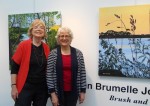
Joanne Waters, left, and Karen Brumelle. (photo by Olga Livshin)
Karen Brumelle and Joanne Waters have much in common. They have been friends for more than 40 years. Both spent their childhood and young adulthood in the United States. Both came to Vancouver when their husbands started working at the University of British Columbia. Both are artists and have participated in multiple exhibitions. Both are inspired by nature. But they never exhibited together until now. Their show, Brush and Wire, is at the Sidney and Gertrude Zack Gallery until March 16.
The artists’ visual narrations complement each other, as Brumelle’s cheerful paintings of rivers and forests provide a quaint background for Waters’ wire sculptures of birds and sea creatures.
“You’re influenced by the place you live in,” Brumelle said, explaining her landscapes of local scenery. Color and line serve as her creative language, the vehicle of her love for her adopted land. “Everything I look at, I mentally put a frame around. I always wonder: what might make a good painting? I take lots of photographs but I don’t want photographic likeness. I want to simplify the images, find their emotional core. I am more concerned with portraying a spiritual essence.”
Orange leaves blaze on her autumn trees. The green flow of the Fraser River invites contemplations. What many Vancouverites see from their windows, Brumelle explores through brushstrokes, paper and scissors.
“Collages are more fun. They are spontaneous, a free exploration.”
In her collages, Brumelle combines paper shapes with painting. “Collages are more fun. They are spontaneous, a free exploration. The pattern of the paper often suggests the collage details. I collect papers, buy them wherever I travel. My collages are more abstract than my paintings but they’re also more playful.”
Perhaps the playfulness of her collages is an echo of her long career as an art teacher. Before she retired in 2004, she taught art at Arts Umbrella and other schools. For 10 years, she taught art at Lord Byng and loved it.
“When I was a teacher, I constantly tried to come up with new exercises for my students. I wasn’t painting as much then – no time – but my creativity was engaged fully. The fun part of teaching was to see what my students would come up with.”
Now, when she has more time, she is drawn to capturing the quiet, elusive beauty of nature. Recently, she also started adding figures to her compositions. “I want to express the wonder of the world, its size, its light and shadow, its patterns and its hidden places. I need to paint. I get grumpy if I don’t.”
“Crochet, knitting, felting, macramé, I’ve done it all. I also made baskets and sculptures from dry kelp and driftwood for 20 years.”
Like her friend, Waters feels the irresistible attraction of nature and the urge to share her artistic discoveries. “I always had to create,” she said. Although by education, she is an occupational therapist, art has always been important to her. “I started with fabric art,” she said. “Crochet, knitting, felting, macramé, I’ve done it all. I also made baskets and sculptures from dry kelp and driftwood for 20 years.” Not many artists occupy such a niche, and her crafty, whimsical kelp pieces sold well at arts-and-crafts boutiques around British Columbia.
She also taught various arts-and-crafts classes and worked in recreational therapy. Among her students were not only healthy adults and children but also seniors with mental and physical disabilities. “When I worked with low-functioning people, my creativity went into making their work look good. Being creative isn’t just art.”
Her transition to wire sculpture is more recent. “When my husband died a few years ago, I moved to a smaller apartment,” she said. “There was no place to dry kelp, so I started experimenting with wire. I made a wire basket. Then I thought: if I could make a basket I could make anything. I made a dolphin. Then a bird. I use picture books and the internet and I usually fiddle with wire in front of the TV. About two hours at a time; afterwards my hands get tired.” Her wire ducks promenade in front of Brumelle’s paintings of ponds and rivers. Her starfish cling to the plastic stool legs as if they were pier piles submerged in a river. Her fisherman dreams of the biggest catch of his life and, behind him, a father and son roam a beach on her friend’s painting. The organic connection between the two artists links them on a subliminal level, as well as in their everyday lives.
Olga Livshin is a Vancouver freelance writer. She can be reached at olgagodim@gmail.com.