The Feb. 18 silent march in honor of Alberto Nisman began on the steps of the Vancouver Art Gallery. (photo by Cynthia Ramsay)
Approximately 75 members of the local Argentine community and their friends and supporters gathered at the steps of the Vancouver Art Gallery on Feb. 18 in memory of Argentina’s federal prosecutor Alberto Nisman.
Jewish community member Gabriel Patrich (left) was one of the Vancouver march organizers. (photo by Cynthia Ramsay)
A silent march, there were no speeches, but participants carried signs. They would like the government of Argentina to conduct a full investigation of the suspicious death of the 51-year-old Jewish lawyer who was found dead on Jan. 18 at his home in Buenos Aires. Nisman was investigating alleged Iranian involvement in the terror attack on the AMIA (Asociación Mutual Israelita Argentina) Jewish community centre in 1994, which killed 85 people and injured hundreds of others. He was found dead the day before he was to appear before a congressional hearing to air his contention that President Cristina Fernández de Kirchner, among others, arranged a deal with Iran to cover up its involvement in the bombing in exchange for economic benefits.
Jewish community member Gabriel Patrich, one of the organizers of the march in Vancouver, was satisfied with the local support. “The main rally in Argentina drew [up to] half a million people, and there were big events in Miami, Australia, Spain, France and Israel. We are proud to take our part and demand a full investigation of Nisman’s murder and the truth he was about to bring to light.”
In addition to the call for justice, Patrich told the Independent, “we were also there … to honor a courageous man, who knew that his life was in danger – he said that his investigations might cost him his life.”
Reports are that some 400,000 people attended the Buenos Aires march alone. On her website, Kirchner criticized that event as being politically motivated and, “not at all an act of homage to the tragically deceased, with the obvious exception of their immediate families.” She said its one merit was that it showed “that in Argentina, your country, you can disagree, you can insult the government and the president, and can move freely. It was not always so, so do not speak of dictatorship.”
For those interested in more about the AMIA bombing, Argentine author Gustavo Perednik has written a “lightly veiled” fictional account based on documents provided him by Nisman. It has been translated into English – To Kill Without a Trace: A Prequel to 9/11, the 1994 Terrorist Bombing in Buenos Aires and the Iranian Connection (Mantua Books Ltd.) – and Perednik will be in Vancouver for the book’s launch at the Isaac Waldman Jewish Public Library on March 23, at 7 p.m. Also speaking will be Dr. Elena T. Feder, who wrote the introduction to the English translation. Anticipating a full house, the library requires an RSVP to 604-257-5111, ext. 248, or library@jccgv.bc.ca by March 19.
Shahar Ben Haleviis a writer and filmmaker living in Vancouver.
Caitlin McCarthy and Amitai Marmorstein co-star in What You’re Missing by Tamara Micner, which is at Chutzpah! March 10-15. (photo by Tim Matheson)
Playwright Tamara Micner returns to Vancouver in March for the North American première at Chutzpah! of What You’re Missing, a play based on her family’s stories, but in which we will all, no doubt, see aspects of our own experience.
Tamara Micner returns to Vancouver for the North American première at Chutzpah! of What You’re Missing, a play based on her family’s stories. (photo from Tamara Micner)
Micner left Vancouver in 2003 for Yale, where she earned her bachelor of arts in English literature. She worked with Google for a few years, which took her to San Francisco and Toronto, then studied at Cambridge, receiving her master’s of philosophy in 2011. When she last spoke with the Independent, she was on her way to London, England, because, as she told the JI, “for plays, London is the best city in the world.” There, she has continued learning and working, not only in theatre, but also as a journalist and copywriter. The JI caught up with Micner earlier this month.
JI: When the JI last spoke with you, Fantasmagoriana was at the Edinburgh Festival Fringe, and you also had two new plays in the works, one of which was called Highlight. Could you share some aspects of its development, from its première at Cambridge in 2011 as Highlight to its run last year as What You’re Missing at King’s Head Theatre in London, to its upcoming production at Chutzpah?
TM: What You’re Missing has been in the works for four years, and hopefully it will continue to live after Chutzpah as well.
We started developing the play during my master’s degree at Cambridge, with a rehearsed reading and a run at the main student theatre. I then left it for awhile and worked on other projects, and gave myself time to come back to it with greater distance and a clearer head.
In 2013, I did more rewrites and started submitting it to theatres in London, including the King’s Head, which accepted it for final development. By the time we performed it last year, it was pretty well “finished.”
It’s gone through many rounds of changes. It started out more purely comedic and, over time, it’s gotten more political and more serious, alongside the comedy that (hopefully) pervades the piece.
JI: You described Highlight in the 2011 JI interview as being based on the beginning of your parents’ relationship, and as “a dysfunctional family comedy.” In general, what has been the reaction of family (and friends) to the plays in which they see themselves represented? Do you have any advice for aspiring writers as to how to use family/friend elements without causing (too many) hard feelings?
TM: My sense is that my relatives who inspired the characters in What You’re Missing have enjoyed seeing versions of themselves and their experiences represented onstage. (Or they’ve just been polite.) The play is critical and truthful, but it’s also a dramatization, and it’s written from a place of love and affection, which I think comes through. I wasn’t alive in the 1970s, when this play is set, so it’s drawing from elements of my family’s stories – from a specific time, place and set of experiences – to explore broader questions about family, love, politics, religion, gender and so on.
When we debuted the play in London, people of different nationalities, religions and backgrounds said that they related to the story and characters, and saw themselves or their lives reflected in the piece in some way. That response really pleased me (and was a relief!) because that was my hope. I see theatre as, among other things, a way to bring people together and remind us of the things we share.
I think artists need to share their truths, and personal experience is where a lot of our truths come from. That might cause hard feelings. But, if we’re honest and nuanced, rather than heavy-handed, people will respond and connect to the work, and the truth in it will come through.
JI: In 2011, you said that you chose to move to London for its theatre presence and because you loved the city. Has the city lived up to your expectations? Do you plan on staying for the foreseeable future?
TM: I’m very happy living in London. I’ve found a neighborhood and communities that I feel at home in, including easy access to pita, dates and baklava, and I’m still discovering more of the city and the country. I was approved for Polish citizenship last year, so assuming the U.K. doesn’t vote to leave the EU, I plan to stay here indefinitely.
JI: Will you be coming to Vancouver for the Chutzpah shows? If so, how much input, if any, will you have into this production? Did you have any hand in casting?
TM: Yes, I will be in Vancouver for the run. I’ve met with the director, John Cooper, in person and on Skype, and we’ve talked about the origins and development of the play and his vision for the production. He oversaw the casting, and I trust his instincts and judgment. It’s exciting to see how other people interpret your work and bring it to life, sometimes in surprising ways.
JI: Are there any projects you have currently on the go, or that you’re considering undertaking, that you would like to share with JI readers?
TM: I’m developing a new show, Wink the Other Eye, with two actors and a musician. It’s about music hall, a major genre of British entertainment from the mid-19th century until about the ’20s (when ragtime and revue, and radio, started taking over). For example, if you know the song “Daisy Bell,” that’s actually from music hall.
The show is devised – collaboratively created and written – which is a new style of working for me. We plan to do some showings of the piece in the spring, working toward a production later this year. We’ve been approved for funding from Arts Council England to finish development, which is a big help and a stamp of credibility.
Our show looks at Marie Lloyd, one of the most famous performers of her day, who toured the British Empire (South Africa, Australia, North America) and sang from the age of 15 until she died aged 52. She had a story similar to Whitney Houston’s, Judy Garland’s: an insatiable entertainer who lived to perform and had a pretty awful life offstage (including domestic abuse and alcoholism). The show combines live performances of her songs with important moments from her private life, and the actor who plays her is related to her. (We’ve put some of the music and comedy from the show online: soundcloud.com/winktheothereye.)
What You’re Missing is at the Rothstein Theatre from March 10-15. The other theatre offering is Kafka and Son, performed by Alon Nashman, on March 2. Visit chutzpahfestival.com for more information on these and other productions.
Rafaella Rabinovich’s designs from Sherlock Holmes and the Case of the Jersey Lily directed by William B. Davis at the Jericho Arts Centre. (photo by Steven Hooper)
Rafaella Rabinovich always knew that she wanted to be a theatrical designer, and she became one – and a successful one at that, without many detours or hiccups.
“When I was 12, my father gave me a camera,” she said. “I photographed lots of shows and I knew I wanted to frame the stage myself.”
Rafaella Rabinovich’s costumes sing on stage. (photo from Rafaella Rabinovich)
After graduating from a high school for the arts in Israel and the mandatory army service, she enrolled in the set and costume design program at Rakefet Levy Design School for the Performing Arts in Tel Aviv. Upon finishing the program in 2010, she came to British Columbia. Today, she is a respected local set and costume designer, doing what she loves and living in a place she adores.
Of course, nothing was as easy or simple as it seems from a brief review of her resumé. “I wanted to make sets. I didn’t care about costumes,” she admitted, “but the design school where I studied only offered a combined program, so I took both. Now, I do more costumes than sets; it’s easier for me as a woman, but I still love doing sets.”
When she first came to British Columbia, she didn’t plan on staying. It helped that she was born in Canada and had Canadian citizenship. “I did have a Canadian passport so I wanted to look around and then travel to Africa,” she recalled. “I loved it here so I stayed. I still haven’t gotten to Africa, but it’s in my plans.”
To justify staying, she applied for a job, with Cirque du Soleil, no less. “I didn’t expect to be hired,” she said laughing, “but they got back to me. I ended up doing two jobs for them. After adding that to my resumé, it was easier to look for design jobs here. In the beginning, I worked as a waitress a lot. Now, I sustain myself with theatrical designs. I feel lucky.”
Unlike many costume designers, she doesn’t wish and never did wish to work in fashion. “I interned with a fashion firm and I learned a lot from them, but fashion doesn’t make my heart sing the way theatre does.”
She enjoys the variety her chosen profession offers, and she doesn’t shy from the smallest jobs. Circus and movies, commercials and theatre – they are all significant to her. From a couple costumes for a display at Science World to the set and costumes for the cast of 27 for her latest production, Fiddler on the Roof at Abbotsford’s Gallery 7, she has done it all. In the five years since she settled in Canada, she has worked on about 20 projects and, she is actively seeking more.
Rabinovich said she relishes every aspect of her work, from research to the final audience applause.
When she does her research for a show, she reads a lot. “For historical shows, classical paintings are great references. And, of course, I do a lot of research online,” she said. “I also read the plays. I need to know the story, the characters. We might have two stories set at the same time, but if the stories are different, the costumes and sets are different too. Think Oliver Twist and Napoleonic France: about the same time, but different places and different stories, different characters. I always need to know the character. Who she is, why she is wearing this hat, this dress. The costume has to complement her personality.”
One of Rabinovich’s past projects was a play that took place at the end of the 19th century, the same time period as Fiddler. “For that project, we wanted the costumes to be true to the times. But for Fiddler, I chose Marc Chagall as my inspiration.”
At times, she has collaborated with a director in her artistic decisions. “If he has a vision of the show, I would respect it,” she said. “He might say: ‘I want it sad’ or ‘It should be happy,’ and I would accommodate his suggestions in my designs.”
The sources of the costume materials and sets she creates vary greatly. Some pieces she buys in thrift or regular stores, others she designs from scratch or rents. “I’m not a seamstress but I know how to sew. Sometimes, if the project is on a low budget, I can sew the costumes myself, but usually, I have a seamstress. I know which vintage store in B.C. would be likely to have a fur coat of a certain color or a special type of curtains.”
She makes all her designs by hand, not on computer like some of her contemporaries. “I’m old- fashioned,” she joked. “I like feeling the fabrics, the textures.” She also likes incorporating lighting into her designs.
Each project she works on presents a different challenge, she explained, but all of them embrace their own rewards. “Seeing your vision come to life, take shape on stage, is wonderful. When you hit the right note, when you think, ‘Yes, that’s it!’ its feels good. And of course I love it when the audience applauds, when the actors wearing my costumes are happy. I’m behind the stage, invisible to the public, and I like it that way, but I’m part of it. They applaud my costumes, too.”
Gallery 7 Theatre’s performance of Fiddler on the Roof is on stage March 13- 21 at the Abbotsford Arts Centre. For more information, visit gallery7theatre.com.
Olga Livshinis a Vancouver freelance writer. She can be reached at olgagodim@gmail.com.
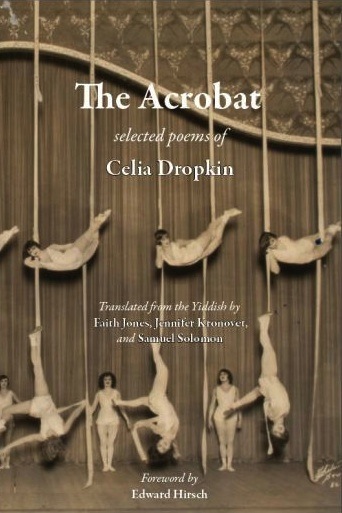
From the moment I read Pat Johnson’s interview with Faith Jones prior to last year’s Limmud, I knew I wanted to read The Acrobat: Selected Poems of Celia Dropkin (Tebot Bach, 2014).
The title of the collection wasn’t mentioned but the topic was: “erotic Yiddish poetry.” Jones, who translated Dropkin’s work into English with Jennifer Kronovet and Samuel Solomon, gave an overview of the poet’s background, which is explained in more detail in The Acrobat. That Dropkin writes with and about such passion is notable given her life’s circumstances. Born in Belarus in 1887, she and her family had to rely on the charity of relatives after her father died. While difficult, it meant that she could receive an education, and she became a writer. In 1909, she married Shmaye Dropkin, a Bund activist whose political activities forced him to flee czarist Russia, and, in 1912, Dropkin (and their son) joined him in New York.
“There,” reads the Translators’ Note, “inspired by the foment of Yiddish culture she found, Dropkin shifted from writing in Russian to writing in Yiddish…. She became a part of the thriving Yiddish literary scene, publishing widely in Yiddish newspapers and literary journals. Yet, she was publicly criticized by her male contemporaries for the perceived extremity of her work. All this time, Dropkin raised five children; a sixth died in infancy. She occasionally wrote stories and novellas in serialization for money, especially during the Depression when her family needed the income. Although the bulk of her oeuvre dates from the 1920s and ’30s, Dropkin never stopped writing poems. She wrote almost until her death in 1956.”
The Acrobat is not a comprehensive collection, but rather, as Jones explained in an interview with Leah Falk at yivo.org, the translators “chose the ones that we thought we could make into good poems in English…. The poems, even some of her quite important poems, that we did not think we knew how to work with, or that lost something in the translation that we didn’t think would be regained, we didn’t keep…. We weren’t able to capture them in the way that we felt really did them justice.”
A page-facing translation – i.e. the Yiddish poem is on the page facing the English version – those who understand Yiddish can not only engage in discussions about a poem’s meanings, but its translation. For example, the title poem, which is generally translated as “The Circus Lady,” gives an idea of the complexity of language, and the different images that are conjured by words that basically mean the same thing.
Dropkin’s poems more than withstand the test of time. Eighty-plus years later, they retain their immediacy. As Edward Hirsch writes in the foreword, Dropkin’s “lyrics come fully loaded. They are erotically frank and emotionally unabashed, deeply engendered, relentlessly truthful. They are terse and musical, like songs, and carefully constructed to explode with maximum impact.”
More than a decade in the making, The Acrobat is, remarkably, the first collection of Dropkin’s work in English, and she could not have gotten a better group of translators. Their love of the poetry comes through, as does their skill. One could almost be forgiven for thinking that Dropkin wrote in English. The Acrobat is truly an inspiring – and sometimes challenging – read. But it is more than that.
In speaking to Johnson, Jones admitted another objective. “I would like people to think about re-envisioning our forbearers as people who were more like us,” she said. “We need to really explore the people in our past and, as a historian, this is what I hope for most: that people will explore the past, understanding that these people were not like us, but in other ways were very much like us.”
In this, she and her colleagues also succeed. This is your bubbe’s poetry, as much as it is yours. And, while thought may be a little unsettling, given some of the subject matter, it is also very cool.
***
He and She by Celia Dropkin (from The Acrobat)
He is a branch;
she – the green leaves on the branch.
From him to her flows
dark power, thick fertile sap.
She shudders with each touch of wind,
whispers and laughs,
turns the silver
of delighted eyes.
He is simple, mute.
Autumn dyes her deep
colors. The cold wind cruelly
exiles her from the branch,
while he remains the same, simple,
robust, mute.
The attack on a Copenhagen synagogue – and the public reaction to it – has been illuminating. It also raises echoes from Danish and Jewish history, in ways that are not encouraging.
Of all the many incidents during the Holocaust when non-Jews acted righteously, one of the most notable and successful was the evacuation of Denmark’s Jews in 1943. The Danish resistance, aided by throngs of ordinary Danes, mobilized a flotilla of fishing boats to convey Danish Jews to Sweden, thus saving 99 percent of Denmark’s Jewish population at a time when other Jewish communities in Europe were being annihilated.
This extraordinary example of dangerous sacrifice in defence of Jewish people and basic humanity has rightly given the Danish people a special place in the narrative of opposition to Nazism. The narrative, at times, has gotten out of hand, as with the debunked story that the Danish monarch, King Christian X, himself donned a yellow star as an act of solidarity when the Jews of his country were ordered to affix the signifying marker to their clothing. In fact, Denmark’s Jews were among the few in occupied Europe not required to wear the yellow star. This story may not have been true, but the underlying message of Danish solidarity with the Jewish people against the Final Solution is undeniable.
It might have been expected, therefore, that Denmark would live up to its reputation in the aftermath of the recent terror attacks that wounded five police officers and killed two civilians – Finn Norgaard, a 55-year-old filmmaker who was attending a free speech symposium that was the gunman’s first target, and Dan Uzan, a 37-year-old congregant serving as security at the city’s Grand Synagogue.
In a heartening show, 30,000 Danes gathered on Feb. 16 for a vigil to commemorate the two terror victims. The current monarch, Queen Margarethe II, expressed condolences and restated her country’s commitment to the values “that Denmark is based on.”
However, a number of concerning responses cast a shadow over the fine words and deeds of these Danes.
Prime Minister Helle Thorning-Schmidt called the murders a “cynical act of terror,” but then offered this ponderous and contradictory observation: “We don’t know the motive for the attacks but we know that there are forces that want to harm Denmark, that want to crush our freedom of expression, our belief in liberty. We are not facing a fight between Islam and the West, it is not a fight between Muslims and non-Muslims.”
The motive for the attack could hardly have been clearer. First, attempt mass murder at an event explicitly dedicated to free expression then, for good measure, head over to a synagogue to kill some Jews. The actions of the perpetrator betray the motives in the most obvious manner imaginable. It is baffling that the prime minister should have chosen to cast question on the motive. And while it is widely held that the actions of violent radical extremists do not represent a universal trait of Islam, it still rings odd to hear the leader of a country in such a situation tack on a declaration about what the incident is not, while offering no specifics about what is at the root of the attack.
Far more disturbing was the veneration given to the perpetrator. The funeral for Omar Abdel Hamid El-Hussein, who police say was responsible for both attacks and who police shot and killed, was attended by an estimated 500 people. One organizer said the turnout was a sign of support for the family of the gunman, not an endorsement of his actions, but the crowd of hundreds at the funeral of a murderer of this sort is not a good sign.
Moreover, flowers were left at the scene of El-Hussein’s death, as is the mania these days anytime a tragedy strikes. These were later removed – by masked men chanting who said their actions were based on the fact that Muslims (like Jews) do not mark the passing of people with flowers.
These weird and disheartening reactions stand in contrast with the uplifting story of the moment – the “circle of peace” that took place last weekend in Oslo, Norway, in which 1,000 Norwegian Muslims and their allies encircled a synagogue in an act of solidarity and protection.
Similarly, the involvement of a Muslim figure with a history of antisemitic rhetoric drew some criticism, though organizers pointed to his participation as a sign of progress and that change is possible even among radical extremists and fundamentalists, and those who espouse hate.
Members of the Momo Minyan with Lhamo Dolma, Phurba Jompa and Lobsang Dolma. (photo from David Berson)
After a meeting between the Dalai Lama and Prime Minister Stephen Harper in 2007, and with the later support of then citizenship and immigration minister Jason Kenney, a resettlement plan for 1,000 displaced Tibetans in Canada was announced.
Seven years later, in April 2014, Or Shalom congregant Vicky Robinson gave a presentation on sponsoring Tibetan migrants. The presentation resulted in a number of congregants coming together to establish the Momo Minyan. The group was named by David Berson to represent a mixture of Jewish and Buddhist culture to help facilitate the move and integration into Canadian Society of two Tibetan refugees. (For a March 2014 story about the background of the group, click here.)
“I feel like I won the birthright lottery living here in Vancouver,” Berson said. “We started discussing the responsibility that this involves, because the Canadian government had given a go ahead for 1,000 people to come from Arunachal Pradesh, which is on the border with Tibet.”
Many of the refugees have been without status for more than 50 years, after India stopped granting Tibetans citizenship in 1959. As described by Berson, the Tibetans who are being sponsored lack many of the rights associated with citizenship and have been left with few choices.
“Tibetans that are on the border have limited rights, limited education [and] health care, but can work. We were moved by their story and their whole notion of the immigrant experience…. It is what the Jewish people have gone through.”
A trip was organized by the Minyan and its partners to visit the Tibetan communities in the fall of 2014. The trip involved assessing the conditions in remote villages in Arunachal Pradesh while trekking in the Himalayan mountains. On the journey, the participants traveled through areas considered sacred to Buddhists, where religious texts have been buried in Pemako, an area with 108 lakes.
Berson attended on behalf of the Momo Minyan, which joined with members of North Shore Search and Rescue. Many members of Or Shalom fundraised for the trip through donations to the Tibetan Cultural Society of British Columbia.
The main destination was Tuting, a city where 200 of the migrants live. When Berson arrived there, he was shocked at what he saw. “In Tuting, there is no internet, so any communication has to be done via snail mail. It can sometimes take a month or two … the way of life for Tibetans in this city is involved in some commerce and some farming, but they are still not looked at as full citizens.”
The trip also was an opportunity to promote Canada as the refugees’ new home. “We went to visit the resettlement office and presented them with a big Canadian flag, and we gave out a lot of Canadian pins along the way,” he recalled.
Since that trip, two Tibetan women who are being sponsored by the Momo Minyan have arrived in Vancouver. In September, Vancouver welcomed 36-year-old Lobsang Dolma and, in December, 28-year-old Lhamo Dolma arrived with her sister Phurba Jompa (who was sponsored by another group).
Once in Vancouver, members of the Momo Minyan assisted the new migrants in obtaining medical insurance, signing up for a social insurance number, assisting with English tests, helping to find work and housing for a one-year period.
Lobsang’s first job was at Or Shalom Synagogue, where she worked in the kitchen and as a custodian for pay. She has since worked as a dishwasher elsewhere four days a week and continues to take evening English classes.
While Lhamo continues to attend English classes alongside her sister four nights a week, her road has been less smooth and she has had less luck with employment.
According to Berson, members of the Momo Minyan are committed to introducing the migrants to people in their new communities. “It is hard for them; they left their families behind, want to be with their families. It is a sense of urgency many of us here do not need to experience because we do not need to worry about the basics of life.”
There are other challenges for members as well, Berson described. “It is clothing, it is language, it is how to get from one place to another, we take a lot of things for granted … and language is so important. And, at the same time, these women want to start working because they will need to support themselves and to make a living, a real tradeoff between learning the language and wanting to earn.”
Financial challenges are deepened, as the two women want to make money to support themselves, but also want to save money to send back home to help their families.
Cultural norms also affect the migrants’ experience in Canada. An example is in acquiring doctor’s services, which can lead to issues with communication, and access to health services. In India, services are far away and there is not an expectation that there will be an interaction between patient and doctor. “There are different expectations [here],” Berson explained. “Canadians interact more with their doctors than in India.”
The minyan and the Tibetan Cultural Society of B.C. are committed to bringing as many Tibetans from Arunachal Pradesh as are on the list to resettle in Canada and welcome support for the project. Residential accommodation and employment opportunities are areas where the minyan has asked for assistance. More opportunities to sponsor future migrants may occur, as well.
Gil Lavieis a freelance correspondent, with articles published in the Jerusalem Post, Shalom Toronto and Tazpit News Agency. He has a master’s of global affairs from the Munk School of Global Affairs at the University of Toronto.
Forty years ago, Ian Merkel was involved in clandestine film screenings. The films were nothing Canadians would consider illicit, but in apartheid South Africa, color barriers meant it was illegal to show films featuring blacks and whites together, and the films had to be smuggled into the country. Merkel watched these contraband films in friends’ garages. When the police raided the screenings, people sometimes landed in jail. Even with this possibility, for a young Merkel, film was worth the risk.
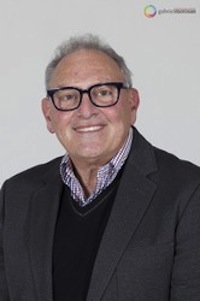
Ian Merkel (photo by Gabriel Morosan)
Years later, Merkel is still as passionate about the evocative nature of film as he ever was. He has been involved in many film related organizations in Vancouver, including as a board member and executive director of the Vancouver Jewish Film Festival. Today, Merkel in involved with the potential of working toward social change through film, and has become involved with Reel Causes and the Vancouver Foreign Film Society.
“Film, for me and a lot of people, is the most memorable art genre,” said Merkel about why he believes film can change the world.
According to their website, the mission of Reel Causes is “to educate, inspire and engage the community around social justice, environmental and health-related issues.”
Merkel described how the organization began in an interview with the Independent. “Mohamed Ehab, a pharmacist from Egypt, had just moved here and wanted to meet people. He loved movies, so he began having movie nights in his home, then began bringing films in [from out of town] for the public.”
In 2010, Reel Causes registered as a nonprofit society and has since partnered with many B.C.-based nonprofits to promote health, environmental stewardship and social justice.
“We bring films that are not political or religious and partner with what we call community causes, in order to educate people,” Merkel said. “The belief is that the media of film is one of the most powerful ways to get people involved in causes. People connect as a group while they watch a film and are able to engage with our community causes to effect positive change.”
Reel Causes has an arrangement with Vancity that enables the organization to screen films once a month at Vancity’s theatre at Simon Fraser University and once every six months at the Vancity Theatre downtown on Seymour Street. They aspire to raise awareness and funds for the causes with which they engage.
“Our most successful event was a partnership with the Lipstick Foundation, which provides esthetic services to patients in palliative care in a hospice on the North Shore,” Merkel said. “We showed a movie called Happy. The Lipstick Foundation brought a big sheet of paper and cupcakes. Whenever a person wrote on the sheet about what makes them happy, they got a cupcake. We had over 200 people there.”
Coming up next for Reel Causes is a film dealing with youth issues and a partnership with Artquake, an organization whose mission it is to empower young people and build confidence through art.
Reel Causes is at a turning point as an organization, Merkel said. Several younger people sit on their newly enlarged board of directors and Merkel said he anticipates passing the torch to a new generation soon, while still maintaining some involvement.
At the same time, he looks forward to turning his attention to his other passion: promoting foreign films.
The Vancouver Foreign Film Society was formed in May 2014 as a result of the dearth of independent movie theatres in Vancouver. While the Ridge Theatre has been demolished and Fifth Avenue and the Park are now owned by Cineplex, the demand for quality foreign and international films remains high. Eight films were screened by the society last year and 12 screenings are planned for this year at Pacific Cinémathèque.
“The criteria for our films is that they are produced outside of North America, but for some French films from Quebec we may bend the rules because they are never seen outside of Quebec,” said Merkel. “We’ve had films from France, Sweden, Norway, Britain, Australia and soon will show films from Japan, India, Spain, Turkey and Thailand.”
For Merkel, providing his insider knowledge of how to procure films and put on events is a labor of love. “The impact of a film will inspire for pure entertainment or for social justice,” he said. “Film shows us things that happen around the world and people remember powerful images from film. I see that film can stimulate the mind and somehow retain the content so those images are lodged in your mind.”
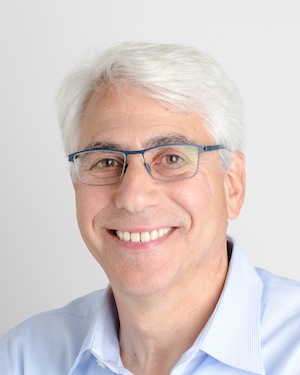
Jewish Family Service Agency has appointed Richard Fruchter as senior management consultant. He began working in this position on Jan. 7, and will be leading JFSA while the executive director search committee continues its efforts in identifying candidates and hiring of the long-term ED.
Richard Fruchter (photo from Jewish Family Service Agency)
“We are pleased to welcome Richard, who not only brings with him tremendous experience and a proven track record in not-for-profit organizations in Jewish communities in North America, but also has a thorough knowledge of our Jewish community, having served as the senior management consultant of the Jewish Federation of Greater Vancouver from 2013-2014,” said board chair Joel Steinberg.
“Richard will support the agency with his extensive knowledge in areas of finance, fundraising, communications, board governance and human resources – initiatives that were identified in our strategic plan. Prior to his tenure in Vancouver, he was the president and CEO of the Jewish Federation of Greater Seattle and, over the last 30 years, he has been in top executive positions with federations, Talmud Torah [schools] and other general community organizations in Seattle, Wash., Minneapolis, Minn., and Tucson, Ariz.”
“It’s an exciting time at the JFSA as we build for the future,” said Fruchter. “I will be playing a strategic and advisory role with the board and staff to help JFSA continue to transform the lives of individuals and families, through quality services and innovative programming. The last few weeks, I’ve had the opportunity to visit some of our programs, see their impact, and learn more about how we respond to evolving community needs. I found our staff to be dedicated and committed professionals – passionately working day in and day out to care for their clients. Our board and volunteers are talented and willingly share their wisdom and resources to provide for our community’s welfare. During this transition, I look forward to having renewed and fresh conversations with our community members, leaders and donors about how JFSA can even more effectively service our community.”
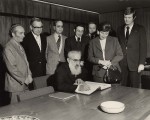
A visiting dignitary signs the VIP guest register as others look on, Congregation Schara Tzedeck, 1974. (JWB fonds; JMABC L.14413)
If you know someone in this photo, please help the JI fill the gaps of its predecessor’s (the Jewish Western Bulletin’s) collection at the Jewish Museum and Archives of B.C. by contacting archives@jewishmuseum.ca.
Bodies are taken away following an explosion at the cafeteria of Jerusalem’s Hebrew University on July 31, 2002. Hamas took responsibility for the bombing, which killed seven people and wounded 70, but a new U.S. federal court ruling found the Palestine Liberation Organization and the Palestinian Authority liable for that attack and other committed during the second intifada. (photo from Flash90)
A New York City-based federal jury on Monday ordered the Palestine Liberation Organization (PLO) and the Palestinian Authority (PA) to pay $218.5 million in reparations to American citizens who were targeted by terror attacks in Jerusalem, and to the victims’ families. The ruling is seen as a major victory for those seeking to hold so-called moderate Palestinian factions accountable for terrorism.
The court ruled in favor of 10 American families who sued the PLO and PA for six different terrorist attacks that were linked to those groups during the second Palestinian intifada. Thirty-three people were killed in those six attacks between 2002 and 2004, and 450 were injured. Since the lawsuit was filed in a U.S. court under the Anti-Terrorism Act, the reparation amount is expected to triple to $655.5 million.
Among the families involved in the landmark ruling were representatives of four victims of a Hebrew University cafeteria attack in 2002, in addition to Palestinian shooting attacks and suicide bombings that took place between 2002 and 2004 in Jerusalem.
The plaintiffs won the case after a 10-year legal battle in which the defence claimed that the PLO and the PA were not directly responsible for the attacks, which were carried out by the al-Aqsa Martyrs Brigade and Hamas. The verdict is likely to bolster Israel’s longstanding claim that Palestinian factions such as Mahmoud Abbas’ PA – which many in the West consider to be more moderate than Hamas – support terrorism.
“The PA and the PLO and the Fatah faction were all involved in terrorism during the second intifada,” said Jonathan Schanzer, vice-president for research at the Foundation for Defence of Democracies and a former terrorism finance analyst at the U.S. Department of the Treasury. “Abbas reined in those groups and has done a reasonably good job of preventing their resurgence. But the sins of his predecessor, Yasser Arafat, continue to haunt him. And now it looks as if it will cost him, as well.”