Talking about mental health

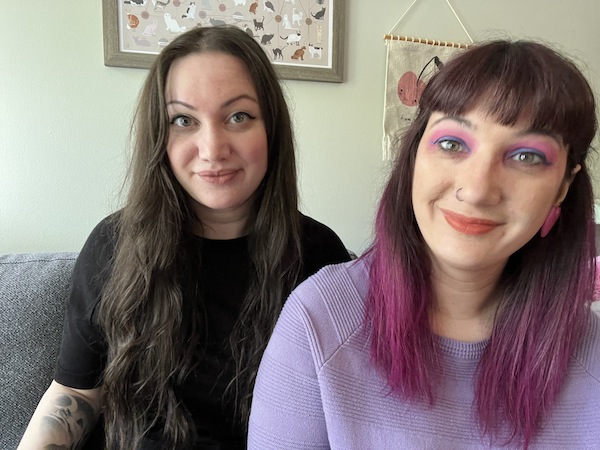
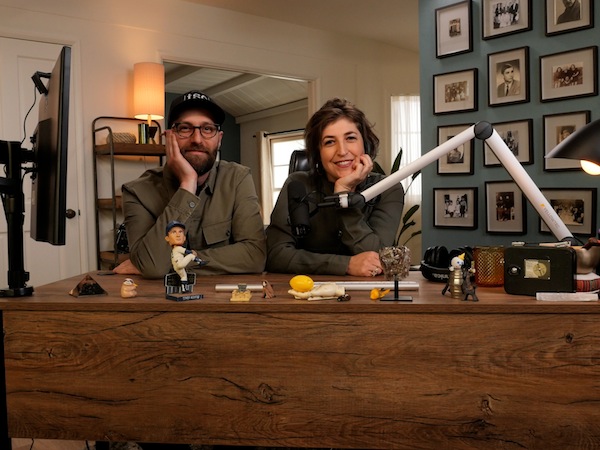
Jonathan Cohen and Mayim Bialik, co-hosts of the podcast Mayim Bialik’s Breakdown, help launch the Jewish Federation of Greater Vancouver’s annual campaign on Sept. 8. (PR photo)

Television viewers watched Mayim Bialik grow up, most notably as the character Blossom Russo on the series Blossom, and in a string of other TV and movie roles, including playing the child version of Bette Midler’s character in Beaches. More recently, Bialik has been nominated four times for an Emmy Award for her role in The Big Bang Theory and it was announced last month that she and Ken Jennings will jointly fill the late Alex Trebek’s shoes as hosts of the game show Jeopardy.

But, when Bialik speaks to a Vancouver audience Sept. 8, she will not be acting or holding the cards with all the answers. She will be opening up about an issue that is close to her own experience: mental health.

Bialik is one of three headliners at the opening event of the Jewish Federation of Greater Vancouver’s annual campaign. She will be beamed in live from Los Angeles, along with her podcast partner Jonathan Cohen. They co-host Mayim Bialik’s Breakdown, which is described as “a quirky, informative and interactive podcast breaking down the myths and misunderstandings about mental health and emotional well-being.” While the pair will join from Los Angeles, live on stage at Congregation Beth Israel will be Fran Drescher.

Best known for her titular role in the 1990s sitcom The Nanny, Drescher is also an accomplished producer and author who has won several awards in the health field. Only recently, she has begun to open up about the traumas and major health issues she experienced earlier in her life, including those she says she never adequately dealt with at the time. At the campaign launch, she will reflect on how important mental health issues are to overall well-being.

In a recent interview with the Independent, Bialik and Cohen shared some of their vision and a little of what audiences can expect when they speak. Mental wellness is a core theme of the opening event, in part because these issues have become more pervasive due to stress, uncertainty and isolation caused by the pandemic. Bialik has been open about her own experiences with these challenges.

“I think one of the things about mental health is, depending on what you’re dealing with, there can be a lot of isolation,” Bialik said. “Talking about it, and being part of challenging the stigma, I think, makes you feel less alone. I definitely feel less alone. A lot of my fears around my challenges have definitely gotten less. I have less fear about talking openly about it. I think that’s really made an impact on me.”

On the podcast, she and Cohen discuss their personal experiences, welcome experts and also introduce a buzzy crowd of celebrities like Sarah Silverman, Dustin Hoffman, Margaret Cho and Howie Mandel. Topics include managing anxiety, overcoming trauma, alternative medicine, body positivity, grief and gratitude.

A lot of the time, Bialik said, people tell her and Cohen that the show raises questions viewers didn’t know they needed to ask, or that they didn’t have the ability to express to their medical professional – or maybe they do not have access to professional care.

“We are not doctors of that sort, we’re not looking to make diagnoses,” she said. “But, in sharing our experience, a lot of people are hearing their stories and that’s been really, really very powerful. We’ve had some incredible interactions with some of our fans. One of the reasons that we do a lot of giveaways and things like that is it creates a sense of community and it lets people know that we are real people behind our microphones.”

They hope to hear from audience members in Vancouver.

“We really want to have an interactive component to the evening because, for us, we are very interested in other people’s stories and we really enjoy that part of our podcast,” said Bialik. “So we’re excited to bring that to an audience live and be able to share, and also hear what other people want to share. We are also quite funny together – we think so, but other people have told us that as well – so it will be a way for us to show how we use our humour to interact and especially discuss difficult things like mental health.”

In addition to the podcast, the pair have pitched a few TV pilots, which have yet to get picked up, but they have more up their sleeves.

“It’s been a very fun partnership and we have lots of ideas of ways we’d like to change the world,” she said.

“We also both like to explain things,” said Cohen, “which sometimes makes us compete for airtime, but usually results in a further understanding of something.”

They both balked jokingly when asked if they were drawn together by their “nerdy” pursuits. Bialik is a neuroscientist and Cohen’s expertise is artificial intelligence.

“Neuroscientists and people in AI are the new superstars,” said Cohen.

“It’s not really nerdy,” Bialik insisted with a laugh.

But seriously, she continued: “Really, when we started talking again and connecting again, [that] was when we started realizing how much we had in common in terms of our interest in science and mind and body.”

Bialik is tough to pigeonhole. A mother, a scientist, an actor, an author, a game show host, a proud Jew, a vocal Zionist – she doesn’t feel a need to choose between her complex identities.

“I don’t know if it was ever really a question of settling for just one,” she said. “I’m a mother and I think that is the role I most enjoy personally. In terms of professional activities, I really did enjoy being a scientist and the knowledge that I acquired does not go away just because I’m not a full-time scientist. I do love advocating for causes that are important for me. I love writing. I do love writing. I guess it’s hard to pick just one.”

Hosting Jeopardy is a very different kind of job than being an actor, she acknowledged.

“I obviously have to be myself, but I have producers and judges talking in my ear the whole time, so it’s a big division of attention and that can be hard,” she said. “It’s a lot of really difficult words to pronounce, which I do get to practise a little bit that morning before we tape each set of episodes, but [it’s] very, very different and you have to be ready for anything because anything really does and can happen at Jeopardy.”

As one of Hollywood’s most visible Zionists, Bialik has been a lightning rod for anti-Zionism and antisemitism. But that’s not new, she said.

“The fact is, I’ve been dealing with antisemitism and anti-Zionism for decades in my professional presence,” Bialik said. “I will say that the climate of North America has definitely shifted.… [But] for me, it’s always been an issue. It’s one I was raised to know about and be aware of. I think I’m more touched, as many of us are, by the increase in antisemitic acts, and violent acts especially, against Jews. As someone who has been going to Israel and continues to go to Israel – I’ve been probably a dozen times – that’s always something on my radar. There’s definitely been more of this kind of hatred and activity and specifically targeting me. But it’s also been something that I’ve always had to think about.”

The Thursday, Sept. 8, Federation annual campaign launch at Beth Israel starts at 7:30 p.m. Tickets, $18, are at jewishvancouver.ca.
Averbach back home

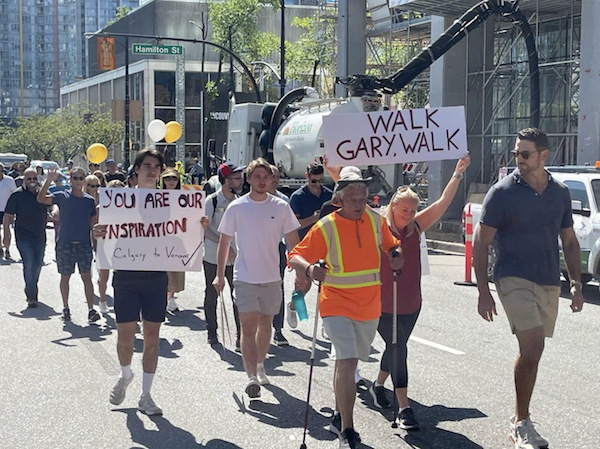
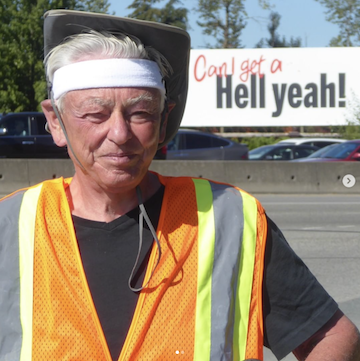
Supporters join Gary Averbach as he completes his walk from Calgary to Vancouver. (photo from Instagram @bobswalkforcancer)

When Gary Averbach told friends and family he was going to raise money for cancer research by walking from Calgary to Vancouver, they asked him if he was joking or crazy. His podiatrist urged his kids to get him to rethink his scheme. But when he strolled into Vancouver Aug. 11, he was greeted with a hero’s welcome at Jack Poole Plaza by those same people and plenty more who joined his cause.

The 79-year-old Averbach was inspired to raise at least $500,000 after he suffered the loss from cancer of four people close to him in a mere seven weeks last year. First, his cousin, business partner and friend Robert (Bob) Golden passed away. Averbach decided to do the fundraising walk in Bob’s honour. He connected with the B.C. Cancer Foundation and the planning for Bob’s Walk for Cancer was set in motion. Sadly, Averbach would soon find himself walking in memory and honour of three more people – cousins Ronnie Onkin and Darlene Spevakow, as well as his longtime and beloved housekeeper, Angelita Tica.

“At that point, I said, I can’t just do this walk for Bob,” Averbach told the Independent while taking a break from his walk in British Columbia’s Shuswap region last month. “I’ve got to include them as well because they are just as worthy of being included as Bob. Although it’s called Bob’s Walk, I made it clear that I’m walking for the four of them and everybody I’ve lost and anybody that has lost loved ones to cancer. There isn’t a family that that hasn’t happened to.”

The name of the campaign caused a little confusion on the road. As he trod along highways and byways, people yelled out encouragement to “Bob.” Averbach gave up correcting well-wishers.

“For awhile there, I was maybe correcting people but I thought, let me be Bob. It doesn’t matter, as long as they’re supporting me.”

What he didn’t get used to was the outpouring of support. All along the way, from the very first day of his trek, passersby sent shouts, honks, thumbs up and words of encouragement.

The cancer foundation helped Averbach set up a fundraising and information website, where people could follow his progress. He also blogged his journey, including interesting or thoughtful reflections on what had taken place that day or things that had popped into his head during his long, solo trek across the province.

Walking has always been a favourite pastime for the Vancouver businessman and philanthropist.

photo - Gary Averbach’s fundraising journey took him from Calgary to Vancouver over several weeks
Gary Averbach’s fundraising journey took him from Calgary to Vancouver over several weeks. (photo from Instagram @bobswalkforcancer)

“I love sports and I wish I could be a good athlete but I was born with one eye weaker than the other,” he said. “Because I do not have good depth perception, I cannot be a good athlete. But one thing I always knew was that I had good stamina and I could walk for hours. I walked all through Israel when I was in my 20s and I’ve always enjoyed walking as a way to keep fit.”

Padding through some of North America’s most dramatic scenery was an experience, he said. Although he had been on the route many times, it was always at 100 kilometres an hour. The majesty of the Rockies, the rivers, streams, waterfalls and wildlife led him to change the theme song of his venture from “High Hopes” to “What a Wonderful World.”

“Watching closely like you do when you’re walking, it does make you realize not just how beautiful it is – you can’t do that when you’re driving – but also how amazing it is, how everything works together, like the water starts with a glacier and ends up being a river going out to the Pacific. Everything follows its path. And the flora, the way it changes here.”

He was in Banff National Park on Canada Day, but noticed that every day seems like Canada Day in some rural areas. The maple leaf flies frequently in small towns, he said.

“I think there’s a level of patriotism in the countryside that doesn’t exist in the big city,” he remarked.

He also noticed signs of the times. The pandemic and its associated labour shortages have led even the legendary 24/7 diner Denny’s to reduce its hours, and some of the motels his team stayed at along the way were short-staffed.

On foot, Averbach was also more aware than he might have been behind the wheel that the road system is not uniformly modern.

“It is so piecemeal,” he said. “There are some sections of the Trans-Canada that would not even be rated a good country road, especially going through some of the towns. It’s a disgrace in some cases.”

He had some trepidation about wildlife he might encounter – bears, obviously, were a worry – but infrastructure, more than luck, may have prevented any interactions with Smokey or Yogi. Wildlife-protecting fences have been installed along much of the country’s highway system, with overpasses for animals to safely get from one side to the other.

“I didn’t see a single bear,” Averbach said – not even from a distance. Mosquitoes, beetles and grasshoppers, on the other hand, were plentiful.

“If I was an entomologist, it would be fascinating,” he said.

Averbach was assisted by a team of two, Bart Zych and Alex Krasniak.

“Alex primarily drives the van behind me, he follows me like a puppy dog,” joked Averbach, noting that people undertaking adventures like this are required to have a vehicle adjacent for traffic safety. The usual schedule was to walk five hours, rest for a bit and then continue for another three or four hours.

“Bart is the person who does all the logistics. He arranges the hotels before we go from one place to the other. He even does my laundry much better than I do,” Averbach said. “He meets us and he brings us sandwiches.”

Averbach is a warm weather guy – he trained for the walk in Hawaii and Palm Springs – and didn’t appreciate the cold mountain weather in the early days of the walk. Even near the end, he encountered rain, despite it being the height of summer. On the other hand, he also traipsed through Canada’s desert zone.

“If I had my druthers, I’d rather be in hot temperatures than the really crappy weather we had in the mountains,” he said.

When he first spoke with the Independent, Averbach was worried about meeting his target of $500,000.

“For awhile there, it slowed down at about $320,000, $330,000,” he recalled. “I started to think, am I going to be able to reach my goal, which is a half-million?”

As of his arrival in Vancouver, he had surpassed his minimum goal of $500,000 and now has his sights on more.

“According to commitments and some of the cheques that are in the mail, we are probably somewhere around $570,000,” he said. The campaign will continue and the website will stay active until his 80th birthday, on Oct. 10.

He offers special thanks to friends in the Jewish community – donations in multiples of $18 are a sure sign of Jewish philanthropy.

“Over two-thirds of the donors, maybe even three-quarters of the actual donors, were from the Jewish community,” Averbach said. “The Jewish community really came out and supported me.”

While he is happy to be in his own bed and will continue pushing to raise more funds until his birthday, at least, he is not resting on his laurels or basking in the accolades.

“Been there, done that,” he quipped. “My 15 minutes are over.”

He was touched, though, by the crowd of about 200 who greeted him as he completed his journey.

“It was very heartwarming,” he said.

Does history matter?

The promise of the internet was that people could access unprecedented volumes of information for the benefit of themselves and society as a whole. What has regrettably proven to be the case is that it is a fount from which people draw to “prove” falsehoods they choose to believe – or, for nefarious reasons, claim to believe.

Amid the oceans of “information” online, it is sometimes difficult to tell what people genuinely believe as opposed to what they say they believe in public to mislead their audiences. For example, does the U.S. member of Congress Marjorie Taylor Greene actually believe that reliance on solar energy means the lights will go out when the sun goes down? Or is her apparent stupidity a deliberate foil for her support of polluting energy sources? If she believes what she said, this is misinformation. If she knows she is telling a lie, it is disinformation.

The terms “misinformation” and “disinformation” are sadly necessary to understand what is happening in our era, as we have said in this space before and feel moved to repeat. In few places is this difference as consequential as in discussions of the history of the Holocaust.

Correspondence between Polish Prime Minister Mateusz Morawiecki and right-wing journalist Bronislaw Wildstein (and two others) leaked last week defines some of the world’s foremost Holocaust scholars as “enemies of the entire Polish nation.” There is other chilling language in the back-and-forth, detailing how top Polish authorities are expending enormous energies to rewrite the history of Polish collaboration in the Shoah.

A 2018 law forbids any suggestion that the Polish state or Polish people participated in Nazi crimes against Jews. International pressure saw the penalties for breaking this law reduced from a criminal conviction to a civil matter potentially resulting in a fine. But the intent and impact remain clear. Prof. Jan Grabowski, a Polish-born Canadian academic, and a Polish colleague, Barbara Engelking, were victorious in a 2021 appeal that saw an earlier court decision order to apologize to a descendant of a Shoah-era perpetrator for betraying Jewish neighbours to the German Nazis. But this court decision has not quenched the thirst for revisionism.

The obsession among top Polish officials on this subject is unabated. The email exchange includes the suggestion that Polish authorities should strategically coopt the Jewish experience in the Holocaust to their own benefit, recasting Poles as the Nazis’ primary targets and victims.

Poland also recently extended its Holocaust-related legislation to explicitly forbid financial restitution or compensation to survivors or their heirs.

The Polish government has steadfastly asserted that Nazi atrocities catastrophically affected non-Jewish Poles, which is plainly true. But two things can be true simultaneously. Many Poles were victimized by the Nazis and many Poles collaborated with the Nazis – and, in some cases, both involved the same individuals.

Wildstein, the journalist who seems to have the prime minister’s ear, makes threatening noises about top Holocaust research and archival bodies, including the Jewish Historical Institute, in Warsaw, and the POLIN Museum of the History of Polish Jews, and mentions “the possibility of introducing our people into their midst.” He accuses the Polish Centre for Holocaust Research of presenting “an almost obsessive hatred of Poles.”

There is paranoia in the idea that exposing historical truth is identical to hatred. Ironically, while Germany is the European country that has engaged in the most introspective contrition, as much as a society can hope to do for so unparalleled a crime, Poland has steadfastly dug in its heels. The society that bears more blame for complicity with the Nazis than any other is the one that is not only refusing to confront its grotesque past but most stridently whitewashing it.

All of this has led to strained relations between Israel and Poland. It should also be a source of friction with other countries, including Canada, partly because it is a Canadian citizen, Grabowski, who is among the most targeted objects of Polish scorn, and partly because all democracies should stand up to this appalling historical revisionism.

There is a grim silver lining in this “debate.” The Polish authorities understand, as too few in the world seem to, that history matters. What happened in the past informs our present and future. If they can recast the past, they can affect the future.

The question for us is whether we, as a society, have the same understanding of and commitment to historical power. Are those who seek truth as motivated as those whose goal is to subvert it?

Editor’s Note: For a contrary point of view, click here to read the letter to the editor that was published in the Jewish Independent’s Sept. 2/22 issue.

Help break the cycle

Canadian Hadassah-WIZO’s S.O.S. – Starting Over Safely campaign is 27 hours long, beginning at 9 a.m. PT on Aug. 23. (photo by Mickey Noam Alon)

With the COVID-19 government shutdowns and mandatory quarantines, domestic violence has increased significantly across the globe over the past two years. The drastic increase in intimate partner and domestic abuse has been coined the “Shadow Pandemic” by the United Nations.

In Canada, one woman is killed in a violent act every two-and-a-half days. According to the provincial ministry for public safety and Statistics Canada, every year in British Columbia there are more than 60,000 physical or sexual assaults against women – almost all of them committed by men.

In Israel, the situation is just as critical. In the first year of the pandemic, 20,140 domestic violence complaints were lodged with police, an increase of 12% from the previous year. Twelve women were murdered in the first six months of this year.

In accordance with its mission, Canadian Hadassah-WIZO (CHW) is working to empower women by stepping up emergency support and services at this critical time. CHW is launching the second annual S.O.S. – Starting Over Safely summer campaign, with proceeds helping empower victims of domestic violence in Canada and Israel.

One of the most frightening things about domestic abuse is that half of the women murdered by their partners never experienced physical violence before. Domestic violence can happen to anyone, anywhere, anytime. This year, through a new partnership with Michal Sela Forum, CHW is also promoting an awareness campaign to help women understand the warning signs in a relationship.

S.O.S. – Starting Over Safely 2022 has three campaign priorities, including Franny’s Fund in Canada, and WIZO programs and the Michal Sela Forum in Israel. The following campaign goals are intended to empower at-risk women and children to break the cycle of violence in Canada and Israel:

  • Provide help for parents and families in need of an urgent response;
  • Provide access to critical resources such as legal counsel and counseling services;
  • Provide women and their children with the basic essentials to start over safely;
  • Empower women and their children by providing financial help, social and personal support, employment support, and access to a network of other women in similar circumstances;
  • Provide women and their children with specially trained canine protection; and
  • Fund respite summer camp experiences for at-risk youth.

“CHW strongly believes that every human being deserves the right to achieve their full potential, while living in safety and security. You have the power to empower,” said Lisa Colt-Kotler, CHW chief executive officer.

The 2022 fundraising goal is $350,000. All funds donated will be matched three more times by a community of dedicated donors recognized as “Matching Heroes” during the 27-hour campaign, which kicks off at 9 a.m. PT on Tuesday, Aug. 23, 2022. During the crowdfunding period, each gift donated on the website chwsos.ca is quadrupled.

To donate or learn more, visit chwsos.ca.

– Courtesy Canadian Hadassah-WIZO

Hate crimes on the rise

On Aug. 2, Statistics Canada released police-reported hate crime data for 2021revealing, once again, that hate crimes targeting the Black and Jewish populations remain the most common reported by police.

“We are deeply concerned that incidents of hate crime rose yet again in Canada in 2021,” said Shimon Koffler Fogel, president and chief executive officer of the Centre for Israel and Jewish Affairs (CIJA).

There were 642 reported hate crimes against Black Canadians in 2021, a slight decrease from the 676 reported in 2020, but an 86% increase from the 345 incidents reported in 2019.

Overall, hate crimes targeting religious groups increased 67% from 2020, breaking a three-year downturn. Incidents targeting the Jewish community grew by 47% from 2020 to 2021. Statistically, this reflects 1.3 in 1,000 members of Canada’s Jewish community reporting having been the target of a hate crime in 2021.

Jewish Canadians remain the most targeted religious minority for hate crime and second overall. There are approximately 380,000 Jews in Canada, representing only one percent of the population, yet members of the Jewish community were victims of 14.5% of all reported hate crime in 2021.

“Statistically, Canadian Jews were more than 10 times more likely than any other Canadian religious minority to report being the target of a hate crime. This is alarming,” said Fogel.

“This report should be a call to action for all Canadians to stand against antisemitism and all forms of hate…. We are grateful that police services across the country take these incidents seriously, but more needs to be done to protect vulnerable communities,” he said. “This includes greater support for security and safety at community institutions such as houses of worship; equity, diversity and inclusion education that includes training on antisemitism; and a national strategy to target online hate and radicalization.

“Although Canada remains one of the best countries in the world in which to be Jewish, or any other minority for that matter, these numbers should concern all Canadians. One hate crime is one too many.”

For more on the Statistics Canada report, visit www150.statcan.gc.ca and click on the link for the publication Juristat.

– Courtesy Centre for Israel and Jewish Affairs

A new creative arts market

Siblings Becky, left, and Margaux Wosk (photo from We Belong!)

The first-ever We Belong! Festival will take place Aug. 27 in Downtown Vancouver. Organized by siblings Margaux and Becky Wosk, We Belong! is a “one-of-a-kind creative arts market with a focus on giving disabled artists the opportunity to showcase and sell their art.”

Margaux Wosk is a self-taught artist, an activist and a disability rights advocate, fighting for disabled small business owners to get resources. Becky Wosk is an artist, designer, writer and musician; she and Emmalee Watts form the duo Hollow Twin.

Margaux Wosk started their business, Retrophiliac (shopretrophiliac.com), more than 10 years ago. Its focus is on visual art.

“Being an openly autistic person,” said Wosk, “I found that there was a void in the marketplace for the type of items I wanted to see and purchase.

“My business has really ramped up in the last five years,” they continued, “and I focus on autistic, neurodiversity and disability pride items, such as enamel pins, patches and stickers. I design retro-inspired pins, stickers and patches as well. I also have other items I offer and I have over 26 retailers between Canada and the United States.”

Wosk also uses their business “as a way to talk to the government about disabled small business owners” and they have gone to the provincial budget meeting two years in a row “to rally for funding and resources for other people like myself.”

They explained, “Currently, as it stands, we have no resources, and any of the funding that goes to ‘inclusive employment’ only goes to employers that hire disabled people, not disabled people who own their own business.”

Part of the mission of the We Belong! Festival is to raise awareness.

“I have been part of other markets and I do enjoy it, but none of them meet all of my needs,” said Wosk. “I find that sometimes there are financial barriers, sometimes the events are just too long and I find that it can take a toll on my mind and body. I wanted to create something with little barriers for other disabled artists and we were lucky enough to be the recipients of the Downtown Vancouver BIA’s [Public Space] Vibrancy Grant. This way, we won’t have to charge our vendors any costs and we can provide them tables, canopies and chairs. I want people to see what we’re all capable of.”

The Downtown Vancouver Business Improvement Association helped secure the market’s space at 855 West Hastings St. (Lot 19), and it is being provided free of charge. The location, which is between Burrard and Howe streets, is close to Waterfront Station and other public transit points.

“Once the location and date were confirmed,” said Becky Wosk, “we were able to figure out how many vendors we can accommodate and, from there, we put out a call to artists/makers. We have a specific budget to work with, so we have been able to gather quotes for the supplies we will need to make this event successful.

“When working on an event,” she said, “it’s important to work backwards from the date that you have secured and determine what needs to be ordered/booked in advance of that date – for example, canopies need to be booked 30 days out etc. [There are] lots of small details to be mindful of!”

In addition to the vendors who will be selling their creations, the market will include four nonprofits: Artists Helping Artists, Curiko, the Jewish Community Centre of Greater Vancouver’s Art Hive, which is run by Leamore Cohen, and the BC People First Society, on whose board Margaux Wosk sits, as regional director, Lower Mainland West.

While the deadline to apply as an exhibitor has passed, the Wosks are still looking for volunteers to help with set up and tear down. Anyone interested should email webelongfestival@gmail.com.

The Aug. 27 market runs from 11 a.m. to 3 p.m.

New school year starts

As a new school year approaches, many parents are looking for fresh ways to rekindle their child’s spark for Jewish – and general – learning. Chabad Richmond Hebrew School has put forward a curriculum that offers children an immersive experience.

“Over the course of last year and throughout the summer, we have had moms and dads asking us for advice on how to nurture their child’s Jewish identity,” said Chana Gordon, director of Chabad Richmond Hebrew School. “We believe that … knowledge is power and if you provide a safe and inclusive environment which teaches Jewish values, history and culture, children will thrive mentally, emotionally and in many other aspects of their life.”

Chabad Richmond Hebrew School constantly works to have a curriculum with fresh, new activities and crafts. Using modern methods of teaching, including STEM, they seek to accommodate the needs of every child.

For example, the learning program includes Bereishit: The Story of My Life, which explores the history of the Jewish nation. Beginning with the story of Adam and Eve, and through the birth of the Jewish people, students are taken on an immersive journey allowing them to use their creative minds and imagination.

Through interactive storytelling, inclusive activities and a comprehensive knowledge base, students are encouraged to take an active role of leadership and to express themselves. The program’s aim: students who have a nurtured Jewish identity, a healthy self-esteem, long-lasting friendships and a sense of community.

Chabad Richmond Hebrew School is an affiliate of the Chabad Children’s Network (CKids), which has chapters in 26 countries and engages 25,000 children each year with Jewish education and experiences. To register your child(ren), visit chabadrichmond.com/hebrewschool.

– Courtesy Chabad Richmond Hebrew School

Sculptures inspired by Kahlo

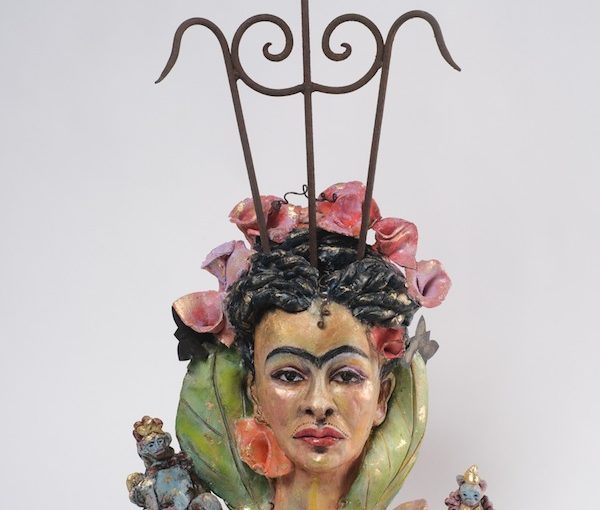
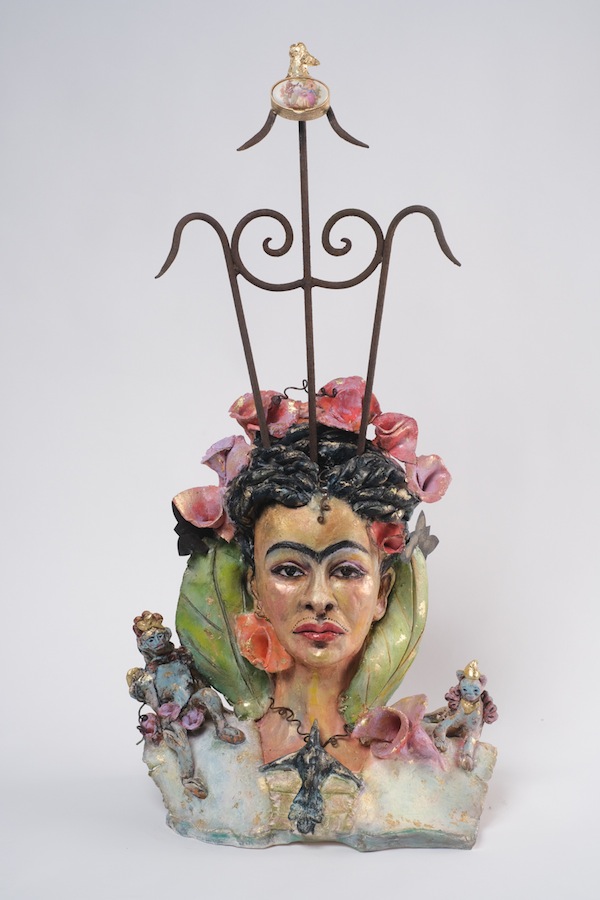
“She Was Like a Walking Flower, Centred by a Rod of Steel,” by Suzy Birstein, inspired by Frida Kahlo’s “Self-Portrait with Thorn Necklace and Hummingbird, 1940.”

“She Was Like a Walking Flower, Centred by a Rod of Steel,” by Suzy Birstein, was inspired by Frida Kahlo’s “Self-Portrait with Thorn Necklace and Hummingbird, 1940.”

photo - “She Was Like a Walking Flower, Centred by a Rod of Steel,” by Suzy Birstein, inspired by Frida Kahlo’s “Self-Portrait with Thorn Necklace and Hummingbird, 1940”
“She Was Like a Walking Flower, Centred by a Rod of Steel,” by Suzy Birstein, inspired by Frida Kahlo’s “Self-Portrait with Thorn Necklace and Hummingbird, 1940.”

In her artist’s statement, Birstein writes about this ceramic work: “‘Self-Portrait with Thorn Necklace and Hummingbird, 1940,’ is one of my favourite Frida self-portraits. In it, she is at her most beautiful, surrounded by flowers, butterflies, her monkey and cat. Her direct stare compels us to reflect upon her body in pain, her complex relationship with Diego [Rivera] and her relentless drive.

“The metal headdress references an iron-clad spirit, topped with a golden bird holding my mother’s pill box. Both Frida and my mother required medication to alleviate their pain, which they housed in these beautiful containers.”

Birstein’s solo exhibit, When I Have Wings to Fly, opened at the Port Moody Arts Centre in the Canadian Pacific Gallery July 28 and runs to Sept. 4. For more information, visit pomoarts.ca/exhibitions/when-i-have-wings-to-fly.

– Courtesy Port Moody Arts Centre

The journey to healing

Katherine Matlashewski is creator, performer and co-producer of Disclosure, which “explores the struggles of a survivor searching for pathways toward healing in an adversarial medical system.” (photo from Disclosure Productions)

Disclosure was inspired by a true story that focuses on the process of healing,” explained Katherine Matlashewski, creator, performer and co-producer of the production that will see several performances during the Vancouver Fringe Festival, Sept. 8-18.

“The way in which trauma affects the mind and body is complex and unique to each individual,” Matlashewski told the Independent. “Through movement, spoken word, soundscape and humour, Disclosure explores the struggles of a survivor searching for pathways toward healing in an adversarial medical system.”

An interdisciplinary artist, Matlashewski is a graduate of Studio 58. She has trained with Arts Umbrella and the Arts Club, and has performed with several companies, including Theatre Replacement, Metro Theatre, Stage 43 and Royal City Musical Theatre. The award-winning theatre artist is an instructor at Carousel Theatre for Young People and Arts Umbrella.

“Prior to attending Studio 58,” she said, “my training was based in movement and musical theatre. In musical theatre, when a character does not have the words to express themselves, they sing. When singing is not enough, they dance. I do not always have the words to describe how I am feeling, so I naturally turn to creating interdisciplinary works. While I was developing Disclosure, I realized that combining multiple disciplines could be utilized to convey what could not be communicated through text.”

Every Fringe performance of Disclosure will include a 10-minute post-show discussion facilitated by a representative from WAVAW Rape Crisis Centre.

The first iteration of the one-person show was presented at Studio 58 as part of Matlashewski’s graduation solo performance this past spring. “With the hopes of expanding Disclosure to a wider audience,” she said, “I applied for the 2022 Vancouver Fringe Festival. After my performance at Studio 58, I was approached by director Jane Heyman about developing my show further. After being selected as a Vancouver Fringe Festival lottery finalist, I reached out to Jane about directing the show for the Fringe and I was overjoyed when she accepted! I then began building a creative team of local emerging and early career artists.”

Heyman is also a member of the Jewish community, and she was already attached to the production when creative producer Natasha Zacher came on board.

“Katherine and I connected in May 2022, after Disclosure was accepted into the Vancouver Fringe Festival,” said Zacher. “However, we have known each other for a few years, since working alongside each other on a (very!) different Vancouver Fringe Festival show in 2015. Katherine reached my way as she knew a good deal about my professional journey, integrating work as an independent theatre-maker and a mental health clinician. We reconnected quickly on the premise and hopes for the production, and I was very glad to join the team.”

As a producer, Zacher said, “My primary focuses are on seeking funding for the show (grants, sponsorships, donations), creating and managing our budget, coordinating timelines for marketing and promotions initiatives for the show … contracting artists, liaising with the Vancouver Fringe team regarding production needs and, recently, developing and facilitating COVID-19 safety plans.”

Given the nature of the production, there are additional safety plans.

“It is important to take the time to create a safe, inclusive and accessible rehearsal and performance space,” said Matlashewski. “Part of my artistic practice is to create a ‘room agreement.’ This is a living document, written by the artists involved in the production. In our room agreement, we include boundaries and guidelines about how we will communicate and conduct ourselves in the rehearsal process. Something I value is taking the time to include a check in and out at the beginning and end of each rehearsal day.

“In addition,” she said, “to promote self-care, the artistic team has decided to stagger rehearsals, and also observe Shabbat by not rehearsing on Fridays.”

The seriousness of the material does not mean Disclosure is devoid of lighter moments.

“There are many ways to heal from trauma. Humour is one of them!” Matlashewski said. “Having witnessed and experienced generational trauma, I have come to understand that humour can help create distance from a difficult incident. In addition, sometimes humour is more palatable for an audience. For me, the journey to healing is like a rollercoaster. It is not linear in any way. Even in the most challenging of times, humour can facilitate healing.”

Disclosure will be presented at the NEST on Granville Island during the Fringe Festival. For anyone wanting to support the show, there is a GoFundMe campaign. “Funds raised will go directly to production costs and compensating the artists involved for their time, energy and expertise,” said Matlashewski.

Other ways to support the production include buying tickets to one of the shows (vancouverfringe.com/festival/disclosure), sharing the GoFundMe page link (gofund.me/43a8ae0d) with friends and following the production on Instagram (@disclosure.production).

“I am looking forward to seeing how the audience responds to the performance,” said Zacher. “I don’t have any expectations, and want to walk into the experience of getting the show on stage as an open book. I hope the audience feels empowered to take with them whatever supports them to feel seen and heard.”

Celebrating Leonard Cohen

Take This Waltz performers Ted Littlemore, left, and Daniel Okulitch. (photo by Victoria Bell)

Take This Waltz world premières at Rothstein Theatre Sept. 10-11.

“The concert as a whole tells a story, and each song finds its place within that story,” Idan Cohen told the Independent about Take This Waltz, which sees its world première as a Chutzpah! Plus event Sept. 10-11 at the Rothstein Theatre.

Cohen is the artistic director of Ne. Sans Opera and Dance, so it might seem odd that he’s staging a show celebrating the music of Leonard Cohen. But he’s a fan of the Canadian icon, who died in 2016, and this production piqued his interest.

“I’ve admired Cohen’s lyrics and music for years,” said Cohen, who is not related to the singer-songwriter. “So, when Daniel Okulitch, one of Canada’s most appreciated operatic baritones reached out to me to directly to produce Take This Waltz, I immediately said yes. Daniel’s vision was to look at Cohen’s music through the classical tradition of the Song Cycles (Lieds). I thought that it was a really interesting way to look at Cohen’s music through a fresh, exciting lens.”

Okulitch contacted Cohen after having created a successful online concert that included some of Leonard Cohen’s work, as well as that of other singer-songwriters, which took place via Pacific Opera Victoria in winter 2020. Okulitch wanted to add dance to the concert.

“I knew that, if I was to take this on, I would want to focus on Cohen’s body of work and say something meaningful about the times we live in,” said Idan Cohen. “Ne. Sans’ mandate is to follow the operatic tradition in the full sense of it – to create work that integrates all the classical arts of theatre, music, dance, set and costume design. It is challenging to do in this economy, but I strongly believe in this type of offering.

“It took us some time to fundraise so that we can present this work as I believe it should be presented,” he noted. “We have an ensemble of cello, violin and accordion, with stunning arrangements by Adrian Dolan, and Daniel’s voice is so rich and sensitive, that it speaks straight to the heart. Amir Ofek is designing the set, Itai Erdal creating the light design and Christine Reimer the costumes. Alongside Daniel is the dancer/musician Ted Littlemore, with whom I’ve been collaborating for almost five years, who’s such a wonderful artist. I am truly blessed, and I hope that we’ll not just do justice to Cohen’s legacy, but help audiences experience it in a different, new way.”

About that legacy, Cohen added, “I had coffee with the wonderful Vancouver-based composer Rodney Sharman the other day, to discuss a future project that we’re working on, and Rodney said something that I found to be really relevant to Take This Waltz. He said that he thinks that my body of work is a variation of two core elements: love and death. And I thought to myself, that’s life, right? Cohen got it. His wisdom is so profound that it sometimes seems as if he knew the secrets of the human soul. I think it’s because he was brutally honest, a thing that we don’t see a lot in our contemporary culture. There’s so much pain and often bitterness and anger in his work, that are then composed in such generosity and love. What a beautiful combination. My work is to honour that.”

About his collaborators on Take This Waltz, Cohen said the production started at Pacific Opera Victoria, “as an intimate, beautiful concert of various music that included just a few of Cohen’s songs, and Vancouver Opera decided to support its development and creation. Jessica Gutteridge, a wonderful human and the artistic director of Chutzpah!, has given us a very generous creative residency at the Norman and Annette Rothstein Theatre in Vancouver’s JCC [to further develop the work]. It’s all live, no film or projections. I felt that Cohen’s work needs to be honest and direct. Having said that, there are quite a few surprises in the show – you’ll just have to come and see!”

Take This Waltz is being presented with Pacific Opera Victoria and Vancouver Opera, and Chutzpah!’s live music programming is supported by a grant from AmplifyBC. The Sept. 10-11 shows are also being supported by the Bierbrier family, in memory of Len Bierbrier, who was a dear friend of Chutzpah! board chair Lloyd Baron, said Gutteridge. Bierbrier was also a friend of Leonard Cohen, she said.

While most people cannot claim that level of connection to the legendary musician, many people do feel connected to him in some way. When asked to confirm that, indeed, he was not related to the singer-songwriter, Idan Cohen said, “We are all related, aren’t we? I first heard Cohen’s music through my dad and, in many ways, always felt that he is a father figure to me. So many of us feel that way about him and his music and poetry. I love him like family. Does that count?”

For tickets to Take This Waltz, visit chutzpahfestival.com.