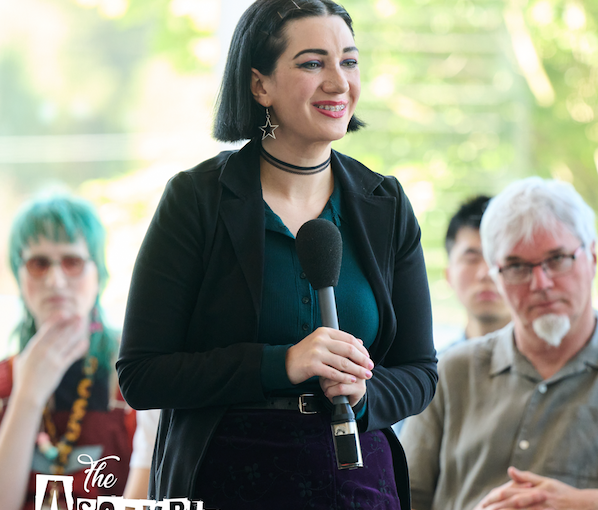
Margaux Wosk is a cast member of The Assembly, currently streaming on CBC Gem. (photo by Erich Saide / The Assembly)
“I am so proud of what we accomplished,” Margaux Wosk told the Independent about The Assembly, which is now streaming on CBC Gem. “The show offers fresh perspectives on autism and highlights how diverse autistic experiences can be. It also makes for authentic interviews, because no questions are off the table, which is rare to see in mainstream programming.”
Having watched the show, I couldn’t agree more. Produced by Vancouver-based production company Small Army Entertainment, The Assembly is entertaining. The way in which everyone interacts is refreshingly respectful, the content of the questions is unexpected and the honesty from both the interviewers and interviewees makes for compelling viewing. Everyone comes off as down-to-earth, friendly, with joys and fears most of us have experienced, just in different ways. In the inaugural season, the cast comprises more than 40 autistic and neurodivergent British Columbians interviewing six celebrities – Howie Mandel (America’s Got Talent), Maitreyi Ramakrishnan (Never Have I Ever), singer-songwriter Jann Arden, Allan Hawco (Saint-Pierre), Arlene Dickinson (Dragon’s Den) and comedian Russell Peters – over the course of six episodes.
According to CBC, the show is adapted from a French program, Les rencontres du Papotin, which started in 2022 on France 2 and became so popular that it has been commissioned in 19 countries to date. It was renamed The Assembly for British audiences, which is how it has been imported into Canada. But the origins go back even further, notes CBC – “The TV program was inspired by a real-life newspaper that has been written and published by autistic journalists since 1990.”
Wosk found out about the Canadian production via a Small Army Entertainment social media post.
The casting process took more than a year, according to CBC. “Producers worked with professional organizations within the autistic community to find people who would be interested in appearing on the show. Once selected, they were provided with some background information about each celebrity guest, but it was up to them to do their own research and decide how much or how little they would prepare,” says a Nov. 6 CBC Gem post.
“We received information about each guest and submitted about five questions each,” said Wosk. “These were then narrowed down to the best questions, and the team made sure there were no duplicates from other cast members. This process allowed us to craft questions that were both meaningful and unique.”
Filming took place in various places. “We filmed mostly during the summer at a few locations around the city that had natural lighting to accommodate people with light sensitivity, like myself,” said Wosk, who wanted to participate in the show for a few reasons.
“I love public speaking, and I wanted to help reduce the stigma around what autistic people are capable of,” they said. “I also wanted to reclaim my narrative. My childhood was difficult in many ways, so being able to feel empowered and share my perspective as an adult is really meaningful to me.”
Wosk serves as president of BC People First, where they support self-advocacy and inclusion for people with intellectual and developmental disabilities. They have written for or been featured in numerous publications and been interviewed for radio and other media many times. They received a BC Achievement Community Award this year, recognizing that their work with BC People First “breaks down barriers, fosters pride and amplifies underrepresented perspectives through creativity, advocacy and education”; that their business, Retrophiliac, empowers “others to express themselves, reduce stigma and build community”; that, in their leadership on accessibility, education and business development, their artwork and other initiatives, they are “a strong voice for inclusion, pride and important systemic change.”
Retrophiliac “sells items focused on disability, neurodiversity and self-expression, as well as communication cards that help people communicate,” and has a couple of access points: retrophiliac.etsy.com and shopretrophiliac.com. Wosk’s website is margauxwosk.com.
One particularly exciting moment for me as a viewer of The Assembly, though I only know Wosk slightly through some volunteer work we’ve done, was when Arden, as she was chatting with some of the interviewers after the main filming, said Wosk looked “kick ass.”
“It was amazing,” said Wosk when I asked how it felt to hear that. “I had planned my outfit weeks in advance for each taping, and my sense of style is really important to me. It is one of the ways I express my personality, so hearing Jann Arden compliment it felt very affirming and special.”
Wosk isn’t the only Jewish community member on The Assembly. I recognized Lyle Lexier and Wosk thought there might be another. CBC didn’t respond to my emails.
“I hope viewers have their assumptions about autism challenged and reduced,” said Wosk about the show. “I also hope they enjoy seeing Canadian celebrities and public figures answer questions in ways they probably have not seen elsewhere, giving a deeper sense of how human and relatable they are.”
Margaux Wosk, left, receives a Community Award from BC Lt.-Gov. Wendy Cocchia (photo from BC Achievement Foundation / Don Craig, photographer)
On May 1, Premier David Eby and Walter Pela, chair of the BC Achievement Foundation, named the recipients of the 22nd annual Community Award. The program, presented by BC Achievement – an independent foundation that honours excellence and inspires achievement throughout the province – recognizes extraordinary British Columbians who build better, stronger and more engaged communities. This year’s recipients included Jewish community member Margaux Wosk.
Wosk is an advocate, artist, designer and entrepreneur who champions disability justice and neurodivergent inclusion.
As president of BC People First, they provide leadership to elevate disabled voices and advocate for meaningful change across the province. Their work breaks down barriers, fosters pride and amplifies underrepresented perspectives through creativity, advocacy and education.
Through their business, Retrophiliac, Wosk designs communication tools and products by and for disabled, LGBTQIA2+ and neurodivergent individuals – empowering others to express themselves, reduce stigma and build community. They also founded the We Belong market, which highlighted neurodivergent and disabled entrepreneurs, and were featured on AMI’s Our Community episode for their advocacy and small business endeavours.
An emerging leader, Wosk spoke on Parliament Hill at the Disability Without Poverty rally and has collaborated with People First of Canada, McMaster University and Curiko on accessibility and small business development. Their artwork – featured in York University’s Mental Health Literacy Guide for Autism, to which they also contributed – reflects their commitment to advocacy through creativity. Several of their products are available from the Museum of Vancouver on their open MOV platform.
“The recipients of this year’s Community Award remind us that the strength of British Columbia lies in the compassion, creativity and commitment of its people,” said Eby. “Whether they’re leading grassroots initiatives or mentoring future changemakers, these individuals exemplify the power of community and the impact of selfless service. Their efforts uplift us all and set a powerful example for what we can achieve together.”
“This year’s program shines a spotlight on emerging leaders alongside long-standing changemakers,” said Pela. “Each recipient demonstrates what’s possible when individuals step up with purpose and heart. Their contributions strengthen our communities and remind us that leadership isn’t defined by title or age – it’s defined by impact, generosity and vision.”
The Community Award recipients are selected by an independent jury panel, whose 2025 members include Mayor Suzan Hewat of Kaslo, Mayor Sarrah Storey of Fraser Lake, and past recipients Herman Ho of Vancouver, Meeka Morgan of Ashcroft and Upkar Singh Tatlay of Surrey.
This year’s award recipients were recognized in a formal presentation ceremony held in Victoria on May 7 in the presence of BC Lt.-Gov. Wendy Cocchia.
Each awardee will receive a medallion designed by Robert Davidson. They will also be celebrated through the online campaign #shinethelightbc, to commemorate their inspirational achievements positively impacting British Columbians.
For more information about the BC Achievement Foundation or Community Award program, visit bcachievement.com.
* * *
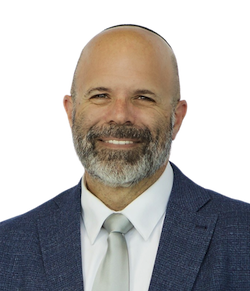
Rabbi Dan Moskovitz
Rabbi Dan Moskovitz was honoured with the doctor of Jewish nonprofit management, honoris causa, from Hebrew Union College at its 2025 Graduation Ceremony in Los Angeles.
Moskovitz has served as senior rabbi of Temple Sholom since July 2013. Before joining Temple Sholom, he was associate rabbi at Temple Judea in Los Angeles for 13 years. He is also a past chair of the Reform Rabbis of Canada and was on the steering committee for Canadian Reform Judaism. Moskovitz is the author of numerous articles and publications, including The Men’s Seder (MRJ Press), an experiential journey through the Passover seder for Jewish men.
“As we continue our celebration of both emerging and established leaders through thisseason of ordination and graduation, we take special pride in awarding honorarydegrees to graduates whose professional journeys exemplify our mission and values,” said Dr. Andrew Rehfeld, president of Hebrew Union College. “Through their vision, service and enduring impact, they define how bold leadership can shape a vibrant Jewish future.”
* * *
The fifth edition of the Western Canada Jewish Book Awards, presented by the Cherie Smith JCC Jewish Book Festival in Vancouver, took place May 13 at the Jewish Community Centre of Greater Vancouver. There were winners in six awards categories.
Helen Pinsky presented the Nancy Richler Memorial Prize for Fiction to Dave Margoshes for his novel A Simple Carpenter. Set in Middle Eastern “Holy Land” in the early 1980s, against the backdrop of the civil war in neighbouring Lebanon, the protagonist is a Christ-like character trying to live a low-key life in Israel/Palestine. Part biblical fable, part magic realism and part thriller, A Simple Carpenter is a meditation on memory and identity, religious faith and doubt, the yearning for a messiah, and the perennially tangled, fraught state of Arab-Israeli relations.
Bernard Pinsky presented Prof. Richard Menkis with the Pinsky Givon Family Prize for In a “Land of Hope”: Documents on the Canadian Jewish Experience, 1627-1923, which Menkis edited with Prof. Pierre Anctil. The collection prioritizes diverse Jewish voices that express the multiple realities of the Canadian Jewish experience. Organized chronologically, from the arrival of the first Jewish migrants to New France, to Jewish Canadian experiences during and shortly after the First World War, this volume includes sources never before published.
Robert Matas presented the Cindy Roadburg Memorial Prize for memoir/biography to former federal cabinet minister and senator Jack Austin who wrote, with Edie Austin, Unlikely Insider: A West Coast Advocate in Ottawa. The memoir is a reminder of the value of public service as a force for economic progress, social justice and nation-building. As a British Columbian, Austin worked to ensure that BC’s perspectives and interests mattered in Ottawa; as someone who came from a disadvantaged background, he is sensitive to the need to make the country a place of fairness and opportunity for all.
The Diamond Foundation Prize for writing for children and youth was presented by Daniella Abramowich to Ellen Schwartz for Schwartz’s Friends to the Rescue, illustrated by Alison Mutton. Inspired by a true story, and told in two different time periods, the book takes place in Fossa, Italy, a small mountain village that offered refuge to Jews during the Holocaust. When the village suffers a devastating earthquake 65 years later, the Jewish refugees whom the town had helped travel to Fossa to return the favour.
Rhea Tregebov received the Betty Averbach Foundation Prize for poetry from Leanne Averbach for the book Talking to Strangers. In it, Tregebov mourns, praises, prays, regrets, summons, celebrates and bears witness with artistry and tenderness. Talking to Strangers was also awarded the Canadian Jewish Literary Award for poetry in 2024.
The Kahn Foundation Prize for writing on the Holocaust was presented by Saul Kahn to Marie Doduck for her memoir A Childhood Unspoken. Mariette was only 5 years old when the Nazis invaded her hometown of Brussels, Belgium, in 1940. She and her siblings were scattered across the city and countryside, hiding with non-Jews and in convents and orphanages or working for the resistance. Mariette emerged from the war quick-thinking, independent and ready to start a new life in Canada. As she navigated to a new identity as Marie – an industrious and resourceful community member, mother and advocate for children’s rights – Mariette, the silent child, found her voice.
Jurors for the 2025 Western Canada Jewish Book Awards were Miranda Burgess, Susanna Egan, Elisabeth Kushner, Roger Nash, Norman Ravvin and Harriet Zaidman.
Daniella Givon, chair of the awards committee, introduced the evening and Dana Camil Hewitt, director of the JCC Jewish Book Festival, concluded the awards celebration.
* * *
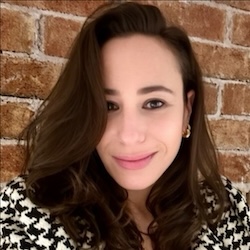
Jessica Kronis
Jessica Kronis is the new director of the Jewish Community Foundation. She brings a wealth of experience from Toronto’s philanthropic sector and a deep commitment to mission-driven work. From her leadership at ACCESS Community Capital Fund to her role with Hillel at Florida International University and helping launch the Nova Exhibition in Toronto, Kronis has consistently built strong programs and meaningful connections.
The Jewish Community Foundation plays a vital role in building a strong, sustainable future for our community. Through endowments, legacy gifts and other forms of planned giving, it helps ensure support for community institutions and responds to emerging needs. The foundation closed the fiscal year with $108 million in assets, surpassing the $100 million milestone. This achievement reflects both the trust our fundholders place in the foundation and the oversight of its investment committee, whose guidance has kept the investment strategy focused, effective and responsibly managed.
* * *
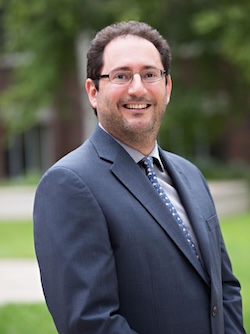
Dr. Siamak Boroomand
Dr. Siamak Boroomand has been appointed as King David High School’s new deputy head of school. He will be taking over the position from Alex Monchamp, KDHS’s deputy head of school for the past 24 years, who is moving on to new ventures.
Boroomand brings more than 20 years of experience as an educator and leader in Canadian Accredited Independent Schools (CAIS) institutions across Canada. A proud British Columbian, he graduated from St. George’s School and earned his teaching certification from Simon Fraser University. He began his career teaching chemistry and math at Southridge and Meadowridge schools before relocating to Ontario.
For the past 15 years, Boroomand has been a leader at Branksome Hall, an all-girls International Baccalaureate school in Toronto. There, he served as a science and math teacher before moving into administrative roles, including assistant head of middle school, assistant head of operations and, most recently, assistant head of grades 9-10, where he supported 220 students and their families.
Boroomand will be moving back to Vancouver with his wife, Bonnee, son Aaron and daughter Kayla. He steps into his role at KDHS in August.
* * *
The Ronald S. Roadburg Foundation has awarded a $350,000 multi-year grant to support the new USY (United Synagogue Youth) Lower Mainland Community Director initiative. This funding will subsidize the program’s growth through 2029 and aims to foster deep Jewish engagement for teens through enriching programming, mentorship and community involvement.
The initiative is a collaborative effort between multiple synagogues in a geographic area to serve teens. In the Lower Mainland, the three main participating Conservative congregations are Congregation Beth Israel (Vancouver), Congregation Har El (West Vancouver) and Beth Tikvah Congregation (Richmond). Launched in September 2024 with the hiring of Shayla Brewer as the Lower Mainland’s first community director, the program has already seen growth in local and international USY participation by teens.
Margaux Wosk makes pins, magnets, necklaces and other items. (photo from the artist)
Last year’s Affordable Art Show at the Zack was such a success that the gallery is repeating it in 2022, just in time for the winter holidays. Gallery director Hope Forstenzer hopes it will become an annual tradition.
Everything in the show is less than $250, and the selection is wide enough to appeal to a variety of tastes. The participating artists are a mix of repeat appearances and newcomers. Some of the newcomers have exhibited in Zack group shows before. For the others, this is their first event at the gallery.
Margaux Wosk is one of the new artists. Their company, Retrophiliac, produces pins, magnets, necklaces and other items, many of which are priced below $20.
“I’m an autistic, self-taught artist, designer, writer, entrepreneur and disability advocate,” Wosk said. “I have been a ‘retrophiliac’ for a long time. I am inspired by retro and vintage styles, but I also want to celebrate neurodiversity.”
In addition to their company’s distinct merchandise, Wosk creates vibrant, retro-inspired paintings and mixed media work. “I hope to break down barriers and eliminate the stigma of neurodiversity,” they said. “With my art, I want to open a dialogue about what autistic and disabled people are capable of.”
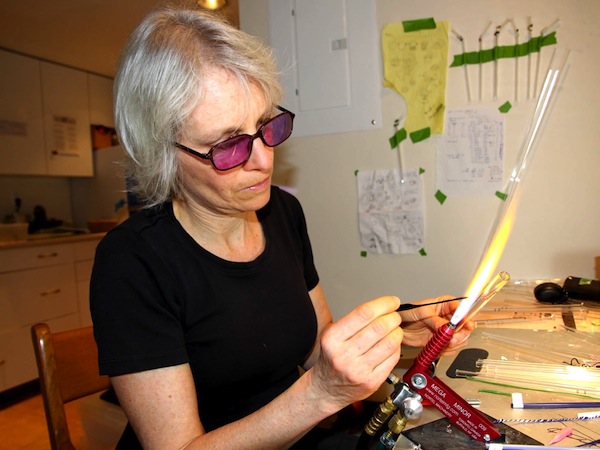
Aimee Promislow, another new artist, works with glass. Her company, Glass Sipper, produces reusable drinking straws. “I met Hope [Forstenzer] a number of years ago,” she told the Independent. “We were both members of the same glass co-op. When she joined the Zack Gallery, she began reaching out to me for various events and shows. Last year, I participated in the Hanukkah show here. I’m excited to be part of the Affordable Art Show this year.”
Aimee Promislow works with glass, making reusable drinking straws. (photo from the artist)
Promislow summed up her creative path and why she chose it. “I have always, since a young age, dabbled in art,” she said. “My mother is an artist, Nomi Kaplan. She had introduced me to various art forms. After high school, I tried pottery, then glass enamel, then I played with resin. Eventually, about 15 years ago, I started melting coloured glass. I love colour and I love watching things form in fire. Glass is hard when cold, but, once heated, it is malleable, and I love moving it around.”
At first, Promislow made glass beads and sculpted little animals out of glass: dogs, cats, turtles. “At the same time, our family enjoyed smoothies,” she said. “The kids wanted straws for their smoothies, but the only smoothie straws I could find were plastic ones.”
Concerned about the environment, she combined her passion for glass with her care for nature. “I had a ‘eureka’ moment,” she recalled. “I realized that, instead of making glass beads, I could make reusable glass drinking straws and decorate them with my tiny creatures. That night, Glass Sipper was born.”
She also makes glass mezuzot and yads (the pointers used to read Torah). “They are perfect gifts for bar and bat mitzvah,” she said. “And everything I make is under $100, ideally suitable for the Affordable Art Show.”
Another glass artist in the show is Sonya Labrie. Her company, SML Glassworks, produces vases and other elements of home décor, as well as jewelry. “I’ve always created pieces that could be in anyone’s home,” she said. “The idea that art is to be loved and available to everyone in our community is very important to me.”
With such a mindset, when Forstenzer invited her to participate in this show, Labrie’s answer was an unequivocal yes.
“I started working with glass in 2005,” she said. “The first glass class I attended was at Red Deer College in Red Deer, Alta. Then I went on to complete a three-year advanced diploma in craft and design at Sheridan College, majoring in glass. I’ve also had the opportunity to study glass at the renowned Pilchuck Glass School in northern Washington.”
Glass artist Sonya Labrie creates vases and other elements of home décor. (photo from the artist)
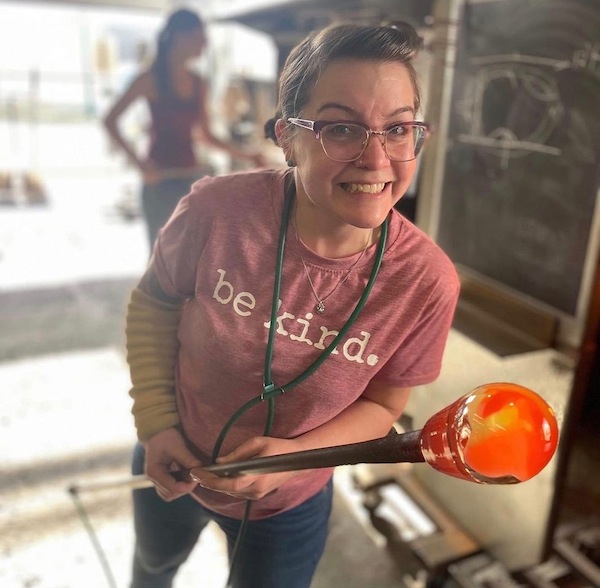
Labrie said she can’t imagine her life without creating beautiful things out of glass. “My body of work includes blown glass, flamework and kilns-cast items,” she elaborated. “Glass has endless possibilities, it is a challenging medium, and I keep discovering new ways of working with it.”
She also teaches glasswork for the Vancouver School Board. “I teach students grades 8 to 12 and I teach continuing education workshops for adults at the Terminal City Glass co-op.”
Unlike these company-owning creators, fibre artist Deborah Zibrik doesn’t consider herself a full-time artist. Not yet.
“I am a registered dietitian,” she said. “I’m still working part time, finishing a career that started in 1975. I will retire soon, after a research project at the B.C. Children’s Hospital Research Institute is completed. Until then, I simply don’t have enough time each day to work as a full-time artist. However, I consistently carve out ‘me time’ every day to complete some stitching. Ideas are constantly percolating in my head. Typically, many pieces are framed up or in the sketchbook phase at any one time. Perhaps the best descriptor for me is a part-time artist.”
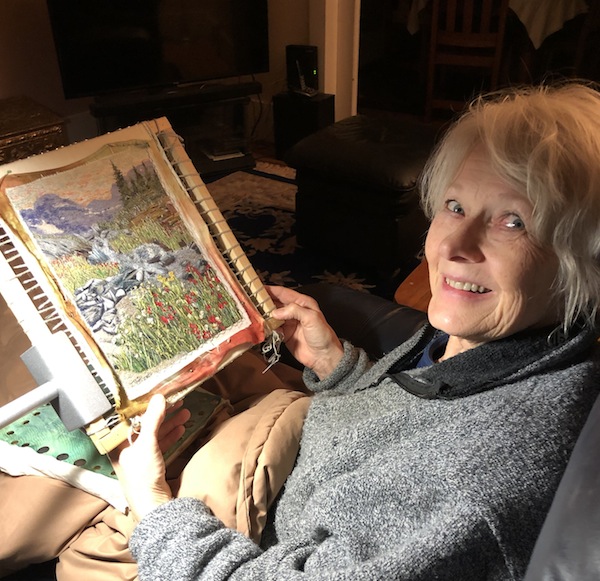
Zibrik makes elaborate embroidered pieces. Some of them are like miniature tapestries, landscapes emerging out of fabric and threads. Others are tiny blossoms, beetles and butterflies that could be used separately or together, each one a delightful surprise. She also does golden embroidery.
“Smaller pieces are often whimsical and stitched quickly, with a minimum of stitches. On the other hand, my gold work requires hours to complete, and the materials are much more costly.”
Zibrik started learning needlecraft when still very young. “Like many girls growing up in rural Canada, I was taught by my mother and grandmother. They wanted to make sure I had all the critical homemaker skills, from crocheting blankets to mending socks…. Later, after 10 years of part-time study at Gail Harker Creative Studio, I completed Level 2 Design (based on a City and Guilds of London Institute in the U.K. curriculum) and Level 4 Diploma for stitch. Luckily for me, the studio is located in La Connor, Wash. That made it possible for me to attend sessions in-person to complete the evidence-based curriculum.”
Fibre artist Deborah Zibrik makes elaborate embroidered pieces. (photo from the artist)
After receiving her diploma in 2015, Zibrik decided to share her skills with others. “Time permitting, I have been teaching workshops for specific needlework techniques,” she said. “Guild members are my usual students. There is currently a discussion among the guilds about the lost generations of children who haven’t learned any of the needle arts, including embroidery; they haven’t had the exposure. Because of that, membership in the guilds is declining, as members age. I am considering ways to fix that. Perhaps I could offer embroidery classes to youngsters, maybe at the community centre level, to teach basic skills and prime creativity to future artisans.”
When asked where they see themselves on the scale of art versus craft, artists’ replies varied.
“I’m an artist and a designer,” said Wosk.
Promislow said, “I am a craftsperson. I use my medium to make things that are functional and beautiful.”
“My work rides a fine line between both,” said Labrie. “There is a fluid movement in my practice.”
“My personal journey suggests that, especially for women, craft and art are inextricably linked,” offered Zibrik. “More, they have been connected for thousands of years. They are but different places on the same continuum. In that sense, I am privileged to say: I am an artist.”
The Affordable Art Show continues until Dec. 30. And, if you’re visiting the exhibit Dec. 5-7 or 12-14, check out the Jewish Community Centre of Greater Vancouver’s Chanukah Marketplace, which takes place in the centre’s atrium.
Olga Livshin is a Vancouver freelance writer. She can be reached at olgagodim@gmail.com.
Siblings Becky, left, and Margaux Wosk (photo from We Belong!)
The first-ever We Belong! Festival will take place Aug. 27 in Downtown Vancouver. Organized by siblings Margaux and Becky Wosk, We Belong! is a “one-of-a-kind creative arts market with a focus on giving disabled artists the opportunity to showcase and sell their art.”
Margaux Wosk is a self-taught artist, an activist and a disability rights advocate, fighting for disabled small business owners to get resources. Becky Wosk is an artist, designer, writer and musician; she and Emmalee Watts form the duo Hollow Twin.
Margaux Wosk started their business, Retrophiliac (shopretrophiliac.com), more than 10 years ago. Its focus is on visual art.
“Being an openly autistic person,” said Wosk, “I found that there was a void in the marketplace for the type of items I wanted to see and purchase.
“My business has really ramped up in the last five years,” they continued, “and I focus on autistic, neurodiversity and disability pride items, such as enamel pins, patches and stickers. I design retro-inspired pins, stickers and patches as well. I also have other items I offer and I have over 26 retailers between Canada and the United States.”
Wosk also uses their business “as a way to talk to the government about disabled small business owners” and they have gone to the provincial budget meeting two years in a row “to rally for funding and resources for other people like myself.”
They explained, “Currently, as it stands, we have no resources, and any of the funding that goes to ‘inclusive employment’ only goes to employers that hire disabled people, not disabled people who own their own business.”
Part of the mission of the We Belong! Festival is to raise awareness.
“I have been part of other markets and I do enjoy it, but none of them meet all of my needs,” said Wosk. “I find that sometimes there are financial barriers, sometimes the events are just too long and I find that it can take a toll on my mind and body. I wanted to create something with little barriers for other disabled artists and we were lucky enough to be the recipients of the Downtown Vancouver BIA’s [Public Space] Vibrancy Grant. This way, we won’t have to charge our vendors any costs and we can provide them tables, canopies and chairs. I want people to see what we’re all capable of.”
The Downtown Vancouver Business Improvement Association helped secure the market’s space at 855 West Hastings St. (Lot 19), and it is being provided free of charge. The location, which is between Burrard and Howe streets, is close to Waterfront Station and other public transit points.
“Once the location and date were confirmed,” said Becky Wosk, “we were able to figure out how many vendors we can accommodate and, from there, we put out a call to artists/makers. We have a specific budget to work with, so we have been able to gather quotes for the supplies we will need to make this event successful.
“When working on an event,” she said, “it’s important to work backwards from the date that you have secured and determine what needs to be ordered/booked in advance of that date – for example, canopies need to be booked 30 days out etc. [There are] lots of small details to be mindful of!”
In addition to the vendors who will be selling their creations, the market will include four nonprofits: Artists Helping Artists, Curiko, the Jewish Community Centre of Greater Vancouver’s Art Hive, which is run by Leamore Cohen, and the BC People First Society, on whose board Margaux Wosk sits, as regional director, Lower Mainland West.
While the deadline to apply as an exhibitor has passed, the Wosks are still looking for volunteers to help with set up and tear down. Anyone interested should email webelongfestival@gmail.com.