Yom Ha’atzmaut love, spirit

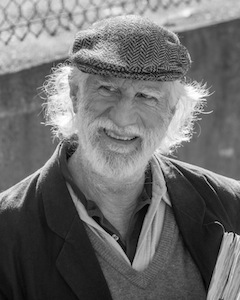
Shlomi Shaban will be joined by Ninet Tayeb (right) at Metro Vancouver’s celebration of Yom Ha’atzmaut on April 18 at the Chan Centre. (photo from Jewish Federation)

Two award-winning veteran musicians, not to mention good and longtime friends, will be headlining our community’s Yom Ha’atzmaut celebration on April 18 at the Chan Centre for the Performing Arts. Tel Aviv’s Shlomi Shaban will be joined by Los Angeles-based Ninet Tayeb.

“I have performed once outside the country on Yom Ha’atzmaut,” Shaban told the Independent. “It was Israel’s 60th anniversary. It was in Stockholm, Sweden. A lot of musicians and myself traveled over there, like Beri Sacharov, Eran Tzur and many others. We had a great show over there. But, beside that, I can’t remember performing outside Israel on Yom Ha’atzmaut, mostly I’m here in Israel, performing across the country or just being with my family, it depends.

“I’ve never been to Canada before, so, naturally, I’m very, very excited,” he said. “I’ve heard a lot of really great things about Vancouver and I’m really looking forward to just hang there, travel around and explore the place, although we’re going to be there for too short [a time] I’m afraid, two days, but I hope to catch as much as I can.

“I remember my friends Jane Bordeaux performing there last year,” he added, “and they came back really excited about the crowd and the place.”

Shaban was born in Tel Aviv and has lived there his whole life, except for a few years, when he was in London, England, to study classical piano. “I’m in love with Tel Aviv,” he said.

Like Tel Aviv, music has always been a part of Shaban’s life.

“I started learning how to play the piano when I was 6 years old,” he said. “I started privately, like a lot of kids. Then I went to a conservatory, and studied there for 10 years. And then, in London … I received an artist’s diploma from the Royal College of Music. I’m very proud of that, though I haven’t looked at that diploma since I got it.

“I always wrote little songs, since I was 10, I think, and always considered that as kind of a hobby, or kind of an intermission – I was practising a lot of piano, five hours a day, six hours a day, and more and more, and I always saw that as kind of a comic relief from practising…. When I was 21, I started thinking, maybe I went the wrong direction, so to speak, and the little hobby that I considered to be a comic relief, might be my main interest, and tried to publish my songs. I was very lucky, I was signed by a major label, here in Israel, of course, and faded away from the classical world, and never went back.”

Shaban now has four albums under his belt, and has won several awards for his work.

“In terms of career highlights,” he said, “I would mention two. As I said, I left the classical world but, five years ago, or six years ago, I was approached by the Israel Philharmonic. They celebrated their 75th year, and they asked me to do a concert of my music, my songs, with the orchestra.

“It was a great closure for me because, when I was 17, I played with the orchestra as a classical pianist with Maestro Zubin Mehta. I was a kid, so, naturally, very excited and very nervous, and now I came back through the main door with my own songs. It was another exciting and, again, nerve-wracking in a way, event for me. I had to practise piano again because I played my own songs and a little classical music we mixed throughout the songs. That was definitely a highlight.

“Nowadays, I’m touring with Chava Alberstein,” he continued. “She’s Israel’s, let’s say, Edith Piaf. I don’t know. She’s Chava Alberstein – she has more than 60 albums. I recorded a song with her four years ago, and asked her to consider touring with me and being her pianist – just me and her, she sings and I play…. We planned to do four or five shows, and now the tour has evolved and it’s sold out, and we are adding more and more shows. I sing only one song during the show, the song that I wrote for her…. It’s a great, great pleasure for me and I learn so much and enjoy so much doing it. So, that’s another big highlight for me.”

Shaban has been inspired by many musicians.

“I’ve covered many artists, Israelis and non-Israelis,” he said. “Mostly, I tend to cover storytelling songs, people like Bob Dylan, Leonard Cohen … I’m going to play a few songs by him in the show.

“I was trained as a classical musician and, when I left it and began hearing popular music, in a weird way, my heart went to very simple music, very text-based music, people, as I say, Dylan and Leonard Cohen, Tom Waits, Lou Reed, all that gang. And, during the years, they have remained my main love and inspiration, but I have listened to a lot of other music – new music, old music, jazz. I love jazz pianists and composers, people like [Thelonious] Monk … Miles Davis, and many, many others. I’m not interested in a specific genre, just getting as much inspiration as I can from different genres. But, as I said, my main interest always was the lyrics, funnily enough, and the story that the song conveys, and that hasn’t changed.”

In terms of his creative evolution, however, Shaban has been focusing more on the music. He described his early composing as “very functional,” something he used mainly to help the story to come across. “Nowadays,” he said, “I’m writing more rich music. I think, in that way, I’m heading backwards to the classical time and thriving on inspiration from all kinds of music, and not just folk music or rock music.”

photo - Ninet Tayeb
Ninet Tayeb (photo from Jewish Federation)

Shaban is excited to be performing in Vancouver with Tayeb, who he described as “one of the best singers I have ever heard.” He added, “She’s a great friend of mine, so that’s another bonus, meeting her in Canada – she’s in L.A. now and I rarely see her, so I’m looking forward to that, and meeting you all.”

For her part, Tayeb has recorded five albums and, like Shaban, has been recognized numerous times for her work. Also like Shaban, music has been a lifelong passion.

“Music has been my life ever since I was a little girl,” she told the Independent. “I started writing my own music at the age of 23. To be able to express myself through music is the most amazing gift I could have.”

Tayeb said, “My style is a mixture between Israel, L.A., Berlin and New York, kind of a Middle Eastern rock ’n’ roll with a slight hint of electronic. Music keeps evolving all the time and so do I – thank God! – and, for me, the most important thing is to keep moving forward and keep my mind open.”

It was this drive to continually enrich her knowledge and creative spirit that took her to Los Angeles, she said. She moved there from Tel Aviv.

On Yom Ha’atzmaut, said Tayeb, “The show will be me singing with Shlomi and Shlomi will sing alone, as well. One thing I can promise you – the show will be full of love and true spirit.”

For tickets ($18) to the April 18, 7:30 p.m., concert at the Chan Centre, visit jewishvancouver.com.

Unique coming of age

Richard Newman and Gina Chiarelli in Bar Mitzvah Boy, at Pacific Theatre until April 14. (photo by Damon Calderwood)

The number 13 means different things to different people. To a baker, it’s that extra pastry that he adds to a dozen; to the superstitious, it’s considered bad luck to the extent that some buildings do not have a 13th floor. To a Jewish boy, it means his right of passage into manhood, a journey fraught with both angst and joy.

But what if you missed that momentous occasion, for whatever reason, and now, as a grandfather, as your grandson’s bar mitzvah approaches, you have an urgent need to have a bar mitzvah ceremony? This premise forms the basis of local playwright Mark Leiren-Young’s Bar Mitzvah Boy, a two-hander being staged at the intimate Pacific Theatre in Vancouver until April 14. It won the American Jewish Play Project’s prize for best new Jewish play last year, with successful staged readings in New York, Boston and Charlotte, N.C.

Joey Brandt (Richard Newman) is a successful Vancouver divorce lawyer who wants to study privately with Rabbi Michael (Gina Chiarelli) in order to have his bar mitzvah before his grandson’s big day. He is surprised to learn that she is female, and even more surprised when she refuses him as a student, suggesting that he join Cantor Rubin’s bar mitzvah class instead. Joey is obviously a man used to getting his way and, not surprisingly, his stint in Rubin’s class turns into a fiasco, as Joey disrupts the class and takes all the boys out for Hawaiian pizza (you know, the kind that has ham on it). The rabbi eventually relents, in light of both Joey’s advocacy skills and a big donation to the synagogue’s renovation fund.

The chemistry between the two actors is palpable. The audience is led through a witty pas de deux, and both teacher and student experience personal metamorphoses through their weekly interactions. Joey – who has not been to shul for 52 years – learns to put on tefillin, as well as studying the liturgy and history of his people, in a crash course in Judaism. Meanwhile, the somewhat bohemian rabbi (she jogs and smokes marijuana – for “medicinal purposes” only) works through her own demons, which include an almost-12-year-old daughter with cancer and a husband who cannot cope with the illness. In an engaging twist, the professional roles reverse as the players grapple with the existential question of whether G-d is a metaphor or a real entity on which to base our faith.

Newman, who says that he is “Jewish on both sides” is stellar in his role as Joey (and his Hebrew is not too bad, either) but it is Chiarelli who steals the show with her sublime portrayal of a working mom having to deal with a sick child and an unsupportive husband. Kudos to Chiarelli, who is not Jewish, but who has mastered the dialogue and rituals of the script.

The set design is sparse but effective. One side is a backlit bimah with a lectern and a dove-shaped eternal flame hanging above. The other side does double duty as the rabbi’s study (replete with a library that includes Kosher Sex by Rabbi Shmuley Boteach and the Kama Sutra) and Joey’s office. The costumes are simple and the music – klezmer, what else.

Leiren-Young peppers the play with local references that will resonate with some of the community audience – names like Cantor Rubin, Rabbi Solomon, Schara Tzedeck, the astronomical prices of the real estate – some contemporary quips about the Broadway musical hit Hamilton and singer Kenny Rogers, and a multitude of Jewish clichés. He is the master of witty repartee, as anyone will know who has seen his play Shylock, which was, most recently, at Bard on the Beach last year.

“I had a truly crazy bar mitzvah at the Beth Israel,” said Leiren-Young when asked in an email interview by the JI about his own bar mitzvah experience. “There was a snowstorm and my mom’s car was hit en route to the shul for Friday night services. After that, standing at the bimah

and singing was easy! I drew a lot of inspiration for this play from real experiences – a mix of my own and stories from friends – but I just realized I left out the snowstorm. Maybe that’ll go in the movie.”

As to whether or not you have to be Jewish to get the play, he said, “No more than you have to be Catholic to ‘get’ Doubt or Mass Appeal or Sister Mary Ignatius (three ‘Catholic’ plays I love). But there are definitely moments that will hit harder for a Jewish audience and, I suspect, there will be jokes only Jewish audience members will laugh at.”

It is somewhat ironic that the world première of this play is being held in the basement of an Anglican Church, but that is part of its cachet.

The audience take-away from any play is deeply personal but, as Joey says in his bar mitzvah speech at the end of this journey into his faith: today, I am a man here to honour my family and ancestors, to celebrate being a Jew and becoming a member of a community with all the rights and responsibilities that go along with that membership. And, to that, we say, amen.

For tickets, visit pacifictheatre.org or call the box office at 604-731-5518.

Tova Kornfeld is a Vancouver freelance writer and lawyer.

Faculty boycott Hillel

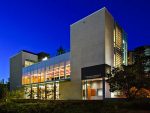
Hillel House building at the University of British Columbia. (photo from Hillel BC)

The University of British Columbia Geography Students Association (GSA) recently canceled a gala that was to take place in rental space owned by UBC’s Hillel chapter, due to pressure from some of the faculty in the department of geography.

The faculty members said they insisted on boycotting the event because of what they called the “controversial” and “political” nature of Hillel, according to numerous reports. The faculty members had not been publicly identified as of press time and could, therefore, not be located to clarify their position.

The Centre for Israel and Jewish Affairs (CIJA) has accused them of boycotting the GSA gala based on the perception that Hillel supports the state of Israel, which CIJA is calling discriminatory.

“Boycotting Jews or a Jewish organization simply because you object to the state of Israel’s policies is classic antisemitism,” said Nico Slobinsky, CIJA’s director for the Pacific region.

“It is hard to believe that there is such blatant antisemitism on a Canadian university campus in 2018. There should be zero tolerance for any expressions of discrimination, racism and antisemitism on campus and anywhere else in Canada.”

Samuel Heller, the assistant executive director of Hillel BC, told the CJN that, “The actions of these faculty members have resulted in a de facto boycott of the Jewish student centre on campus. To boycott Jews based on one’s political views about Israel is discriminatory and antisemitic. Their actions have led to the resignation of the lone Jewish student on the executive of the GSA, as he felt marginalized and discriminated against because of his Jewishness.”

Addressing the claim that Hillel is a controversial and political space, Heller said, “Hillel doesn’t have any politics. What these faculty members really object to is Hillel’s support of Israel’s existence. We are a Jewish organization and Israel is a part of Jewish identity.… To demand that Jews disavow parts of our identity to placate faculty members is wrong and discriminatory.”

But not everyone accepts Heller’s characterization of Hillel as “having no politics.” The Progressive Jewish Alliance at UBC (PJA) released a statement on Facebook on March 16, saying: “While we recognize the right of the GSA to move the gala based on political considerations, we urge the GSA to recognize that Hillel is the physical Jewish space on campus, alongside having a political position. While we wait for a statement from the GSA, we would like to point out that the ramifications of their decision are alienating Jewish students on campus. Likewise, we encourage Hillel to consider how their political positions, such as an opposition to all boycotts of Israel, can alienate other Jewish and non-Jewish organizations and students.”

The PJA is referring to Hillel International’s Standards of Partnership, which state that Hillel will not partner with, house or host organizations, groups or speakers that deny the right of Israel to exist as a Jewish and democratic state with secure and recognized borders; delegitimize, demonize or apply a double standard to Israel; or support the boycott of, divestment from or sanctions against the state of Israel.

In 2012, concerns about Hillel’s refusal to partner with Jewish organizations that support the BDS movement led to the formation of Open Hillel, an organization that agitates for Hillel to end the Standards of Partnership.

Numerous controversies have broken out over Hillel boycotting groups or individuals in recent years. In one example, in March 2017, B’nai Keshet, a queer Jewish group at Ohio State University, co-sponsored a Purim fundraiser for LGBTQ refugees in the Columbus area. Because Jewish Voices for Peace, an organization that supports BDS, was one of the sponsoring groups, OSU Hillel cut ties with B’nai Keshet, due to pressure from Hillel International, prompting students on numerous American campuses to hold “solidarity Shabbats” with the LGBTQ group. In June, a letter calling for the end of the standards was signed by more than 100 rabbis and submitted to Hillel.

The UBC Progressive Jewish Alliance hopes that the controversy will not only provoke change in the GSA, but in Hillel, as well.

“We hope that both organizations take this opportunity to engage in genuine dialogue around the complexity of politics and place,” it concluded in a statement.

Philip Steenkamp, the vice-president of external relations at UBC, told the CJN that the university is “aware of concerns that have been expressed by CIJA” and “are looking into this matter and will follow due process to ensure it is appropriately addressed.”

Matthew Gindin is a freelance journalist, writer and lecturer. He writes regularly for the Forward and All That Is Interesting, and has been published in Religion Dispatches, Situate Magazine, Tikkun and elsewhere. He can be found on Medium and Twitter. This article was originally published by the CJN.

Marching in right direction

Estimates of the number of people – most of them teens and young adults – who rallied in Washington, D.C., last Saturday range from 500,000 to 800,000. They called for sensible gun control legislation and mourned lives lost to gun violence, mobilized particularly by the memory of the mass murder of 17 in a Parkland, Fla., school Feb. 14. Many more rallied across the country and even in Canada. A small group gathered in solidarity at Vancouver’s Jack Poole Plaza.

Despite the horrors that inspired the marchers, the day was uplifting and inspiring. Survivors of the Marjorie Stoneman Douglas school shooting – who have become the faces and voices of the movement – proved youthfulness was not a barrier to eloquence or to courage. In fact, they may have proved it was a prerequisite.

After nothing changed when 20 children, 6 and 7 years old, plus six adults, were killed at Sandy Hook elementary in Connecticut, in 2012, many of us concluded that nothing would ever be done to confront gun violence and the monetary and grassroots power of lobbying groups like the National Rifle Association. What the Stoneman Douglas students determined was that, if the adults of the world were not going to protect them, they would take matters into their own hands. The movement they have launched – and the dialogue they are fomenting – is being compared with the anti-Vietnam War movement that mobilized their grandparents’ generation.

It will take time to see if the power they seem to have unleashed develops into something long-lasting. Voters aged 18 to 29 consistently have the poorest turnout record among American (and Canadian) voters.

While it is encouraging to see the political waves being made by the movement, it is a cause of additional naches to witness the role of Jewish young people. Synagogues and JCCs became makeshift hostels for Jewish students piling into D.C. last weekend.

Zoe Terner, a Florida leader in the Reform movement’s North American Federation of Temple Youth, spoke at a Shabbat event the night before the march. “This is how we grieve,” she told JTA. “Tomorrow I will pray with my feet and, with every step, I will think of those few hours a month ago when I didn’t know if my friends were alive or dead.”

Students from Minnesota, who traveled 21 hours to the capital, wore T-shirts reading “Dayenu,” repurposing the Passover refrain to echo the anti-gun movement’s chant “Enough!”

We can’t help noting with a bit of disappointment the appropriation of the term #NeverAgain, which the movement adopted in good faith. Perhaps they were unaware that it has been the rallying cry for Holocaust remembrance and education for decades. It is one oversight in what has largely been a seamlessly orchestrated affair. Of course, groups cannot claim monopoly on sentiments like “Never Again,” but we wonder if it loses some resonance when used for other purposes. Perhaps parents and teachers have not sufficiently educated successive generations on the lessons of the Shoah. Or, just as likely, it may be that a familiar refrain expressed the urgency of the moment: the Jewish population of Stoneman Douglas high school is estimated at about 40%. (Several of the murder victims were and a number of the vocal activists are Jewish.)

The movement for sensible gun legislation in the United States faces hurdles. While last weekend’s rallies were an important start, and this fall’s midterm elections a crucial testing ground, it is difficult to foresee the trajectory of the cause.

A commentator on CNN over the weekend noted that the issue of marriage equality reached a tipping point, from where opposition to same-sex marriage reversed to majority support in a remarkably short time. By contrast, the debate over reproductive freedom has seen two sides dig in their heels for decades, with little middle ground.

Moreover, gun control is a more complex matter than the comparative yes-or-no approach one can take to gay marriage or abortion. There are dozens if not hundreds of permutations that gun regulation and control legislation could take.

But, for whatever challenges the youth movement for sensible gun policies faces in future, last weekend was the sound of millions of feet marching in the right direction.

Miller play remains relevant

Arthur Miller’s Incident at Vichy is set in a Nazi detention centre in Vichy France, where a group of prisoners are being held. (photo from Theatre in the Raw)

Theatre in the Raw is bringing Arthur Miller’s Incident at Vichy to the Studio 16 stage April 11-22.

The play was chosen and recommended to the theatre’s board of directors in 2017, said Jay Hamburger, artistic director of Theatre in the Raw and director of the theatre’s production of Incident at Vichy. “It had been a piece that had been suggested previously as well,” he said. “But, with the recent political developments in the U.S. as well as worldwide, I felt that, as a theatrical piece, it spoke closely to issues today perhaps even more so than when it was written in the 1960s, and these events were behind the popular consciousness in some way.”

In Incident at Vichy, Miller – whose most popular plays include Death of a Salesman, The Crucible and A View from the Bridge – explores our moral responsibility to act in the face of intolerance and hate. The one-act play, which was first performed in 1964, is set in a Nazi detention centre in Vichy France, where a group of prisoners are being held. “Their unease, fear and confusion is stirred up as they contemplate what may divide or unite them. And what fate awaits them,” reads the press material.

Panel discussions will follow each performance and explore the question, Can it happen here?

“That is the overall and main question placed before the audience as well as to ourselves,” said Hamburger. “Can fascism, or a wave of totalitarian, racially dividing politics take place in Canada? We see fragments of such distressing political and socially oriented movements happening worldwide. Even in the U.S., so close to Canada, there are semblances of divide and conquer. Sadly, it seems to come from the current administration in Washington, D.C. This is cause for real concern.

“Now more than ever this may be the time to warn people that eternal vigilance is key to the well-being of our daily lives, especially given the rise of violent hate crimes against Jews, Muslims, South Asian and First Nations communities, even in Canada…. The play finds a way to touch on economic and class concerns related to the increasing gap between the rich and the poor. It notes that certain people are at an insurmountable disadvantage in seeking ways to survive. Certain characters in the play point out the way prejudices are manufactured and fomented, often condemning people because of misconceived notions concerning races of people, ethnicities or religions.”

Incident at Vichy doesn’t only examine how genocide can happen, however, but what people could do to prevent it.

“Each character in the play has their own experience and background in relation to being interrogated for being Jewish or perhaps seen as an ‘undesirable’ in some way,” explained Hamburger. “The play is basically a dramatized account of events that took place in 1942 in the unoccupied ‘free zone’ of Vichy France,” he said, and it presents many of the attitudes that “people had who weren’t quite ready to accept the extent of what was happening around them until it is completely undeniable – and too late.

“It also includes as an important aspect the perspectives of characters who are non-Jewish Germans, and Austrians as well,” he added. “It implores members of the society to not be complacent in the face of governments and demagogues that wish to grab power by lying and oppressing the large swaths of society.

“A question and statement is placed forward within the play: who is responsible for such horrendous acts of cruelty leading to genocide? At what point must one consider themselves also responsible? The play suggests it is for all in society to give a damn or have a sense of responsibility to such terrible events. There is an important act of human kindness in the play, but I won’t give away the ending here. But, obviously, Miller is writing about shattering events, with shreds of hope that a holocaustal deluge will not repeat itself, that such human massacres will not happen again.”

Audiences should come away from Incident at Vichy with some answers, but perhaps as many questions about the nature of evil, how we perceive it and deal with it.

“I think the play is trying to answer the question, How did things get so far out of hand without people rising up and stopping the madness?” said Hamburger. “The play tries to answer that question, even though you get the impression of how relentless the evil and suffering was once certain powers were in control and the momentum of a horrific madness got going…. I think the play insists that ordinary people are instrumental in realizing evil actions, without necessarily wanting to see the bigger picture themselves. Thus, a vigilant eye is necessary on governments and draconian racial laws implemented upon a citizenry. Such policies must be watched, debated and fought against in a fair and free manner without fear of punishment or reprisal.”

photo - Theatre in the Raw artistic director Jay Hamburger directs the theatre’s production of Incident at Vichy
Theatre in the Raw artistic director Jay Hamburger directs the theatre’s production of Incident at Vichy. (photo from Theatre in the Raw)

Theatre in the Raw’s mission statement is on their website. Part of it is to be “risk-takers, willing to give exposure to voices seldom heard, striving for artistic excellence, in the presentation of unusual, awakening and exchanging theatre.”

“We are an independent grassroots theatre that has been in production and functioning for 24 years, residing on the Eastside of Vancouver,” said Hamburger. “We have produced comedies, tragedies, radio play works, original one-acts and full-length mainstage plays, as well as original and revived musicals of quality and enjoyment. Our process is to take the art of theatre and performance seriously and to present it first on a local level to Vancouver audiences and then beyond.”

The audition process for Incident at Vichy started seriously in early January and continued to the end of February.

“We saw dozens of actors (actually over 50 for weeks on end) that also included an extensive call-back set of days,” said Hamburger. “A few actors were called in to audition because I attended the unified general auditions that the Greater Vancouver Professional Theatre Alliance provides for theatre company members in the province. That proves an invaluable resource for those involved in the theatre arts.”

Rehearsals started at the end of February and will continue until the opening of the play on April 11 at Studio 16, which is housed in La Maison de la francophonie de Vancouver. “We are meeting three to four times a week, as well as individual meetings and sessions with each of the 15 actors cast in the show,” said Hamburger.

Incident at Vichy features some longtime Theatre in the Raw company members, he said, naming Roger Howie, Jacques Lalonde, David Stephens, zi paris, Brian Leslie, Stanley Fraser, Michael Kruse-Dahl and Ralston Harris. Hamburger is also part of the cast, as are Rob Monk, Julie Merrick, Daniela Herrera Ruiz, Laen Avraham Hershler, Giuseppe Bevilacqua and Simon Challenger, with Amanda Parafina as stage manager.

“We are fortunate to have such a dedicated and hardworking group of able thespians on the boards for the April run of the show Incident at Vichy,” said Hamburger, adding that fellow Jewish community member Cassandra Freeman also has been helpful.

“Cassandra has been an invaluable advisor and advocate for a number of years with Theatre in the Raw,” he said. “She has been a coordinator with the Tuesday night Vancouver Actor’s Drop-In sessions. We have cast at times from those evening sessions for some of our shows. She is a creative writer and has made the effort to report about Theatre in the Raw in a column or two she does for the press.”

Tickets for Incident at Vichy are $25/$22 and can be purchased from theatreintheraw.ca or 604-708-5448.

* * *

In his interview with the Jewish Independent, Jay Hamburger, artistic director of Theatre in the Raw and director of the theatre’s production of Arthur Miller’s Incident at Vichy, said, “A question and statement is placed forward within the play: who is responsible for such horrendous acts of cruelty leading to genocide? At what point must one consider themselves also responsible? … There is an important act of human kindness in the play, but … Miller is writing about shattering events, with shreds of hope that a holocaustal deluge will not repeat itself, that such human massacres will not happen again.”

Hamburger added, “The sentiment reminds and brings forth four related historical quotes that speak directly to significant parts of the play”:

“How can we expect righteousness to prevail when there is hardly anyone willing to give himself up individually to a righteous cause. Such a fine, sunny day, and I have to go, but what does my death matter, if, through us, thousands of people are awakened and stirred to action?” – Sophie Scholl, a member of the anti-Nazi White Rose group, who was executed for treason by the Nazis

“Of course, the terrible things I heard from the Nuremberg Trials, about the six million Jews and the people from other races who were killed, were facts that shocked me deeply. I was satisfied that I wasn’t personally to blame and that I hadn’t known about those things. I wasn’t aware of the extent. But, one day, I went past the memorial plaque which had been put up for Sophie Scholl in Franz Josef Strasse, and I saw that she was born the same year as me, and she was executed the same year I started working for Hitler. And at that moment I actually sensed that it was no excuse to be young, and that it would have been possible to find things out.” – Traudl Junge, one of Adolf Hitler’s secretaries

“I don’t believe that the big men, the politicians and the capitalists alone are guilty of the war. Oh, no, the little man is just as keen, otherwise the people of the world would have risen in revolt long ago!” – Anne Frank

“I’ve found that there is always some beauty left – in nature, sunshine, freedom, in yourself; these can all help you. Look at these things, then you find yourself again, and God, and then you regain your balance. A person who’s happy will make others happy; a person who has courage and faith will never die in misery!” – Anne Frank

Inspired by cultures, nature

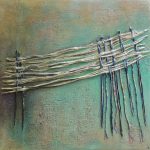
Artist Monica Gewurz’s “Woven Tallit” was inspired by her father.

Judaism’s history, traditions and clothing and my Peruvian upbringing are always latent in my inspirations,” artist Monica Gewurz told the Independent.

Gewurz will be one of more than 90 exhibitors at Art! Vancouver, which takes place April 19-22 at the Vancouver Convention Centre East.

“Both of my parents were Polish Jews,” said Gewurz. “My mother left Poland before the war to Palestine as part of the youth aliyah to help establish Israel. My father left Poland to study in France where, after completing his studies, he went to Peru to work for a French mining company. During the British Mandate, my father volunteered to help build the underground tunnels as part of the Jewish resistance. He met my mother and, in three weeks, they were married. My father had to return to work in Peru, where they both stayed. I was born there and left in 1976.”

Though Gewurz’s mother was a nurse, she “had a passion for rendering still life in pastels and watercolours.”

Gewurz left Peru, she said, because of the military situation there, “and the increased level of antisemitism in Peru and in South America in general.” She obtained both her bachelor of science and her master’s in landscape architecture and environmental planning from the University of Guelph, in Ontario, then worked for the federal government in Ottawa until 1987. She moved to Montreal, she said, “to work in the private sector for pension funds and, later on, for Canadian Pacific Railway, working on both environmental decontamination and commercial real estate planning, marketing and sales until December 1997. I moved that year to Vancouver because of the rise of the separatist movement in Quebec and the lack of professional opportunities because I was not fully bilingual.”

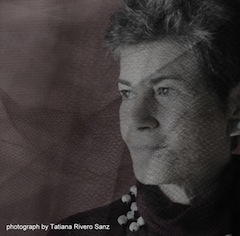
photo - Monica Gewurz will be participating in Art! Vancouver, which takes place April 19-22. (photo by Tatiana Rivero Sanz)
Monica Gewurz will be participating in Art! Vancouver, which takes place April 19-22.

During her career, Gewurz has worked in both large-scale commercial real estate development and sales; eco- and cultural tourism planning and marketing; environmental assessment; and for the Canadian government dealing with aboriginal issues. Her work in jewelry, photography and painting began as hobbies. However, in 2014, she received a fine art certificate from Emily Carr University of Art and Design, and embarked on a new career as a professional artist. She is currently enrolled in Emily Carr’s advanced study certificate in painting.

“My textured paintings strive to reflect and connect cultures through the use of ancient and modern materials, colours and techniques,” she said. “I use texture to blur the line between painting and sculpture, integrating man-made elements such as paper, natural elements like semi-precious stones and gravel, and traditional textile designs from various cultures, including Israel and my native Peru.”

Gewurz also travels a lot, which has allowed her to study different art forms, she said. She has been to Peru, Chile, Argentina, Brazil, Bali, France, Germany, Italy, Greece, Switzerland, Spain, Portugal, India, Israel, Turkey, China and several islands in the Caribbean. She said she always tries to visit museums and historical sites when she’s traveling. Last summer, for example, she participated in a guided art tour through the rivers of Holland, which included visits to UNESCO sites.

Her travels and love of archeology and tribal symbolism inspire her art, she said, and lend it broad dimensions.

“I am attracted to the abstraction of stylized figures done in wood, metal or in textiles that are decorated with simple colours … the myriad high relief textures and multicolour metallic patinas that have been created by weathering and the use of metals to indicate status or ceremonial purposes.

“I am also attracted by their simplicity, honesty and inventiveness, and the fact that they are all made with natural materials and pigments,” she said. “Distorted yet primal in its raw geometry, it provides my inspiration to create a new artistic language with new forms, colours and meanings.

“In my paintings, I use an earthy, quiet palette echoing the colour found in metallic patinas, Raku pottery and ancient glass. To accomplish the above, I use intense turquoises, luminous teals and yellows, haunting blues, earthy ochres and siennas, deep burgundies and mysterious charcoals and blacks. I also use metallic paints and foils to accent textures to give my paintings more luminosity.”

Gewurz really does seem to communicate with the earth. Her sea- and landscapes are alive with colour and texture. In some paintings, it’s almost a wonder how the water stays within the frame, its flowing movement captured somehow into a moving stillness.

“My studio is located amidst the rainforest with an ocean vista,” she said. “I am surrounded by the subtleties of changing skies and rhythms of the ocean. Hikes into the local mountains, forests and beaches up the north coast inspire my abstract work.

“The abstraction of the constant changing of shapes, colours and patterns of light in the reflected water and changing skies during sunrises and sunsets mesmerize me and are a source of my inspiration. I am fascinated with the contrasting nature of the organic and how that can provide an escape to a dream-like place.”

As for works in which her Jewishness played an important role, Gewurz offered the Independent a few examples.

The mixed media piece “Woven Tallit,” she said, “was inspired by the one my father wore until he passed away.” It not only depicts a tallit in the early stages of being made, but also symbolizes, she explained, “the tapestry that we call life, where individually we are nothing much more than a single thread intertwined with others, and also the ‘woven’ aspect of the various cultures and religions that have come together to create modern Israel.”

Gewurz created “Rachel de Matriarch I” and “Rachel de Matriarch II” to honour her mother, whose name was also Rachel, and who was “an artist, and had similar abilities and qualities as Rachel the matriarch,” one of the four spiritual matriarchs of the Hebrew Bible, she said, noting that “Rachel means a small lamb, and she is described as ‘beautiful of form and beautiful of appearance’ (Genesis 29:17).”

“Although she is no longer alive,” said Gewurz of her mother, “she continues to guide me in my daily life and artistic journey.

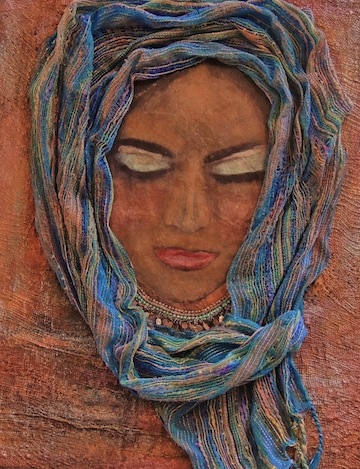
photo - Monica Gewurz’s “Rachel de Matriach” was inspired by her mother
Monica Gewurz’s “Rachel de Matriach” was inspired by her mother.

“In terms of symbolism,” she added, “the pose of Rachel is of deep thought, dreaming and hoping for the well-being of all people in the world. The texture, patinas and colour palette of copper, earth tones and turquoise are inspired by the simple but colourful clothes, jewelry and headdresses that Rachel would have worn while working in the fields.

“The many layers of this painting are reminiscent of the layered depth of a person’s life, and like looking into ourselves. While the surface layer is easily recognized and understood, deeper exploration is needed to reveal the complex and veiled richness of the person within.”

The last example Gewurz gave was her “Friendship Shawl,” which she described as “an abstraction of a silk and gold scarf which can be wrapped around the shoulders of two friends. Friendship is one of the key values of Judaism and a fundamental building block of the global community.” This painting was also inspired, she said, “by the patterns formed by the warp and weft of the friendship bracelets woven over the centuries by aboriginal people from Central and South America. According to tradition, a person will tie a string or fabric bracelet around the wrist of a friend while making a wish or prayer for them … the wish will come true if the bracelet is worn until it falls off by itself.”

Gewurz is represented by four different galleries. “I have been represented by Ukama since 2016, the Kube Gallery and Sooke Harbour House Gallery since 2017 and, this year, I will be also represented by Mattick’s Farm Gallery in Victoria,” she said.

In addition to paintings, Gewurz also creates “wearable art.”

“They are all based on my paintings,” she said of these works. “I take a portion of the image and expand it so it is an abstraction of a painting rather than the whole painting. I have been doing it only for one year, mainly as part of participating in the Slow Clothes fashion show held as part of the Harmony Arts Festival every year, and to give them away as a thank you for people that buy my artwork, i.e. somebody who buys a large painting receives a scarf or a pillow as a gift.”

Gewurz also donates a percentage of her sales to the Brooke Foundation, whose mission is to improve “the lives of working horses, donkeys and mules” around the world, and to the SPCA (Society for the Prevention of Cruelty to Animals) in Vancouver. She has donated art to numerous organizations, including the B.C. Cancer Foundation, the Children’s Heart Network Foundation and the Stephen Lewis Foundation’s Grandmothers to Grandmothers Campaign.

“It is a way of giving back to the community that has supported me in the past and continues to support me,” she said. “I like to donate art, money and time: ‘it’s better to give than to receive.’ I also like doing something useful and helping others, which makes me feel good about myself, which increases my self-esteem, and greater personal empowerment and better health.”

Other Jewish artists in the exhibition include Art! Vancouver director Lisa Wolfin – “I am doing a forest with a pipeline going in front of the forest to show what is going on in B.C.,” she told the JI. As well, Wolfin’s sister, LeeAnn Wolfin, and daughters, Taisha Teal Wayrynen and Skyla Wayrynen, will be showing their work. The event also features artist demonstrations and workshops, speakers and panel discussions, dance and other performances. For schedule and ticket information, visit artvancouver.net.

Art and act of prayer

Alden Solovy leads two sessions at Limmud Vancouver, which takes place April 14-15. (photo from Limmud Vancouver)

Alden Solovy would like you to fall in love with prayer. His own love of prayer has been fueled by his aliyah to Israel, learning Talmud and Torah in Jerusalem, and the liturgy of the siddur. It has been deepened by the tragedies he has experienced, including his wife’s multiple suicide attempts and her sudden death from catastrophic brain injury in 2009.

Solovy will present two sessions at Limmud Vancouver, the festival of Jewish learning that takes place this year on April 14-15 at Congregation Beth Israel. He will speak on An Israeli Life – in which he shares his experience of two wars, a refugee camp and of living in Israel as an older, liberal oleh (immigrant) – and offer Spiritual Chevruta, a workshop-style session in which participants will study a passage of prayer, then break into pairs to delve into personal prayer.

Prior to and in partnership with Limmud, Solovy will be a liturgist-in-residence at Temple Sholom. His program there will include his workshop The Art and the Act of Prayer.

Solovy grew up in Chicago and made aliyah in 2012. Living in Israel, he said, nurtures his emotional and spiritual well-being. When asked to elaborate, he highlighted a couple of the cultural differences between the United States and Israel. In the United States, he said, following a tragedy, people typically react with pity whereas, in Israel, his experience has been of empathy and of interest in the rest of his life. As well, he said, in the United States, independence is highly valued, while Israelis place more value on interdependence.

Solovy has faced some challenges in Israel. In 2015, he was attacked and injured as he celebrated Torah with women at the Kotel. In an opinion piece following the attack, he cautioned readers to not use his experience as justification for hate and prejudice. Instead, he asked them to continue to rally against misogyny and in favour of justice.

Solovy is a liturgist whose work has been used by people of all faiths. He has written nearly 700 pieces of liturgy and has an extensive publication list. His books are available on Amazon. (His most recent publication, This Grateful Heart, from CCAR Press, has enriched my own daily prayer practice.)

Solovy is a talented teacher and writing coach, and an award-winning essayist and journalist. He shares his work online at tobendlight.com and he also teaches at Hebrew Union College-Jewish Institute of Religion in Jerusalem.

Solovy has energized learners at Limmud conferences in the United Kingdom and in the United States. He loves the enthusiasm and joy of learning that bubbles through the conferences. He finds this energy whenever he engages with adults who are active in choosing what they want to learn, which is a central value of all Limmud conferences.

In addition to Solovy’s sessions, Limmud Vancouver offers more than 40 other learning opportunities, everything from current events to Torah, history, music, art and food. This year, Limmud also offers a full day of programming for children and youth. For more information and registration, visit limmudvancouver.ca.

Leora Zalik is a volunteer with Limmud Vancouver.

Be a builder, dreamer

Temple Sholom is hosting Inspired to Act. The event will feature the comedy of Yuk Yuk’s co-founder Mark Breslin, plus the music of young local artists Liel Amdour and Adrienne Robles, and will honour the winners of the 2018 Tikkun Olam Youth Awards.

This annual spring fundraising event will take place the evening of May 6 at Performance Works on Granville Island. It will be an uplifting night of entertainment and inspiration, and the recognition of Vancouver’s Jewish youth’s efforts to repair the world, or tikkun olam.

Yuk Yuk’s is the largest chain of comedy clubs in Canada, and Breslin will keep the audience in stitches. He will also share his view that comedy is a way of life. “You don’t just perform comedy; you live it,” he said. “It’s something you do onstage and off; whether you’re in the business or not.”

After Breslin’s performance, the 2018 Tikkun Olam Youth Awards will be presented to two teenage members of the Metro Vancouver Jewish community. These young community leaders will be honoured for their vision to heal and their passion to make the world a better place. The winner of the Dreamer category will have envisioned an action plan to address an issue in need of repair, while the winner of the Builder category will have volunteered at the grassroots level to cause change.

Community members have until April 9 to nominate a candidate, who is a member of the Jewish community between 13 and 19 years of age. The Dreamers Award is $1,800, while the Builders Award is $270, and the awards are funded by the generosity of the Neil and Michelle Pollock Family Foundation. For more information and the online application, visit templesholom.ca/youth-award.

The entire community is invited to Inspired to Act. For more information, tickets or to make a donation, visit templesholom.ca/inspired.

$10K to Jewish Food Bank

Chabad Lubavitch BC’s 40th Annual Gold Plate Celebration raised $10,000 for the Jewish Food Bank. (photo courtesy)

photo - Chabad Lubavitch BC director Rabbi Yitzchak Wineberg and his wife, Henia
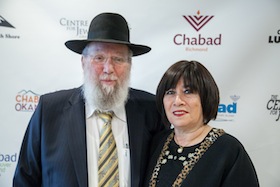
Chabad Lubavitch BC director Rabbi Yitzchak Wineberg and his wife, Henia. (photo courtesy)

Lubavitch BC held its 40th Annual Gold Plate Celebration on March 15, 2018. The dinner celebrated 43 years of Chabad Lubavitch service to British Columbia.

Instead of having a sit-down affair this year, Chabad Lubavitch BC had a cocktail reception and donated the money raised (the costs saved by not having a sit-down dinner) – $10,000 – to the JFS Vancouver Jewish Food Bank to help those in need.

There was also a raffle for the grand cash prize of $18,000.

Vancouverites excel at Chidon

Left to right, Rabbi Yerachmiel Benjaminson, executive director of Tzivos Hashem, philanthropist George Rohr, Grade 7 gold trophy winner Mendel Bitton and his father, Rabbi Binyomin Bitton. (photo courtesy)

Out of some 4,000 kids from 96 schools worldwide, four B.C. students qualified to attend this year’s Chidon Sefer Hamitzvos Shabbaton two weeks ago in New York: Mendel Bitton (Grade 7) and Levi Bitton (Grade 5), Sholom Baitelman (Grade 5) and Mendel Kaplan (Grade 5). All of the boys did well, receiving plaques and medals, and Mendel Bitton took home the gold trophy for Grade 7, one of only 15 trophies awarded.

Students from the 96 schools competed over several months, roughly from September to February. During these months of study, they took three major tests. Based on the results, 853 qualified to attend the Shabbaton weekend and the grand finale in New York. These 853 students from grades 4 through 8 competed in the individual competition, where there were gold, silver and bronze winners in each grade.

“The competition was inspired by the Rebbe’s request to unite Yidden through the study of the 613 mitzvos of the Torah. The Rebbe repeatedly emphasized that this effort will hasten the coming of Moshiach,” explains chabad.org about the tournament.