Skip to content
  • Home
  • Subscribe / donate
  • Events calendar
  • News
    • Local
    • National
    • Israel
    • World
    • עניין בחדשות
      A roundup of news in Canada and further afield, in Hebrew.
  • Opinion
    • From the JI
    • Op-Ed
  • Arts & Culture
    • Performing Arts
    • Music
    • Books
    • Visual Arts
    • TV & Film
  • Life
    • Celebrating the Holidays
    • Travel
    • The Daily Snooze
      Cartoons by Jacob Samuel
    • Mystery Photo
      Help the JI and JMABC fill in the gaps in our archives.
  • Community Links
    • Organizations, Etc.
    • Other News Sources & Blogs
    • Business Directory
  • FAQ
  • JI Chai Celebration
  • JI@88! video

Recent Posts

  • Story of Israel’s north
  • Sheltering in train stations
  • Teach critical thinking
  • Learning to bridge divides
  • Supporting Iranian community
  • Art dismantles systems
  • Beth Tikvah celebrates 50th
  • What is Jewish music?
  • Celebrate joy of music
  • Women share experiences 
  • Raising funds for Survivors
  • Call for digital literacy
  • The hidden hand of hate
  • Tarot as spiritual ritual
  • Students create fancy meal
  • Encouraging young voices
  • Rose’s Angels delivers
  • Living life to its fullest
  • Drawing on his roots
  • Panama City welcoming
  • Pesach cleaning
  • On the wings of griffon vultures
  • Vast recipe & story collection
  • A word, please …
  • מארק קרני לא ממתין לטראמפ
  • On war and antisemitism
  • Jews shine in Canucks colours
  • Moment of opportunity
  • Shooting response
  • BC budget fails seniors
  • Ritual is what makes life holy
  • Dogs help war veterans live again
  • Remain vital and outspoken
  • An urgent play to see
  • Pop-up exhibit popular
  • An invite to join JWest

Archives

Follow @JewishIndie
image - The CJN - Visit Us Banner - 300x600 - 101625

Month: September 2021

Election changes little

Election changes little

Green party leader Annamie Paul lost her bid for a seat in Toronto Centre. (photo from annamiepaul.ca)

Annamie Paul, the first female Jewish leader of a Canadian federal party, saw her hopes crushed Monday night as the Green vote plummeted across the country and she badly lost her bid for a seat in Toronto Centre. Paul came fourth in the riding, taking less than 9% of the vote. Her party lost one of its two British Columbia seats but, in their only bright spot, picked up a new riding in Ontario.

Having been kneecapped by internal party clashes in the lead-up to the election call, Paul was in an unenviable position, leading a party that had tried to oust her in a battle sparked by, or at least nominally blamed on, Paul’s moderate call for restraint during the Israel-Hamas conflict last spring.

Paul was not the only leader disappointed on election night. While politicians painted the outcomes in sunny terms, no one got much of what they wanted. After a $600 million election in the midst of a pandemic, the big picture in Canada’s political landscape is almost unchanged. With minor adjustments expected as mail-in ballots are counted, the Liberals and Conservatives are almost exactly where they were when the election was called.

Most prominently, reelected Prime Minister Justin Trudeau failed in his gambit to turn his minority into a majority government. The expense, resources and dangers of a pandemic election were rewarded with a nearly identical outcome as the last election.

Likewise, Erin O’Toole, who led his Conservatives to an almost identical result, will face discontent over his attempts to pull the party to the centre. Had the strategy worked, he would have been dubbed a genius, but failure will almost certainly unleash the wrath of his party’s right flank, which was largely thrown under the bus after O’Toole won the leadership on a slogan that depicted him as the “true blue” candidate, the more right-leaning of the two front-running options.

Jagmeet Singh, leader of the New Democrats, and Yves-François Blanchet, leader of the Bloc Quebecois, both appeared to resonate with their target constituencies, but, when the votes were counted, their electoral fortunes were only mildly improved. Maxime Bernier, leader of the People’s Party, lost his bid for a seat in Quebec and, while his party’s surprisingly strong showing in parts of the country, particularly on the Prairies, may have hurt the Conservatives, it left his own candidates empty-handed.

Several B.C. ridings remained too close to call at press time, including Vancouver Granville. Liberal Taleeb Noormohamad was about 200 votes ahead of New Democrat Anjali Appadurai as mail-in ballots were being counted. Despite polls showing Liberals falling behind in the province, the party appears to have held all its seats and even picked up both Richmond ridings. Steveston-Richmond East is a swing riding that has returned to the Liberal fold after a two-year interregnum. But, while few observers thought Richmond Centre was in play, Conservative incumbent Alice Wong is marginally behind Liberal Wilson Miao.

There were only two known Jewish candidates in British Columbia. In Nanaimo-Ladysmith, Conservative Tamara Kronis remains about 1,000 votes behind New Democrat Lisa Marie Barron at press time, a margin that will be a steep climb to overcome with just mail-in ballots remaining. The riding was watched nationally, as it was one of just two Green seats in Parliament. Paul Manly, who has a history of anti-Israel activism, fell to third place in a tight race. In West Vancouver-Sunshine Coast-Sea to Sky Country, New Democrat Avi Lewis placed a respectable third, with about 26% of the vote in one of Canada’s wealthiest ridings, while Liberal incumbent Patrick Weiler held on against a comeback effort by former Conservative MP John Weston.

(See editorials, “Election about nothing” and “Green party reckonings.”)

Format ImagePosted on September 24, 2021September 23, 2021Author Pat JohnsonCategories NationalTags Annamie Paul, Avi Lewis, Canada, elections, politics, Tamara Kronis
Creating life in face of death

Creating life in face of death

A still from the feature film Charlotte, about artist Charlotte Salomon.

The creative drive that some people have astounds me. In about a year-and-a-half, as the Holocaust closed in on her – and her family’s history of depression became known to her – Charlotte Salomon painted hundreds of works, telling her life story in images and words, in what is considered by many, apparently, as the first graphic novel.

Somehow, despite the artist having inspired a live action film, a documentary feature, an opera, a novel, a ballet and several plays, I’d never heard of her, or of her masterpiece, Life? Or Theatre? That is, until I watched the animated feature film Charlotte, a Canada-France-Belgium collaboration that was just released. Featured at the Toronto International Film Festival earlier this month, Charlotte has two screenings at the Vancouver International Film Festival: Oct. 3, 3 p.m., and Oct. 6, 9:15 p.m., at Vancouver Playhouse.

Based on the story and the cast, the Jewish Independent chose to be a media sponsor of the local screenings. And, on these points, the film scores high. Led by Oscar nominee Keira Knightley as the voice of Charlotte, the actors do a formidable job with dialogue that is, at times, stilted and animation that is pretty basic, with the exception of the scenes and transitional pieces that depict Salomon’s artwork. These parts of the film are sumptuous and give the most sense of Salomon as a person and artist.

The film begins near the end of Salomon’s life, as she is handing over her paintings to a man, who we find out later is a local doctor and friend, in what we later find out is the south of France. She asks him to guard the paintings for her, as they are her life, almost literally, given their content. The narrative then jumps to Berlin, to a young Charlotte trying to comfort a woman who is ill and sad. The woman turns out to be Charlotte’s mother, who dies, the young girl is told, of influenza.

Jumping ahead, still in Berlin, Charlotte’s father, Albert, has married Paula Lindberg, an opera singer, through whom, incidentally, a teenage Charlotte meets her first love, Alfred Wolfsohn, who is a singing teacher. He is also a veteran of the First World War.

Wolfsohn has a lot of personal issues, to say the least, and he ultimately betrays Charlotte, but he is also strongly supportive of her being an artist. While she gains entrance to Berlin’s art academy, despite being Jewish – it is 1933 and the Nazis are now in power – she is expelled pretty soon thereafter, though whether that’s because of her nonconformity to the artistic norms taught at the school, her Jewishness or both, is not clear.

What is certain is that, after Kristallnacht, the violence against Jews in Berlin has become unavoidable and Charlotte’s parents send her to the south of France to take refuge, and care for her maternal grandparents. Her grandmother is a troubled woman and her grandfather is, in a word, an asshole, but Charlotte finds beauty in her friendship with a wealthy American, Ottilie Moore, who owns a villa in Villefranche, and in her relationship with fellow refugee Alexander Nagler, whom she marries eventually.

image - In a scene from the film, Charlotte stares into the water, thinking about her aunt, who had drowned
In a scene from the film, Charlotte stares into the water, thinking about her aunt, who had drowned.

When Moore returns to the United States, she offers to try and take Charlotte and Alexander with her, but they stay in France – Charlotte because of her sense of duty to her grandparents. It is in caring for them that she witnesses the tragedy of her grandmother’s suicide and finds out from her grandfather that mental illness runs in the family, having claimed the lives of Charlotte’s mother, aunt and several other relatives.

Spurred on by the potential that she, too, will fall ill, as well as by the Nazis’ proximity, Charlotte turns her focus to creating the almost 800 paintings that comprise Life? or Theatre? She manages to give them (and other works, it seems) to Dr. Georges Moridis, who she had consulted about her own health and who had tried to help her grandparents, before she and Alexander are seized by the Nazis. Both Charlotte and Alexander are killed at Auschwitz; Charlotte five months pregnant.

The film, which isn’t shy about showing some of the brutality of the Holocaust, does step back from showing the deaths in Auschwitz, leaving viewers instead with an image of the idyllic setting in which they lived in France, as we hear the noises of their arrest, then silence.

Before the credits, the filmmakers tell us what happened to Charlotte, Alexander and Ottolie, and show us clips of a real-life archival interview with Charlotte’s father and stepmother, who survived the Holocaust, as well as a sampling of Charlotte’s paintings.

As depressing as Charlotte’s story is, it is not a depressing movie. That she anticipated her demise and created an artistic legacy in the face of death is somehow uplifting. As producer Julia Rosenberg states in the film’s production notes, “… hope isn’t rainbows and unicorns. It’s finding the courage to see beauty despite suffering.

“Charlotte Salomon’s ability to do just that is exceptional and inspiring.”

Indeed, it is.

Charlotte is a worthy introduction to a person we all should know.

For the full Vancouver International Film Festival schedule and tickets, visit viff.org. To potentially get free tickets to the Oct. 6 screening of Charlotte, email [email protected]. Tickets will be available as supplies last (there are 10 to giveaway).

Format ImagePosted on September 24, 2021September 23, 2021Author Cynthia RamsayCategories TV & FilmTags animation, art, Charlotte Salomon, Holocaust, neurodevelopmental disorders, painting, Vancouver International Film Festival, VIFF

Election about nothing

Justin Trudeau’s gamble on winning a majority backfired. Still, whatever outrage Canadians felt about marching to the polls amid a pandemic didn’t cost him much (beyond the $600 million expense of the election itself). The Liberal party returned with an almost identical seat count as the one they started with. All the other parties had an equally uneventful night. In 338 ridings, of course, there were plenty of individual surprises – candidates expected to win lost and longshots saw victories – but it all amounted to a wash in the big picture.

Aside from Trudeau’s personal ambition to turn a minority government into a majority, the election turned out to be about not much. The handling of the pandemic, the economy, the environment, foreign affairs – all the usual topics got their time in the limelight but none captured the passion of voters. The ballot question, if there was one, turned out to be, quite simply, more of the same, yes or no? And Canadians responded: meh.

The campaign began inauspiciously, with a split screen showing Trudeau visiting Rideau Hall at the very moment all hell broke loose in Afghanistan. Foreign affairs are rarely a defining factor in Canadian elections, and this one was no different. Canada’s sometimes wishy-washy foreign policy will likely be unaltered. Barring some dramatic shift, Canada will probably continue to placate the Chinese government rather than confront them, go along to get along at the United Nations and walk a mushy middle ground on Israel and Palestine.

Equally unchanged, presumably, will be Canada’s domestic policies. The economy is doing well, especially given the challenges of the pandemic, and voters seemed to neither reward nor punish the governing party.

On the campaign trail, we saw alarming images of vitriol and even some violence. Voices of rage drove some of the fringe movements, like the People’s Party, to surprising levels of support, but gratefully their xenophobia and base hatreds will not be represented in the House of Commons. That particular incarnation of far-right extremism will ideally dissipate in the aftermath of their electoral failure.

Yet, voters who before thought that a prime minister dissolving Parliament to seek a majority mandate is hardly an unknown phenomenon in our system may now look at the status quo that resulted from the 36-day campaign with even more cynicism. As it stands, Trudeau survived. But, in the end, what was the election about? The answer appears to be … nothing.

Posted on September 24, 2021September 23, 2021Author The Editorial BoardCategories From the JITags Air Canada, Canada, COVID, Election, politics

Green party reckonings

During the election campaign, Green leader Annamie Paul was surprisingly candid about her precarious position at the helm of her party. She acknowledged that she spent almost all the campaign in her home riding of Toronto Centre because she might not be welcomed by Green candidates across the country. She suffered a near-defenestration just before the election and the simmering internal strife the Greens barely managed to conceal through the campaign will inevitably boil over now, especially after her own poor results in Toronto Centre.

Paul faced horrific online racism and antisemitism during and after her campaign for the party leadership. We trust that she will share more of her experiences without reservation now that her tenure is almost certainly at an end. Rarely has so talented and qualified an individual offered themselves for public office – and even more infrequently has any political figure been so ill-treated by their own party.

Canadians, but especially Green party regulars, must examine what happened. Paul and other members of the party owe it to Canadians to examine the entrails of this affair and determine what roles racism, misogyny and antisemitism played in the matter. If there are Green activists who have legitimate grievances against Paul, they should be transparent and demonstrate that their extraordinary treatment of their leader was based on policy or strategic differences and not on her innate identities.

Posted on September 24, 2021September 23, 2021Author The Editorial BoardCategories From the JITags Annamie Paul, antisemitism, Canada, Election, Green party, misogyny, politics, racism
The Kitchen is new JFS hub

The Kitchen is new JFS hub

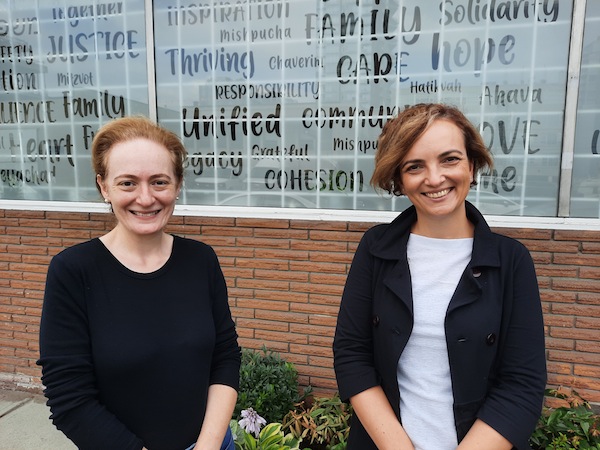
JFS Vancouver staff member Golriz Boroomand, left, and chief executive officer Tanja Demajo. (photo by Pat Johnson)

Tucked into a neighbourhood of low-rise industrial buildings, warehouses and mixed-use developments west of Main Street and south of Olympic Village is the new locus of Jewish Family Services Vancouver. The Kitchen, which opened mid-April, is the people-friendly hub for many of the programs JFS delivers to hundreds of clients every month.

“The Kitchen is an integration of a number of services that address poverty issues,” said

Tanja Demajo, chief executive officer of JFS Vancouver, which operates the Kitchen. While some components of the Kitchen’s programs are still on hold pending the end of the pandemic, it is already a busy and social environment. Clients can come weekly to pick up supplies from the Jewish Food Bank. While there, if they want, clients can meet with a caseworker to discuss access to government supports, meet with social workers or housing advocates or access other services. Behind the reception area are three private offices for caseworkers to meet with community members.

JFS still maintains a head office on Clark Drive, where some administrative work takes place, and where services best delivered in a less-social environment – such as counseling programs and services to Holocaust survivors – are offered. But the Kitchen really is the beating heart of JFS now.

“For example, with the seniors, they often have complex needs in terms of health, in terms of managing the relationship with the landlord, with different service providers, and the social worker is pretty much a point person and coordinates all that care for the client,” Demajo said. With many British Columbians, including too many seniors, unable to find a permanent family doctor, JFS can help connect them with help and accompany them to appointments if requested, she added.

“People who don’t have a [general practitioner] come and they need a prescription,” said Demajo. “Often, they aren’t comfortable going to just a general walk-in clinic, but often that’s the way to start. In many situations, our caseworkers would also go with the client to see the doctor, if they don’t feel like they can go on their own. We often try to see if we can find someone who will take them as a [patient] and it’s the same thing with the dentist. That’s how we work with people. When people are struggling to pay some of the bills because, of course, there’s a lot of unexpected emergencies, then we support them with that.”

Poverty is not only an economic challenge, she said, but a social one, too.

“It’s important just to acknowledge that people living in poverty are also dealing with a lot of isolation,” she said. So the busy and welcoming space the Kitchen provides is serving more than one need.

While the food bank has been operated by JFS in partnership with Jewish Women International for 15 years, this is the first time the program has had a permanent, purpose-built warehouse. In the back of the building, in a high-ceilinged space, are food-laden shelves, refrigerators and sorting spaces.

A parallel program is meals for those who are not able to prepare healthy dishes themselves, either temporarily due to illness or more permanently. JFS has had a meal delivery program for some time, but it was supplied through a third party. With a state-of-the-art commercial kitchen, JFS is now making their own plant-based kosher meals for delivery.

This component has allowed JFS to build relationships with farmers, which allows food bank clients the opportunity to select fresh produce.

“There are vegetables, berries, whatever is available on the farm,” said Demajo. “Customers can go to this online platform, choose what they want and pick it up from here on Thursday. The nice thing is that, again, people of different backgrounds can come here and connect with each other without knowing what their needs are.”

At the Kitchen, Tuesday is Breakfast Club.

“It’s a day for families,” Demajo said. “What they receive through the program is fresh vegetables and fruit, milk, cheese, yogurt, eggs, bread, peanut butter and cereals.” (There are dairy products in take-away food programs but the commercial kitchen is strictly pareve.)

Other food-related programs JFS delivers include Cooked with Chesed, through which clients can have five meals delivered every two weeks, featuring plates such as borscht, mushroom penne pasta, vegetarian Cobb salad, coconut chickpea curry and spaghetti and “meat” balls. Also available at the Kitchen are food vouchers that allow people to do their own shopping.

While pandemic restrictions have kept a damper on some of the social aspects, Demajo looks forward to a post-COVID world where the place will be hopping even more than it is now.

“This will hopefully become really a community hub,” she said. “Our hope was really to have a dedicated space for the community that JFS serves because one of the things that we recognized over the years is that JFS clients do not have space for gathering. They could come to different spaces, but they didn’t have their own dedicated space.”

This, she said, is why the Kitchen has a host of homey touches – artwork, photo displays, a play area for kids, a small library and, adjacent the kitchen itself, a café-like space where communal meals will occur when safe to do so.

The combined food programs serve more than 1,600 people. The food bank itself serves about 950 people.

“These numbers are constantly changing because some people stay with us for a long time, some people use the supports temporarily,” said Demajo.

Funding for the programs comes from the Jewish Federation of Greater Vancouver, private donors, and some federal and provincial government funding.

“When it comes to food, we’re also trying to build more partnerships and relationships where there is more in-kind food as well,” Demajo said.

Because they have a dedicated food storage space, including plenty of refrigerated shelves, the agency can now take in more perishable items than they could have accepted in the past. That means more fresh and healthy food for clients.

JFS has relationships with four farms – in Langley, Richmond, Pemberton and Chilliwack – that provide seasonal specialties.

“There are a lot of educational opportunities,” Demajo noted. “They have some animals there and provide not just food … so the plan is that down the road we also do some different programming with them as well.”

Format ImagePosted on September 24, 2021September 23, 2021Author Pat JohnsonCategories LocalTags food bank, health, Jewish Family Services, JFS, Kitchen, social services
Familiar face celebrates 100

Familiar face celebrates 100

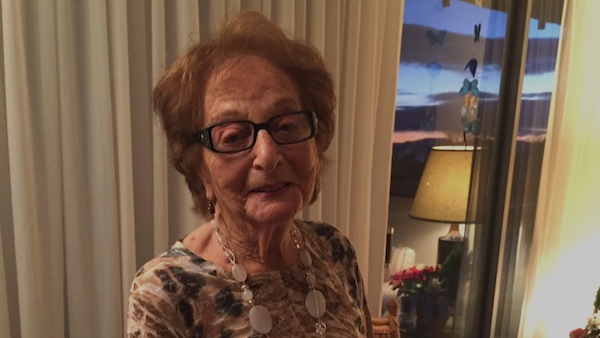
Goldie Kassen celebrated her 100th birthday on Aug. 12. (photo from Barbara Taranto)

Goldie Kassen, who turned 100 on Aug. 12, was fêted by family and friends from across Canada and around the world.

“My entire family was here for my birthday,” she told the Independent over the weekend. That includes two sons from Vancouver, another son from Alberta and a daughter from Israel, as well as 13 grandchildren and seven great-grandchildren. In all, about 40 fully vaccinated guests celebrated at the home of son Dr. Barry Kassen.

“A lot of the children of my friends were there,” she added. “My friends are gone, but their children came from Calgary, Montreal.… I had a lot of out-of-town people.”

Kassen was born in D’Arcy, Sask., in 1921. While there were a number of Jewish farm colonies during that era in Saskatchewan, D’Arcy was not one of them.

“My parents were the only Jewish people there,” she said. “My father came to Canada in the early 1900s. He went to Montreal. He worked there for awhile, then he heard about this land that he could get, so he went out to the land with an axe and a hammer and made his start there. Then my mother joined him about four years later.”

The couple had met and married in the area just outside Kiev, Ukraine. “The town was destroyed during the Holocaust – and the people,” said Kassen.

While the family fled Europe well in advance of the Nazi era, they nevertheless experienced tragedy. A daughter in Ukraine died of pneumonia at three months of age. After the migration to Saskatchewan, another daughter also died of pneumonia, at age 10. That left one son, but then came another son and, finally, Goldie.

“I had wonderful parents,” she recalled. “We lived off the land. What we grew, we ate. We didn’t have money. My mother had a huge garden and we ate everything that she grew. My father, of course, eventually got cattle, so we had our own beef. We just lived off what they produced. There wasn’t any money for extras.”

Her father was handy with carpentry and built the elementary school in D’Arcy where Goldie got her primary education. The building still stands, she said, but it is now used as a church.

There was a high school in D’Arcy, too, but it was six miles from the farm, so Goldie moved to Winnipeg, where her elder brother, 13 years her senior, and his wife had set up home. She graduated from St. John’s Technical High School, then returned to the farm. She wanted to go into nursing, but her father said there was no money for a three-year program, so she enrolled in a business course in Saskatoon.

For four years, she was a stenographer for a lawyer.

“I met my husband during the war years,” she said, referring to Abraham Kassen. She and other members of her Jewish youth group would be bused to dance halls to attend events for soldiers stationed nearby. “I met him at one of these dances,” she said.

“He was working in a store called Adilman’s in Saskatoon. It was a huge department store.”

Although the store closed in 1974, the building still stands in Saskatoon and is recognized as one of the city’s finest remaining examples of Streamline Moderne architecture – think art deco rounded corners and sleek silver accents.

“He was the head of the shoe department,” said Kassen. “Eventually, he became the manager of the whole store.”

The couple had twin boys, then another boy and finally a daughter.

“My children all did well for a mother who came from …” she paused and began to laugh, “I don’t know where.”

After raising her family, Kassen was asked by the Saskatoon Jewish community to become the local representative for JIAS, Jewish Immigrant Aid Services.

“The [Jewish] Russians were coming out of Russia in 1979 and they needed someone in Saskatoon,” she recounted. “I met them at the plane and I found places for them to live, I found jobs for them, I took their children to register for school. I settled over 100 Russians in Saskatoon.”

Even though her parents were from the Russian empire, she didn’t know much of the language to ease the work of settling newcomers. “I know two words,” she said, again with her quick laugh.

“I did that from 1979 until I left Saskatoon.”

Abraham died in 1986 and the two sons who live in Vancouver (both doctors) convinced her to move to the coast.

Any regrets about the move? “Never.”

Kassen didn’t know much about Vancouver or the Jewish community here when she arrived. But she did know a number of people from Saskatoon who had retired to the Louis Brier Home and Hospital. So, she walked in and volunteered shortly after arriving in town in 1988.

“I have to have something to occupy my time,” she said. “I worked there for over 25 years. Thirteen of those years I was the manager, the buyer and the bookkeeper of the gift shop.”

Her imprint on the gift shop was very personal. In addition to serving as a sort of tuck shop where residents can buy a chocolate bar or odds and ends, Kassen stocked it with collectibles she assembled from around Metro Vancouver and much further afield. Her frequent trips to Israel resulted in suitcases filled with kippot, tallitot, seder plates, mezuzot and other Judaica and tchotchkes that she thought shoppers might like.

Her time at the gift shop came to an abrupt end on Feb. 4 last year. With the emergence of the COVID pandemic, and on the advice of her MD son, she decided to close up shop. “I didn’t realize at the time that it would be the end,” she said.

The energy she devoted to the gift shop has not dissipated. “I still bake my own bread,” she said. “I gave away about eight challah on Rosh Hashanah. I’m always baking and cooking. I’m happy.”

The Independent spoke to her Sunday, just before she put a leg of lamb in the oven for family guests.

Phyllis and Michael Moscovich have been friends with Goldie since she arrived on the coast. Michael went to B’nai B’rith camp in Alberta with the Kassen boys.

“Her outlook on life is just always positive,” said Phyllis. “She just seems to take everything as it comes and to be cheerful all the time and positive all the time. I think that is who she is. She makes everyone around her feel good. Every time she comes to me for a meal, she brings something homemade with her. She cooks and bakes more than I will do in my lifetime, with ease. She just does it. That’s just who she is.”

Asked the inevitable question about the secret to longevity, the centenarian credits a healthy start and a refusal to settle down.

“I think the fact that I grew up eating from the earth, no toxins, everything was pure, I think that  gave me a good start,” she said. “I’ve always kept myself busy volunteering. I have to be busy. I can’t just sit and sleep. I have to be doing something or making something. I have a determination to keep going and I’m going to work on the next hundred now.”

Format ImagePosted on September 24, 2021September 23, 2021Author Pat JohnsonCategories LocalTags birthdays, Goldie Kassen, Louis Brier, Michael Moscovich, milestones, Phyllis Moscovich
A special open house

A special open house

Highlights of the Scotiabank Dance Centre’s 20th anniversary celebration include a performance on the outside wall of the building by aerial dance company Aeriosa. (photo by Louise Cecil)

Scotiabank Dance Centre celebrates its 20th anniversary on Oct. 2 with a special edition of its annual open house. Highlights include a performance on the outside wall of the building by dance company Aeriosa; a creative activation of the Granville Street frontage by Company 605 and guests; free classes, events and exhibits; and the online première of a short film by Milos Jakovic and Hossein Fani.

“The Scotiabank Dance Centre is an important and colourful feather in Vancouver’s cultural cap,” said Jewish community member Linda Blankstein, a former Dance Centre board chair and current Dance Foundation board chair. The facility was built “specifically for dance in all its creative forms, from hip hop to ballet and flamenco to contemporary and everything in between,” she said. “Pre-COVID, the building would see approximately 87,000 people pass through its front door every year. It is extremely important for people of all ages, from toddlers to seniors, and amateur to professional dancers, to have a facility where creativity is shared while nurturing a sense of belonging for individuals seeking activity and connection.”

One of the centre’s studios is named after another Jewish community member, Judith Marcuse, who has had her offices and rehearsal space in the building since its inception.

Some of the highlights of the open house – for which all recommended COVID-19 protocols will be in place – include Aeriosa’s Home/Domicile, choreographed by Julia Taffe in collaboration with visual artists Sarah E. Fuller and Stuart Ward. This new aerial dance work is inspired by moths, and the dancers, wearing “moth” cloaks designed by Fuller, will perform on the north wall.

Company 605’s SPLAY comprises a special program of artists who will animate various spaces of the Scotiabank Dance Centre building. Each artist will create encounters for viewers inside and outside, making their process and practice visible, culminating in a sharing of intimate performance experiences across a variety of formats.

There will also be a performance of excerpts of new works in progress from artists Sujit Vaidya, an exponent of Bharatanatyam (a form of Indian classical dance), and Dumb Instrument Dance. Classes include tap and footwork with Danny Nielsen and Shay Kuebler; flamenco with Kasandra “La China” of Al Mozaico Flamenco Dance Academy; hip hop, breaking, waacking and contemporary with Cristina Bucci of OURO Collective; and AfroBeats with AKS Bison.

The documentary by Jakovic and Fani – which has the working title of Our Dance – will also be screened. It captures the impact Scotiabank Dance Centre has had on the dance community over the 20 years of its existence.

Housing six dance studios and a theatre, Scotiabank hosts hundreds of rehearsals, classes, workshops, performances and events every year.

“It has been immensely rewarding to see how Scotiabank Dance Centre, which began as a dream so many years ago, has contributed to the arts scene in our city and the growth of B.C.’s dance community,” said Mirna Zagar, executive director of the Dance Centre, which operates the building and runs programming. “As hub for dance, it provides high-quality studio space, but it is much more than just a building: we have nurtured a stimulating environment that is supportive of the creative potential of dance artists, contributing to a thriving synergy within the arts sector in Canada.”

Oct. 2’s open house runs from 1 to 6 p.m. at Scotiabank Dance Centre. For more information, call 604-606-6400 or visit thedancecentre.ca.

– Courtesy Scotiabank Dance Centre

Format ImagePosted on September 24, 2021September 23, 2021Author Scotiabank Dance CentreCategories Performing ArtsTags dance, Linda Blankstein, milestones, Scotiabank Dance Centre
Do you recognize anyone?

Do you recognize anyone?

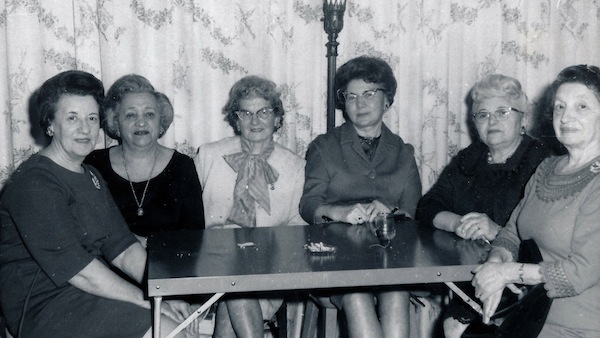
This photo was taken at the home of Harry and Ida Fishman, 4862 Ridgelawn Dr., in Burnaby, in the 1960s. If you recognize anyone in it, please email Roni (Fishman) Wosk at [email protected].

Format ImagePosted on September 24, 2021September 23, 2021Author Roni WoskCategories LocalTags Fishman, history
Ida Nudel passes away

Ida Nudel passes away

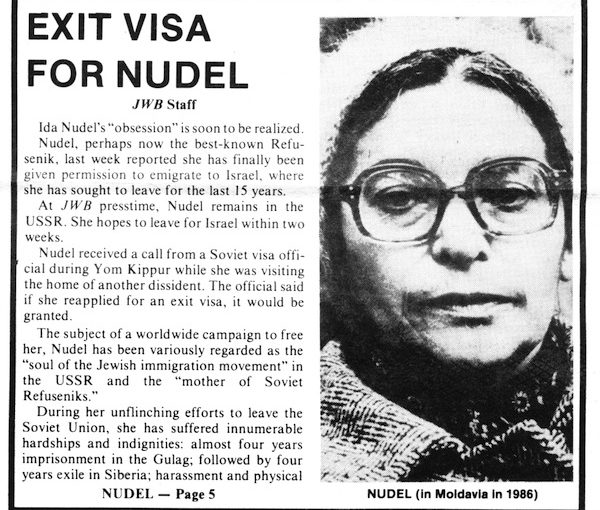
A cover story in the Oct. 14, 1987, JWB announced that Ida Nudel would be granted her long-sought-after exit visa from the USSR.

In the Jewish Independent’s special 90+1 issue this past May, reader Ronnie Tessler recalled one of the regular features of the JI’s predecessor, the Jewish Western Bulletin – the Gulag Record. Starting in 1978, the paper regularly reminded readers of how many days certain refuseniks were being held in the Gulag in the former USSR. One of the refuseniks featured, Ida Nudel, died this month, on Sept. 14, at the age of 90.

“The subject of a worldwide campaign to free her, Nudel has been variously regarded as the ‘soul of the Jewish immigration movement’ in the USSR and the ‘mother of Soviet refuseniks,’” reads the Oct. 14, 1987, JWB cover story announcing that Nudel would be granted an exit visa from the USSR.

“During her unflinching efforts to leave the Soviet Union, she has suffered innumerable hardships and indignities: almost four years imprisonment in abuse by the ever-present KGB, combined with travel restrictions amounting to incarceration,” the article continues.

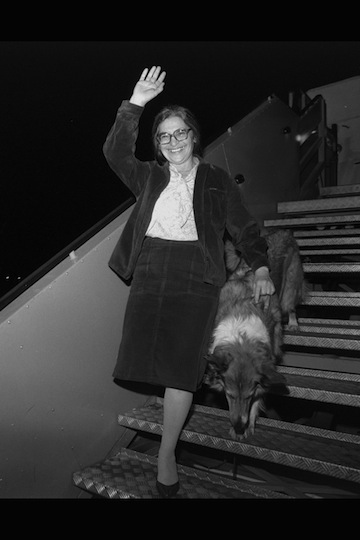
photo - Ida Nudel and her dog arrive on a private Boeing jet, owned by American oil billionaire Armand Hammer, at Ben-Gurion Airport on Oct. 15, 1987
Ida Nudel and her dog arrive on a private Boeing jet, owned by American oil billionaire Armand Hammer, at Ben-Gurion Airport on Oct. 15, 1987. (photo by Harnik Nati / IGPO)

“Occasionally, it was feared that, owing to diminished health, the 56-year-old Nudel would not live to see the Jewish state or be reunited with her sister Ilena Fridman, now residing in Israel.”

Fridman, the article notes, “visited Vancouver in October 1986 to lobby for Nudel’s release at a NETWORK-sponsored Soviet Jewry rally here….”

In addition to a concerted, long-term effort by Jewish groups worldwide, “urging Soviet officials to grant her an exit visa,” Nudel was visited over the years “by numerous delegations and dignitaries, including actress Jane Fonda, to bolster her spirits and encourage her efforts to leave the USSR.

“Under glasnost (openness), Nudel was allowed greater freedom to move and meet with Western journalists and fellow dissidents. Last month [September 1987], she was permitted to travel from her home in Moldavia to Moscow to meet with a group of women refuseniks to discuss their plight.”

Nudel was born in 1931, near Crimea, and “was raised by her maternal grandparents on a collective farm until she was 3,” writes Sam Roberts in the New York Times article about her death. “Her father was killed in World War II fighting German troops near Stalingrad when she was 10.

“After graduating in 1954 from the Moscow Institute of Engineering and Economics, Ms. Nudel worked for a construction company and later as an accountant for the Moscow Microbiological Institution,” notes Roberts.

As a result of her protests in the 1970s, Nudel lost her job and was exiled. When her exile ended, she settled in Moldova. After she was allowed to make aliyah, Nudel “originally lived in a rural settlement,” writes Roberts, “then moved to the city of Rehovot, about 18 miles south of Tel Aviv, to be closer to her sister [who had been allowed to emigrate in 1972].”

Nudel wrote an autobiography, A Hand in the Darkness, which was translated into English, and there was a movie made about her experience.

Format ImagePosted on September 24, 2021September 23, 2021Author Cynthia RamsayCategories WorldTags A Portrait of Jewish Americans, history, Ida Nudel, politics, refuseniks, USSR

Novels miss the mark slightly

I was very much looking forward to two recent novels. Both are love stories, but unconventional ones. I enjoyed them, and read them cover to cover – generally, I allow myself to stop reading, watching or listening to whatever it is I’m not enjoying, so that I wanted to know how the stories ended is a compliment to the writers. But I was disappointed in the novels, ultimately. In both instances, I felt a little robbed of emotional impact.

Perhaps, given their protagonists, I shouldn’t have been surprised that the cerebral aspects of the books would outweigh, even quash, the heart-rending effects. Morningside Heights by Joshua Henkin (Pantheon Books, 2021) is about an uber-accomplished, hyper-intelligent professor who is struck by early-onset Alzheimer’s. Never Anyone But You by Rupert Thomson (Other Press, 2020) is about two real-life cultural icons who were in the same social circles as people the likes of Ernest Hemingway and Salvador Dalí.

Love faces adversity

Within the first 20 pages of Morningside Heights, I didn’t particularly like either Prof. Spence Robin or his wife, Pru. He is an all-star academic, winning awards and grants of all sorts; he has ambition and has achieved some power in his world, and carries himself as such. He is Jewish but changed his name early in life, “to escape the Lower East Side.” He is Pru’s teacher, though only six years her senior, and downplays her concerns of being seen on campus as just his girlfriend, not as a person in her own right. And it is only after he semi-proposes that he tells her he has a sister with brain damage, who he visits rarely, and that he’d been married before and has an estranged son from that marriage.

For her part, Pru lets Spence get away with all these things. Worse, she abandons her own beliefs and dreams, basically, to be with him. For example, she keeps kosher before she meets him and in their early days together, but lets that go by the wayside. She has her own promising career that she gives up because her own areas of interest overlap with his award-winning expertise. He lets her become his shadow. He lets her main purpose become supporting him, while not reciprocating or appreciating that support at all, it seems.

So, it’s hard to empathize with the individual characters when their lives are completely upturned by Spence’s Alzheimer’s, which begins to affect him in his late 50s. That said, one doesn’t wish ill on anyone. The challenges both Spence and Pru face are severe, and Henkin brilliantly communicates the difficulties on both sides. Spence’s confusions and his not being able to understand fully the state he’s in are as heart-wrenching as his strong will and refusal to step down from work or admit his frailties are frustrating. Pru’s sadness at the loss of her partner and the heavy responsibilities of caring for him are palpable.

Perhaps the weight of these feelings and circumstances is part of what inspired Henkin to give – in my opinion – too much ink to Spence’s troubled son. Spence and Pru’s daughter Sarah doesn’t figure as prominently, but a lot of time is spent on Arlo and, in some respects, Arlo allows readers to get to know more about Spence. But those story threads interrupted, for me, the potential intensity of the Spence-Pru storyline, which, I have to admit, was both a relief and a letdown. I wasn’t surprised that Henkin has personal experience with dementia. In an online interview with the publication Shelf Awareness, he shares, “Although much of Morningside Heights is invented, it is, in many ways, my most autobiographical novel to date. My father, like Spence, was a professor at Columbia who developed Alzheimer’s, though my father developed it much later in life than Spence did. In writing about the ways Pru lost Spence, I was re-experiencing my mother’s loss, and my brothers’ and my loss.”

The rawness of that real pain is tempered in the novel, perhaps out of personal necessity. And perhaps most readers will appreciate that emotional distance, but I was hoping for a more intimate portrayal.

Not-so secret love

Never Anyone But You also lacks intimacy, even though it is about Suzanne Malherbe and Lucie Schwob, who fall in love and become both personal and professional partners. Thomson writes about the real-life French artists in a somewhat didactic and distanced way. He has done all his research but never fully inhabits or gives full life to his characters, who must have been quite passionate and committed people to have accomplished what they did under the circumstances in which they did it.

The women knew each other from childhood but end up becoming stepsisters when Lucie’s father (who was Jewish) connects with and eventually marries Suzanne’s mother (who was Catholic). Suzanne is immediately captivated by Lucie when they meet more formally; Suzanne is almost 17 years old and Lucie a couple years older than that. Never Anyone But You is told from the perspective of Suzanne.

Early on, the two decide to collaborate – Lucie’s words and Suzanne’s drawings. Lucie transforms herself into Claude Cahun before Suzanne reinvents herself as Marcel Moore. But the new persona cannot heal Claude’s bouts of depression and, throughout her life, she struggled to stay alive.

Claude and Marcel were unofficially (because they weren’t men) part of the Surrealist scene in 1920s Paris but their artistic (notably, photographic) success was tempered by the Second World War. They leave Paris in the late 1930s and take refuge in Jersey, where they use their talents to unsettle and educate the Nazi soldiers who occupied the island from 1940. It was their hope that their leaflets would demoralize the soldiers, and even cause some of them to desert. Marcel was fluent in German, so they could make the subversive material appear as if it were coming from one of the soldiers. Eventually, the two would be discovered and arrested. Though they would suffer imprisonment, they survived the war.

The bravery of Claude and Marcel is remarkable, as is their dedication to each other, though Claude is depicted as being unlikeable at times, between her mental health issues and her being more fluid with her sexuality than Marcel, ie. she had other relationships. Nonetheless, for Marcel, there was never anyone but Claude, though it is difficult to see why there was such devotion and loyalty on her side, and Thomson’s novel doesn’t answer that question. Ultimately, the two were together for more than 40 years, until Claude’s death in 1954, so there was, I guess, really never anyone but Marcel for Claude, either.

Posted on September 24, 2021September 23, 2021Author Cynthia RamsayCategories BooksTags Alzheimer's, Claude Cahun, dementia, fiction, historical fiction, Holocaust, Joshua Henkin, Marcel Moore, Morningside Heights, Never Anyone But You, photography, Rupert Thomson

Posts pagination

Page 1 Page 2 … Page 4 Next page
Proudly powered by WordPress