Skip to content
  • Home
  • Subscribe / donate
  • Events calendar
  • News
    • Local
    • National
    • Israel
    • World
    • עניין בחדשות
      A roundup of news in Canada and further afield, in Hebrew.
  • Opinion
    • From the JI
    • Op-Ed
  • Arts & Culture
    • Performing Arts
    • Music
    • Books
    • Visual Arts
    • TV & Film
  • Life
    • Celebrating the Holidays
    • Travel
    • The Daily Snooze
      Cartoons by Jacob Samuel
    • Mystery Photo
      Help the JI and JMABC fill in the gaps in our archives.
  • Community Links
    • Organizations, Etc.
    • Other News Sources & Blogs
    • Business Directory
  • FAQ
  • JI Chai Celebration
  • JI@88! video

Recent Posts

  • Story of Israel’s north
  • Sheltering in train stations
  • Teach critical thinking
  • Learning to bridge divides
  • Supporting Iranian community
  • Art dismantles systems
  • Beth Tikvah celebrates 50th
  • What is Jewish music?
  • Celebrate joy of music
  • Women share experiences 
  • Raising funds for Survivors
  • Call for digital literacy
  • The hidden hand of hate
  • Tarot as spiritual ritual
  • Students create fancy meal
  • Encouraging young voices
  • Rose’s Angels delivers
  • Living life to its fullest
  • Drawing on his roots
  • Panama City welcoming
  • Pesach cleaning
  • On the wings of griffon vultures
  • Vast recipe & story collection
  • A word, please …
  • מארק קרני לא ממתין לטראמפ
  • On war and antisemitism
  • Jews shine in Canucks colours
  • Moment of opportunity
  • Shooting response
  • BC budget fails seniors
  • Ritual is what makes life holy
  • Dogs help war veterans live again
  • Remain vital and outspoken
  • An urgent play to see
  • Pop-up exhibit popular
  • An invite to join JWest

Archives

Follow @JewishIndie
image - The CJN - Visit Us Banner - 300x600 - 101625

Month: June 2018

Encounters with the divine

Encounters with the divine

Barbara Pelman speaks at the opening of the exhibit Encounters, which is at Congregation Emanu-El in Victoria this summer. (photo by Frances Aknai)

On June 3, the exhibit Encounters opened at Congregation Emanu-El in Victoria. It is the culmination of the most recent Calling All Artists exchange, a project that has been going on for more than a decade.

“Bible has to be interpreted to be relevant,” said Barbara Pelman, coordinator of Calling All Artists since its inception. “All Renaissance art is Bible interpretation. That’s what we do with this project.”

In 2004, Pelman was the head of the adult education committee at the synagogue.

“Rabbi Harry [Brechner] came up with the idea to gather a bunch of artists and writers for a few study sessions to teach them a particular theme and its rabbinic interpretation,” she recalled. “I thought it was a wonderful idea. The sessions were conducted once a month for five months. Afterwards, the artists would offer their own interpretations of the theme, and the synagogue would have an exhibit of their works.”

While the congregation also produced colourful chapbooks – mini catalogues of the exhibitions – in previous years, they did not do so this year.

Over the course of the project, the artists have studied a variety of subjects. The first exchange was based on the topic of Paradise, and the exhibit was held in 2005. In subsequent years, themes have included dreams and prophecies; creation; the Book of Ruth; death and afterlife; and reinventing rituals.

“We missed a few years since the beginning,” said Pelman. “Once, we thought that maybe we are finished with the project and won’t do it anymore, but everyone involved said, ‘No! No! We should continue.’ Another year, holidays interfered.”

This year’s theme examines divine-human interactions.

“What happens in these encounters? What does one look like and how is it reported and remembered? What are some examples in biblical and rabbinical tales? How do we understand divinity and how does that understanding affect our worldview? These are some of the questions the artists of different genres have been exploring,” Pelman explained.

She said that not all participating artists are members of the congregation, or even Jewish. “The project is open to the community,” she said. “This year, 30 people signed up for the project; 17 artists remained to the end to exhibit their works. Five of them are not Jewish, but all of them are interested in learning.”

Studying with the rabbi is a mandatory part of Calling All Artists, Pelman said. “This entire project is about learning from those who know more than we do. The point is not to exhibit but to learn. That’s why the art is not vetted.”
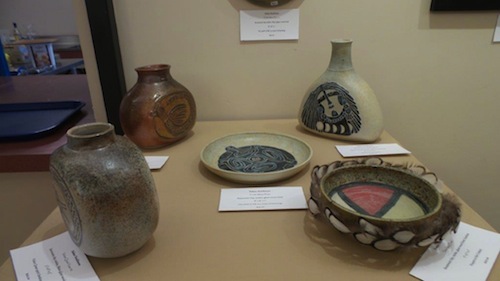
photo - Encounters features a range of artistic genres, including pottery
Encounters features a range of artistic genres, including pottery. (photo by Frances Aknai)

Participating artists represent a wide variety of media and genres, as well as skill levels. Some participants are professionals; others do art as a hobby. The exhibits feature photographs and paintings, fibre art and pottery, sculpture and poetry. Every piece is accompanied by an explanation of the work by the artist.

Pelman is a poet, so her involvement in every year’s project has been a poem. For her, divinity is not an all-knowing old guy somewhere above. “It’s the biggest and best part of you, of us all,” she said. “How do we find it? How does it inform our muse?” This is what she contemplates in her poem for this year’s explorative journey.

Pelman worked as an English teacher for many years. She taught high school, college and university classes, and she has been writing poetry for a long time. “I have three poetry books published,” she said. “The last two by Ronsdale Press, a Vancouver publisher.”

Another frequent participant in the project, artist and writer Isa Milman, said, “I participated in the first Calling All Artists, The Paradise Project, in 2005. It was a spectacular experience. The combination of Rabbi Harry Brechner’s teaching, the group of artists who gathered and learned from each other, wrestling with text that most of us were unfamiliar with, was truly energizing. The process involved five sessions spread over a few months, to learn from Harry’s teachings and engage with one another, as we entered a spiritual quest for meaning. Then we went off to put our learning into practice and create our responses.”

Milman has taken part in a number of Calling All Artists projects. “I’ve written poems as well as created paintings for these projects,” she said. “Learning with Rabbi Harry is an inspiration. He’s a gifted teacher and a wonderful spiritual guide. My Jewish education was extremely Orthodox and doctrinaire and I rebelled against it. Learning Torah with Rabbi Harry is so different. It’s an invitation to engage and converse, which I so welcome.”

Olga Livshin is a Vancouver freelance writer. She can be reached at [email protected].

Format ImagePosted on June 29, 2018June 28, 2018Author Olga LivshinCategories Visual ArtsTags art, Barbara Pelman, Emanu-El, Isa Milman, Judaism, spirituality, Victoria
Movement and sound mix

Movement and sound mix

Vanessa Goodman is part of MascallDance’s OW, which premières at Dancing on the Edge. (photo from DOTE)

Audiences saw a glimpse of MascallDance’s OW last year at Dancing on the Edge. This year, the full work premiéres at the dance festival, with six performances July 6-14 at MascallDance’s home, in St. Paul’s Anglican Church downtown.

OW “analyzes timing, accents and rhythms of the sounds that erupt from the body as expressions, building a libretto of repeatable human emotions. Exploration is physically challenging and unpredictable; what has emerged to date is fast, rhythmic, often wildly funny and noisy,” explains MascallDance’s website.

Jewish community member Vanessa Goodman, artistic director and choreographer of dance company Action at a Distance, is one of the dancers in OW.

“One of the interests in the work that we keep coming back to is finding out how sound moves the body and how the body moves sound,” Goodman told the Independent. “As we dive deeper into the process, we are often faced with more questions about accessing the authentic experience of voice and movement. We started by exploring what sounds come from the body with specific physicalities and then also tried to see what happened physically when we made specific sounds.”

Goodman has been involved in the project since 2012, when MascallDance Society founder and artistic director Jennifer Mascall started doing research with her “to explore some of the thematic content that is present in OW,” said Goodman. “Then I was brought back into the process in January 2017 to continue with Walter [Kubanek], Eloi [Homier] and Anne [Cooper].”

The website notes that 17 dancers perform in the production. Also performing will be composer and violist Stefan Smulovitz and specialist in experimental voice D.B. Boyko.

“One of the inspirations for this work,” said Goodman, “was musicals – we watched a lot of clips from older films and observed the complexity of their compositions. They use tons of counter and polyrhythms, and our material was set so that we could achieve a similar result. What you are going to see is definitely not a typical musical formula, but, inside OW, some elements have been inspired by their compositions.”

Goodman has worked with Mascall before.

“My first experience with Jennifer was in 2005, when I was a student at SFU [Simon Fraser University] and she created a piece in my rep class exploring the voice of Glenn Gould. One of my favourite memories from that experience was that she watched the piece from the corner one day in rehearsal. It was one of our final runs before the show and, after watching, she declared that was how the work was meant to be seen, so we adjusted our ‘front’ to this new diagonal perspective. I loved this, as it allowed us to have a brand new experience inside the work and showed me that the creative process is always in a state of evolution.”

Working with Mascall “is fantastic,” said Goodman. “She has a deep practice of finding movement for the body from physiological systems. This is a vibrant place to work from, and I am also interested in anatomical processes and how they relate to movement.”

One of the most rewarding aspects of OW for Goodman has been working with all of the production’s collaborators. “Each artist involved on the team offers unique and critical information,” she said. “Performatively, this process has expanded my practice and has allowed me to discover new interests and curiosities.”

Dancing on the Edge runs July 5-14. For the schedule and tickets, visit dancingontheedge.org.


Format ImagePosted on June 29, 2018June 28, 2018Author Cynthia RamsayCategories Performing ArtsTags dance, Dancing on the Edge, DOTE, MascallDance, Vanessa Goodman

The pot talk we need

Last week, Prime Minister Justin Trudeau announced that marijuana would become legal in Canada on Oct. 17. He had intended that it should be legal this Sunday – Canada Day. But the Senate, rousing itself from obsolescence just long enough to throw a wrench in the plans, delayed passage of the pot legalization bill until this month, making implementation by Canada Day impossible.

This may not seem like a particularly relevant topic for a Jewish newspaper editorial, but substance use is just as relevant in our community as it is in any. A few years ago, a panel discussion took place at Schara Tzedeck Synagogue on the topic. Prof. Raphael Mechoulam, a chemist and expert on marijuana’s medicinal uses visiting from the Hebrew University of Jerusalem, and Dr. Kathryn Selby, a University of British Columbia clinical professor in pediatric developmental neurosciences, took opposing sides.

Mechoulam said that cannabidiol (CBD), a component in marijuana, may have medical uses “in almost all diseases affecting humans.” However, little scientific research has been done.

Cannabinoid receptors are abundant in several regions of the brain, including those where movement control, learning and memory, stress, cognitive function and links between cerebral hemispheres occur. CBD can also impact appetite, blood pressure, cerebral blood flow, the immune system and inflammation. It can, in some cases, reduce or eliminate seizures and cancerous tumours.

But Selby raised an issue that has gone almost entirely ignored throughout Canada’s national discussion about marijuana legalization.

Marijuana can have deeply deleterious effects on the brains of adolescents and young adults, altering the brain’s structure and function in lifelong ways. The development of the human brain continues into the 20s, Selby said, and the prefrontal cortex, where judgment and executive functions occur, is the last to develop – thus the most likely to be affected by intensive marijuana use.

Longer-term impacts of marijuana use by adolescents have been shown to correlate with schizophrenia later in life and a 50% to 200% increase in psychoses among heavy users. Daily marijuana use during high school has been correlated with a 600% increase in depression and anxiety in later life.

Selby recommended that marijuana use, if undertaken at all, should be “as late and as little as possible.”

During the national discussion around this issue, much concern was expressed about the ability of law enforcement officials to identify and measure marijuana impairment among drivers. Almost no discussion was devoted to the effects of marijuana on developing brains.

Part of the reason for delaying legalization until October was to allow provincial and municipal governments to prepare for the related distribution, legal and other public policy issues legalization raises. While criminal law is a federal issue – marijuana legalization is on Ottawa’s plate – it is the provinces that determine where, how and to what consumers the “product” may be marketed. In Alberta and Quebec, the age will be 18; in the other provinces, 19. (Most provinces have made the decision to create equal ages of majority for alcohol and marijuana purchase.)

Alcohol has its own harmful impacts on the bodies of young (and older) people, but marijuana may have particular harms on the development of adolescent and young adult brains.

Once the brain is fully developed, by the mid-20s, the dangers of permanent damage by marijuana use are significantly reduced. This scientific evidence – not the fairly random legal decision to permit consumption at age 18 or 19 – should perhaps have received more attention than it has. Given that it did not, it now falls to parents, grandparents, trusted adults and educators to share with young people the potential harm heavy marijuana use has for adolescents and young adults.

It is time Canada moved away from prohibition and towards a compassionate model that reduces and minimizes the harm that stems from fear and a lack of evidence-based policies. Fear-mongering is a waste of time – and marijuana’s positive impacts can’t be denied.

However, for those of us with young people in our lives, a good approach is to model the moderate use of all substances, to leave open lines of nonjudgmental communication (however hard that is) and to demonstrate for one another how to make wise and healthy choices. Sharing information in a rational way and asking young people to avoid heavy use or to delay if possible is the least we can do. It is our hope, too, that pot companies will temper their impulses to capitalize on every opportunity and avoid marketing edibles made to appeal to children and teens so that we’re not fighting an uphill battle. Healthy communities with resilient kids are a group effort.

Posted on June 29, 2018June 28, 2018Author The Editorial BoardCategories From the JITags Canada, children, health, legalization, marijuana, politics, science, teens

Do you have a gratitude list?

Ever had coffee with a friend and complained the whole time? As the gripe session takes a downward spiral, I often feel worse than I did beforehand. I’ve taken time off to see a friend … and we may be smiling, but we’re dumping negativity on each other.

True, we need to get those feelings out, but repeating bad thoughts without finding upbeat solutions doesn’t do us any good. The mind creates an “alternate reality” in which we only see the negatives. Plus, by doing this with someone else, we compound the bad experience. How do we change our inner narrative?

Recent neuroscience and psychology research indicates that consciously creating a daily gratitude list may help us feel better. This rewires the brain, helping us get rid of toxic feelings in order to embrace the good ones. If you’re Jewish and traditionally religious, this may not be news. The world’s major religions feature “gratitude lists” in daily prayers. If you already pray – and you pay attention to those thanksgiving prayers we do each day – you may provide yourself with a more positive outlook, even if those prayers aren’t necessarily personalized ones.

It’s great to have a gratitude list “built in,” but, if you don’t do formal prayer, for whatever reason, you can still create an informal gratitude list. Here are some tips to get started.

1) Food. Most Canadians are lucky, we have enough food. Choose things that taste good – and be grateful. Think about it. While you’re at it, consider what it’s like to be hungry. If you can afford to donate to the food bank or provide food for others, that’s a great way to show your gratitude.

Most of us know the Hamotzi, the blessing over bread, or the Kiddush, over wine or grape juice. You could push yourself just a bit farther and think about learning the blessings for other foods. Even if you aren’t saying a blessing each time you eat, even a moment of gratitude for food is worth it.

2) Sleep. There’s a reason that sleep deprivation is used as a form of torture. If you’ve gone without sleep for extended periods – parents, this means you! – you know that having uninterrupted, deep sleep is something to appreciate. I am grateful every day that I get more than six hours of resting horizontally. In that hazy space after waking up and before getting out of bed, relish that feeling of rest. Anyone with a small child knows you can’t be sure when you’ll next get enough sleep, so enjoy it whenever you can.

We’ve got prayers for this, too, of course. We say Modeh Ani when we get up, expressing thanks for “returning our soul” after waking up from sleep. Another prayer thanks G-d for giving the tired strength. I often look around at a service when this is said and think about how we all keep on keepin’ on, getting things done even when we feel exhausted.

3) Housing. Did you sleep in a safe place? Are you able to eat your meals indoors when it’s cold out? Not everyone has this opportunity. Stable access to affordable housing is a Canadian problem. There are days when we all worry that we cannot afford to keep up with housing maintenance. However, there is nothing better than a cozy, warm space indoors during a rainstorm. If you feel thankful to have a safe, comfortable home, consider those who don’t. Homelessness is a Canadian problem. Together, we can think of positive solutions beyond a gratitude list, but we work together better by taking care of ourselves first.

The prayer for this? Birkat Habayit. Different versions include verses from the Torah. The summary? Let this be a peaceful, joyful house, without discord, fear or conflict. Let there be knowledge, wisdom and learning in this home. Let it be filled with holiness, G-d’s presence and beauty.

4) The weather and our natural world. Canadians love to moan about weather. It’s a popular hobby. Yet, we have access to four amazing seasons. Jewish prayers include mention of rain, the growth of crops and animals, sunshine, and even the arrangement of the stars in the firmament. That’s pretty great stuff in there. I’m pretty inspired by nature, growing things and the earth when I read the liturgy carefully.

5) Our bodies. Did you know that many faith traditions have specific ways to appreciate how our bodies are made? It can be amazing to acknowledge how cleverly our bodies work. When you exercise next, even if it is walking to the corner, consider how well things function. Even moderate amounts of exercise keep us healthy and make us feel good. The next time you play a musical instrument, sing, talk, laugh, smell a scent or breathe? Remember to be grateful it’s all working mostly as it should.

Our liturgy includes Asher Yatzar, a prayer that acknowledges how amazing it is that our bodily functions (like going to the bathroom regularly) work so well. Without this functionality, we couldn’t use our bodies to their greatest potential.

6) Our clothing. Are you dry and comfortable? Warm or cool according to the season? Humans used to spin, weave, knit, crochet and sew everything they wore by hand. We’re lucky that our “modern” clothes are easy to come by, but disposable clothing doesn’t show gratitude towards the earth or those who made the clothes. Another aspect of thankfulness is to make things last – to take care of our clothes, mend them, wash them and pass them along when they’re no longer needed. If we value well-made, long-lasting clothes, we also help others stay warm and clothed by using less.

We recite the Malbish Arumim, thanking G-d for clothing the naked. It’s a chance to remember how lucky we are to have the right clothing for the season, occasion and our needs.

Focusing on gratitude doesn’t mean ignoring bad stuff. We can’t (and shouldn’t) screen out the world news, suffering, or upsetting things that happen every day. However, being thankful for small, everyday things can make us better able to cope. Research indicates that it can ease depression, make us more patient, better at taking care of ourselves and our relationships, and help keep us on an even keel, where we might do things in moderation: sleep well, eat less and maintain a sustainable feeling of contentment.

These are many reasons to figure out why we’re thankful – every day. If you voice your thanks to others, you’ll be using good manners. All could benefit from an increase in honest, well-intentioned civility! Pay it forward. Pass along these good feelings of gratitude about what we have. I’ll start. Thank you for reading this – and thinking about gratitude.

Joanne Seiff writes regularly for CBC Manitoba and various Jewish publications. She is the author of three books, including From the Outside In: Jewish Post Columns 2015-2016, a collection of essays available for digital download or as a paperback from Amazon. See more about her at joanneseiff.blogspot.com.

Posted on June 29, 2018June 28, 2018Author Joanne SeiffCategories Op-EdTags gratitude, Judaism, philosophy
A chuppah for another 150

A chuppah for another 150

Congregation Emanu-El’s chuppah is on display throughout the summer. (photo by Janna Ginsberg Bleviss)

Congregation Emanu-El in Victoria is celebrating its 155th year. It is marking the occasion, in part, with the art exhibit Encounters, as well as by displaying a quilted chuppah that was created by a group of women in the community for the congregation’s 150th birthday.

The creation of the quilt was spearheaded by Janna Ginsberg Bleviss, who talked with the Independent about this unusual project.

“Five years ago, when Congregation Emanu-El was celebrating its 150th anniversary, I was active with a couple of projects,” she said, “and I was looking for a specific art project. Rabbi Harry Brechner suggested a new chuppah.”

The original chuppah of Emanu-El has a long history. According to Ginsberg Bleviss, it dated from 1864. Made in England from Chinese silk with gold embroidery, it was donated to the synagogue by the Hebrew Ladies of Victoria. Throughout the intervening century and a half, it had been used repeatedly. Of course, by 2013, it was showing its age. “It was frayed and tired looking,” said Ginsberg Bleviss.

The congregation needed a new chuppah, but was unsure how to approach the making of a new one. “Rabbi Harry directed me to Colleen Golumbia, a gifted quilter and fabric artist,” recalled Ginsberg Bleviss. “I had seen her work at the shul’s Calling All Artists displays and I thought that a fabric project would be suitable for the chuppah, as I already knew many textile artists. Colleen agreed to work with me, to coordinate putting the pieces together and make it look like a chuppah. She was absolutely the right person to be involved.”

Golumbia decided the chuppah would feature a central panel surrounded by 12 squares. “Colleen designed the gorgeous centre piece, resembling the stained glass window in the sanctuary ceiling, with colours of gold, red, white and blue,” said Ginsberg Bleviss.

Meanwhile, Ginsberg Bleviss put out a call and found 12 women interested in creating the surrounding panels. In the end, 14 women worked on the project.

“These women ranged in ages, the oldest [then] being 86. They came from Victoria, [elsewhere on] Vancouver Island and even as far away as Washington, D.C. Some were professional artists, some were experienced sewers or quilters or knitters, some worked in fabric from time to time and some took it on as a challenge. They were all pleased to participate in this project. Although not all were synagogue members, all were connected in some way to Congregation Emanu-El.”

Golumbia gave snatches of fabric to everyone in the colours of her portrayal of the stained glass window, thus linking the whole composition by colour; other than that, every participating woman had full creative freedom. Ginsberg Bleviss recalled: “I was frustrated at first because I kept asking Colleen: ‘Don’t you want to give them some directions?’ She didn’t.”

The artists got together a few times anyway, to share and learn from one another. Since they didn’t all live in Victoria, they mostly communicated through emails circulated by Ginsberg Bleviss.

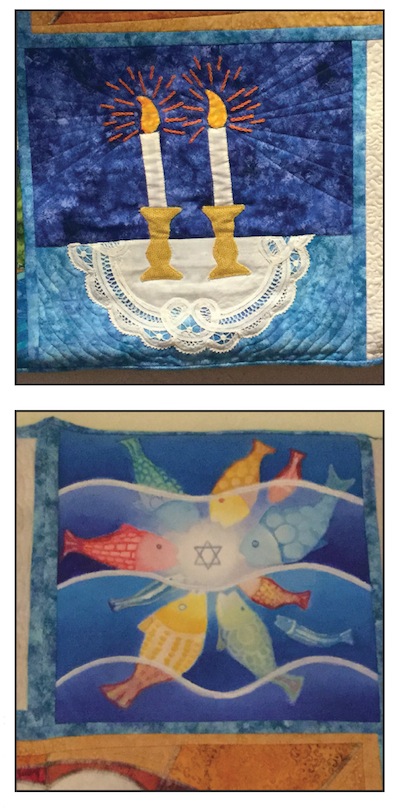
photo - Each panel was created by a different artist. Annette Wigod sewed Shabbat candles, using an antique doily as the tablecloth and Phyllis Serota painted fish coming toward a Magen David (acrylic on canvas)
Each panel was created by a different artist. Annette Wigod sewed Shabbat candles, using an antique doily as the tablecloth and Phyllis Serota painted fish coming toward a Magen David (acrylic on canvas). (photos by Janna Ginsberg Bleviss)

“When the squares came in, the diversity and similarities were quite amazing. Many used the Magen David in various forms. There were images of Judaism, nature, light and colour. Some of the squares were abstract. Only one had words on it – the last piece that came in was from Washington, D.C. It said, ‘I am my beloved and my beloved is mine,’ which is often said at weddings. Done by Nancy Micklewright, it was a stunning gold stencil on a white background…. Phyllis Serota, known for her early fish paintings, painted fish coming into a Magen David centre. Annette Wigod, our oldest contributor, sewed Shabbat candles and used an antique doily as the tablecloth. Enid Elliot created a West Coast theme of oceans, mountains and sky. Arlene Ackerman, another experienced quilter, created pomegranates.”

The other participants included Narcis Kellow, Isa Milman, Jackie Saunders Ritchie, Natalie Beher, Charlotte Sutker, Gail Steinberg, Janis Diner Brinley and Barbara Horowitz.

“It was truly a communal effort, vibrant and colourful, meticulously sewn together,” Ginsberg Bleviss said. “Some squares were hand-stitched, some machine-stitched, some reflected quilting traditions, and some used appliqué. It was extremely varied. Colleen put all the pieces together and did the quilting lines. Several months later, in March 2013, we handed it to the synagogue as a donation from all the women…. It was too beautiful not to let others see it. We decided to place it in the sanctuary, where it has been ever since. Its first proper use came that same summer for the wedding of one of the artists and her partner.”

The old chuppah now resides at Royal B.C. Museum, although it was brought out for the 150th historical exhibit at Emanu-El.

Five years have passed since the new chuppah’s creation, and Ginsberg Bleviss thought it was time to display it to a wider audience.

“It was hanging in the sanctuary, with no explanation,” she said. “It kind of looked like a wall-hanging. I wanted to acknowledge the shul’s 155th anniversary this year and felt that there was still something to be learned about the chuppah and the process that went on in 2013. I wanted to move the chuppah to a more visible spot and give it some attention.”

Besides, everyone was getting older, she added. The oldest participant, Annette Wigod, is now 91. Ginsberg Bleviss wanted to give each woman a chance to talk about their pieces and what inspired them.

The new exhibit consists of the chuppah, the creators’ photographs and a story of each square.

“It is modern and beautiful, something that we could all be proud of,” said Ginsberg Bleviss. “I hope it might last as long as the original chuppah.”

Olga Livshin is a Vancouver freelance writer. She can be reached at [email protected].

Format ImagePosted on June 29, 2018June 28, 2018Author Olga LivshinCategories Visual ArtsTags art, chuppah, Emanu-El, Janna Ginsberg Bleviss, Judaism, quilting, Victoria
#MeToo and education

#MeToo and education

Lu Winters, academic and student wellness counselor at King David High School. (photo from Lu Winters)

In the fourth of a series of articles on sexual harassment and violence in the Jewish community, the Jewish Independent speaks with Lu Winters of King David High School, Elana Stein Hain of the Shalom Hartman Institute and Rabbi Carey Brown of Temple Sholom.

The first step in reducing bullying and other abuse in schools is to work with the students, said Lu Winters, academic and student wellness counselor at King David High School.

“I build connections with students in class,” she told the Independent. “And, with various groups in the school, I sometimes take them on trips. After the connection has been built, then the helping relationship can happen. It can happen one-on-one, in groups, in gender groups and through workshops.

“At King David, I’ve created a wellness program. Each grade receives a workshop, or two or three, depending on what’s going on during the year, on specific topics that I think are age-appropriate. I wish I could do every workshop for every single grade, but then the academic part of school would fall to the wayside.

“We run workshops on topics like LGBTQ awareness; healthy relationships with your body; self-esteem; stress and anxiety; drugs and alcohol; choices and values; and sexual health.”

Since the start of the #MeToo movement, Winters has seen some momentum. People have a lot to say about the movement, she said. “We haven’t had a specific workshop about it this year, but it’s on my radar for next year. During our sexual health education classes, we do address sexual harassment and consent, including talking about the roles of everyone involved, people’s faith, and making appropriate decisions for themselves at the right time … what to do if, G-d forbid, anything happens: who to talk to, what kind of support you can get.”

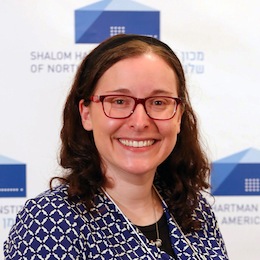
photo - Elana Stein Hain, scholar resident and director of faculty at the Shalom Hartman Institute
Elana Stein Hain, scholar resident and director of faculty at the Shalom Hartman Institute. (photo from Elana Stein Hain)

In the greater Jewish educational sphere, the Shalom Hartman Institute has produced a series of videos about related topics and examines how scripture has educated Jews on the subject over the years. Elana Stein Hain, scholar resident and director of faculty, has been leading the project.

“What we do is essentially develop curriculum around challenges facing the Jewish people,” Stein Hain told the Independent. “And I wouldn’t even say it’s about developing curriculum as much as developing conceptual frameworks for thinking about issues that arise. We’re an educational think tank. We ask ourselves what issues are now facing the Jewish people and consider how to develop educational material that deepens how we think about these issues. Then, we speak with change agents in the Jewish community about some ways of thinking.”

Stein Hain and her team began by looking for Torah teachings that address the topic of harassment directly. They came up with a three-part video series, which launched with a presentation that addressed the question of how, as a 21st-century teacher, you can educate people with our most sacred text and have the value proposition of our most sacred text being very important and continuing to give us the wisdom we seek, said Stein Hain. “And, also, we address the absence or relative absence of women’s voices and women as an audience.”

The next video talk was by Dr. Paul Nahme, a member of the institute’s Created Equal Team. He speaks on how definitions of manhood are dependent on cultural context.

“There’s this ‘boys will be boys’ kind of assumption and he says that, actually, there are places in Jewish tradition where that assumption had been challenged,” explained Stein Hain. “Young men were being trained to not be bravado macho, arrogant and assertive – to instead be trained to think about what it means to have doubts, to need someone else’s help. That was in contrast to what masculinity was understood to be.”

The last talk in the series was done by another member of the team, Dr. Arielle Levites, who discusses the portrayal of women in some Jewish traditional texts.

“It’s a deep folk story about women who try to move beyond their station or to move beyond the assumptions of them being portrayed as monsters,” said Stein Hain. “And she relates that to the … women who come forward with claims of sexual harassment or sexual violence who become seen as the offending party, getting questioned and vilified in certain ways.”

All of the videos can be accessed at hartman.org.il.

“The idea is really to get to the root of education,” said Stein Hain. “We are glad that people are going to do trainings on sexual harassment, on mandated reporting and on how to respond in the moment. We’d like to get to the root thought process of a culture that has come to this. And we want to learn how we can educate better, so we can have an adaptive change in the way people think, talk and act. Then, society and the Jewish community in particular can be built upon a different foundation.”

The educational realm within synagogues has also felt reverberations of the #MeToo movement, according to Rabbi Carey Brown of Temple Sholom.

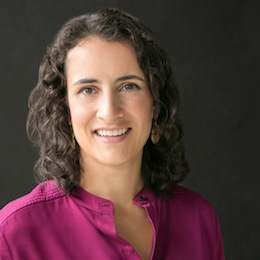
photo - Rabbi Carey Brown of Temple Sholom
Rabbi Carey Brown of Temple Sholom. (photo from Carey Brown)

“I have seen an incredible amount of conversation among rabbis about this issue,” said Brown. “Some have been from within female rabbinic circles of women … some confronting it … things that people had kept within themselves for years or decades … and, now, gaining the courage to talk about it – everything from struggles to trying to understand the situation insofar as its professional implications for female rabbis … major discussions are being had on the topic at our annual conferences.

“Within the congregation, I haven’t had any individuals come to talk to me about personal experience,” she said. “But I have had a sense that women are feeling more free to bring up topics having to do with abuse, with safety, within the congregation, [at the] board level or [from a] staff perspective.”

A couple of months ago, the synagogue’s Men’s Club had a program on the #MeToo movement and sexual harassment in the workplace, including panel discussion on the topic in which Brown participated.

“I was really glad they took the initiative to have this program,” said Brown. “This didn’t come from the rabbis; it came from their leadership wanting to have an opportunity to talk about it. The conversation was really good and those who attended were very engaged and didn’t want to leave.”

Brown spoke about the Jewish perspective, discussing its tradition of values and ideas around sexual harassment, as well as her own personal experience with harassment.

“We talked a lot about consent,” said the rabbi. “A few different pieces of Talmud were discussed. We looked at this one that was about what happens if a man – one who counts money for a woman from his hand to her hand in order to look upon her – even if he has accumulated knowledge of Torah and good deeds like Moses, he will not be absolved from punishment.

“We talked about how, if someone even has a good reputation in the community, is known for their knowledge, good deeds and business … if they are abusive or using their power in a way that puts someone else in a position in which they are abused and powerless … our tradition says that, no, that is not OK.”

Abuse can be as simple as the way one person looks at another – if there is a misuse of power or position to objectify someone, Jewish tradition says that is not acceptable, stressed Brown.

“We talked about how we need to stand up when someone is being objectified, abused or put into a difficult situation,” she said. “That is part of our Jewish imperative – not to look away. It is part of what the Torah teaches us: that we can’t be indifferent and we must act.”

Over the years, Brown has had inappropriate comments directed at her. She said, “I’ve received comments like, ‘You don’t look like a rabbi’ or ‘If my rabbi looked like you, I’d have gone to shul a lot more when I was younger,’ or comments on my clothing and hair, and such.

“I mentioned at the event with the Men’s Club that my experience, both in Vancouver at Temple Sholom and in Boston, has been that the longer that I am the rabbi of a community, the stronger the relationships. And, I feel some of those things begin to fade away … within the regular, active population of the synagogue.

“It’s often when I’m in a new environment with people who don’t know me – at a shivah minyan, a wedding or something like that – my antennae go up. I’m very aware that it’s very likely I’ll get comments that are really inappropriate or that I have to psyche myself up a little bit to deal with.

“If I’m at a shivah minyan, I’m there to comfort the bereaved. I’m generally not going to confront in that situation,” she said. “I will take it with a grain of salt and maybe grumble about it to a friend. But, sometimes I’ll say, ‘That’s not appropriate.’ Sometimes, I’ll hear things like, ‘I’ve never kissed a rabbi before.’ And, I’ll say, ‘Well, we don’t need to kiss.’ I’ll push back a little bit to establish some boundaries.”

Rebeca Kuropatwa is a Winnipeg freelance writer.

Format ImagePosted on June 29, 2018June 28, 2018Author Rebeca KuropatwaCategories LifeTags #MeToo, Carey Brown, Created Equal, education, Elana Stein Hain, harassment, KDHS, King David High School, Lu Winters, Shalom Hartman Institute, Temple Sholom
Rabbi chosen as a fellow

Rabbi chosen as a fellow

Rabbi Susan Shamash began a fellowship with Rabbis Without Borders this month. (photo from Susan Shamash)

“Rabbis Without Borders addresses borders within Judaism,” said Rabbi Susan Shamash, one of two Canadian rabbis who began a fellowship with Rabbis Without Borders (RWB) this month. “The fellowship aims to span denominations and to break down barriers between rabbis of different denominations, so that they can cross the borders and collaborate.”

While at a Shabbaton led by RWB when she was a rabbinical student, Shamash became interested in the Clal fellowship. Established in 1974 by Rabbi Irving Greenberg and Elie Wiesel, Clal’s “mission has been to help prepare the Jewish people for the unprecedented freedom and openness of North America,” notes the announcement of Shamash’s acceptance into the competitive program, which began in 2008.

Shamash told the Independent that RWB tries to develop rabbis who are able to think and work outside the box while working inside specific communities. Although based in the United States, Clal welcomes Canadian rabbis to its fellowship and, this year, Rabbi Denise Handlarski of Toronto’s Oraynu, a secular humanist congregation, was also accepted.

Shamash completed her rabbinical training in January 2017, obtaining semichah (ordination) from Aleph: Alliance for Jewish Renewal, after a decades-long career as an administrative law judge. Shamash received semichah with four others at that year’s Ohalah conference in Boulder, Colo., from a large number of rabbis, 10 of whom signed her certificate. Her training was overseen, as are all Aleph rabbinic trainings, by a committee of three. In her case, it was Rabbi Victor Gross, Rabbi Hanna Tiferet Siegel (one of the founders of Vancouver’s Or Shalom) and Rabbi Laura Duhan Kaplan (formerly spiritual leader of Or Shalom, now on the faculty of Vancouver School of Theology).

Shamash has been involved with Or Shalom since it started and counts the founding teachers, Siegel and her husband Daniel, among her mentors, as well as Duhan Kaplan, who is delighted to have her aboard. “As a longtime member of the RWB network, I’m delighted that Rabbi Susan Shamash will join us,” Duhan Kaplan told the Independent. “We need more Canadian voices like Rabbi Susan, willing to creatively address emerging issues in our religious and cultural life.”

“I am excited to join Rabbi Laura Duhan Kaplan and [Or Shalom] Rabbi Hannah Dresner in bringing the deep wisdom of this fellowship to Metropolitan Vancouver,” said Shamash.

“I went into law school because I needed a professional skill, and it was a wonderful and rewarding career,” she explained. “I met Rabbi Daniel Siegel while at school – he was a Hillel director at the time and just founding Or Shalom. I learned a lot under his and Hanna Tiferet’s mentoring.”

Although Shamash enjoyed her judicial career, she said she is deeply satisfied with her transition to a second career. “In some ways, I came home, even though I really loved the law,” she said. “I might have become a rabbi for my first career but, at that time, it was not at all encouraged [for a woman]. I was very interested in the study and the prayer life as a kid.”

Primary areas of interest for Shamash include interfaith ceremonies and outreach to underserved Jewish communities, both of which she thinks the fellowship will help equip her for. “The fellowship will inform the work that I do with interfaith families or marriages between observant Jews and unaffiliated Jews or non-Jews, as well as working with people who want some Yiddishkeit for ‘hatching, matching and dispatching,’ as they say, the cycles of life, but want that outside of synagogues and institutions,” she said. “I would also like to take Judaism [beyond] the Lower Mainland and bring Jewish experience to smaller communities in B.C.”

She said there is a lack of diverse offerings for Jews outside of major urban centres, and she would like to help fill that gap.

Shamash currently teaches Talmud at Or Shalom, where she delights in making the study available to people who might otherwise not have access to it. She is hoping, over the years to come, to collaborate with others in the Jewish community to increase the options for serious adult yeshivah-style learning for the non-Orthodox.

Matthew Gindin is a freelance journalist, writer and lecturer. He is Pacific correspondent for the CJN, writes regularly for the Forward, Tricycle and the Wisdom Daily, and has been published in Sojourners, Religion Dispatches and elsewhere. He can be found on Medium and Twitter.

Format ImagePosted on June 29, 2018June 28, 2018Author Matthew GindinCategories LocalTags ALEPH, Judaism, Or Shalom, Rabbis Without Borders, RWB, Susan Shamash
Around the world in 382 days

Around the world in 382 days

Naomi Steinberg has toured the world with Goosefeather and is now working on a book of her travels. (photo from Naomi Steinberg)

Naomi Steinberg’s Goosefeather started in 2011. “It began with interviewing my French maternal grandfather in Paris before he died,” she said. “I wanted to know how he had helped my Jewish grandmother survive the Second World War and why he was a collector of maps, weights and scales. Given his work with the metric system, I also thought it would be interesting for us to talk about measurements in general.”

Fascinated by her grandfather’s story, the kernel of Goosefeather was born. “I made him a promise that he would see the final result,” she said.

She immersed herself in research. “Measurements are extremely important to humans,” she said. “We measure everything, but we have to realize that no measurement is 100% accurate; we have to accept that…. As I went deeper into it, I wanted to know how we measure the truth. What is the truth? What is reality? Same as when measuring length and weight, measuring reality can’t be 100% accurate. We have to accept this area of the unknown. We have to let ourselves ‘not know.’ We have to let everyone just be.”

The show that emerged out of her research is a multifaceted tale involving maps of places and relationships, measurements of physical elements and of abstract concepts. “How should we measure the space between me and another person? Between me and the planet?” she asked herself. “It soon became clear not only that I had a complicated story to tell, I also had an entertaining show that wanted to be on the road…. Goosefeather was going adventuring and I would be going around the planet, by land and sea, carrying a performance with me. As I journeyed, I would be carrying my own prime meridian in the form of presence. I had hypothesized that if, with this, I charted the space-time between myself and others, I might be guided in a good way.”

As the show was still coming into form, Steinberg’s grandfather was dying in a hospice in France. In 2013, she visited him in the hospice one last time and showed him the first draft of Goosefeather. “I shared with him all my ideas, and he said I got it ‘correctly.’ For a man obsessed with measurements, that was a high praise.”

The first performance of Goosefeather occurred in 2014 in Vancouver. (For a short review, see jewishindependent.ca/storytellers-excel-at-fringe.) But Steinberg needed to take it on the road. “I knew the show should travel like a Canada goose, all around the world,” she said. “I love traveling. I have a nomad soul, and I value my experience as a traveler, but I care very much about the environment. I didn’t want to just take a plane. You don’t experience your travels fully when you fly. It should be closer to the ground, slower, so I could stop and perform.”

In November 2014, she left Vancouver for California, where she boarded a cargo ship heading to Australia, which started her journey around the world. “It was easy,” she said. “The cargo companies sell tickets. They often have a couple cabins vacant – an owner’s cabin and a pilot’s cabin. That’s where I stayed on the cargo ships.”

She also performed Goosefeather on the first ship, as a Christmas gift for the sailors. When the captain asked her for a repeat performance, she bartered: a show for a phone call to her father, who celebrated his birthday while she was on the water.

It took her 21 days to reach Australia. From there, she took another cargo ship to China. Her further travels – by boat, bus and train – included Japan, Russia, Belgium, France, Switzerland, the United States and, finally, back to Canada. The entire trip took 382 days.

In every country, she performed Goosefeather, facilitated workshops and participated in creative collaborations. In every country, she stayed with friends. “I came back with $100. I lived in a cash economy for over a year and I fully supported my journey with my shows and workshops,” she said. “In the entire time I was away from home, I only paid for a hotel for seven nights.”

Despite the crazy itinerary, she didn’t prepare all her stops beforehand. “Sometimes, I didn’t even know where I would spend the night when I arrived in a city or a country, but I always found friends,” she said. “I researched storytelling organizations on the internet. I put my scheduled countries on my Facebook page and asked my friends for help. They asked their friends, and the word spread around the world like a goose feather. Everywhere, people wanted to see my show. I got contacts in every city and country. Everywhere, people wanted to help.”

Even the language barrier in countries like Japan and Russia didn’t deter Steinberg. She can perform Goosefeather in either English or French, and she always found a translator when she needed one.

“In Japan, they asked me to perform for children, and I created a special show for them: a Kamishibai show.”

For Steinberg, a professional storyteller, a storytelling tradition like Kamishibai is extremely compelling. According to Wikipedia, “Kamishibai is a form of Japanese street theatre and storytelling popular during the Depression years and the postwar period … until the advent of television.” Storytellers would travel from town to town, performing on “street corners with sets of illustrated boards … narrat[ing] the story by changing each image.” Some consider Kamishibai to have influenced manga and anime.

“For my first Kamishibai show, the adventures of a little goose feather, a talented 8-year-old drew the illustrations,” said Steinberg. “It was a big success. Now, I perform it with the pictures created by a wonderful Japanese artist, Shiho Oshita Beday.”

Currently, Steinberg is busy writing a book, a travelogue of her journey around the world with Goosefeather. She aims to publish it next year. To learn more, visit goosefeather.ca.

Olga Livshin is a Vancouver freelance writer. She can be reached at [email protected].

****

Note: This article has been edited to reflect that Steinberg’s total journey took 382 and not 386 days.

Format ImagePosted on June 29, 2018May 28, 2020Author Olga LivshinCategories Performing ArtsTags family, Goosefeather, Naomi Steinberg, storytelling, travel
Negev Dinner helps Israeli children

Negev Dinner helps Israeli children

Left to right: Ilan Pilo, Michelle Pollock, Dr. Neil Pollock, Wendy Eidinger Spatzner and David Goldman. (photo by Robert Albanese)

Vancouver supporters of the Jewish National Fund (JNF) gathered in their finery at the Four Seasons Hotel Vancouver on June 3 to celebrate Israel’s 70th birthday and pay tribute to philanthropists Neil and Michelle Pollock.

Michelle Pollock is a former lawyer, the immediate past president of the board of the Jewish Community Centre of Greater Vancouver, and has co-chaired the Jewish Federation of Greater Vancouver annual campaign’s women’s division for six years, as well as supporting Jewish education, among many other causes. Dr. Neil Pollock is chief surgeon and medical director of Pollock Clinics. He has undertaken teaching missions to Rwanda, Congo and Haiti, as well as being involved in philanthropy at home and abroad.

photo - Bernice Carmeli, dinner co-chair, with Ilan Pilo, David Goldman and Ilene-Jo Bellas
Bernice Carmeli, dinner co-chair, with Ilan Pilo, David Goldman and Ilene-Jo Bellas. (photo by Robert Albanese)

JNF Pacific Region president David Goldman welcomed the crowd – who had to pass a few dozen protesters on their way into the hotel – and introduced the evening’s emcee, Michael Nemirow, a friend of the Pollocks, who is also involved in various community organizations and activities. “I’ve done the math, and we have around 11 hours of speeches and entertainment for you this evening, but we’ll try to compress it into three,” Nemirow said, eliciting laughter from the crowd.

After Maurice Moses led the audience in O Canada and Hatikvah, B.C. Lt.-Gov. Janet Austin took the stage. She praised JNF for its work in the “restoration and preservation of the Jewish homeland,” which covers everything from ecological to social to security initiatives. Austin also commented about the Pollocks, highlighting Neil Pollock’s work in Rwanda to prevent the spread of HIV.

Galit Baram, consul general of Israel for Toronto and Western Canada, focused her remarks on the 70th anniversary of Israel, “the only democracy in our region, a bastion of democracy.” She described its strengths in the areas of human rights, medicine, multiculturalism and technological innovation. She said Israel is led by people “both on the right and on the left who love their country with all their hearts” in the face of multiple existential threats. “We rely on our friends who share common values, and Canada, our ally, is among them,” she said.

photo - Honourary chairs Jodi and Alex Cristall
Honourary chairs Jodi and Alex Cristall. (photo by Robert Albanese)

“The success of Israel did not happen in a vacuum,” said Baram, citing JNF as a key organization in supporting the state, one in whose name every Israeli has a tree planted. She also spoke of JNF’s contributions in a multitude of activities, including supporting soldiers with post-traumatic stress disorder and her “personal favourite,” the building of a protected playground in Sderot in an area that has suffered shelling from Hamas and other militant groups. Baram thanked Canadians for the warm welcome and open arms with which Israeli diplomats are welcomed in the country.

After Hamotzi, chanted by the Kollel’s Rabbi Avraham Feigelstock, Ilene-Jo Bellas, former president of the JNF Pacific Region (2012-2015), was presented with the JNF Bloomfield Award by local shaliach Ilan Pilo. He described Bellas as an indefatigable servant for Israel who “bled blue and white,” a portrayal she affirmed as fact after taking the podium.

The video on the work of the JNF was introduced by JNF Canada president Wendy Eidinger Spatzner, who explained that the First Zionist Congress established a fund to purchase land in Israel and that this fund became JNF. She talked about JNF’s extensive work to “build the infrastructure of Israel,” noting that it affects the daily lives of “pretty much every Israeli citizen.”

photo - Honourary chairs Jodi and Alex Cristall
Honourary chairs Jodi and Alex Cristall. (photo by Robert Albanese)

Rabbi Dan Moskovitz then led everyone in Birkat Hamazon, before Vancouver TheatreSports performed a series of improv skits centred on the Pollocks’ life as a married couple.

The keynote speaker of the dinner was Doron Almog, a former major general in the Israel Defence Forces, who received the Israel Prize for lifetime of achievement. He discussed his role as founder of ALEH, the charity for children with developmental disabilities that the Pollocks chose to support with monies raised from the evening.

Almog spoke on the theme of commitment, as experienced throughout his life and in the work he has done for children. He shared the story of the death of his brother, a tank operator who died after being injured, left behind by his fellow IDF soldiers. Almog subsequently swore to never leave behind an injured soldier.

Almog’s son Eran, who was named after his fallen uncle, was born with a combination of autism and developmental problems, and a psychiatrist told the family that he would probably never speak, remaining at the cognitive age of an infant. “This son became the greatest teacher of my life, he taught me more than anyone about life, about commitment,” said Almog.

After his son died, Almog went to see how children like Eran are treated “in the only Jewish state in the world.” What he saw horrified him: “The first thing you saw is the stink; distorted, terrified faces; shameful things. What the hell are these places, why are they being punished more?”

photo - Keynote speaker Maj. Gen. (Res.) Doron Almog, founder of ALEH, right, with local businessman and philanthropist Gary Segal
Keynote speaker Maj. Gen. (Res.) Doron Almog, founder of ALEH, right, with local businessman and philanthropist Gary Segal. (photo by Robert Albanese)

Almog discovered that such children were objects of shame in Israeli society. Golda Meir, prime minister of Israel from 1969 to 1974, had a granddaughter with Down syndrome who, as an adult, gave interviews to the press, said Almog. In these interviews, he continued, “she said, ‘Golda never visited me, Golda never loved me, Golda told my mom, “Never mention the prime minister of Israel having a retarded granddaughter.”’ Yigal Alon [deputy prime minister of Israel, 1968-1979] had a beautiful child who, at age 5, was taken away from the kibbutz she was born in and sent away to Scotland and he never spoke about her. And inside me I heard my son screaming, ‘My dear father, I will never complain to the media, you can send me away to Scotland and never speak of me, but, if you do that, you do not deserve even the title of “father” or even the title of human. I am the ultimate test of commitment,’ he said to me, the echo box of your bleeding brother.”

After Almog left the military, he established the village of ALEH, “a paradise where the children can have a full life. We broke the walls of stigma and shame and stereotypes.”

ALEH Jerusalem, a multi-service home for children with disabilities, now receives help from more than 450 volunteers from all over the world. Some of them, said Almog, are children of Nazis, who say they are coming as atonement for Hitler’s decision to kill people with disabilities. “The social chain is always measured by its weakest link,” said Almog, receiving a standing ovation.

After a video explaining more about ALEH, there was a video tribute to the Pollocks introduced by their children, Josh, Elliot and Shoshana. The Pollocks said a few words, after which Goldman and Pilo wound up the celebration.

Matthew Gindin is a freelance journalist, writer and lecturer. He is Pacific correspondent for the CJN, writes regularly for the Forward, Tricycle and the Wisdom Daily, and has been published in Sojourners, Religion Dispatches and elsewhere. He can be found on Medium and Twitter.

Format ImagePosted on June 29, 2018June 28, 2018Author Matthew GindinCategories LocalTags ALEH, children, health, inclusion, Israel, Jewish National Fund, JNF, Negev Dinner, Pollock
Celebration and call to action

Celebration and call to action

More than 130 people joined the Chai Tea celebrations June 10. (photo by Alan Katowitz)

“Life is not measured by the number of breaths you take, but by the moments that take our breath away.”
(Rabbi Abraham Twerski)

The Chai Tea celebration on June 10 brought together 135 people to support the work of the Jewish Seniors Alliance and to honour Serge Haber on his 90th birthday.

Educator and writer Matthew Gindin emceed the event, which took place at the Peretz Centre for Secular Jewish Culture. Shelley Rivkin of the Jewish Federation of Greater Vancouver emphasized Haber’s effectiveness in bringing the issues of seniors to the fore in the Jewish and general communities, while Grace Hann, coordinator of JSA’s peer support services (with Charles Liebovitch), described Haber as a visionary who created the program because of his love and commitment to seniors. She told the story of a woman, alone, sick with cancer, who had lost both her eyesight and hearing. Peer support services provided her with three levels of support: a peer counselor, a driver and a friendly telephone caller.

JSA coordinator Liz Azeroual and her assistant, Rita Propp, joined Hann and Liebovitch for a tribute to Haber to the tune of “This Land is Your Land.” Music by Dave and Julie Ivaz filled the room, and Julie Ivaz read a summary of Haber’s biography, which was accompanied by a slide show of some of his life experiences. The musicians then serenaded Haber with a medley of his favourite songs.

Ken Levitt, president of JSA, emphasized the importance of “reinventing oneself,” both in terms of venue and occupation. Haber is a prime example: from being a pharmacy student in Romania, to surviving the Holocaust, to reaching safety in Cuba and then, with the help of an uncle, settling in Montreal in 1950 and coming to Vancouver in 1978. Here, Haber ran Kaplan’s Jewish delicatessen from 1981 until 2000. During that time, he began working with seniors – JSA started as a subcommittee of Federation – and he continues to be productive and active.

At the Chai event, Haber recited the prayer, “Blessed art thou, O Lord our God, King of the Universe, for giving us life, sustaining us and enabling us to reach this season.” His wife Elinor passed away seven years ago; they had been married 57 years and have three children, Wanda, Geoffrey and Stephen. Haber has five grandchildren and one great-grandchild. He acknowledged with affection his friend and partner Sheila Gordon, who supports all his endeavours.

Haber lamented that, whereas JSA is in the business of prevention, the government is mainly concerned with responding to the urgent needs of seniors. A public program of prevention would prolong healthier lives for seniors, he said, and eliminate the expensive costs associated with sickness and mental decay.

The 70 volunteers who work with 175 seniors at JSA are not going to be enough, said Haber. “Sometime, somewhere in your life, rich or poor, you’ll need the services of JSA,” he said.

Throughout the afternoon, tickets were drawn for donated door prizes. The 50-50 draw was won by Carole Kline, who donated the money back to JSA. The grand prize of a night at the Grand Villa Casino Hotel was won by Julia Wallstrom.

Helene Rosen and Marie Doduck were the co-conveners of the Chai Tea. Their efforts and work were acknowledged along with that of Gyda Chud and Propp. Delightful portrait caricature drawings by artist Katie Green were available all afternoon. Gala Catering served up the sandwiches and cake. It was a memorable afternoon.

Tamara Frankel is a member of the board of Jewish Seniors Alliance. Shanie Levin, MSW, worked for many years in the field of child welfare. During that time, she was active in the union. As well, she participated in amateur dramatics. She has served on the board of the Jewish Federation of Greater Vancouver and is presently on the executive of JSA and a member of the editorial committee.

Format ImagePosted on June 29, 2018June 28, 2018Author Tamara Frankel and Shanie LevinCategories LocalTags JSA, seniors, Serge Haber

Posts pagination

Page 1 Page 2 … Page 6 Next page
Proudly powered by WordPress