
Skip to content
  • Home
  • Subscribe / donate
  • Events calendar
  • News
    • Local
    • National
    • Israel
    • World
    • עניין בחדשות
      A roundup of news in Canada and further afield, in Hebrew.
  • Opinion
    • From the JI
    • Op-Ed
  • Arts & Culture
    • Performing Arts
    • Music
    • Books
    • Visual Arts
    • TV & Film
  • Life
    • Celebrating the Holidays
    • Travel
    • The Daily Snooze
      Cartoons by Jacob Samuel
    • Mystery Photo
      Help the JI and JMABC fill in the gaps in our archives.
  • Community Links
    • Organizations, Etc.
    • Other News Sources & Blogs
    • Business Directory
  • FAQ
  • JI Chai Celebration
  • JI@88! video

Recent Posts

  • המלחמות של נתניהו וטראמפ
  • Zionism wins big in Vegas
  • Different but connected
  • Survival not passive
  • Musical celebration of Israel
  • Shoppe celebrates 25 years
  • Human “book” event
  • Reclaiming Jewish stories
  • Bema presents Perseverance
  • CSS honours Bellas z”l
  • Sheba Promise here May 7
  • Reflections from Be’eri
  • New law a desecration
  • Resilient joy in tough times
  • Rescue dog brings joy
  • Art chosen for new museum
  • Reminder of hope, resilience
  • The national food of Israel?
  • Story of Israel’s north
  • Sheltering in train stations
  • Teach critical thinking
  • Learning to bridge divides
  • Supporting Iranian community
  • Art dismantles systems
  • Beth Tikvah celebrates 50th
  • What is Jewish music?
  • Celebrate joy of music
  • Women share experiences 
  • Raising funds for Survivors
  • Call for digital literacy
  • The hidden hand of hate
  • Tarot as spiritual ritual
  • Students create fancy meal
  • Encouraging young voices
  • Rose’s Angels delivers
  • Living life to its fullest

Archives

Follow @JewishIndie
image - The CJN - Visit Us Banner - 300x600 - 101625

Tag: Barbara Pelman

Pelman participates in Word

Pelman participates in Word

Barbara Pelman (photo from Word Vancouver)

Among the writers being featured at this year’s Word Vancouver, which runs Sept. 26-30, is Victoria-based poet Barbara Pelman.

Pelman’s latest collection, narrow bridge (Ronsdale Press, 2017), is her third book of poetry. Its title comes from Rabbi Nachman of Breslov’s famous advice (at least in Jewish circles): “All the world is a narrow bridge – the important thing is not to be afraid at all.” Other than in one poem, however, called “Öresund,” where she tells herself, “I will not fear,” Pelman doesn’t come across in her writing as fearful.

“I’m delighted that I don’t come across as fearful,” Pelman told the Independent, “as I am full of fear, and certainly before each visit to my family in Sweden, I imagined everything that could go wrong and how incompetent I am. And was amazed that I survived intact.

“Generally, I tend to be a worrier (‘a misuse of the imagination’) but fight this negativity all the time. The tension, which I hope comes across, is between a general optimism and belief that, ‘in the long run’ … things sort themselves out. So, I tend to take on things that might terrify me, like art classes or solo trips to Berlin or train rides through Europe, and sign up, so there’s no going back. Not, however, bungee jumping or skydiving.

“When I have to deal with adversity – a separation and divorce, primarily – I talk and I write,” she said. “Both are clarifying agents. The poems in this book put forward a lot of my difficulty in being in the present, without wishing to be elsewhere. As in the first poem, ‘Gentle Reader’ – the desire to desire only what you have, and not what is somewhere else.”

On the family front, at least, Pelman’s journeys have become shorter since the book was published. Her daughter, who had been living in Sweden for three years, moved to Vancouver this summer, meaning that Pelman’s grandson is also now that much closer. He features in more than one poem – “Still Life with a Small Boy” is especially poignant. In it, he and his bubby, Pelman, are out having a hot chocolate and croissant. “Heads together, bending into each other. / They are a world. Outside, the world breaks. / She cannot read the news while she is with him, / tries to be calm, listen while he tells her / his new red bike helmet makes him safe.”

The collection is divided into three sections and includes some poems that Pelman has published before. Her previous books of poetry are One Stone (Ekstasis Editions, 2005) and Borrowed Rooms (Ronsdale Press, 2008), and she also has produced a chapbook, Aubade Amalfi: The Marcello Poems (Rubicon Press, 2016).

“This book had three iterations, each time being sent back by the publisher with suggestions – too much of Marcello and the adorable grandson, for example,” she said of the decision-making process for what would make it into narrow bridge. “So, I rejigged the poems, took out a lot of them, put in more recent ones, and relied on Russell [Thorburn] to put them in order. He sees an organic pattern of the poems, sometimes based on image or theme. I trust his choices, only changed a few.”

The poems in narrow bridge include many with Jewish themes.

“Most of my childhood centred around the synagogue, not in a hugely observant fashion, but, as my father was choir leader at the Beth Israel, I often went to services with him,” Pelman said about the place of Judaism and Jewish culture in guiding her work or approach to life. “Now, as a member of Congregation Emanu-El [in Victoria] and ‘den mother’ for the Calling All Artists project, I am interested and involved in learning Hebrew, chanting Haftorah, and generally intrigued by the culture and traditions of an ancient people.

“Moreover, and this is what I think is really wonderful, poetry and study of Torah have many similarities. Hebrew is a language that I think is embedded in metaphor, and studying Torah is the kind of layering analysis that I am used to in studying poetry. Layer upon layer of meaning and ambiguity. Rabbi Harry Brechner considers art as ‘mishnah’: another way to interpret, to find meaning that is relevant to us personally and globally.”

In narrow bridge, Pelman explores kabbalistic ideas, her own family history and relationships, as well as biblical ones (the poem “Isaac” is powerfully evocative). In at least two poems, she explores the concept of “thisness” – notably in the poem of that name, where, she writes, “Happiness, fed from detail: the thisness of things, / resting in the eye of the beetle, the creak of the board / she leans against, the cold air pricking her ears.” And several poems have to do with the spaces or pauses between, for example, a heartbeat or a pendulum’s swing; those moments that happen all the time but that we rarely acknowledge or even notice.

Aging features prominently, as well. And, while some poems are wistful – such as “Suitcase in the Closet,” where recollections of past travel suffice – others are almost calls to arms. “A woman over seventy should open her travel account, / run her fingers over the globe, and choose / She should trade her sensible shoes for sandals, / her Gucci bag for backpack, her datebook for weather reports,” begins the poem “Go,” a favourite in this collection, though this reader is still a couple of decades shy of 70.

As for how her style or subject matter has changed since her first collection, Pelman said, “I have continued to work with various poets in workshops and retreats, and continue to learn a great deal from poet friends and reading. I think my poems have become shorter, a bit more compressed. I am aware of the musicality of the poem – the cadence, the pacing, the rhythm. But the struggles are still there: how to get started, how to edit, how to know when a poem is done. I have a huge file on my computer, called ‘Working On.’

“And my subject matter has changed as my life has changed,” she said. “The first book dealt with the divorce and finding a new identity; the second book included the death of my father; this book is about travel, and daughters, and grandsons, and the new life of retirement. About balance. But there are still hummingbirds in the hawthorn tree. Jasmine and tulips. Old lovers and mothers.”

Pelman is at Word Vancouver on Sept. 30, 1:20 p.m., in the Suspension Bridge tent at Library Square Conference Centre, one of three poets participating in “Another Taste of Poetry.” She also joins two other poets in Ronsdale’s Fall Poetry Showcase at Dunbar Public Library on Nov. 7, 6:30 p.m.

For more about Word Vancouver – where Jewish community members Mark Winston and Claire Sicherman will also share their work, at 1:20 p.m. and 2:30 p.m., respectively on Sept. 30 in the Alma VanDusen Room at Library Square – visit wordvancouver.ca. The interim manager of the festival this year is community member Bonnie Nish.
Format ImagePosted on September 21, 2018September 20, 2018Author Cynthia RamsayCategories BooksTags Barbara Pelman, books, Judaism, poetry, Victoria, Word Vancouver
Encounters with the divine

Encounters with the divine

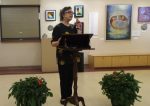
Barbara Pelman speaks at the opening of the exhibit Encounters, which is at Congregation Emanu-El in Victoria this summer. (photo by Frances Aknai)

On June 3, the exhibit Encounters opened at Congregation Emanu-El in Victoria. It is the culmination of the most recent Calling All Artists exchange, a project that has been going on for more than a decade.

“Bible has to be interpreted to be relevant,” said Barbara Pelman, coordinator of Calling All Artists since its inception. “All Renaissance art is Bible interpretation. That’s what we do with this project.”

In 2004, Pelman was the head of the adult education committee at the synagogue.

“Rabbi Harry [Brechner] came up with the idea to gather a bunch of artists and writers for a few study sessions to teach them a particular theme and its rabbinic interpretation,” she recalled. “I thought it was a wonderful idea. The sessions were conducted once a month for five months. Afterwards, the artists would offer their own interpretations of the theme, and the synagogue would have an exhibit of their works.”

While the congregation also produced colourful chapbooks – mini catalogues of the exhibitions – in previous years, they did not do so this year.

Over the course of the project, the artists have studied a variety of subjects. The first exchange was based on the topic of Paradise, and the exhibit was held in 2005. In subsequent years, themes have included dreams and prophecies; creation; the Book of Ruth; death and afterlife; and reinventing rituals.

“We missed a few years since the beginning,” said Pelman. “Once, we thought that maybe we are finished with the project and won’t do it anymore, but everyone involved said, ‘No! No! We should continue.’ Another year, holidays interfered.”

This year’s theme examines divine-human interactions.

“What happens in these encounters? What does one look like and how is it reported and remembered? What are some examples in biblical and rabbinical tales? How do we understand divinity and how does that understanding affect our worldview? These are some of the questions the artists of different genres have been exploring,” Pelman explained.

She said that not all participating artists are members of the congregation, or even Jewish. “The project is open to the community,” she said. “This year, 30 people signed up for the project; 17 artists remained to the end to exhibit their works. Five of them are not Jewish, but all of them are interested in learning.”

Studying with the rabbi is a mandatory part of Calling All Artists, Pelman said. “This entire project is about learning from those who know more than we do. The point is not to exhibit but to learn. That’s why the art is not vetted.”

photo - Encounters features a range of artistic genres, including pottery
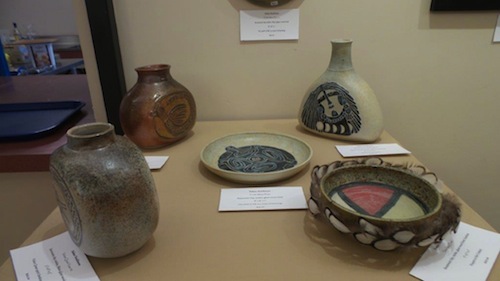
Encounters features a range of artistic genres, including pottery. (photo by Frances Aknai)

Participating artists represent a wide variety of media and genres, as well as skill levels. Some participants are professionals; others do art as a hobby. The exhibits feature photographs and paintings, fibre art and pottery, sculpture and poetry. Every piece is accompanied by an explanation of the work by the artist.

Pelman is a poet, so her involvement in every year’s project has been a poem. For her, divinity is not an all-knowing old guy somewhere above. “It’s the biggest and best part of you, of us all,” she said. “How do we find it? How does it inform our muse?” This is what she contemplates in her poem for this year’s explorative journey.

Pelman worked as an English teacher for many years. She taught high school, college and university classes, and she has been writing poetry for a long time. “I have three poetry books published,” she said. “The last two by Ronsdale Press, a Vancouver publisher.”

Another frequent participant in the project, artist and writer Isa Milman, said, “I participated in the first Calling All Artists, The Paradise Project, in 2005. It was a spectacular experience. The combination of Rabbi Harry Brechner’s teaching, the group of artists who gathered and learned from each other, wrestling with text that most of us were unfamiliar with, was truly energizing. The process involved five sessions spread over a few months, to learn from Harry’s teachings and engage with one another, as we entered a spiritual quest for meaning. Then we went off to put our learning into practice and create our responses.”

Milman has taken part in a number of Calling All Artists projects. “I’ve written poems as well as created paintings for these projects,” she said. “Learning with Rabbi Harry is an inspiration. He’s a gifted teacher and a wonderful spiritual guide. My Jewish education was extremely Orthodox and doctrinaire and I rebelled against it. Learning Torah with Rabbi Harry is so different. It’s an invitation to engage and converse, which I so welcome.”

Olga Livshin is a Vancouver freelance writer. She can be reached at [email protected].

Format ImagePosted on June 29, 2018June 28, 2018Author Olga LivshinCategories Visual ArtsTags art, Barbara Pelman, Emanu-El, Isa Milman, Judaism, spirituality, Victoria
Proudly powered by WordPress