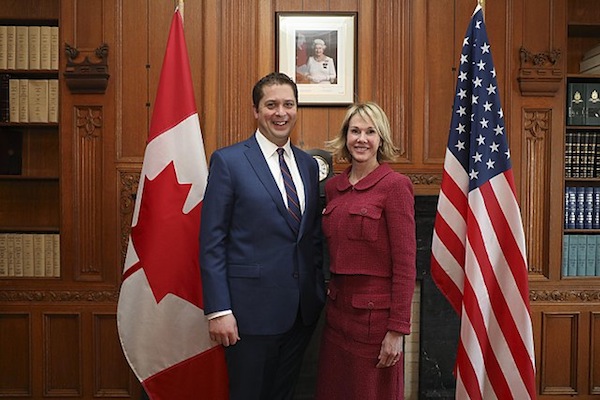
בתמונה: יו”ר מפלגת השמרנים, אנדרו שייר, ביחד עם שגרירת ארה”ב לקנדה לשעבר, קלי נייט קראפט, באוטווה: ינואר 9, 2018. (Andre Forget)
השגרירה של ארצות הברית בקנדה, קלי קראפט, מונתה לפני מספר ימים לשגרירה של המדינה באומות המאוחדות. כך החליט נשיא ארה”ב, דונלד טראמפ. קראפט תחליף את השגרירה היוצאת של ארה”ב באו”ם, ניקי היילי, שהחליטה לפרוש בפתאומיות (בסוף דצמבר) לאחר כשנתיים בתפקיד.
טראמפ אמר על המינוי של קראפט לשגרירה החדשה באו”ם: “אני שמח להודיע כי קלי קראפט, שגרירתנו הנוכחית בקנדה, תמונה לשגרירת ארה”ב באו”ם. קלי עשתה עבודה יוצאת מן הכלל בייצוג ארצנו בקנדה ואין לי ספק כי היא תמשיך לייצג את האומה שלנו ברמה הגבוהה ביותר באו”ם”. שר החוץ האמריקני, מייק פומפאו והיועץ לביטחון לאומי ג’ון בולטון, תמכו במינוי החדש של קראפט לאו”ם. מנהיג הרוב של המפלגה הרפובליקנית בסנאט, מיטש מקונל, בירך אף הוא על המינוי של קראפט ואמר: “מדובר במינוי ראוי ביותר למשרה היוקרתית. יש לקרפט ניסיון עשיר בשירות המדינה ואני בטוח היא תמשיך להצטיין גם בתור השגרירה האמריקנית באו”ם”.
להערכת מקורבים לקראפט היא הייתה מעוניינת דווקא להמשיך ולעבוד באוטווה ולא לעבור לתפקיד השגרירה של האו”ם בניו יורק. המקורבים מציינים כי עתה על קראפט לעבוד ביחד עם היועצים הבכירים של טראמפ בולטון וג’ארד קושניר (המחותן של הנשיא) וזה לא דבר שהיא שמחה לעשות. אך נרמז לה שאם טראמפ מבקש שהיא תיקח על עצמה את התפקיד החדש באו”ם עליה לענות לבקשתו.
קרפאט (בת החמישים ושבע) נעימת ההליכות זכתה להוקרה מיוחדת בקנדה לאור התפקיד אותה מילאה בהצלחה גדולה, במשך שישה עשר חודש. ראש הממשלה, ג’סטין טרודו ושרת החוץ, כריסטיה פרילנד, בוודאי מצטערים על עזיבתה של קראפט שנחשבה לידידה קרובה, בעיקר כשמדובר בעידן טראמפ הכל כך עויין. קראפט עזרה בכל כוחה לקנדה במהלך המו”מ הקשה להשגת הסכם הסחר החדש של מדינות צפון אמריקה. לקראפט יש גם קשרים מצויינים בממשל האמריקני והיא עזרה לא פעם לפתור מיידית בעיות שונות בין שתי המדינות השכנות. יש לזכור שקרארפט היא ילידת קנטקי (כמו מקונל) ולמדינה זו קשרי מסחר ענפים עם קנדה. לכן השגרירה הזכירה לא פעם עד כמה חשוב לה באופן אישי כי יחתם הסכם סחר חדש בין ארה”ב לקנדה.
קראפט הגרושה פעמיים נשואה למיליארדר ג’ו קראפט, המחזיק בחברת לכריית פחם אליינס ריסורס פרטנרס. בני הזוג ידועים בתמיכתם רבת השנים במפלגה הרפובליקנית והם אף תורמים לה כספים רבים. במקביל הם תורמים כספים לפעילות צדקה. לפני כניסתה לתחום הפוליטי קראפט הייתה אשת עסקים והחזיקה בחברת שיווק וייעוץ עסקי למנהיגים ועסקים.
השגרירה בין היתר חברה עם אשתו של מקונל וכאמור יש לה קשרים ענפים עם רבים מבכירי המפלגה הרפובליקנית והממשל של טראמפ. יצויין כי בתקופת כהונתו של הנשיא, ג’ורג’ בוש הבן, נמנתה קראפט על חברי משלחת ארה”ב לאו”ם.
כשנשאלה קראפט מה דעתה על הנשיא טראמפ היא אמרה: “מיומנויות התקשורת שלו צריכות קצת להשתפר”. בזמן העבודה על הסכם הסחר החדש בין ארה”ב, קנדה ומקסיקו אמרה השגרירה: “אני לא חושבת שהוא טוב בלהביע איך אנו הולכים להשיג את התוצאות המבוקשות. זה יועיל לכולנו אם יניח לנו לעשות את עבודתנו”.
בנוגע להתחממות כדור הארץ והשינוים באקלים – נושא החשוב למוסדות האו”ם ורוב מוחלט של מדינות העולם, למעט טראמפ, אמרה קרפאט: “אני מאמינה שיש לשני הצדדים חיזוקים מדעיים מדויקים. שני הצדדים מסתמכים על מחקרים ואני מעריכה ומכבדת אותם”.
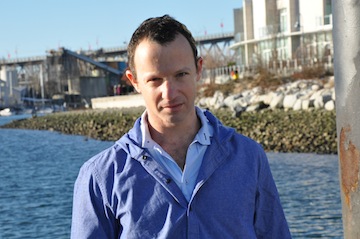
Turning Point Ensemble performs The Old Man and the Sea, directed by Idan Cohen, March 9 and 10. (photo by Tim Matheson)
“There’s something that I really love about these kinds of projects and the agenda that Turning Point holds – creating an operatic experience that is contemporary and designed to communicate music in a truly creative way. I hope this will attract not just the core of new music and opera lovers, but also those of us who are passionate for the arts and want to experience something different. This is what opera is truly about,” said Idan Cohen about Turning Point Ensemble’s Words & Music, which is at the Annex March 9-10.
The collaborative endeavour features the theatrical mini-opera The Old Man and the Sea by Rita Ueda, and Bee Studies, created by poet Renée Sarojini Saklikar and composer and musician Owen Underhill. Choreographer and opera director Cohen is directing The Old Man and the Sea.
“This past summer, I was invited by Rita Ueda and Mark Armanini, who run the AU Ensemble, to stage their concert at the Podium Mozaiek in Amsterdam,” Cohen told the Independent about how he met Ueda. “I had a wonderful time working with the ensemble and found the work they do highly inspiring. Rita’s work is very immersive and, in her scores, the musicians play a significant role as characters, fully engaged and active on stage. We found a deep foundation of understanding, and so Rita introduced me to Turning Point. It’s an honour to be working on such a beautiful piece alongside such an exquisite group of artists and musicians.”
The Old Man and the Sea, composed by Ueda with a libretto by Rod Robertson, is based on the short novel by Ernest Hemingway. The story centres around Santiago, an aging fisherman, who battles with a marlin. In the concert, baritone Willy Miles-Grenzberg sings the part of the Old Man (Santiago) and Turning Point co-founder and trombone soloist Jeremy Berkman musically plays the marlin.
“Rita and the librettist Rod Robertson have created a highly poetic rendition of Hemingway’s novel,” explained Cohen. “It’s quite condensed and, at the same time, leaves a lot of room to reflect on its different topics and themes. It creates a rendition of the story that is almost abstract – I love this quality in opera, when the poetic aspects of a story are drawn out through the layered richness of the written word, music and live performance. I connected to it on a very deep level.”
Choreographer and opera director Idan Cohen focuses “on body language and sensitivities that are dance-related” in The Old Man and the Sea. (photo by Or Druker)
The work is so expressive, said Cohen, “and focuses on the journey of Santiago … and his connection to the sea. There are beautiful moments that ‘paint’ that through the language of music. Unlike my other work, there won’t be any dance in this production, but I do focus on body language and sensitivities that are dance-related. Santiago is a humble man, full of wisdom, close to the end of his days, and Willy Miles Grenzberg, portraying him, embodies the part beautifully.”
Cohen hopes that this staged concert will appeal to a wide audience – “whether you’re a new music lover, a literature, theatre or poetry enthusiast, there’s going to be something there for each and every one of us,” he said.
This type of production can be somewhat complex to direct.
“My role is often to bring different elements together in order to create the operatic experience,” said Cohen. “By nature, music is abstract and, since the musicians are so valuable in this opera and play a significant role, I wanted to come up with creative ways to support this special vision. Drawing that vision from the mind of the composer and librettist to the experience of the viewers can be quite a challenge at times, but the musicians of Turning Point are truly exceptional, best in their field, and they do wonders.”
In addition to the power of the music, The Old Man and the Sea has many powerful – and universal – themes. Cohen described it as “a story about human determination, strength and faith but, most of all, it is about fragility and humbleness. It reflects on our connection to nature, and that is very valuable in our times, when there is so much denial and violence in the way the human race treats its surroundings. Robertson relates to this in a rich way and creates a very relevant testimony. The opera reflects on these important topics through the drama of the music, to expose an extreme human condition. It is powerful in a way that I find not just poetic, but also very emotional.”
Following the performance of The Old Man and the Sea is the première of Bee Studies, which includes texts from Sarojini Saklikar’s Listening to the Bees, a book of science and poetry, and features soprano Dorothea Hayley.
According to the press material for Words & Music, a “special bonus of the evening is a performance of some witty and rarely heard songs from the 1930s, Duet for Duck and Canary and Frogs by the great unheralded Mexican composer Silvestre Revueltas, plus his most-heralded work, Ocho por Radio.”
Tickets for Words & Music, March 9-10, 7:30 p.m., at the Annex are $33 ($20 for seniors and students) and can be purchased at turningpointensemble.ca.
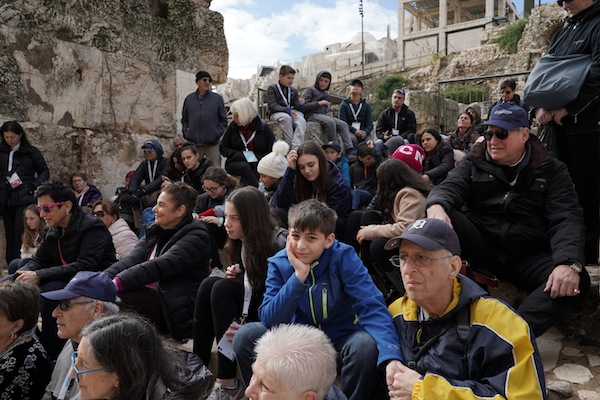
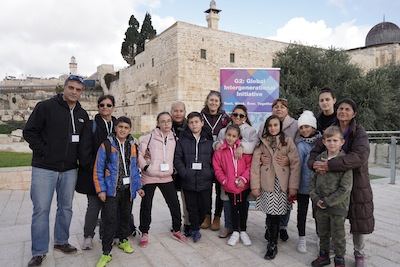
Grandparents and grandchildren discover their roots in Jerusalem with the G2: Global Intergenerational Initiative. (photo by David Salem / Zoog Productions)
The G2: Global Intergenerational Initiative is a new yearlong program being offered by the Jewish Agency. It helps bring grandparents and grandchildren closer with activities and conversations. It is spearheaded by Jay Weinstein, a rabbi from New Jersey who now lives in Israel.
“I work in the partnership unit, trying to build relationships between Jews around the world and Israelis,” Weinstein told the Independent. “I bring my connections from North America and also am exposed to Israeli communities here … trying to build bridges with Israel and overseas.”
The project stems from findings gleaned from meetings that the Jewish Agency held in a few prominent Jewish communities, which pointed to a lack of programming provided to older adults and a lack of an Israel connection among the young.
“We went to our partners on the ground, saying, ‘Let’s come up with something together’ … versus coming up with the idea ourselves and then trying to sell it or take it somewhere,” said Weinstein. “We wanted to do it in collaboration.
“Much of what we do in the Jewish community is for the younger generation,” he continued, “but, here, you have … people who spent their lives building up the federations, schools and synagogues. They’re usually the ones volunteering and donating, [yet] we’re failing to have something to really offer to them.”
Certainly, grandparents can be a positive influence in creating a Jewish identity in their grandchildren.
“When they’ve done studies asking young adults why they are involved in Jewish life or Jewish programming, what came back involved Jewish grandparents,” said Weinstein. “That’s even truer in interfaith marriage, [where] the role of the Jewish grandparent passing down values to their grandchildren is of even greater importance.”
The G2 initiative brings grandparents and grandchildren together over the course of a year through activities and creative projects.
“It gives grandparents the chance to think about what is important to them, about what they want their grandchildren to know about, how their family narrative makes them unique, and special things they care about,” said Weinstein.
Participating grandkids should be in Grades 5 and 6, preteens old enough to have deeper conversations, while still under the guidance of their parents “and they aren’t yet too cool to be with Grandma and Grandpa to do the activities,” said Weinstein.
“It’s not a text-based study. It’s more experiential,” he said. “And, at the monthly meetings, we give the grandparents and grandchildren things to do on their own time without a facilitator, like a little mesima (activity) or venture to do in the community.”
Each month has a different focus, such as discussing the most important Jewish gem of a place. This particular theme gives grandparents the opportunity to take their grandchildren to one of their favourite places and explain why it is important to them. Then, the grandchildren guide the grandparents to the most important Jewish gem to them, also sharing why it is important. If the grandparents and grandchildren so choose, they can record the visits on a two-minute podcast to share with others.
“Based on the partnership platform, we have communities overseas doing it with communities in Israel,” said Weinstein. “And, over the course of the year, they’ll connect with each other digitally. Sometimes, they’ll be synchronized and do a Zoom call, sometimes unsynchronized. One of the bigger goals of the unit is to connect Jews from around the world to Israel and, on the other hand, to teach and educate Israelis about what Jewish life is like outside of Israel.”
(photo by David Salem / Zoog Productions)
Many larger Jewish communities can run G2 on their own, in-house, connecting with their sister city in Israel, but most communities won’t be able to carry it out on the same scale as that of the Jewish Agency.
“We believe there is power in the global Jewish community,” said Weinstein. “To be part of a worldwide network of people is a wonderful experience. I don’t think, oftentimes, that a fifth or sixth grader in Vancouver is connected with another Jewish fifth or sixth grader in Miami and Sydney … and we believe that is a very powerful experience. We’ve been in touch with the Jewish Federation in Vancouver and they are interested in G2.”
The partnership unit needs a local organization to launch the program in a region.
“In most cases, [the partner] is the federation, as they are our national partner, but, that being said, we’ve designed this program to be brought to any organization,” said Weinstein. “So, if there’s a synagogue that wants to participate in G2 or a JCC, we can work with them.
“I’ve gotten a tremendous amount of interest from communities all around North America and the world. People understand that grandparents and grandchildren have this special and unique bond. When we can build meaningful Jewish experiences around the grandparent and grandchild relationship, it’s just very powerful.”
The yearlong program includes an eight-day visit that the grandparents and grandchildren take to Israel – traveling about the country, learning and meeting their Israeli partners. They also get the opportunity to stay in the homes of their Israeli partners for part of the trip, getting a firsthand glimpse at everyday life in Israel.
While there is a cost for the program, G2 works with the different community partners to subsidize some of that, and is also looking for philanthropic partners.
“We’d love to have a partner to help us bring this around the world and not have a barrier of prices and expenses prohibiting families from participating,” said Weinstein. “We truly believe … sometimes we use the language of Birthright … that it’s a birthright of every grandparent to have meaningful Jewish experiences with their grandchild, including traveling with them to Israel.”
Historical ignorance has been in the news recently, with polls indicating widespread lack of awareness of the Holocaust, especially among young people in North America and Europe. (See jewishindependent.ca/much-work-left-to-do.) Some media reports got the story wrong, however, claiming that many people “don’t believe” six million Jews died in the Holocaust. The reality is that many people “don’t know” this fact, and there is a big difference between not knowing and not believing. Then there is a different phenomenon altogether: denial.
Plenty of well-informed but ill-intentioned people know the truth of the Holocaust but, for various reasons, take a position that the facts are falsified. The notorious Holocaust denier David Irving is reportedly again making the rounds in Britain, promoting his ahistorical ideology. In a nice contrast, Irving’s nemesis, Prof. Deborah Lipstadt, is back in the news promoting her new book, Antisemitism: Here and Now.
Lipstadt went from respected Emory University professor to a sort of global superstar when Irving sued her for libel in a British court in 1996 for correctly characterizing him as a Holocaust denier. Although Lipstadt is an American, she and the book’s U.K. publisher were targeted because Irving apparently thought that country’s libel laws might serve his cause. In the United Kingdom, libel law places the burden of proof on the defendant instead of the plaintiff. As a result, the trial played out as a public history lesson, with Lipstadt’s legal team forced to prove the historical truths of the Holocaust. They did, of course, and won the case. Nonetheless, Irving’s career as a provocateur and historical revisionist continues.
More serious than a nasty British gadfly is the Holocaust denial taking place in Poland right now, a phenomenon that has led to a collapse in Israeli-Polish relations.
Until recently, Poland was one of Israel’s closest allies on the world stage. While Polish society has never undergone the self-reflection that Germany did after the Holocaust, Polish governments developed excellent relations with the Jewish state. After the fall of the communist regime, relations between the two countries grew quite warm. Trade and diplomatic relations at the highest levels flourished.
With the election of the right-wing nationalist Law and Justice party, in 2015, things began to change. Last year, the Polish government passed a law criminalizing speech that references Polish collaboration with the Nazis during the Holocaust.
Canadian Prof. Jan Grabowski, who spoke in Vancouver last fall, heads a team of researchers, most of them in Poland, who are scouring archives throughout that country amassing what is probably the most comprehensive assessment ever compiled on the subject of Poles’ complicity in the Holocaust. Without Polish collaboration – frequently offered willingly and without compulsion, the research indicates – the Nazis could not have succeeded nearly so completely at their murderous destruction of Polish Jewry, Grabowski insists.
Politicizing this history – that is, criminalizing the truth – has put the Polish government on a trajectory of institutionalized denial. Unlike masses of young North Americans and Europeans, the Polish leaders know very well what transpired in their country during the war. As Grabowski notes, it is not the collaborators and their descendants who are today ostracized in small communities across Poland but rather those families whose members helped their Jewish neighbours.
It was inevitable that Poland’s approach would have repercussions in the Polish-Israeli relationship. It happened dramatically in recent days. The Visegrád Group, which is a cultural and political alliance of the Czech Republic, Hungary, Poland and Slovakia, was slated to meet with Israeli leaders at an extraordinary summit in Israel this week.
A week ago Friday, Prime Minister Binyamin Netanyahu was visiting the Museum of Polish Jews, in Warsaw, when he stated, in a meeting with Israeli reporters where recording devices were not permitted, that Poles had aided the Nazis. A flurry of confusion followed as the prime minister’s office clarified that he had said “Poles,” and not, as some media had reported, “the Poles” or “the Polish nation.”
Polish Prime Minister Mateusz Morawiecki decided to snub Netanyahu by withdrawing from the summit and sending his foreign minister instead.
Yisrael Katz, on his second day on the job as Israel’s foreign minister, dumped fuel on the simmering conflict in a TV interview. Ostensibly sent to smooth over the matter, Katz used the opportunity to quote the late Israeli prime minister Yitzhak Shamir to the effect that “the Poles imbibe antisemitism from their mothers’ milk.”
Suffice to say the summit is off. The leaders of the three other countries are still slated to travel to Israel for bilateral meetings but Polish-Israeli relations are on the rocks.
The conflict illuminates a strange dichotomy. The government of one of the countries most affected by the Holocaust tries to blot out what they certainly know to be the truth. Meanwhile, a generation of young people look on, unaware of even the barest details of what is at the root of the uproar.
A couple years ago, I sat smugly through a lecture on helicopter parenting, feeling fully confident that nothing spoken during that time applied to me. Who were these overly involved parents who just couldn’t let go, even once their kids had left for college? They were nothing like me, I thought. I’d been an early advocate of children’s independence in my community, encouraging my kids to navigate Vancouver’s public transit alone at the age of 12. My 9-year-old daughter walks around Steveston Village with her best friend and my 15-year-old girls have flown to the United States on their own. I thought I had the helicopter mom in me under control – until my son left for college.
That’s when my over-protective mama-bear instincts kicked into gear, where they remain on high alert. How do you protect your child when they’re so far from home? And where is the line between supportive help and concern, and running your child’s life instead of allowing them to live it on their own? These days, I ponder these questions a great deal, my stomach churning with anxiety as I contemplate all the unseen dangers my son could encounter in the absence of his mother’s watchful eyes and words of cautious advice.
Yesterday, a phone call. “Mom, the craziest thing happened as I was walking to school this morning,” he declared. “I was crossing the road at the traffic lights when a hard tug on my backpack pulled me backwards. I stepped back just as a car ran a red light, flying past inches away from me. I was so close to being hit!”
The vision torments me as I write this, my child so close to life-threatening danger. I worry now about more cars hurtling at breakneck speed on those icy roads that separate his dorm room from his lecture halls. About his reading break, when he’ll be a passenger on the icy 401, his safety at the mercy of drivers I’ve never met. About his plans to go ice fishing in the Muskokas – what if the ice breaks?
This precious, precious child of mine is so excited to experience the world in all its beauty, to challenge his personal limits and dive deep into the friendships and opportunities that surround him. I want all this for him, of course. He is growing, thriving and learning with every turn in this journey far from home. Yet I cannot stop the worry for his vulnerability, nor the fear of “what if?” that pesters my mind incessantly. If that’s the whirring of helicopter parenting, then I’m guilty as sin.
As parents, it’s not always easy to know when to step back and when to be actively involved, particularly when our children head off to college. It’s natural for us to want to protect our kids, said Julie Lythcott-Haims, who published the book How to Raise an Adult after witnessing years of helicopter parenting when she was dean of freshmen at Stanford University. “We love our children fiercely and we’re fearful about what the world has in store for them. But we make the mistake of … being like a concierge in their lives.” (See jewishindependent.ca/ dont-helicopter-parent.)
If I’m a concierge in my kids’ life, let it be known I’m a darn good one. Case in point: my son recently signed a lease on an apartment with a friend-who-turned-out-not-to-be-a-friend, and needed to get out fast. The management company delivered a virtual shrug when he asked for his money back. “We’re not in a position to do refunds,” they told my 18-year-old. At that age, you don’t necessarily know how to respond to a statement like that. But, when you’re 46, you do. You call the company’s chief financial officer and let them know in no uncertain terms that a refund needs to be forthcoming. Posthaste. Voila, the cheque arrived.
I canvassed a mom’s group to ask for their definitions of helicopter parenting, hoping they might help identify the line between caring, support and over-involvement in the lives of college-age kids. You might be a helicopter parent, they suggested, if:
You know your kids’ passwords so you can register them on time for courses.
You have been known to call your kids’ instructor/professor, suggest they graded an essay, test or exam unfairly and insist that they reconsider the grade.
You proofread and edit your kids’ college essays because you want them to get the best results possible.
You feel compelled to step in and prevent your kids from making mistakes.
I suspect we all want to shelter our children from making awful, life-changing mistakes, so we try to gently guide them around the sharp curves of young adulthood, intervening perhaps too often in our efforts to break their fall. There is deep love in this act, a love that stretches way back to their infancy and embeds us with the certainty that our children are our richest legacies, irreplaceable treasures we want and need to hold close. There will be times when we teeter on the line of over-protectiveness, when the whirring sounds of helicopter parenting will be obvious to those around us. But the best we can do is walk the line, treading with the utmost care. Trust me, it’s much harder than it sounds.
Lauren Kramer, an award-winning writer and editor, lives in Richmond. To read her work online, visit laurenkramer.net.
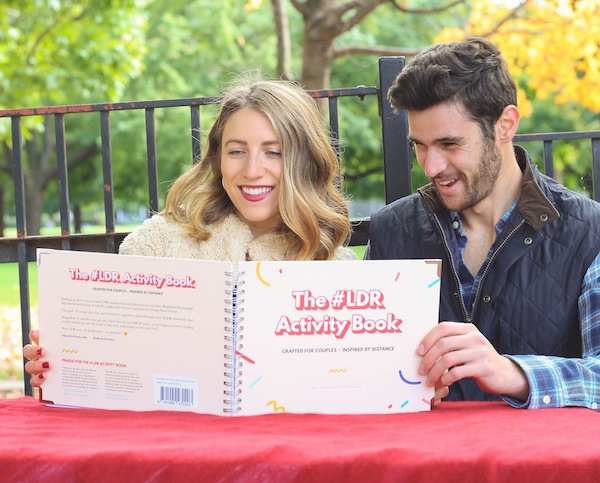
Sam Laliberte and Jared Schachter share what they’ve learned about long-distance relationships in The #LDR Activity Book. (photo by Ricky Pang / Sincerely Image)
The first quote in The #LDR Activity Book is from American writer Meghan Daum: “Distance is not for the fearful, it’s for the bold…. It’s for those knowing a good thing when they see it, even if they don’t see it enough.”
Sam Laliberte and Jared Schachter, co-writers of the activity book for people in, or contemplating, a long-distance relationship (LDR) knew a good thing when they saw it, and didn’t let Schachter’s move from Toronto to San Francisco get in the way.
“For two years,” they write in The #LDR, “we were long-distance loves, capturing our visits on Instagram and maxing out our data plans during weekly video calls. We picked up many lessons (most learned the hard way) and fun activities to keep our relationship strong AF despite living three time zones apart. It definitely took work, epic relationships don’t just happen, but we made it through and now we want to share our learnings with the world.”
In an email interview with the Independent, Laliberte and Schachter said they “always wanted the book to be interactive and fun for couples, since long, text-heavy books can be daunting and would be less conducive to creating positive interactions between couples.”
The #LDR Activity Book has eight chapters covering topics at the core of any relationship, even with yourself: understanding your personality, how you like to give and receive love, your values, what triggers you, envisioning the future, and more. Each chapter begins with an explanation of why the topic – expressing love, communication, IRL (in real life) visits, keeping the spark alive, values, trust, conflict resolution and planning – matters, followed by some “best practices”: assuming good intent, for example, giving “your partner the benefit of the doubt and operat[ing] under the impression that they’re trying their best.” Laliberte and Schachter then share a few tips of what worked best for them and, of course, there are several activities, some of which you complete on your own; others, with your partner.
Laliberte and Schachter wrote this book with Schachter’s mother, Beverley Kort, who is a registered psychologist in Vancouver, with more than 40 years’ experience counseling couples. They also interviewed dozens of other couples “who survived and thrived as long-distance lovers.”
“On top of all this,” they told the Independent, “we were also honest about the fact that our long-distance relationship didn’t work out. We too were scared of the associated stigma and didn’t have any resource to turn to, to help alleviate some of our concerns. The ability to create something for other couples [in a long-distance relationship] was really exciting for us.”
The #LDR Activity Book takes couples through various activities.
Laliberte and Schachter are still together, though, just closer geographically.
“We’ve been in a relationship for almost three years now,” they said. “We spent one-and-a-half years in a full long-distance relationship (Toronto-San Francisco) and, now, because we have flexible jobs, we spend a majority, but definitely not all, of our time together. We were separated for two months at the end of 2018 but are now on an extended travel together in South America for four months.”
Feedback about the book – which Laliberte and Schachter encourage readers to share – has been very positive, they said, giving a couple of examples. Thessa (New York) and Anthony (Dublin) wrote about The #LDR, “Absolutely love it. The quality is great, the art and quotes in the book are gorgeous, and information in the book is spot on.” Sara (Los Angeles) and Charles (Toronto) emailed, “#LDR was a fun way to build our relationship after knowing each other for only a week! We met at a music festival and spent the next year living on different coasts and time zones, and used this book to provide a framework for exploring our new relationship.”
A longtime long-distance couple with whom the JI shared the book completed several sections, some that reinforced what they were already doing – daily rituals (regular texts and phone calls) and planning out IRL visits, for example – and some that either introduced new ideas or suggested activities they wanted to do more often, such as creating a joint vision board and talking about important moments during texts and calls, respectively.
To fund the publication of The #LDR Activity Book, Laliberte and Schachter ran a Kickstarter campaign. Seeking $6,000, they received contributions of more than $10,000 from almost 200 backers, with their initial funding goal being covered in less than 24 hours. The result is a smart-looking, durable, 63-page, full-colour, hardcover (with metal corners), spiral-bound “scrapbook.” More importantly, it is a book full of good advice and beneficial activities and exercises, if you (and your partner) are willing to be open and put in the time. And the learning continues online.
“We’ve also now partnered with a sexologist to create a bonus chapter on ‘Sex from a Distance,’ after a number of readers began asking more detailed questions about this area,” Laliberte and Schachter told the Independent. “It is available for free download if you signup for our email newsletter on our website.”
The #LDR Activity Book is for sale on ldractivities.com for $35 per copy, or $60 for a set of two. Laliberte and Schachter have created a special discount code for Jewish Independent readers: use JINDEPENDENT20 to receive 20% off.
***
On Feb. 17, Sam Laliberte and Jared Schachter were interviewed on the podcast From Long Distance to Marriage. The episode can be found on audioboom.com.
Sarah Jacobsohn is the Ultimate Canada 2018 Junior Female Athlete of the Year. (photo from Sarah Jacobsohn)
Last month, Ultimate Canada named Sarah Jacobsohn the 2018 Junior Female Athlete of the Year.
“I was in the middle of biology class, looked at my phone, and saw that one of my teammates had texted me saying congratulations and a long paragraph,” recalled Jacobsohn about hearing of the award. “And I was like, what’s going on? I had no idea.
“Then, I saw the article that was written about me and I got the notification that they had selected me for the award … and I started crying in the middle of class and I called my mom. It was so surreal and just amazing.”
Jacobsohn was born in St. Louis, Mo., in 2000, and moved with her parents and older sister to Winnipeg in 2006. She has been attending Gray Academy of Jewish Education since then, and will be graduating this year.
Athleticism runs in the family. Both of Jacobsohn’s parents played sports into adulthood. She also gets her height from her parents: her mom is 5’11” and her dad is just over six feet.
Sarah Jacobsohn is the Ultimate Canada 2018 Junior Female Athlete of the Year. (photo from Sarah Jacobsohn)
Jacobsohn has played sports for as long as she can remember. “I played Timbits soccer since I was in Grade 1, then I continued playing competitive tennis and soccer. Once I found ultimate, I quit all those other sports to play ultimate,” she told the Independent. “For my high school, I still play volleyball, basketball and ultimate but, on a competitive level, I gave the others up for ultimate.” (That said, she remains a competitive player at the other sports. For example, on the school’s varsity basketball team, she has been averaging 37 points per game.)
Ultimate was designed to be played without referees. “The spirit of the game is heavily emphasized, which is something you don’t find a lot in competitive sports in this day and age,” said Jacobsohn. “Essentially, it’s about maintaining a level of sportsmanship and integrity while playing the sport. You have to make the calls yourself and communicate with other players on the other team. And, it’s always maintained, that sportsmanship and respect for other players. Even at the highest level, ultimate is still heavily dependent on player communication, which I think is amazing.”
At the higher levels, there are “observers,” who help the players regulate the game, but they only intervene when asked by the players to do so. And, even after having been asked for their opinion, it is still up to the players to accept or disregard an observer’s call.
“I think that’s what a lot of sports have lost in the past few decades,” said Jacobsohn. “That competitive atmosphere takes away from the sportsmanship, and it shouldn’t. There should be a balance.”
In ultimate, she said, “people understand that, to keep that respect of the game, they have to be honest. It’s really amazing to see that, even at the highest level.”
Jacobsohn started playing ultimate in Grade 6 and, at 14 years old, her coach convinced her to try out for the provincial junior team. She made the team, as one of the youngest in the group. It was there that a national coach spotted her and, at age 15, she traveled to Vancouver for the national tryouts and made the team.
Jacobsohn participated in her first world championship in Poland in 2016, and Canada took home the gold. Last summer, Jacobsohn, as captain, led the provincial team to a gold medal. She went on to captain Team Canada to a bronze medal at the world championship in Waterloo, Ont.
All of these feats, as well as her extensive involvement in the ultimate and broader communities, contributed to Jacobsohn being chosen for the athlete-of-the-year award.
“The award is strictly based on achievements from the past year,” said Jacobsohn. “So, last year, I was captain of my provincial team and we won gold at nationals for the first time ever. Then, as captain of Team Canada, we won bronze at the worlds. And, I’ve done a lot of community stuff locally.
“I’ve been involved in the Winnipeg ultimate community for six or seven years, which is a lot, when I’m only 18 years old. I’ve gotten to know essentially the entire ultimate community. I’ve literally grown up in this community – finding a lot of leadership opportunities in it and chances to voice my opinion. I fight a lot for gender equity and voice that opinion a lot in the Winnipeg ultimate community.”
Jacobsohn serves on the Manitoba Disk Sports board, offering suggestions, as a high school student, about tournament arrangements and how the province runs the sport. She also has been very involved in the Winnipeg Ultimate Women’s Competitive League, helping to get a lot of juniors involved.
“As a very competitive female athlete, I understand my responsibility growing up as a female athlete in today’s world,” she said. “I have an immense responsibility to stand up and role model for other female athletes, and I’m not scared to do that.
“And, going to school where I’m one of six girls in my grade, I’ve been able to gain respect from a lot of boys and change perspectives on what being a female athlete means.”
Now, Jacobsohn is busy training for the under-24 national team tryouts. And, while her main aspiration is to become a doctor, like her dad, she is hoping to continue playing ultimate competitively for many years to come.
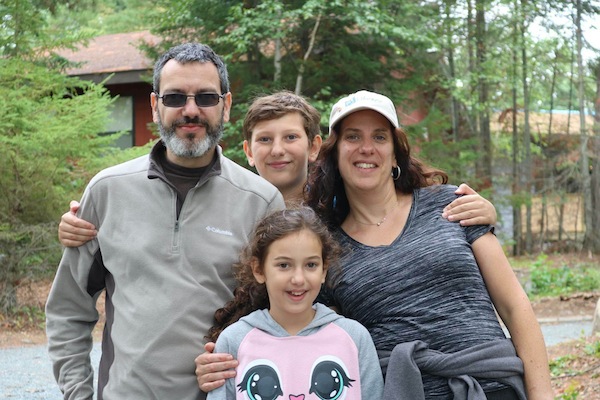
Florencia Katz and family. (photo from Florencia Katz)
PJ Library, which provides Jewish children with free Jewish-themed books and CDs, has expanded its program and now serves readers up to 11 years old.
Available in Jewish communities across North America, PJ Library is supported by local Jewish federations and many other donors. In Winnipeg, the program is in its 10th year, and Florencia Katz has been coordinating it since 2011. As a mom of two, she has experienced firsthand the impact the books have on her kids.
Eventually, Katz’s children aged out of the PJ Library program, which is for kids ages 6 months to 8 years old. But now, with the new program, PJ Our Way, Katz’s younger child, Tali, can once again enjoy the perks of PJ.
“PJ Our Way is the next chapter of PJ Library, for kids ages 9 to 11,” explained Katz. “Kids throughout the United States and Canada are eligible to enrol in the program from the day they turn eight-and-a-half until the day before their 12th birthday.
“The Harold Grinspoon Foundation, with the generous support of PJ Alliance Partners, provides PJ Our Way subscriptions at no cost to families or partner communities.”
PJ Our Way is considered the next chapter of PJ Library because it follows the same goals of the original program: engaging families and children in Jewish values, content and, ultimately, community.
PJ Our Way offers tweens the possibility of engaging online – allowing them to choose their own book, write book reviews, blog and more.
“My children and family have enjoyed the PJ Library program for years and, as avid readers, my kids were quite sad to stop receiving books at home once they aged out from PJ Library,” said Katz.
“My daughter, Tali, currently 10-and-a-half, was over the moon when I told her that she can now sign up to PJ Our Way. On the morning of the launch of PJ Our Way in Canada, before going to school, we signed up as one of the first sign-ups in Winnipeg, and maybe all Canada.
“As a parent, I am excited that, through this amazing program, my daughter will have the opportunity to keep reading quality Jewish-themed literature. The possibility that this program offers to engage online to choose the book, watch and read reviews, and submit their own reviews makes [it] attractive and exciting for this demographic.”
Tali was excited to pick her first book and spent some time on the PJ Our Way website, reading reviews and the synopses of all the available books, before choosing.
After narrowing her choice down to two books, she asked her mom for help deciding which to pick. After reading each book summary herself, Katz went to the parent section of the site to read more about the Jewish concepts and values and about the positive role models featured in each book. This helped her suggest which book her daughter might enjoy the most.
“Besides the synopsis and the concepts and values section provided for parents, there is also a section called Talk it Over, which suggests a question to discuss with your child after reading the book,” said Katz.
“I will definitely check all the information out and make a point of including it into our conversation about the book if it comes up. I will also suggest to my child to write a review of the book after she is done, so other kids can read it, the same as she read reviews when she picked the book. I want this experience to be enjoyable and fun, so I will not put any pressure or make it feel like a school task.”
Katz said the more Tali reads and learns about Jewish culture and tradition, the better equipped she will be to make her own decisions on how to live her Judaism when she grows up.
Candice Tenenbein, another parent who is part of the Winnipeg PJ Library initiative, is also very excited to have her older son, Jacob, 9, be part of PJ Our Way.
“Every month, our boys eagerly await their newest PJ Library arrivals,” said Tenenbein. “Both of our boys are avid readers. Recently, we were becoming sad that our older son, Jacob, was graduating out of this program. When we heard from Katz that PJ Our Way is now available in Winnipeg, we immediately signed up! We love that the books are exciting and fun to read, and that they all have a Jewish connection.
Candice Tenenbein and family. (photo from Candice Tenenbein)
“In our home, we celebrate Shabbat and all the Jewish holidays. These books and the online portion will add more layers to raising our children to be more knowledgeable about, and proud of, their Jewish heritage.”
Tenenbein is also looking forward to her sons spending time on their iPads in a more educational and productive manner, instead of just watching videos. PJ Our Way offers a safe and protected online environment.
At the Tenenbein house, all family members read the books provided by PJ Library, as they love to discuss their favourite parts of each one and share their thoughts of how the books impacted them.
“Jacob is especially excited that his friends will also be joining PJ Our Way,” said Tenenbein. “The kids are planning to choose the same books each month, so they can have their own book club.
“Growing up, my mother, may she rest in peace, instilled in us a love of reading and a pride in our Jewish heritage. Now, as a mother myself, I understand how truly important opportunities are which provide for our kids to understand what the religion means to them and their daily lives.
“This is especially important in today’s environment, where antisemitism and its newer anti-Israel BDS face are becoming more prevalent. My husband and I are grateful for the excellent education our children receive at Gray Academy [in Winnipeg]. PJ Library and PJ Our Way are excellent supplements for helping foster and strengthen these feelings in our children.”
Jacob is also excited about going online and becoming part of a larger community of Jewish peers. He is looking forward to being able to share his thoughts about each book and read what others have to say.
“He cannot wait to begin blogging once he reads his latest PJ Our Way book!” said Tenenbein.
These days, getting paper mail is not common, so PJ kids receiving a free gift in the mail, addressed just to them, is a unique and individual part of the experience. The online aspect then allows them to connect with other Jewish kids who are reading the same books as them. For more information, visit pjourway.org.
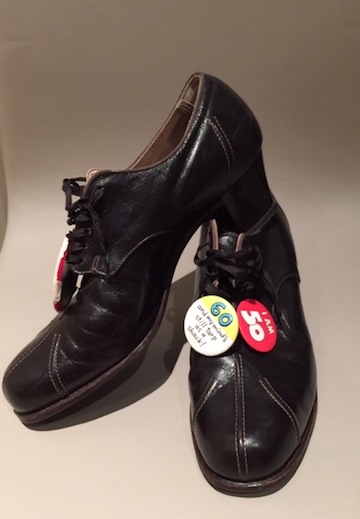
Penny Sprackman receives the special shoes on her 60th birthday, in 2006. (photos from Shirley Barnett)
Some things just happen and, before long, they become a tradition. In 1987, Harvey Shafron, while working at Freedman Shoes on South Granville, came across a rather clunky pair of women’s shoes on a top shelf and gave them to his sister, Rhoda (Shafron) Brickell.
Brickell, in turn, presented them to her friend Lola Pawer for her 50th birthday. Since then, the shoes have been passed from friend to friend among a group of Vancouver Jewish women on birthdays that end in a zero or five.
“It just happened,” said Shirley Barnett, a two-time recipient – on her 60th and 70th birthdays. “It became kind of fun to say, ‘Oh my God, it’s the shoes again.’”
The pair is not casually delivered; the recipient is formally presented the shoes at a celebration, usually at a restaurant, in front of the assembled pals.
“I really believe, as they were passed around, that it’s a story about friendship,” Barnett said. “When you reach a special age of some sort, everybody seems to say girlfriends are really important. It doesn’t matter if you’re divorced or widowed or you’re still married. At a certain age – and that could be 60, 70, 80 or 90 – a light seems to go on in women’s heads that says girlfriends are important. They are the ones you call in the middle of the night – maybe not, maybe you call your kids, I don’t know – but there seems to be an unwritten code that the older you get, you just need a few good girlfriends.”
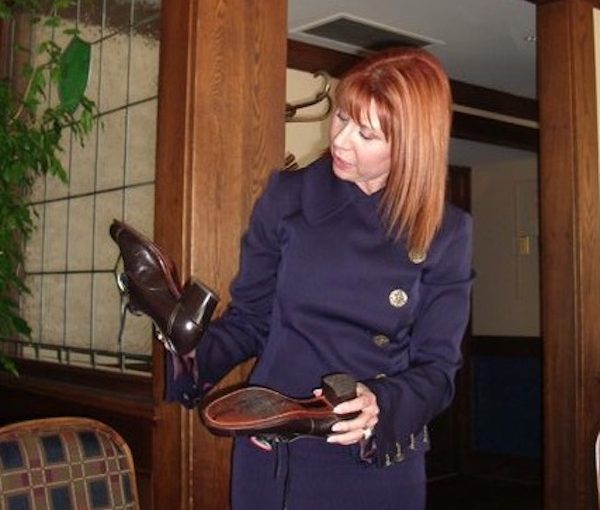
The “traveling shoes.” (photo from Shirley Barnett)
The size 8C shoes have fit every recipient, Barnett said. A ceremonial walkabout by the birthday celebrant is a part of the ritual.
Leslie Diamond and Pawer have received the shoes five times. Sylvia Cristall and Darlene Spevakow have received them four times. Karla Marks is a three-time recipient and Carole Chark and Penny Sprackman have gotten them twice. Others who have been honoured with the pair are Maja Mindell, Shelley Lederman, Anita Silber, Sandy Magid, Esther Glotman and Cynthia Levy.
At the start, the names of the recipients were written on the soles of the shoes but, as Dorothy Parker said, time wounds all heels, and the inscriptions have become mostly illegible.
What has remained indelible are some of the remarks made by recipients over the years. Barnett, who is sort of the informal archivist of the group, has collected words of wisdom shared over the years.
“It is the friends we meet along life’s way who make the trip more fun,” said one birthday celebrant.
“Friends make good things better and bad things not so bad,” said another.
“Being older sets you free,” reflected one. “You care less about what other people think, you no longer need to question yourself. You have earned the right to be wrong and not think about what could have been or what will be.”
On one birthday, a friend declared: “Remember, growing old is a privilege and old friendships are rare. So, when your ‘old’ friends reach for your hand, grab it.”
Another gem Barnett has collected: “The better the friend, the less cleaning you have to do before they come over!”
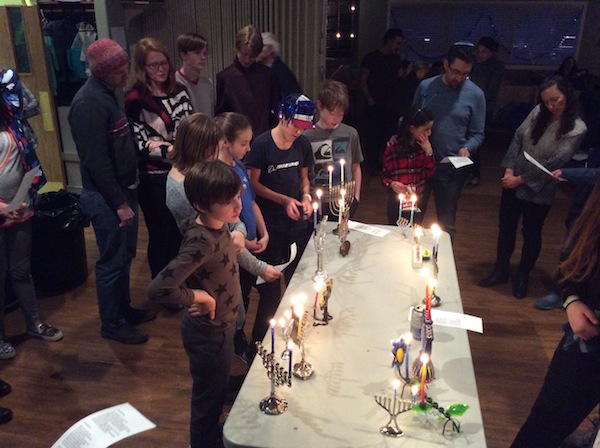
Members of the Okanagan Jewish Community came together to celebrate Chanukah. (photo from OJC)
The Okanagan Jewish Community in Kelowna has been keeping a busy schedule. Bolstered by many new members who have moved to the region – word has gotten out … who wouldn’t want to live here? – the community is growing both in numbers and in strength.
The Tu b’Shevat seder on Jan. 20 was attended by 30 members. (photo from OJC)
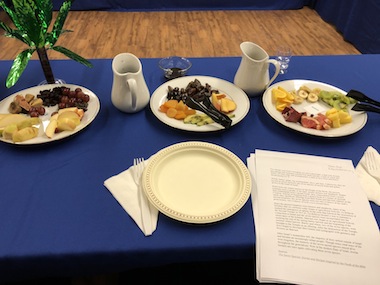
Traditional events such as the High Holidays – with visiting rabbis Larry and Linda Seidman from California – Sukkot and a Chanukah party attended by 80, started out our Jewish year. Of particular note was a Tu b’Shevat seder on Jan. 20, led by OJC member Barb Pullan, which was attended by 30 members. Everyone gathered to celebrate trees and discuss their importance to the preservation of life. We ate specific fruits representing those grown in Israel, drank wine or grape juice, recited blessings, told stories and sang songs. This definitely will be a repeat event in 5780.
Shabbat services were led by visiting Cantor Russ Jayne from Calgary in October and November, along with other services led by local community member Evan Orloff.
A Movie Night (The Boys: The Sherman Brothers Story) was presented on Nov. 9. The screening was organized by OJC member David Spevakow and took place at the Okanagan College Theatre, with almost 200 guests in attendance. We hope to continue the movie nights on a regular basis.
New programs this year have included:
Coffee, cake and cultural anthropology talks. I gave the first talk, on my experience meeting with the Jews in Gondar, Ethiopia. The second session was presented by Murray Oppertshauser, a retired Canadian diplomat, who spoke about his many postings throughout the world. Further talks are planned.
Several intercultural “meet and greets” have been planned with various cultural/ethnic groups in town.
The OJC participated in Taste of Home, a Kelowna community event, in which various ethnic communities in the city participated by selling a sampling of their ethnic food, and with ethnic dancing. We contributed 340 cheese knishes prepared by our members under the direction of Barb Finkleman. Our local Israeli dance group provided the entertainment.
Future events include a ball hockey tournament, Purim, Passover, regular meetings of the Ladies Group, the continuation of the Hebrew school, and our annual golf tournament in the summer.
The OJC is searching for a full-time resident rabbi. We are in the process of having several candidates come out for a Shabbat weekend, after which the community will decide which spiritual leader best fits our needs.
If you’re visiting Kelowna or, better still, moving here, contact the OJC at 250-862-2305 or admin@ojcc.ca.
Steven Finkleman is one of the original members of the Okanagan Jewish Community, having arrived in 1982. He has acquired lots of memories over the years. Currently retired, he has been serving as the president of the OJC since October 2018.