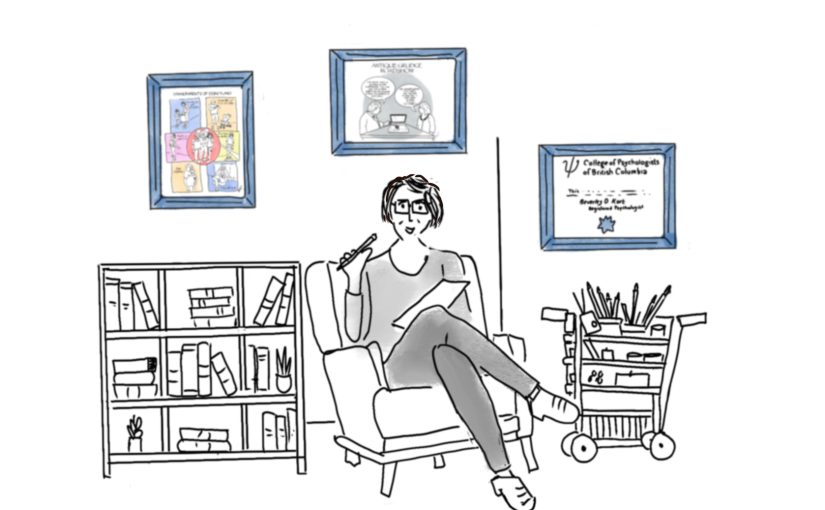
Beverley Kort is a therapist who brings a psychological perspective to her worldview – and to her cartoons. (illustration by Beverley Kort)
At 75, Beverley Kort is just getting started with her second career as a cartoonist. A frequent contributor to the Jewish Independent, Funny Times and Grand Magazine, Kort is a therapist who brings a psychological perspective to her worldview – and to her cartoons.
“I was always told I was a lousy artist,” she admitted in a recent conversation with the JI. “So, when I was looking for a new, more sedentary hobby, I thought to myself, ‘let me take up something that I know I’m not good at, and perhaps I can get mediocre at it!’”
She began with art classes and quickly gravitated towards cartooning five years ago. Since it was a hobby and something she wasn’t taking too seriously, she submitted her work in myriad directions just to see what would happen. To her surprise, the response has been positive, resulting in publication in magazines, newspapers and a 2023 book, Hold That Thought, edited by David Endelman.
“In the art world, you don’t get seen until you’re somebody, but, in the cartoon world, if you’re willing to take a risk, you can get seen,” she explained. “With cartoons, it’s the idea that matters, not the art.”
Kort has two separate stations at her home office, one for therapy and one for cartooning. These days, she carries a notebook to record ideas, reads newspapers and listens to podcasts for inspiration.
“I give myself three hours each week just to sit and play with cartoons,” she said. “I’m having so much fun! I’m in touch with many creative people I’d never have otherwise met and, while I don’t ever want to take cartooning too seriously, I am improving.”
Her work as a therapist has a strong influence on her cartoons, and her examination of the human condition and its quirks is great for generating ideas. Her topics range from life’s frustrations to aging, parenting and grandparenting, and the fresh, lighthearted perspective Kort brings is unequivocally humourous.
“Arriving at cartooning late in life has been liberating for me, but I still get a thrill each time an editor accepts my work,” she said. “There’s a fearlessness that comes with no longer needing to build a career or impress others, though I hope my sense of humour connects with as many people as possible. What’s more, I’ve discovered that new passions can find you at any age.”
Lauren Kramer, an award-winning writer and editor, lives in Richmond.
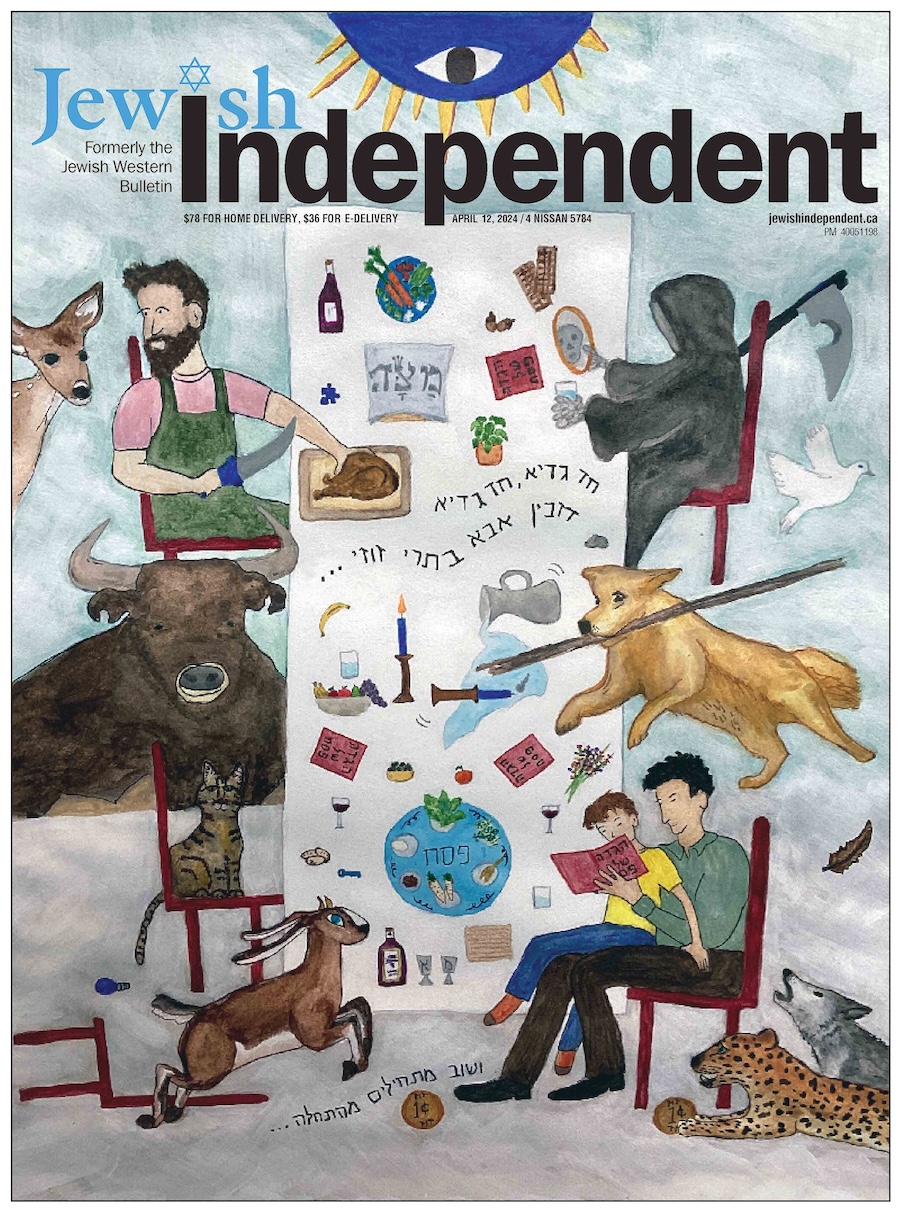
There are numerous interpretations of Chad Gadya (One Little Goat), which ends the Passover seder. A cumulative song, like “There Was an Old Lady Who Swallowed a Fly,” it starts with Father buying a goat, which is then eaten by a cat. Because it’s easier to summarize from the end, the last verse is, depending on your translation: then came the Holy One, Blessed be He, and slew the angel of death, who killed the butcher, who slaughtered the ox, that drank the water, that quenched the fire, that burnt the stick, that beat the dog, that bit the cat, that ate the goat. The Hebrew on the table in the cover image is the beginning of the song: Chad gadya, chad gadya, d’zabin Aba bitrei zuzei (that Father bought for two zuzim).
Often sung with different seder participants making the sounds of the succeeding aggressors, Chad Gadya is a cheerful song despite its violent imagery. With the numerous conflicts that mark human history and our present, I imagined the song’s characters, animate and inanimate, sitting down for a seder and what that might look like. This idea forms the centre of the cover scene.
While specifically about the Israeli-Palestinian conflict, Chava Alberstein’s 1989 version of Chad Gadya has always spoken to me more personally than politically. I have “been” the deer and dove of her song in my more empathetic and hopeful moments; her wolf and leopard in my more angry, fearful and hurt moments. As she sings – I, too, sometimes “don’t know who I am” in this world that can be so incredibly harsh. I, too, have thought, as Alberstein sings, and which I’ve written on the bottom of the cover art in Hebrew: “And we start again from the beginning …” each time one of us attacks another, with words or actions.
But giving up is not an option. So, while the characters of Alberstein’s song lie at the periphery of the seder image I created, 16 other symbols that might appear on a modern seder plate are scattered throughout. They represent what each of us can do to make ourselves better humans and the world a better place. They are not my ideas. I completely lifted all of them from “Beyond Bitter Herbs: Contemporary Additions to the Seder Plate” by Beverley Kort (with Leland Bjerg), which we ran in the Jewish Independent’s Passover issue last year.
Kort explains the meanings behind the fruit, acorns, chocolate, coloured light bulb, key, mirror, potatoes, banana, olives, basil, whole wheat matzah, vegetables, dried flowers, feather, rock and puzzle piece. For all the explanations, visit jewishindependent.ca/the-modern-seder-plate. Highlighting some of them: the acorns at the top of the picture represent an acknowledgement of Indigenous land rights; the rock above the dog’s head is symbolic of resilience; the key by the seder plate is about unlocking doors, embracing change; on the left side, the coloured lightbulb symbolizes the creative spirit; and the feather wafting off to the right is a reminder of the importance of kindness and compassion.
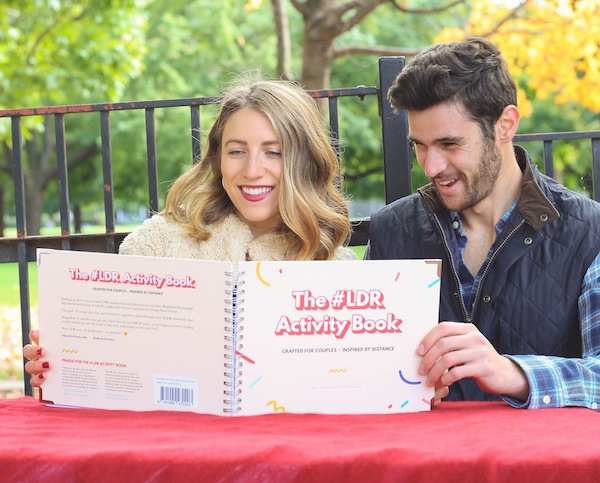
Sam Laliberte and Jared Schachter share what they’ve learned about long-distance relationships in The #LDR Activity Book. (photo by Ricky Pang / Sincerely Image)
The first quote in The #LDR Activity Book is from American writer Meghan Daum: “Distance is not for the fearful, it’s for the bold…. It’s for those knowing a good thing when they see it, even if they don’t see it enough.”
Sam Laliberte and Jared Schachter, co-writers of the activity book for people in, or contemplating, a long-distance relationship (LDR) knew a good thing when they saw it, and didn’t let Schachter’s move from Toronto to San Francisco get in the way.
“For two years,” they write in The #LDR, “we were long-distance loves, capturing our visits on Instagram and maxing out our data plans during weekly video calls. We picked up many lessons (most learned the hard way) and fun activities to keep our relationship strong AF despite living three time zones apart. It definitely took work, epic relationships don’t just happen, but we made it through and now we want to share our learnings with the world.”
In an email interview with the Independent, Laliberte and Schachter said they “always wanted the book to be interactive and fun for couples, since long, text-heavy books can be daunting and would be less conducive to creating positive interactions between couples.”
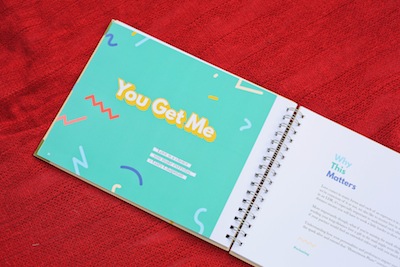
The #LDR Activity Book has eight chapters covering topics at the core of any relationship, even with yourself: understanding your personality, how you like to give and receive love, your values, what triggers you, envisioning the future, and more. Each chapter begins with an explanation of why the topic – expressing love, communication, IRL (in real life) visits, keeping the spark alive, values, trust, conflict resolution and planning – matters, followed by some “best practices”: assuming good intent, for example, giving “your partner the benefit of the doubt and operat[ing] under the impression that they’re trying their best.” Laliberte and Schachter then share a few tips of what worked best for them and, of course, there are several activities, some of which you complete on your own; others, with your partner.
Laliberte and Schachter wrote this book with Schachter’s mother, Beverley Kort, who is a registered psychologist in Vancouver, with more than 40 years’ experience counseling couples. They also interviewed dozens of other couples “who survived and thrived as long-distance lovers.”
“On top of all this,” they told the Independent, “we were also honest about the fact that our long-distance relationship didn’t work out. We too were scared of the associated stigma and didn’t have any resource to turn to, to help alleviate some of our concerns. The ability to create something for other couples [in a long-distance relationship] was really exciting for us.”
The #LDR Activity Book takes couples through various activities.
Laliberte and Schachter are still together, though, just closer geographically.
“We’ve been in a relationship for almost three years now,” they said. “We spent one-and-a-half years in a full long-distance relationship (Toronto-San Francisco) and, now, because we have flexible jobs, we spend a majority, but definitely not all, of our time together. We were separated for two months at the end of 2018 but are now on an extended travel together in South America for four months.”
Feedback about the book – which Laliberte and Schachter encourage readers to share – has been very positive, they said, giving a couple of examples. Thessa (New York) and Anthony (Dublin) wrote about The #LDR, “Absolutely love it. The quality is great, the art and quotes in the book are gorgeous, and information in the book is spot on.” Sara (Los Angeles) and Charles (Toronto) emailed, “#LDR was a fun way to build our relationship after knowing each other for only a week! We met at a music festival and spent the next year living on different coasts and time zones, and used this book to provide a framework for exploring our new relationship.”
A longtime long-distance couple with whom the JI shared the book completed several sections, some that reinforced what they were already doing – daily rituals (regular texts and phone calls) and planning out IRL visits, for example – and some that either introduced new ideas or suggested activities they wanted to do more often, such as creating a joint vision board and talking about important moments during texts and calls, respectively.
To fund the publication of The #LDR Activity Book, Laliberte and Schachter ran a Kickstarter campaign. Seeking $6,000, they received contributions of more than $10,000 from almost 200 backers, with their initial funding goal being covered in less than 24 hours. The result is a smart-looking, durable, 63-page, full-colour, hardcover (with metal corners), spiral-bound “scrapbook.” More importantly, it is a book full of good advice and beneficial activities and exercises, if you (and your partner) are willing to be open and put in the time. And the learning continues online.
“We’ve also now partnered with a sexologist to create a bonus chapter on ‘Sex from a Distance,’ after a number of readers began asking more detailed questions about this area,” Laliberte and Schachter told the Independent. “It is available for free download if you signup for our email newsletter on our website.”
The #LDR Activity Book is for sale on ldractivities.com for $35 per copy, or $60 for a set of two. Laliberte and Schachter have created a special discount code for Jewish Independent readers: use JINDEPENDENT20 to receive 20% off.
***
On Feb. 17, Sam Laliberte and Jared Schachter were interviewed on the podcast From Long Distance to Marriage. The episode can be found on audioboom.com.

 She began with art classes and quickly gravitated towards cartooning five years ago. Since it was a hobby and something she wasn’t taking too seriously, she submitted her work in myriad directions just to see what would happen. To her surprise, the response has been positive, resulting in publication in magazines, newspapers and a 2023 book, Hold That Thought, edited by David Endelman.
  “I give myself three hours each week just to sit and play with cartoons,” she said. “I’m having so much fun! I’m in touch with many creative people I’d never have otherwise met and, while I don’t ever want to take cartooning too seriously, I am improving.”