
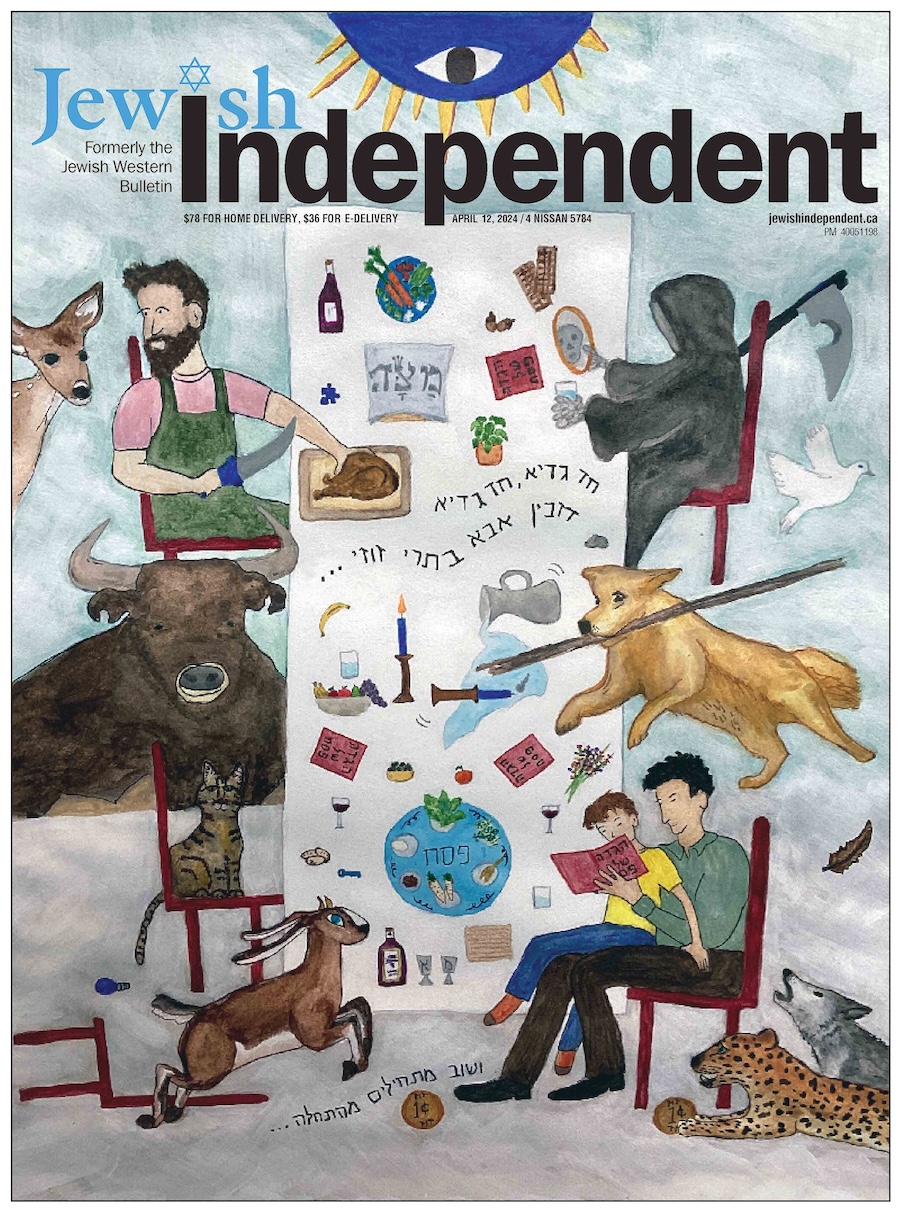
 There are numerous interpretations of Chad Gadya (One Little Goat), which ends the Passover seder. A cumulative song, like “There Was an Old Lady Who Swallowed a Fly,” it starts with Father buying a goat, which is then eaten by a cat. Because it’s easier to summarize from the end, the last verse is, depending on your translation: then came the Holy One, Blessed be He, and slew the angel of death, who killed the butcher, who slaughtered the ox, that drank the water, that quenched the fire, that burnt the stick, that beat the dog, that bit the cat, that ate the goat. The Hebrew on the table in the cover image is the beginning of the song: Chad gadya, chad gadya, d’zabin Aba bitrei zuzei (that Father bought for two zuzim).
Often sung with different seder participants making the sounds of the succeeding aggressors, Chad Gadya is a cheerful song despite its violent imagery. With the numerous conflicts that mark human history and our present, I imagined the song’s characters, animate and inanimate, sitting down for a seder and what that might look like. This idea forms the centre of the cover scene.
While specifically about the Israeli-Palestinian conflict, Chava Alberstein’s 1989 version of Chad Gadya has always spoken to me more personally than politically. I have “been” the deer and dove of her song in my more empathetic and hopeful moments; her wolf and leopard in my more angry, fearful and hurt moments. As she sings – I, too, sometimes “don’t know who I am” in this world that can be so incredibly harsh. I, too, have thought, as Alberstein sings, and which I’ve written on the bottom of the cover art in Hebrew: “And we start again from the beginning …” each time one of us attacks another, with words or actions.
But giving up is not an option. So, while the characters of Alberstein’s song lie at the periphery of the seder image I created, 16 other symbols that might appear on a modern seder plate are scattered throughout. They represent what each of us can do to make ourselves better humans and the world a better place. They are not my ideas. I completely lifted all of them from “Beyond Bitter Herbs: Contemporary Additions to the Seder Plate” by Beverley Kort (with Leland Bjerg), which we ran in the Jewish Independent’s Passover issue last year.
Kort explains the meanings behind the fruit, acorns, chocolate, coloured light bulb, key, mirror, potatoes, banana, olives, basil, whole wheat matzah, vegetables, dried flowers, feather, rock and puzzle piece. For all the explanations, visit jewishindependent.ca/the-modern-seder-plate. Highlighting some of them: the acorns at the top of the picture represent an acknowledgement of Indigenous land rights; the rock above the dog’s head is symbolic of resilience; the key by the seder plate is about unlocking doors, embracing change; on the left side, the coloured lightbulb symbolizes the creative spirit; and the feather wafting off to the right is a reminder of the importance of kindness and compassion.
Chag Pesach sameach.