שוק מגדלי הקנאביס בקנדה רותח בימים אלה בעקבות החלטת הממשלה הפדרלית, כי מכירת מריחואנה היא חוקית החל השבעה עשר בחודש.
שלוש מגדלות הקנאביס הגדולות בקנדה הן: במקום הראשון – טילריי שמניותיה נסחרות בבורסה בשווי של למעלה משלושה עשר מיליארד דולר קנדי, במקום השני – קנופי שמניותיה נסחרות בבורסה בשווי של כאחד עשר מיליארד דולר קנדי ובמקום השלישי – אורורה קנאביס שמניותיה נסחרות בבורסה בשווי של כעשרה מיליארד דולר קנדי.
אורורה קנאביס רכשה לאחרונה את חברת מדריליף הקנדית תמורת כשניים וחצי מיליארד דולר קנדי. מדובר בעסקת המיזוג הגדולה ביותר בענף שוק הקנאביס עד כה. חברת תיקון עולם הנחשבת לגדולה ביותר בישראל (בבעלות צחי כהן ודורית כהן) החזיקה בעשרה אחוז ממניות מרדיליף, ובעקבות המיזוג היא קיבלה רבע מיליון דולר קנדי. תיקון עולם הייתה שותפה בהקמת מרדיליף (בשנת 2014). זאת כדי שיתאפשר לחברה הישראלית לשווק את זני המריחואנה שלה בשוק הקנדי. בעקבות רכישת מרדיליף תיקון עולם תשווק מעתה את מוצריה בקנדה באמצעות אורורה קנאביס.
בראשית השנה רכשה אורורה קנאביס חברה נוספת בענף – קאנימד – תמורת מיליארד דולר קנדי. עתה מועסקים קרוב לכשש מאות עובדים באורורה קנאביס וכושר הייצור שלה נאמד בקרוב לשש מאות טון קנאביס בשנה.
אורורה קנאביס שהונפקה בשנת 2014 והפכה לאחת ממגדלות המריחואנה הגדולות בעולם, ניהלה לאחרונה מגעים עם חברת קוקה קולה, לייצור משקה קל שמבוסס על מריחואנה.
קנדה נחשבת כיום ליצרנית הקנאביס הגדולה בעולם. במקביל לשיווק המריחואנה לשווק המקומי היא מספקת את צמחי הסם למדינות רבות נוספות. בהן: גרמניה, ברזיל, אוסטרליה, קרואטיה, צ’ילה וצ’כיה. היקף שוק הקנאביס העולמי הוערך בכתשעה מיליארד דולר בשנת 2016. ולפי התחזיות של האו”ם הוא צפוי להגיע לכמאה וחמישים מיליארד דולר בעוד כשבע שנים (בשנת 2025). היקף שוק הקנאביס בקנדה מגיע כיום ללמעלה ממיליארד דולר, ולפי תחזיות האנליסטים המקומיים הוא צפוי להגיע לשישה מיליארד דולר בעוד כשבע שנים (בשנת 2025).
חברת אהלוט מטורונטו מחפשת בימים אלה מבקרים של קנאביס (או בהגדרה המקצועית “אוצרי קנאביס”) שיוכלו להבדיל בין הזנים השונים, ולהסביר זאת ללקוחות במילים פשוטות, בין היתר באמצעות פרסום פוסטים ברשתות החברתיות. במודעות הדרושים שלה מפרטת אהלוט: “דרושים מומחים אניני טעם שחיים יחד עם הקנאביס מספיק זמן, כדי להבין ולבטא את ההבדלים הדקים בין זן למשנהו. בואו להשתכר חמישים דולר לשעה להערכת המיטב שיש למגדלי הקנאביס בקנדה להציע. את העבודה ניתן לבצע מהבית בכל רחבי קנדה”. לדברי מנכ”ל אהלוט, גרג פנטליק, החברה מחפשת “אוצרי קנאביס” כדי להדריך את הלקוחות, כיוון שצפוי שיהיה קשה לבחור בין הזנים השונים והרבים כל כך.
בניאגרה קולג’ שבמחוז אונטריו נפתחה תוכנית ללימוד סטודנטים איך לגדל צמחי המריחואנה באופן מסחרי. וזאת כדי לאפשר לסטודנטים להשתלב בענף שכאמור צובר תאוצה גדולה בקנדה. תוכנית הלימודים כוללת בין היתר את האספקטים הבאים: מסחר, ביולוגיה, תרבות ובריאות של גידול, מכירת ושימוש בקנאביס. הסטודנטים ילמדו למשל איך לתכנן מערך שתילה, איזה תאורה נחוצה לגידול הצמחים בחחמות, איך להשקות את שתילי המריחואנה, תהיליך הדישון הדרוש, הגנה, בטיחות ומעקב אחר הגדילת השתילים, בדיקה פיננסית של עלויות הגידול, מעקב כמה העבודה דרושה עבור הליך הגידול, ניתוח ומחקר היכן עדיף לגדל את הצמחים ועוד. בשלב זה כבר עשרים וארבעה סטודנטים נרשמו לתוכנית הלימודים היחודית ללמוד אך לגדל מריחואנה.
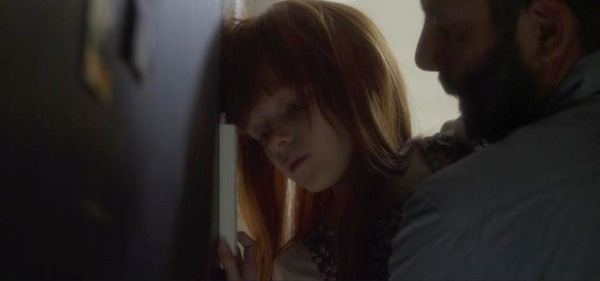
Tzahi Grad, left, and Ala Dakka are great together in The Cousin. (photo from Shaxaf Haber/Venice Film Festival)
The 30th annual Vancouver Jewish Film Festival, which runs Nov. 7-Dec. 2, has an impressive lineup. Not only is there a wide range of quality films from which to choose, but the reach of the festival has widened, with screenings this year also taking place in West Vancouver and Port Moody. Here are just some of the great films you’ll be able to see.
Peace possible?
After Naftali, a successful Israeli actor-director, proudly shows his newly hired Palestinian worker, Fahed, the trailer for his latest creation – an internet series called One by One, which will bring Israelis and Palestinians together to talk and, eventually, Naftali believes, help bring about peace – Fahed’s response is, “Yes, it’s nice. It’s a little, um, a little naïve, isn’t it?” Begrudgingly, Naftali admits, “Totally, but not impossible.”
Maybe not impossible, but certainly beyond the scope of a web series, as Naftali soon finds out in The Cousin. When a ninth-grade girl is attacked in the neighbourhood, suspicion immediately falls on Fahed, who is arrested, then let out on bail – bail paid for by Naftali, who is pretty sure that Fahed is innocent. As the film progresses, Naftali’s beliefs are seriously challenged, both by his neighbours, who are champing at the bit to mete out their own justice on the not-proven-guilty Fahed, and by his wife, who wasn’t comfortable having a Palestinian worker in the first place. The pressure forces Naftali to confront his own latent racism, which arises rather quickly.
The acting in this film is excellent. Writer, director and star Tzahi Grad is convincing as the somewhat pompous but well-meaning Naftali and Ala Dakka is wonderful as Fahed, a compassionate, laidback, not-so-handy handyman who shows some promise as a rap musician. The supporting characters fulfil their roles believably. The oddball neighbours, who at first just seem to have been added for comic relief, become truly menacing, and Osnat Fishman as Naftali’s wife aptly portrays her transformation from merely nervous and annoyed to scared and angry.
The writing in the film is mainly good. The serious dialogue and action are compelling and there are humourous interjections that work to both lighten the material and shed light on it. However, there are other attempts at humour that are inconsistent with the overall mood and message. And the last three minutes of the film are completely bizarre, and really should have ended up on the cutting-room floor. But this should not stop you from seeing what otherwise is an entertaining, gripping and thought-provoking movie because, if nothing else, it’s such a bad ending that it’s almost good; at the least, it’s memorable, in a shake-your-head-in-wonder way.
The Cousin has three screenings: Nov. 10, 6:45 p.m., at Fifth Avenue Cinemas; Nov. 25, 2 p.m., at Kay Meek Studio Theatre (West Vancouver); and Nov. 26, 6:45 p.m., at Inlet Theatre (Port Moody).
– CR
A tragic thriller
In Act of Defiance, Antoinette Louw, imbues Molly Fischer with backbone, wit and warmth to match her husband, Bram, played with verve and intelligence by Peter Paul Muller. (still from Act of Defiance)
Bram Fischer is one of the great Jewish heroes of the 20th century, yet he is not widely remembered outside his native South Africa. The crackling moral thriller An Act of Defiance, which recreates the attorney’s gutsy exploits during the Rivonia Trial in the early 1960s, brilliantly revives his legacy.
From the outset, the film defines Fischer (played with verve and intelligence by Peter Paul Muller) less by his considerable legal skills and reputation than by the company he keeps: he is a strategist and ally of Nelson Mandela and the other leaders (several of them Jewish) covertly plotting against the apartheid regime. In fact, Fischer is supposed to be at the meeting where the police bust in and arrest the activists.
Free and available to represent the accused against charges of sabotage, Fischer is more than their defender and advocate: he’s an active member of the resistance whose actions – epitomized by a tense, protracted sequence in which he smuggles key documents out of a government building, inadvertently placing his family in danger – express his commitment and courage even more than his legal challenges and parries.
Fischer’s extracurricular activities have the effect of pushing An Act of Defiance out of the realm of courtroom drama and into a full-bore thriller. That said, the film never loses sight of the plight of the Rivonia defendants, who face death sentences if convicted.
Dutch director Jean van de Velde fills the cast with South African actors such as Antoinette Louw, who imbues Molly Fischer with backbone, wit and warmth to match her husband. Along with its other attributes, An Act of Defiance is a moving love story.
An Act of Defiance screens Nov. 11, 3:30 p.m., at Fifth Avenue.
– MF
Faith and family
Emily Granin and Moshe Folkenflik share one of several touching moments in Redemption. (still from Redemption)
Redemption, which is called Geula in Hebrew, after the main character’s daughter, is a powerful film, the emotional impact of which builds up imperceptibly, such that you may only find yourself teary-eyed awhile after it has ended, when all the feelings it evokes finally reach the surface.
Co-directors and co-writers Joseph Madmony and Boaz Yehonatan Yacov grab viewers’ attention right away, with a lyrically and musically edgy song accompanying us as we follow Menachem through the streets to the drugstore, where he gets his photo taken – even though his attempts at smiling fail – then pausing to have a smoke before returning to his apartment to relieve the babysitter. Within the first five minutes, we know he is an awkward, sad, kind and generous Orthodox Jew, as well as an attentive, caring and loving father.
Other aspects of his life come into focus as he reconnects with his former friends and band mates, including his reason for reuniting them. Menachem’s 6-year-old daughter, Geula, needs expensive cancer treatments if there’s a chance for her to survive the cancer that killed her mother. Menachem, who works at a supermarket, needs the money that the band could make from playing at weddings.
The renewal of the friendships involves the reopening of some old wounds, and the men’s paths to healing are stories well told, though the film is mainly about Menachem, who, we find out, broke with the group when he became religious 15 years earlier. Moshe Folkenflik plays the widower with nuance, humility and depth, and Emily Granin as his daughter, Geula, captures the strong will, intelligence, bravery and fear of this young girl, playing with subtlety what could have been a maudlin role.
Redemption will be screened twice: Nov. 12, 8:45 p.m., at Fifth Avenue and Nov. 29, 8:45 p.m., at Inlet Theatre. [It will also screen as part of the Victoria International Jewish Film Festival on nov. 4, 1:30 p.m., at the Vic Theatre. For tickets and information to the Victoria festival, visit vijff.ca.]
– CR
Smiles and belly laughs
Nate Kroll, left, and Elliot Gould provide many laughs in Humor Me. (still from Humor Me)
Sam Hoffman’s resoundingly funny debut feature, Humor Me, imagines a well-appointed New Jersey retirement community as the setting for mid-life rejuvenation and resurrection. Neatly avoiding or flipping every cliché about seniors (cute, crotchety or flirtatious), the adult son-aging father dynamic and the theatre, Humor Me is a warm-hearted, flawlessly executed fable.
When his wife takes their young son and leaves him for a billionaire, talented-but-blocked playwright Nate Kroll (New Zealand actor Jemaine Clement) has to move out of their Manhattan brownstone and into the guest bedroom at his dad’s town house at Cranberry Bog. Bob (a note-perfect turn by Elliot Gould) is an inveterate joke teller, but his repertoire doesn’t work on a 40-year-old failed artist.
“Life’s going to happen, son, whether you smile or not,” he declares, a philosophy that the audience can embrace more easily than Nate can. If it contains a bit of Jewish fatalism, well, that’s Gould’s voice. So Bob’s jokes, which are consistently risqué and constructed with an ironic twist, have a faint air of the Borscht Belt about them. (It’s not a coincidence that Hoffman produced and directed the web series Old Jews Telling Jokes.)
There’s not a single stupid character in Humor Me, including Nate’s bland, successful brother (Erich Bergen), and this generosity of spirit means we’re always laughing with Nate’s foils, not at them. It helps immeasurably that Hoffman (best known for producing the TV show Madame Secretary) assembled a veteran cast – Annie Potts as Bob’s girlfriend, Le Clanché du Rand as a flirtatious senior and Bebe Neuwirth as a theatre heavyweight – that nails every last punch line and reaction shot.
Humor Me plays out the way we hope and expect it will, which is to say it delivers on its implicit promises. En route, it provides lots of smiles and several belly laughs. Even Nate, who’s well aware that he’s earned every joke that he’s the butt of, gets his share of one-liners. There’s plenty to go around, you see.
Humor Me is at Fifth Avenue on Nov. 14, 1 p.m.
– MF
For the full Vancouver Jewish Film Festival schedule and tickets, visit vjff.org.
Michael Fox is a writer and film critic living in San Francisco.
Gili Roskies co-stars in Red Birds, which opens Nov. 2. (photo from Gili Roskies)
Jewish community member Gili Roskies co-stars in the world première of Red Birds, written by Aaron Bushkowsky. Presented by Solo Collective Theatre and Western Gold Theatre, the play opens Nov. 2.
Described as a “bittersweet comedy,” Red Birds centres around “three generations of dirt-poor women whose lives are thrown into chaos when a birth mother is revealed. She is both incredibly wealthy and ready to marry a charming gold-digger.”
“I play Ashley in Red Birds,” Roskies told the Independent. “She is Carol’s daughter and helps her mother navigate through difficult decisions and new relationships. Despite being the youngest character in the play and dealing with her own hardships (that most 30-year-old women experience), she is the voice of reason in the play.
“I love the female relationships in this story,” Roskies said, “and, also, I’m more and more appreciative of seeing and starring in shows that have more women on stage than men. It’s rare and shouldn’t be. This show deals with a woman diving into some sort of unknown and the support the other women in her life provide her with. That is timeless.”
According to the production’s promotional material, Red Birds is a sister piece to Bushkowsky’s The Big Blue Bird, which had “a workshop reading by Western Gold more than 12 years ago. The Big Blue Bird looked at the sad but poignant relationship between three generations of men: a grandfather, father and son. It was subsequently nominated for a Jessie Richardson Award for outstanding original script.”
Red Birds will be Roskies’ first show with Western Gold Theatre, but her third with Solo Collective Theatre.
“I’ve been fortunate enough to work with Solo Collective on two other occasions. I was in a really fun musical called Cool Beans that was written by Anton Lipovetsky and directed by Rachel Peake in 2013. That show, I think, will always remain high on my favourites list. It was so hip and new. The music was catchy and fun, the story was relatable and relevant.
“I also was in Dressing for a Wedding, written by Aaron Bushkowsky and directed by Sarah Rodgers, in 2015. In both cases, I had the chance to assist in the creation of a new show, which is always an exciting process.
“I find Solo Collective really supports its playwrights, giving them time and space to better their pieces,” she said about what keeps her coming back to the troupe. “It’s an ensemble environment, which I consider myself lucky to get to be a part of. Aaron was my writing teacher at Studio 58 and has (thankfully) continued to allow me opportunities to learn about theatre-making.”
This summer, Roskies starred as Girl in Arts Club Theatre’s Once, which “was a blast,” she said.
Roskies was also in what she called “an incredible new show this past year called Glory. Tracey Power masterfully wrote and choreographed an important show about the Preston Rivulettes, a women’s hockey team from the 1930s. Steve Charles created the most intricate music for our insane hockey games/dances. James MacDonald directed a real winning show. It’s a must-see and will be on next year at the Richmond Gateway Theatre April 4-13. We were welcomed and loved debuting the show in Kamloops and performing in Calgary. We have a tour in the summer through B.C. and Ontario. Though I sadly won’t be able to be a part of this remount, I highly suggest going.”
As for future roles, she said she doesn’t have anything big coming up. “At least not to my knowledge!” she qualified. “‘I audition all the time,’ as my character Ashley states so aptly. I’ve been happy tinkering around with some music-making lately, that might take up some of my focus this year. Hard to say.”
Directed by Scott Bellis, Red Birds also stars Anna Hagan, Christina Jastrzembska, Gerry Mackay and France Perras. The set is by Stephanie Wong, lighting by John Webber, sound design by Ben Elliott, and costumes and props by Alaia Hamer.
Red Birds is at PAL Studio Theatre, 581 Cardero St., Nov. 2-18, with shows Tuesday to Saturday. Tickets ($27/$32) are available from redbirds.brownpapertickets.com or 604-363-5734.
British Columbians have been tasked, once again, with voting on whether or not to change our electoral system.
Until Nov. 30, we are being asked to choose what voting system we should use for provincial elections, whether to keep the current first-past-the-post (FPTP) system or switch to one of three proportional representation (PR) voting systems offered on the ballot. This is our third referendum on electoral reform, the 2005 and 2009 votes having chosen the status quo rather than change to a single transferable vote system. While the STV forms a component of one of our choices this time around, it is not one of the systems being proposed.
The 24-page voter’s guide from Elections BC describes our current system, FPTP: “the province is divided into electoral districts and each district is represented by one member of the legislative assembly (MLA). Voters mark their ballot for one candidate. The candidate with the most votes in the district wins and represents the district in the legislature. The number of seats a party gets in the legislature equals the number of districts its candidates win.”
In PR, however, “the share of seats a political party wins in the legislative assembly is about the same as the party’s share of the popular vote. So, if a party receives 40 percent of the popular vote, they are likely to have about 40 percent of the seats in the legislature. There are many different voting systems that are designed to produce proportional results.”
Indeed, there are dozens of variations on the PR theme, and herein lies one of the problems with the 2018 referendum. British Columbians will be asked: 1) which system, FPTP or PR, should be used for provincial elections, and 2) if a PR system were to be adopted, which of three systems – mixed member, rural-urban or dual member – we would prefer. There will be no second referendum, as there was in New Zealand, asking us whether we would prefer FPTP or the majority-chosen type of PR, with its details fleshed out by a parliamentary, expert or other committee.
We are, in essence, being asked to take our best, semi-educated guess as to which of three vaguely described PR options might yield better results than FPTP. Several key factors are “to be determined” after the referendum results, if PR is chosen, such as how electoral boundaries will change, how candidate lists would be drawn up, the total number of MLAs to be elected, how coalition governments would be formed. All of these elements determine how effective a PR system will be in producing a more responsive, diverse and balanced government. And we will not have a direct say in these decisions.
There is no way in this limited amount of space that we can satisfactorily explain all of the PR systems being put forward in the referendum. Readers should go to elections.bc.ca/referendum for the basics and research as best they can. This may not yield satisfactory results, however, because only one of the referendum’s PR options is actually in use in other countries; the other two are theoretical at this point. Mixed member PR is used in New Zealand, Germany, Scotland, Mexico and other countries, while the rural-urban system combines approaches used in various countries and the dual-member version is akin to a system Prince Edward Island once used (but no longer does) and also, according to one pro-PR website, “echoes our own voting history,” as British Columbia had multi-member ridings until the 1990s.
So, what do to then if we treat this referendum as less of a choice between which PR system we prefer and more of a choice between keeping the status quo and changing to a new system?
Vote PR BC and the No BC Proportional Representation Society each received $500,000 in government funding to advocate for and against PR, respectively. However, you will find little in-depth information from these sources. Think tanks and other groups have tried to fill in the gaps of knowledge but, perhaps not surprisingly, there’s valid-sounding evidence on both sides of the issue. For each piece of evidence supporting PR – such as it will end adversarial politics and hold politicians more to account – there is an evidence-based opposite finding. How many of us will look at all the studies, check the sources and determine how rigorous and accurate the conclusions are? Likely very few of us.
For what it’s worth, among the supporters of PR, you will find the left-leaning Canadian Centre for Policy Alternatives, the B.C. NDP and B.C. Green Party. Among those skeptical of it are the right-leaning Fraser Institute and the B.C. Liberals. At the end of the day, most of us will probably base our decision on the opinions of those people and organizations with whom we agree on other subjects. We also will consider what we know personally (as opposed to filtered through another researcher’s lens) of PR systems elsewhere in the world, such as in Israel – even though the specific Israeli form of PR is not one of those on the B.C. ballot, it is similar. Some of us might opt for change for change’s sake, and others will stick with the devil we know. It might comfort some voters to know that, if we choose change, there will be another referendum in two election cycles to see if we want to return to FPTP or stay the course.
Knowledge is power and we recommend that voters do the absolute best to educate themselves about the various alternatives. But don’t be discouraged if you’re still uncertain after your research. Both FPTP and PR have their strengths and weaknesses. However, a vital aspect of both FPTP and PR – and one that directly speaks to the health of our democracy no matter what the electoral system – is that people exercise their right to vote. Whatever your choice, please fill out your ballot when you get it in the mail.
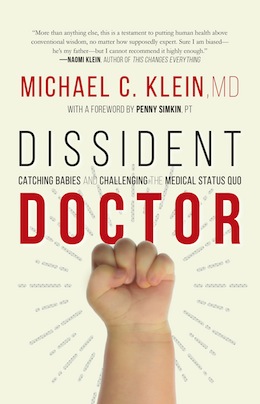
Michael Klein recently had his first book published. (photo from Michael Klein)
Dr. Michael Klein has published almost 200 scientific articles. Earlier this month, he launched his first book, Dissident Doctor: Catching Babies and Challenging the Medical Status Quo (Douglas & McIntyre).
Klein, who, with his wife Bonnie, splits his time between Robert’s Creek and Vancouver, is professor emeritus of family practice at the University of British Columbia, adjunct professor of family practice McGill University in Montreal and senior scientist emeritus at B.C. Children’s Hospital Research Institute. He was recognized as a member of the Order of Canada in 2016 for playing “a vital role in placing maternity care at the heart of family medicine.”
Klein has had a significant impact on the way the Canadian medical system has come to view midwifery and he played a prominent role in midwives becoming part of the healthcare system, first out east and later in here in British Columbia.
“I’m on the board of Canadian Doctors for Medicare, an organization that is trying to save Medicare from various encroachments from private interests, including U.S. multinationals,” Klein told the Independent. “We are about improving and extending Medicare. We are not about justifying things as they are. But, we are very much unhappy with the way privatization is going, which is a solution that is worse than the disease.”
About his new book, Klein said, “It began as something that I was writing as stories for my children and grandchildren … and, it got out of hand.”
At it happened, publishers at Douglas & Macintyre heard Klein tell a few of these stories and wanted them made into a book.
Klein set about developing them thematically. “I had to find out what the storyline was,” he said. “It’s a great deal about birth, but it’s not a birth book, per se. In many respects, birth is a metaphor.
“It’s about birth, family practice, midwifery, social justice, and about improving our rather challenged healthcare system. At the same time, I’ve deliberately chosen stories that have a message. For example, there are stories about people who were not supposed to get better but did. Many of the stories are actually detective stories. What I mean by that is that I try to make the stories go beyond the actual patient issue…. In what context does this illness take place? ”
Klein feels this approach to storytelling makes the point that, to provide really good care, you need to understand the patient, the full breadth of their situation.
He hopes the book also serves as a primer on how to advocate for yourself and your family in the complex medical system.
“Misunderstandings and mistakes in the healthcare system are actually inevitable,” said Klein. “I talk a lot about advocacy and the importance of making sure that, if things don’t seem right, they probably aren’t right.
“Because of my involvement with Canadian Doctors for Medicare, the whole issue of privatization is explored. For me, I have a special need to express this, because I’m in a unique position. I’ve practised in Canada before Medicare. I’ve practised in the States and ran health centres without Medicare – that wasn’t a lot of fun. And, I’ve practised back in Canada with Medicare.”
The main point Klein wants to impress upon readers is that humane, holistic care in the context of a person’s whole life is the ideal. “I am not putting this out as a dispassionate physician-scientist, but as somebody who really understands the big picture and can situate the patient or the system within a very large context of where we are going as a society,” he said.
The book is almost completely free of medical jargon, although it deals with complicated issues. Klein said the book is equally accessible to medical trainees, people in the profession and to the general public.
The stories he chose, the themes he discusses and the politics, he hopes, will be easily understood by anyone who has ever encountered the healthcare system. “Not just pregnant people and their partners, but anybody; also family physicians, midwives, obstetric nurses, dulas,” he said.
Klein showed the manuscript to people in all these categories, and, he said, “it seems to work for them.”
The feedback Klein has been getting is that people love the book’s advocacy stories. He even includes his wife’s experiences following a series of strokes, when she was told she was inoperable and would die. A surgeon in London, Ont., saved her life.
“There are a series of stories of my patients and other peoples’ patients who defied the odds, and where patient advocacy has been absolutely essential,” said Klein. “Whether they are physicians or laypeople, they became engaged in the right way with the health providers and improved their outcome.
“People relate to that very strongly, regardless of whether they are patients. The experiences they’ve had when their children, spouse or parents were sick and, either they were sidelined by the system or they embraced by the system. It varies enormously with who is providing the care and what their attitudes are. I cover that in the book.”
Other stories in the book tell of how Klein battled with the U.S. army and avoided going to the Vietnam War.
He also delves into his strong support for midwives. “People wondering if home birth is safe are very interested in that section,” said Klein. “Home birth is clearly safe. However, safe in the right kind of system, with the right kind of supports and back up. In other words, an integrated system like we have in British Columbia, as opposed to the chaos of the U.S.”
The launch event for Dissident Doctor took place in Toronto on Oct. 9.
Selina Robinson, B.C. minister of municipal affairs and housing, admires the new mezuzah on her office door, while Rabbi Yechiel Baitelman looks on. (photo from Chabad Richmond)
Born and raised in Montreal before moving to British Columbia, Selina Robinson first lived in Richmond, then relocated to Coquitlam. She was elected as the member of the Legislative Assembly of British Columbia for Coquitlam-Maillardville in 2013 and again in 2017. Robinson is a member of the B.C. NDP.
When I learned that Rabbi Yechiel Baitelman of Chabad Richmond recently helped Robinson affix a mezuzah to her office door at the legislature, I was surprised. I called to ask her how she came to invite Baitelman to help her. “I didn’t,” she replied. “He just showed up with it!”
As it happens, Baitelman was in Victoria to fix a Torah scroll. While there, he reached out to Robinson, a longtime family friend, to see if they could meet briefly. She invited him to her office, where they talked about her portfolio and how they could work together to improve housing in Richmond. Never one to miss an opportunity, Baitelman asked Robinson whether she would like to put up a mezuzah. She loved the idea, but told the rabbi she didn’t have a hammer. Without skipping a beat, he said, “That’s OK, you don’t need one. This mezuzah has adhesive on the back.”
I guess that falls into the category of “I just happen to have a mezuzah on me.” I mean, don’t all rabbis carry them around?
Robinson has known the Baitelman family for decades, through her mother’s work at Chabad Lubavitch in Vancouver years ago. She told me that the Baitelman kids used to call her mother “Bubbe Rhoda.”
While she was a university student in the 1980s, Robinson helped run Camp Gan Israel of British Columbia day camp for two years. Later on, when she was living in Coquitlam, she helped build the Burquest Jewish Community Association. She also used to work at Jewish Family Services.
Robinson’s commitment to the ideals of Jewish life and culture is resolute, and she proudly refers to herself as a “Habonimer.” Yet, her affinity for Chabad is strong, especially their dedication to helping Jews at all levels of observance.
Robinson regularly shows her new mezuzah to colleagues, and takes the time to explain what it means.
Shelley Civkinis a happily retired librarian and communications officer. For 17 years, she wrote a weekly book review column for the Richmond Review, and currently writes a bi-weekly column about retirement for the Richmond News.
The Centre for Judaism of the Lower Fraser Valley is looking for nominations for its annual Lamplighter Award, which honours a child who has performed an outstanding act of community service. Candidates must be between the ages of 6 and 18 and submission of potential recipients must include two references describing the child’s community service.
The chosen Lamplighter will receive the award, as well as a monetary gift, on Dec. 9, 7 p.m., at Semiahmoo Shopping Centre in a ceremony led by Rabbi Falik and Simie Schtroks, directors of the Centre for
Judaism, with various official representatives of the cities of Surrey, White Rock, Langley and Delta in attendance.
Last year, twins Emily and Jessie Miller received the award for spearheading the Live2Give program in their NCSY chapter. They also managed to get many other teenagers to get involved in projects focused on helping others.
To nominate a candidate for the award or to sponsor the gift or event, contact Simie Schtroks as soon as possible at c4j@c4j.ca.
Left to right, National Council of Jewish Women of Canada Vancouver section’s 2018/19 board of directors Catherine Stoller (president), Linda Arato (secretary), Anne Lerner (social action chair), Rochelle Garfinkel (administration) and Debby Altow (past president) were installed by Shelagh Stoller, who gave a brief bio of each member and presented the traditional red rose. The 94th annual general meeting, which took place Oct. 14, confirmed members’ support of NCJWC’s advocacy at the United Nations, on Canada’s citizenship issues and against antisemitism here and abroad. Catherine Stoller reported on the programming for disadvantaged schools in Vancouver, which receives help from the B.C. Gaming Commission.
Construction on the Centre of Excellence for the Deaf and Hard of Hearing is expected to be complete by fall 2019. (photo from WIDHH)
British Columbians who are deaf and hard of hearing will soon benefit from a state-of-the-art Centre of Excellence for the Deaf and Hard of Hearing that is being built by Vancouver’s Conwest Group of Companies.
The Western Institute for the Deaf and Hard of Hearing (WIDHH), a registered charity established in 1956, together with Conwest, has commenced construction on a new $16 million facility with $1 million in funding from the Ministry of Health. The $1 million in government funding, which was announced Sept. 26, will be applied to an $8 million capital fundraising campaign that WIDHH is aiming to launch to the public early next year.
“From youth to seniors, this new centre will improve people’s quality of life and help prevent those with hearing and communication challenges from feeling isolated,” said David Eby, attorney general and MLA Vancouver-Point Grey.
The centre will provide hearing aids and assistive listening device services, employment counseling, seniors outreach programs and a refurbished hearing aid program for people on limited income. It will also accommodate expansion of WIDHH’s clinical research program within the field of hearing health, telecommunications and accessibility.
“We look forward to using technology in the new facility to reach out and provide unparalleled levels of hearing health care and support to homebound seniors and those living in rural communities across British Columbia,” said Grace Shyng, interim executive director of WIDHH.
Construction on the new centre at 2005 Quebec St., in Vancouver, is expected to be complete by the fall of 2019.
My kids have developed a fascination with the PBS TV show This Old House. They love watching how old houses are fixed, restored and cared for by these talented workmen. I have always liked this show, too, and, as it goes, this is a pretty safe way to share “adult” TV programming with 7-year-olds.
Over Thanksgiving, one of my boys decided that we should all sit on the couch. Mommy would help one boy with his knitting and the other with his crochet and we would watch this show. Well? It would be a great weekend. (This kid also suggested we eat potatoes, noodles and rice for dinner, thus creating the ultimate “couch potato” scenario!)
While this may just be a funny episode in our family life, it’s a good reminder that we’re all quirky folk. My family might be different but, in reading the weekly Torah portions from Simchat Torah onwards in Genesis, we learn that, historically, the Jewish people originate from interesting stock. So, if we look to our ancestors (way, way back) to inform our understanding of ourselves, that might be a good thing.
There’s plenty of negativity in Genesis (Bereishit) in terms of how people behave towards one another. It’s a reminder, without giving a list of every kind of licentious or bad behaviour, that we have the capacity to do each other great harm. There are murders and sexual assaults. There are also people held up as role models, despite their flaws.
There are Abraham and Sarah, who welcome in guests, make them bread and offer them hospitality, and then Sarah demonstrates that having a sense of humour goes a long way. When told she would give birth to Isaac as an old woman, she laughs. This was a great response in many ways – she has a healthy sense of both humour and skepticism about the world.
There’s Rebecca, who offers (more) hospitality to Abraham’s servant. Isaac is so respectful of his father that he follows him up Mount Moriah to do a sacrifice – even when it seems clear that he will be killed.
Genesis offers one story after another. Each one deserves examination. However, when doing a quick reading through several of these episodes, I saw how different the characters are from one another. Some individuals struggle with what they learn from G-d, and some are believers. Others, like the people of Sodom and Gomorrah, are deemed irretrievably flawed, but Lot’s wife, who is initially saved, is too curious or doubtful, and turns to salt anyway.
I pondered some of this as we watched the guys from This Old House go to Texas to help after Hurricane Harvey hit Houston. We described the terrible flooding from hurricanes and boat rescues to our kids in ways they would understand, so we talked about Noah and the ark. On another episode, we learned that one of the young apprentices on the show had passed away in his sleep, from a longtime medical condition. He was age 18. So we paused the TV show. We talked about how he worked hard and did a good job, and his family and the people he worked with – all loved him. That his death was a shock and very sad, but that we believe, as Jewish people, that when a person’s body is buried, his soul goes up to be with G-d.
There is no perfect way to talk about life-threatening storms or untimely death. Though we try to shield our kids from the hardest things in the news, truth be told, the gentle teaching of the craftsmen and parents on This Old House was just right for my kids to understand. Between very basic Torah stories and real-life events, we had a lot of help in talking about these hard issues.
Even as an adult, sorting through the stories in Genesis seems daunting, just as coping with the news has been. My husband and I have both lived in places where we’ve experienced tornadoes and hurricanes. I wish I could spare others the experience of waiting in the cellar until the storm passes. However, I’ve been struck by the commonalities I’ve seen between our weekly Torah portions and these challenges.
It’s important, when facing adversity, to offer generous hospitality and kindness to those around you.
It’s good to give respect to your elders and those who might be able to lead you through hard experiences.
Being a resourceful “maker,” someone who builds or creates what he or she needs during an emergency, can save a life or bring forth life.
A sense of humour can help us through really difficult challenges.
People who suffer through losing everything during life-threatening situations like hurricanes and tornadoes are just like everyone else. They’re individuals, who may be quirky or kind, who do good and bad things. It can be hard to relate to their situation and remember that beyond all our differences and preferences, they are just like you and me.
We read Genesis every year at synagogue. We revisit these ancestors and remember how they persevered through difficult experiences. It’s a chance to imagine yourself not just as Abraham or Isaac, but as Hagar, abandoned with an infant, or Keturah, a second wife. We can be Noah’s family in the flood, just as many hurricane survivors might have felt.
Religious traditions interpret these biblical stories in different ways, but in watching This Old House, we see people rebuild homes after a hurricane, and how they offer each other food, water, tools and other necessities. This reminds me that some lessons are the same for everybody. Hospitality, kindness, respect, resourcefulness and a good sense of humour – whether you learn them from Genesis or from fix-it shows on TV, they help bring us together in positive ways.
Joanne Seiff writes regularly for CBC Manitoba and various Jewish publications. She is the author of three books, including From the Outside In: Jewish Post Columns 2015-2016, a collection of essays available for digital download or as a paperback from Amazon. See more about her at joanneseiff.blogspot.com.