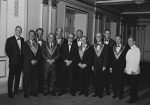
B’nai B’rith event, 1969. (photo from JWB fonds, JMABC L.09488)
If you know someone in this photo, please help the JI fill the gaps of its predecessor’s (the Jewish Western Bulletin’s) collection at the Jewish Museum and Archives of B.C. by contacting archives@jewishmuseum.ca or 604-257-5199. To find out who has been identified in the photos, visit jewishmuseum.ca/blog.
החל מיום רביעי שעבר (ה-17 בחודש) מכירת מריחואנה היא הליך חוקי בקנדה. בכך מקיימת הממשלה הליברלית ברשות ג’סטין טרודו, הבטחה מקמפיין הבחירות, להפוך את השימוש במריחואנה לחוקי בקנדה. כמובן שיש מתנגדים, בהם שמרנים שלא יכולים לסבול התקדמות כשלהי וגורמים באופוזיציה מטעם מפלגת השמרנים שתמיד יחפשו לשלול החלטות של ממשלת הליברלים. אצלם הפוליטיקה היא בראש וטובת האזרח לא תמיד נראית באופק. בממשלה הליברלית מציינים כי הלגיליזציה של הקנאביס תצמצם את השימוש במריחואנה על ידי בני נוער ובמקביל תצמצם משמעותית את הפשיעה בתחום.
קנדה היא בסך הכל המדינה השנייה בעולם שהופכת את השימוש במריחואנה לחוקי, אחרי אורוגוואי שעשתה זאת לפני כחמש שנים. באורוגוואי מותר לאזרחים לרכוש עד ארבעים גרם של הסם מדי חודש מבתי המרקחת. לחילופין הם יכולים לגדל את צמחי המריחואנה בעצמם, או להצטרף למועדוני עישון הסם באופן חוקי.
מדינות רבות בעולם וכן ארגון ברית מדיניות הסמים (שפועל מוושינגטון) יעקבו מעתה אחרי מה שקורה בקנדה בתחום המריחואנה, כדי לראות מה ההשפעה לאור האישור לשימוש בה, מעבר לצרכים הרפואיים הידועים.
עשרות חנויות למכירת מריחואנה ממתינות לאישור המיוחל לשיווקה ברבים. אם קבלת האישור כאמור לפני שבוע צפוי שחנויות רבות נוספות יפתחו ברחבי קנדה למכירת הסם. הממשלה הפדרלית תאפשר גם את מכירת הסם באמצעות רשת האינטרנט. במקביל כמאה ועשרים גופים עד כה קיבלו אישור מיוחד לגדל את צמחי המריחואנה בחממות. חלק מגופים אלה נסחרים בבורסות של קנדה וארה”ב כאשר מחירי מניותיהם עולים כל הזמן.
עדיין לא ברור כיצד משטרות התנועה ברחבי קנדה יוכלו לבדוק אם נהגים צרכו מריחואנה, כפי שהם נבדקים אם צרכו אלכוהול. נראה שבתוך מספר חודשים ימצאו המכשירים חדשים לבדיקת כמויות הסם בדמם של הנהגים.
לקנדים שישתמשו בקנאביס באופן חוקי או שיעסקו בתחום גידול ומכירת הסם צפויות בעיות בכניסה לארצות הברית, כך מסתבר. זאת כיוון שבארה”ב הקנאביס אינו חוקי ונחשב לסם מסוכן. אמנם תשע מדינות בארה”ב אישרו את השימוש במריחאונה אך עדיין החוק הפדרלי האמריקני אוסר זאת. לפיכך קנדים שיעברו את הגבול לארה”ב צפויים להיחקר בנושא השימוש בסם, או להישאל האם האם משתייכים לתעשייה ליצור ומחירת המריחואנה. כבר ידוע לפחות על מקרה אחד של קנדי מתעשיית המריחואנה שגורש מארה”ב ונאסר עליו לתמיד לבקר בה שוב. יש כבר מספר קנדים העוסקים בתחום שהודיעו כי לא יבקרו עוד בארה”ב מהחשש שמה אף הם יגורשו ממנה.
כיצד מגיבים הגולשים מישראל לידיעה כי קנדה הפכה את השימוש במריחואנה לחוק? להלן לקט תגובות מעניינות שפורסמו באתר ווינט:
“הסטלנים חושבים שהקנביס יביא להם מיליארדים. שימשיכו בהזיות”.
“קנאביס זה רעל מסוכן הגורם נזק חברתי ואישי. בבתי חולים בארץ יש לא מעט צעירים המגיעים לאישפוז בשל שימוש בקנאביס ואף משימוש חד פעמי. זה מידע בדוק שקיבלתי מאחד ממנהלי בתי החולים לשעבר”.
“הטייקונים מפחדים שאנשים יפסיקו לצרוך אלכוהול, טבק, תרופות בכמויות. וגם אנשים יתחילו לנהוג לאט יותר ואז את מצלמות המהירות יהיה אפשר לזרוק לפח”.
“כולם נהיו פה נרקומנים חולים”.
“זאת בכייה לדורות”.
“עיוולת בדומה לאלכוהול”.
“איך הצביעו לג’סטין טרודו? בקושי מסוגל לנאום, שהוא עומד ליד טראמפ הוא מתחיל לרעוד, הגבות המודבקות שלו הם בכלל בדיחה. ג’סטין טרודו הוא השמאל הכי קיצוני בעולם עכשיו בזמן שכל המדינות עוברות ימינה. אם הוא אישר את מכירת המריחואנה אז זה כנראה לא דבר טוב”.
A scene from Who Will Write Our History, about the secret Warsaw Ghetto archives that were hidden from the Nazis. The film screens Nov. 1 at the Rothstein Theatre. (photo by Anna Wloch / Katahdin Productions)
One of the better known documents of the Oyneg Shabes Archive is written by David Graber, who was 19 at the time. In his will, he wrote: “What we were unable to cry and shriek out to the world, we buried in the ground…. I would love to see the moment in which the great treasure will be dug up and scream the truth at the world…. May history attest for us.” While Graber did not survive Holocaust, his words did. As did the words and tens of thousands of pages of material collected by historian Emanuel Ringelblum and the 60 Oyneg Shabes members in Warsaw from 1940 to 1943.
The documentary Who Will Write Our History, written, produced and directed by Roberta Grossman, highlights the story of the archive and some of the Oyneg Shabes members, only three of whom survived. It will be screened by the Vancouver Jewish Film Centre on Nov. 1, 7 p.m., at the Rothstein Theatre and Grossman, along with executive producer Nancy Spielberg, will be in attendance.
The film is based on the book of the same name by Samuel D. Kassow.
“When I read Sam’s book, I was just absolutely shocked that I didn’t know the story because I’ve done a lot of work and been very engaged in learning about this period of time my entire life and, to me, it seemed like a travesty that it was so little known outside of academic circles and it seemed that it really should be known,” Grossman told the Independent. “To my mind, it is the most important unknown story of the Holocaust.”
Being a filmmaker, Grossman said, “I felt that the best way to help Ringelblum and the other members of the Oyneg Shabes achieve what they wanted, which was to tell the story of the war from the Jewish point of view and to be remembered as individuals,” was through film, that the “medium is the best way to tell stories that will reach a lot of people and not just scholarly circles.”
Grossman optioned Kassow’s book in 2012.
Roberta Grossman, writer, producer and director of Who Will Write Our History. (photo from Katahdin Productions)
From that time to the finished film, she said, “The goal and the vision for the film stayed the same, it just took a long time to figure out how to achieve that because you need to set the story of the Oyneg Shabes Archive in the historical context. You need to know what’s going on between the wars [and] during the war; you need to know the story of the Warsaw Ghetto; you need to know the story of the Oyneg Shabes and how they operated; and then you need to know the individual story arcs of the people that we chose to highlight…. It’s a lot to pack in, so the challenge was in figuring out the pieces of that puzzle.”
Of the three caches of material hidden by the Oyneg Shabes, two have been found, in 1946 and 1950. They contained more than 35,000 pages of material, including letters, artwork, photographs, circulars, posters and so many other documents, which are housed at the Jewish Historical Institute in Warsaw. In 2008, the Vancouver Holocaust Education Centre mounted the exhibit Scream the Truth at the World: Emanuel Ringelblum and the Hidden Archive of the Warsaw Ghetto, which presented parts of that extensive collection to Vancouver. But the exhibit must have been a relative rarity because Spielberg also hadn’t heard of Ringelblum – who was among those murdered by the Nazis (in 1944) – and the archive.
“We worked together on Above and Beyond,” Spielberg told the Independent about how she came to work with Grossman on the documentary. “I came to Vancouver with that film and showed it in the [2014 Jewish] film festival there…. She had just bought the rights to Who Will Write Our History? and she left the project to come on board to direct Above and Beyond. We were spending time together, we were in the car, we were driving to locations, [and] I’m listening to her on the phone talking about this other project, and then she started telling me the story, and I knew nothing about this.”
Grossman eventually asked Spielberg if she’d be interested in joining the project and, having worked with Grossman before, Spielberg said, “We’re a wonderful balance and I loved this story. And we did [the film] with the idea that someone could come out of their immediate misery and sit down and do something with eyes to the future when it looks like there’s no tomorrow for you.”
“We know about people who, against all odds, rose up to the best of their ability militarily against the Nazis,” said Grossman, “but we haven’t spent a lot of time necessarily paying attention to and giving honours to people who resisted in other ways and, to me, this is an incredible example of spiritual resistance. They saw themselves as being literally engaged in a battle of humanity versus barbarism and I think that, especially now, the idea of or the question, who writes our history, and what is true and what is false, and what is propaganda and what is truth, and who controls the narrative is as important today as it’s ever been.
“In an era,” she continued, “where truth is not particularly valued in some of the most powerful corners of our world and a lot of lies and hateful propaganda is being propagated, especially vilifying the other, whether they be immigrants or Muslims or whoever ‘the other’ of the moment is, we know from history, if we pay attention, that’s an extremely dangerous – very powerful and, therefore, dangerous – way to operate. It’s important for people who are victimized or marginalized to tell their own story.”
The upcoming screening here of Who Will Write Our History is part of a tour of the film. Both Grossman and Spielberg have been attending various screenings, sometimes together, sometimes not.
“I think that the most common reaction is twofold,” said Spielberg. “One is of gratitude that the story was told. That may come in many ways, first of all, from people who are hungry for more knowledge and didn’t know anything about this … and also, of course, from survivors and their children; keeping these stories alive and honouring these people so that their lives would not have been in vain.
“And the other response is ‘I didn’t know that, how come I didn’t know that?’… Then you know you’ve unearthed a gem, that you were able to teach somebody another aspect of the Holocaust, just when we thought we’ve heard it all. Getting this out to the general populace will be really, really important, Jewish and non-Jewish.”
“I feel very proud to have fulfilled in some small way the wishes of the members of the Oyneg Shabes to tell the story from the Jewish point of view and to be remembered as individuals,” said Grossman. “I get the feeling, when I watch the film with audiences, that there is a way in which people sitting in the audience feel as if they’re honouring those people just by watching the film, and that’s really exciting.”
Tickets to the Vancouver screening of Who Will Write Our History are $72 and can be purchased via vjff.org.
Social media is instrumental in forming and reflecting the prevalent views of our society. One sign of its importance is that leaders like U.S. President Donald Trump and Israeli Prime Minister Binyamin Netanyahu communicate mainly through Twitter nowadays. And, while many of us may bemoan this fact, the demand for simplistic, polarizing and aggressive political discourse seems as strong as ever.
In our own community, differences of opinion, especially on the topic of Israel, have led to divisiveness. Many Jewish community members choose to avoid the topic altogether. But, while pausing to think before we speak and refraining from saying hurtful things are to be lauded, there are issues that require discussion if we are to ever improve them, ourselves, the community, and the world. We need to create the spaces in which these conversations can safely take place. Any steps we can take to reach that goal, even incremental ones, like holding an event that is admittedly mainstream, but allows for debate on Israel, is a positive development.
This is one reason the Jewish Independent has joined the Jewish Federation of Greater Vancouver, Centre for Israel and Jewish Affairs, Jewish Community Centre of Greater Vancouver, Ameinu, Or Shalom, Schara Tzedeck, Beth Israel and Temple Sholom in co-sponsoring Left vs. Right: The Battle for Israel’s Soul. On Oct. 23, J.J. Goldberg of the Jewish Daily Forward and Jonathan S. Tobin of JNS.org – whose visit here is part of a series that has taken them to dozens of other Jewish communities – will model how we can argue passionately about something as heated as our views on Israel while remaining not only respectful of our “opponent,” but maybe even come to like them. (Click here for event information.)
The modeling of civil discourse about contentious issues is also one of the purposes of the Faigen Family Lecture Series, which will take place on Oct. 30. Presented by Vancouver Hebrew Academy, along with several sponsors, this year’s speaker is conservative journalist and commentator Ben Shapiro, who suggests that social media is not the appropriate place to seek dialogue, noting, “you don’t look to Twitter for meaningful conversation.” (Click here for story.)
The JI sponsored the documentary The Oslo Diaries at this year’s Vancouver International Film Festival for similar reasons. (The Israel Consulate General, Toronto and Western Canada, also sponsored this film. See jewishindependent.ca/oslo-diaries-peace-possible.)
While we all know that, ultimately, the Oslo Accords failed to bring an end to the Israeli-Palestinian conflict, the film shows just how close we came to peace. One of the most important aspects of the documentary, which is based on the diaries of the Israeli and Palestinian negotiators of the accords, is the evolution of the relationship between these enemies, which they were at the time.
One of the most powerful scenes in the film is a conversation between the two chief negotiators, Uri Savir on the Israeli side and Abu Ala on the Palestinian side. Initially, they compete with regard to the history of their ancestors in Jerusalem and how far back their family ties go. However, they soon agree that they are not at these talks to make a better past but to make a better future. While the Oslo Accords failed for reasons beyond their control, the negotiators accomplished what seemed impossible – they formed an agreement – and Savir and Ala, at least, became friends.
Earlier this year, as part of the Civil Conversations Project of the podcast On Being, host and creator of the show Krista Tippet interviewed Imam Abdullah Antepli of Duke University in Durham, N.C., who also co-created and co-leads the Shalom Hartman Institute’s Muslim Leadership Initiative, and Rabbi Sarah Bassin of Temple Emmanuel in Beverly Hills, Calif. The whole conversation is fascinating but one exchange illustrates why respectful discourse on controversial topics is so difficult.
First, Tippet notes that agreement shouldn’t be the goal of such discussions, but rather understanding. She gives an example from an interview Antepli did with Israeli journalist and author Yossi Klein Halevi, where Halevi told Antepli, “I am not a dove. I am not a leftist. My positions are very mainstream, skeptical Israel.” To which Antepli replied, “And I’m not interested in marginal Jews who will agree with everything Muslims believe about Israel.”
Second, in talking about this interview and his relationship with Halevi, Antepli says there is often “a conflation of political disagreement with moral disagreement…. Yossi is like my brother. There is hardly anybody who is closer to me like him, but watch us when we talk about Israeli-Palestinian conflict…. But do I ever doubt his integrity? Do I ever doubt his moral red lines? Do I ever doubt his moral imagination?… I think many people think political disagreement translates itself as moral arguments.”
About her work creating spaces in which her community can engage on controversial issues, Bassin says, “I put out the line that the only people I don’t want in this space are people who are going to physically threaten our security. But, beyond that, I think that we want to welcome as [many] diverse voices as possible…. And it’s been hard, and some people have been challenged by it, but, ultimately, the leadership has really embraced that, because they see the need for it.”
Many of our community leaders and organizations – not just those mentioned here – also see the need, and are continuing or beginning to establish spaces for civil dialogue and debate. We owe it to ourselves and the future of our community to lend them our support – and our voice.
Some Jewish communities see making eco-friendly choices as the Jewish and socially conscious thing to do. I’ve also participated in Jewish meals and events in which environmental choices were the farthest thing from anyone’s mind. In fact, as they cheerfully dump hundreds of disposable paper products and plastic tablecloths into the garbage, I’ve heard people say that this “social action nonsense” is all some liberal craziness that doesn’t have much to do with Jewish practice.
Sometimes, as families grow more comfortable financially, the notions of reuse and salvage seem less attractive. However, for many of us, junk yards and scrap peddling are an important part of our immigrant past. All this came up in conversation recently with my husband.
As we walked past a neighbour’s renovation, there was a 100-year-old wooden door in a rain-sodden trash heap. We’ve been to architectural salvage places in the past, looking for these doors because they match everything else in our old house. They’re well-made and last a long time. Even second-hand, they aren’t cheap. My husband commented that too many folks feel that, “if I can’t use it, it isn’t useful.”
We contrasted this with a famous family story. As a kid, my husband’s family travelled to Toronto to see their Lubavitcher relatives. On the way home to upstate New York, they carried an unusual gift across the border. They strapped a steel security door on top of their car – a gift from a cousin’s scrap yard. In our families, old-school values still ring true. If you need a door and you can get a perfectly good used one, why not?
While Jewish families often cross borders and levels of Jewish practice and observance, how often do we think about the cause and effect of our actions when it comes to the environment?
I began thinking about this more particularly when my kids learned brachot (blessings) at preschool. Each time we thanked G-d for something that grew from a tree, a vine or the ground, we were acknowledging the power and importance of the earth for our well-being.
When attending services, we pray all winter, from Shemini Atzeret through to Passover, for wind to blow and rain to fall. But what if the rain is polluted? What if our lakes, rivers and oceans are filled with microplastics waste?
We need to focus on how we can reduce our consumption and increase our reuse of what we’ve got. If we thank the Almighty and appreciate the earth’s healthy produce, how do we reconcile that, for instance, with the mounds of plastic we create with packaging, disposable cups and bottles, and more? Most of our recycling products travel to China to be processed. Lately, China has gotten stricter in what it will accept. This means that more of our low-quality waste ends up in a landfill here at home. Current research shows it ends up in our water and bodies, too.
The next logical step of our concern is how we vote. If we vote for candidates who support environmental initiatives (the use, for instance, of compostable bags or a plastic bag ban), we vote our values at the polls. Of course, most of us don’t make voting decisions merely on one issue, but what’s the point of voting for someone whose views contradict what we pray about?
These are big issues, and not easily covered in one column. Still, I see reasons to be optimistic. I’ve noticed that some congregations have shifted their usage of plastic. Maybe Kiddush is being served in glass shot glasses instead of plastic cups, or folks are offered ceramic coffee mugs rather than Styrofoam at events. Some Jewish groups do tikkun olam (fixing the world) activities, cleaning up parks or waterfront areas. Others offer digital bulletins or newsletters rather than printing hardcopies and mailing them.
Some say that individuals can’t make any difference; it’s big polluters that we need to stop. Yes, we need to address big pollution as well as practising small-scale change. When you make an effort to reuse, recycle and responsibly discard your waste, it matters. It’s obvious when walking up a back lane that much of this happens one water bottle or overflowing trash can at a time.
We certainly have a lot of business opportunity in Canada, too. We’ve got lots of Hydro “clean” electricity for processing. I wonder what the next stage of the long Jewish tradition of reuse (scrap yards and junk peddling) might be. In the meantime, start with your next big holiday meal. Could you skip the paper plates or Styrofoam coffee cups and wash some dishes instead?
There is no sense in teaching our kids to say thank you for what they eat and how it grows, or how to be grateful for rain, if we don’t make an effort to keep the world alive and healthy for future generations. Is this a Jewish value or a human one? If we are truly “a light unto the nations” as Jews, we must do this work, and show others how to do it. We can innovate on these earth-saving issues here, educate others elsewhere and pass this knowledge on. We may find ourselves buried under a mountain of plastics and garbage if we don’t.
Joanne Seiff writes regularly for CBC Manitoba and various Jewish publications. She is the author of three books, including From the Outside In: Jewish Post Columns 2015-2016, a collection of essays available for digital download or as a paperback from Amazon. See more about her at joanneseiff.blogspot.com.
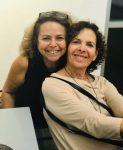
Claudie Azoulai, left, and Nicole Schouela. Their work comprises the exhibit Heart to Heart, which is at the Zack Gallery until Nov. 9. (photo from the artists)
The latest show at the Zack Gallery, Heart to Heart, presents the work of two artists in two vastly different media. Claudie Azoulai makes felt tapestries, while Nicole Schouela specializes in photography. Despite the differences in material representation, however, the colour palettes and the themes are amazingly similar – places close to their heart, places that invoke love and peace. The places and the emotions they inspire consolidate the show into a seamless, cohesive whole.
“We wanted to have a shared show forever,” Azoulai told the Independent. “We’re cousins, Nicole and I. We grew up together.”
They came up with the idea of a joint show about a year ago. “The timing is perfect,” said Azoulai. “It takes me, on average, about a month to create one piece, and there are 13 pieces of mine in this show, all new.”
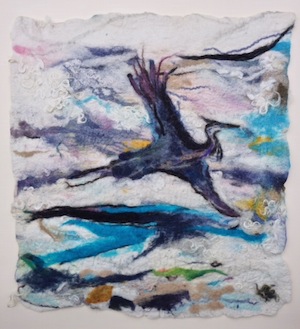
“Heron” by Claudie Azoulai.
All of these pieces are related to a children’s book Azoulai has written. “The book will be called The Spring Feast. It’s about the flora and fauna of Hornby Island, one of my favourite places. I will photograph every tapestry here, and they will be the illustrations for the book,” she said.
Azoulai considers herself a part of the great pageantry of life, and Hornby Island provides her with the opportunity to experience it firsthand. One of the tapestries, “Herring Run,” reflects her connection with nature.
“Every spring, herring come to Hornby Island to spawn,” she explained. “Then salmon come to eat the herring. Seals come to eat the salmon. Whales come to eat seals. Eagles fly over to eat the roe. Everything is alive, this great circle of life, and I’m part of it, too. When I come to Hornby Island in spring, I try to stay outside all day.”
Many of the tapestries depict various birds of Hornby Island. “I work from my imagination,” Azoulai said, “but when I need a particular pose or gesture, I go to the beach to watch the birds or look at photographs.”
Azoulai dyes her wool herself, and no batch comes out of the vat exactly the same, even if all the ingredients of the dye match. “Colours of the fleece always surprise me,” she said. “They influence the images. When I’m stuck, I would dye a new batch, and the new colours might affect the image, lead to a change. The colours dictate the picture more often than not.”
She frequently experiments with new materials, incorporating silk or synthetic particles into the base of wool to add a shine or a different texture. “As long as the fleece entangles the other threads, the image stays together,” she said about that technique.
Mixing and matching is also Schouela’s preferred technique, using Photoshop to work with different parts from a multitude of photographs.
“I have nine pieces in this show,” she said. “They are places I revisit often, not by traveling far away, but the places where I live and work. The places I walk. The places I love. The places that have almost a ritualistic meaning for me.… Sometimes, they are physical places. Other times, they are mental places.”
Schouela started her artistic life as a dancer, but dance is an unforgiving art form that takes its toll on the body. She switched first to ceramics, and later dedicated herself to photography. In everything she creates – a dance or a vase or a photo collage – there is movement and transformation. The images flow through each other, striving towards abstraction and emotional truth.
“Perceived Threat” by Nicole Schouela.
“Photo manipulation is freeing,” she said. “I could take pieces from here and there and create a new image I want, while it still retains the essence of the originals. It might take me several months to finish one picture. I would stop working with it and then, later, I would return to it again and again, until I’m satisfied.”
She photographs places that are part of her and her search for connections and understanding. By now, she has thousands of photos in her digital archives. “Sometimes, I would use a photograph or a fragment of one years after it was taken, because it would fit one particular composition or a feeling I want to explore,” she said. “I don’t want my images to resemble the real places. The original photographs are not important by themselves. They are part of the process. Sometimes, I play with pieces of 30 to 50 photos for one picture. It is fun.”
Schouela’s abstract compositions on the gallery walls lean towards pastel or black and white, with occasional splashes of bright colour. Some are geometrical. Others tell a story or convey an emotion.
“Traditional photography doesn’t interest me anymore – anyone can take a picture now with their phones,” she said. “I don’t want my imagery to be like paintings either. Photography is a separate art form. If I wanted a painting, I would paint. No, I want my collages to keep their photographic elements obvious.”
The exhibit Heart to Heart opened on Oct. 11 and continues until Nov. 9. To learn more about the artists, check out their websites: claudieazoulai.com and nicoleschouela.com.
Olga Livshin is a Vancouver freelance writer. She can be reached at olgagodim@gmail.com.
American political commentator Ben Shapiro will give the Faigen Family Lecture on Oct. 30. (photo by Gage Skidmore)
“We live in a world where opinions are formed, far too often, based on preconceived notions and emotion. A hallmark of the critical thinking that we impart in schools today is the ability to hear differing viewpoints and draw informed conclusions. We need to be able to engage, debate and discuss. We may ‘agree to disagree,’ but there needs to be an avenue for dialogue,” Rabbi Don Pacht, Vancouver Hebrew Academy’s head of school, told the Independent about the importance of the Faigen Family Lecture Series.
The series has featured five speakers to date: Israeli journalist Caroline Glick, American activist David Horowitz, American radio talk show host Michael Medved, British journalist Melanie Phillips and American political commentator Daniel Pipes. On Oct. 30, 7:30 p.m., at Congregation Schara Tzedeck, Ben Shapiro will join that list. The next day, he will speak to a sold-out event at the Chan Centre for Performing Arts, hosted by the University of British Columbia Free Speech Club.
Among other things, Shapiro is editor-in-chief of DailyWire.com, host of The Ben Shapiro Show and author of seven books.
“We were in touch with him almost two years ago,” said Pacht. “It took months and months to find a date that worked for him and did not conflict with other events in our community.
“He was certainly a household name when we first approached him, but it is not an exaggeration to say that he has grown considerably in his craft and has become quite the celebrity in recent years. We have already sold more tickets to this event than to any of our past lectures – including a packed house for Caroline Glick [in 2011] – and we anticipate that we will have another sell-out on our hands.”
The Faigen Family Lecture Series “began as a friendship between myself and Dr. Morris Faigen (of blessed memory). We would speak at length about politics and Israel and we often saw eye to eye on issues,” explained Pacht. “Many Jews often feel as though Israel gets a raw deal when Middle East politics are reported in the news. Dr. Faigen wanted to create a vehicle to spread a more balanced – and decidedly more pro-Israel – view.”
The process of selecting speakers was set in place by Faigen, who passed away in 2012. “His daughter, Gina [Faigen], leads a committee who meet to discuss various possibilities,” said Pacht. “The committee has a mandate – based on Dr. Faigen’s wishes and stated goals – and they will shortlist possible speakers based on these criteria.”
Pacht said the selection of Shapiro reflects the values of open debate and respectful dialogue.
“When my board chair, Glenn Bullard, and I spoke with Ben recently, we asked him directly whether he thought he was maintaining Jewish standards of respectful speech. He acknowledged it was a challenge, but he said, ‘If people want to cherry-pick something I’ve said on Twitter, all I can say is, you don’t look to Twitter for meaningful conversation.’ He hoped instead that people concerned about his tone would look at his work on many issues over many years.
“In the past,” said the rabbi, “we have had people who disagree with a point expressed by our speaker. That is your right. Our expectation is that conversations will focus on the corroboration of evidence and, as always, maintain the highest standards of menschlichkeit.”
With regards to the school’s mission, the lecture series gives VHA an opportunity “to step outside of our ‘zone’ and provide a service to the community,” said Pacht. “Obviously, our primary mission is that of Jewish education. This lecture series is a way that we can reach – and benefit – many within our community who will never see the inside of one of our classrooms.
“It fits well with our value of Israel as central to the life of every Jew and as the ancestral homeland of our people,” he added. “While our lectures are not geared towards elementary school children – we are more likely to see parents and grandparents in the audience – the message is one that is supported by the philosophy of the school.”
As for the physical future of the school, Pacht said VHA “has secured an eight-year lease with the Vancouver School Board. That gives us the security that we have been lacking for years. We know that we have room to grow in our current location.”
To support that growth, aging portables will be replaced with one large modular building. “We are currently on schedule for this renovation to be carried out in the summer of 2019,” said Pacht. “We are also thrilled to report that we are over 90% towards our fundraising goal for this project.”
Encouraged by “the generous response of our community,” he said, “We have no doubt that we will be able to make up the difference and reach our goal.”
The campaign will resume after the Jewish Federation of Greater Vancouver’s annual campaign has closed. “Meanwhile,” said Pacht, “we are moving forward with the process itself and our permit application has been submitted to the City of Vancouver.”
J.J. Goldberg, left, and Jonathan S. Tobin will participate in Left vs. Right: The Battle for Israel’s Soul on Oct. 23, 7:30 p.m., at the Jewish Community Centre of Greater Vancouver. (photos from JFGV)
On Oct. 23 at the Jewish Community Centre of Greater Vancouver, J.J. Goldberg and Jonathan S. Tobin will participate in Left vs. Right: The Battle for Israel’s Soul.
Representing the left is Goldberg, editor-at-large and senior commentator at the Jewish Daily Forward. On the right is Tobin, editor-in-chief of JNS.org and a contributing writer for National Review. The debate is one of a series that the two men are doing to model civil dialogue about contentious issues.
In a Jan. 24, 2018, article on the Goldberg-Tobin event that month at Temple Emanuel in Newton, Mass., which was organized by CJP (Combined Jewish Philanthropy) Strategic Israel Engagement’s CommUNITY Israel Dialogue initiative, Tobin is quoted as saying, “Don’t take away from this our talking points. Take away from this our ability to try to learn, to try to listen to each other. We’re both Zionists, we both love Israel. We interpret facts differently, but we think seriously about each other’s arguments.”
Of the debate they hosted, Hannah Rosenthal, chief executive officer and president of the Milwaukee Jewish Federation, said, “The program drew a large crowd and the debate was substantive and interesting. To us, the value of this program was not only that it helped us learn about the issues but also that we saw J.J. and Jonathan model civil, heartfelt and passionate debate about Israel. That kind of respectful communication over disagreements is rare and was refreshing. After the program, we posted all the audience questions online, urging people to continue the conversation.”
Tobin and Goldberg discuss many critical issues concerning the state of Israel in their two-hour debate. “Is Israel locked in a tragic dispute between two peoples claiming the same land – or a global conflict between Western democracy and Islamist terrorism?” gave Robin Wishnie, executive director of the Jewish Federation of Somerset, Hunterdon and Warren, as an example. “Is partition into two states the only way to ensure Israel’s survival – or is it the surest path to ever-increasing bloodshed and possibly even endangering Israel’s survival?”
Goldberg was the Forward’s editor in chief from 2000 to 2007. He has served as U.S. bureau chief of The Jerusalem Report and managing editor of the New York Jewish Week and his books include Jewish Power: Inside the American Jewish Establishment and Builders and Dreamers, a history of Labour Zionism in America.
Before entering journalism, Goldberg worked as an education specialist with the World Zionist Organization in Jerusalem, was a founding member and secretary-general of Kibbutz Gezer, near Tel Aviv, and was a New York City cabdriver. He has been a sharpshooter with the Israeli Border Police Civil Guard, a member of the central committee of the United Kibbutz Movement and a member of the Pulitzer Prize jury.
In addition to his roles at the Jewish News Syndicate (JNS.org) and National Review, Tobin is also a columnist for the New York Post, The Federalist, Haaretz and the New York Jewish Week. In his writing, he covers on a daily basis the American political scene, foreign policy, the U.S.-Israel relationship, Middle East diplomacy and the Jewish world.
Previously, Tobin was first executive editor and then senior online editor and chief political blogger for Commentary magazine for eight years. Prior to that, he was editor-in-chief of the Jewish Exponent in Philadelphia for 10 years and, before that, the editor of Connecticut’s Jewish Ledger. He appears regularly on television commenting on politics and foreign policy.
The Vancouver event Left vs. Right: The Battle for Israel’s Soul is co-sponsored by the Jewish Federation of Greater Vancouver, Centre for Israel and Jewish Affairs, Jewish Community Centre of Greater Vancouver, Jewish Independent, Ameinu, Or Shalom, Schara Tzedeck, Beth Israel and Temple Sholom. It takes place in the JCC’s Wosk Auditorium and starts at 7:30 p.m. There is no charge to attend but an RSVP is required to jewishvancouver.com/left-vs-right.
Hart Snider has followed up his award-winning animated short The Basketball Game with Shop Class, one of four National Film Board of Canada shorts selected for the 2018 Spark Animation Festival, which runs Oct. 25-28.
“I wrote and developed Shop Class while editing the TV series Yukon Gold, Klondike Trappers and Ice Pilots – documentary/reality series driven by ‘manly men’ who would run into big problems in remote locations, but then they’d break out some tools, rock music would start playing, there’d be a montage, and the guys would ‘man up’ to fix the problem,” Snider told the Independent. “While they were very successful shows, it made me laugh to be a not very macho guy telling these stories. It reminded me about being 14 and wanting to take home ec, but instead being forced to take industrial arts class, where my teacher tried to scare us into becoming men. I was inspired to write the story, which, yes, felt very cathartic – especially when I shared it with friends who also had him for a teacher.”
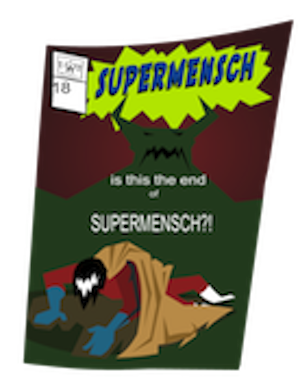
Not only does young Hart have to endure the bullying of his shop teacher, but he and his friends are targets for their bullying classmates. In one scene, Hart and his buddies are hanging out at a convenience store, when the friend checking out the latest Supermensch comic receives a punch in the stomach.
“The comic is not just a reference to being Jewish,” said Snider, “but to my first film. Shop Class is actually a sequel of sorts, to my 2011 National Film Board of Canada animation The Basketball Game, another autobiographical story. It’s about being 9 years old and at Jewish summer camp for the first time, when ex-students of notorious Holocaust denier/high school teacher Jim Keegstra come to our camp in Pine Lake, Alta., for a ‘day of fun and fellowship.’ Early in the film, my character is reading a Supermensch comic (which is there mostly because of the unnamed villain in Supermensch, seen fighting on the cover, that ends up inspiring a nightmarish transformation later in the story).
“Shop Class has a documentary-type scene that takes place in a convenience store, so I added a teenager reading Supermensch, issue #18, the same comic, to show that both the stories actually exist in the same cinematic universe.”
Every single character in Shop Class is voiced by Corner Gas and Dan for Mayor star Fred Ewanuick.
“Fred went from listening to me imitating my old teacher’s way of talking,” said Snider, “to stepping into the recording booth and totally bringing that character to life – and he did it just by saying, ‘Sit down, Turkeys,’ over and over until he totally nailed it.”
As for the other characters in the film, Snider said, “I’m still friends to this day with people I met in kindergarten at Talmud Torah in Edmonton, and I included a couple of them in both of my films. The love interest is totally inspired by my wife, Galit Mastai.”
The couple lives in Vancouver and, according to his bio, Snider “can usually be found either in an edit suite or at the park with his wife Galit, daughter Leora and dog Wolfie.”
In addition to writing and directing Shop Class and The Basketball Game, Snider also wrote and directed the animation segments for I Am Sam Kinison, a feature-length documentary about the late comedian that aired on Spike television. “I’ve edited animated short films as well,” he said, “including Lisa Jackson’s The Visit and Elisa Chee’s Lucy. Most recently (outside of animation), I’ve written and edited the theatrical documentary features I Am Heath Ledger and Botero, which will be released next year.”
On the NFB media site for Shop Class – on which he reveals his plan to create a third short “in this trilogy of animated films about growing up in Edmonton in the 1980s” – Snider traces his love of animation “back to being a little kid on Saturday mornings, glued to the TV. I have loved animation ever since,” he says, “but it took attending a screening of adult animation shorts (which included the film Lupo the Butcher by Danny Antonucci) when I was in high school to make me realize I really wanted to write and direct animated films. After interning at Nelvana animation in university, I thought I was on my way, until a job in post-production on a doc series about Cirque du Soleil back in 2001 led me on a totally different path as a documentary editor and writer.”
So, while he still loves animation, he doesn’t do the art for his films. “I just love telling stories using the medium,” he told the Independent, “and I’ve gotten to work with some brilliant artists – Sean Covernton animated The Basketball Game and the team at Jesters Animation, led by animation supervisor Brad Gibson, brought Shop Class to life.”
Shop Class screens Oct. 26, 11 p.m., at Vancity Theatre (19+). The NFB’s Animal Behaviour, by Jewish community member David Fine and Alison Snowden (jewishindependent.ca/animated-therapy-session), screens Oct. 25, 7 p.m., at Scotiabank Theatre. For the full festival lineup and tickets, visit sparkfx.ca.
Gilda Radner scrapbooking in Love, Gilda, a Magnolia Pictures release. (photo from Magnolia Pictures)
The late, great sketch comedian Gilda Radner is a Jewish icon. Offstage and out of character, however, she wasn’t especially Jewish.
“I think you would have to ask Gilda if she considered herself a Jewish comedienne,” mused Laraine Newman, her friend and fellow Jewish cast mate for the first five seasons of Saturday Night Live.
“I’d love to hear the answer,” replied Lisa D’Apolito, director of the deeply affectionate and painfully revealing documentary, Love, Gilda.
“Honest to God, I don’t know,” Newman said. “I couldn’t characterize her one way or the other. I would think that would have to come from her.”
In Love, Gilda, D’Apolito does the next best thing: she wisely channels her subject’s voice through a trove of clips, personal audiotapes and diary entries (read by contemporary comics Amy Poehler, Maya Rudolph, Melissa McCarthy and others).
Love, Gilda, which has screened at numerous Jewish film festivals to rousing applause, is part of this year’s Vancouver Jewish Film Festival lineup.
Radner grew up in a well-off Jewish family in Detroit. But her beloved father was diagnosed with a brain tumour when she was 12 and died two years later. Her mother delegated many of the child-raising duties, and the film hints that she was not the most supportive parent.
“Gilda was also raised by her nanny, who happened to be Christian,” D’Apolito related hours before Love, Gilda opened the San Francisco Jewish Film Festival in July. “So Gilda observed all kinds of different religions and what she identified with, I wasn’t really sure. I wanted to cover where I thought some of her insecurities came from. Losing her father was really important – and her mother putting her on diet pills.”
The nanny, Dibby, was the inspiration for one of Radner’s most popular SNL characters, Emily Litella. As for the diet pills, Gilda’s body image issues as an adolescent led to eating disorders that plagued her into adulthood.
“When I found the audiotapes, it was so different to hear her talking than to see her on an interview or hear people talking about her,” D’Apolito said. “It was just mesmerizing, because you get a real sense of Gilda. She’s sitting in a café talking to somebody, she’s ordering things, she’s telling stories and she’s extremely intelligent and extremely funny. That was really important to me, that an audience have the same experience I had.”
D’Apolito was guided in her interview choices – musician Paul Shaffer, actor Martin Short and writer Alan Zweibel, among others – by whom Gilda spoke about on the tapes. Alas, Gene Wilder, the love of Radner’s life according to D’Apolito, and her husband from 1984 until she died in 1989, was too ill to participate. (He died in August 2016.)
Gene Wilder, Gilda Radner and Sparkle in Love, Gilda, a Magnolia Pictures release. (photo from Magnolia Pictures)
“Gene was everything she was looking for, because he was a Jewish guy from the Midwest,” D’Apolito said of the Milwaukee native, born Jerome Silberman. “That’s what she always wanted, I’ve been told.”
Radner and Wilder met on the set of the 1980s film Hanky Panky, which originally was going to co-star Richard Pryor and was rewritten for a female lead. Wilder then directed Radner (and himself) in the equally disappointing comedies The Woman in Red and Haunted Honeymoon.
The brashness and vitality of Radner’s TV and stage work showed “that she never doubted that she was equal to any man,” D’Apolito said. “That’s what I take away from Gilda’s performances.”
Newman lamented that Radner’s movie career suffered because casting directors and producers lacked the imagination to cast her correctly.
“The specific nature of her talent was she did characters, and she would probably have been better served if she had taken part in writing the things that she did. But I don’t think it occurred to her,” Newman said. “If she and Alan Zweibel had collaborated on a feature, it might have been a whole different thing.”
D’Apolito’s connection to Radner goes back to the first videos she directed eight years ago for Gilda’s Club, a cancer support group founded by Wilder in New York after Radner died from ovarian cancer at age 42.
D’Apolito didn’t meet Wilder, however, until he invited the filmmaker to his house the year before he died. They spent a memorable day talking, and hanging out with his dogs.
“Somehow, at the end of the day, Gene and I just sat in the garden together,” D’Apolito recalled. “I could see why Gilda loved him.”
Love, Gilda (86 minutes, unrated) screens Nov. 8, 1 p.m., at Fifth Avenue Cinemas. For the full schedule of the Vancouver Jewish Film Festival, which runs Nov. 7-Dec. 2, visit vjff.org.
Michael Foxis a writer and film critic living in San Francisco.