More than 80 volunteers came together to help Jewish Family Services sort the food on Sept. 26, organizing nearly 1,300 bags of food and toiletries. (photos from facebook.com/JFSVancouver)
During this year’s Project Isaiah food drive, the Metro Vancouver community donated four months’ worth of provisions for the Jewish Food Bank, which will feed and support the 300 households who turn to the Jewish Food Bank each month.
More than 80 volunteers came together to help Jewish Family Services sort the food on Sept. 26, helping unload, box and organize nearly 1,300 bags of food and toiletries. The collection is a huge effort and JFS could not have done it without all of its partners across the Jewish community, as well as the countless individuals who donated and volunteered, and Vancouver Talmud Torah and Congregation Beth Israel who offered the use of their facilities.
The number of those who rely on the Jewish Food Bank continues to rise. JFS’s services also include home delivery to seniors and people with disabilities, and the recently launched Jewish Food Link program extends the agency’s reach to serve people in the Tri-Cities and Richmond areas.
Left to right: The Bayit president Michael Sachs, Richmond Mayor Malcolm Brodie and Marc’s Mensches winner Taya Benson. (photo from the Bayit)
Marc’s Mensches winner Taya Benson fundraised more than $7,500 for the Richmond SPCA, where she also volunteers every week. She was awarded the cash prize on Sept. 26 at the Pizza in the Hut event for Sukkot, which was co-sponsored by the Jewish Federation of Greater Vancouver and Marc’s Mensches. The event brought out a diverse crowd of more than 200 people, including many local officials and civic election candidates.
While the Marc’s Mensches initiative continues, the program is in the process of switching objectives: instead of being a contest, it will be focused on working as a group to do acts of chesed (loving kindness) around the city and community. “People can still nominate [youth] for the monthly gift card draw,” Bayit president Michael Sachs told the Independent, “but the main focus in Year 2 is harnessing the power of these mensches and doing good all over.”
In anticipation of the annual Shabbos Project – this year on Oct. 26-27 – where Jews from around the world, and from every level of observance, celebrate and experience Shabbos together, I decided I needed to get prepared.
On the continuum that is my journey to Yiddishkeit, I’m probably less than a third of the way there. I’ve chosen to take it one step at a time.
A few weeks ago, after a particularly inspiring Torah class, I broached the subject of Shabbos with my husband, Harvey. I asked him if he’d be on board with trying to observe it the following weekend. He tentatively agreed, knowing that, if he said no, I’d make his life a living hell. A smart man knows when to say yes.
A few days went by before I started planning in earnest for our Shabbos-ready tech shutdown. I confirmed with Harvey that we’d be powering off all our devices, taping the refrigerator and other light switches, using electric tealights to light the requisite rooms, and just generally relaxing for 24 hours. He agreed. All systems go. Or so I thought.
Shabbos candles – check. Tealights – check. Crock-Pot in which to make cholent – check. Beef, carrots, potatoes, etc., to cook the cholent – check. Challah – check. Wine – check. In my naiveté and enthusiasm to be shomer Shabbos, I hadn’t really considered everything that goes into preparing to do so. Not even close. And, of course, my lack of preparation came back to bite me in the proverbial tuchus.
Very early Friday morning, a note was slipped under our door, informing us that the water would be shut off from 9:30 a.m. to 1:30 p.m. that day. I was thrown headlong in a haze of cholent-making confusion. Instead of starting my cholent at 3 p.m. to be ready for lunch the next day, I panicked and started assembling it at 7:30 a.m. So, we had cholent for dinner Friday night, for lunch on Saturday and, yes, again for dinner Saturday night. You can see where this is headed: cholent overload.
A real Shabbos queen would have made an array of cold salads, had a back-up chicken for Friday night dinner and another main dish for Saturday dinner. I could find a thousand excuses for why I hadn’t thought this through, but none of it matters now. Luckily, I have a very easygoing husband, when it comes to food. Put it in his bowl or on his plate, he’ll eat it. Don’t get me wrong, Harvey is a real connoisseur when it comes to good food and wine. But he also knows when not to complain. So, he ate cholent three meals in a row. And it didn’t kill him. As for me, I was slightly embarrassed that I hadn’t planned more thoroughly for a beautifully scrumptious Shabbos experience. Food’s a big part of all this, right?
The lack of variety in food was accompanied by several, how shall I call them, Shabbos slips. Halfway through lighting the candles, I remembered that I hadn’t changed the Crock-Pot timer to 10 hours, so I did it. “Broke” Shabbos. But I carried on, certain that G-d would forgive my little error. And confident that there is more likelihood of us trying to keep Shabbos again if we don’t approach it with an all-or-nothing attitude. Baby steps will keep us on the right path, whereas a “let’s call the whole off” right now because I messed up with the Crock-Pot will turn us off forever. There were a few other Shabbos boo-boos, like writing something down on a piece of paper. And carrying my purse to shul. Oh, and that pesky little detail of not keeping kosher.
I’ve actually studied a bit about how to keep Shabbos. I just haven’t put it all into practice quite yet. Not even close. But the intention and desire is there. I have to admit, I have a small obsession with understanding new things fully before embracing them. Reading before doing. I guess that’s a residual habit from spending 34 years as a librarian. In case you weren’t aware, librarians can’t rest until they have all (or most) of the answers. So, the journey continues.
The best part of Shabbos for me, besides lighting the candles and eating the delicious challah I made, was having my husband’s undivided attention, and he, mine. The time we spent talking on that one Friday night is probably equal to the time we usually spend talking all week. After nearly 13 years together, I learned new things about Harvey that Shabbos. In an atmosphere of love and relaxation, with no distractions of any kind, we eased back into each other’s lives calmly and sweetly. It was wonderful.
On Saturday, in the late afternoon before Shabbos ended, I walked into the living room and sat down. Harvey looked at me with a touch of fear in his eyes and asked: “Does this mean we have to talk again?” I guess the feeling about the beauty of it all was slightly inequitable. But I’ll keep trying. There’s always next Shabbos.
Shelley Civkinis a happily retired librarian and communications officer. For 17 years, she wrote a weekly book review column for the Richmond Review, and currently writes a bi-weekly column about retirement for the Richmond News.
Millie Krause, who runs Elman’s, with receptionist Bonita Bouchard. (photo from Elman’s)
They started making horseradish 80 years ago and haven’t stopped. Elman’s Food Products is still making horseradish in small batches and, over the years, they have added new pickled products to the mix.
Today, Elman’s is run by Millie Krause, widow of the founder’s son, Manny Finkleman, who passed away in 2004. The company is gradually increasing its reach west from Winnipeg, led by Millie Krause’s daughter, Payton.
Six years ago, Payton Krause moved to Vancouver to be closer to friends and expand the family business, in which she first started working in the late 1980s. By then, the family had moved the company out of the garage and into its current-day location on Jarvis Avenue in Winnipeg’s North End.
“At that time, Payton, my daughter, was working here,” Millie Krause told the Independent. “And that was good, because she could keep an eye on things while I was running back and forth to hospitals, and taking Manny back and forth to this and that.”
In 2004, Manny Krause passed away. Since then, the brunt of the management has been in his wife’s hands.
“It was a really big learning curve for me, because my background was in sales. It took awhile,” she said. “Everybody wanted the same deals that Manny used to give and they didn’t really know who I was … but we survived.
“I always say that, if you don’t know something, find out. Just ask. If we look a little stupid or something down the road, who cares? Just get it done. That’s really the attitude we took it with. Now, what Manny said to me before he passed away … was that I should run it [Elman’s] for a couple of years, with Payton’s and everyone’s help … and then, sell it. So, 15 years later, I’m still here. The thing is, back then, when Manny was running the business, he ran it, if I might say, by the seat of his pants. He dealt with every problem that came up at the time, but he didn’t really remember what he did the next time, so it was like constant chaos.”
She and her daughter have tried “to reformulate the company and brand it – brand it into something that maybe wasn’t there at the time,” she said.
They position their products in the specialty food section, staying away from big retailers like Walmart and Giant Tiger. They sell the product by promoting the story behind it – making sure people know they’re a small, local family business with a long history in the city.
“I think we’ve succeeded in doing that,” said Krause, saying the process has “been a little slow.”
“Before Manny passed away,” she explained, “we were shipping from Winnipeg to Thunder Bay, and then west, but in very small ways. Then, Payton wanted to move out there, as apparently she needs mountains and water around her, and she wanted to open it up further. Actually, she’s done that.”
Expansion means winning over new clients, and that is exactly what her daughter is achieving in Vancouver.
“In fact, Payton had to pass a taste test,” said Krause. “Some of the wannabe customers she went to call on cut up 10 slices of pickles and said, ‘OK, now, which one is yours?’ And, I think she thought, ‘Sheesh! What if I get this wrong?’ But, she got it right.”
One breakthrough is that Elman’s pickles are included in all B.C. Ferries’ burgers. “They put the pickle on the top of the bun,” said Krause.
As another example, she said Elman’s are also used by Fairmont Hotels in Vancouver.
“The goal is to obviously get more business,” she said. “Up until this point, we didn’t have a lot of boots on the ground. We don’t have salespeople. The only ‘salespeople’ we have is Payton in the Vancouver area, but she has managed to do quite well. That is her goal – to get as much business as we can. It will hopefully get to a point that we can get enough business to be busy continually.”
Krause is hoping to get in with another large food service restaurant, which would allow Elman’s not only to be busier but to have the working capital to keep operations going. According to its website, the company currently has about 10 regular staff and casual employees.
Elman’s products carry a kosher certification from OU Kosher. For more information, visit elmans.ca.
One of the few things in life that we can absolutely count on is change. Therefore, no matter what age or stage in life, just about everyone has a need for insurance. It is especially important to have a review-revise-repeat approach when it comes to planning for you, your family and your ever-changing lifestyle and situation.
Do you have assets that you don’t plan on spending in your lifetime? Do you want to leave an inheritance but are worried about leaving your family with a large tax burden? A cascading life insurance strategy is a simple way to preserve your wealth for the generations to come.
Cascading life insurance is an intergenerational transfer of wealth, allowing grandparents to provide a significant legacy to their grandchildren without giving up control during their lifetime. It is an efficient tax-advantaged way to preserve your wealth for those you love by taking advantage of the tax-sheltered features of permanent life insurance.
The best way to be prepared is with a well-thought-out plan. Let’s take a closer look at how to use cascading life insurance. Here’s how it works.
Purchase a permanent life insurance policy with your grandchild as the life insured. If your grandchild is not the age of majority, their parent (your son or daughter) can be the contingent owner. When a contingent owner is named, the policy ownership will automatically transfer to the contingent owner without tax.
You or your son or daughter can be named as the beneficiary. Similar to the ownership structure noted above, you can be the beneficiary and your son or daughter can be the successor beneficiary.
Some of your non-registered assets will be used to fund the policy, thus reducing your future annual tax burden. The funds invested in a life insurance policy will allow for accumulation of cash value inside the policy, and you don’t have to pay income tax on its growth. Upon your death, the ownership of the policy is transferred to your adult child as contingent owner (or your grandchild, if the age of majority) without your estate paying any tax on the cash value growth. The transfer is free of probate, executor and legal fees.
The cash value in the policy remains completely accessible and in your control while you’re alive in the event that you do require additional income.
Meet Brian and his family
Brian is 66. He has $300,000 invested that he doesn’t need to meet his own costs of living. Brian wants to minimize the amount of tax he pays on his non-registered portfolio. In addition, he wants to shelter those assets from tax and probate fees when the assets are transferred to his grandson James, Janet’s son, who is a minor today.
Brian purchases a permanent life insurance policy and deposits the $300,000 into the policy over a 10-year period. Brian is the owner of the policy, and he names Janet as the contingent owner. The insurance is placed on his grandson James’s life and his daughter Janet is the beneficiary of the policy.
When Brian dies, Janet will become the owner of the policy, since she was named as the contingent owner. Janet can continue to own the policy indefinitely or transfer the policy to James when she thinks he is fit to be the owner.
The cash value will continue to accumulate in the policy and will be eventually owned by James.
Now, here’s the important part: the policy, when transferred from Brian to Janet and eventually from Janet to James, will pass along with its cash value, free of tax and probate fees.
James will have a few options:
Access cash value from the policy (a taxable event),
Borrow money using the investments in the policy as collateral, providing him with tax-free cash flow, or
Change the beneficiary to his children, ultimately creating a lasting legacy passed down through four generations.
Insurance is a valuable and creative tool that can help provide peace of mind for you, your family and their financial future. The cascading life insurance policy provides several benefits:
Permanent life insurance protection and control of capital in a tax-exempt life insurance policy.
The ability to accumulate tax-exempt cash within the life insurance policy.
The ability to transfer the policy’s cash value growth tax-free to your grandchild, who is the only life insured on the policy.
Death benefit proceeds are paid out tax-free to named beneficiaries at the death of the life insured.
Probate fees are not applicable on the life insurance proceeds upon the death of the life insured with a named beneficiary other than the estate.
The cascading life insurance strategy is designed for individuals who have annual tax obligations from non-registered investments, who would like to reduce the tax burden upon their death and are interested in legacy planning (family and charity).
Philip Levinson, CPA, CA, is an associate at ZLC Financial, a boutique financial services firm that has served the Vancouver community for more than 70 years. Each individual’s needs are unique and warrant a customized solution. Should you have any questions about the information in this article, he can be reached at 604-688-7208 or plevinson@zlc.net.
One of the last problems you’d expect in creating a power of attorney is to find your company losing a bunch of tax advantages because the Canada Revenue Agency (CRA) decides you and the person you appointed in the power of attorney have related companies.
If your company is small and Canadian-controlled, it gets certain tax advantages; however, CRA doesn’t want you to break a large company into a bunch of small pieces to multiply those tax advantages. If you give each of those pieces to a different person, but maintain control through powers of attorney, CRA will still consider all those pieces to be one company.
Unfortunately, CRA doesn’t recognize the difference between a general power of attorney used to control a company and an enduring power of attorney used to help someone when they’re incapacitated. Here’s an example of the trap that can happen if you’re not careful with a power of attorney.
(Disclaimer: this is not tax advice; it is a simplified illustration of the small business tax rules and how they’re applied with respect to control and powers of attorney.)
I’ll give you two scenarios. The first one illustrates what CRA is trying to avoid, and the second one illustrates what it catches by accident.
First scenario: avoiding multiplication of the small business deduction
Patricia Hindenburg has three adult children: Roberta, Paulina and Bradley. She runs a clothing company, Whole Lotta Cashmere Fashions Inc., with stores in the Kitsilano, Yaletown, Commercial Drive and Marpole neighbourhoods.
Whole Lotta Cashmere Fashions is doing very well. Last year, it earned $2.4 million before tax. The company is a Canadian-controlled private corporation and is eligible for the small business deduction. The deduction means that, instead of paying about 35% income tax on $2.4 million, Whole Lotta Cashmere Fashions only pays that on $1.9 million. The first $500,000 is taxed at about 10%. (Again, these are not the real tax rates and I’m simplifying the calculations.)
Patricia realizes that, if she split the company into four companies, each owned by a different person, the companies would together pay 10% on $2 million and only $400,000 would be caught by the higher tax rate. So, she splits the company into four, giving one to each of her children and keeping one for herself. This way, each of the four companies will be eligible for the small business deduction – each will only pay 10% on its first $500,000 of earnings.
To make sure that the companies remain successful and operating just the way she likes, Patricia asks her kids each to grant her power of attorney over their voting shares in their companies.
She now has control over all four companies. Their combined income is still around $2.4 million, but she believes the collection of companies has a small business deduction of $2 million instead of $500,000. She expects to pay 10% on $2 million and 35% on $400,000.
CRA does not allow this, however. Because of the powers of attorney that give Patricia control over all of the companies, CRA taxes them as one big company the same way it did before the split.
This seems fair. If the companies are truly independent, they should each get the small business deduction but, if you split a big company into a bunch of smaller ones and you maintain control over them, you don’t get a bunch of small business deductions.
Second scenario: getting tax-trapped in incapacity planning
Stephanie Edwards has a metalworks shop, Icarus Metalworks Inc., that is doing very well. She has apprenticed each of her five children, Adriana, Murray, Nicole, Dickens and Jan, in the art and trade of blacksmithing.
A few years ago, Adriana and Dickens decided they prefer ceramics, and they opened their own company, Can I Play With Porcelain Ltd.
Last year, Icarus earned $700,000. Can I Play With Porcelain did pretty well too; it earned about $450,000.
Icarus should pay 10% on the first $500,000 and 35% on the remaining $200,000. Can I Play With Porcelain is under the limit for the small business deduction, and should only pay 10% on all $450,000 of its earnings.
Unfortunately, after all these years of literally bending iron and steel to her will, Stephanie has serious joint problems. She is finding it hard to write. This has her thinking about making sure her kids can take care of things for her if (and when) she’s unable.
Stephanie thinks carefully about her kids, and who would be in the best position to help her. She decides to grant an enduring power of attorney to her eldest, Adriana. The power of attorney is, as is the case with most enduring powers of attorney, unrestricted and it is effective from the moment it is signed. Stephanie wants to make sure that Adriana can help her even while she is still capable, because she doesn’t know for how much longer she’ll be able to sign cheques, etc., given her joint problems.
Here’s the trap: the CRA determines that the power of attorney allows Adriana to use Stephanie’s shares to control Icarus. This is true – Adriana can do anything on behalf of Stephanie that has to do with finances (including business, real estate and legal matters). Therefore, Icarus Metalworks Inc. and Can I Play With Porcelain Ltd. are now considered related companies. Can I Play With Porcelain Ltd. loses its small business deduction. Between the two companies, the first $500,000 is taxed at 10% and the remaining $650,000 is taxed at 35%.
Is there a way around this? Yes.
Two powers of attorney are prepared, both enduring, both restricted – in exactly opposite ways – and one is made “springing.”
In the first instance, Stephanie grants an enduring power of attorney to Adriana, effective immediately and without any limits or restrictions except that Adriana may not use it to vote or in any other way act on Stephanie’s shares of her company, Icarus Metalworks Inc.
This will probably cover about 95% of what Stephanie needs Adriana to do.
Eventually, Stephanie may lose capacity and need Adriana to take control of her company. At that point, the benefit of Adriana controlling Stephanie’s shares will outweigh the tax consequences. There’s also the slim hope that by then, the Income Tax Act will be amended so as not to catch enduring powers of attorney anymore.
Stephanie grants a second enduring power of attorney to Adriana, but this one has two limitations in it. It only applies to Stephanie’s shares of her company, to avoid any confusion regarding which power of attorney applies in any given situation. Also, it is not effective until Stephanie loses capacity – this is called a “springing” power of attorney. It springs into effect only when Stephanie is no longer capable of managing her affairs. This prevents CRA from considering the companies to be related until it’s absolutely necessary, and this is a recognized technique among lawyers who practise regularly in the areas of estate and incapacity planning.
Jeremy R. Costin, JD, is a business, estates and ecommerce lawyer at Costin Law. He can be reached at 604-742-0717 or jeremy@costinlaw.ca.
Aretha Franklin sings “My Country ‘Tis of Thee” at the U.S. Capitol during the 56th presidential inauguration in Washington, D.C., Jan. 20, 2009. Franklin is one of many celebrities who died without a will. (photo by Cecilio Ricardo, U.S. Air Force)
The passing of Aretha Franklin in August sparked a lot of response, once it became known that she did not make a will. It is, in some sense, shocking that, with an estate estimated to this point as valued at $80 million – and, of course, her estate will continue making money, from record sales, merchandising and so forth – somehow she could not find time to make a will.
And she is hardly alone in that conundrum. Many celebrities have died intestate (without a will), as you will see. The real question is why.
Franklin was a brilliant, very hardworking person. She had a gifted voice and she was raised in a musical family – her father apparently sang in church and was a good singer in his own right. Without a doubt, she overcame numerous obstacles, not the least of which was that, at the start of her career, the United States was still a segregated society. The late great singer-songwriter, Otis Redding wrote the song “Respect” in 1965. Franklin turned the well-written song into an earth-shaking song, which was released in 1967. In the Rolling Stone magazine compilation of the top 500 songs of all time, “Respect” was No. 5.
Ironically, perhaps, a relevant portion of the lyrics for this column goes as follows: “I’m about to give you all of my money / And all I’m askin’ in return, honey / Is to give me my propers / When you get home (just a, just a, just a) / Yeah, baby (re, re, re, re) / Whip it to me (respect, just a little bit) / When you get home, now (just a little bit) / Ooh, your kisses / Sweeter than honey / And guess what? / So is my money….”
Excellent lyrics, to be sure, and groundbreaking for the times. Perhaps it was a battle cry for millions of women in the day. And it was hardly her only big hit. As most readers will know, Franklin had many major hits.
With such success and obviously a high level of income over many years – how else do you accumulate an estate worth $80 million? – it is not easily understood why Franklin never made a will. As she grew up poor, perhaps nobody could convince her that a will was needed. Perhaps she was busy enough that she felt she could always “do it later” (a common sentiment in North American society), though, given she had pancreatic cancer, she would surely have had time to do some planning.
What we do not yet know is the status of her relationships with her family members. Perhaps she did not want to make a will and was not overly concerned with the distribution of her estate. Perhaps she wanted to bequeath assets to charities, which might have angered her family. Certainly that won’t happen now, given the nature of intestacy law. The law of Michigan, Franklin’s home state, is that, without a will, an estate is distributed among children. Franklin had four children. But it is presumably possible that the nature of her relationship with her children had a lot to do with her apparent decision to do little or no estate planning.
Some of the other celebrities who did not have wills when they died include:
Sonny Bono, former partner of Cher, died in a ski accident in 1998, without a will. His estate was valued at $4 million. His surviving wife, Mary Bono, had to launch proceedings in probate court to be named executrix.
Prince died in 2016 without a will and with an estate valued at $200 million. Numerous persons claimed to be a former wife, sibling, child or other relative. Though a judge last year ruled in favour of Prince’s surviving sister and five half-siblings (to get the estate), others have filed appeals, so the estate will not likely be resolved for years.
Bob Marley died in 1981, leaving no will. Under Jamaican law, his estate was to be given to his wife and 11 children. However, more than 30 years later, the estate remains in litigation.
Jimi Hendrix died in 1970, also without a will. The estate was fully settled 45 years later, with a resolution regarding the commercial use of Hendrix’s likeness.
Kurt Cobain (photo by Run Mizumushi-Kun)
Kurt Cobain, who died in 1994 without a will, left a $450 million estate. The estate was apparently resolved in 2010.
Pablo Picasso died in 1973, leaving an estate that cost $30 million to resolve (in a six-year battle). The incredible artist died without a will … he could have at least painted one!
So, do you really need a will? The short answer is yes, and here are some reasons.
Even if you are a young family with no major assets except for a heavily mortgaged residence, once you have children, you should make a will. A will is the best – and perhaps least expensive – document in which to appoint a guardian for minor children. Without it, grandparents will battle the province for custody of your children.
Another reason to make a will is that an executor is appointed under a will. This means that somebody is there to manage your estate and deal with Canada Revenue Agency, all the beneficiaries, the province, and so forth. Without a will, somebody has to step forward and apply to become administrator. That takes time and, before the Supreme Court of British Columbia grants letters of administration, the would-be administrator has no legal authority, so it ends up taking a lot more time to deal with the estate, and it will probably cost more as well. The beneficiaries will not be pleased.
Yet another reason to make a will is to have control over where, to whom and how much to whom your assets will go. Without a will, chances are that some person you may not have intended will receive something from the estate.
As well, if you own a residence in the Lower Mainland, you have a large estate now. With a will, you can control when a child receives her or his portion of the estate. Without a will, a child will receive their portion when they reach age 19. That may not turn out well because not all 19-year-olds can manage a large inheritance. It may be overwhelming for such a person, having just lost her or his parents.
Having a will brings order to an estate and a family at a time when they need it. And it is a statement of the will-maker’s wishes. A person who owns the assets should be able to decide who gets what, and when. That can really help a family.
Whether celebrities have a sense of invincibility, are not getting good advice, or are just like the rest of us – surveys say that half of all Canadians don’t make wills – too many of them are not making a will. Their agents should be more firm with them, making sure they see a lawyer and get the advice they need. People do not do their families any favours by not making a will. Those who die intestate may be bestowing attorneys with the major portions of their estates.
Jack Micner is a barrister and solicitor at Spry Hawkins Micner. He can be reached at 604-233-7001 or jack@willpowerlaw.ca.
The anthology Miracle Nation: Seventy Stories About the Spirit of Israel; A Tribute to Rebirth in the Land of Our Ancestors by Israela Meyerstein (Mazo Publishers, 2018) highlights the amazing achievements of Israel in the 70 years since its rebirth in 1948. It contains the stories of ordinary people leading lives of courage, altruism and inspiration; stories that embody tikkun olam, repairing the world, which is at the heart of Judaism.
Meyerstein, a family therapist for more than 40 years, dedicated the book to Israel’s 70th birthday and in memory of relatives who perished at Treblinka. Each of the stories, many of which are contributed by writers other than the author, reminds us of how much there is to be proud of, as well as offering hope and optimism for the work still to be done.
Shlomo Alima, in “Destination: Return to Zion,” tells of his Iraqi ancestors, who were from the oldest Jewish Diaspora community in the world. His family left everything behind in 1925 to pursue their destiny in Israel. Their long, dangerous journey was made on donkeys, camels, bicycles and taxis – a two-month trek through Syria and Lebanon. They settled in Bet Yisrael, near Mea Shearim, and, in a two-room house, his grandparents raised 12 children. (Sadly, at only 30 years old, his father was murdered.)
Rabbi Micha Odenheimer contributed “Tevel b’Tzedek: Creating a Just, Compassionate and Beautiful World,” about a caste called the Mahji, who lived on the hills nearby rivers cascading from the majestic snow-covered Himalayas. They lived by fishing, both for feeding themselves and for trading with their neighbours, who grew rice, corn and wheat. Eventually, however, new roads brought people from other castes, who used explosives to kill the fish and bring them to the surface, and the Mahji ended up working in a brick factory, in order to survive. In addition, logging depleted the forests such that, during the monsoon season, the torrential rain couldn’t be absorbed into the earth quickly enough to recharge the springs that were needed in the dry season. Their life became unbearable.
But, a few years ago, something changed. An Israeli organization called Tevel b’Tzedek came to the area and joined up with a Nepali group, helping them grow enough crops for their own needs as well as for sale. Tevel b’Tzedek is Hebrew for “earth in justice.” Founded by Rabbi Micha Odenheimer in 2007 with 15 volunteers, there are now 800 volunteers, working with others to help some 40,000 Nepalese living in slums and villages.
Tevel b’Tzedek is just one of the many such Israeli organizations featured in this book. Another is Eco Peace Middle East, an environmental project that brings together young people from both sides of the Jordan River and the Dead Sea to try and prevent the waters from drying up, and to conserve water.
Pikuach nefesh (saving a life) is illustrated by stories of amazing acts by the Israel Defence Forces and of field hospitals for wounded Syrian civilians. Israeli hospitals offer medical care to Jews, Christians, Muslims, Druze – all nationalities and ethnicities without bias. There are wonderful organizations like Magen David Adom, Natal, Zaka and others that are always ready to save lives.
Another notable institution is Leket Israel, started by Joseph Gitler, a lawyer from New York. He found a way to garner good, surplus food – thrown out by supermarkets, caterers at event halls and farmers who grew too much – and collect it for those who need it. Leket is now an enormous food rescue network, which annually has 50,000 volunteers and feeds hundreds of thousands of Israelis every week.
Another miracle in Miracle Nation is described in “Oasis of Peace: Can a Song Heal?” by master musician Yuval Ron. Neve Shalom (Oasis of Peace) is a village where Jewish, Christian and Muslim families remain faithful to their own religious traditions, while dedicating their lives to advancing peace. It began as a dream of Father Bruno Hussar, who was born in Egypt and brought up in France. Only in adulthood did he discover that his family was Jewish. He started Neve Shalom on a monastery hillside, living alone until five families joined him. Today, the community is thriving – visitors from all over the world, including those who work for nongovernmental organizations and the United Nations, come to study in Neve Shalom. Friends of Oasis of Peace now exists in 11 countries.
On every page of this inspiring book, you will find a reason to be proud of this “miracle nation” – Israel – and its contribution to making the world a better place.
Dvora Waysman is a Jerusalem-based author. She has written 14 books, including The Pomegranate Pendant, which was made into a movie, and her latest novella, Searching for Sarah. She can be contacted at dwaysman@gmail.com or through her blog dvorawaysman.com.
ישראלים קונים, מוכרים ומוסרים בוונקובר והסביבה: מדובר בקבוצה סגורה בנושאי מכירה, קנייה ומסירה.
הישראלים שגרים בקנדה הקימו קבוצות באתר פייסבוק בערים שונות, בנוסף על קבוצות הישראלים בטורונטו ובוונקובר. בעיר השנייה בגדולה בקנדה – מונטריאול, פועלות מספר קבוצות של ישראלים. בהן: ישראלים במונטריאול – מדובר בקבוצה סגורה שמתמקדת בעסקים, שירותים, מודעות דרושים ואירועים המיועדים לקהילה בעיר. הקבוצה כוללת כשבע מאות חברים והיא נוסדה לפני כשנתיים. קרובים רחוקים במונטריאול – מדובר בקבוצה סגורה שמתמקדת במפגשים חברתיים לקדם את התרבות הישראלית והשפה העברית בקרב הישראלים, וכן לאפשר חיבור בין הישראלים שכבר חיים במונטריאול לישראלים שעוברים לגור בה. הקבוצה כוללת כחמש מאות וארבעים חברים והיא נוסדה לפני כארבע שנים. מועדון קוראות מונטריאול – מדובר בקבוצה סגורה שכוללת מפגשים פעם בחודש בנושא ספרים בכלל ומה שקורה בחיים בפרט. הקבוצה כוללת כשבעים חברים והיא נוסדה לפני כארבע שנים. אירועים בעברית במונטריאול – מדובר בקבוצה פתוחה שפועלת לרכז את כל האירועים בשפה העברית. הקבוצה כוללת כשישים חברים והיא נוסדה לפני כשלוש שנים. קבוצות קטנות נוספות במונטריאול: מונטריאול, לשאול, לטייל ולשתף ואין טראנזיט-קבוצת פרוייקט מונטריאול.
גם לישראלים באוטווה יש קבוצה: מדובר בקבוצה סגורה שכוללת כחמש מאות ושמונים חברים והיא נוסדה לפני כשש וחצי שנים. יש אף קבוצה קטנה לישראלים בוויניפג: מועדון אוהבי הספרים-ויניפג מניטובה. מדובר בקבוצה סגורה שכולל כשלושים חברים בלבד והיא נוסדה לפני כשלוש שנים.
במחוז אלבטרה יש שתי בקבוצות. ישראלים באדמונטון: מדובר בקבוצה פתוחה שמתמקדת בעסקים, שירותים, מודעות דרושים ואירועים המיועדים לקהילה בעיר. הקבוצה כוללת מאה ארבעים ושמונה חברים והיא נוסדה לפני קרוב לארבע שנים. ישראלים בקלגרי והסביבה: מדובר בקבוצה סגורה שנוסדה כדי להכיר אחד את השני, לעזור אחד לשני ולקרב לבבות. הקבוצה כוללת כארבע מאות וארבעים חברים והיא נוסדה לפני כחמש שנים.
להלן עוד מספר קבוצות קטנות בוונקובר: ישראלים קונים, מוכרים ומוסרים בוונקובר והסביבה: מדובר בקבוצה סגורה בנושאי מכירה, קנייה ומסירה. הקבוצה כוללת כשלוש מאות ושמונים חברים והיא נוסדה לפני כשנה. ישראלים שטוב להם בוונקובר: מדובר בקבוצה סגורה לניהול דיונים בנושאים שונים. הקבוצה כוללת כארבע מאות ועשרים חברים והיא נוסדה לפני כשלוש שנים. ישראלים מבשלים בוונקובר: מדובר בקבוצה סגורה שחברים בה כמאתיים ושישים חברים והיא נוסדה לפני כשנתיים וחצי.
להלן מספר קבוצות נוספות של ישראלים בקנדה. סטודנטים ישראלים בקנדה: מדובר בקבוצה סגורה שמיועדת לסטודנטים הלומדים בקנדה, או כאלה שרוצים ללמוד בה, וכל כל מי שמעוניין לקבל כל סוג של מידע על לימודים בקנדה. הקבוצה כוללת כשש מאות וארבעים חברים והיא נוסדה לפני כשנתיים. קנדה למטיילים: מדובר בקבוצה סגורה כדי לחלוק ולשתף מידע על ההכנות הדרושות לטייל בקנדה, טיפים והמלצות ממי שכבר טייל כאן וייעוץ למטייל. הקבוצה כוללת כאלף שמונה מאות וחמישים חברים והיא נוסדה לפני כשלוש שנים. ישראלים צעירים בקנדה: מדובר בקבוצה סגורה שמיועדת לצעירים שחיים או מבקרים בקנדה ומעוניינים להיות חלק מהקהילה כאן. הקבוצה כוללת כאלפיים חברים והיא נוסדה לפני קרוב לשנתיים. ישראלים בקנדה-ארה”ב: קבוצה סגורה למי שמחפשים עבודה, עובדים, עסקים נדל”ן, מידע על אירועים חברתיים, אטרקציות, בתי ספר וגנים, מלונות, מתכוני אוכל, בייביסטרים, בתי כנסת ועוד. הקבוצה כוללת כשלושת אלפים חברים והיא נוסדה בראשית השנה הנוכחית. קבוצות קטנות של ישראלים בקנדה: ישראלים גולשים בקנדה, חילופי בתים בין ישראלים בקנדה וארה”ב, ישראלים בקנדה מעבירים הלאה וישראלים בקנדה זה הכי טוב שיש.
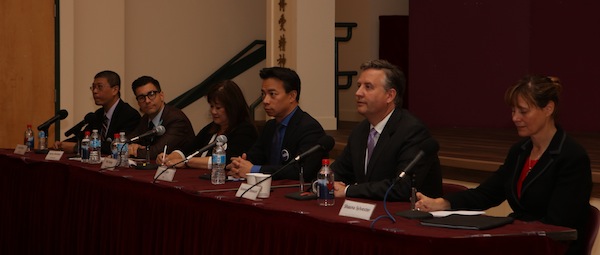
A full house came out to the CIJA-SUCCESS townhall Sept. 23, which featured six Vancouver mayoral candidates. (photo from CIJA)
The refracted nature of Vancouver’s civic politics was on full display at a candidates meeting featuring six of the perceived front-running candidates for mayor. The near-implosion of the governing Vision Vancouver party, combined with divisions among erstwhile Non-Partisan Association members, has led to a race with both the left and right sides of the political spectrum divided and struggling to gain traction in a campaign with 21 contenders.
The afternoon event Sept. 23 was co-sponsored by the Centre for Israel and Jewish Affairs and the multicultural organization SUCCESS, which is rooted in the Chinese-Canadian community. Veteran Vancouver broadcaster Jody Vance handily moderated the occasionally raucous meeting.
Housing affordability topped the list of issues, with Kennedy Stewart, a former NDP member of Parliament for Burnaby-South who resigned that seat to run for Vancouver mayor as an independent, said his plan to attack unaffordability calls for building 85,000 new homes over the next 10 years, including affordable and market rentals.
Ken Sim, an entrepreneur who founded Nurse Next Door and Rosemary Rocksalt Bagels and who is the candidate for the centre-right Non-Partisan Association (NPA), responded by claiming that the construction industry does not have the capacity to meet Stewart’s construction schedule.
Wai Young, a former Conservative member of Parliament for Vancouver South, is running with a new party, called Coalition Vancouver, which was originated by a group of former NPA members who felt betrayed by what they call a lack of democracy in that party.
“Vancouver does not have a supply issue,” Young said about the housing situation. “There are no millionaires wandering around Vancouver that are unable to buy a house or a luxury condo. The issue is that we are not able to keep our young people, our young families, here because they can’t afford to buy a house. We have an affordability issue in Vancouver.”
“If I am mayor, we will have a three percent vacancy rate,” said Shawna Sylvester, who is running as an independent but has roots in Vision Vancouver. The rate today is about zero. She supports more co-ops, cohousing and what she called “gentle densification,” as well as addressing how the housing situation has particular impacts for women, who experience poverty in greater proportions than men.
Left to right are David Chen, Hector Bremner, Wai Young, Ken Sim, Kennedy Stewart and Shauna Sylvester. (photo from CIJA)
Partly related to the affordability issue is the topic of Vancouver’s reputation as a place that is welcoming of people from diverse backgrounds.
David Chen, who is running with another new party, ProVancouver, noted that racism is alive and well in the city.
“My parents were first-generation Taiwanese [Canadian],” said Chen. “I was born in St. Paul’s [Hospital] because, at that time, it was the only hospital they were allowed to go to. During this campaign, I heard somebody say to me, ‘Go home.’ Well, I am home.” He added: “We haven’t progressed as much as we should or could.”
The NPA’s Sim echoed the experience and extrapolated it to the Jewish community.
“I’m 47 right now,” said Sim, “and I still remember the hurtful comments that I faced when I was 5 years old. It was tough. I think of what’s going on to our Jewish community right now. We still have a lot of issues. I’m acutely aware of what our Jewish community goes through because, when something happens halfway around the world, our friends in the Jewish community have to worry about their physical safety. That’s terrible. We will have zero tolerance for that, as mayor of Vancouver. We’re going to work with community groups, work with the Jewish community, work with all communities identifying threats to our communities and working on solutions to protect us, to protect our communities, and we will monitor our results.”
Hector Bremner, another former NPA member now leading another new party, YES Vancouver, is the only candidate for mayor currently sitting on Vancouver city council.
“Racism is a symptom, it’s not the disease,” Bremner said. “When do racial tensions flare up, when do they happen? They happen in a time when the people feel that resources are scarce and they feel pressure economically. It’s really a function of tribalism and nativism that occurs when people feel that it’s hard for them to make it. We look for scapegoats.”
Sylvester, who among many other roles is director of the Morris J. Wosk Centre for Dialogue at Simon Fraser University, said people need to stand up to extremist voices and actions.
“There are forces in our communities, whether we want to acknowledge them or not, that are trying to divide us,” she said. “What we need to do [is] not be tolerant of any kind of hate crime, not be tolerant of antisemitism.”
Stewart said those who don’t subscribe to Canadian ideas of tolerance should be helped to change their minds.
“Immigration is really one of the best things about being Canadian,” he said. “We travel around the world and we brag about it. Multiculturalism is a Canadian word and it’s something we’ve exported. It’s something we should embrace, and most of us do. Those that don’t, we have to help them understand, change their opinions.”
Accusations of intolerance and implications of racism emerged in the debate.
Young, who had originally sought the NPA mayoral nomination, implied that her supporters, many of whom were from the Chinese community, weren’t welcome in the NPA. This brought a sharp rebuke from Sim.
“Guess what, I’m Chinese,” he said. “Here’s the real issue. When you [say] inflammatory statements like that to win a political agenda, you create divisions in our communities. People don’t like that. You put a wedge. That is a problem and you’ve got to knock it off.”
Sim went on to accuse politicians of stoking already existing embers of intolerance around foreign purchasers of Vancouver real estate.
“For political expediency, what politicians are doing is pointing at groups and blaming groups for problems,” he said. “We have a lot of issues with affordability and there are a lot of things that affect affordability and housing. I’m not saying foreign purchases do not affect housing. But, when we point to it and we blame a group, that starts a slippery slope. That’s what’s dividing our city, our province and our country. I call on everyone here to knock it off, because there are a lot of things that affect affordability – permitting delays, interest rates, the economy – but to point to something for political expediency because it wins votes is dividing people and it’s hurtful.”
The meeting took place in a SUCCESS building in Chinatown, close to the Downtown Eastside. Candidates agreed that more needs to be done to confront the seemingly intractable challenges facing that area of the city.
Young said she had visited a seniors home in Chinatown earlier in the day and was told residents are afraid to go outside.
“They can no longer walk outside of their building,” she said. “That should not happen in our beautiful city. There was a time I remember coming down here to Chinatown when it was vibrant, when it was safe, when you didn’t feel like you couldn’t be on the wrong side of the street here.… This city has gotten dirtier and grittier…. There are needles everywhere, there is defecation everywhere. We are one of the top 10 cities in the world and yet, currently, it’s embarrassing to have your friends come visit.”
She promised to be “John Horgan’s worst enemy,” referring to the B.C. premier, in demanding provincial help to address the issues in the area.
Stewart touted his connections with former NDP member of Parliament Libby Davies, who previously represented the area in Ottawa.
“Last week, I was very proud to stand with Libby Davies in the Downtown Eastside and announce that, as mayor, I would immediately strike an emergency task force to deal with the opioid epidemic and homelessness,” Stewart said. “We cannot have the number of deaths that are happening and the number of overdoses. We can’t have the impacts on the people that are suffering through illness and addiction problems.”
Another perennial issue candidates addressed was transportation and congestion.
“Vancouverites spend 88 hours of your life every year sitting in congestion,” said Young. “That’s like a two-week holiday.”
Sim promised an independent review of congestion in the city.
“The number of cars has not increased in the city in the last 20 years but congestion has,” he said. He blamed a range of factors, including bike lanes, left-hand turns, people running yellow lights and getting stopped by police, pedestrians crossing after the indicator says “don’t walk,” and roads that are closed for construction longer than necessary.
Chen said getting people to switch from cars to transit requires improving the system.
“If you use negative reinforcement, you’re not going to get people to switch,” he said. “It’s not reliable, it’s not convenient, it’s not cheaper, it’s not faster. You [improve] those four items and suddenly people may just switch.”
The would-be mayors mooted the availability of culturally appropriate services, such as seniors care, community security for institutions like synagogues and the Jewish Community Centre of Greater Vancouver, and unisex washrooms.
During the debate, Stewart repeatedly emphasized that he, Bremner and Young were the only ones with elective experience, a tack that may be motivated by the few polls on the race, which have indicated that Stewart’s toughest opponent is Sim.


 More than 80 volunteers came together to help Jewish Family Services sort the food on Sept. 26, helping unload, box and organize nearly 1,300 bags of food and toiletries. The collection is a huge effort and JFS could not have done it without all of its partners across the Jewish community, as well as the countless individuals who donated and volunteered, and Vancouver Talmud Torah and Congregation Beth Israel who offered the use of their facilities.