Skip to content
  • Home
  • Subscribe / donate
  • Events calendar
  • News
    • Local
    • National
    • Israel
    • World
    • עניין בחדשות
      A roundup of news in Canada and further afield, in Hebrew.
  • Opinion
    • From the JI
    • Op-Ed
  • Arts & Culture
    • Performing Arts
    • Music
    • Books
    • Visual Arts
    • TV & Film
  • Life
    • Celebrating the Holidays
    • Travel
    • The Daily Snooze
      Cartoons by Jacob Samuel
    • Mystery Photo
      Help the JI and JMABC fill in the gaps in our archives.
  • Community Links
    • Organizations, Etc.
    • Other News Sources & Blogs
    • Business Directory
  • FAQ
  • JI Chai Celebration
  • JI@88! video

Recent Posts

  • Story of Israel’s north
  • Sheltering in train stations
  • Teach critical thinking
  • Learning to bridge divides
  • Supporting Iranian community
  • Art dismantles systems
  • Beth Tikvah celebrates 50th
  • What is Jewish music?
  • Celebrate joy of music
  • Women share experiences 
  • Raising funds for Survivors
  • Call for digital literacy
  • The hidden hand of hate
  • Tarot as spiritual ritual
  • Students create fancy meal
  • Encouraging young voices
  • Rose’s Angels delivers
  • Living life to its fullest
  • Drawing on his roots
  • Panama City welcoming
  • Pesach cleaning
  • On the wings of griffon vultures
  • Vast recipe & story collection
  • A word, please …
  • מארק קרני לא ממתין לטראמפ
  • On war and antisemitism
  • Jews shine in Canucks colours
  • Moment of opportunity
  • Shooting response
  • BC budget fails seniors
  • Ritual is what makes life holy
  • Dogs help war veterans live again
  • Remain vital and outspoken
  • An urgent play to see
  • Pop-up exhibit popular
  • An invite to join JWest

Archives

Follow @JewishIndie
image - The CJN - Visit Us Banner - 300x600 - 101625

Month: July 2016

התחרות לתיירות ונסיעות

התחרות לתיירות ונסיעות

קנדה נמצאת במקום העשירי והמכובד ואילו ישראל מדורגת רק במקום ה-71 והלא מכובד, במדד התחרות העולמי לתיירות ונסיעות. (צילום: reports.weforum.org)

קנדה נמצאת במקום העשירי והמכובד ואילו ישראל מדורגת רק במקום ה-71 והלא מכובד, במדד התחרות העולמי לתיירות ונסיעות. כך עולה מהדוח לשנת 2015 שכולל 141 מדינות. הדוח של הפורום העולמי מתפרסם אחת לשנתיים. עם זאת יש מקום לציין שקנדה נמצאת הרחק מאחור לגבי סוגיית המיסים הגבוהים הנגבים בשדות התעופה המקומיים, שמרביתם בבעלות הממשלה הפדרלית. העלויות הגבוהות כרוכות בדמי שכירות גבוהים והארנונה גבוהה. שדה התעופה היקר ביותר בקנדה הוא זה שבמונטריאול. ירידת מחירי הדלק וחולשתו של הדולר הקנדי משפיעים לטובה על ענף התעופה הקנדי, אך המיסים והיטלים גבוהים מצד הממשלה מונעים מחברות התעופה המקומיות, לעמוד בתחרות מול החברות הזרות. הנוסע הקנדי הוא זה שבסופו של דבר שמשלם את המחיר. מניסיוני האישי אני יכול לספר כי כרטיס מוונקובר לטורונטו וניו יורק היה זול בכ-200 דולר קנדי, לעומת כרטיס מוונקובר לטורונטו ומונטריאול.

עשר המדינות הראשונות במדד התחרות לתיירות ונסיעות העולמי הן: ספרד, צרפת, גרמניה, ארצות הברית, בריטניה, שווייץ, אוסטרליה, איטליה, יפן וכאמור קנדה עשירית. חמש המדינות האחרונות בדירוג העולמי הן: מאוריטניה, תימן, אנגולה, גינאה ובמקום ה-141 והאחרון צ’אד. בחלוקה לפי אזורים גיאוגרפים קנדה נמצאת במקום השני בצפון אמריקה והקריביים לאחר ארצות הברית. אחרונה באזור זה שכולל שש עשרה מדינות היא האיטי. במזרח התיכון מתוך שש עשרה מדינות מדינות ישראל שוב יוצאת רע, כיוון שהיא ממוקמת רק במקום השביעי. שש הראשונות לפניה: איחוד האמירויות הערביות, בחריין, מרוקו, ערב הסעודית ועומאן. במקום האחרון במזרח התיכון נמצאת תימן.

מחברי הדוח מציינים כי ב-2015 נרשם גדול תיירות ונסיעות למרות ההאטה הכלכלית בחלק ממדינות העולם. ענף הנסיעות והתיירות מהווה תשעה אחוזים מהתל”ג העולמי ועומד על שבעה טריליון דולר. לפי מחברי הדוח הגידול בענף התיירות והנסיעות עומד על כארבעה אחוזים מדי שנה.

הדוח מתחלק למספר תחומים בענף התיירות והנסיעות. אווירה עיסקית: סינגפור במקום הראשון, קנדה במקום ה-16, ישראל במקום ה-51 וונצואלה במקום האחרון. ביטחון ובטיחות: פינלנד במקום הראשון, קנדה במקום ה-21, ישראל במקום ה-99 וניגריה במקום האחרון, בריאות והגיינה: אוסטריה במקום הראשון, ישראל במקום ה-36, קנדה רק במקום ה-58 ומוזמביק במקום האחרון. משאבי אנוש ושוק העבודה: שווייץ במקום הראשון, קנדה במקום השביעי, ישראל במקום ה-39 ומאוריטניה במקום האחרון. מוכנות: פינלד במקום הראשון, קנדה במקום ה-27, ישראל במקום ה-32 וצ’אד במקום האחרון. מתן עדיפות לתיירות ונסיעות: מלטה במקום הראשון, קנדה במקום ה-36, ישראל במקום ה-64 ובורונדי מקום האחרון. פתיחות בינלאומית: סינגפור במקום הראשון, קנדה רק במקום ה-66, ישראל רק במקום ה-99 ואנגולה במקום האחרון. מחיר תחרותי: במקום הראשון והמפתיע איראן, קנדה הרחק מאחור במקום ה-124, ישראל במקום עוד יותר גרוע -136 ובמקום האחרון שווייץ. קיימות סביבתית: שווייץ במקום הראשון, קנדה במקום ה-26, ישראל רק במקום ה-101 ובמקום האחרון פקיסטן. תשתיות לתחבורה תעופתית: קנדה במקום הראשון, ישראל במקום ה-50 וצ’אד במקום האחרון. תשתיות לנמלים ותחבורה קרקעית: הונג קונג במקום הראשון, קנדה רק במקום ה-46, ישראל במקום ה-52 ומאוריטניה במקום האחרון. תשתיות לשירותי תיירות: אוסטריה במקום הראשון, קנדה במקום ה-14, ישראל במקום ה-72 ובורונדי במקום האחרון. משאבים טבעיים: ברזיל במקום הראשון, קנדה במקום העשירי, ישראל במקום ה-99 ובמקום האחרון האיטי. משאבי תרבות ותיירות עסקית: ספרד במקום הראשון, קנדה במקום ה-15, ישראל רק במקום ה-52 ולסוטו במקום האחרון.

Format ImagePosted on July 27, 2016July 20, 2016Author Roni RachmaniCategories עניין בחדשותTags tourism, travel, נסיעות, תיירות
Images and their impacts

Images and their impacts

Sergio Toporek made Beware of Images to educate people about the power of images. The documentary’s poster includes the pipe from René Magritte’s 1929 painting “The Treachery of Images,” which shows a pipe and, under it, the words, “This is not a pipe.” The Beware of Images website notes that, when Magritte was told he actually had created a pipe, he responded, “OK, you should try filling it with tobacco then.” (image from Sergio Toporek)

Sergio Toporek worked in advertising for more than two decades before realizing he had a problem – “I had become a tool of the market,” he admits in a 2013 CreativeMornings Vancouver talk that can be seen on YouTube. He decided then to become his own client, and to educate people about how images are being used. The result is the feature-length, animated documentary Beware of Images, which premières at Vancity Theatre July 27 and 28, with Toporek answering audience questions after each screening.

”I first conceived of the idea for a media literacy documentary about 10 years ago, but started working on it two years later,” Toporek told the Independent. “At first, I was doing it part-time, but gradually it took over most of my time.

“The documentary is based on a 24-hour course I teach at Vancouver Film School. The documentary and course have been influencing each other for the past decade and have evolved in parallel. The original script was five hours long, but I have been distilling it to its current 2.5-hour format.

“While the original idea was more focused on current technologies, the final piece has evolved to include much of the history of mediated representation,” he said. “The idea is that the best way to truly understand our current media environment is to understand how it came to be. There are explicit and suggested similarities between past and present technologies throughout the film. My hope is that we will be able to create a better media landscape by learning from past mistakes, mostly by encouraging the audience to be active participants to its future.”

photo in Jewish Independent - Sergio Toporek
Sergio Toporek (photo from vfs.edu)

In the 2014 Kickstarter campaign video for the documentary, which can also be seen on YouTube, Toporek explains that his aha moment came when he was given the opportunity to work on a Budweiser commercial in 2007. The way in which the advertising objectified women started him thinking differently, not to mention that he would be working to increase awareness of a product that didn’t need any more awareness, in his view. Add to that the fact that serious issues – many caused, in his opinion, by the corporations hiring him, such as consumerism, environmental pollution, racial stereotyping and glamorized violence – receive little attention, and are even “intentionally underreported.”

“The documentary is divided in 14 interconnected chapters,” said Toporek. “My hope is that educators can address specific media literacy subjects by screening its corresponding chapter. While the best way to experience the film is to watch it in full, short chapters on propaganda, advertising, race/gender representation, etc., can be very helpful to educators to set up and start a conversation.”

He will be promoting the film by screening it in educational and community settings around the world, he said. “I’m interested in the potential post-screening dialogue it can generate. After a year or so of touring with the documentary, I’d like to start writing a new film about the history of automation and its current implications.”

Toporek was born and raised in Mexico City. There, he studied photography and graphic design and earned the bulk of his living designing CD covers for Latin American musicians, work that dwindled after he moved to Vancouver in 1996 because of distance in part, but mainly because of changes in the music industry as it went digital. He was mainly earning his living in advertising by 2005, and joined the Vancouver Film School faculty in 2006. He has a master of education from Harvard University and “completed the thesis for Beware of Images at Stanford University based on research he conducted at the University of British Columbia,” notes the short bio on the film’s website.

“I grew up in a Sephardi-Ashkenazi family in Mexico City,” Toporek told the Independent. “Even though I became an agnostic at a very young age, my Jewish background has been essential…. The great value placed on education during my formative years was instrumental in fostering the constant pursuit of knowledge that has led me to embrace all culture – Judaism included – as a single field of studies.”

Since leaving advertising, making a living “has been one of the most difficult aspects to address,” Toporek admitted. “Commercial design and advertising can be very lucrative careers, particularly when compared to the severely underfunded educational sector. That said, there are many fulfilling rewards in education, even when they can’t be monetized. For now, I’ve made peace with the fact that my income will remain more modest than when I was serving the corporate world.

“For the past years, my income has come from teaching at VFS and from the odd commercial project I do when money becomes an issue. I am very lucky, though, to have a very supportive life partner. She has been an amazing champion of this project, helping it come to life with her constant understanding and encouragement.”

And what an ambitious project, trying to educate people about the power of images. Not only is he up against wealth and power, but ignorance. As he explains in the 2013 CreativeMornings talk: most people believe they can tell the difference between images and reality or are too sophisticated to fall for advertising campaigns, but our reaction to images is emotional not intellectual, and we like the illusions they create. It is our belief that we are immune to images that makes us so vulnerable to them, he contends.

So, he’s up against seemingly insurmountable odds – and others have tried before him (Naomi Klein and Adbusters, for example). In what ways will his efforts be unique or different?

“This is a great question, and one that I ask myself constantly,” he said. “I think that we all have a part to play in the media literacy discourse. There are no simple solutions or absolute victories, and there will never be. It is all just tendencies and gradual improvements. I see my work as a small contribution to a vast field of studies – studies that are as ancient as the Taoist cautious examination of language and as new as virtual reality.

“I greatly admire the work of Naomi Klein and the Adbusters Media Foundation, as well as that of media scholars such as Neil Postman and Jacques Ellul. I think that my work differs from theirs mostly in the way it is being delivered. While I think that the book is still the most nuanced and comprehensive medium we have to address complex issues, we are gradually shifting towards a visual and short-attention-span culture. In that respect, I think that Beware of Images talks about its subject in its own language and terms: images about images.”

For tickets to the July screenings, visit viff.org.

Format ImagePosted on July 22, 2016July 19, 2016Author Cynthia RamsayCategories TV & FilmTags advertising, Beware of Images, marketing, media literacy, Toporek
Love’s potential centre stage

Love’s potential centre stage

Matt Montgomery as Tony and Jennifer Gillis as Maria have a great chemistry and energy on stage. (photo by Tim Matheson)

Love conquers all. Then again, sometimes, it just isn’t enough. Theatre Under the Stars explores the power – and limits – of love in its two productions this year: Beauty and the Beast and West Side Story.

Love’s transformative power plays front and centre in Beauty and the Beast. The story begins at a prince’s castle, where he refuses to help a beggar. It turns out the woman is a sorceress and she puts a curse on the household, turning him into a beast and all the house staff into objects. It’s a slow-acting spell though, so everyone is in a state of transition, which will be complete when the last petal of a rose falls – unless the prince-cum-beast can fall in love and be loved in return.

Meanwhile, Belle lives in a village with her inventor father – the townspeople think he’s crazy and she’s odd, as she rarely has her nose out of a book. But she is beautiful, as her name suggests, and the most-sought-after man in the village, the handsome, muscle-bound and narcissistic hunter Gaston, is smitten. He is determined to have Belle for his wife.

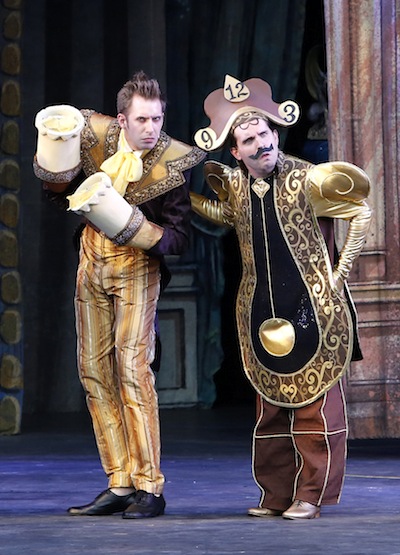
photo in Jewish Independent - Victor Hunter as Lumière, left, and Steven Greenfield as Cogsworth are a superb comedy team
Victor Hunter as Lumière, left, and Steven Greenfield as Cogsworth are a superb comedy team. (photo by Tim Matheson)

In the TUTS production, Jaime Piercy as Belle is the strongest singer by far, though the overall best actor in the show is, hands down – combining acting, singing and dancing – Victor Hunter as Lumière, the slender and bendy maître d’ who is transforming into a candelabra; his comedy partner, Steven Greenfield as Cogsworth, the butler becoming a clock, also stands out.

Dane Szohner as Gaston is hilarious and his singing is energetic and enthusiastic, if not always on key, and Sheryl Anne Wheaton as Mrs. Potts – the cook becoming a teapot – is delightful, her rendition of the title song perfect. Jewish community member Bodhi Cutler does a fine job as Mrs. Potts’ young son, who spends most of the night wheeled around in a tea trolley with only his face seen in the body of the teacup into which his character is transforming. Fellow Jewish community member Julian Lokash shows his dancing skills in a few numbers, including as an unidentifiable household object in “Be Our Guest,” which is wonderfully performed by numerous cast members – and the orchestra, which was great throughout, led by musical director Wendy Bross Stuart, another Jewish community member involved in the production.

While some of the household items are hard to discern – including one talented cart-wheeling rug (?) – and the angry wolves that beset people in the forest look more like black cats, in general, the costumes by Chris Sinosich are spot on, as per the Disney movie on which the musical is based. As Belle comes to dinner in one of the final scenes, adorned in her signature gold ball gown, one young audience member couldn’t contain her excitement, happily exclaiming, “She’s wearing the Belle gown!”

By that point in the opening night show, the Beast, played by Peter Monaghan, had settled into his role. In the first half, with only limited lines, it was hard to tell what Monaghan was trying to do with his character, his grunts and hunched-over movements not scary or funny. In the second half, however, he found his feet and his attempts to woo Belle – with the very amusing help of Lumière and Cogsworth – were well done.

Most of the princesses in the audience – several girls dressed up for the show – enjoyed the over-the-top acting, as did the adults, but there were a couple of frightening moments. At the beginning, Gaston is hunting and a gunshot goes off, which put at least one little girl into tears momentarily. And there was a lot of quiet in the audience much later, when Belle’s father is almost hauled off to an insane asylum by a jilted Gaston. To stop that from happening, Belle shows the crowd the Beast through a magic mirror to prove that her father really had seen a “monster” and isn’t crazy. This sets the mob, led by Gaston – who is now also jealous because he realizes that Belle loves the Beast – to the castle and the ultimate fight between the two men, which leads to a dire end for Gaston and near-death for the Beast. There were audible gasps when the Beast becomes human again, as do all his servants.

There is no such happy ending in West Side Story, of course. On opening night, the Romeo and Juliet-inspired tale of gang rivalries turned deadly was intensely and movingly acted. The reality – as much as can exist in a musical – was increased by having some Spanish-speaking actors who get to reel off several lines in Spanish and, with some exceptions (such as Jewish community member Kat Palmer as Consuelo), having non-white actors playing the Puerto Rican Sharks and their entourage, while the Jets and their friends, as well as the police, are played by seemingly white actors. Normally, color doesn’t matter in casting, but the whole point of this musical is that fear and racism can be fatal, and the visual clues are helpful in sending this message home.

While the acting in this production is top-notch, the only performer who is a triple threat – singing, dancing and acting very well – is Daniel James White as Riff, the leader of the Jets. The Sharks’ leader, Bernardo, played by Alen Dominguez, doesn’t get much chance to sing, but handles himself well in the other two departments.

The doomed romantic duo, former Jets leader Tony (Matt Montgomery) and Bernando’s sister Maria (Jennifer Gillis), have a great chemistry and energy on stage, and they really do seem head over heels in love – and then completely lost and distraught when the rumble between the gangs goes lethally wrong. Montgomery has a lovely tenor voice but some of his notes/words are lost, while Gillis has some beautiful moments – Maria is a hard, high part to sing, and Gillis makes a valiant effort.

On the acting front, Alexandra Lainfiesta, who plays Bernando’s girlfriend and Maria’s confidante, is fabulous and almost steals the show. She plays a range of emotions convincingly, from the genuine joy and mischievousness she has in the song “America” to the defiance and anger she has in the upsetting and disturbing “The Taunting.” (Parental advisory: in this pivotal scene, the Jets’ sexual assault of Anita is more than implied.)

As much as there is heartbreak and horror in West Side Story, there is humor and hope. While cheesily done, this production has a young actress representing hope and her role at the end will choke people up a bit, as will the solo reprise by Daren Dyhengco of the song “Somewhere” for the appropriately subdued finale.

Among the highlights of this production, directed almost perfectly by Sarah Rodgers – the only scene that drags is the one in which Tony and Maria declare their intention to marry – is the choreography by Jewish community member Tara Cheyenne Friedenberg. Off-kilter movements, unique body angles, more use of the hands and shoulders than usual, judicious use of slow-motion (in the scene where Tony and Maria first meet) and other Friedenbergesque touches inject life into the musical, which is heavily dance-based.

Beauty and the Beast and West Side Story run until Aug. 20 on alternate evenings at Stanley Park’s Malkin Bowl. For tickets, visit tuts.ca or call 1-877-840-0457.

Format ImagePosted on July 22, 2016July 19, 2016Author Cynthia RamsayCategories Performing ArtsTags Beaty and the Beast, Malkin Bowl, musical, Theatre Under the Stars, TUTS, West Side Story
A chance to educate

A chance to educate

Monika Schaefer is a violin instructor in the Alberta mountain town of Jasper. She was also a candidate for the Green Party of Canada in the federal elections of 2006, 2008 and 2011. Last week, a video went viral of Schaefer declaring that, after “a great deal of time researching this topic,” she has concluded that what Canadians have been taught about the Holocaust is rife with “inaccuracies.”

“When I started to look at the evidence, and I researched, and I researched and I researched, and the lies are coming apart,” she told the CBC. “This house of cards is crumbling, and that is why there is this very fierce reaction against what I’m saying, because this lie, this public myth, has shaped our world.”

She calls the Holocaust “the six million lie” and “the biggest and most pernicious and persistent lie in all of history.”

With all the things happening in the world today, the misguided ramblings of a soundly defeated candidate for Parliament is far from the most crucial issue we face as a civilization. Yet, the incident deserves consideration.

Despite that the Green party is being rightly condemned for anti-Israel resolutions set for debate at its upcoming national convention, let’s not attribute to an entire group the poison of one of its (soon-to-be-former) members. Holocaust denial and antisemitism have been expressed across the political spectrum and no party has a monopoly on that. Green party leader Elizabeth May responded immediately and appropriately, condemning Schaefer’s comments and moving to have her membership in the party revoked. That is one positive outcome.

The most generous assessment of the video is that Schaefer herself, who is of German heritage, is a victim of the collective trauma of Nazism. As the director of community relations and communications for the Jewish Federation of Edmonton, Tal Toubiana, told the CBC: “I find it curious that a woman who allegedly faced bullying based on her country of origin would rather continue a cycle of irreflexive hate than reflect deeply on the wounded history and trauma the Holocaust did create.… The Holocaust is a historical event that is not only undeniable in regards to the facts and documentation of its existence, but in the collective trauma it created. Ms. Schaefer is a product of the very trauma she claims does not exist.”

This is a very insightful analysis. It is easy to dismiss the people who conjure such fabrications as irredeemably wicked, but to adopt a more humane response in the face of inhumane statements would invite us to wonder what personal circumstance would lead an individual to such a distorted and easily disprovable worldview.

This appears to be the first public utterance Schaefer has made on the subject and perhaps it will open the door for her to be confronted with facts and have the sources upon which her deeply flawed conclusions rest debunked. Whatever happens in this instance, little is to be gained by demonizing the individual even though we rightly demonize her words.

Each time such an incident occurs is an opportunity to return to the basics and realize that we still have work to do. We need continued vigilance and we must educate all people, especially young people, about history.

Googling Schaefer’s name confirms this. Her ideas attract some breadth of support in the dusty extremities of the internet, where she is lauded as a “truth revealer and free speech advocate.” It is, of course, impossible to tell whether the hordes of online comments coming to her defence represent a sizable cohort or a tiny but prolific cluster of keyboard pounders. What they certainly represent is an unadulterated reminder that shockingly inhumane ideas retain sway among some of our fellow citizens.

There are now human rights complaints lodged against Schaefer in the Alberta and Canadian human rights commissions and already Schaefer is positioning herself as a martyr.

“Right now, the issue for me is freedom of speech,” she told a Jasper news outlet. “Last I checked, I thought we had freedom of speech in Canada and suddenly I’m the criminal.”

Wrong again. By law, Schaefer is innocent until proven guilty, so she is not “suddenly” a criminal. Moreover, her research fails her once more. Canada has freedom of speech, but not without limitations. To become the criminal Schaefer contends she already is would require proof that she intended to incite hatred against an identifiable group. This is a very difficult motivation to prove.

Whatever happens in the quasi-judicial processes Schaefer faces, we should be heartened by the response of many of Schaefer’s fellow residents of Jasper and we should take the opportunity to recommit ourselves to sharing the truth.

Format ImagePosted on July 22, 2016July 19, 2016Author The Editorial BoardCategories From the JITags antisemitism, Green party, Holocaust, Holocaust denial, human rights, Schaefer
A 22-year-old open wound

A 22-year-old open wound

Every year on July 18, thousands of people gather to remember the victims of the AMIA bombing, and demand that justice prevails. (photo by Jaluj via commons.wikimedia.org)

After more than 20 years, an entire nation continues to search for answers and justice.

With an estimated population of 330,000, Argentina’s Jewish community is the largest in South America and, outside Israel, the sixth largest in the world. First arriving in Argentina in early days, Jews have continued to immigrate ever since. During its “golden era” (1900s to 1950s), an estimated 500,000 Jewish people lived there.

The vast majority of Jews in Argentina are Ashkenazi, from central and eastern Europe. From the start, this active, prosperous and engaged community has left its mark in local business, infrastructure, culture and politics. My family was part of this group; Argentina was the place we called home and where four generations of my family were born. AMIA (Asociación Mutual Israelita Argentina or the Argentine Israelite Mutual Association) is the central support organization for all Jews in Argentina, tracing its roots back to 1894.

Everything changed the morning of July 18, 1994, at 9:53 a.m. While I was attending a history class, more than 600 pounds of explosives hidden in a vehicle were detonated in front of AMIA. The explosion was followed by a cloud of smoke and dust seen for miles. In seconds, along with the iconic Jewish organization in Argentina and everything surrounding it, the building housing all of Argentina’s rich Jewish history was, simply, gone. This tragedy was followed by panic, mayhem, sirens, ambulances, calls for help, deaths totaling 85 and hundreds more victims, severely injured and traumatized, transported to hospital.

At my school, phones started to ring. The principal rushed into our classroom to have a private word with our teacher, who then broke the news that AMIA in Buenos Aires was bombed. We were in shock. The same black dusty cloud that could be seen above AMIA descended upon the student body, the teachers and the administrative staff. Frantic activity ensued and, within a few hours, the school was deserted.

My first reaction was concern for my family and friends, many of whom worked at AMIA. I would soon learn that, although one miraculously survived under the rubble and a few others were spared, having not yet arrived at the time of the attack, three died in the explosion. I would learn of the tremendous cultural and historical loss of books, manuscripts, community records, art, pictures and more. I would learn of the disorientation felt by so many who could not comprehend the magnitude of the attack. And I would learn of the rage of those who survived their loved ones. To this day, I will never forget the conversations around the dinner table that revealed the pervasive feeling we were no longer safe.

Some of my friends were immediately withdrawn from the private Jewish school I attended and transferred to the public school system. I would learn of sentiments such as “Jews should be concentrated in one place and live together so innocent Argentines would not suffer.” Yet, in my mind, we were all Argentines.

Over the following years, as I transitioned from my teenage to adult years, I would learn of government cover-ups, of the miscarriage of justice, and of injustice done in the name of greed and corruption. I would also learn of Hezbollah, Iran and other terrorist elements suspected of involvement one way or another. And I would be constantly reminded of the pain of those left behind, and the impunity of the perpetrators, which reinforced the sense of insecurity that took over a proud and vibrant Jewish community.

In spontaneous reaction, hundreds showed up to the site where the AMIA building had stood. Many, my father was among them, were volunteering to assist in the rebuilding process. Those were dark days. The community needed to reorganize. Within a week of the attack at Pasteur 633, a community building a few blocks away began to function. As the temporary head office of AMIA, the Ayacucho 632 site became the place where families sought information about the victims of the attack and where AMIA resumed essential operations, especially those pertaining to social services and community relations.

The Ayacucho building also became the place in which I started my journey as a Jewish community volunteer and where I later decided to pursue a professional career serving the Jewish community.

Five years after the attack, on the original site, a new building was opened that symbolized the creative drive of a community willing to preserve the heritage of a cultural tradition that honors life and collective memory.

This July 18, as every year, the bombing was commemorated with a ceremony in front of the new, now heavily fortified, AMIA: This year’s ceremony marked 22 years since the attack, Argentina’s deadliest bombing ever.

The AMIA bombing was an assault on all society and one that has left deep political scars, not just upon Argentina’s Jewish community. It is a symbol of the entire Argentine state and a society still searching for the truth. And the truth – about a sophisticated terrorist act of mass murder that sent a brutal message of destruction and death – must come to light. The attack is a wound that remains open to this day.

I vow to neither remain silent nor rest until those guilty of these attacks are apprehended, and I hope that the Argentine government will make every effort to ensure that the terrorists responsible for this horrendous act are brought to justice.

Viviana, Cristian and Guillermo, I will never forget. Porque tenemos memoria, exigimos justicia. Because we have memory, we demand justice.

Nico Slobinsky is director, Centre for Israel and Jewish Affairs, Pacific Region. He was born and raised in Argentina before immigrating to Israel and, later, to Canada.

Format ImagePosted on July 22, 2016July 19, 2016Author Nico SlobinskyCategories Op-EdTags AMIA, Asociación Mutual Israelita Argentina, bombing, CIJA, justice, memory, terrorism
VHEC looks at past, future

VHEC looks at past, future

Éloge Butera, a survivor of the genocide against the Tutsis of Rwanda, and Robbie Waisman, a survivor of the Holocaust, at Vancouver Holocaust Education Centre’s gala event on May 26. (photo from VHEC)

For the Vancouver Holocaust Education Centre, the first half of 2016 has been a time of intense activity, though the pace of contemporary events has been accompanied by a very conscious reflection on both the past and the future of the organization.

The VHEC held its first gala-style event in more than a decade on May 26, a dinner and program titled “Looking Back, Moving Forward.”

“The event was very deliberately intended to recognize that the organization is at a moment of profound significance,” said Nina Krieger, VHEC executive director. “We took the opportunity to reflect on the past, show our gratitude to those who founded and led the organization, and to take pride in the achievements we have had. But the program was also quite emphatically focused on the future. The VHEC began as a small organization and we have grown dramatically in size and impact, in the depth and breadth of the programs we deliver, and it was our intention to illustrate both of these profiles to the nearly 500 people who attended.”

Co-chaired by Marie Doduck, Helen Heacock-Rivers and Shoshana Lewis, “Looking Back, Moving Forward” intended to give guests a taste of what more than 25,000 British Columbia students experience every year through VHEC programs. Annually, a symposium on the Holocaust takes place at the University of British Columbia. An additional 12 symposia take place in school districts throughout Metro Vancouver. Each of these is an opportunity for students to learn about the Holocaust from an historical perspective, view a film on the subject and then meet and hear the testimony of a survivor.

“The symposia are undoubtedly the most impactful thing we do,” Krieger said.

“We have thousands of letters from students telling us about the life-changing impact meeting a survivor has had on them,” she explained. “We have classes brought to our symposia by teachers who chose their profession because of the impact of a symposium they attended years earlier.”

In a moving moment at the gala event, Caden Dorey, a Grade 11 student from Surrey, read aloud a letter he had sent to survivor speaker Lillian Boraks-Nemetz after he met her at a symposium.

“I have never been so moved in my life,” he wrote. “You have changed my perspective on the Holocaust, and life itself.… I will never forget you, and thank you for letting me share this moment with you. I’m forever impacted by this day.”

The centrepoint of the evening was a joint presentation by Robbie Waisman, a survivor of the Holocaust, and Éloge Butera, a survivor of the genocide against the Tutsis of Rwanda. Both spoke of the importance of sharing their survival stories and the influence it has had on students and others.

Waisman explained that it is difficult to help young people comprehend the idea that 1.5 million Jewish children were murdered in the Holocaust, so he tells the story of his nephew, Nathan. Waisman was only 8 years old when his older brother Haim and his wife Golda had Nathan. Waisman spoke of his pride on being an uncle, but the Holocaust destroyed their family.

“Nathan was not yet 3 years old the last time I saw him,” Waisman said. “His mother Golda could have easily gone to work in the ammunition factory after the Nazis established the ghetto, but she would have had to give up her little Nathan. She refused to be separated from her little boy and so was sent to the Treblinka gas chambers with him.”

Butera credited Waisman for inspiring him to speak up about his experiences and devote himself to confronting racism and the potential for genocide.

The evening, which was emceed by Dr. Art Hister, also represented the increasing engagement of younger members of the community in VHEC’s work. Children and grandchildren of survivors, as well as others of their generations, were involved in the planning committee and Katia Hessel, a granddaughter of four survivors, spoke about the obligation she feels for carrying on the memory of her family’s history.

While not lining up exactly with the calendar, the VHEC gala event marked three significant milestones. It is more than 40 years since the first symposium on the Holocaust for high school students took place. It is about 30 years since the society that created the centre was founded. And it is more than 20 years since the centre first opened its doors as a teaching and research museum. Honorary chairs of the event were the four past-presidents of the organization: Robert Krell, Waisman, Rita Akselrod and Jody Dales.

Passing the torch of Holocaust memory from one generation to the next has been central to the Holocaust centre’s work recently.

“The greatest single challenge we face is continuing to maintain the relevance of our mission and mandate in a post-eyewitness survivor era and I think we are well-positioned to do that,” said Ed Lewin, who retired after six years as president of the VHEC board at the annual general meeting a week after the gala.

The centre is undertaking a major project of digitizing the archival collections, which will make them accessible worldwide. The process of digitization will also allow the centre to integrate historical materials seamlessly into pedagogical materials for use by teachers locally and wherever educators are seeking supplementary classroom resources.

“We are finding a way to keep the students, who are our audience, enthused and energetic and interested in hearing about stories without actual eyewitness survivors to tell it to them,” Lewin said.

For visitors to the centre, planned upgrades will make artifacts and some of the archival materials more accessible, including through interactive electronic kiosks and visible display units.

Lewin was honored at the AGM with a life fellowship in the VHEC, as was Jack Micner.

Phil Levinson, who succeeded Lewin as president, said he intends to continue to ensure that the VHEC’s mission is met as the number of eyewitnesses to the Shoah declines.

“We have to plan for the time when we don’t have someone standing on the stage who was there,” he said. “It’s going to be easier to deny [the Holocaust] and it’s going to be harder to have an impact live. I would see that, for me and the president after me, as the biggest challenge and the most important challenge.”

While there may be a perception that working in the field of Holocaust remembrance and education is a sad or depressing vocation, people associated with the Holocaust centre say it is quite the opposite. Levinson said watching the reaction of students, who frequently mob survivor speakers and hug them at the end of a symposium, is uplifting. Such reactions demonstrate the power of the program, Levinson said.

“You see what’s happening in that room over the few hours of the symposium, and you look at all the different types of people that are in there that leave unified,” he said. “There are 1,000 people who have a better chance of going out in society now and not being racist and not tolerating it and not turning the other way. That is super-rewarding. That is why I do it.”

Pat Johnson is a communications and development consultant for the Vancouver Holocaust Education Centre.

Format ImagePosted on July 22, 2016July 19, 2016Author Pat JohnsonCategories LocalTags Butera, genocide, Holocaust, Rwanda, VHEC, Waisman
Uniquely B.C. baseball story

Uniquely B.C. baseball story

Ellen Schwartz (photo from Ellen Schwartz)

Historical fiction is a great way to learn about the past and, while aimed at younger readers, many an adult will enjoy and learn from Ellen Schwartz’s Heart of a Champion (Tundra Books).

For Schwartz, a TV documentary led to her novel about the fictional Sakamoto family, set in the very real time when Japanese Canadians were interned during the Second World War. It was in watching this documentary that Schwartz first found out about the Asahi baseball team.

In the author’s note, she explains that asahi means “morning sun.” The team was established in 1914, winning their first title in 1919, the Vancouver International League championship. They won the Pacific Northwest League championships every year from 1937 through 1941.

After Japan attacked Pearl Harbor on Dec. 7, 1941, and declared war on Canada, the United States and the United Kingdom, writes Schwartz, “In Canada, Japanese Canadians were branded ‘enemy aliens’ and quickly lost their rights. The government, fearing that they would be loyal to Japan and would share war secrets with the enemy, took away their fishing boats, cars, radios and cameras. The Japanese were subject to a dusk-to-dawn curfew.

“In the spring of 1942, the Canadian government began to remove Japanese Canadians from the west coast of British Columbia. Men between the ages of 18 and 45 were sent to road camps in the Interior to build roads. Women, children and older people were sent to internment camps, many in abandoned mining or logging ‘ghost towns.’ Small, primitive shacks were hastily built to house them. The people lost their homes, businesses and possessions, never to get them back.”

In her research for the novel, Schwartz told the Independent, “I learned so much. In addition to the Asahis, I delved into the history of the Japanese-Canadian community in Vancouver and then in the internment camps. I hadn’t realized how established and prosperous the Japanese-Canadian community was in the pre-World War II years. Although there was a lot of discrimination – for example, Japanese Canadians didn’t have the vote, they were paid less than Caucasians for the same work and they often suffered racial slurs – these were middle-class families who were integrated into Canadian society. That’s why it was such a shock when they were uprooted and sent to internment camps in the Interior.

“I had heard about the internment camps but I didn’t realize how awful they were until I went to the Nikkei Internment Memorial Centre in New Denver [on Slocan Lake in the Kootenay region] as part of my research. When I stepped inside the original 1942 shack that is preserved there, I was shocked at how primitive and barren it was. In that moment, the second half of the book came to me, as I experienced what it must have felt like for Kenny and his family.”

book cover - Heart of a Champion by Ellen SchwartzIn the novel, 10-year-old Kenny (Kenji in Japanese) aspires to be an Asahi like his older brother, star player Mickey (Mitsuo). However, Kenny has been diagnosed with a heart condition, which means he has to practise secretly, so as to not worry his parents. After the attack on Pearl Harbor, dreams of baseball are replaced with the nightmare of having to register as an enemy alien, of being subjected to a curfew, of having his father’s business closed, of his father being sent to a work camp and of being evacuated to an internment camp, only allowed to bring minimal belongings. In Kenny’s case, he, his mother, older brother and younger sister (Sally) are sent to New Denver, where Kenny and his mother manage to find the strength to inspire others in the camp to hope – and play baseball again.

The Sakamotos’ neighbors, and dear friends, are the Bernsteins, who have two daughters, Susana and Brigitte (aka Gittie). This allows Schwartz to draw parallels between the treatment of Jews in Europe leading to the Holocaust and Japanese in Canada during the war.

“I wanted to point out that the treatment of Japanese Canadians, although obviously not nearly as lethal or horrific, was comparable to that of Jews in Europe,” explained Schwartz. “In both cases, a minority was being persecuted simply because of their religion or nationality. Giving Kenny a Jewish best friend would make both characters sympathetic about this issue.

“The other reason I made Susana Kenny’s best friend is that, because of his heart defect, he would not have been able to keep up with other boys and might have had a girl as a best friend. Initially, Susana was a minor character, but I really liked her – she had chutzpah – so I gave her a bigger role in the story. It’s her courage and loyalty that give Kenny the impetus to find his own.”

Schwartz herself didn’t have a particularly religious childhood. “My mother was religious; my father wasn’t. We went to High Holiday services and that was about it,” she said. “But we lived with my grandparents when I was little, and my grandfather was observant and I adored him, so I grew up with a real fondness for Jewishness. I loved the family seders with everyone together and my grandfather chanting the Haggadah. I feel Jewish inside even though I’m not observant now.

“When I’m thinking of characters, I don’t set out to make them Jewish, but sometimes they emerge that way. Even if a character isn’t identified as Jewish, I know that that character is, and that gives the character an inner richness for me. For example, my first novel series was about a girl named Starshine Shapiro. I never mentioned that Starshine’s family was Jewish, but in my mind they were, and some of the humor in the books had a definite Jewish flavor.”

Schwartz hasn’t always been a writer.

“After I stopped teaching elementary school in the late ’70s, I started writing educational stories. That was my first foray into writing,” said Schwartz, who grew up in New Jersey and moved to Canada in 1972 with her husband, Bill. “I wrote stories for kids about energy conservation and the environment, which were important to me. I suppose I started with educational writing because I was comfortable ‘talking’ to and teaching kids. I sold the first educational story to the government of B.C. and the second one to the National Film Board. Then I decided to try to write a regular story, and that became my first book, Dusty.”

Schwartz teaches creative writing at Douglas College and she also works as a corporate and technical writer and editor, she said. “My husband and I own a small communications company called Polestar Communications. We do all kinds of writing and editing for public agencies and companies – reports, brochures, articles, educational material, technical material, web writing, etc. We also do marketing and organize events. That’s how I spend most of my writing time.

“I also write magazine articles, mainly for the Costco Connection, the magazine of the Costco corporation,” she added. “The editor usually assigns me stories about books and authors, which, of course, I love. I have interviewed and written about some great authors, including Ann-Marie MacDonald, Richard Wagamese, Linden MacIntyre and Alice Munro.”

On her website, Schwartz notes that she hasn’t even always wanted to be a writer.

“Dancing is my favorite thing,” she said, “and I often tell kids that if God tapped me on the shoulder and said, ‘You can be a professional dancer tomorrow if you give up writing,’ I wouldn’t hesitate for a minute. I take a jazz class once a week and love it.”

While her career path may have changed a few times, Schwartz said the process of getting an idea to publication hasn’t changed much since she published her first book more than 30 years ago.

“Essentially, it’s the same,” she said. “I get an idea, mull it over for awhile, make notes and then plunge in. Many drafts later, I send it to a publisher and hope for the best. Once a manuscript is accepted, I work with an editor (I love working with editors) and do another rewrite. Then the book goes into production, which I have very little to do with other than approving the cover. (I have no artistic talent – my abilities extend to stick figures – and don’t illustrate or do any book design.)

“Of course, now I can submit work electronically, and it’s a lot easier to bounce ideas back and forth with my publishers before I send them the story,” she continued. “And I do a lot of research on the internet rather than in the library, though, for most stories, I still read many print articles and books for background information.”

And she does more than that.

Linda Kawamoto Reid, research archivist at Nikkei National Museum in Burnaby, writes in the foreword of Heart of a Champion that Schwartz “thoroughly researched the times by talking extensively with members of the Japanese-Canadian community. She met Kaye Kaminishi, our last Asahi baseball player, who was a rookie in 1941, and sought out the facts by conducting interviews, reading books and watching films. The story has surprising elements of reality, from the food eaten to the description of events following the bombing of Pearl Harbor.”

Japanese Canadians were not allowed to return to the coast until 1949 and it wasn’t until 1988 that the Government of Canada formally apologized for the treatment of Japanese Canadians during the war. As for the Asahis, the team was inducted into the Canadian Baseball Hall of Fame in 2003 and into the B.C. Sports Hall of Fame in 2005; in 2008, the team was designated an Event of National Historical Significance.

So, is the country in which we’re now living less, more or similarly susceptible to the factors that allowed the refusal of Jewish refugees fleeing the Holocaust and the internment of the Japanese, as but two extreme examples of the racism of those decades?

“Call me a cockeyed optimist, but I think we’re less susceptible to that kind of racism and exclusion in Canada,” said Schwartz. “The recent acceptance of the Syrian refugees is a heartwarming example. When my kids were in school in Burnaby in the ’90s, there were kids of every color and nationality in their classes and no one thought anything of it. We can’t ever take tolerance for granted, but I think that Canada in 2016 is a pretty welcoming place.”

Ellen Schwartz will be at Word Vancouver on Sept. 25, at the Vancouver International Writers’ Festival Oct. 18-23 and at the Calgary Jewish Book Festival Dec. 4-11.


Format ImagePosted on July 22, 2016July 19, 2016Author Cynthia RamsayCategories BooksTags Asahi, baseball, Holocaust, internment, Japanese Canadians, racism, Schwartz, sports
Can murder become extinct?

Can murder become extinct?

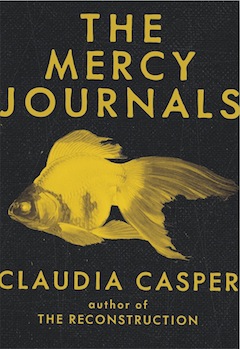
The Mercy Journals is a new novel by Claudia Casper, author of The Reconstruction and The Continuation of Love by Other Means. In it, she creates a compelling post-climate change West Coast, where nations no longer exist. Her hero, Allen Levy Quincy, lives in Seattle, now called Canton #3, Administrative Department of Cascadia, and the novel consists of the journals he writes in a desperate attempt to evade suicidal urges, brought on by post-traumatic stress disorder. In this layered, hopeful post-apocalyptic novel, Casper looks at the future through the story of Cain and Abel. In fact, one of the early titles for the novel was The Last Murder, as a bracket to the story of that first murder.

Jewish Independent: The novel takes place in the (near) future in a climate-changed world. Is it a dystopian novel, science fiction or eco-fiction? How would you describe it?

Claudia Casper: Genre-bending fiction was being written well before the advent of ebooks, Amazon and the internet’s stretching of the forms of fiction, but I would say there are a number of writers who pay less mind to the dictates of genre and simply go wherever the story takes them. One example would be The Yiddish Policeman’s Union. [Michael] Chabon combines detective noir with fantasy or alternative history to create a miraculous new, possibly one-of-a-kind thing.

Science fiction readers have proven a generous and open-minded community and seem to have embraced the new raft of novels whose driving force is the environment and climate change. Margaret Atwood’s Oryx and Crake trilogy, Cormac McCarthy’s The Road, Hilary St. John Mandel’s Station Eleven – all are “literary” (I use the air quotes not to comment on these novels’ literariness, but because “literary fiction” is an over-precious, stifling term for a genre) novels written in the future, with only Atwood using some of the classic tropes of science fiction. This kind of writing, trying to find a place in the speed-of-light marketing world, calls itself variously eco-fiction, cli-fi, post-apocalyptic, dystopian, speculative fiction, each sub-genre carrying its own nuance. I would place The Mercy Journals in all these categories except dystopian, as the government imagined in 2047 is actually pretty good.

JI: While the book does not explicitly make reference to Judaism, there are parallels between the story of Allen Quincy and Leo (Quincy’s brother) and the biblical tale of Cain and Abel.

CC: I read the story of Cain and Abel closely, using the Jewish Publication Society of America translation, and studied the midrash on the text. The language is so rich and layered, from “Am I my brother’s keeper?” to “You shall be more cursed than the ground, which opened its mouth to receive your brother’s blood from your hand.” The story in the Torah is short but its power resonates throughout our literature and our culture.

In The Mercy Journals, I sewed in references to Cain and Abel throughout the text. At one point, when Leo, the long-lost, nihilistic brother of my main character, Allen Quincy, returns, Allen says wryly, “I suppose that means I have to keep you?” The earth drinking blood, also an image I use at least twice. The final scene, which I cannot give away, reenacts Cain going out to the field.

What I wanted to do in this novel was bookend the Cain and Abel story with a metaphorical last murder, as opposed to the first murder, to write the murder of Cain by Abel, a closing of the circle. Of course, I could not believably write about a time when humans completely stop murdering each other, but I do carry the narrative of our species to a possible turning point, where we turn away from murder and its practise becomes truly taboo and despised in every context.

JI: When Quincy, a soldier, is ordered by his superiors to do something against his own moral code, he obeys, though reluctantly, and with some subversive evasions. Although genetics and environment affect who we may become, Judaism teaches us that we have free will and can choose to do right or wrong. Quincy suffers from PTSD partly because of the unresolvable internal conflict following those orders causes in him. What influenced you to make your main character an individual suffering from PTSD? How do we reconcile liking him with the fact that he is complicit in two of humanity’s worst sins?

CC: After the genocide in Rwanda and post-9/11, I felt deeply uneasy at the rhetoric used by the media and by politicians, in which it was implied that only “those” people, “those” cultures – read Africa, Cambodia, Germany, the Arabs – commit atrocities. First Nations people must have read those articles with a deep sense of irony. Because the lens through which I look at the world is always informed by evolution, I believe that genocidal behavior, for example, is a part of our species. It has been documented in chimpanzees and any behavior that exists both in living primates and ourselves is behavior that was very likely present in our ancestors.

book cover - The Mercy JournalsThere’s a kind of implied self-righteousness and superiority in that kind of distancing rhetoric that seeks to separate us from the behavior of the “bad” cultures. I felt very deeply that, if we are to have any hope of truly limiting atrocities within our species, we have to accept that they are part of who we are. Part of the reason The Mercy Journals was set in the future in the first place was because I wanted to write about a genocide that hadn’t happened yet, and that happened in North America, that was committed by “our” culture, “our” team.


Allen Quincy is a good man, a decent man, even though he’s haunted by the sins – and he counts them as sins – he has committed in the past. His brother Leo, the Cain figure, also is pushed towards sin, and there is even a scene where Leo literally crouches at Allen’s door and Allen writes wryly in his journal, “Salvation comes in many forms.” The novel really is about whether Allen Quincy, standing in for our species, has the possibility of moving forward, of living a life with his dark legacy.

JI: Quincy carved a covenant on a rock, which seems a very Jewish thing to do. After Cain murdered Abel, God said to him: “… your brother’s blood cries out to Me from the earth.” As the word used for blood is plural, does this mean that what cries out is not only Abel’s blood but all of his descendants that will never be born? Was that what Quincy was saying about murder when he said the murder of one is the murder of all? How does a person atone for murder?

CC: Yes, Rashi says that the plural here indicates also the extinguishment of all Abel’s descendants with his murder. Because The Mercy Journals is about the future of our species, compressed in the suspenseful tale of a West Coast, post-apocalyptic, post-climate change tale, I take it one step further. The murder of Abel, the murder of anyone, is expanding the place of murder in our species, is further entrenching its place in our repertoire. Thus, the murder of one is the murder of all. Thinking about climate change shows us again how deeply connected we all are, that we can never really escape each other, we have to find a way to deal with one another, and murder is always a failure. There is no possible atonement for murder in my mind, it is irrevocable, yet still, short of suicide, one must find a way forward. Who is without sin? And whose life exists without the legacy of murder at its very root? God’s punishment of Cain seems to acknowledge this.

JI: Quincy’s brother Leo was jealous of Quincy as was Cain of Abel. Why did God reject Cain’s offering? Why did Leo’s parents reject him?

CC: Without being an expert in midrash, I believe one of the main interpretations these days is that Abel, as a shepherd and a man who did not gather possessions, represents a nomadic, hunter-gatherer existence, while Cain, as a farmer who cultivated the fields and, therefore, had property, represents an agrarian one. God’s preference for Abel’s offering can be understood to be preferring nomadic values over agrarian ones, or the old ways over the new.

That being said, if we interpret God in this story as in a parental role, the choosing of favorites is always destabilizing to family unity, creating deep wounds and lasting resentments. From an evolutionary perspective – so, viewing our behavior with the understanding it arose in a pre-birth control context – such favoritism can result in a life and death situation for an individual. We are living in a time of relative wealth, but it wasn’t long ago when a family could easily have eight or nine children and be faced with drought or famine. The favored child would thus be the one who received a little more food, a little more medicine, the one who would be picked, even if unconsciously, to be prioritized to survive. Studies of mothering behavior in human evolution bear this scenario out.

When I reread the story of Cain and Abel eight years ago as I was beginning this novel, I felt sympathy for Cain, and felt that God was shirking responsibility a bit. Why can’t God see Cain’s pain? Surely telling the less-favored child to not worry about the advantages their sibling is getting and take their own good behavior as its own reward, doesn’t pass muster in a family. Why doesn’t God see Cain murder Abel? Why doesn’t God punish Cain with death? Why does God decide, when Cain cries out that he will surely be killed by strangers if he’s banished, to put his divine mark on him to protect him from death? Is there an implicit acceptance of the fact of murder in this story? And, if so, I wanted to imagine forward to a time when God would find murder utterly unacceptable, as taboo as incest, for example. In our society, murder is still seen as inevitable between human beings in certain circumstances; in wartime, it’s accepted. What would the world be like if humans were starting to evolve past murder, past genocide? Those seeds are at the core of The Mercy Journals.

Barbara Buchanan, QC, is a Vancouver lawyer who provides practice advice to other lawyers. She and Claudia Casper are longtime friends who are in the same book club. Buchanan recently attended the Los Angeles launch of The Mercy Journals with Casper, who was introduced by actress Jamie Lee Curtis, a big fan of the book.

Format ImagePosted on July 22, 2016July 19, 2016Author Barbara BuchananCategories BooksTags biblical, Cain and Abel, Casper, cli-fi, climate change, eco-fiction, fiction, Mercy Journals, murder, post-apocalyptic
Art sets B.C. hotels apart

Art sets B.C. hotels apart

“Lying on top of a building,” by U.K. artist Liam Gillick, wraps around the Pacific Rim Hotel in downtown Vancouver. (photo from Pacific Rim Hotel)

If you happened to have missed Ira Hoffecker’s Berlin Identities exhibit at the Jewish Community Centre of Greater Vancouver recently, you’re not entirely out of luck. Hoffecker’s work has a seemingly permanent spot on the walls of Sooke Harbor House on the west coast of Vancouver Island.

The stylized maps and cityscapes, similar to those shown in the Zack Gallery, are quite the contrast to the First Nations wall hangings, Group of Seven-inspired landscapes and whimsical nautical- and plant-themed room décor. But gallery manager Sharan Nylander says the collection is meant to reflect a range of B.C. artwork and, as works are sold and replaced, the exhibit is kept fresh and varied.

Indeed, the display in Sooke Harbor House has much more of a gallery feel today than it did when I last visited more than a decade ago. And, while Hoffecker’s work definitely leans in a more modernist direction than other pieces, perhaps there is more of a connection to Harbor House than one might think.

Hoffecker’s work speaks to her past growing up in Germany, and her interest in how society and cities change. Sooke Harbor House is believed to have been the location of a safe house for immigrants, and the book Generation to Generation: A Collection of Jewish Thoughts and Remembrances relates a story where the house was used as refuge for 15 German Jews.

The boutique hotel, just an hour from Victoria, is so committed to showing local artists’ works, it is creating a dedicated art gallery/ meeting space, due to be completed by year end. Until then, visitors can get their fill by wandering the winding corridors, hidden passages and surprise stairways.

Sooke Harbor House is not the only accommodation that makes a point of emphasizing artwork as part of its brand. The Fairmount Pacific Rim in downtown Vancouver has not only devoted space for some exquisite exhibits, but also provides a half-hour walking tour you can download to a smartphone. In all, four Jewish artists are represented on the tour.

If you stand at the corner of Cordova and Burrard streets and look up, you’ll notice strings of words that wrap around the outside of the building. The installation is a poem by U.K. artist Liam Gillick: “Lying on top of a building the clouds looked no nearer than when I was lying on the street.” It’s comprised of two-foot-high letters on floors five through 22, created in 2010 when the hotel opened for the Olympics.

Approaching the building’s entrance, you’ll see “Tree 16.480” by Omer Arbel, creative director of international design firm Bocci. The installation stands more than 18 feet high and is named for its 480 glass leaves. Arbel was born in Jerusalem, but moved to Vancouver as a teenager with his family.

If you’re walking past “Blackwater Ophelia” by Adad Hannah on the main floor and think the photograph blinks at you, you’re not hallucinating. The piece is actually a tableau vivant – a costumed actor poses in what looks like a still life, but is actually a video combined with stills – a little creepy, but stunning. “Ophelia” runs on a 10-minute loop and, if you pause long enough and look closely, you’ll see the subtle movement of her hands in the water, as well as that of her eyes.

Finally, if you’d like to feel you’re actually part of the artwork, take a seat in the dining area on the terrace just off the lobby. Phrases from Bob Dylan lyrics are projected across the tables so that plates, cutlery, napkins – and you – become part of the installation.

To find out more, visit sookeharbourhouse.com and fairmont.com/pacific-rim-vancouver.

Baila Lazarus is a freelance writer and media trainer in Vancouver. Her consulting work can be seen at phase2coaching.com.

Format ImagePosted on July 22, 2016July 26, 2016Author Baila LazarusCategories Visual ArtsTags Adad Hannah, Bob Dylan, Bocci, Harbour House, hotel, Liam Gillick, Nylander, Omer Arbel, Sooke
Overlapping exhibits

Overlapping exhibits

“Girl with Flower” by Esther Warkov, 1964, acrylic on canvas. (WAG collection; gift of Arthur B.C. Drache, QC, G-98-296; photo by Leif Norman)

Russian-born Jewish artist Marc Chagall (1887-1985) was a modernism pioneer. So much so that Pablo Picasso proclaimed that, when Henri Matisse dies, “Chagall will be the only painter left who understands what color really is.”

In the early 1920s, Chagall left Russia for Paris. In 1941, he escaped France and reached safe haven in New York. He returned to France a few years after the end of the Second World War.

“This sense of displacement Chagall feels throughout his life is reflected in his works, often featuring characters who hover over the earth…. Even if they’re lying down, they’re sort of levitating,” said Andrew Kear, Winnipeg Art Gallery (WAG) historical Canadian art curator. “There’s a sense of rootlessness to his work that’s quite interesting, and it’s reflected in his later work, too. By the 1940s – an important time for Chagall – he loses his first wife, his first love really, Bella, to cancer in or around 1944 … and is absolutely distraught.”

In an exhibition overseen by Kear, WAG has brought in the exhibit Chagall: Daphnis & Chloé from the National Gallery of Canada (NGC). It will be in Winnipeg until Sept. 11.

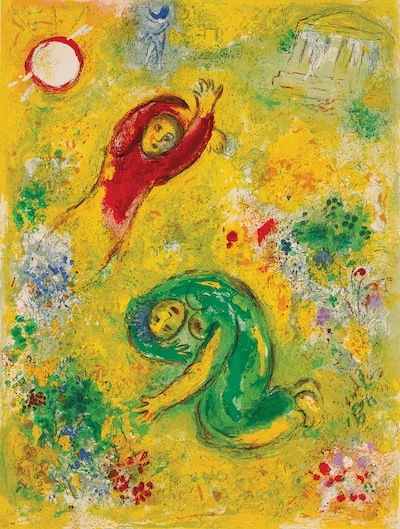
The exhibit, the latest NGC-WAG collaboration, features 42 lithographs, widely considered the crowning achievement of the artist’s career as a printmaker. The series depicts the semi-erotic tale written by the ancient Greek poet, Longus. Through fanciful compositions and bright hues, Chagall expresses the pastoral idylls of the young goatherd Daphnis and the young shepherdess Chloé on the island of Lesbos.

At WAG, there is also a complementary mini-exhibit called Chagall & Winnipeg, which tells the little-known tale of friendship between Chagall and former WAG director Dr. Ferdinand Eckhardt through letters, photographs and works of art.

image - Marc Chagall, “The Trampled Flowers / Les fleurs saccagées” (detail), circa 1956-1961, printed in 1961
Marc Chagall, “The Trampled Flowers / Les fleurs saccagées” (detail), circa 1956-1961, printed in 1961. (NGC/MBAC, Ottawa; gift of Don de Félix Quinet, Ottawa, 1986, in memory of Joseph and Marguerite Liverant)

“In addition to sketching out the story, this second exhibition … include[s] a number of paintings by Chagall that we’ve borrowed from the NGC and the Minneapolis Institute of Art,” said Kear.

In addition to these two Chagall exhibits, WAG is featuring Winnipeg Jewish artist Esther Warkov in an exhibit that includes her work from the 1960s to the 1980s. It runs until Oct. 16.

Born in 1941, Warkov did not do that well in school, but there was a lot of family pressure to succeed. By chance, she discovered jewelry making as a young teen, which, in turn, exposed her to the world of fine art. She eventually studied art at the University of Manitoba.

Today, Warkov is one of Manitoba’s most distinguished artists. This current exhibit highlights a celebrated and defining period of her work, which was forged in Winnipeg’s North End. Her stylized motifs reveal the clear influence of the eastern European immigrant community’s Jewish folk art roots.

“Although abstract painting was the most common form of contemporary art in the 1960s and 1970s, Esther really bucked the trend,” said Kear. “She was very interested in the human figure, representational drawing/painting, and in paintings that tried to convey a story. It’s this kind of point where she really outlines nicely with Chagall. Chagall’s paintings are very much recalling memories and tell[ing] a story.”

Warkov’s work during this featured period was large-scale and multi-paneled. “It’s not just a painting on one canvas,” said Kear. “It’s multiple canvases that are sort of cobbled together, in a way, to make almost loose grids. Her work is narrative, seems to tell a kind of story, but you’re not sure what the story is. It’s very whimsical and draws a lot on memory.

“I had the pleasure of meeting her for the first time a couple weeks ago,” he added. “I was curious about how she paints, or went about making these works. Apparently, she very rarely started with a coherent plan. She would start with one canvas and do an image on it. That would lead into another image that she’d tack on this other canvas next to the original one, to build the … visual story. But, it was a story she was making up as she went along. I thought she would plan it out first, but that’s not how it went down apparently.

“She’s got a wild sense of humor and great wit, which are really reflected in the titles of her works, [which] are often very long.”

WAG director and chief executive officer Stephen Morris said, “When we installed the exhibition a few weeks ago and we had the works up – many of them painted 40 to 50 years ago – they were as fresh, relevant and dynamic, I think, as the day they were painted. They reference so many interesting stylistic developments, but I’d also say they reach into the heart of who Esther is – someone who has lived in the North End for years, exposed to not just the Jewish culture, but also to Jewish folk art and eastern European traditions … that whole interesting development in terms of painting which you see in her work.

“Esther also brings people into interesting scenarios with her paintings and, in the composition, it can be a little unnerving, a little jarring. But, there is, with both her and with Chagall, a surreal aspect. So, while they’re painting recognizable images and motifs, the way they’re composed takes us back a bit and actually twists things. Some call it ‘the dream,’ others something else. Regardless, it’s delightful and one could see an overlap between the artists in terms of imagery.”

Morris enjoys being able to “bring cultures and ethnicities together.” He said having a famous Russian artist like Chagall next to Warkov, “who, in a way, had a much more regional impact, I think it’s interesting. I love the fact that a visitor can walk between Chagall and Warkov and, yes, they know they’re in a different space, in a different time, with a different artist, but they’ll also see connections.”

Of those connections, Morris pointed to how Warkov’s “roots overlap with Chagall’s roots, in terms of her life, faith and culture.”

The Chagall exhibit is set up in a series of small spaces to highlight the story of Daphnis and Chloé – visitors walk through it in a chronological way. Warkov’s work is displayed in one large gallery and visitors are surrounded by her canvases.

Also at WAG this summer are several permanent galleries, as well as a major retrospective of Winnipeg artist Karel Funk, who, Morris said, “is at the height of his career.”

Rebeca Kuropatwa is a Winnipeg freelance writer.

Format ImagePosted on July 22, 2016July 19, 2016Author Rebeca KuropatwaCategories Visual ArtsTags art, Chagall, Daphnis and Chloé, WAG, Warkov, Winnipeg

Posts pagination

Page 1 Page 2 … Page 6 Next page
Proudly powered by WordPress