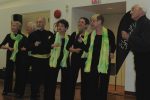
JCC Showtime performers in action, left to right: Nassa Selwyn, Jocelyne Hallé, Marshall Berger, Dawn Hurwitz, Daniella Givon, Debbie Cossover and Arnold Selwyn. (photo by Binny Goldman)
Sunshine and song greeted the 120 people who gathered to enjoy a BBQ lunch and watch the sensational JCC Showtime perform on June 27 at Congregation Beth Tikvah.
Toby Rubin, executive director of the Kehila Society of Richmond, welcomed everyone and explained the event’s agenda. She then highlighted two of the society’s outstanding volunteers, Stacey Kettleman, who at one time had been co-president with Rubin, and Sylvia Yasin, a 90-year-old dynamo who had directed the set up of the whole room.
Marilyn Berger, president of the Jewish Seniors Alliance, which partnered with Kehila to present the afternoon’s program, noted that it was the fourth and final session in this year’s Empowerment series. The lunch’s theme, “A smile on your face – a song in your heart,” was brought to fruition through the dedicated efforts of Gyda Chud and Shanie Levin. The food – salads, beef and vegetarian burgers, fruit and chocolate cake – was catered by Kettleman and her staff.
JCC Showtime’s Debbie Cossover explained that the troupe consisted of volunteer performers who have been together 13 years, with their next show making a total of 200 performances so far. The group was created by Beryl Israel, who immigrated from South Africa in 2002; he had been involved with a similar group there and was inspired to establish one here.
The afternoon’s program began with Marshall Berger singing “Showtime,” accompanied by the group’s pianist, Muriel Morris, and aided by sound technician Gary Zumer. The crowd was transported down memory lane with nostalgia-laced songs such as “Chattanooga Choo Choo,” complete with suitcase; Cossover’s foot-stomping rendition of “You Can’t Get a Man with a Gun”; heart-tugging duets by Arnold and Nassa Selwyn, which included “Together,” “Do You Love Me?” from Fiddler on the Roof and the particularly crowd-pleasing “I Remember It Well.”
The “Hello, Dolly!” number charmed the audience, as well, as it actually included a visit from “Dolly,” a life-size doll that danced in the arms of Berger and Selwyn, both men vying for her attention. Another fun number was a chorus of cowgirls sequence, which required precisely timed twists and turns. And “Tzena Tzena” and “Hava Nagilah” set everyone’s hands to clapping, as the audience joined in with Berger and Selwyn on the last stop on a world tour of songs.
Clever costumes, with outfit changes accomplished in mere minutes, and intricate choreography achieved the illusion of instant scene changes and delighted the audience, which showed its appreciation by loud, sustained applause.
Rubin remarked in thanking the performers that she doesn’t mind growing old now that she has seen what seniors can accomplish. She noted that audience members were from the Weinberg Residence, Louis Brier Home and Hospital, L’Chaim Adult Day Centre, Jewish Seniors Alliance and, of course, Kehila Society.
Attendees left wanting more – some smiling, some singing – all buoyed by the afternoon’s session. I’m still humming.
Binny Goldmanis a member of the Jewish Seniors Alliance of Greater Vancouver board.
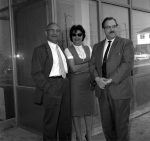
Outside the Jewish Community Centre of Greater Vancouver, 1950. (photo from JWB fonds, JMABC L.11151)
If you know someone in this photo, please help the JI fill the gaps of its predecessor’s (the Jewish Western Bulletin’s) collection at the Jewish Museum and Archives of B.C. by contacting archives@jewishmuseum.ca or 604-257-5199. To find out who has been identified in the photos, visit jewishmuseum.ca/blog.
Since it takes place in summer, Tu b’Av has become popular for open-air events. A local example is the JNF Future’s annual Summer Sail, for which guests are encouraged to follow the tradition of wearing white.
Picture this potentially risqué scene: “… the daughters of Jerusalem used to go out … and dance in the vineyards [and] whoever did not have a wife would go there.”
Surprisingly, perhaps, this description is in the Babylonian Talmud, Tractate Taanit, 31a. In the days before internet dating sites and apps, speed-dating or singles bars, this was how Jewish singles met up at least once a year, on Tu b’Av. Welcome to the Jewish day of romance, Temple-times style.
Maybe it didn’t go as far as the cliché “clothes make the [wo]man,” but even back then, it apparently mattered what you wore to the vineyard. The bachelorettes decked out in white. If a single woman didn’t have white clothes, she’d borrow from someone else. In fact, the tractate describes this nice touch – everyone borrowed, so that no one felt embarrassed if they didn’t have something.
Presumably, wearing white at night had its advantages, too, as it made the women stand out in the moonlit vineyard. Moreover, when we think “white,” most of us think purity and, associatively, virginity, which brings us to this: wearing white underscores the next step, the Jewish wedding. At this ceremony, both the bride and the groom traditionally wear white – the groom (chatan, in Hebrew) puts on a white robe (kittel) or a prayer shawl (tallit) and the bride wears a white dress.
The writings of medieval Jewish scholars like Rabbi Aaron ben Jacob ha-Kohen and Rabbi ben Solomon ibn Abi Zimra (the Radbaz) suggest that wearing white at Jewish wedding ceremonies is a very old custom. They write that one’s wedding day is like a personal Yom Kippur, when the bride and groom’s sins are forgiven. Thus, the wearing of white becomes a proof-text for the line from Isaiah 1:18: “If your sins prove to be like crimson, they will become white as snow.”
Jewish scholars actually connect Yom Kippur and Tu b’Av. Unexpectedly, the Talmud claims that Tu b’av is as important as Yom Kippur in at least one way: “Rabbi Shimon b. Gavriel said: There were no days as joyous in Israel like the 15th of Av and Yom Kippur.” (Taanit 26b)
Chag Haahava, the Holiday of Love, or Tu b’Av (the 15th day of the Jewish month of Av), falls just six days after we mournfully recall that, on Tisha b’Av (Ninth of Av), both the First and Second Temples were destroyed, and numerous other Jewish catastrophes occurred. Here again, we link Tu b’Av to another Jewish wedding custom – the breaking of the glass, recalling the Temples’ destruction.
According to Tractate Taanit (30b-31a), the 15th of Av also joyously commemorates a number of other events in early Jewish history:
(1) This day marked the end of the “wilderness” generation; that is, the end of G-d’s punishing with death the Hebrews who had been the contemporaries of the spies who lacked the requisite faith for conquering the land (Numbers 14: 29-35). The 40 years of desert wandering ceased at this point and the children of the exiles entered Canaan.
(2) On 15 Av, G-d lifted the restriction on intermarriage between members of the 12 tribes.
(3) G-d reinstated the tribe of Benjamin, which He had banned for the tribesmen’s gang rape in Gibeah of a visiting concubine, who subsequently died.
(4) During the Temple period, the task of providing firewood for sacrifices ended on 15 Av, when the woodcutters would ceremoniously break their axes.
(5) Hosea, son of Elah, the last king of the Northern Kingdom, permitted travel to Jerusalem’s Holy Temple for the pilgrimage holidays.
(6) This day also marks when permission was given to bury those killed by the Romans at the Betar fortress.
While the Shulchan Aruch (Code of Jewish Law) doesn’t specify any particular customs for Tu b’Av, it does indicate that, as with other joyous days in the Jewish year, Jews should skip reciting tachanun (confession of sins) on this day.
Given the injunction to “be fruitful and multiply,” it is not hard to understand why this ancient holiday was judged to be so important. Indeed, one could make the claim that the holiday’s timing is hardly coincidental. It comes when the moon is full, reminding us that its cycle parallels women’s 28-day reproductive cycle.
Moreover, on a spiritual level, the sun’s illumination of the full moon suggests a cosmic union of the masculine and feminine – a kesher (Hebrew for connection) between G-d and His Divine Presence (Shekhinah). Rabbi Dr. Jill Hammer writes: “In the Zohar, the full moon signals the time when the
Divine womb creates pure and blessed souls. It is the time when the moon and sun, which, in kabbalist thought, represent the feminine and masculine faces of G-d, are most in contact. The Zohar [notes] that, at the full moon, the Shekhinah is called a field of apples, while at the dark moon, she is called field of anatot [poverty].”
It is somewhat ironic that this great holiday was not celebrated in Israel until recently. But Israelis seem to be making up for lost time. As Tu b’Av approaches, articles on the true meaning of love appear on a variety of websites, in ultra-Orthodox through to humanistic Judaism posts. Moreover, the day has evolved into a favorite Jewish Israeli wedding date – to get married on this day, couples must make their wedding arrangements far in advance.
As Tu b’Av falls in the summertime – this year, it starts the evening of Aug. 18 – it is ideal for outdoor events. Hence, the holiday has become popular for open-air evening concerts and all-day festivals.
As we become more of a global community, it is not surprising that modern Tu b’Av rituals have been influenced by Valentine’s Day accoutrements. Indeed, Tu b’Av art often mimics Valentine’s Day graphics, Israeli magazines guide people to romantic getaways, Israeli newspapers recommend places to feast on heart-shaped ravioli or splurge on rich chocolate mousse desserts or get tipsy on Pink Monica cocktails.
Anyone interested in learning more about Jewish rituals for celebrating Tu b’Av, however, can start their research at ritualwell.org.
Deborah Rubin Fields is an Israel-based features writer. She is also the author of Take a Peek Inside: A Child’s Guide to Radiology Exams, published in English, Hebrew and Arabic.
From left to right: Andy Kaplowitz, Camp Solomon Schechter vice-president/president elect; Sam Perlin, camp executive director; Sarah Kahn Glass, camp president; Jerry Cohen of the Samis Foundation; and Jay Holzman, leadership donor. (photo from CSS)
On July 10, Camp Solomon Schechter hosted a formal groundbreaking ceremony to commemorate the start of major construction at their facility. From 60 to 120: The Campaign to Build Jewish Continuity is a $12 million multi-year project, beginning this fall, to refurbish the camp’s facilities over the coming years.
But this campaign is about so much more than buildings. “Camp is kids,” said CSS executive director Sam Perlin, but “Schechter is also about adults. That’s because it’s not just a summer experience or a school-years’ experience. As we have found, it’s a lifelong experience.”
The facilities currently host more than 500 campers and staff each summer and are used during the year by the Osprey Camp program, which primarily works with distressed school districts in southwest Washington to provide students with an application of science concepts as they live and learn in the outdoors. It also provides a rental venue for a range of organizations and individuals.
Speakers at the groundbreaking included Sarah Glass, CSS board president; Andy Kaplowitz, CSS board vice-president; representatives of major donors, including Jerry Cohen for the Samis Foundation and Jay Holzman for the Holzman family; Tumwater Mayor Pete Kmet; and two CSS campers. Several local officials were in attendance.
The newly found Philistine cemetery in Ashkelon National Park. (photo by Leon Levy Foundation via Ashernet)
Over the past 30 years, excavations have been undertaken in the park by the Leon Levy Expedition and the cemetery was actually located in 2013, but kept secret until the excavation was complete. The cemetery is located about 10 feet below ground level on a site that was later used as a Roman vineyard, and between 150 and 200 bodies lie buried there. The findings, dated to the 11th-8th centuries BCE, may well support the claim that the Philistines were migrants from lands to the west who arrived in ancient Israel around the 12th century BCE. Some of the Philistines were buried with perfumed oil, bracelets, earrings and other jewelry. The findings are on display until February in an Israel Museum exhibit at the Rockefeller Archeological Museum in Jerusalem.
אולי מישהוא ראה את הכפיל של וינסנט ואן גוך? פסל מוונקובר מחפש מחפש ג’ינג’י שדומה לצייר ההולנדי המפורסם
“אולי מישהו מכיר ג’ינגי’ שדומה לווינסט ואן גוך?” השואל הוא פסל וסופר קנדי בשם דאגלס קופלנד, שגר בוונקובר. קופלנד מעוניין לפסל יצירה בדמות הצייר ההולנדי המפורסם, הנחשב לאחד מהגדולים ביותר בכל הזמנים.
קופלנד מנהל בימים אלה קמפיין תקשורתי בינלאומי גדול למציאת כפילו של ואן גוך, באמצעות אמצעי התקשורת השונים ואתר אינטרנטי (שכתובתו: איי אם וינסנט.קום), שמועלות בו תמונות של המועמדים השונים, שמאמינים שהם הם שדומים לוואן גוך. הגולשים בעצמם מדרגים מי לטעמם המתאים ביותר למשימה המכובדת – להיות לא פחות מכפילו של הצייר ההולנדי שחתך את אוזנו ברגע של משבר נפשי קשה. כתשע מאות גברים ג’ינג’ים מכל רחבי העולם העלו תמונות שלהם באתר. במקום הראשון מוביל בהפרש ניכר מהאחרים, נמצא ג’ינגי’ משבדיה שקיבל כ-17,000 קולות. במקום השני והרחק מאחוריו גם כן מועמד משבדיה שקיבל כ-14,000 אלף קולות. ברשימה קנדיים רבים ואפילו אף שני ישראלים שנמצאים הרחק מאחור במקומות האחרונים, וכמעט אף אחד לא חושב שהם יכולים לשמש הכפילים של ואן גוך. הראשון מבין הישראלים הוא פנחס אליהו סדרובסקי והשני הוא אליקו מימרן. הזוכה בקמפיין של קופלנד יקבל פרס מכובד בגובה חמשת אלפים יורו (שהם למעלה משבעת אלפים דולר קנדי) וכן כרטיס נסיעה זוגי לוונקובר ובחזרה מהמקום בו הוא חי.
קופלנד מתכוון ליצור פסל גדול מברונזה שגובהו יגיע לשלושה מטר ורחובו יגיע לשני מטר, נושא פניו של הכפיל. זאת לאחר שיסרוק ויצלם אותו בתלת מימד. פסלו של ואן גוך “החדש” יוצב בחוצות העיר. פסל זה יהיה הראשון בסדרת פסלים של ראשים ג’ינג’ים שקופלנד נערך ליצור בקרוב, שיוצבו ברחבי ונקובר. לדברי קופלנד ג’ינג’ים נחשבים לבני אדם נדירים ויוצאי דופן. הוא חקר ומצא שבין אחוז עד שני אחוזים מאוכלוסיית העולם הם ג’ינג’ים. בקרב מדינות צפון אירופה ומדינות המערב מספר הג’ינג’ים גדול יותר, והם יכולים להגיע אף לכשישה אחוזים. (כל הכנראה שבסקוטלנד יש את מספר הג’ינג’ים הגבוה ביותר עולם). קופלנד מאמין שהקמפיין התקשורתי שלו למציאת כפילו של ואן גוך, יעורר אף שיחות על קשרים חדשים בין המדע, האמנות והגלובליזציה.
קופלנד בן החמישים וארבע יליד גרמניה מוכר בין היתר בעקבות ספרי המדע הבדיוני שכתב, ופסלי חוצות יוצאי דופן שעיצב. הוא השתתף בעבודה במדיומים נוספים בהם קולנוע וטלוויזיה וכתב קרוב לשלושים שספרים . האמן משמש חבר באקדמיה המלכותית של קנדה לאמנות וזכה להכרות ופרסים רבים.
על פי תוכנית עבודה של הפדרציה היהודית ל-2020: מספר היהודים בסרי, וויט רוק ו’הטרי-סיטיס’ גדל משמעותית
בהתאם לתוכנית העבודה ארוכת הטווח עד ל-2020 של הפדרציה היהודית של מטרו ונקובר, מספר היהודים שגרים מחוץ לוונקובר עלה משמעותית בשנים האחרונות. התוכנית הוכנה כדי לקבוע את סדרי העדיפויות והמשאבים הכספיים הדרושים להתמודד עם האתגרים החדשים עומדים בפני חברי הקהילה, כיום ובעתיד הנראה לעין.
לדברי מנכ”ל הפדרציה היהודית, עזרא שנקן, לפי נתוני 2011 כ-46% מחברי הקהילה היהודית גרים מחוץ לוונקובר וסביר להניח שכיום מספרם גבוה יותר. מספר היהודים שגרים בערים וויט רוק וסרי גדל בהיקף של כ-50%. ואילו מספר היהודים שגרים בערי ‘הטרי-סיטיס’ גדל בהיקף של כ-45%. בערים מייפל רידג’, פיט מדוז ולאנגלי מספר היהודים גדל בהיקף של כ-23%. שנקן מוסיף כי כ-20% מאוכלוסיית היהודים הם ילדים וקרוב ל-900 מהם גרים מחוץ לוונקובר.
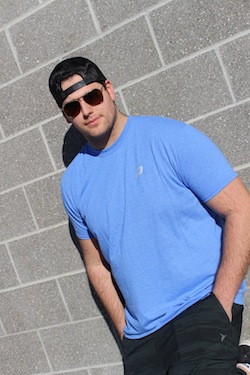
Potential Apparel co-founder Shane Golden. (photo from Shane Golden)
There’s one thing on the mind of Vancouverite Shane Golden, 24, and that’s tikkun olam. The Richmond native is co-founder of Potential Apparel, a sports clothing company that donates a portion of sales from each of its garments to the Make-A-Wish Foundation, and has contributed $20,000 to the charity over the last three years.
“Since my earliest days at Jewish elementary school, even when I was a toddler at Beth Tikvah preschool in Richmond, I was taught the ideology of repairing the world,” Golden told the Independent. “It was reinforced through my family’s actions in the Jewish community. From my earliest memories, I grew up knowing that every action I take has an opposite and equal reaction. I’ve always asked myself, how can I use these physics to help the world around me, to help repair the lives of individuals I’ve never met, and faces I’ll never see?”
Golden and David Dotan founded Potential Apparel three years ago, while Golden was studying engineering at Simon Fraser University. He switched to marketing management at B.C. Institute of Technology but left 18 months ago to work on Potential Apparel full-time. The concept behind the company was Dotan’s, he said. “David used to play professional hockey in the NHL, and we thought we could use his connections and network to start developing the brand.” Those connections include professional athletes Brendan Gallagher, Martin Jones and Ryan Johansen of the Nashville Predators.
The concept behind Potential Apparel came from company co-founder David Dotan. (photo from Shane Golden)
“We develop the shirts with them to create a product that they want to wear,” Golden explained. “Sure, they might have deals with Nike to wear clothes, but they’re wearing Potential Apparel when they want to be comfortable – and they’re definitely influencers.”
To date, Potential Apparel has sold more than 200,000 shirts, most of them in Canada. The clothing, which includes hats and hoodies, is made in Burnaby – which costs more, he conceded. “It’s interesting having to spend a bit more money to manufacture locally but we find people really appreciate locally made products,” he said. “Between local manufacturing and donating a portion of sales to charity, our business has been an interesting challenge, but we’ve figured it out, and we’re making money.”
One thing that’s helped is the charitable golf tournament the pair began last summer in Whistler (whistlerinvitational.com). They matched participants with NHL players for a round of golf and raised $16,000 for the Make-A-Wish Foundation. This summer, the tournament will be held Aug. 5-7 in Whistler, hosted by Johansen and fellow NHLer Brenden Dillon of the San Jose Sharks. “This year, we’re hoping to double last year’s donation,” Golden said.
Asked why he and Dotan selected Make-A-Wish as their charity of choice, Golden said, “At one time, I asked Ryan Johansen why he chose to spend so much of his free time working with charities. He told me that were it not for the privileged lifestyle in which he was raised, with parents who could drive him to the rink every morning and buy him new gear every couple of years, he wouldn’t be where he was today. Make-A-Wish grants terminally ill children the ability to achieve their dreams, and that ability to empower a child is what resonates with us. Whether we choose to stay with Make-A-Wish or, down the road, swap over to helping another charitable organization, it will always be to help kids.”
Golden’s hopes are that Potential Apparel will become a household name that makes a statement. “The statement is that you’ve chosen to reach your potential and help others achieve theirs as well,” he said. “Potential Apparel, since day one, has always been more than just clothing. We are a movement empowering people to take a leap of faith and inspire others while doing so.”
Golden said he’s always looked up to entrepreneurs and philanthropists Mark Cuban and Elon Musk, but that it’s his parents and grandparents who have shaped his character. “My grandmother Marie and late grandfather Sidney Doduck created a legacy called the Marsid Family Foundation, which actively contributes to the Jewish community and causes which they deem important,” he said. “I plan on following suit in a similar manner.”
Lauren Kramer, an award-winning writer and editor, lives in Richmond. To read her work online, visit laurenkramer.net.
Bob Prosser’s “Cuts” is part of the PhotoClub Vancouver group exhibit now on at the Zack Gallery.
Members of PhotoClub Vancouver don’t consider their photography a way to capture moments in life as they come across them, but rather as a complex, multifaceted art form. They experiment with their cameras, discover the limits of Photoshop, and modify their images in unpredictable ways. Their group show at the Zack Gallery demonstrates the results of their explorations.
The club was founded in 1998, “as an outgrowth of a photography course a couple years earlier,” said Bob Prosser, the club secretary responsible for organizing the show, in an interview with the Independent. “I wasn’t among the founding members, only joined in 2011, but I can tell that this club is unlike many others in Vancouver. It’s more informal, less competitive, with a constructive, supportive atmosphere. We encourage experiments, and our members subscribe to all sorts of styles.”
Prosser said that, at the moment, the club counts 28 paid members. “There are men and women among the club members; most of them middle-aged or retired. I guess, younger people may be look for a different environment, more social media-oriented.”
“Selfie” by Wayne Reeves.
The club offers a variety of services and activities to its members. “We critique each other’s works, organize guest speakers and presentations on some inspiring masters of photography, offer technical workshops and field trips to some interesting places, like an Italian festival on Commercial Drive or a Pride parade,” said Prosser. “We organize shows every year, usually at a different venue, and publish books, the best of [each] year. We also have a challenge once a month, and everyone is invited to participate.”
Most of the club members are amateurs. “It’s almost impossible now to make a living as an artistic photographer,” Prosser said. “Everyone has a camera in his cellphone. A professional photographer should be so much more. He should be versatile, able to make video, websites, engage in social media, marketing. Some of our members do very well selling their photos to stock photo companies. Others do it simply for fun.”
Prosser resides firmly in the second category. He shoots lots of photos and participates in club shows, but sales are not his priority. “Of course, I photograph when I travel – just came back from a trip to Japan – and I make portraits of my family but, in general, I’m not interested in capturing people with my camera. I don’t like it when people pose. I prefer doing studio shoots: objects, scenes, and then playing with Photoshop, seeing what I can do.”
The club encourages such an approach, and Prosser relishes its easy atmosphere and its emphasis on experimentation. “I’m not interested in copying nature,” he said. “I try to convey a mood, a message. I want to move my photography towards abstraction, and I use Photoshop to push my photos in that direction, enhance them. I’m fond of impressionist paintings and I’m trying to achieve similar solutions. With software, you can combine several images in different combinations, change colors and shapes. Not all of it is even possible in painting – photography is a unique art form.”
His image “Cuts” in the exhibit represents the Cubist movement. The visual style and the method of execution overlap in the picture, creating a sharp, edgy feel, a scattering of cutouts on a red background. It could be an echo of our hectic lives or a reflection in a broken mirror.
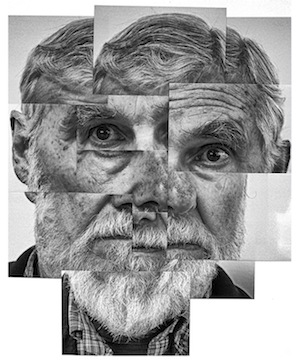
Another fascinating Cubist image is the experimental self-portrait by Wayne Reeves, one of the founding members of the club. The older man in the image comes across as a jumble of conflicting angles, just like so many of us.
In contrast, a lyrical, lovely picture of mother and child inspires contemplation and promotes harmony. It belongs to Richard Markus, the current president of the club.
Terry Beaupre’s “Floating on Fog.”
On the opposite end of the range of expressions are various landscapes and cityscapes. Some are earthy nature snapshots, bursting with colors. Others stress glass-filled urban architectural motifs. Still others are romantic and airy, like Terry Beaupre’s “Floating on Fog,” a dreamscape rising out of the mist.
The selection at the gallery encompasses a number of genres: portrait and still life, street scenes and travel mementos. While some photographs lean towards the traditional, others push the boundaries of the medium. Beside the colorful landscapes or abstract compositions, there are also a few images in the black and white palette. “In certain cases,” Prosser said, “color could get in the way of feelings. It could be a distraction, lessening the impact of the message.”
The group show opened on July 7 and runs until Aug. 6. For more information about the photo club, visit photoclubvancouver.com.
Olga Livshinis a Vancouver freelance writer. She can be reached at olgagodim@gmail.com.
Prime Minister Justin Trudeau at the Auschwitz Memorial and Museum (photo from auschwitz.org)
On July 10, Prime Minister Justin Trudeau visited the Auschwitz Memorial and Museum. He was accompanied by, among others, Nate Leipciger, a former prisoner of Auschwitz born in 1928 in Chorzów, who emigrated to Canada in 1948 and has visited the memorial on more than one March of the Living; Canadian Minister for Foreign Affairs Stéphane Dion; and Rabbi Adam Scheier from Montreal, vice-president of the Council of Rabbis. The guests were welcomed by museum director Dr. Piotr M.A. Cywiński, who told them about the history of the camp and the contemporary challenges of the memorial.
Trudeau laid a wreath and held a minute’s silence in front of the Wall of Death in the courtyard of Block 11, where executions by shooting were held, as a commemoration of all victims of the German Nazi concentration and extermination camp.
The guests visited the vast portion of the museum’s exposition. They saw, among other places, Block 4, which was dedicated to the extermination of Jews and which contains German photographs documenting the arrival of the transport of Jews from Hungary, a model of gas chamber and crematorium II from Birkenau, Zyklon B canisters, as well as human hair taken from the murdered. There is also a display dedicated to the story of storage rooms for looted property which, in the jargon of the camp, were called “Kanada.” In Block 5, the visiting delegation saw personal objects of victims that were found in these storage rooms after the liberation of the camp, such as shoes, suitcases, glasses, brushes and kitchen utensils. The delegation also visited the building of the first gas chamber and crematorium in Auschwitz I.
In the second part of the visit, Trudeau walked through the former Auschwitz II-Birkenau camp. He walked along the rail ramp where the Germans conducted selection of the Jews, and also saw the ruins of the gas chamber and crematorium III, where the Jewish prayer for the dead, the Kaddish, was said. Candles were lit at the monument, commemorating all victims of the camp.
The prime minister also made an entry in the guest book of the museum. “Tolerance is never sufficient: humanity must learn to love our differences,” wrote Trudeau. “Today, we bear witness to humanity’s capacity for deliberate cruelty and evil. May we ever remember this painful truth about ourselves and may it strengthen our commitment to never again allow such darkness to prevail. We shall never forget. Nous nous souviendrons.”
Dr. Robert Krell, left, listens to Prof. Elie Wiesel, as Wiesel addresses the capacity crowd that came to the Orpheum in 2012 to hear him speak (photo by Jennifer Houghton). Elie Wiesel passed away on July 2. May his memory be for a blessing.
The following article was originally published on Sept. 21, 2012, and initially reposted on July 2, 2016. The photographs were added with its republication in the newspaper and online July 15:
“The Jewish people is based on what is called in the Prophets, ‘Edim atem l’Hashem,’ ‘You are witnesses to God.’ Says the Talmud something horrible: the Talmud says God says, ‘If you are my witnesses, I am your God. If not, I am not your God.’… That is the importance of testimony.”
This was part of Nobel Peace Prize-winner Elie Wiesel’s response to a question about the role of March of the Living alumni. “You are now the witnesses,” he said. “Remember, to be a witness to the witness is as important as to be a witness.”
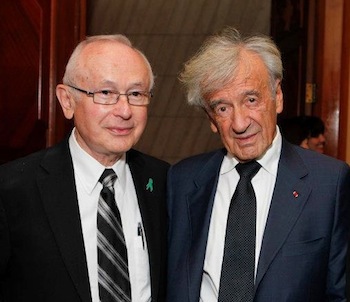
Elie Wiesel with friend and fellow survivor Robbie Waisman (photo by Jennifer Houghton)
Wiesel was in Vancouver to launch the Jewish Federation of Greater Vancouver’s annual campaign on Monday, Sept. 10. The event, which was held at the Orpheum, featured Wiesel in conversation with his friend, fellow survivor Dr. Robert Krell, as well as a presentation of another of Wiesel’s friends, Robbie Waisman, who accompanied this year’s March of the Living program to Poland and Israel. Participant Jenna Brewer read the account written by Monique de St. Croix of Waisman’s emotional return to his birthplace, after which Waisman himself addressed the nearly 2,700 people in attendance.
The campaign launch was the culmination of Wiesel’s day here, which included a proclamation from Vancouver Mayor Gregor Robertson declaring Sept. 10, 2012, Elie Wiesel Day.
Among Wiesel’s many activities was the receipt of an honorary degree from the University of British Columbia, where he spoke to university administrators, students and Holocaust survivors. A formal academic procession led Wiesel into the hall and a short panel discussion followed his remarks, involving the university’s president, Prof. Stephen Toope, Prof. Richard Menkis, a professor of modern Jewish history, and Barbara Schober, a graduate student. UBC Chancellor Sarah Morgan-Silvester presented Wiesel with the doctorate.
Also on Wiesel’s itinerary was a morning interview with the Jewish Independent; one of only two interviews he granted while here, the other being with the Vancouver Sun.
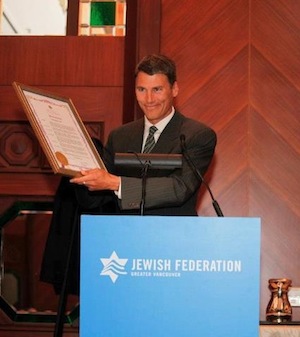
Vancouver Mayor Gregor Robertson declares Sept. 10, 2012, Elie Wiesel Day. (photo by Jennifer Houghton)
As editor Basya Laye and I introduced ourselves, Wiesel admitted his dependence on the New York Times, a copy of which he had not yet picked up that day. Once the “bible of journalism,” according to Wiesel, he lamented the Times’ decline in quality as the newspaper industry itself has declined. He wasn’t worried about the change to internet media, however.
“Our stories are not dominated by concern with the press, it’s person to person,” he said. “If you relied on the New York Times, the New York Times’ background, record in those years, is not the best, during the war.”
Wiesel recounted how, years ago, he complained to the Times about how little there was in the paper about the Holocaust while it was happening. Subsequently, he was invited to a luncheon, at which he gave them a piece of his mind. As a result, said Wiesel, in the paper’s offices, they have a plaque/letter saying, “We failed,” as a reminder to themselves.
Yet, admission of failure on the world level – that countries did not do enough to prevent the Holocaust – has not resulted in the prevention of other attempts at genocide.
“Can human nature change?” Wiesel said about that fact. “It’s society. Whatever the issue we have is, for instance, believe me that, I say, a sex story will have the front pages. Not what we try to say, but the sex story will have the front pages. It is our culture. We go with what is easy, what is cheap, and what is accepted as interesting by more people than before. And that goes everywhere, that’s in literature, that’s in the movies. I don’t know where we are heading.”
For his part, Wiesel has spent most of his life – as a witness, storyteller and teacher – trying to ensure that “never again” is a promise kept.
Born in Sighet, Romania (which was in Hungary during the war), Wiesel was 15 when he and his family were taken to Auschwitz. His mother and younger sister were killed there, his father died in Buchenwald, where Wiesel also was imprisoned when the war ended; his two older sisters survived. Wiesel’s book about his experiences in the camps, Night, was first published in 1956. It has since been translated into more than 30 languages, with millions of copies being sold.
A professor at Boston University since 1976, Wiesel was founding chair of the United States Holocaust Memorial Council, which created the U.S. Holocaust Memorial Museum, and, with his wife, Marion, he established the Elie Wiesel Foundation for Humanity soon after he received the Nobel. He has written more than 50 books, and his lengthy resumé continues.
When asked how he would categorize his body of work, Wiesel told the Independent, “Not enough.”
“What would you like to have been able to do?”
“More.”
“In terms of?”
“More,” he repeated. “Not enough. Look, look, on the surface, I’ve done a lot, published many books. Many books have been published about me, and so forth. I have approached presidents and kings, but all of that, somehow, it is not enough. Maybe, deep down, all of us who have survived have had a feeling, if we told the story, the world would change, and the world hasn’t changed. Does it mean that we did not tell the story? Or not well enough? Simply, we did not find the words to tell the story? Had we told the story well enough, maybe it would have changed the world? It hasn’t changed the world.”
“Do you feel like you have failed in some measure there?”
“Not failed,” Wiesel replied quickly. “I didn’t say fail. Failing, if I had not tried. Look, I know I tried. I still try.”
Complementing his activism for human rights, Wiesel is a dedicated student of Talmud and has a deep appreciation of Chassidic and biblical stories, which the Independent referred to as “old” in asking a question about such stories’ relevance today.
“They are not only old, they are immortal,” said Wiesel. As to specific lessons we could learn, he added, “It depends what area. If it’s the Bible, then the eternal truth, or at least the eternal quest for truth. The Talmud, it’s my passion – I grew up with the Talmud and, to this day, every day, I study – I love it. I love study.”
Wiesel explained, “There is so much beauty in all that. There is so much….” He paused. “Truth is a difficult word because my truth may be mine, but not yours, but learning, the quest for truth, is extraordinary. For me to teach those texts is so rewarding, so rewarding. And we take a theme, a talmudic theme or a biblical theme or a prophetic theme, and it can go on, it can last for us for hours and hours and hours in class.
“Come on, the beauty of an Isaiah, the tragic sense of a Jeremiah, and the immortal dimension of a Habakkuk. It is all these. They survived. The very fact that they survived, you know, how did they survive? These are texts conceived, written and spoken 3,000 years ago or so, 2,500, and they survived. What made them survive?”
The concept of truth came up again when the Independent asked Wiesel’s opinion – as a former journalist himself – about how much a newspaper should reflect extremes within the community it serves.
“I gave up journalism. Do you know why?” asked Wiesel. “I liked journalism at the beginning; I loved it. It was to be at the nerve centre of history, come on, I loved it. Then I realized, what, two things. Number one, I repeated myself – which means I changed the names, but the words remained the same.” He paused, then continued, “I am going to spend my life like that? Second, I realized the people that I loved and admired; occasionally, they had such an attitude of fear and respect for the journalist – I said, I don’t want that, I don’t want to inspire that. That’s when I moved to the academic. I gave up, for that reason.”
Hesitant to give advice, Wiesel eventually said, “Young lady, your truth is truth. Listen to it. It’s your truth that matters. Don’t accept somebody else’s truth. And, if you are a journalist, if you have the respect for your own words, that will be read by hundreds or thousands of people, who will read it and maybe be influenced by it – you, just you, don’t listen to [anyone,] not even to your editors. Don’t tell them, don’t even listen to that,” he said, looking at Basya as he made the comment, and laughing. “You decide. When you publish an article under your byline, it’s yours.”
Despite having wondered aloud as to the effectiveness of his efforts to change the world, Wiesel still gets up every morning to do just that. “What is the alternative?” he asked rhetorically. “What is the alternative? There is no alternative. True, I fought many battles and lost. So what? I’ll continue fighting. Look, my life is not a life of success or victory, much more of failures. I tried so many things and failed, you have no idea. Of course, so what? I’ll continue. The only area where I feel I must continue is, first of all, education. Whatever must be done in Jewish life, and in life in general – not only for Jews – education must be a priority. Not the only one, but the main priority, education. Let’s surely aim for that. And then, Israel, to me, of course is – the centrality of Israel in my life is here,” he said, putting his hand over his heart.
A few moments later in the conversation, Wiesel returned to the topic of journalism.
“You know, as a journalist, my love would be to interview, not for news, [but] to have the interview. And that’s really what I loved about it, to meet people, to have real conversations, I mean, real dialogues – not questions and answers, because I know now about you more than you think, simply by the questions that you ask. But that’s the journalist in me.”
“So, you obviously have faith in human nature … and you like to know more about people?”
“I do,” he said, with hesitation. “In spite of. It’s not because of, but in spite of.”