Skip to content
  • Home
  • Subscribe / donate
  • Events calendar
  • News
    • Local
    • National
    • Israel
    • World
    • עניין בחדשות
      A roundup of news in Canada and further afield, in Hebrew.
  • Opinion
    • From the JI
    • Op-Ed
  • Arts & Culture
    • Performing Arts
    • Music
    • Books
    • Visual Arts
    • TV & Film
  • Life
    • Celebrating the Holidays
    • Travel
    • The Daily Snooze
      Cartoons by Jacob Samuel
    • Mystery Photo
      Help the JI and JMABC fill in the gaps in our archives.
  • Community Links
    • Organizations, Etc.
    • Other News Sources & Blogs
    • Business Directory
  • FAQ
  • JI Chai Celebration
  • JI@88! video

Recent Posts

  • Story of Israel’s north
  • Sheltering in train stations
  • Teach critical thinking
  • Learning to bridge divides
  • Supporting Iranian community
  • Art dismantles systems
  • Beth Tikvah celebrates 50th
  • What is Jewish music?
  • Celebrate joy of music
  • Women share experiences 
  • Raising funds for Survivors
  • Call for digital literacy
  • The hidden hand of hate
  • Tarot as spiritual ritual
  • Students create fancy meal
  • Encouraging young voices
  • Rose’s Angels delivers
  • Living life to its fullest
  • Drawing on his roots
  • Panama City welcoming
  • Pesach cleaning
  • On the wings of griffon vultures
  • Vast recipe & story collection
  • A word, please …
  • מארק קרני לא ממתין לטראמפ
  • On war and antisemitism
  • Jews shine in Canucks colours
  • Moment of opportunity
  • Shooting response
  • BC budget fails seniors
  • Ritual is what makes life holy
  • Dogs help war veterans live again
  • Remain vital and outspoken
  • An urgent play to see
  • Pop-up exhibit popular
  • An invite to join JWest

Archives

Follow @JewishIndie
image - The CJN - Visit Us Banner - 300x600 - 101625

Month: July 2016

Mourning Elie Wiesel

Dr. Elie Wiesel was motivated by his experience as a survivor of the Holocaust to become one of the world’s foremost advocates for social justice and human rights. He was also a friend to members of the Vancouver Holocaust Education Centre community and we mourn his passing. In his writing and his activism, he gave voice to the experiences of survivors but, as he acknowledged, also saw it as his responsibility to represent those who did not survive.

Wiesel and Robbie Waisman, a past president of the VHEC, were among the 426 “Boys of Buchenwald” liberated on April 11, 1945, and began their post-Shoah lives together at a facility in France.

“We had a common bond,” Waisman said. “On the 11th of April, I usually go into my office and call some of the boys. Elie was part of it. There’s so much that I shared with him.

“The world lost an irreplaceable human being.”

Dr. Robert Krell – recipient of the Elie Wiesel Holocaust Remembrance Medal for his work in Holocaust education, psychiatric contributions to the care of Holocaust survivors, and his role as founding president of the VHEC, which Wiesel visited – became friends with Wiesel over several decades.

“He was the kindest, gentlest, wisest person in my life,” said Krell. “And he always made time for me, although he was also the busiest and most prevailed upon person imaginable.”

Wiesel once said: “There is much to be done, there is much that can be done.” And the Vancouver Holocaust Education Centre commits to continuing the work that defined his life’s mission.

The VHEC will honor the life and work of Elie Wiesel during our annual High Holidays Cemetery Service. The commemoration will take place at 11 a.m. on Sunday, Oct. 9, at Schara Tzedeck Cemetery, 2345 Marine Dr., New Westminster. Everyone is welcome.

The service, held annually on the Sunday between the High Holidays, affords participants the opportunity to mourn those who perished during the Holocaust at this symbolic gravesite.

Posted on July 15, 2016July 13, 2016Author Vancouver Holocaust Education CentreCategories LocalTags Elie Wiesel, High Holidays, Holocaust, Krell, survivors, Waisman

Reacting to others’ suffering

Gun violence in America is an intractable, apparently unsolvable crisis. This month, it has intersected catastrophically with other tenacious American ailments: race and police violence. These issues have been inextricable in many ways for decades, of course, but the pervasiveness of video-recording and social media have helped turn what was once a matter of competing testimonies into irrefutable proof of police overreach, including murder.

The police killings of black civilians in Louisiana and Minnesota last week, followed by the revenge killing of five police officers in Texas, created a climate of crisis in the United States. Such times are, sometimes, opportunities for progress. The Civil Rights movement of the 1950s and ’60s was advanced by the widespread awareness among Americans of all races of injustices being perpetrated against black Americans. However, anything involving guns in America seems somehow impervious to reason.

Race is a unique flashpoint in American life and approaches to it have very often split directly along color lines. This may be changing, with more white Americans recognizing the injustices experienced by their fellow citizens of color. Like sexual orientation equality, issues of racial justice seem to be advancing because of a wider appreciation that transcends personal identity and relies on human empathy for those who are different from ourselves.

Still, Americans – and Canadians in somewhat different contexts, and all peoples – struggle to find balance and moral approaches to confounding issues. In response to the Black Lives Matter movement, a counter-campaign declares “All Lives Matter.” After the police killings in Dallas, “Blue Lives Matter” became a slogan. While the veracity of these statements cannot be refuted, they are nonetheless unhelpful and dismissive. Responding to Black Lives Matter with an appropriated variation is disrespectful. It is akin to the complaints by members of the majority when gay pride events occur and the question arises, “When do we celebrate straight pride day?” The answer, as empathetic people know, is that straight people (or white people) don’t need special days to celebrate their situation in society.

The insensitivity of such approaches has been slyly critiqued in social media recently, with one cartoon showing a house on fire while firefighters douse the house next door in water, declaring “All houses matter.” Similarly, a man in the doctor’s office with a broken arm is told, “All bones matter.”

The message should be clear: the perennial problems America has around race are particularly enflamed right now and attempting to dilute these through banal attempts to universalize what is a very particular problem effectively exacerbates the issue. Just last week in this space we noted that the specious way some people respond to any mention of the Holocaust is to note that Jews aren’t the only people to have suffered. Replying to the suffering of one group by an erroneous universalizing of race-particular situations is not a healthy response.

Another development seen recently is the attempt by “pro-Palestinian” activists in the United States to co-opt the Black Lives Matter movement and the recent catastrophes to their own narrow ends. Students for Justice in Palestine at New York University declared that those responsible for the “genocide” of Palestinians are likewise responsible for the “genocide” of African-Americans, a circle they attempt to square with the fact that a small number of U.S. police have received anti-terrorism training from the Israel Defence Forces.

There are plenty of issues competing for the attention of people of goodwill. There are injustices everywhere, God knows. There is racism, homophobia, antisemitism, Islamophobia and every range and permutation of human misery that deserve attention. Yet, when something as systemic and pernicious as the murder of African-Americans by those entrusted to protect American citizens becomes epidemic, this is not the time to elbow one group out of the way or try to co-opt their tragedies.

Posted on July 15, 2016July 13, 2016Author The Editorial BoardCategories From the JITags Black Lives Matter, empathy, equality, guns, racism
Remembering a friend

Remembering a friend

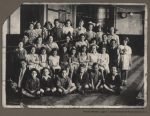
On the back cover of Arnold Wesker’s book Say Goodbye: You May Never See Them Again, Alan Tapper is the third boy from the left seated on the ground and Arnold is the fourth.

British playwright and author Arnold Wesker passed away in April. He and I were good friends, and I miss him greatly.

I went to school with Arnold 80 years ago. We were in the same class at Commercial Street School. I am among the students in the photo on the back cover of his book Say Goodbye: You May Never See Them Again – I am the third boy from the left seated on the ground and Arnold is the fourth. The book’s paintings, by John Allin, were of the old Jewish East End of London, England.

We grew up together in the Spitalfields area of Stepney. We regularly visited each other’s homes; his house was on the next street to mine. His family were staunch communists and his aunt – who lived on the same street I did – was involved with the local garment workers union. I was introduced to political discourse at an early age through the discussions that regularly took place at his home, but we also enjoyed playing games, like Monopoly. And we did so often.

Arnold, like me, was evacuated to Barnstaple in North Devon during the war. I was evacuated three times: when war broke out in September 1939 to Aylesbury; in the early 1940s to Barnstaple; and, in 1944-45 to Newcastle upon Tyne, returning to London the day that the last rocket landed on a tenement building not far from where we lived, killing and injuring many people. One of my friends, Mossy Berkovitch, was a survivor from the rubble.

Arnold and I kept in touch after returning to Stepney after the evacuation to Barnstaple. I remember visiting with him the different air-raid shelters in the local area but we lost touch after the war. We both served in the Royal Air Force – he wrote about his RAF experiences in two of his plays, The Kitchen (1957) and Chicken Soup with Barley (1958).

We connected again in 1953, when I went to see a production of R.U.R. (Rossum’s Universal Robots) by Czech futurist writer Karel Capek. Arnold was in a local drama group, called the Query Players, who performed the play. The show and his performance gave me the theatre bug and I also joined the Query Players a short time later, appearing in many of the group’s productions. Arnold was my mentor, and. I continued to act and write, but became involved in local politics. Since moving to Canada, I have been involved with and worked on committees of many Jewish and non-Jewish organizations, and presented and produced Anthology of Jewish Music on Vancouver Coop Radio for 35 years.

I am currently re-reading Arnold’s autobiography, As Much as I Dare, which he wrote in 1994. It is a vivid account of his life to that point, and I am pleased that he remembered me in his story. He was a prolific and multi-award-winning writer and his plays have been performed all over the world. He was one of the first among the Angry Young Men literary group and was knighted by the Queen for his service to English literature. But, mostly, I will remember him as my friend.

Alan Tapper is a local freelance writer. His work has been published in the Vancouver Sun, Province, Courier, National Post, among others, as well as the Jewish Western Bulletin, now the Jewish Independent, and online publications. His first story was published in the London Evening Star when he was 14.

Format ImagePosted on July 15, 2016July 13, 2016Author Alan TapperCategories WorldTags Angry Young Men, Wesker
Star-crossed & honky-tonk

Star-crossed & honky-tonk

Bard on the Beach opened its 27th season with Romeo and Juliet. (photo by David Blue)

William Shakespeare wrote a beautiful but tragic love story in 1595 and called it Romeo and Juliet. Its theme of forbidden love resonates with modern-day audiences as much as it did with the Elizabethan crowd – and countless crowds in between. Bard on the Beach opened its 27th season under the red and white tents at Vanier Park on the BMO Mainstage last month with renowned Canadian director Kim Collier’s innovative twist on the timeless tale.

Two prominent families of Verona, the Montagues and the Capulets, have been feuding for years. Their children, Romeo and Juliet, meet one night at a masked ball and become infatuated with each other. Then follows a secret wedding, a banishment, a miscommunication and two suicides – such woe.

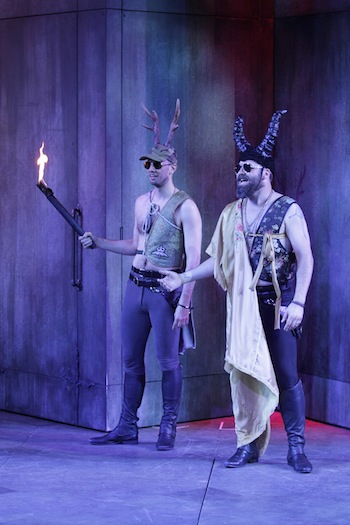
Collier sets the story in its proper period but with some modern gadgets – Bose headphones on the friar, Moosehead caps and beer cans for Mercutio and Benvolio, Romeo’s friends. Collier also has the cast break down the fourth wall to move into and interact with the audience – an interesting approach if used sparingly.

The success or failure of any Romeo and Juliet production depends on the actors in the eponymous roles. Collier imported her two leads from Ontario. Hailey Gillis portrays the 13-year-old Juliet in an endearing and playful manner and Andrew Chown, as the slightly older Romeo, has moments of brilliance. There is clearly chemistry between the innocent young lovers and their scenes together are lovely.

photo in Jewish Independent - Ben Elliott, left, and Andrew McNee shine in Romeo and Juliet
Ben Elliott, left, and Andrew McNee shine in Romeo and Juliet. (photo by David Blue)

The supporting players, mostly Bard veterans, give depth to the story, one driven by supposedly intelligent adults, whose actions lead to the ultimate tragedy. Jennifer Lines plays the nurse – usually portrayed as older and subdued – as young, sexy and vibrant, more a friend and confidante than anything else. Scott Bellis is a kind and caring Friar Laurence, and Andrew McNee as Mercutio and Ben Elliott as Benvolio steal the scene every time they appear together.

Although McNee’s forte is comedy, he shows the versatility of his thespian skills in Mercutio’s death scene, as he chokes out, “A plague on both your houses.” Killed by the sword of Tybalt – played by Jewish community member Anton Lipovetsky – Tybalt is subsequently killed in a sword fight with Romeo, who is banishéd from Verona by Prince Escalus (Victor Kolhai). Interestingly, it is not the sword that does Tybalt in.

Romeo’s parents are played by David Marr and Amber Lewis and Juliet’s by Ashley Wright and Dawn Petten. These are smaller roles but with some touching moments, particularly at the end, when the parents finally understand what the feud has done to their respective families.

This production is very much about the visuals. Pam Johnson’s set design is simple but powerful: two grey metal bunker-like walls that are separated and joined as needed – perhaps a metaphor for the rifts and couplings of the feuding families – to create a ballroom, balcony, bedroom, tomb and other places, all against the spectacular backdrop of the North Shore mountains. Gerald King’s lighting provides the proper mood. Nancy Bryant’s costumes are a mix of the historical and the contemporary. Bringing it all together is Brian Linds’ sound design, which runs the gamut, from soft romantic lilts to heavy metal clunk.

While the play gets off to a slow start, the second act picks up, culminating in the final scene that had most of the opening night audience on their feet. One hopes that, over the next three months, the shaky bits will be ironed out. Overall, it is certainly worth a trek to the beach to partake of the tale of the star-crossed lovers.

Rockin’ Merry Wives

Playing in repertory on the BMO Mainstage with Romeo and Juliet is The Merry Wives of Windsor. This country and western musical farce played to soldout audiences on the smaller Douglas Campbell Stage in 2012. Moving it to the big stage has only added to its pizzazz. When you walk out of a theatre on opening night thinking you have to tell everyone to come see the show, you know you have just been treated to something special.

The play is set in Windsor, Ont., circa 1968, at the Garter Pub, a honky-tonk bar that is home to some eccentric characters. It is open mic night and mesdames Page and Ford (Katey Wright and Amber Lewis) start the evening off with a rocking version of “These Boots are Made for Walking.” Portly Sir John Falstaff (Ashley Wright), an expat, penniless, full-of-himself Brit and frequent bar patron, decides to seduce the married housewives for financial gain. To that end, he writes each of them an identical letter. The women learn of Falstaff’s deceit and set a scheme in motion to humiliate him to avenge their honor. Then, the fun begins.

Round 1: a secret tryst, the arrival of a jealous husband (Scott Bellis as Mr. Ford) and Falstaff’s quick exit in a laundry basket, culminating in his unceremonious plunge into the river.

Round 2: Falstaff in drag, a golf club-wielding Mr. Ford and a hasty exit stage right.

Round 3: The final knock-out round of humiliation takes place at night near an abandoned curling club amid prancing fairies – a bit far-fetched but, surprisingly, it works.

A sub-story revolves around young Anne Page (Hailey Gillis) and her three suitors, Slender (Ben Elliott, who does double duty as the musical director), Dr. Caius (Andrew Chown) and Fenton (Daniel Doheny). Which swain will win her hand?

Ashley Wright, reprising his role as Falstaff, owns the stage. Katey Wright, Lewis and Bellis – also reprising their roles from 2012 – are even better this time around. In particular, Bellis’ beatnik portrayal (a disguise to trick Falstaff) and that of the cuckolded husband are priceless.

photo in Jewish Independent - Ashley Wright and Jennifer Lines in The Merry Wives of Windsor
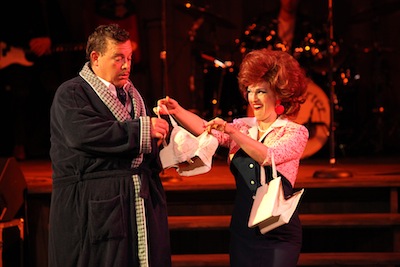
Ashley Wright and Jennifer Lines in The Merry Wives of Windsor. (photo by David Blue)

Other notable performances include David Marr as Justice Swallow bopping around on his scooter, Anton Lipovetsky as the hippie host of the bar, Dawn Petten as buck-toothed Simple, Jennifer Lines as Mistress Quickly – who takes her housekeeper character over the top with her flaming red hair, nails, lipstick and bawdy wiggle – and Andrew McNee as Pastor Evans, who has to quickly learn to fence to stave off the challenge of the foppish Dr. Caius.

It is a credit to the talent of this company that they can move from the tragedy of Romeo and Juliet to the light-hearted Merry Wives with such ease. Each of the cast is a quadruple threat – they sing, dance, play an instrument and, boy, do they emote. This is an ensemble that really works well together and their chemistry is palpable.

Pam Johnson’s set is legion hall kitsch complete with moose heads, dartboards and the obligatory photograph of Queen Elizabeth. The sub-set – white picket fence, pink flamingos and garden chairs – is pure sixties nostalgia. The costumes are fab (kudos to designer Drew Facey) – very Mad Men, with pedal pushers, crop tops, saddle oxfords, crinolines, bouffant hairdos, zoot suits, and some Canadiana touches, a Hudson’s Bay blanket and a curling sweater. Elliott’s sound design and Valerie Easton’s fancy choreography ties it all together. Director Johnna Wright notes that Merry Wives was Shakespeare’s “love letter” to the Elizabethan middle-class, his only comedy that takes place on “home turf” and his only play written almost entirely in prose. What a gift.

While purists will shake their heads at the thought of this Shakespearean musical, their toes will be tapping to the likes of “Baby, Baby Don’t Get Hooked on Me,” “Your Cheating Heart” and “Ramblin’ Man.” The whistling and foot stomping of the opening night crowd seems to indicate that this will be the hit of the season. It is a lot of fun. Don’t miss it.

Bard runs until Sept. 24, and reviews of its other two productions – Othello and Pericles – will appear in a future issue of the Independent. For more information and tickets, visit bardonthebeach.org or call 604-739-0559.

Tova Kornfeld is a Vancouver freelance writer and lawyer.

Format ImagePosted on July 15, 2016July 13, 2016Author Tova KornfeldCategories Performing ArtsTags Bard on the Beach, Merry Wives, Romeo & Juliet, Shakespeare
Necessary for people to act

Necessary for people to act

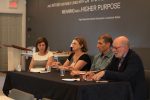
Left to right, emcee Yael Dirnfeld with panelists Penny Gurstein, Tom Davidoff and Michael Geller, who discussed the Metro Vancouver real estate market. (photo by Lior Noyman)

Few topics in Vancouver are debated more intensely than real estate. “It is now possible to use the words ‘housing crisis’ without being labeled an alarmist,” noted Michael Geller at the Ohel Ya’akov Community Kollel’s Stunning Views: Vancouver Real Estate panel discussion last month.

Held on June 28 by the Barry & Lauri Glotman Kollel Business Network, the event was the second meeting hosted by the Kollel to look at the situation in the Metro Vancouver real estate market and its impact on the Jewish community. This second session focused on practical, grassroots solutions, featuring once again presenters Tom Davidoff, Michael Geller and Penny Gurstein and emcee Yael Dirnfeld.

Davidoff is an associate professor at the University of British Columbia’s Sauder School of Business and incoming director of the Sauder Centre for Urban Economics and Real Estate, and Geller is an architect, real estate consultant and property developer, president of the Geller Group and an adjunct professor in Simon Fraser University’s Centre for Sustainable Community Development. Gurstein is a professor and the director of the School of Community and Regional Planning and the Centre for Human Settlements at UBC, while Dirnfeld is director and team lead in private banking with Scotia Wealth Management.

Each of the three presenters brought differing but complementary perspectives. Davidoff spoke in rapid-fire witticisms and big picture sketches, focusing on the international picture and willing to offer speculative answers and predictions about the future. Geller was more cautious, and drew on his extensive knowledge of Vancouver history and urban planning to weigh different possible futures and suggest options for buyers and investors. Gurstein spoke of political solutions, emphasizing the importance of both legislative changes and broad community organization and activism to effect change and provide more housing, increased diversity of housing and a sustainable real estate economy.

Davidoff discussed different possible ways forward. Should the city build more housing to drive down prices? Should the province raise taxes? Should the federal government intervene? Davidoff said the situation is authentically worrisome and there are possibilities of the market undergoing “a nasty correction.” He argued that legislative changes were the most effective long-term solution, and that the tax on vacant houses being discussed by Vancouver Mayor Gregor Robinson is a good start.

From where will change come? asked Davidoff. Quoting George Orwell’s book 1984, he said, “If there’s hope, it’s from the proles,” the proletariat, or the common people. Pressure needs to be put on government from people other than wealthy homeowners, investors and developers, said Davidoff.

Geller warned the audience that everything being discussed should be taken “with a grain of salt.” He said, “None of us up here know very much but, since we are sitting up here and you down there, we are obliged to be sage.”

Geller pointed to the impending crackdown on unscrupulous real estate agents as a positive development, as well as the federal government’s allocation of $150 million for affordable housing in British Columbia, the utility of which Davidoff doubted. Geller emphasized the cyclical nature of markets and the likelihood that the boom would not go on much longer. “I think it will peak, but I am not sure it will crash,” he said. “I am inclined to think the correction will not be severe.”

Gurstein also thought that there have been positive developments in the last few months. “We need a government intervention,” she stressed. But, she said, “… there is a fear that, if they intervene, it could have a serious impact. This points to the need for a serious, wide-ranging economic strategy: we cannot be dependent on global capital coming in and generating a whole real estate industry from that.”

Gurstein emphasized the need for large-scale diversification, as well, pointing out that Vancouver needs different kinds of housing to meet everyone’s needs, as opposed to a market-driven fixation on condos and detached single-family dwellings.

photo in Jewish Independent - Panelists Tom Davidoff, second from the left, and Michael Geller, third from the right, mingle with the crowd at the Community Kollel on June 28
Panelists Tom Davidoff, second from the left, and Michael Geller, third from the right, mingle with the crowd at the Community Kollel on June 28. (photo by Lior Noyman)

The audience’s questions were directed to future developments and which investments are best. “Michael,” an attendee asked, “where are things going, what will prices look like in five to 10 years?”

“You’re going to have as many people saying prices will go up as go down,” replied Geller. “Some will say it will go up because of Brexit, or matters in China, or the stable Canadian economy. Other people will say it simply cannot continue and, if you look at the history of Vancouver, we have seen bubbles like this before that burst. Some of the remedies that people have been asking for – taxing foreign investment and vacant homes, government money for affordable housing, taxing BnBs, building more houses, all of those things – will have some impact in dampening things a little bit but, again, I don’t see a severe crash coming.”

Geller also spoke about the subjective nature of assessments. “Will things drop or stabilize? … After Brexit, the market dropped 200 points, then 200 points more, then it was 150 points up again because some people said Lloyds Bank is down 40% and it has to be a good time to buy! So, now it’s going up. Why did it drop at first? Fear. Then it comes up because of hope. It’s all so psychological.”

Geller and Davidoff agreed that investing in central Vancouver real estate is unlikely to pay off at this point, but looking farther afield to New Westminster, Squamish, the Sunshine Coast and other developing communities is a good bet. Asked whether one should rent or buy, Geller suggested, “Why not rent somewhere near a shul and buy a property elsewhere you can rent out for income?”

Gurstein spoke about Tikva Housing Society, which was formed to address the needs of working families, single people and others having difficulty finding affordable housing. “What they’ve done is work with other nonprofit housing societies and the Jewish community and they are now building housing,” she said. “They have one development in Richmond with 10 units, they have [one with] 32 units in Vancouver, and they are amazing and beautiful.”

Gurstein cited Tikva Housing’s work as an example of proactive, effective action. “We need to be supporting these kinds of institutions because they are going and making connections with other nonprofit housing societies to really address this,” she said. “Forty-two [new] units doesn’t solve the problem, but it begins to address it.”

Geller added that Tikva is not the only Jewish housing society and advised that people should take a close look at what’s on offer.

Asked what was the most effective activism for change, Geller emphasized the importance of going to town hall meetings, writing editorials and otherwise making it clear to government that there is a sizable, active constituency desiring intervention. All three presenters agreed that, absent such public activism, the only voices likely to be heard by government are the ones that have prevailed so far: those of wealthier homeowners, developers and foreign investors.

Matthew Gindin is a Vancouver freelance writer and journalist. He blogs on spirituality and social justice at seeking her voice (hashkata.com) and has been published in the Forward, Tikkun, Elephant Journal and elsewhere.

Format ImagePosted on July 15, 2016July 13, 2016Author Matthew GindinCategories LocalTags housing crisis, Kollel, real estate, Tikva Housing
Moving musical

Moving musical

Karen Kelm, left, and Judith Chertkow-Levy in Like a Fly in Amber, which premièred at the Toronto Fringe Festival. (photo by Victor Dezso)

After seeing Like a Fly in Amber, a musical at the Toronto Fringe Festival, I dreamt of my mother, regretting that I hadn’t spent more time with her, wishing that I had asked and listened to more about her as a person beyond her being my mother.

Karen Kelm, a Vancouver singer and musician, wrote the script and music of Like a Fly in Amber. She also takes on the role of Iris, the 62-year-old daughter of 89-year-old Grace, played by Judith Chertkow-Levy, in this two-person, 80-minute show directed by Susanne de Pencier.

The play revolves around Iris’ writing of a eulogy for her mother while sitting in the attic of the house in which she grew up. She struggles to evoke memories of the person her mother was and to put her personhood into words. The resulting tribute is beautiful.

In the interest of full disclosure, Judy is my sister, the youngest of four daughters of David and Rachelle Chertkow. She was born and raised in Vancouver, then studied opera in Toronto and in London, England. She now lives in San Diego, where she is a cantorial soloist.

Like a Fly in Amber is poignant and moving, evoking memories for all of us who have experienced a parent’s gradual decline. Karen has found the words to describe universal feelings that exist within the daughter-mother relationship. I saw audience members nodding in recognition and chuckling at some of the comments of both mother and daughter. Many families, for example, have a “brother Greg” who can do no wrong, whom we love and resent at the same time.

The music is lovely, melodic with memorable lyrics. I especially like the title song, which expresses the feelings of an old woman who is losing her power, both physical and mental. “On the Wings of an Eagle” moved me to tears as I thought of our mother in her chair in the den and on her hospital bed, expressing her sorrow that she would not see another spring. And I have been humming “Ain’t it Great to be Senile” – funny, in a bittersweet way. I wish you could hear “Pills, Pills, Pills,” a Music Man-type, rapid-fire dialogue between the characters, focused on “keeping regular” – really funny, also in a bittersweet, isn’t-life-a-bitch kind of way.

I loved seeing, as Judy put it, a play about two old broads, written for and acted by two old broads. It was so great to see Judy and Karen perform together, as I recalled their performance in a Fiddler on the Roof production in Vancouver nearly 40 years ago. I closed my eyes and remembered them both young, then opened my eyes to see the beautiful older women they are now.

Both Judy and Karen have wonderful voices and performed their roles with heart and soul. I couldn’t look at Judy, for fear I would break her up, especially when she used expressions of our mother’s or referred to stories I remember. I did laugh out loud when her character, Grace, recounts how she was so angry at a driver who cut her off in traffic that she stuck her tongue out at him.

If you missed the play in Toronto and are unable to see it in the Hamilton Fringe (until July 24), you can hear the music if you visit cdbaby.com.

Format ImagePosted on July 15, 2016July 13, 2016Author Carol HerbertCategories Performing ArtsTags Fringe Festival, Kelm, musical
Learning to live with autism

Learning to live with autism

Owen Suskind is the subject of the documentary Life, Animated. (photo from A&E Indiefilms)

Children’s films – especially the animated variety – always make sure to highlight the moral of the story. But very few children embraced those lessons as deeply and thoughtfully as Owen Suskind.

Now in his mid-20s, Owen had a normal East Coast childhood until he suddenly stopped speaking when he was 3. His parents, Ron and Cornelia, tried every strategy and tactic to treat Owen’s autism, but he remained uncommunicative and seemingly unreachable.

Ron Suskind, the bestselling author of such nonfiction books as The Price of Loyalty: George W. Bush, the White House and the Education of Paul O’Neill, relates in the beautifully crafted and irresistibly touching documentary Life, Animated that he was stunned one day to hear Owen repeat a snippet of dialogue while watching a Disney animated movie.

It took a few years, however, to figure out that Owen was using the characters, behavioral cues and ethical directives of Disney films to make sense of and deal with his own experiences. Benefiting from the dedicated attention of his mother and various tutors, Owen regained the ability to speak, interact with other people and thrive.

Adapted from Suskind’s 2014 book, Life, Animated: A Story of Sidekicks, Heroes and Autism, the documentary will see four screenings at Vancity Theatre Aug. 5-11 (viff.org). It isn’t a stretch to predict that it will be a strong contender for the year-end shortlist for the Academy Award for documentary feature.

Unexpectedly, when Ron, Cornelia and Roger Ross Williams – the first African-American director to win an Oscar, for the documentary short Music by Prudence – sat down for an interview on a Sunday morning in early May, before they presented Life, Animated at the San Francisco International Film Festival, the conversation centred on Owen’s bar mitzvah.

“When he was about 11,” Cornelia recalled, “his therapist gave me a book, which no one’s ever heard of, called God and the Autism Connection. It talks about how so many, many of these kids operate on a different emotional plane.”

“He always had been spiritual,” Ron added. “In some ways, he preserved sort of a notion of God being there within reach that kids have but, even as he grew in sophistication, he didn’t give that up. He always had this way in which he was not encumbered by the usual doubts or hesitations that become the common currency of most people’s lives as they grow.”

Ron and Cornelia (who is Catholic and did not convert) belonged to a Reconstructionist synagogue in Bethesda, Md. Owen’s bar mitzvah tutor was Miriam Eisenstadt, whose mother was the first woman to be bat mitzvahed in the United States and whose grandfather was the founder of Reconstructionism, Mordecai Kaplan.

“The question was how would we get him up to the bimah and have him do what’s needed,” Ron said. “First, we had a problem where we didn’t know what movies to go to, because he really didn’t have much of a taste for The Prince of Egypt. It just didn’t work for him.”

So, Ron switched from one Exodus story to another, pointing Owen to An American Tale: Fievel Goes West. “Basically, it’s Eastern European Jews as mice,” Ron said.

At the same time, Owen embraced the part of his parashah that discussed the commandments a person should follow.

“He’s very rule-oriented,” Cornelia explained. “He’s better now but he used to be very black and white, and rules are very important.”

On the bimah, Owen honed in on one rule in particular: never put a block in front of a blind person.

“He talked about that in his speech, the notion of special, and he broadened it,” Ron said. “He had the designation of ‘he’s a special kid.’ He said, ‘But I think God wants us to see everyone as special.’”

Williams said Life, Animated included a poignant flashback scene from Owen’s bar mitzvah until it was removed from one of the last cuts. Indeed, the director goes so far back with the Suskinds that he arranged for the editing of Owen’s bar mitzvah video. Consequently, it’s ironic and moving to see that the most savvy film buff in Life, Animated is Owen, who discerns and delineates the positive themes of Disney films to other autistic children and young adults.

At the same time that it recounts Owen’s childhood journey, the documentary follows his current path to living independently in a residential community with support.

“You can almost feel his desire – I think it’s deep in all of us – to arrive at a place of faith, of constancy, of a sense of a universe that is coherent, and a place of love and possibility,” Ron said. “He was searching for that on his own. He was often using the best of Disney to help support that architecture, which actually is a pretty good pick, if you think about it.”

Michael Fox is a writer and film critic living in San Francisco.

Format ImagePosted on July 15, 2016July 13, 2016Author Michael FoxCategories TV & FilmTags autism, Disney, Suskind
לא שוכח

לא שוכח

ביקור לרה”מ ג’סטין טרודו במחנה ההשמדה אושוויץ. (צילום: auschwitz.org)

ראש ממשלת קנדה, ג’סטין טרודו, לא שוכח את זכרם של קורבנות השואה והניצולים ממחנות ההשמדה. לאחר ועידת הפיסגה של חברי נאט”ו שנערכה בסוף שבוע שעבר בווארשה פולין, הגיע טרודו ביום ראשון כמתוכנן מראש לביקור ארוך באתר של מחנה ההשמדה אושוויץ- בירקנאו. את טרודו ליוו שר החוץ, סטפן דיון, השרה לשיתוף פעולה בינלאומי, כריסטינה פרילנד, ניצול מחנה אושוויץ, נייט לייפציגר, הרב אדם שאייר, המשמש חבר מועצת הרבנים של מונטריאול, ומנהל מוזיאון אושוויץ, פיוטר צ’יווינסקי. לייפציגר בן ה-88 נולד בצ’ורזו פולין ב-1927 ובגיל 11 הועבר למחנה אושוויץ עם משפחתו. שם איבד את אימו ואחותו שנשרפו בתאי הגזים. הוא ואביו ניצלו לאחר שהאב הצליח לשכנע קצין אס. אס להעבירו לקבוצה של הפועלים שעבדו במקום. לייפציגר היגר לטורונטו בשנת 1948 עם אביו עת היה בן 21. הוא הוציא תואר בהנדסה ושימש כל העת אחד מראשי הקהילה היהודית של טורונטו.

באמצעי התקשרת בקנדה פורסם בהרחבה דבר הביקור הראשון של טרודו באושוויץ, והביקור עצמו זכה לסיקור נרחב מאוד. טרודו ביקש לראות מקרוב את מה שנשאר מאחד הפרקים האפלים ביותר בתולדות האנושות. כמליון ומאתיים איש נרצחו באושוויץ- בירקנאו שבדרום מערב פולין ומרביתם היו יהודים.

טרודו ביקר בחלק גדול של התערוכה המוצגת במוזיאון הממלכתי, שכוללת צילומים של יהודים שהגיעו ברכבות מהונגריה, ציוד שנבזז מהיהודים ואת המבנה שאיחסן את תאי הגזים. לאחר מכן הוא צעד ליד מסילת הרכבת ונגע בקרונות שהובילו את הקורבנות למחנה. טרודו עם כיפה לראשו בחלק מהביקור עבר גם ליד הריסות תאי הגזים, בהן נהרגו אמו ואחותו של לייפציגר ושם לא יכל לעצור את דמעותיו. הוא אף קרא את תפילת יזכור באנגלית. טרודו הניח זר לזכר הקורבנות של הנאצים. ראש הממשלה הקנדי לא אמר מילה ורק דמע מספר פעמים, ובסוף הביקור חיבק את לייפציגר שנשק על לחייו. הביקור הארוך נמשך כמעט שלוש שעות. לאחריו כתב טרודו בספר האורחים של המוזיאון, את הדברים הבאים: “התרגשתי מאוד לבקר באושוויץ ובירקנאו. האנושות חייבת ללמוד לאהוב את ההבדלים בינינו. היום אנו עדים על היכולת האנושית בביצוע אכזריות מכוונת ורוע. נקווה שהיותנו עדים ליכולת של האנושות לבצע מעשים רעים שכאלה, רק תחזק את המחוייבות שלנו שלא לאפשר עוד לעולם לחשיכה שכזו לנצח. מדובר באחד הפרקים הגרועים ביותר בהיסטוריה האנושית ואנחנו לעולם לא נשכח זאת. זה המקום להזהיר בפני חוסר סובלנות ולהציע מסר של אהבה”.

לייפציגר אמר בראיון לאחר הביקור עם טרודו: “לא חשבתי שאשרוד את המחנה, שלא לדבר לראות את ראש ממשלת קנדה צועד כאן. לא הייתה שום דרך שיהיה לי עתיד. והיום אני חוזר לכאן לאחר 73 שנים עם ראש הממשלה של קנדה הנפלאה. טרודו הוא מנהיג רהוט שלוקח את קנדה לכיוון חדש. ניסיתי להראות לטרודו מה בני אדם עשו לבני אדם. השנאה הזו שהניעה קבוצה של אנשים לרצוח אנשים אחרים. שנאה כזו ממשיכה להתקיים בעולם גם כיום, ומיעוטים מופלים לרעה ונרצחים. טרודו קיבל את המסר שלו לזכור את העבר, תוך כדי עבודה להגיע לעתיד טוב יותר. הוא בכה איתי, הוא הזיל דמעות איתי. זה הביטוי הגדול ביותר של הבנה ורגשות שהוא היה יכול לעשות עבורי”.

טרודו הוא ראש הממשלה השלישי של קנדה שמבקר אושוויץ- בירקנאו. קדמו לו ז’אן קרטיין וסטיבן הרפר שטרודו החליפו.

Format ImagePosted on July 13, 2016July 13, 2016Author Roni RachmaniCategories עניין בחדשותTags Auschwitz-Birkenau, Holocaust, Leipciger, survivors, Trudeau, אושוויץ- בירקנאו, טרודו, לייפציגר, ניצולים, שואה
Fogel on health, Trudeau, BDS

Fogel on health, Trudeau, BDS

Shimon Fogel, chief executive officer of the Centre for Israel and Jewish Affairs (photo from CIJA)

Shimon Fogel, chief executive officer of the Centre for Israel and Jewish Affairs (CIJA), was in Vancouver June 20 to speak at the Jewish Federation of Greater Vancouver’s annual general meeting. He spoke with the Jewish Independent prior to the gathering.

“CIJA does not regard itself as an independent organization with an independent ego,” he said. “We very much see ourselves as an internal mechanism of the community. We regard making a presentation at the AGM as addressing our stakeholders and providing an assessment of what value we add to the Federation program, and giving an opportunity to receive feedback.

“This takes us back to what the rationale was in consolidating different Jewish organizations together and the value of integrating all of the different silos that emerged in the Jewish community, for good reasons in their time,” he said, referring to the merging of Canadian Jewish Congress and the Canada-Israel Committee to form CIJA in 2011. “Integrating everything ensures that there is an holistic approach. It also provides us with an opportunity to show Canadians that we are not unidimensional. If I were just working within the Canada-Israel Committee, you would think that there were no issues of importance to me other than Israel, but the truth is that I am as seized with the issue of the protection of transgender rights as I am with immigration issues and having a meaningful response to the international refugee crisis.”

The dissolution of CJC and the CIC was controversial at the time, however, and there are community members who still feel their absence.

“We were never sanguine about people’s attachment to the CJC,” said Fogel. “It had a long and storied history. There were points during that history when the CJC shined as an example not just in Canada, but internationally. There was never an intent to diminish that or marginalize the importance that they had. The reality was that the political landscape changed, pressures within the community in terms of limited resources came to bear, and there was a need to eliminate the kind of competition that was emerging between one agenda and another…. Confusion was beginning about this alphabet of acronyms and who does what, and this made it obvious that there was real benefit in consolidation.”

The issues with which CJC dealt remain on CIJA’s agenda, said Fogel. “On balance, at any given time, we’re spending way more than 50% of our time and resources both staff and programming on things other than Israel,” he said.

As an example, the week prior to when Fogel spoke with the Independent, an interfaith coalition called on elected officials “to support a robust, well-resourced, national palliative care strategy.” CIJA was involved in this initiative.

“The recent discussion about physician-assisted dying (PAD) [prompted by Bill C-14] begs a larger question, one that we have been concerned about for a long time, but didn’t lend itself to the kind of focused attention that we were able to secure in the last few weeks,” explained Fogel. “All evidence, if we look at the countries that have adopted some kind of protocol with regard to PAD, points to the conclusion that almost no one in a given society accesses that option to manage their end-of-life situation.

“If we were to translate it to Canadian terms, I don’t know that we would have two dozen a year who would be availing themselves of that option. What that means is a need to ensure that resources are in place to provide support for the individual who is suffering the illness and, no less importantly, for their family members, the front-line caregivers, who are assisting and supporting the individual as they approach end of life. Because there was such a focus on PAD, we felt that it should not be lost in the course of the public policy debate that what’s really important for Canadians to appreciate is that as we are confronted by an aging population and we need to look at improving palliative care options. We had to wrap our heads around a national strategy that was going to ensure the same set of standards that are applied to other dimensions of the health-care system. A discussion now about palliative care is an important and therapeutic complement to the narrow-band discussion about PAD.”

Palliative care covers a much broader range of issues and affects a much larger group of people than PAD. With the aging population, said Fogel, “we have adult children who have become caregivers, who are being torn in multiple directions, between home responsibilities and work, between attending to their parents and attending to their children; it is costing them physically, emotionally and financially.

Accommodation in the workplace is not what it should be, and the provision of relief support is not there in an adequate way and, sometimes, not there at all; for example, in communities outside of the largest urban centres.

“We want governments to direct their attention to this. We are coming up to a new national-provincial agreement on the provision of health care in the next year or so. This is a health-care issue, not a social or political issue. It has to be seen as part and parcel of the package of health-care services that are provided, or there is no hope of getting it addressed in any kind of meaningful way.

“There are things that are unique to the Jewish community but most things are generic and we have to constantly reinforce that the experience of the Jewish community is simply a reflection of the broader experience within Canadian society,” he added. “Because we are a little more sophisticated in our infrastructure and the importance that we attach to communal organization, we are often at the leading edge of issues, so reaching out and partnering with others is both important to advance the issue and provides us with an opportunity to develop relationships that are important both for Canada as a society and for us.”

One of those to whom CIJA reached out was Prime Minister Justin Trudeau – well before he and the Liberal party were elected last fall.

“There were some challenging times a number of years ago and, in that period, the Conservative party asserted themselves as a party that was remarkably sensitive and responsive to the needs of the Jewish community, not just with regards to Israel but on issues of antisemitism and inclusion,” Fogel said. “That skewed things perceptually more than they might have been otherwise, but we’ve never stopped investing in the Liberal party.

“People like Justin Trudeau were individuals who we reached out to and brought to Israel long before he was a candidate. He went with his wife and then facilitated all of his advisers to participate in trips to Israel, so we greeted the new government knowing all of the principals and having developed a very, very close and positive relationship.

“That it’s a very different government is beyond question and that’s really genetic to their whole approach to things,” Fogel acknowledged. “They attach a great deal of importance to multilateralism and that’s distinct from the approach of the previous government, which was fond of saying that it was driven by principle and principle alone. The Trudeau government sees inherent value in partnering with other countries. That brings its own challenges because, when you are just responsible for your own opinion, you can articulate whatever opinion you want; when you want to join with others, it means accommodating different views, whether they are substantially different or it’s just nuance.

“That having been said, I think that the record over the last eight months has been remarkably strong. I’m fond of pointing to what many saw as a low point as proof that things really are quite good. You will recall back on International Holocaust Remembrance Day, some were quite upset that in the initial comment from the PMO [Prime Minister’s Office] there was no explicit reference to Jews. Now, I know how that happened. January is still very early days in the new government, they were still staffing up. This was a whole new government and really a whole new generation – 10 years is a long time in politics. Not everything was in place [for the Liberal government], and this was an absolutely honest oversight.

“The real test,” said Fogel, “wasn’t that a comment was released that didn’t include the word ‘Jewish’ – the test was that, within half an hour after we had flagged for them that this wasn’t being well received, a new statement was issued which was quite explicit. The degree of responsiveness that the government demonstrates for a concern expressed by the Jewish community is the real test for the quality of the relationship.”

CIJA does not take its relationship with the government for granted.

“We’re grateful for it,” said Fogel. “Even in terms of things that are Israel-related. We think the French-led initiative on an Israeli-Palestinian peace process is not just unhelpful, it has the potential to push back a peace process rather than serving as a catalyst for it. Now, because of Canada’s desire to be part of the international effort on anything, doesn’t matter what, Canada wanted to participate in a conference on that a few weeks back, which we accept because that’s the orientation of this government.

“What we had asked for was for Canada to advocate for a particular direction, and they were very responsive. They made the point about nothing replacing direct negotiations and that established resolutions like [the 1967 United Nations Security Council Resolution] 242 had to be seen as the foundation for anything going forward. For good measure, they threw in that Israel was their strong ally, language which does not go way back in Canadian descriptions of the relationship with Israel.

“I don’t think it’s going to remain so consistently good on each issue that comes up,” he cautioned. “I think there will be times we differ from the government. People find it a little hard to believe, but we differed from the last government too and the relationship was sustained notwithstanding.”

One issue on which the current and previous federal governments have agreed is their condemnation of the boycott, divestment and sanction movement against Israel. The issue is high on CIJA’s agenda, of course.

“I see the BDS movement as inherently toxic,” said Fogel. “I see it as antisemitic and I see it as a base, cynical strategy. What it does is exploit the natural and rightful resonance that human rights language has. The language of human rights has become almost a secular religion and it resonates with people so, when that is the language used in order to promote and advocate for something, the default inclination of most people of goodwill would be if not to embrace it, at least to refrain from criticizing it. Yet, we know that the genesis of the BDS movement is in anything but human rights, and core promoters don’t hide their core agenda to delegitimize, isolate and dismantle the Jewish state. What I’m gratified at is that the progressive majority have come to recognize that BDS is not about critiquing a particular Israeli government or position, it’s about denying the right to self-determination of the Jewish people in a way that differentiates from the way you would treat any other group. The way that it iterates antisemitic tropes has prompted many to push away from association with BDS, so I do take some encouragement from people finally starting to apply critical thinking to and connecting the dots and saying, no, this isn’t what it appears to be.”

When asked what are the most effective strategies for the Canadian Jewish community to fight against the negative aspects of the BDS campaign, Fogel said, “I don’t think it is limited to BDS – I think the best strategies to advance understanding boil down to three things.

“We have to be intellectually honest about who we are. The Jewish community offers something valuable to the larger society, and we should be eager to share that and to use that as a way to achieve the second thing, which is to partner with others. We have much more in common with others than that which separates us. We have a rich legacy to share. We have experiences that are instructive and helpful to others in terms of challenges that they face and, very often, we find ourselves in the position of providing advice and direction.

“The third is recognizing that we have to reach out to others on the basis of what is meaningful to them. I can feel whatever I feel about anything but I will never be able to present a persuasive argument if they can’t relate to the terms of reference. This has been, I think, both our greatest source of success and the greatest source of criticism from some sectors of the Jewish community. We can’t indulge in those emotionally satisfying but superficial arguments where we pound our fist on the table and say that we’re right because we have justice on our side; because, for most, that has no meaning and we’re simply relegated to the same place as our adversaries by those who can relate to neither. We have to communicate on the basis of shared values.”

Matthew Gindin is a Vancouver freelance writer and journalist. He blogs on spirituality and social justice at seeking her voice (hashkata.com) and has been published in the Forward, Tikkun, Elephant Journal and elsewhere.

Format ImagePosted on July 8, 2016July 6, 2016Author Matthew GindinCategories NationalTags BDS, Canada-Israel Committee, Canadian Jewish Congress, CIC, CIJA, CJC, Fogel, Israel, palliative care, Trudeau
Songs with meaning

Songs with meaning

Geoff Berner brings his hard-hitting, eminently entertaining klezmer to the Vancouver Folk Music Festival on July 16 and 17. (photo by Fumie Suzuki)

Geoff Berner doesn’t mince words. An excellent musician, he puts them to melodies that range from mournful to joyous to angry, sometimes all in one song, sometimes all at the same time. There are lyrics that inspire and those that disturb. Every song makes you think, feel, move. Berner will no doubt draw an enthusiastic crowd at the Vancouver Folk Music Festival next weekend.

His latest CD, We Are Going to Bremen to be Musicians (2015, Oriente Musik/COAX), was produced by Socalled, aka Josh Dolgin, who also contributes piano and vocals to the recording. The title song is a reinterpretation of the Brothers Grimm fairy tale Town Musicians of Bremen.

“I had an urge to retell that fable,” he told the Independent in an email interview. “At the time, I didn’t know why. I just became obsessed with it. It’s so strange. It’s a kids story about talking animals who are condemned to death but instead run away, with the plan of becoming professional musicians. Then they drive some thieves from their den, and take over the den and all the stolen goods. ‘The End.’ What?”

The animals in Berner’s song, who “people say” are “too used up to be allowed to live,” head to Bremen to be musicians, “to speak of death another day and have a sacred feast with what we stole from the thieves.” The donkey fearlessly leads his small troupe, “realism is something he’s not needing. People talk like they understand the world but they may find, when it kicks them in the head, it’s liable to change their mind.” The rooster, meanwhile, “thinks he can predict the future. Actually, he’s just a rooster. If he could read his own entrails he would see the comfort-giving chicken soup that is his destiny.” Finally, the “dog is full of moral confusion, but the cat is under no illusion. The dog did his killing out of loyalty, and for pay, but the cat knows why he would have done it anyway.” The animals are on their way to Bremen to be musicians: “They’re going to build a statue of us in the square. To commemorate the fact that we were never there.”

Berner told CBC that he thought that his obsession with the story was connected to the loss of both of his parents from cancer within a short amount of time of each other (2013-2014). “Grappling with the story,” he said, “was me trying to find a back door to processing what was going on in my life at the time … contemplating and dealing with mortality of people who were really great parents and very important to me.”

Raised in Vancouver in the Reform and Conservative traditions, Berner’s lyrics, while mostly English, are steeped in Yiddish culture and his style is most definitely klezmer.

“My grandparents spoke Yiddish,” he explained to the JI, “but it was not seen as something worth teaching to their children. So, to a certain extent, I’m trying to reclaim my heritage. We listened to some klezmer music at home and at Hebrew school, and a lot of other stuff, too.

“I originally learned music playing improvised blues piano. I love all kinds of music but, by bringing klezmer into my songwriting, I get to connect with a part of myself that I’d otherwise feel was missing from my life. And I feel strongly that there’s a radical left-wing Jewish culture that deserves to live, as much or in fact more than the nutso Orthodox tradition that represses women and worships a toxic, murderous form of Zionism.”

Berner has strong opinions, that’s for sure, and his songs can be highly critical, no doubt – just ask Gregor Robertson or Stephen Harper, among many others who have made their way into Berner’s discography. But, while he may be tilting at windmills, Berner is trying to rouse action and, with his music, he is trying to do something himself to change the world. Which is why a description of Berner in the Ottawa Citizen as “eternally cynical” doesn’t quite ring true, nor do other similar categorizations.

“I guess I get more of a thrill than a lot of people out of somebody saying flat-out, unvarnished, just how bad a thing really is,” Berner told the JI. “Does that mean I’m a cynic? I don’t know. I like the way George Orwell defined himself, as ‘an independent man of the left.’ That’s how I would define myself, politically. Am I cynical if I believe that a lot of public figures are lying and don’t have the public interest at heart? OK, so be it. Am I cynical if I don’t believe that the narrative of the human story is ‘progress upwards’? OK, so be it. I believe that there’s genuine, eternal divinity residing in the act of fighting the good fight, even if you strongly suspect you’re going to lose. To me, God lives there, so I don’t need optimism in order to feel hope.”

One of the most fun and, at the same time, discomforting songs on Berner’s latest recording is “Dance and Celebrate,” which doesn’t just talk about celebrating the “misfortunes of people we hate” but wishes misfortunes on people, and lumps together the likes of Joseph Stalin, Margaret Thatcher, Ariel Sharon and Harper.

“That song is more about allowing yourself to feel so-called ‘negative’ emotions like, for instance, white-hot, burning hatred, without judging yourself,” Berner explained. “I’m a big believer in that. What you then do with those feelings, that’s another thing. I think the Irish peace process is a good model for other conflicts because, in that case, instead of demanding a utopian, inhuman level of forgiveness from enemies, it asked less of people. Let’s not worry about whether or not we love each other, or whether or not, deep down, everyone is the same, blah, blah, blah. Let’s just begin by not actually killing each other – today. Then take it from there. If we acknowledge our real emotions, truthfully, maybe that’s a better way to begin improving the situation than to ask for the moon.”

Realism – unnecessary to the Bremen-headed donkey and so many of us – is at Berner’s core, and it sets him apart. A Georgia Straight article earlier this year was headlined, “Geoff Berner finds the humor in being a Lotusland outsider.”

“I don’t know if I really am on the outside – I have loads of privileges – but I feel like I’m on the outside,” he told the JI. “I feel apart from this culture that we’re living in, which seems floridly insane to me. In this world, there are half the birds that there were the year when I was born. Half the birds are gone. It doesn’t seem to matter to anyone. People go to plastic surgery and pay thousands of dollars to cut themselves up to look more like magazine covers. Christmas. Weddings. ‘Camping.’ What the hell? None of the things that seem central to this culture make any sense to me. I need an alternative culture to belong to, so I don’t just feel like everyone else is right and I’m a monster. So, my writing is a way to try to be part of building that. The feedback I get is that some people appreciate it. And, of course, some people don’t.”

book cover - We Are Going to Bremen to be MusiciansMany people have appreciated We Are Going to Bremen to be Musicians, it seems. In addition to the recording, Berner created a book of the tale, with illustrations by Tin Can Forest. Tin Can Forest Press’ first printing of it, published in 2015, sold out; the second printing will be available next month.

Berner has also written a novel, Festival Man (Dundurn Press, 2013) – wherein “[m]averick music manager Campbell Ouiniette makes a final destructive bid for glory at the Calgary Folk Festival” – which was well received, and he has a second novel on the way, called The Fiddler is a Good Woman, expected in late 2017.

On Berner’s website, the Bremen story is described as “an absurd tale of irrational hope and optimism in the face of horror, and that’s where the story connects with the songs on the album.” Berner describes the album “as a compendium of strategies against despair.”

He’s right – as serious as Bremen is, it’s uplifting. There is much humor, as song titles such as “I Don’t Feel so Mad at God When I See You in Your Summer Dress,” readily attest, and much with which Vancouverites in particular will relate – take the song “Condos,” for example. And where else will you hear David Bowie’s “Always Crashing in the Same Car” in Yiddish?

Berner is one of more than 60 performers scheduled to perform at the Vancouver Folk Music Festival this year. The festival, which takes place at Jericho Beach July 15-17, also includes Israel’s Yemen Blues with Ravid Kahalani. For a 2011 interview with Kahalani, click here. For the full lineup and tickets of the folk festival, visit thefestival.bc.ca.

Format ImagePosted on July 8, 2016July 6, 2016Author Cynthia RamsayCategories MusicTags Bremen, Geoff Berner, klezmer, politics, Tin Can Press, Vancouver Folk Music Festival, VFMF

Posts pagination

Previous page Page 1 Page 2 Page 3 Page 4 … Page 6 Next page
Proudly powered by WordPress