מעצרה של מנג וואנג’או

סיפור מעצרה של סמנכ”לוואווי מנג וואנג’או שמואשמת בקנוניה להונות מוסדות בינ”ל גורם למשבר ביחסי סיןעם ארה”ב וקנדה. (צילום: Roni Rachmani)

סיפור מעצרה של סמנכ”ל הכספים של וואויי, מנג וואנג’או, בשדה התעופה הבינלאומי של ונקובר בראשון לחודש, זכה לכותרות נרחבות בכל רחבי העולם. מעבר לכך הוא גרם למשבר ביחסים של סין עם ארה”ב וקנדה.

לאחר שלושה ימים של דיונים משפטיים ארוכים בבית המשפט העליון של מחוז בריטיש קולומביה, הצליחה וואנג’או (בת הארבעים ושש) לקבל שחרור על תנאי. עתה היא ממתינה לדיון המשפטי בבקשת ארצות הברית להסגירה לידיה. לאמריקנים יש חודשיים ימים להגיש את הבקשה. צפוי שהדיון המשפטי בסוגיה זו ימשך חודשים ארוכים ואולי אף שנים. וואנג’או שהופכת עתה שלא ביוזמתה להיות תושבת של ונקובר כנראה לתקופה ארוכה מאוד, מתעדת לעשות בזמן החופשי הרב שצפוי לה דוקטורט באוניברסיטה של בריטיש קולומביה ואולי אף לכתוב ספר.

תנאי השחרור על תנאי של סמנכ”ל הכספים של ענקית התקשורת הסינית וואווי וסגן יו”ר מועצת המנהלים, לא פשוטים כלל ועיקר. היא חוייבה להפקיד בבית המשפט ערבות גבוהה בגובה עשרה מיליון דולר. כן היה עליה להפקיד את כל הדרכונים שבידיה. וואנג’או תוכל לנוע רק באזור מטרו ונקובר אך נאסר עליה להתקרב לשדה התעופה הבינ”ל. מוצמדת לה אבטחה מרגע שהיא עוזבת את ביתה היוקרתי בצד המערבי של ונקובר. וזאת במימון שלה כשלפי הערכה מינימלית מדובר בלמעלה מאלף דולר ליום בודד. כן הוצמד לרגלה צמיד אלקטרוני. על וואנג’או להישאר במעצר בית בכל שעות לילה, החל מאחת עשרה ועד שש בבוקר שלמחרת. בנוסף יש חמישה אנשים שהתחייבו אישית שהיא לא תברח לסין, בהם בעלה, הבעלים של חברת האבטחה שתלווה אותה וסוכן הנדל”ן שלה בוונקובר.

(צילום: Roni Rachmani)

התביעה בניו יורק הוציאה צו מעצר לוואנג’או (בתו של מייסד וואווי הביליונר רן זנפיי) באוגוסט, בטענה שהיא עקפה את הסקנציות האמריקניות על איראן, ועשתה עימה עסקים באמצעות חברת מדף מהונג קונג בשם סקאי.קום, בשנים אלפיים ותשע-אלפיים וארבע עשרה. זאת תוך שהיא מציגה מצג שווא לבנקים האמריקנים שסקאי.קום כביכול היא חברה נפרדת מוואווי, למרות שלטענת האמריקנים מדובר באותה חברה. התביעה הקנדית ציינה שוואנג’או נמנעה מלטוס לארה”ב לאחר שהבינה שיש חקירה פלילית בעניינה. היא נעצרה בוונקובר לבקשת האמריקנים, עת החליפה מטוס בטיסה מהונג קונג למקסיקו. באם תורשע וואנג’או בארה”ב היא צפויה לעונש מאסר של עד שלושים שנים.

פרשת וואנג’או יצרה משבר גדול ביחסי ארה”ב וסין על רקע בעיות המסחר בין שתי המדינות שרק הולך מתעצם. הסינים מצידם החליטו בשלב זה לפגוע בקנדה והם עצרו את הדיפלומט הקנדי לשעבר, מייקל קובריג, שעבד בעבר בשירות הציבורי הקנדי כעשר שנים (שכלל את הקונסוליה בהונג קונג, בייג’ינג וכן שימש כחבר במשלחת קנדה לאו”ם בניו יורק). הוא שימש יועץ לראש הממשלה ג’סטין טרודו, עת ביקר בהונג קונג לפני כשנתיים. כיום משמש קובריג אנליסט ואסטרטג של פוליטיקה בינלאומית, בצומת של תקשורת, פוליטיקה כלכלה וביטחון גלובלי.

נשיא ארה”ב דונלד טראמפ, שפועל כהרגלו בניגוד לכל מה שמנהיג במעמדו צריך לעשות, הזדרז להכריז כי יתערב בפרשת וואנג’או וידאג שתשוחרר לחלוטין, אם הדבר יעזור לארה”ב להשיג הסכם סחר חדש עם סין. זאת בניגוד גמור לעמדת ממשלת קנדה כפי שנמסרה לממשלת סין, שפרשת וואנג’או קשורה למערכת המשפט בלבד, והמערכת הפוליטית לא מעורבת בה כלל כיאה לכל מדינת חוק. אך טראמפ כמו טראמפ מצפצף על כולם וגם על החוק.

Health for the workers

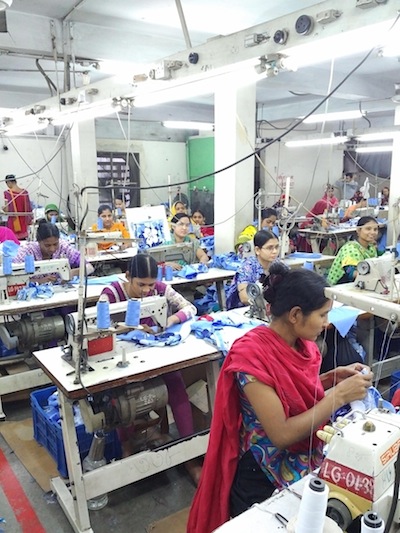
Marianne Hladun, second from the right, and fellow delegation member Melanie McConnell (chair of Women of Steel committee for USW Local 7619, Kamloops, B.C.), fifth from the right, at the Bangladesh Centre for Worker Solidarity in 2016. The other women are volunteers who work to promote unions in the factories, and health and safety. (photo from NCJWC Winnipeg)

The Winnipeg section of National Council of Jewish Women of Canada is opening Canadians’ eyes to yet another critical, yet often overlooked, worldwide dilemma – that of garment workers’ working conditions.

Part of its focus on fair trade, NCJWC partnered with Congregation Shaarey Zedek Sisterhood to bring a national expert on the topic to Winnipeg for a speaking engagement on Dec. 13 at the synagogue. Event organizer Sharon Graham and guest speaker Marianne Hladun, regional executive vice-president of the Public Service Alliance of Canada, spoke with the Jewish Independent before that talk.

Originally from Toronto, Graham moved to Winnipeg 12 years ago, and joined the local NCJWC in 2016, serving as the volunteer secretary.

“I became interested in this topic around 2017,” she said. “There were a lot of reports in the news and radio about a new union-led report on supply chain transparency in the garment and footwear industry.”

Large retailers like Canadian Tire, Sport Chek and many others have made it hard for consumers to know where the products they sell are made, said Graham. It is a common tactic of most large retailers, so that individual manufacturers can’t dictate prices and product availability. However, there are other impacts.

A factory in downtown Dhaka, Bangladesh, in 2016. (photo from NCJWC Winnipeg)

“This way, you don’t really know where their items are made. And, because you don’t know which factory they’re made in, there’s no way to tell under what conditions they’re made,” said Graham. “So, I wrote a letter to Canadian Tire and, to their credit, they sent me the name and I looked them up online. There are websites you can look up online to see manufacturers – what kind of record they have for labour rights, or for transparency about labour rights, like, if they allow outsiders into their factory.”

For Graham, the subject is also personal. “If you’re an Ashkenazi Jew,” she said, “you probably have an ancestor or ancestors who’ve worked in the garment trade. For me, it was my grandfather and great-grandfather on different sides. And, for both those men, the garment trade brought them a good living. My great-grandfather did really well in furs and my grandfather had a good living as a patterner in the garment trade.”

In her capacity at PSAC, which is a federal union representing about 180,000 members across Canada, Hladun said, “I represent about 21,000 members in the Prairies and, as part of that responsibility, I was able to participate in a mission to Bangladesh in February 2016, following the Savar plant collapse disaster, which was on April 24, 2013.”

The Savar building was a workplace for thousands of garment workers. In the collapse, 1,134 people died and approximately 2,500 were injured.

Following the tragedy, a legally binding accord was drawn up on fire and building safety in Bangladesh. The accord was an agreement between global brands, retailers and trade unions, and set for five years, after which time, the operations and oversight would be transferred to the government.

“Coming from a country like Canada, where we do have a true democracy, corruption doesn’t come to our mind first and foremost when we’re talking about government and workers,” said Hladun. “But, when you go to a country like Bangladesh, you realize very quickly that their parliament is basically garment manufacturer factory owners. So, there seems to be no one that’s working for the workers. That was something that a lot of us had a hard time really comprehending – that no one has your back.”

During the visit in 2016, Hladun found that, in factories of brands that had signed the accord, changes were being made. But, the factories that had not signed it were continuing with business as usual.

“Keep in mind that very few factories are actually part of the accord,” said Hladun. “But, the ones that were part of it had started remediation. They had done the inspections and, basically, if the certified building inspector there on behalf of the accord says a factory doesn’t have a fire sprinkler system and needs to instal one, they will tell them so.

“Then, the brand is responsible to work with the factory owner, and the brand is actually taking responsibility by funding the remediation. And, we’re starting to see some of that work happening. It was slow, as it took awhile to get the inspections done. But, it was starting to happen [in 2016]. I think there were about 1,400 factories covered, out of about 5,000, at that time.”

According to Hladun, the Bangladesh high courts are now forcing the accord to close their main office in Dhaka. The plan was to have a transition accord wherein, over the next couple of years, the office would aim to transfer everything to the government and a national agency would continue this work. But, as a result of a lot of political pressure, it appears that the government would rather eliminate the accord.

“There is a lot of pressure,” said Hladun. “Canada’s high commissioners sent a letter in October to several of the ministers in the Bangladesh government, urging them to override the court and to legislate that the accord stay in place until the transition to the government body is done … because the work is nowhere near ready.”

If the accord is eliminated, she said, the situation would return “to conditions pre-Savar building collapse.”

The accord’s website, bangladeshaccord.org, shows the brands that have signed onto the accord. Hladun urged Canadians to contact the brands and ask them to advocate with the government to continue with the program. She also suggested that interested Canadians contact their federal MP and ask them to pressure the Bangladesh government to continue the accord.

Hladun strongly advised against lobbying for a boycott, saying “that is the worst thing we can do. Basically, the garment industry is 4.2 million workers in Bangladesh. That industry is the only thing that provides income for workers in Bangladesh. They do not want to see a boycott. They want to see support for better working conditions.”

Another way to show support is with your wallet, by shopping and supporting factories and brands that have signed onto the accord or are treating their workers ethically regardless.

Rebeca Kuropatwa is a Winnipeg freelance writer.

Operation Warmth wraps up

Left to right: Caryl Kochen, Darcy Billinkoff and Caron Bernstein were three of the many Operation Warmth volunteers over the years. (photo from JWI-BC)

More than 40 years ago, Sylvia Handlesman, one of our B’nai B’rith Women (now Jewish Women International-B.C.) members, brought us a wonderful service project she remembered from her earlier years in England – providing home-baked refreshments, tea, coffee and juices to visitors and staff at hospitals on Christmas Eve and Day.

On checking with the B.C. Children’s Hospital, Sylvia learned that the only cafeteria serving visitors and staff was closed over Christmas to allow staff to celebrate the holiday with their families. The hospital assigned us a small room with a fridge, long table and a number of carts to be loaded with home-baked goodies and beverages that added to the festivities of the season. Even Mr. and Mrs. Santa Claus and their helpful elves enjoyed the repast.

The heart-warming project – Operation Warmth – was both a service and a social gathering for members and family members who volunteered for three-hour shifts, while enjoying coffee, a snack and greeting and visiting with other volunteers as they came during shift changes. Some, who could not walk the halls, stayed in the room filling trays, loading carts and making coffee. 

Originally, our members only served refreshments to the visitors and personnel in the children’s wards – due to dietary restrictions, patients were always excluded. 

Because of the success of Operation Warmth, the hospital soon requested that our members also cover the B.C. Women’s maternity section.

Since then, on Christmas Eve and Day, JWI-BC family members and community volunteers have traveled through the halls of these wards with loaded carts. A table on the main floor in the area close to the elevator was also kept supplied with goodies for visitors and staff. With time, the original coffee and home-made baking was supplemented with fruit juices, mandarin oranges and other treats donated by local stores and bakeries.

It is impossible to express the appreciation the volunteers received from the hospital personnel, visitors whose children were unable to go home and expectant or newly delivered mothers who were also hospital bound for the holidays. The only years when Operation Warmth was not provided took place when Christmas fell on Shabbat or a snowstorm made travel too dangerous.

With time, most of our original volunteers were no longer with us and, with them, has gone much of the fantastic home-baked cookies and squares that once filled the plates on the carts.

For a number of years, Operation Warmth was organized by Zmirah Rosenthal, with the invaluable assistance of her longtime friend, Ena Salamon. Although Ena was not a JWI-BC member, she was responsible for a major share of the planning that made this project so successful. One year, she even organized the two-day program completely on her own.

Last October, the new Teck Acute Care Centre opened at B.C. Children’s Hospital. As well, hospital staff make every effort to get patients and families home, if only for the day or two, over the holidays. And patients on the maternity wards also have a much shorter hospital stay. As a result of all of these changes, the Operation Warmth program is wrapping up after four decades.

“It has been a privilege and honour to work with the B’nai B’rith Women, now Jewish Women International, in the planning and delivery of this annual event,” said Pat Gillis, manager, volunteer resources, B.C. Children’s and B.C. Women’s Hospital. “My sincere thanks to Zmirah and Ena, who have been the driving force for an event that brightened the days of families from all across British Columbia for so many years. As our facility changes, we want to take this time to thank the many community volunteers who have been a part of our history on Oak Street.”

JWI-BC is also appreciative, and thanks the staff and volunteers of the hospitals and the many individuals and their families who helped make Operation Warmth a success for so many years.

Inukshuk in Jerusalem

Jerusalem sculptor Israel Hadany’s modern interpretation of the First Nations beacon. (photo from Jerusalem Foundation)

The Inuit, Iñupiat, Kalaallit and Yupik peoples of the Arctic region of Canada, Greenland and Alaska built inukshuks with granite boulders to warn against danger, mark a hunting or fishing site, or stand as a direction marker. Like the traditional inuksuit erected in the treeless tundra, Jerusalem sculptor Israel Hadany’s modern interpretation of the First Nations beacon serves as a marker symbolizing friendship, family and hospitality, humankind’s responsibility toward one another.

On Oct. 17, Hadany’s four-metre-high limestone inukshuk sculpture was installed at the entrance to Canada House in downtown Jerusalem’s Musrara neighbourhood.

Hadany was the winner of a design competition celebrating 50 years of the reunification of Jerusalem, since the 1967 Six Day War. Toronto lawyer Lewis Mitz, president of the Jerusalem Foundation of Canada, initiated the challenge as part of a $4 million renovation of the Canada House community centre on Shivtei Yisrael Street, a location that is becoming increasingly popular with film and art students. Four other Israeli artists were invited to participate: David Gershoni, Ruslan Sergeev, Yisrael Rabinowitz and Ellia Shapiro. The competition jury that selected the winning design included representatives from the Jerusalem Municipality, the Israel Museum, the Jerusalem Foundation and local residents.

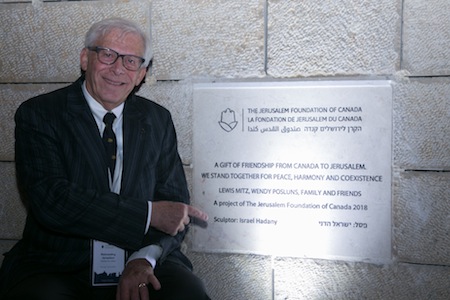
Toronto lawyer Lewis Mitz, president of the Jerusalem Foundation of Canada, who initiated the art competition. (photo from Jerusalem Foundation)

“The inukshuk is a communication structure. Providing vital information for people to survive in the frozen Arctic; it isn’t merely a statue, rather an enchanted entity that guides man and seals his fate,” explained Hadany in a press release. “The sculpture tries to create a fascinating synthesis between the primordial and the innovative, between the formulated esthetics and magic.”

Inukshuk, he explained in his remarks at the unveiling of the sculpture, means “helper.”

The sculptor and environmental artist insisted his inukshuk be positioned alongside the street rather than in the courtyard of Beit Canada to increase its visibility. Initially reluctant to appropriate another culture’s symbol, Hadany came to understand that, rather than being decorative in the Western context of art, an inukshuk is “an information-giving object in the space. Emphasizing a religious space, directing people to where there is good fishing. It’s actually a language. It’s sculpture that creates a language in space.”

The judges wrote in their decision that Hadany’s proposal was a “classic sculpture that is suited to and connects with its environment. The artist presents an interpretation that respects the original without copying it. It is obvious that a great deal has been invested in planning and in the use of proportion, materials, light and shade.”

The sculpture was dedicated during the Jerusalem Foundation’s international conference in October in the Canada House garden. The playground around the inukshuk, which is still being landscaped, was a gift of the Joffe family of Calgary, Alta. 

Gil Zohar is a journalist based in Jerusalem.

A royal panto at Metro

Katherine Matlashewski plays Mopsy in Metro Theatre’s musical panto King Arthur’s Court. (photo by Tracy-Lynn Chernaske)

While Katherine Matlashewski has numerous acting, singing and choreographing credits on her resumé, the musical panto King Arthur’s Court, which opens tonight (Dec. 14) at Metro Theatre, will be her first pantomime.

“Unlike a traditional play, there is a lot of improv and audience participation,” she explained about a panto. “This can be a challenge because, as an actor, you never know what is going to happen.”

But it’s also part of the fun. “In any show,” she said, “everyone brings something unique to the table. In this wonderful cast [of 28], there is such a wide range in age and skill level.”

In contrast, King Arthur’s Court marks fellow Jewish community member Heather Webster’s third panto. Webster has been stage-managing at Metro for about five years now, but her connection to Metro – and pantos – goes further back.

“My first theatre experience came from my grandmother, Shirley Rose,” Webster told the Independent. “She took me to the Metro Theatre when I was 12 for my first panto. From there, I got into working backstage and learning stage craft in high school at Kitsilano from Julie Bond. In Grade 11, I began volunteering at the Metro Theatre, and have been ever since.”

Webster, who used to work as an on-call tech for the Rothstein Theatre at the Jewish Community Centre of Greater Vancouver, does stage-managing in her off-time. Her full-time job is with Purolator.

Matlashewski teaches at Arts Umbrella. “I love having the opportunity to share my love of visual and performing arts,” she said. “I believe it is so important for kids to have a creative outlet as part of their education.”

In addition, Matlashewski owns a small business, Sweetheart’s Baking, which can be found on Instagram and Facebook. “Like theatre,” she said, “my passion for baking started at a young age. This keeps me extremely busy when I am not in a show.”

At age 2, her mother enrolled her in her first dance class at Arts Umbrella. “In the years to follow,” Matlashewski said, “I continued my training in dance while also exploring theatre and visual arts. My love of musical theatre began at a very young age. Since then, I have not looked back. I feel extremely blessed to have had multiple opportunities to train with so many professionals in the industry. I am grateful to have taken part in programs such as the Arts Club’s Musical Theatre Intensive and the Pre-Professional Musical Theatre Troupe at Arts Umbrella.”

Among Matlashewski’s teachers and colleagues in the Jewish community have been Erika Babins, Perry Ehrlich and Wendy Bross Stuart, to name only a few.

“As a result,” said Matlashewski, who comes from a small family, “I have had many wonderful opportunities to connect with others in the community, create a positive support network, and learn more about my culture. I feel so blessed to be a part of such a warm and welcoming community.”

Matlashewski has also worked with the director of King Arthur’s Court before.

“Last year,” she said, “I worked with Chris Adams (our director) on RCMT’s [Royal City Musical Theatre’s] concert production of Into the Woods. He encouraged me to take part in this production.”

Adams was most recently featured in the Independentfor directing and co-producing Sweeney Todd: The Demon Barber of FleetStreet (jewishindependent.ca/experience-sweeneys-revenge). While this isMatlashewski’s first show with Metro, this will be Adams’ seventh show andthird panto with the theatre.

“I remember sitting in the audience, as a little kid, booing the demon and cheering the good fairy and then rushing to the stage after the show, just to get autographs from the cast,” he recalls on Metro’s website. “From that childhood time,” he says, “panto has kept a warm place in my heart.”

King Arthur’s Court will feature a demon and a fairy, too, along with a dragon and, of course, Arthur and the Knights of the Round Table. Chivalry and chicanery will run aplenty, and the audience will be encouraged to cheer and jeer.

Matlashewski plays Mopsy, the court jester. “My role requires me to do lots of singing, dancing and goofing around onstage,” she said. “I also talk directly to the audience at certain times.”

And, behind the scenes, Webster will be managing the chaos. For her, she said, “The best part is when I get to hear the kids talk to the actors during the meet-and-greets, and hearing their favourite parts of the show.”

For more information about and tickets to KingArthur’s Court, visit metrotheatre.com/currentshow. It runs until Jan. 5.

There remains darkness to light

A recent poll determined that a large number of Europeans hold views that are antisemitic and, at the same time, awareness about the Holocaust is decreasing.

More than 7,000 people were polled on behalf of the news network CNN. In each of seven countries – Austria, France, Germany, Hungary, Poland, Sweden and the United Kingdom – 1,000 people were surveyed.

One-third of those surveyed – and one in two respondents in Poland – stated that Jews exploit the Holocaust to advance their goals and that Israel uses the Holocaust as a tool to justify its policies.

One in 20 Europeans have never heard of the Holocaust. In Austria, 12% of respondents said they had never heard of it, while 40% admitted they know little about it.

About 40% of respondents in Poland and Hungary claim that Jews have too much influence on business and finances. One-third of Poles and Hungarians think Jews exert too much influence on global politics.

Other findings in the poll deliver a mixed bag. Half of respondents in all countries claimed to know “quite a lot” about the Holocaust, with 20% claiming to have “extensive knowledge.” Two-thirds of Europeans agree that commemorating the Holocaust helps ensure similar atrocities do not happen in future and half believes that Holocaust commemoration helps combat antisemitism today.

While Jewish people constitute about 0.2% of the total world population, 25% of Hungarians and 20% of Polish and British respondents believe that more than 20% of the world is Jewish.

The poll says that 54% of Europeans believe that Israel has a right to exist as a Jewish state. (One almost wishes they had been asked if France has a right to exist as a French country, or Poland as a Polish country.)

One-third of Europeans, according to the poll, believe that criticism of Israel is symptomatic of antisemitism, while 20% believe that it is not.

Deflecting blame for antisemitism away from its perpetrators and onto its victims, 28% of respondents contend that antisemitism in their respective countries is a direct response to Israel’s actions. Fully 18% of Europeans blame antisemitism on the behaviour of Jews themselves.

Polls like these are an important barometer of opinion. There is little in the results that will surprise anybody who has been paying attention to European developments in recent years. Previous surveys have indicated that Europeans (as well as North Americans and others) have what we would consider an inadequate grasp of the realities of the Holocaust. Likewise, nobody needed a survey to know that antisemitism in Europe is at a level unprecedented in recent decades. However, it is important to have empirical evidence like this, especially a survey that is both cross-national and includes enough respondents to make it statistically significant.

It would be no help at all to throw up one’s hands and declare Europe lost, as some people have done in recent days. But neither do we, in Canada, have all that much influence over what happens there.

We do, however, have the ability to influence things closer to home and we should redouble our efforts to ensure that trends in Europe are not transmitted to our shores. We are, by no means, immune to this kind of thinking. A similar study done in Canada or the United States would indicate some parallels with the European results, albeit, we hope, not to the deeply concerning degree that this study has indicated.

We must continue to support every area ofHolocaust education possible. The work being done at the Vancouver HolocaustEducation Centre and by organizations across Canada must be supported andstrengthened. As Prof. Jan Grabowski said in delivering the annual Vrba lecture(jewishindependent.ca/revealing-truth-elicits-threats), there is still verymuch primary research left to do about the Holocaust, unearthing basic detailsthat are still not recorded about that time in history.

On the front of combating antisemitism here, the Jewish community must continue being vigilant and raising alarms whenever antisemitic ideas or actions emerge because this work has fallen primarily to Jewish Canadians. We must continue to build strength through our allies in all the multicultural communities in the country. This is the surest method to combat the growth of antisemitism – and this has to be a two-way street. As a community, we must stand with other groups and individuals when they are unjustly targeted if we are to expect others to stand with us.

While the last lights of Chanukah our now extinguished, we still have the season of winter before us and it is our responsibility to continue bringing light where there is darkness.

Gourmet anything but lazy

Susan Mendelson, founder of the Lazy Gourmet, shares a little about herself and her business at the launch of this year’s The Scribe. (photo by Kenneth I. Swartz)

One of Vancouver’s most successful food industry professionals shared her story recently, helping to launch this year’s edition of The Scribe, the journal of the Jewish Museum and Archives of British Columbia.

The topic of the 2018 issue is food, covering restaurants and related sectors from the early days of the community up to destinations that are still operating today. Susan Mendelson, best known around town as founder of the Lazy Gourmet, brought her thespian side to the audience at the Western Front Nov. 28, eliciting laughter as she guided the packed hall on a tour through her remarkable career.

“My mother’s mother, Grandma Faye, was a large influence in my life,” Mendelson said. An extraordinary baker and cook renowned in her small Jewish community of Quebec City, Grandma Faye took it as a challenge to keep a deep freezer filled with baking for when friends dropped by or to be ready for a tea party.

As a child, Mendelson loved to cook and bake. When the Six Day War broke out in Israel, in 1967, the family rallied to raise funds to send to Israel. Young Susan planned a bake sale in their backyard. She made all of her favourite squares and cookies and the neighbours snapped them up. Mendelson’s mother only told her years later that the cost of the ingredients was on par with what was raised that day. Thankfully, Mendelson told the audience, that wasn’t a harbinger of things to come.

Mendelson came to Vancouver to study at the University of British Columbia and gravitated to the theatre department. Her theatre professor, Larry Lillo, became a close friend. He broke the news to Mendelson that she would never be a great actress … though he really loved her cheesecake.

After third year, Mendelson took a break from school and worked in a group home for troubled teens. There, she met Deborah Roitberg, with whom she made the food for the kids in the group home. An instant friendship developed.

After traveling to Europe and Israel, Mendelson thought she would return to school and pursue social work. Around that time, Lillo had founded Tamahnous Theatre, an experimental ensemble that was becoming the resident company at the Vancouver East Cultural Centre. He hired Mendelson as house manager, which allowed her to go to school during the day and work at the Cultch, as the institution is familiarly known, at night. But the salary didn’t cover her expenses, so she began to make cheesecake to sell at intermission, later adding carrot cake and Nanaimo bars to her repertoire – “when the curtain came down at intermission, the lobby was stormed by people pushing in line to make sure that they got their piece of the cake.”

Anne Petrie of CBC radio’s afternoon show called Mendelson, having heard about the cheesecake phenomenon, and asked her to come on the program.

“I told her that I was putting myself through university with the recipe, but that I would come onto her show to tell her listeners how to make chocolate cheesecake, a recipe that my friend Miriam Gropper had given me,” Mendelson said.

Her cheeky attitude was a hit with audiences, and she was asked back. She returned for Valentine’s Day, talking about aphrodisiacs. Soon she had a regular radio gig paying $25 per appearance.

Mendelson’s boss at the Cultch started asking her to cater opening night parties. Wedding catering followed and then Mendelson was given the responsibility of catering to all the performers at the first iteration of the Vancouver Children’s Festival. She and Roitberg discussed opening a take-out food business.

“Our concept was that people would bring in their casserole dishes and platters and we would fill them with our food and they would take them home and pretend that they had made them themselves,” she said. “We would call ourselves the Lazy Gourmet, in honour of our customers who wanted gourmet food but were too lazy to make it themselves.”

Over the years, Mendelson had shared scores of recipes with radio listeners and some asked her to put them in book form. Mama Never Cooked Like This sold out and went into reprints; it was picked up by an American publisher.

To coincide with the publication of her second book, which was written for children and titled Let me in the Kitchen, the producer of the Children’s Festival, Chris Wootten, asked Mendelson to produce her own show. The best part of that experience, Mendelson recalled, was that a single dad in the audience brought his 7-year-old son and they bought the cookbook and made recipes

from it. “Six years later, I met those two,” she said. “And, seven years later, I married the dad and became stepmother to the most wonderful young teen. I was so happy that Jack and Soleil had experienced that show and that in some way we shared that amazing experience of my life.”

TV appearances followed and Mendelson was asked to write a souvenir cookbook for Expo 86.

But the trajectory was not entirely positive. After expanding the Lazy Gourmet from one store to three, the company began losing money. They eventually abandoned two of the storefronts and Roitberg left the business to raise a family.

Soon after the birth of daughter Mira, Mendelson was invited to cater a new event that was coming to Vancouver: the Molson Indy Vancouver.

“If you thought that the Children’s Festival wore me out … you can’t even imagine what that event did to me physically,” she said. “But, of course, I loved it and, by the last few years of the race, which took place on Labour Day weekend – Jack will tell you that it was our anniversary weekend that we didn’t celebrate for nine years – we were also catering the Abbotsford Airshow, which took place two weeks beforehand and, two weeks before that, we catered the Skins Game at Predator Ridge in the Okanagan.”

In addition to hard work, Mendelson credits her success to hiring people who she says are smarter and more talented than herself. A couple of years ago, she gave shares in the company to two long-term team members and moved into a part-time role. The company continues to expand, including a lifecycle catering department. “We call it womb-to-tomb catering,” she said, citing baby-namings, britot milah, b’nai mitzvah, weddings and funerals, as well as personal events. More recently, Mendelson took on catering the lunches at Vancouver Talmud Torah.

The Scribe launch also included words from Cynthia Ramsay, editor and publisher of the Independent, who has also, for the past nine years, edited The Scribe.

“When I started the job, the journal was a mix of academic essays and community-related history,” Ramsay said. “But it soon changed to become a means by which the museum could highlight its collection; the oral histories, photographs and other artifacts that it houses on the community’s behalf. We’ve done issues on the Jewish Western Bulletin, the Jewish Independent’s predecessor; on the furniture industry; scrap metal dealers; the clothing industry; on some of the community pioneers who are buried in our cemeteries all around the province; and, this year, of course, our issue is on the food and service industry.”

She credited museum staff Alysa Routtenberg, Marcy Babins and Michael Schwartz, and the publications committee, which this year included Routtenberg, Perry Seidelman, Gary Averbach, Debby Freiman, Fred Swartz and Ronnie Tessler. The JI’s production manager, Josie Tonio McCarthy, does the layout for the journals.

Seidelman, president of the JMABC, urged audience members not to throw out photographs or documents. “Give them to us,” he said.

Canada’s silver tsunami

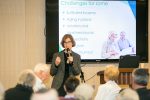
Isobel Mackenzie, seniors advocate for the Province of British Columbia, was the keynote speaker at the Changing Landscape: Pathways Ahead forum Nov. 27. (photo from Jewish Federation)

“Plan for tomorrow!” That’s the message from Isobel Mackenzie, seniors advocate for the Province of British Columbia. With seniors living much longer, there are some urgent issues facing aging Canadians.

Mackenzie was speaking to a packed house at the Changing Landscape: Pathways Ahead forum on the growing population of older adults in the Jewish community. Hosted by Jewish Federation of Greater Vancouver with the Jewish Community Centre of Greater Vancouver, Jewish Family Services, Jewish Seniors Alliance, Kehila Society of Richmond, L’Chaim Adult Day Care, and Louis Brier Home and Hospital, the forum was held at Beth Israel Synagogue Nov. 27. Three key themes were the focus of the evening: caregiver support; aging in place; and social connections.

Sharing insights into best practices and new opportunities for the Jewish community were: on caregiver support, Dr. Beverley Pitman, regional planner, healthy aging, United Way of the Lower Mainland; on aging in place, Terry Robertson of Parkdale Manor; and, on social connections, Gyda Chud (Peretz Centre for Secular Jewish Culture), Ken Levitt (Jewish Seniors Alliance), Toby Rubin (Kehila Society of Richmond) and Lisa Cohen Quay (Jewish Community Centre of Greater Vancouver).

Referencing the United Way’s Better at Home program, which helps seniors live independently in their own homes while remaining connected to the community, Mackenzie emphasized, “We are under-subsidizing people who are aging at home.” She added that many seniors pay for their own care as they age, despite insufficient income. She highlighted the urgency for government and community agencies to increase their funding for seniors who choose to age in place.

Mackenzie told the capacity crowd that, right now, there are 920,000 seniors over the age of 65 living in British Columbia, which represents 19% of the total population. By 2031, there will be 1.38 million seniors in the province, which will represent 25% of the total population. Referring to “the silver tsunami,” she said we need to start planning for that change now.

Addressing financial issues, Mackenzie said many seniors have less disposable income than their younger counterparts. For example, she noted that, for seniors age 65 and older, the bottom 20% of that group have an annual average single income of $17,000, while the top 20% have an annual average single income of $80,000. For seniors 85 and older, she said, the bottom 20% have an income of $17,500 while the top 20% have an income of $73,000. These numbers have a significant impact on how and where those seniors live. “Disproportionately poorer people live in care facilities,” said Mackenzie.

She also commented that there is a disconnect in terms of public policy and the entitlements available to those 65 and older, when the government is giving the same amount of money to both the rich and the poor.

According to Mackenzie, 94% of all seniors who are 65 or older live independently, while 74% of all seniors who are 85 or older live independently. A full 80% of these seniors are homeowners, she said. However, the remaining 20% are renters who are disproportionately poorer than homeowners. Consequently, they often don’t have enough leftover income to buy necessities like glasses, hearing aids and mobility devices, she said.

On the topic of aging in place, Mackenzie pointed to family members’ overall reluctance to allow elderly relatives to “accept risk”; that is, to live independently. Given the dangers inherent in living at home (stairs, rugs, lack of bathtub rails, etc.), she said relatives sometimes try to “control the risks” by encouraging loved ones to move to a care facility, often against the older person’s wishes. “We have to accept the rights of the [cognitively able] elderly to live at risk,” she said. “They have the right to make their own decisions, even if it’s a risky decision.” The message was, while we want our elderly to be safe, it’s not our choice to make.

In terms of the social isolation of those aging in place, Mackenzie said this depends primarily on the senior’s level of engagement. If their interactions with others are limited, they may feel marginalized. However, feeling useful to themselves and others keeps seniors feeling engaged, which is why we see so many senior volunteers. “Everybody needs to feel useful and is useful, in their own way,” said Mackenzie. She encouraged people not to do things for seniors that they can do for themselves, because “everyone needs a sense of purpose and usefulness.” She stressed that not all seniors are frail and not all seniors need help. Rather than viewing seniors as a problem, she said, we should view them as “an active and valuable citizenry.”

On the issue of caregivers, Mackenzie said, “Not everyone comes to this role equally equipped. We need to give more support to caregivers for the frail elderly and those with dementia. It’s more stressful dealing with someone with dementia than with someone who has a physical disability or disease.”

With the possible exception of the workshop on social connections, whose speakers were from Jewish agencies, but whose workshop the Jewish Independent could not attend, none of the presenters addressed how the community could support Jewish seniors in connecting to their Judaism, culture and traditions as they age. Neither Mackenzie or Pitman, the presenter on caregiver support, differentiated between the needs of Jewish seniors and non-Jewish seniors; the workshop on aging in place also did not specifically address Jewish seniors.

Pitman, however, shared some eye-opening statistics in her workshop. According to the Office of the Seniors Advocate for British Columbia’s 2017 report Caregivers in Distress: A Growing Problem:

• Statistics Canada estimates that there are approximately one million caregivers in the province.

• The work of caregivers is a critical pillar in the healthcare system, allowing seniors to remain at home and delay, or even prevent, costly care options.

• Unpaid caregivers provide roughly three-quarters of care for people who receive care at home in Canada.

• Caregiver tasks range from taking over household duties to providing time-sensitive personal and medical care.

• Caregivers’ most common tasks fall into three broad categories: emotional support, assistance with health and daily living, and care management.

• Caregivers are often information and referral specialists and systems navigators dealing with the health system, the housing system and the legal system.

The 2017 report notes that, on average, unpaid caregivers provide 20 hours per week of informal care and that replacing the care they provide with care from paid caregivers would cost an estimated $3.5 billion in British Columbia. And the report warned that “31% of unpaid caregivers are experiencing symptoms of distress such as anger, depression, anxiety and sleep difficulties.” This number seemed low to audience members who are or were caregivers.

Pitman also shared a sample of the resources available for caregivers, including BC211, 8-1-1 HealthLinkBC, local Jewish and other community support agencies, information and referral services, and libraries. She encouraged caregivers to call the Family Caregivers of British Columbia Caregiver Support Line (1-877-520-3267) if in need and highlighted the United Way’s Better at Home, which can provide light housekeeping, minor house repair, yard work and friendly visits. She offered audience members the 2016 publication United Way of the Lower Mainland’s Family & Friend Caregivers Information and Resource Handbook. While acknowledging that it’s somewhat out-of-date, she said it still contains much valuable information.

Shelley Civkin is a happily retired librarian and communications officer. For 17 years, she wrote a weekly book review column for the Richmond Review, and currently writes a bi-weekly column about retirement for the Richmond News.

Sharing holiday spirit

Left to right: Archbishop JohnMichael Miller, Dr. Gregg Gardner, Fr. Nick Meisl, Dr. Jay Eidelman and RabbiJonathan Infeld. (photo by Rabbi Adam Stein)

“This is a unique opportunity to learn and growtogether. What better way to open ourselves to that holiday spirit, to welcomethe mysterious and send away the fear of the unknown,” said Congregation BethIsrael president Helen Pinsky in introducing the Dec. 5 program at thesynagogue on Chanukah and Christmas, which was co-hosted by Beth Israel and theRoman Catholic Archdiocese of Vancouver.

After the lighting of a giant electronic chanukiyah by Rabbi Jonathan Infeld, the reciting of the motzi by Archbishop of Vancouver John Michael Miller and a latke-laden dinner, the crowd moved into the sanctuary to hear three scholars: Dr. Gregg Gardner, Diamond Chair in Jewish Law and Ethics at the University of British Columbia; Fr. Nick Meisl, a professor at St. Mark’s College; and Dr. Jay Eidelman, who lectures on the Holocaust and Jewish history at UBC.

Infeld started things off with a short talk.

“The neighbourhood we grew up in, in Pittsburgh, was 50% Jewish or Catholic,” he said. “The kids did not refer to themselves as Jewish or Christian but as ‘Chanukah’ or ‘Christmas.’ We don’t love this, but it shows that the holidays have a particular power.”

Noting that, for many Jews and Christians of the past, neither Chanukah or Christmas were important as religious holidays, the rabbi quoted a documentary he had watched that argued that Charles Dickens had created Christmas, quipping that maybe Dickens “created Chanukah as well, in its modern version.”

Gardner spoke on the origins of Chanukah, noting it was a festival created by the Maccabees to mark their military successes against the Greeks in an effort to preserve traditional Jewish culture. “Ironically,” he said, “creating a holiday to honour yourself is, in fact, a very Greek thing to do.”

The “subversive” rabbis of later generations altered the holiday to downplay its militaristic elements and its focus on the Maccabees, Gardner explained, replacing that with a focus on God’s miraculous intervention in the miracle of the oil that burned for eight days in the rededicated Temple.

In his remarks, Meisl said the balloon of his “naive beliefs” about Christmas popped when, in the course of his studies, he learned that Dec. 25 was not Jesus’s birthday, but rather a date chosen for other reasons. He explored the theories linking the day to the ancient Roman Saturnalia festival of late December, or the Dec. 25 holiday of Sol Invictus (Unconquerable Sun). With humour, he quoted the ancient Christian theologian Origen, who questioned whether Jesus’s birthday should be celebrated at all, noting that, in the Hebrew Bible, only “bad people celebrate their birthdays.” In seriousness, he said it seems that it was around 336 CE that Christians began celebrating Jesus’s birthday on Dec. 25.

Eidelman took to the podium to the sound of the 1970s classic “Eight Days of Chanukah” by Sharon Jones and the Dap-Kings, while changing from his suit jacket to a tacky Chanukah sweater, in the style of the dreaded Christmas sweater. His speech covered various historical and pop-culture themes related to the two holidays, with a focus on how Jews have imagined and reimagined Chanukah “as a way to define ourselves spiritually and a way to claim space in a culture largely based on Christian customs.”

After a short question-and-answer period in which people asked about the development of certain Chanukah customs and the role the story of the Maccabees has played in the Christian tradition, among other things, the archbishop wrapped up the event.

“This has been a wonderful evening of sharing the joy we each feel in the holidays with each other,” said Miller, who made a point of thanking everyone involved in the event by name, right down to the members of the catering and kitchen staff.

“The event was a splendid manifestation of the ties that bind Christians and Jews together in an age-old spiritual heritage,” Miller told the Jewish Independent by email. “Such occasions foster friendships and mutual understanding, and my hope is that they continue. I am very grateful to Rabbi Jonathan Infeld for his leadership role in interfaith relations.”

Matthew Gindin is a freelance journalist, writer and lecturer. He is Pacific correspondent for the CJN, writes regularly for the Forward, Tricycle and the Wisdom Daily, and has been published in Sojourners, Religion Dispatches and elsewhere. He can be found on Medium and Twitter.

Supporting Israelis in need

Dr. William and Ruth Ross (photo from Canadian Associates of Ben-Gurion University)

Dr. William Hy Ross tears up talking about the motivation behind his philanthropic activities in Israel. Sitting behind a desk in his room at the medical clinic he runs, over which hangs a watercolour painting of the Mount of Olives, Ross said it is because of the grandparents he never met, both of whom died in the Holocaust. “If we had a state back then, that wouldn’t have happened,” he said. “I would have grandparents.”

Ross met with the Jewish Independent last week to talk about the projects the Ross Foundation has undertaken in Israel, projects aimed at lifting up the underprivileged on the fringes of society there. He was accompanied by Sagie Shein, senior program manager of the Jewish American Joint Distribution Committee (JDC). Shein has acted as philanthropic advisor to Ross, and was recently made the fund manager of the Ross Family Foundation, in which role, he told the JI, he identifies projects that will achieve the foundation’s goals in Israel, whether through JDC or otherwise.

Ross and Shein met after Rabbi Shmuel Birnham, formerly of Congregation Har El, introduced Ross to Prof. Jack Habib of the Myers-JDC-Brookdale Institute in Jerusalem. Shein has now been working with the Ross foundation for six years.

Ross is a surgeon and a clinical professor of ophthalmology at the University of British Columbia. In 2012, he established the Morris and Sarah Ross International Fellowship in Vitreo-Retinal Surgery, which funds the training of ophthalmologists from Israel, including, so far, 12 Israeli Jews, three Israeli Muslims and three Israeli Christians.

Also in 2012, he and his wife, Ruth, established the Ross Family Scholarship Program for Advanced Studies in the Helping Professions, which funds education for nurses and social workers serving in the underserved peripheral communities of Israel. Their contributions have gone to select students at Ben-Gurion University (BGU) and they have been recognized as founders of the university, in honour of their contributions. The Ross Foundation appears on the walls of BGU’s Marcus Campus in Be’er Sheva.

In 2016, the Ross Foundation

extended its activity to another initiative – the Project for the Advancement of Employment for Ethiopian Immigrants, which supports the education of engineers, web developers and others.

“Israel is a fantastic success story,” said Ross. “You hear about the start-up companies, etc., but there is a whole fringe society who doesn’t have any of those advantages.”

Ross spoke to the JI about the particular importance of supporting Ethiopian Jewish immigrants in Israel. “When they’re done serving in the army, they often end up in dead-end jobs,” he said. “We are providing living expenses for them in a way that is a game-changer, allowing them to get jobs as practical engineers and in other needed industries.”

Ross and Shein explained that, even when given support to pay for education, many underprivileged Israelis cannot afford to stop working and go to school full-time. The Ross Foundation’s initiatives give recipients a stipend that allows them to stop working and complete a course of education. The foundation is also supporting other communities facing challenges in the workplace, like Arabs and Charedim.

“JDC empowers all Israelis as a social innovation incubator, developing pioneering social services in conjunction with the Israeli government, local municipalities, nonprofits and other partners to lift the lives of Israel’s children at risk, elderly, unemployed, and people with disabilities,” Michael Geller, JDC’s director of media relations, told the Independent.

Operating since 1914, JDC has provided “more than $2 billion in social services and aid to date,” he said.

The JDC funds and organizes experimental programs in the hope that the government will see their success and launch similar efforts.

“We’re looking to pilot programs that can be adopted by the Israeli government,” Ross said.

“In 2020,” added Shein, “the foundation is expected to further expand its activities to additional programs based on the foundation vision.”

“Hy and Ruthie Ross really get Israel,” said David Berson, executive director of Canadian Associates of BGU for British Columbia and Alberta. “They speak the language of social impact and they lead by example. I am so impressed and moved by their understanding of the human equation for social change. Great training, proper guidance and supportive accompaniment can lead to gainful employment.

“As a social worker who trained and worked in Israel with some of her significant social challenges for two decades years, I know that Hy and Ruthie really understand the most critical needs of Israel. It is also an honour for me to be able to partner with JDC Israel, one of Israel’s most noteworthy agencies of real social mobility and empowerment for Israel’s most at-risk populations.”

Ross summed up the strong belief that drives his philanthropy in Israel simply: “I believe every Jew has an obligation to support Israel in some way.”

Matthew Gindin is a freelance journalist, writer and lecturer. He is Pacific correspondent for the CJN, writes regularly for the Forward, Tricycle and the Wisdom Daily, and has been published in Sojourners, Religion Dispatches and elsewhere. He can be found on Medium and Twitter.