
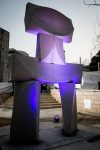
Jerusalem sculptor Israel Hadany’s modern interpretation of the First Nations beacon. (photo from Jerusalem Foundation)
The Inuit, Iñupiat, Kalaallit and Yupik peoples of the Arctic region of Canada, Greenland and Alaska built inukshuks with granite boulders to warn against danger, mark a hunting or fishing site, or stand as a direction marker. Like the traditional inuksuit erected in the treeless tundra, Jerusalem sculptor Israel Hadany’s modern interpretation of the First Nations beacon serves as a marker symbolizing friendship, family and hospitality, humankind’s responsibility toward one another.
On Oct. 17, Hadany’s four-metre-high limestone inukshuk sculpture was installed at the entrance to Canada House in downtown Jerusalem’s Musrara neighbourhood.
Hadany was the winner of a design competition celebrating 50 years of the reunification of Jerusalem, since the 1967 Six Day War. Toronto lawyer Lewis Mitz, president of the Jerusalem Foundation of Canada, initiated the challenge as part of a $4 million renovation of the Canada House community centre on Shivtei Yisrael Street, a location that is becoming increasingly popular with film and art students. Four other Israeli artists were invited to participate: David Gershoni, Ruslan Sergeev, Yisrael Rabinowitz and Ellia Shapiro. The competition jury that selected the winning design included representatives from the Jerusalem Municipality, the Israel Museum, the Jerusalem Foundation and local residents.
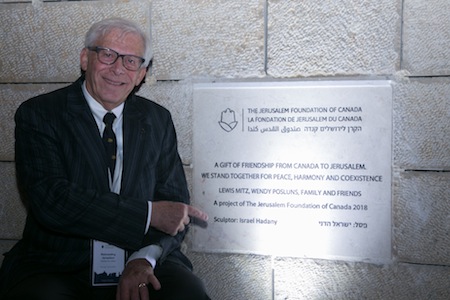
“The inukshuk is a communication structure. Providing vital information for people to survive in the frozen Arctic; it isn’t merely a statue, rather an enchanted entity that guides man and seals his fate,” explained Hadany in a press release. “The sculpture tries to create a fascinating synthesis between the primordial and the innovative, between the formulated esthetics and magic.”
Inukshuk, he explained in his remarks at the unveiling of the sculpture, means “helper.”
The sculptor and environmental artist insisted his inukshuk be positioned alongside the street rather than in the courtyard of Beit Canada to increase its visibility. Initially reluctant to appropriate another culture’s symbol, Hadany came to understand that, rather than being decorative in the Western context of art, an inukshuk is “an information-giving object in the space. Emphasizing a religious space, directing people to where there is good fishing. It’s actually a language. It’s sculpture that creates a language in space.”
The judges wrote in their decision that Hadany’s proposal was a “classic sculpture that is suited to and connects with its environment. The artist presents an interpretation that respects the original without copying it. It is obvious that a great deal has been invested in planning and in the use of proportion, materials, light and shade.”
The sculpture was dedicated during the Jerusalem Foundation’s international conference in October in the Canada House garden. The playground around the inukshuk, which is still being landscaped, was a gift of the Joffe family of Calgary, Alta.
Gil Zohar is a journalist based in Jerusalem.