Wosk, Lederman honoured

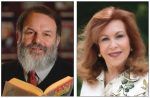
ORT Vancouver will honour Rabbi Dr. Yosef Wosk and Shelley Lederman on Oct. 18 at Congregation Schara Tzedeck. (photos from ORT)

For nearly 140 years, ORT has been equipping people around the world with skills to succeed. The history of the organization in Canada is being celebrated at a gala luncheon next month honouring Rabbi Dr. Yosef Wosk and Shelley Lederman.

The Vancouver region of ORT began in the 1970s and was led by Lederman, who served successive terms as president of the local region and later became co-president of ORT Canada. Carrie Katz, who was Lederman’s co-president, will be the keynote speaker at the event on Wednesday, Oct. 18.

ORT (a Russian-language acronym sometimes translated as the Organization for Rehabilitation through Training) is the world’s largest Jewish education and vocational training nongovernmental organization. Beginning in Russia in 1880, World ORT now operates in 37 countries and engages 300,000 students per year. Originally focused on developing skilled trades among the people, the organization now focuses on high-tech education.

It is ORT’s origin and history – and his own family’s roots – that attracted Wosk to support the organization.

“My father’s family is from Odessa, so I felt a personal connection to the history of the organization and the people they help,” Wosk told the Independent. “Also, the appreciation for the memory of the Jewish community who would not abandon others who needed assistance.”

ORT is founded on the axiom that if you give a man a fish he will eat for a day but if you teach him how to fish he will eat for a lifetime. This is another factor that appealed to Wosk.

“What I was impressed with historically was that it’s not just giving funds,” he said. “It was also educating the people, whether in agriculture or trades and other skills, so that they would be able to eventually help take care of themselves and sustain themselves.”

Local regions, like Vancouver’s, raise funds for ORT educational initiatives in Metro Vancouver, in Israel and around the world.

When Lederman was founding president of the region, there were actually three local branches created, including a Hebrew-speaking group and a Spanish-speaking cohort.

“We created a very strong organization here in Vancouver,” said Lederman, adding that local regions support vital initiatives worldwide, projects that change according to needs over time.

“When people were under duress in Europe during the war and they couldn’t sustain themselves, ORT teachers taught them how to survive as tailors, electricians, as plumbers,” Lederman told the Independent. “And then, in Israel, ORT schools continue to do the same thing. They are teaching those who weren’t going to university but who wanted to come out of high school and be able to support themselves and their families. ORT schools provide education plus trade teachings.”

While she herself did not go to an ORT school, she saw the good works the organization does while growing up in Israel. Being honoured by the organization now means a lot, she said.

“It means a lot because being recognized by your friends and fellow members is really a recognition of all of us,” she said. “By recognizing one person, it’s recognizing the many people who contributed to the success of ORT in Vancouver.”

photo - The honourary chair of the Oct. 18 ORT gala is Dr. Saul Isserow
The honourary chair of the Oct. 18 ORT gala is Dr. Saul Isserow. (photo from ORT)

The theme of the gala is Building Minds Through Inspiration. While ORT began as an educational body teaching skilled trades and crafts, it is now a leader in high-technological training and education. Keeping with this commitment, a percentage of the revenue from the gala will support an ongoing Smart Classrooms initiative at Richmond Jewish Day School (RJDS), as well as provide scholarships for students at the Technological College of Beersheva, in Israel.

Smart Classrooms integrate learning technologies that allow increased interactivity. “The investment by ORT is about allowing Jewish day schools and Jewish schools in Israel to keep pace with technology,” said Abba Brodt, principal of RJDS. “It allows us to marry the best of educational practice with the best of technology for the best possible outcome for students.”

Without the Smart Classrooms funded by ORT, he said, “our students will get a great education but would not be as technologically literate as they should or could be, and they would not be keeping up with changes.”

The gala luncheon takes place at on Oct. 18, 11 a.m., at Congregation Schara Tzedeck. Honourary chair is Dr. Saul Isserow. Master of ceremonies will be Howard Jampolsky. Tickets are available from 604-276-9282 or maryt@ortcanada.org.

Pat Johnson is on the organizing committee for the ORT gala.

New look for campaign

(image courtesy of Jewish Federation of Greater Vancouver)

Jewish Federation of Greater Vancouver’s annual campaign has a brand new look this year, one that will hopefully convey an important message to the community.

“We’d exhausted photographic resources we’ve used in past years and things weren’t looking fresh anymore,” said Alvin Wasserman, a volunteer on Federation’s working cabinet.

Past years have featured photography, but finding those photographs had always presented a challenge. “When you’re talking about housing or food security, people are naturally reticent to be shown,” he explained. “Often we were scrambling for stock photography or images that other federations have used, and that wasn’t as representative of our community as we wanted it to be.”

When the cabinet read the campaign brief that Federation put together this year, the group realized the theme was the existential issues our community is facing. “The brief was about people’s inability to connect with Jewish life because of the high cost of living or because they were moving further outside of the core,” Wasserman told the Independent. “It was about Jewish people having to make serious choices about buying groceries or being involved in Jewish life, so we decided the new look for the campaign should be an illustration, which is an allegory through which you can tell stories.”

This is a pivotal year for the community, added Al Szajman, who has served as marketing chair for the past nine campaigns and helped develop the marketing and communications strategy. “Certainly, the different look helps draw attention to our very focused messaging this year.”

The messaging centres on the importance of maintaining our Jewish community, particularly in the face of the cost of living in Vancouver. “Everybody who resides locally understands that, if you’re living in Vancouver, costs are crazy,” Szajman said. “It’s very hard for many in our community to deal with those costs, plus having the incremental costs of trying to live Jewish and be connected to the community through various services and events. This campaign is about finding ways to help our partner agencies provide services to people locally and make opportunities available at lower rates than otherwise might be available.”

He noted that up to half of the Jewish community of the Lower Mainland now lives outside of Vancouver in cities including Surrey, Delta, Langley, Burnaby, Maple Ridge and Coquitlam. “A lot of these areas don’t have easy access to Jewish services, a Jewish connection. This whole notion of affordability and access is critical,” he noted. “If we’re not a community, what are we? We’re nothing.”

Shelley Rivkin, Jewish Federation of Greater Vancouver vice-president, said the campaign exists to fund solutions that keep people connected. “If we want to have a strong community, we need to make it easy for people to participate, whether they’re living in places like Abbotsford or Squamish and come to the programs we and our partners now offer there, or whether they’re overwhelmed by the cost of living in Vancouver and need more robust subsidies. At the heart of it, there is a sense that we as Jews need each other and we are meant to be a part of a community. That’s what we needed to convey this year.”

Illustrator Paul Gill created the illustration, a Star of David comprised of a community where a couple of people are falling off the edge of one of the triangles. “It describes the issue in a really interesting manner,” said Wasserman, who worked with a creative team that included Kelsey Dundon, Camilla Coates and Becky Saegert. The video in honour of Federation’s 30th anniversary, which was screened at the campaign launch Sept. 13, was produced by Eli Gorn. For more information, to watch the video or to donate to the campaign, visit jewishvancouver.com.

Lauren Kramer, an award-winning writer and editor, lives in Richmond. To read her work online, visit laurenkramer.net.

Krembo Wings unites

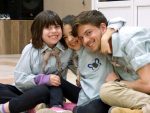
Members of Krembo Wings’ Kiryat Shmona branch enjoy one of the weekly activities. (photo from Krembo Wings)

Claudia Koby co-founded Krembo Wings, the only youth movement open to all youth, regardless of ability level. It was her son, Kfir, who inspired her – seeing him battle severe disabilities and his intense desire to be part of society at large.

Kfir’s friendship with a girl without disabilities changed his and his family’s life to such a degree that his mother decided to find a way to give other kids with disabilities and their families the same simple but incredible gift.

Krembo Wings was established in 2002, growing to 11 branches serving 300 kids by 2010. That was when Merav Boaz (affectionately nicknamed “Boozy”) joined as vice-president. To date, the movement has 61 chapters.

“I knew I could give a lot from my knowledge and experience, to make the movement known in the public eyes and ears … a new idea that was not in existence in Israeli society before,” Boaz told the Independent. “I wanted everybody to know what the Krembo Wings are doing, to see how well they change the world and society. It was like a fire in my heart.

“When I joined, almost no one knew about Krembo Wings…. Today, the movement has 6,000 kids involved – from the special needs kids to the able kids that help them be part of a life-changing movement.

“It’s the kids who run the branches, guided by adults. We give them the power to do so. It’s a lot of thinking to make it happen – to do the seminars really productively, to make them understand they can create their own reality. I think that, because of the kids, we’ve made this breakthrough, this change. From a local initiative, we became a national youth movement.”

When someone has a child with a disability, said Boaz, one of the parents usually stops working and starts taking care of the child, “they look for treatment and doctors to make things better.”

When the parents take their child to register in kindergarten, she said, “They tell you he doesn’t fit, that he can’t be with other children – the ‘regular,’ ‘normal’ children – because of the disability. From this point on, you have a kid who leads a different life within the shawl of society. They don’t belong and are not a part of the kids’ society – don’t go to school with their brothers and sisters, don’t enjoy the after-school programs…. A lot of the parents don’t take the kids outside to the mall or to cafés because of their different behaviour, like slapping hands or making noises. You feel that it’s not right that you’re there…. All of a sudden, you have a kid who doesn’t have a right to take part.”

Often, children in this situation are sent to a different school. In Israel, the school is usually not in the same neighbourhood or city where they live. So, they do not make many friends and, when they become adults, few people will hire them, because no one knows them.

“Why are we so surprised that no one will hire a person with a disability?” asked Boaz. “They don’t know how, were never shown how. We want to change that one day.

“I think the next school established in Israel will be a school with kids of all abilities. We won’t have special education schools separated…. We want the kids to go to the same school and do after-school programs…. When they grow together, they will live together in the same community and care for one another. Then, it won’t be hard for a hospital, for example, to hire a secretary who is blind.”

The disability does not need to – and should not – define the person, she said. And this is where Krembo Wings helps.

“It’s good for them to know other kids, to know and develop social skills, and be part of society,” said Boaz. “How would they know how to behave in a café or at a playground if they’ve never even tried it, practised it, because they’re separated?”

Boaz shared the story of a dad from Krembo Wings’ summer camp who has twin girls, one of whom was born with cerebral palsy and has difficulty walking, so she uses a wheelchair.

“When they go out together, nobody would even notice or try to talk to the twin in the wheelchair, because – automatically – people think she’s not well in her brain,” said Boaz. “Nobody is patient enough to talk to her. No kid stops to get to know her. But, at Krembo Wings, everyone knows her. She has so many friends now, but never in her life did she have friends before. She says, ‘Krembo Wings is my life. It’s where I’m loved by other kids.’”

When kids come to Krembo Wings once a week, they feel a sense of belonging, they sing songs and play together.

“When you accept, you don’t hate. When you don’t judge, you’re tolerant of others, you become more forgiving.”

“You can see how they don’t judge, they include – not because the teacher told them and not because they read it on the walls of the school,” said Boaz. “They practise it and it becomes a part of their souls, lives and values. When you accept, you don’t hate. When you don’t judge, you’re tolerant of others, you become more forgiving.”

The children without disabilities help ensure that their mentees take part in activities. “They learn to be creative, to work with the ability that each person has,” said Boaz, and this “improves their skills and their school success. They are better friends to … friends, to their parents. It’s amazing. Imagine them as grown adults in society – they will care more.”

Parents of children who aren’t able to communicate at Krembo Wings say how big the impact is – their kids do better at school, have more self-esteem and improved communication – from being in an environment of acceptance.

“I had a 16-year-old counselor, able-bodied, who wrote an email saying that, at school, they asked him to write an essay about the person who has influenced his life the most,” said Boaz. “And, he was thinking of his grandfather, a Holocaust survivor, who was a kid when the Nazis came to Poland. He lost all of his family, but he survived. Then he thought about his mom, who had breast cancer – a survivor, too. But, he decided to write about [another] person who influenced his life, because he learned from him what the meaning of being a hero is – of knowing how to deal with tough situations, to be resourceful, smart, full of life and always positive. That person’s name is Don and he’s 10 years old. He has severe cerebral palsy. He tries every day to get up and walk. He tries to practise how to talk with a speech therapist every day, because he wants to be understood. The 16-year-old said that Don taught him the most how to be a hero – disability or not.”

For brothers and sisters of children with special needs who are in Krembo Wings, Boaz said, “They say that, for them, it’s the first time they’re not ashamed to be the brother or sister of a kid with a disability. One girl wouldn’t invite people to her house. Her brother would make gestures no one could understand. She said she prevented her friends from coming to her house. She didn’t want them to know. With Krembo Wings near her house, the youth came to meet him and she saw two girls her age, able-bodied, good-looking, popular, talking to her brother, communicating. She said she was shocked. When her brother started going to Krembo Wings, he came back so relaxed, so happy, like he had had a break. She felt it – the missing piece in his life was filled…. When she came to Krembo Wings and joined in, she had members to mediate activities and, through her connections to another mentee child, she got closer to her own brother…. She learned how to communicate, to be tolerant, to listen – and that it’s OK if he’s like that…. She now knows he has the right to be a part of society and she has the tools to help change things…. More than they have a right, there’s so much they can give to society.

“We believe this change starts with kids. But, it also changes the parents … these same parents who had problems finding a kindergarten. As one of the mothers shared, for the past 15 years, she has been told how her kid does not fit in anywhere, yet no one could tell her where he does fit. All of a sudden, there are Krembo Wings … kids pleading with her to let them take her son to an activity. We pay for transportation, pick them up for three hours and return him satisfied, happy.

“I saw a mother crying, saying the counselor told her she could go do whatever she wanted to do, that they would take care of her kid. She said, ‘I don’t remember what I like to do, how to be alone without her … I’m always taking care of everything … I don’t have friends anymore.’ It changes [a] parent’s life as well.”

“This platform is not only good with or without special needs, it’s good for any society. If it’s not Jewish and Arab, it’s Bedouin and Christian. The kids get tools and values they need. It just happens. It’s more natural for kids than separation.”

When Krembo Wings wanted to open a branch in Lod, city officials recommended they open two branches to avoid mixing Arabs and Jews, but Krembo Wings refused, saying they do not believe in separation of any kind. The city officials conceded and said they could try, but to not expect it to work.

“We opened one and it was a big success,” said Boaz. “So, this platform is not only good with or without special needs, it’s good for any society. If it’s not Jewish and Arab, it’s Bedouin and Christian. The kids get tools and values they need. It just happens. It’s more natural for kids than separation.”

The Vancouver connection

The Kiryat Shmona branch was started in the nearby mechina (pre-army training program) in kibbutz Maayan Baruch before the Jewish Federation of Greater Vancouver took it under its wing, providing space in Kiryat Shmona’s Beit Vancouver for the branch to run its activities. The Federation has also provided funding of $26,000 a year for the last two years.

“They were so sensitive toward the kids’ needs and really understood,” said Boaz. “When you have donors, sometimes the donor – out of good will – starts interfering with the way you deal with the activity or the money or whatever – but Vancouver never did that.”

According to Candace Kwinter, chair of Jewish Federation’s Israel and overseas committee, “Krembo Wings is an incredible program. It enables every child living with any type of disability to take part in enjoyable social interactions between one another and their able-bodied peers and become part of community life in Israel. As a federation, we’re proud to support this program, which is based in Beit Vancouver, and empower both the participants and the volunteers.”

Kwinter quoted one of the mothers of Krembo Wings in Kiryat Shmona, whose daughter has Rhett syndrome. “When Tom was invited to join Krembo Wings,” said the mother, “I tried to explain to the young counselors that it’s difficult to interact with her…. She doesn’t speak and interactions are complicated…. They continued smiling and said that they believe it will be worth our while, that the activities are fun and there are a lot of other children and youth at the branch, with and without disabilities. I said yes, even though I was confident they would give up quickly.

“Today, after Krembo Wings has been in our lives for almost two years, I can confidently say that, where therapists and professionals failed, a group of motivated youth filled with faith and love have succeeded. They have filled Tom’s life with happiness, friends, laughter and songs – and have made our lives infinitely better…. It is an essential part of our family.”

Even with a budget of 22 million shekels (more than $7.7 million Cdn) and 61 branches, Krembo Wings has long waiting lists and not enough money to open new branches. Half of its revenue comes from the Israeli government and municipalities and the fees they collect from members who are able to pay; they subsidize everyone who cannot pay. The other half of the budget comes from fundraising. For more information, visit e.krembo.org.il.

Rebeca Kuropatwa is a Winnipeg freelance writer.

Merkel’s election win

Angela Merkel was returned for a fourth term as Germany’s chancellor on Sunday, defeating her main Social Democrat opponent, as well as a seemingly global surge toward populism. However, while she succeeded, her vote share declined – and the footnote of the election turns out to be the bigger story.

The far-right Alternative for Germany (AfD) party came third, taking about 13% of the vote and entering parliament for the first time. The result was as good as any polls had predicted, meaning that some people who voted for them probably didn’t feel comfortable sharing their voting intentions with pollsters. The party was formed just four years ago, amid an anti-immigrant and anti-refugee backlash in response to Merkel’s liberal approach to the crisis caused by the Syrian civil war. In response, Merkel reined in her liberal approach somewhat, possibly saving her party from defeat. Just a few months ago, Merkel’s reelection appeared to be in doubt.

The success of Merkel’s conservative bloc is a sign that, when push comes to shove, German voters trust her steady hand at a time when the European Union and the world is in upheaval. While immigration remained a central issue in the election, its potentially negative impact on Merkel’s chances may have been blunted by the overarching desire for stable government.

In the face of Brexit and various economic crises in EU member states over recent years, Merkel emerged as the unequivocal leader of the vision of European unity. German voters endorsed her overall approach. But the emergence of AfD is worrying, though not surprising. Extremist parties have been burgeoning all over Europe – and extremism is flourishing in the United States. It would have been stunning if Germany completely avoided this trend.

For their part, the Social Democrats had been in a governing agreement with Merkel’s conservatives and, as is often the case in such scenarios, found themselves at a disadvantage in differentiating themselves from the incumbent government when putting their case to voters. They may choose to rebuild their party from the opposition side, rather than form another coalition with Merkel. However, if they choose to cooperate with the conservatives, that will put the third-party AfD in the enviable position of official opposition. This would give the radical right grouping even greater prominence than their 13% vote share would seem to justify.

“We will change this country,” declared Alexander Gauland, a co-leader of the AfD, on Sunday night. These are eerie words coming from the leadership of a group that promises a return to traditional German “volk” values, glorifies the Nazis and has been accused of racism and antisemitism.

The extremists will have an unprecedented platform (at least in the postwar era) in German politics and, even lacking legislative power, will be able to give voice to ideas that have largely been taboo in the German body politic for the past 70 years.

Yet, we should not allow the dark lining to obliterate the silver cloud. The election secured a stable, reliable and moderate direction for Germany that is good for Europe, the world and, not incidentally, Israel.

In its manifesto, Merkel’s party acknowledged a “special responsibility of Germany toward Israel” and earlier equated the BDS (boycott, divestment and sanction) movement with the Nazi campaign to boycott Jewish businesses. Under Merkel’s leadership, Germany has continued and strengthened its very close alliance with the Jewish state. The German government has been a bulwark, to the extent that a single government can be, against the anti-Israel movements at the EU and the United Nations.

In election after election in Europe over the past year, worst-case scenarios have been avoided. Extremist parties have made inroads, but generally less than anticipated. The AfD’s relative success may be seen as a protest vote, in which case we may be seeing its zenith. In any case, Germans will now get a clear view of what the party stands for – and will have the opportunity to stand up in opposition to the divisive and xenophobic policies the AfD promotes.

Compassion needed

“… what the Lord doth require of thee: only to do justly, and to love mercy, and to walk humbly with thy God.” (Micah 6:8)

Despite its solemnity, Yom Kippur is my favourite of the Jewish holidays. The ritual of atonement, the accounting for our soul’s transgressions, humbles and connects us.

When we ask God for forgiveness, what are we asking for? Not for His acceptance, nor His condoning of our transgressions. What we are seeking is His compassion: the recognition that we are human and that, to be human, is to have both divine potential and to be inherently flawed. Atonement humbles us; His compassion restores our dignity.

As a physician specializing in addiction medicine, I see and support people who truly believe they are unworthy of this compassion. Many people believe that addiction is not something that affects Jewish people. I can attest that Jews are as susceptible to this neurological disease as any other group. From the Downtown Eastside SRO (single-room-occupancy) hotels, to the extravagant homes of Shaughnessy, substance dependence is having a deep impact on our community as a whole.

Our failure to acknowledge the addiction issues within our community has forced people with substance dependence into hiding and fostered ignorance over compassion. Isolating drug users can be deadly. We know that, statistically speaking, the majority of the lives lost throughout the overdose epidemic have been people who have used drugs alone in their homes.

Is it possible for us to consider extending the compassion, the dignity that we desire to receive on Yom Kippur, to people who are dependent on drugs?

For most of my patients, drug use began as a coping tool, a way to manage physical or mental pain. Haven’t we all resorted to coping strategies at some time, sometimes constructive, sometimes foolish?

What is your coping mechanism? When you don’t want to deal with a situation, do you binge on Netflix? Do you eat junk food, work too much, smoke? Fiddle with your phone, endlessly scrolling through social media? Do you sometimes misuse a prescription medication to help you manage your thoughts or worries?

Have you ever experienced shame around your coping mechanism? Do you find yourself shutting the phone off when your spouse walks in the room? Eating differently when others are around?

Imagine if your coping mechanism was not easily hidden. Imagine if, when you realized that it had become a problem and you tried to stop, you plummeted into severe anxiety and physical withdrawal – convulsing, vomiting, sweating, aching everywhere – but you couldn’t afford the days or weeks it would take to withdraw because you had a job to do, a family to care for. So, you spiraled deeper, always in search of a way to manage your pain. Until, eventually, it became impossible to hide.

Drug addicts are our vulnerability and suffering made visible. Or, as Rabbi Shais Taub said, “Addiction is but the human condition writ large.”

Last September marked the launch of Jewish Addiction Community Services (JACS) Vancouver, an organization created to provide members of our community with support around the effects of addiction. Rabbi Paul Steinberg spoke at the opening event. His words continue to resonate: “… I pray that we can tear down our walls of fear and provide a safe place to express our vulnerabilities, truly embracing teshuvah as a real agent of transformation. If our congregations cannot be a place for the depressed, the addicted, the junkie or the ex-con, then what claim are we making on our Judaism? What kind of temple have we really built?”

This Yom Kippur, let us acknowledge and have compassion for the addict in all of us. Let us welcome those with substance dependence into our congregations, and into our hearts and prayers. If you know someone with an addiction problem, let them know that you are grateful for the effort they are making, an effort that reflects a persistent theme in the history of the Jews – escaping enslavement and finding freedom. We all have something to learn from their struggles.

And let them know they are not alone. Tell them about JACS Vancouver. For more information, visit jacsvancouver.com, email info@jacsvancouver.com or call 778-882-2994.

Dr. Alana Hirsh is a Jewish Addiction Community Service (JACS) Vancouver volunteer and program committee member.

Yiddishkeit – a story of love

Dear Yiddishkeit, I’m home! Did you miss me? Sorry I was away for so long. I got kind of lost in the desert. But I’m finally back, and living happily in … well, different places: at Ohel Ya’akov Community Kollel, at Chabad of Richmond and, recently, at the National Jewish Retreat in Palm Desert, Calif. (Not that other desert.)

I met your family, Chabad Lubavitch, about 13 years ago. They seemed authentic and sincere, and welcomed me warmly. I got the sense that they live what they preach: that every Jew is important and has a unique mission in life. This really resonates with me and makes me want to search for the mission that drives my life. Even though I’m not a Torah-observant Jew, your family treats me like one of their own. I don’t dress all that modestly, but I never feel judged by them. It’s funny, I grew up living a fairly secular life, yet I’ve never been more certain about where I belong, and that’s Chabad.

Oh, Yiddishkeit, I’ve admired you from afar for years. I know we haven’t always seen eye to eye on everything – you know, that Shabbos thing, the kosher thing. But there’s always been a chemistry between us. Even if it was unspoken. I have to admit, I’m enthralled; I want to know everything about you. Your likes and dislikes, your temperament, what you look for in a partner. I do know you’re a veritable buffet of fascinating facts and your family’s unabashed optimism and positivity inspires me beyond words. You and your family are smart, solid, attractive and respectful. How could I not love you?

So, how come we’ve played a game of “come here, go-away” most of my adult life? You were shy, yet inviting, all at once. And me? I was just non-committal. You never pushed me into anything though. You just waited me out until the time was right.

I remember in 1997 when one of your family – Rabbi Avraham Feigelstock – called me in the hospital when he found out I was very sick and had been there for 43 days. I’d never even met the man, and here he was calling me: “How are you feeling? Do you want a visit? Can I bring you anything? Let me give you my home and office phone numbers, in case you feel like talking.” I will always be grateful for that. I knew that there was more to this than mere friendliness.

After I recovered, I began going to weekly Friday night dinners and Saturday Shabbat services at the Kollel, where I met Rabbi Shmulik Yeshayahu. His Shabbat sermons jumpstarted something inside me that made me want to know you better. The Kollel is also where I met my bashert, Harvey. I owe you a lot, Yiddishkeit.

Until recently, I wasn’t even sure where I stood with you, Yiddishkeit. But now I know for a fact that I’m smitten. You swept me off my feet. And it only took 61 years! The turning point for me was last year at my retirement party, where another of your family members – Rabbi Yechiel Baitelman – gave a beautiful speech. He said: “Retirement doesn’t mean retiring from life. It means going on to do mitzvahs, and study and do good things.” This fanned the fire inside, and now I enjoy weekly Torah study classes at Chabad of Richmond and volunteer with the Light of Shabbat and Israel Connect programs. I have even attended the Jewish Learning Institute’s National Jewish Retreat. Twice! Rabbi Baitelman’s enthusiasm, encouragement and positivity are infectious.

But let me back up a bit. Early last year, I had a personal issue that was troubling me deeply and I needed someone to talk to. So, I asked Rabbi Baitelman if he could spare the time to speak with me. Long story short, we met at a Starbucks in Richmond and, for the next one-and-a-half hours, he looked directly at me and focused like I was the only person in the world who mattered. That, Yiddishkeit, made a huge impression on me. It reinforced everything I’d heard and read about Chabad – that they consider every Jew important and indispensable.

I once heard someone say, “We don’t choose Judaism. Judaism chooses us.” I am unspeakably honoured that you chose me, Yiddishkeit. I’m sure there are others much prettier, smarter and more devoted than I. Why me? You must have your reasons. Never mind.

All I know for certain is that you have given my life meaning and purpose. I’m more committed than ever to doing mitzvahs, studying Torah and learning about all things Jewish. What started as curiosity has blossomed into commitment. I regularly listen to Jewish scholars like rebbetzins Rivkah Slonim and Menucha Schochet and rabbis Moshe Bryski, Yitzchak Schochet, Y.Y. Jacobson, Mendel Kalmenson and others on Torah Café; and watch Rabbi Simon Jacobson’s videos from his Meaningful Life Centre. Books like The Secret of Chabad, Toward a Meaningful Life, My Rebbe, The 613 Mitzvot, The Empty Chair, The Rebbe’s Army, and books on davening, healing, Tanya, Shabbat and Jewish grieving have enriched my life unimaginably. One of the most life-changing events, though, was the National Jewish Retreat.

As I do more Jewish reading, I come across Yiddish and English adages that impress me with their profundity. It’s what I try to live by now. Check them out:

Tracht gut, vet zein gut,” “Think good, and it will be good.” (Rebbe Menachem Mendel Schneerson of Lubavitch)

“Who is wise? One who learns from every man.” (Ben Zoma from Pirkei Avot, Ethics of the Fathers)

“Always remember: you are never given an obstacle you cannot overcome.” (Rebbe Nachman of Breslov)

Gam zu l’tovah,” “This, too, is for good.” (Nahum Ish Gamzu)

My Jewish learning is like a prospector who shuffles the rocks around on his sieve, hoping to find gold. The more I infuse my life with Yiddishkeit, the more gold I find.

Let me declare, Yiddishkeit, in front of heaven and earth, that I commit, forever more, to being faithful, trusting and open to the love you give me. I promise not to squander or minimize it. I promise to hold you close and be there for you, like you are for me.

Fast forward. Hashem and I are now on a first name basis. We live together blissfully and share the chores. We hold each other up, and we’re true partners. I admire and adore you, Hashem. There is You and only You. Always.

Did I come to this love story overnight? Heck, no! It’s taken me decades of searching, questioning, losing and then finding myself. Yet, here I am – home. Where I’m meant to be.

My husband Harvey says there’s nothing quite as cloying as a convert. Even if it’s a Jewish-to-Jewish convert, like me. I’ve become a cheerleader for Yiddishkeit. Everything excites me, because it’s all so new. Learning to read Hebrew – let’s celebrate! Torah study class – break open the Manischewitz! Trying to keep Shabbat – woo-hoo!

I’m taking it all with baby steps. Nothing too drastic or radical, even though there are days I want nothing more than to totally immerse myself in Yiddishkeit. I’ve learned there’s no speeding up a process that has its own timetable. For now, lighting Shabbos candles, saying certain blessings, going to Torah classes and giving up certain foods is where I’m at.

At this point, I’ll slow dance with Yiddishkeit, keeping a respectful distance. And I won’t let anyone cut in. It’s just the two of us. The perfect shidduch!

Shelley Civkin recently retired as librarian and communications officer at Richmond Public Library. For 17 years, she wrote a weekly book review column for the Richmond Review, and currently writes a bi-weekly column about retirement for the Richmond News.

Win free dance tickets!

Hasta Dónde…? is one of two works Compañía Sharon Fridman brings to Vancouver Oct. 12-14. (photo by Gerardo Sanz)

The work of Israeli choreographer Sharon Fridman comes to the West Coast for the first time, with a program featuring Hasta Dónde…? and All Ways. And Jewish Independent readers can win two tickets to the Oct. 14, 8 p.m., performance at Scotiabank Dance Centre – simply email editor@jewishindependent.ca by Wednesday, Oct. 4, 5 p.m., to be entered in a draw. The winner will be contacted.

Fridman has taken the dance world by storm since establishing his company in Spain in 2006: his athletic, adventurous work is rooted in contact improvisation, filtered through an innate musicality and an eye for design. Hasta Dónde…? explores the relationship between two dancers as it evolves through dependency, struggle and harmony. The endlessly fluid lifts and tumbles are propelled by a surging score. All Ways is a meditation on the multiple paths before us: seven dancers power through a physical and emotional spectrum, which ranges from fierce urgency to calm contemplation.

Hasta Dónde…? premièred in 2011 and has toured to more than 30 cities worldwide, receiving several prizes and audience awards. Fridman describes the work as: “A struggle between two sides, the inner sides we all somehow contain. How far can you transmit? How far can you pull or let yourself be pulled?.… No side is a winner.” All Ways is Fridman’s latest work, and it premièred in 2016. The company visits Halifax prior to Vancouver, in its first North American tour.

Fridman was a dancer with leading companies including the Tadmor Dance Company, the Vertigo Company and Kibbutz Contemporary Dance Company, before moving to Spain and forming Compañía Sharon Fridman in Madrid in 2006. His works have toured to countries including France, Italy, Germany, Belgium, the United Kingdom, the Netherlands, Colombia, South Korea and Singapore, receiving multiple awards. The work of the company is based on the language of contact improvisation, deconstructing and exploring the technique to create a dramatic language that evolves in the hands of the dancers. In addition to many works for the stage, Fridman has created large-scale, open-air, site-specific performances for as many as 70 participants. Fridman’s works are also in the repertoires of companies including Ballet Nacional de Paraguay, Vertigo Dance Company (Israel), Compagnie Jus de la Vie (Sweden) and Compañía Nacional de Danza (Spain).

Compañía Sharon Fridman’s performance is part of the Dance Centre’s Global Dance Connections series. There are shows Oct. 12-14, 8 p.m., at the centre, with a post-show talkback Oct. 13. For tickets ($32/$24), call 604-684-2787 or visit ticketstonight.ca. For a chance to win two free Oct. 14 tickets, email editor@jewishindependent.ca.

JSA AGM honours volunteers

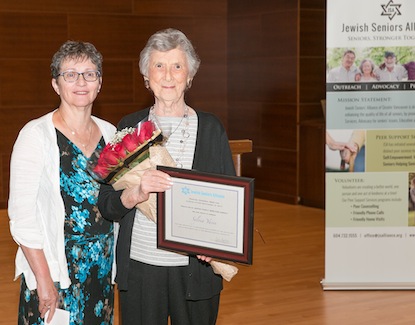
Karon Shear was one of the volunteers honoured at the Jewish Seniors Alliance AGM on Sept. 14. (photo by Alan Katowitz courtesy of Jewish Seniors Alliance)

The annual meeting of the Jewish Seniors Alliance was held on Sept. 14 at Congregation Beth Israel. The business meeting was followed by a dinner and awards ceremony.

The business portion of the evening was called to order by JSA president Ken Levitt. Prior to the presentation of committee reports, a number of organizations offered greetings. A d’var Torah was delivered by Beth Israel’s Rabbi Jonathan Infeld, who emphasized that, according to Jewish law, we are not to cast aside seniors as they are at the heart of the community. And both Ezra Shanken, chief executive officer of the Jewish Federation of Greater Vancouver, and Gudrun Langolf, acting president of the B.C. Council of Senior Citizen Organizations (COSCO), also said a few words.

Following the approval of the agenda and the minutes of last year’s AGM, Larry Meyer delivered the treasurer’s report. He outlined the various funding sources of JSA – government, corporate and private grants, as well as the $18 annual fee from members/supporters. He also listed the programs this money supports, such as peer counseling, Senior Line magazine, the fall symposium, the spring forum and the Empowerment Series, as well as the website, jsalliance.org.

Pamela Ottem, chair of the Peer Support Program, outlined the various aspects of the service. Peer counselors are required to take 55 hours of training prior to being assigned a client. They are given ongoing support in their work by Grace Hann, who is also the trainer, and Charles Leibovitch, who is a social worker. It takes 15 hours of training to become a Friendly Visitor. These volunteers visit shut-ins and lonely seniors; another part of the program is friendly phone calls and service information and referral. The peer support program has 56 trained volunteers serving 70 seniors.

The JSA’s Ambassador Program, whose goal is to raise awareness of elder abuse, started with a one-year grant and has been incorporated into the other offerings. Hann, Leibovitch and some of the volunteers make presentations to other seniors groups about their activities.

Binny Goldman reported that JSA has 596 members/supporters, of whom 320 are individual members, 150 are members of the Most Russian Bridge group and 21 are from affiliate organizations.

photo - Debbie Rozenberg, left, and Sylvia Yasin
Debbie Rozenberg, left, and Sylvia Yasin. (photo by Alan Katowitz courtesy of JSA)

In Levitt’s president’s report, he briefly reviewed the activities of the JSA, emphasizing that the organization would not exist if it were not for the active involvement of its volunteers. He pointed out that the peer support program alone, if it were carried out by paid staff, would cost much more than JSA’s total budget. He thanked everyone, both staff and volunteers, who have worked so hard and contributed so much over the past year.

Marilyn Berger presented the report of the nominations committee. She read out the slate for the coming year and moved for acceptance. Two former board members were mentioned, Edith Shier, who has passed away and was the previous editor of Senior Line, and Milton Adelman, who has retired from the board but was for many years the treasurer of JSA. Levitt then called for the adjournment of the business part of the evening and everyone was invited to move to the tables for dinner, volunteer recognition and musical entertainment.

Jazz singer Jill Samycia entertained the approximately 150 dinner guests, after which came the awards presentations to volunteers. As has become JSA’s custom, several organizations were asked to nominate senior volunteers who have spent time and energy enhancing the goals of their organizations.

Karon Shear, who was coordinator and administrator of JSA from 2005-16, was nominated by JSA. Her service to seniors, and enthusiastic marketing, played a vital role in the development and growth of the organization. In presenting her with the award, Serge Haber described her as the heart and soul of JSA. He spoke of the countless hours she spent, off the clock, on weekends, working at home; how she produced the Senior Line magazine basically on her own for a time.

photo - Nassa and Arnold Selwyn
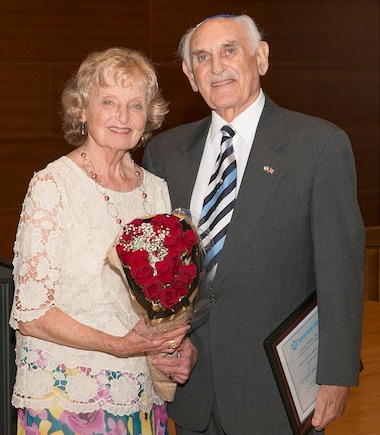
Nassa and Arnold Selwyn. (photo by Alan Katowitz courtesy of JSA)

Sylvia Yasin was nominated by the Jewish Family Service Agency. Yasin has volunteered for many years with the Jewish Food Bank and was instrumental in creating relationships with various groups and individuals and obtaining ongoing donations of supplies for school-aged children. She was presented with her award by Debbie Rozenberg, who noted that Yasin began volunteering while still working full time. Yasin has been involved with the Terry Fox Run and with ORT. Among other things, she organized the gift wrapping in shopping malls that raised funds for ORT. She also helps set up and clear for the seniors lunches at the Kehila Society and is still involved with the Jewish Food Bank.

Nassa and Arnold Selwyn were nominated as a couple for their longtime volunteerism at Congregation Beth Israel. Infeld talked about Arnold’s singing for the congregation and Nassa’s beautiful sewing of the parochet (ark curtain) and the siddur covers. Together they bring holiness into the world, said the rabbi. Both of them act as greeters and have been part of many other committees. They are also active in the general community and are part of Showtime, an entertainment group of seniors.

All of the honourees expressed their thanks and appreciation to JSA and the nominating organizations. The message to all was, volunteer whenever you can and wherever you can – it will bring you feelings of fulfilment and joy.

Samycia performed again, during dessert, and a number of the guests got up and danced to the music. The evening ended with a draw for door prizes.

Barbara Bronstein and Larry Shapiro were co-chairs of the event.

Tamara Frankel is a member of the board of Jewish Seniors Alliance. Shanie Levin, MSW, worked for many years in the field of child welfare. During that time, she was active in the union. As well, she participated in amateur dramatics. She has served on the board of the Jewish Federation of Greater Vancouver and is presently on the executive of JSA and a member of the editorial committee.

Housing, high-tech, musicals and more – this week in the community

Tikva welcomes residents: The Storeys Complex in Richmond. (photo from facebook.com/tikvahousing)

We are taught from an early age that giving, repairing the world and being kind are the tenets of living a Jewish life. In our community we don’t have to look very far to find people who fit this description. One of the latest projects that has come to fruition is the Diamond Residences in the Storeys complex in Richmond. Thanks to the generosity of the Diamond Foundation, Tikva Housing Society now owns 18 (chai!) units that are being rented at below-market rates to people in the community for whom stable, safe housing was unpredictable and unaffordable, at best.

Tikva Housing partnered with four nonprofit societies and the City of Richmond to build these and other apartments. Tikva worked hand in hand with community agencies such as the Jewish Family Service Agency to place tenants in need in these units, as well as with the Jewish Federation of Greater Vancouver and B.C. Housing. Most of the tenants will have moved into their units by the end of this month.

The Diamond Residences will house six singles and, of those, five are seniors. Also, 12 families and a total of 22 children will be living there. One 83-year-old woman cried when she was told she would be moving into a studio unit, as she has not had a place to live for years and was sleeping on someone’s couch. A single Israeli mother with two children is moving into a three-bedroom unit; her kids have never had their own rooms. Another single mother with three children has been sharing a two-bedroom place and has not had her own room in two years. One family has moved to Greater Vancouver from out of town and can now attend Shabbat services, be close to their family and the Jewish community. There are many more such stories.

 – Courtesy of Tikva Housing Society

* * *

Simon Fraser University recognized four distinguished alumni on Sept. 13 at Four Seasons Hotel. Among them was Gary Cristall, co-creator of the Vancouver Folk Festival.

The annual awards, presented by SFU and the Alumni Association, recognize those whose accomplishments and contributions reflect the university’s mandate of engaging the world. An advocate for the arts and human rights, Cristall has been a cultural groundbreaker, having co-founded the Vancouver Folk Music Festival in 1978. In an industry plagued with an unscrupulous reputation, Cristall has been instrumental in fighting for the rights of artists to be treated professionally and with respect while also defending their rights to fair performance fees and copyright ownership.

Cristall served as acting head of the music section of the Canada Council for the Arts and was the founding president of the Public Service Alliance of Canada, the first union at the Canada Council. Today, Cristall continues to serve as a prominent mentor and educator, assisting artists in building their careers and guiding communities in enhancing dynamic cultural interactions that enrich and benefit a healthy, democratic society.

* * *

After a grueling 33 hours of programming, DragonFruit – Benjamin Segall, Jacy Mark, Viniel Kumar and Pritpal Chauhan – completed StoryTree and demonstrated it live to a panel of judges at Hack the North, an international student hackathon held at the University of Waterloo in Ontario, which this year took place Sept. 15-17.

Canada’s biggest hackathon, Hack the North was founded and is organized by Techyon, a student-run nonprofit organization, in partnership with Waterloo Engineering. The event brings together 1,000 students from top universities across 22 countries in the world. Students collaborate and create impactful new hardware projects or mobile and web applications of their own design for a weekend at the University of Waterloo, all expenses paid.

DragonFruit’s StoryTree was one of the 14 projects chosen out of the more than 250 demonstrated at Hack the North. StoryTree is an online workspace for aspiring authors to collaborate on books together. All you have to do is write a paragraph or a chapter, or even just a sentence, and, as more and more people add or branch off from a story, that story you’ve always wanted to write becomes a reality.

DragonFruit will be continuing the project and are looking for alpha testers for January 2018. If anyone is interested in being a part of this project or for more information on it, contact them via facebook.com/dragonfruitcode or dragonfruitcode.com.

* * *

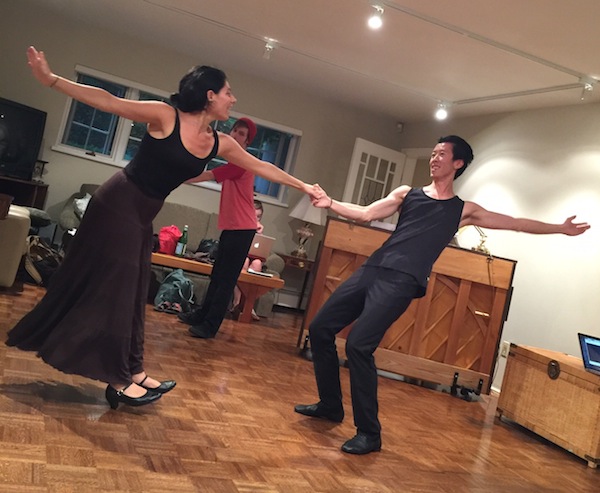
photo - Swinging Sylvia rehearsals: Advah Soudack and Sky Kao create a whirlwind of action in rehearsal of the second one-act play that comprises Two Views from the Sylvia
Swinging Sylvia rehearsals: Advah Soudack and Sky Kao create a whirlwind of action in rehearsal of the second one-act play that comprises Two Views from the Sylvia. (photo by Sue Cohene)

 Rehearsals have started for Two Views from the Sylvia, a new musical theatre production by Kol Halev Performance Society. This original production – which will be at Waterfront Theatre Nov. 8-12 – tells the story of the iconic Sylvia Hotel and its historic connection to the local Jewish community and the city of Vancouver.

Two Views from the Sylvia comprises two one-act plays.

The first play, Sylvia’s Hotel, is set in Vancouver in 1912. It brings to life the origin of the Sylvia Hotel, named for Sylvia Goldstein (Ablowitz) and the story of the Goldstein family who built it. Young Sylvia Goldstein and the legendary Joe Fortes, the beloved English Bay lifeguard, develop a bond that helps Sylvia realize her dreams.

In the second play, The Hotel Sylvia, the story continues as we meet the characters whose lives and loves became interwoven with the story of the Sylvia over her 100-year history. It includes vignettes revealed to the production’s researchers by Huguette, the front desk clerk who worked at the Sylvia for 35 years.

Jewish community members play key roles in both plays. In the lead roles are Advah Soudack (as Sylvia) and Adam Abrams (as Abraham Goldstein); Anna-Mae Wiesenthal and Joyce Gordon are cast in important supporting roles. Behind the scenes are Sue Cohene (producer) and Heather Martin (associate producer), as well as Gordon (assistant producer) and Abrams (graphic designer and webmaster) and Gwen Epstein (production team). Marcy Babins and Michael Schwartz collaborate in their roles at the Jewish Museum and Archives of British Columbia, which has created an historical photo display to accompany the production.

Two Views from the Sylvia is a project of Kol Halev in partnership with the B.C. Arts Council, Government of British Columbia, City of Vancouver, Granville Island Cultural Society, CMHC Granville Island and the JMABC. For information and tickets ($28), visit sylviamusical.com.

– Courtesy of Kol Halev

 * * *

Bema Productions’ Victoria Fringe Festival play Horowitz and Mrs. Washington was a great success. All seven performances at Bema’s Black Box Theatre at Congregation Emanu-El were sold out and the production company’s work was once again as one of the best dramas in the Victoria Fringe.

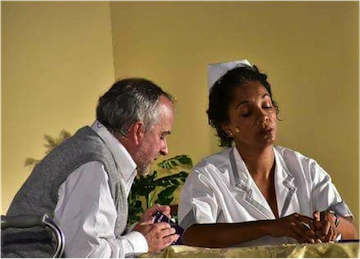
photo - Bema Productions’ Victoria Fringe Festival play Horowitz and Mrs. Washington was a great success
Bema Productions’ Victoria Fringe Festival play Horowitz and Mrs. Washington was a great success.  (photo from Bema)

Mrs. Washington is hired to nurse Sam Horowitz, who’s been mugged and had a stroke. She’s a determined tyrant and he’s a bigoted Jewish widower. The two must find a mutually beneficial relationship when his daughter tries to make him leave his home. The play by Henry Denker reflects the attitudes of the 1970s and illuminates the power to be found in ordinary lives.

“The electric performance of the actors enabled the audience to visit uninhibitedly the issues of racism, stroke recovery and aging in place,” reads the review “Bravo Bema!” on Emanu-El’s website.

“For the most part,” said the review, “the actors were provided with a very humorous script that relied on stereotyping but went beyond it for its punchlines. The audience was asked to stretch their imaginations – who would have considered invoking Michelangelo to explain why the naming of a grandson ‘Douglas’ instead of ‘David’ was inappropriate? There were a few moments when the pace flagged but very few.”

While the play “revealed little about the face of contemporary racism,” the “potential disempowering of aging adults by their loving offspring is an issue of contemporary concern.”

The Bema production was directed by Zelda Dean and Angela Henry and was performed by David Macpherson, Rosemary Jeffery, Christine Upright, Alf Small, Cole Deo and Graham Croft.

– Courtesy of Bema Productions

 * * *

photo - Miki Mochkin teaches a class on baking challah
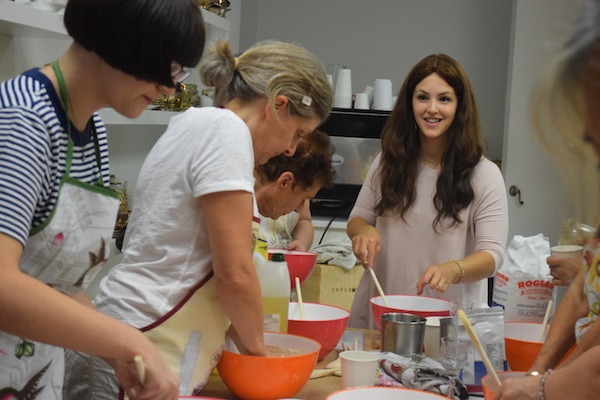
Miki Mochkin teaches a class on baking challah. (photo by Shula Klinger)

Chabad North Shore hosted a challah bake at Mia Claman’s store in West Vancouver on the night of Sept. 6. Miki Mochkin taught a class on baking challah to local women. While the bread was rising, she explained the significance of each ingredient for Jewish women. From the sweetness of the honey to the harshness of the salt, every element serves to remind the baker of its symbolic role in our lives as women and mothers.

– Courtesy of Shula Klinger

* * *

photo - Panelists at Congregation Beth Israel discuss the topic Our Leaders: Are They Above the Law?
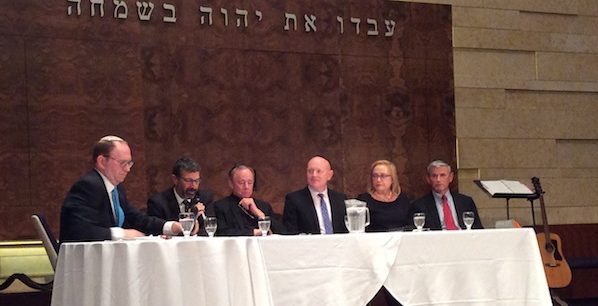
Panelists at Congregation Beth Israel discuss the topic Our Leaders: Are They Above the Law? (photo by Cynthia Ramsay)

In the photo, left to right, are Congregation Beth Israel Rabbi Jonathan Infeld, King David High School head of school Russ Klein, Vancouver Catholic Diocese Archbishop Michael Miller, Vancouver Police Chief Constable Adam Palmer, B.C. Court of Appeal Justice Sunni Stromberg-Stein and MLA Andrew Wilkinson. On Saturday night, Sept. 16, at the synagogue, this panel of speakers took on the topic Our Leaders: Are They Above the Law? Infeld framed the contemporary discussion around a talmudic discussion regarding an important rabbi in a community, rumours surrounding his conduct and whether the rabbi should be excommunicated. The panelists took this starting point to talk about their own professions, present-day accountability standards and various other issues.

– Courtesy of Cynthia Ramsay


Mystery photo … Sept. 29/17

Beth Israel National Confab (clergy), 1975. (photo from JWB fonds, JMABC L.09862)

If you know someone in this photo, please help the JI fill the gaps of its predecessor’s (the Jewish Western Bulletin’s) collection at the Jewish Museum and Archives of B.C. by contacting archives@jewishmuseum.ca or 604-257-5199. To find out who has been identified in the photos, visit jewishmuseum.ca/blog.