At Jewish Federation of British Columbia’s annual general meeting June 22, several individuals were honoured for their dedication to and impact on our community.
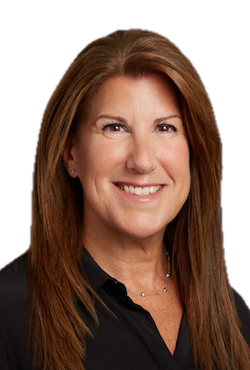
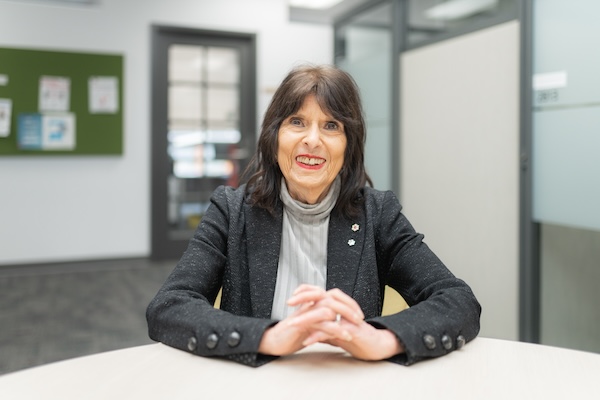
Jackie Cristall Morris (photo from Jewish Federation of BC)
In recognition of her years of dedicated service and heartfelt leadership in Federation’s annual campaign, her role as women’s philanthropy chair and as a Federation board member, Jackie Cristall Morris was recognized with the Elaine Charkow Award.
Federation also recognized leaders beyond our community whose partnership and advocacy make a meaningful difference. Allies of the Year Awards went to Keerit Jutla, chief executive officer of Jutla Strategies; Terry Glavin, author and journalist; and Niels Veldhuis, president of the Fraser Institute.
Young Leadership Awards were given to Daniel Segal (young adult category), Joey Hector (university student category) and Ellie Epstein (high school student category).
***
Jewish Family Services (JFS) was recently named a 2025 Innovation Exchange Winner by the Network of Jewish Human Service Agencies, a distinction awarded to a select group of organizations whose work demonstrates measurable impact, strong design and adaptability across the broader human services sector.
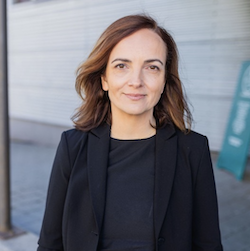
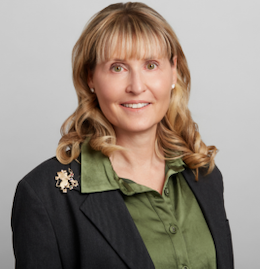
Tanja Demajo (photo from Jewish Federation of BC)
JFS’s Beyond the Waitlist was recognized for addressing persistent barriers to care. In response to growing demand, long wait times and limited system capacity, JFS redesigned how individuals access counseling and support services.
At the centre of this approach is a digital assessment platform that enables real-time triage and connects people to the appropriate level of care. This was paired with the development of an intern counseling clinic, bringing in up to 15 graduate-level students annually alongside a network of registered clinical counselors, family and community.
This model has significantly reduced wait times, expanded access and strengthened future workforce capacity. Through the Innovation Exchange, JFS will join peer organizations to exchange insights and extend the reach of this work to benefit more individuals and families.
As Tanja Demajo, chief executive officer at JFS, shared: “This recognition speaks to the strength of JFS’s mission and values, the creativity and dedication of its team, and the trust placed in its work by partners, funders and the broader community. It also affirms JFS’s role in advancing forward-thinking solutions that improve lives.”
***
The Jewish Independent took home two American Jewish Press Association Rockower Awards this year, for work published in 2025. The honours were presented on June 4 at the 45th Annual Simon Rockower Awards Banquet, held in conjunction with the AJPA’s annual conference, in New York City.
The JI competes in the weekly and biweekly newspapers category. This year’s winners happen to both be Canadians who made aliyah years ago.
Gil Zohar won first place for excellence in North American Jewish history with his article “US long interested in Mideast.” The jury commented: “Timely article traces largely unknown efforts, by private Americans, to colonize or settle the land of Israel.”
Bruce Brown received an honourable mention for excellence in personal essay writing for his piece, “Life amid 12-Day War,” about his and his family’s experiences during the conflict with Iran. The jury called it “[a] sobering view.”
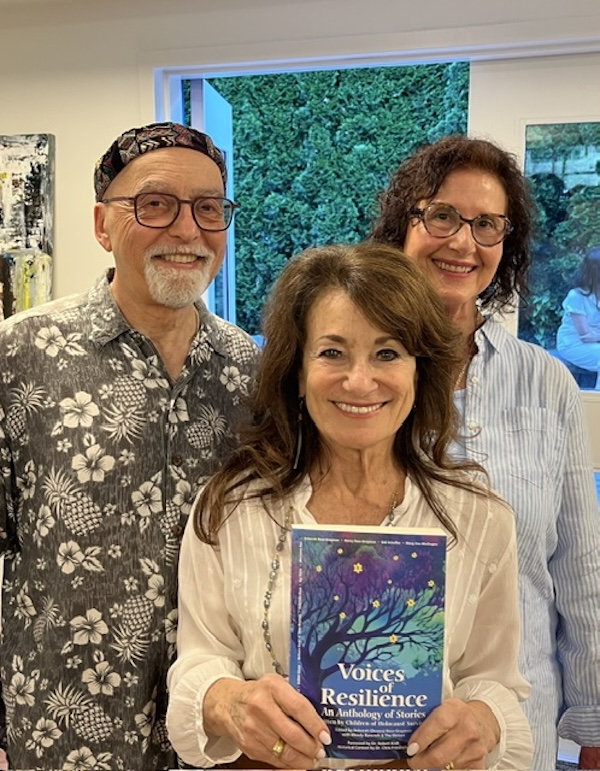
Henry and Deborah Ross-Grayman with Rabbi Tirzah Firestone. (photo by Deborah Ross-Grayman)
Henry and Deborah Ross-Grayman pose with Rabbi Tirzah Firestone, who was in Vancouver recently for an Or Shalom Shabbaton. Firestone holds her copy of Voices of Resilience: An Anthology of Stories Written by Children of Holocaust Survivors, edited by Deborah Ross-Grayman with Wendy Bancroft and the contributors. For more on the book, go to jewishindependent.ca/stories-of-trauma-resilience.
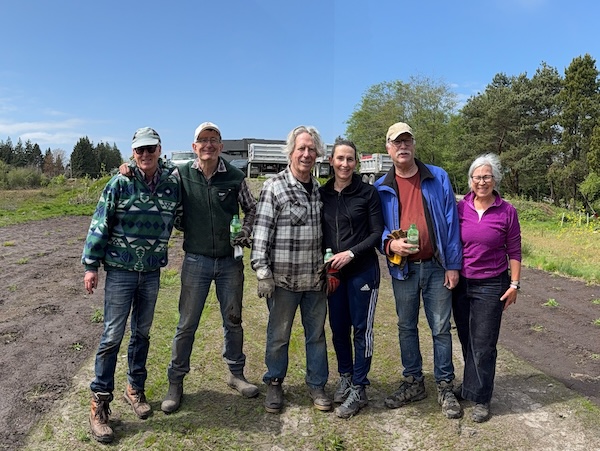
Left to right: Larry Vinegar, Stan Shaw, Lloyd Baron, Michelle Dodek, Steve Schacter and Marcy Schwartzman. (photo from Marcy Schwartzman)
There are roughly 1,200 people who rely on Jewish Family Services food hubs in the Greater Vancouver area, and much of the fresh produce they receive is due to the efforts of Larry Vinegar and Marcy Schwartzman.
Each month, JFS delivers approximately 2,500 bags of groceries to its clients, which include families with children, seniors, new immigrants, people with disabilities and other individuals in need. In 2021, during the pandemic, JFS established the food hubs, in partnership with synagogues and other organizations. The food is collected and distributed, with the help of a team of volunteers, at a central hub in Vancouver on 3rd Avenue called the Kitchen.
JFS hubs, situated in various parts of Greater Vancouver, offer fruit and vegetables. (photo from Marcy Schwartzman)
The hubs, situated in Vancouver, the North Shore, Burnaby, Surrey, the Tri-Cities and Richmond, offer fruit and vegetables. The program does not provide any meats, poultry or shellfish, and ensures that items are available for clients who follow a kosher diet.
“Most of the clients are people who are struggling to make ends meet, and your rent has to get paid. It often takes primary resources to pay your rent, and then food and other necessities come second. A lot of people are at a point where, at the end of the month, they don’t have money to put food on their tables, so they’re looking for assistance for that,” Schwartzman said.
She added that, if people do not have enough money, they choose the least expensive options, which are often not the healthiest. Thus, a community kitchen that supplies nutritious produce can be vital to a person’s well-being, she said.
The Independent caught up with Schwartzman and Vinegar on a spring afternoon. They were about to prepare the ground for planting on a Lower Mainland farm, the produce from which would be distributed by JFS.
Maxwell (Moishe) Vinegar. (photo from Marcy Schwartzman)
On Dec. 31, 2020, the couple suffered a tragedy, losing their 31-year-old son, Maxwell (Moishe) Vinegar, in a skiing accident. Prior to his passing, the family had had a conversation about food security, which reflected on a period when their son was young, and the family would deliver food for the food bank for Hanukkah.
“We had a lot of conversations with our kids about what it means to be a member of your community and be responsible and look out for our other community members,” Schwartzman said. “That December, around Hanukkah time, we were saying to him, ‘Hey, you should go help at the food bank.’ And he said, ‘I’m busy working, Dad, you’re retired, you should go do it.’”
In trying to come out of their grief, Vinegar and Schwartzman started their food efforts with donations people made after Max’s death, which they requested be directed to JFS. A friend of theirs who owned a farm in the Okanagan planted an acre of squash – a sign notes that all the squash growing on the acre is for JFS in Moishe’s memory.
A friend of Larry Vinegar and Marcy Schwartzman, who owns a farm in the Okanagan, plants an acre of squash for JFS in memory of their son, Maxwell (Moishe) Vinegar. (photo from Marcy Schwartzman)
“We went up to help look after that for a couple of weekends that first summer, and that sort of got us thinking that maybe we can find somewhere to grow food to provide it to Jewish Family Services,” Schwartzman said.
The next summer, Vinegar spoke to a blueberry farmer in Richmond, who put the couple in touch with a family that lets them use their half-acre backyard, at no cost, to grow vegetables for the food bank.
“We’ve grown a variety of things over the years, but what grows the best there is zucchini and squash, butternut and acorn, and we also have green beans,” Schwartzman said. “We’ve been generously supported by West Coast Seeds.”
Further efforts include growing 300 plants at Richmond Jewish Day School last year, building relationships with local farmers, and spreading the word about tax benefits for those who donate excess crops to bolster food security.
“Larry has been quite instrumental and not afraid to go talk to different farmers around the Lower Mainland, just at the end of the season, to say you didn’t sell your crop, we’ll be happy to come pick it up,” Schwartzman said.
Vinegar has also developed a relationship with Costco after he walked into one of their stores and spoke with a manager about supplying unsold goods to food banks instead of disposing of them. All Costco stores give away food that is getting close to its stale date, said Schwartzman. “They donate to a different organization each day.”
In 2024, Vinegar and Schwartzman were recipients of the inaugural JFS Lighting the Way Award. At the presentation, they were described as “embodiments of JFS’s values, demonstrating innovation in their commitment to social good.”
“We are grateful for the help of many friends and volunteers who help us plant, tend and harvest,” said Schwartzman. “We couldn’t do what we do without their help!”
For more on JFS’s food and other services, go to jfsvancouver.ca.
Sam Margolishas written for the Globe and Mail, the National Post, UPI and MSNBC.
Dr. Jonathon Leipsic will be honoured by Schara Tzedeck at MOSAIC on June 16. (photo from Schara Tzedeck)
At its annual MOSAIC event on June 16, Congregation Schara Tzedeck will honour Dr. Jonathon Leipsic.
“It would be hard to find someone more worthy,” Rabbi Andrew Rosenblatt told the Independent. “In addition to the countless hours that Jonathon gives toward advancing the synagogue goals, one cannot miss the fact that Jonathon loves Schara Tzedeck with his full heart. He attends, classes, services, programs regularly – which he is clearly fitting in between clinical, research and family responsibilities. Jonathon provides leadership in practice and in personal example and his commitment to personal growth, learning, community and helping others is almost without peer.”
Leipsic is professor and chair of radiology and professor of cardiology at the University of British Columbia, as well as a Canada Research Chair in Advanced Cardiopulmonary Imaging. He has more than 800 published peer-reviewed manuscripts and more than 300 scientific abstracts – he has been one of the top 1% most impactful scientists globally for multiple years, according to the Web of Science citation database.
In addition to his professional roles, Leipsic has been significantly involved in the Jewish community, notably with Schara Tzedeck, King David High School, Vancouver Talmud Torah and the Jewish Federation of Greater Vancouver.
Schara Tzedeck executive director Shelley Rivkin, who is also an active community leader, recently becoming board chair of Jewish Family Services and having worked with the Jewish Federation for 17 years, called Leipsic “a pillar of our community.”
“His impact extends far beyond the boardroom or the walls of our shul,” she said. “His leadership is defined not by title, but by character. As immediate past president of Schara Tzedeck, Jonathon led the board with steadiness, compassion and a deep sense of responsibility to klal Yisrael.
“During the heartbreak of Oct. 7 and the resilience required in its aftermath, his voice as a tireless advocate for our shul and wider community – and his clarity of heart – were the anchor that held us together over challenging times. Jonathon is a man of many talents and accomplishments: community engagement, Torah study and medicine. We are celebrating all of these facets at the gala.”
The evening will feature Shulem, one of Leipsic’s favourite performers, said Rivkin. There will be tributes, followed by dinner and another performance by Shulem, who blends traditional cantorial melodies with classical crossover.
“I am honoured to even be a part of the Schara Tzedeck community,” said Leipsic about his being
recognized by the congregation. “The shul has played a foundational role in my spiritual growth and in infusing ahavat Torah and ahavat Yisroel in my family and amongst so many. I am humbled to have served the shul as a board member and as president.”
Schara Tzedeck has been the spiritual home of Leipsic and his wife, Karly Bogner, since they met. Bogner’s grandparents were members of the synagogue, said Leipsic. “I feel privileged to daven, to celebrate simchas and to join for moments of reflection and learning at Schara Tzedeck,” he said.
“I try to live my life in accordance with the talmudic principle of ‘Klal Yisroel arevim zeh lah zeh’ [‘All of Israel is responsible for one another’]. Karly and I feel deeply grateful to be part of klal Yisroel and to have the privilege to enjoy all that Jewish Vancouver has to offer – a community and institutions that we did not build but that we feel deeply responsible to help strengthen and build,” said Leipsic.
“As we enter our 119th year, longevity is finding the right balance between the responsibilities that the halachah demands and flexibility to meet our congregants’ needs on a contemporary basis,” said Rosenblatt. “We must have that backbone of daily service attendance and regular Torah study, reliable kashrut and Shabbat observance. At the same time, we have to be relevant to the contemporary generation, we have to provide opportunities for them to give back and to leverage Jewish wisdom in their own growth and in answering the questions and challenges they face today.”
This year, MOSAIC’s fundraising focus is the Clergy Sustainability Fund.
“Vancouver is a great distance from the large Orthodox centres, where we primarily recruit our clergy,” said Rivkin. “To attract additional clergy, we need to be able to support the real conditions that make long-term leadership possible: housing, family connection during the holidays, and professional growth. This fund
will enable us to address these concerns and help ensure that Schara Tzedeck can continue to attract outstanding young rabbis to our community and give them the foundation to stay and lead.”
It’s been an incredibly stressful time in our community for more than two years. The relief I felt when Ran Gvili’s body, the last hostage in Gaza, was returned home, was huge. When I saw others at synagogue, all our body language said the same thing. We’re exhausted as a people. It sometimes feels like there is no end in sight to our worry – about the antisemitism, the ongoing violence.
Along with all this, of course, there are the usual life events. For example, we’ve watched the gradual blossoming of independence for our teens. This culminated for me recently when my husband took our twins on a skiing trip with extended family. I got the chance at a staycation – by myself – with our dog. I can almost hear those who would say, “What?! You didn’t join them? You didn’t want to go?”
Reader, I’m not a skier. I’m happiest at home. Staying in a ski house with 15 extended family members isn’t everyone’s idea of bliss. So, for the first time, I wrote the special letter that says I consent to my children traveling outside of Canada without me. I helped everyone pack, drove them to the airport and came home to a quiet house. Once or twice a day, I reminded our worried dog that they weren’t coming home today, while she lingered by the door, waiting.
Friends at synagogue asked what special things I would do. Are you ordering take out? What movies are you watching? What are your plans? At first, I had no answer for them. It’s been 15 years since I was actually by myself for so long. I didn’t even know what I wanted to do.
In the end, what I wanted was small, but it was meaningful. I took walks outdoors every day with my dog, particularly reveling in adventures on the frozen Nestawaya River Trail, right in the middle of the city. I dawdled outside in my crisp winter backyard looking at the stars. I listened to music my household wouldn’t have chosen and ate everyday things that my family doesn’t like. I read a whole book.
I also made inroads, each day, on routine chores that needed to be done. I vacuumed. Did a load of laundry. Cooked and polished silver. Nothing was crazy or so different. In embracing daily rituals, I kept things feeling normal and predictable. The dog got fed and walked. The lights got turned on and off. The phone got answered. The bed got made.
To many, this might not seem like a break or a particularly meaningful experience, but I had exchanges with multiple women, moms in mid-life, who absolutely knew what it meant when I said I was going to be staying home – alone. They offered smiles and good wishes. There was a wistful jealousy there, too. I recognized it well. Everyone asked if I was getting the chance to sleep a lot.
Truth is that I had nightmares more than once. There’s a lot to process. It was harder than I thought it would be to relax and rest. Yesterday though, my children, relatively new to downhill skiing, were finally off the mountain and on their way to an airport and back to the prairies, with my husband. They regaled me with what they’d accomplished. Their cross-country skiing experience, learned in Winnipeg public school gym class, had helped them. They joked that the biggest hill they’d ever gone down on a Manitoba school ski trip was small compared to the bunny hill in the Rockies. Their texts and calls showed 14-year-olds alternately nervous and boastful, a normal teen experience. They grew during their trip away, but I did, too.
Lately, I’ve thought about the many pressures parents face as we’re juggling households, kids, work and community. There are frequently calls to volunteer, donate, “get involved” and do more. This is particularly true in a (relatively small) Canadian Jewish community, in which every one of us helps keep things afloat. However, I’d gotten to a place where I kept showing up, feeling completely exhausted. Yes, I’d woken everyone up and dropped them off to volunteer, or I’d helped at another “do something to help others” event myself. The weekend break reminded me viscerally that when your own “cup” is empty, it’s hard to fill everyone else’s.
Everybody needs breaks to rest and restore themselves. Without that space – and, for this introvert, silence – there’s no way to offer our best selves to others. We often quote the famous Pirkei Avot 2:5 passage from Hillel: “In a place where there are no men [people], strive to be a man [person].”There are many takes on this, including, where there are no leaders, strive to be responsible. Another take is, when people behave as monsters, or aren’t behaving in an upstanding way, try to be a mensch. Yet, when, I woke up after several days by myself, rested and happy, I realized something else.
In a place where there are no other people, self-regulate. Strive to be a good person, one who does the chores and shows up and does her work, even when there’s no one else to hold us accountable. Take responsibility. Make space for recovery, so that we can all “treat others as we wish to be treated.” In the Babylonian Talmud, Tractate Shabbat 31a, Hillel says to the gentile who asks to convert, with the condition that Hillel teach him the whole Torah while he stands on one foot, “That which is hateful to you, do not do to another; that is the entire Torah, the rest is its interpretation. Go study.”
Right in one of our most popular Jewish quotes is a good answer for why a staycation – or a break when you’re tired – matters. Don’t demand something from others that you cannot manage. Instead, give space for others to learn, grow and change. Sometimes, the best restoration and learning happens in the same way we absorb and appreciate music. How do we best appreciate and learn music? In the rests between notes.
Joanne Seiff has written regularly for the Winnipeg Free Press and various Jewish publications. She is the author of three books, including From the Outside In: Jewish Post Columns 2015-2016, a collection of essays available for digital download or as a paperback from Amazon. Check her out on Instagram @yrnspinner or at joanneseiff.blogspot.com.
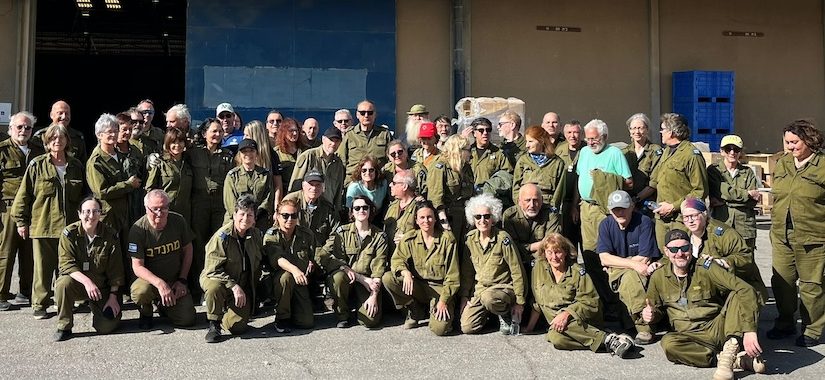
Volunteers with Sar-El in Israel last March. (photo from Marina Sonkina)
Last year, about this time, I was in Israel, volunteering with Sar-El, an organization that connects the Israel Defence Forces with volunteers from more than 30 countries, who provide the army with non-combat support. So many others had wanted to help after Oct. 7 that I had to wait several months for my documents to be processed.
The mood was understandably sombre. Not just the trauma of the Hamas terror attacks, with hostages captive, but also the antisemitism that engulfed the Western world like fire.
I asked some of my fellow volunteers why they had come to Israel during such a dangerous time. The answers I got, especially from non-Jews, both surprised and comforted me. A Christian volunteer from Detroit wanted Israel to know that it did not stand alone. A middle-aged Australian had been sponsored by her church in Sydney to help people of the Holy Land under an attack. Two Romanian girls didn’t speak a word of Hebrew or English, but answered me in Italian: “Aiuto” (“Help”).
“I had a very good life. I had a chance to travel all over the world. But, until now, I’ve been traveling horizontally,” a Parisian Jew of Algerian descent told me. “Now, it’s time to travel vertically,” she said, raising her eyes to the sky. “This land is sacred. I feel it here like nowhere else. And now it’s in peril.”
In spite of rockets being fired into Israel from Lebanon, Gaza and Yemen, the volunteers felt more protected in Israel than they did back home. Many felt relieved that, finally, there was no need to conceal one’s true feelings or to hide one’s Jewishness.
“I don’t feel safe in the US anymore,” said a New York lawyer who had been attacked from behind in the streets of Manhattan, his yarmulke yanked off his head.
A German woman from Munich was on her 10th visit to Israel. “I’m not Jewish, and I can’t explain it,” she said. “All I know is that I love people here. Love their warmth. Chaos? Yes! They talk loud, they are emotional, but I don’t mind that. I plan to spend half a year here once I retire.”
Initially, I wasn’t sure how we, civilians, could help the IDF fight Hamas in Gaza, but my first day at the medical military base near Tel Aviv made it clear. Hundreds of different medications and medical devices that had come from warehouses across the country had to be sorted out, their expiration dates checked. Those who accuse Israel of racism should see these medicines, each labeled in four languages: Hebrew, Arabic, English and Russian. (Thanks to Soviet antisemitism and, lately, to Putin’s war on Ukraine, 15% of Israel’s population comes from Russia.)
On the military base, I saw clearly what is best in Israel: its people. The IDF mirrors the diversity and inclusiveness of a society that, in its short history, has accepted refugees from more than 100 countries.
Without Moshe, for example, we would have had no idea how to sort the truckloads of medications arriving every day. Having come to Israel from Bukhara (in Central Asia) as a child, Moshe kibitzed in three languages, instructing us by means of his hands while talking on his cellphone. From his easy smile, I would never have guessed that his wife had recently died of cancer, that his two sons were fighting in Gaza and that, every day after his work with us, he went to a synagogue to pray. One morning, Moshe directed us to place boxes in long rows on the floor, in an unusual configuration. The next morning, a group of children with autism and down syndrome came to finish the sorting, also helping their people’s army.
Paul, a mathematician who came from France, was in charge of the military base’s math department. Ruth, who had made aliyah from the Netherlands as a teenager, was serving as one of the madrichot (female soldiers tasked with organizing and looking after Sar-El’s volunteers); after the army, she hoped to become a specialist in Japanese culture.
On another military base, about 20 kilometres from Gaza, in the Negev Desert, one of our tasks was to assemble care packages for soldiers spending Passover at the front, away from home. In two days, we filled 15,000 boxes with grape juice, matzah and other traditional items. Asoldier with a distinct Californian accent came to help us. He was a “lone soldier,” a soldier who has no family in Israel. Various families take turns welcoming lone soldiers for Shabbat, feeding them and giving them a sense of home.
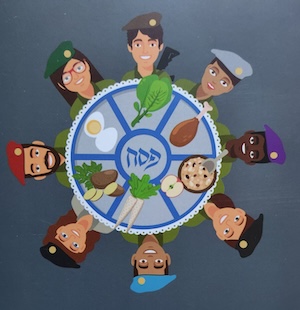
The cover of a Haggadah that Sar-El volunteers inserted into thousands of Passover boxes that were sent to Israeli soldiers in Gaza. It shows the multicultural character of the Israel Defence Forces. (photo from Marina Sonkina)
Once, an officer joined us, helping make up the boxes, which was unusual, given his rank. Later, I saw him in the mess hall speaking in Hebrew to the base commander, who was originally from India. I found out that the officer was Druze. Living mainly in the country’s north, in the Galilee region, the Druze community enjoys all the civil rights of other Israelis, while maintaining their Arabic language and customs. Many Druze reach high echelons in the army, in medicine and other professions. When a Hezbollah rocket struck the Druze town of Majdal Shams, killing 12 children playing soccer, Prime Minister Binyamin Netanyahu went there, addressing community members as “brothers and sisters.” He promised that Hezbollah would “pay a heavy price” for killing their children, and he kept his word.
When I think of the soldiers I met and talked to, one thing sets them apart from young people of their age in North America: a seriousness of purpose, and the burden of responsibility. They know that the survival of Israel lies on their shoulders. They also know that, while defending theircountry, they may not survive. Death lurks behind every corner in Gaza and Lebanon. It has hidden in an effigy of a child pleading, in Hebrew, for help, but booby-trapped with explosives. It was underground, in the tunnels, some going 50 kilometres deep. It disguised itself in doctors’ scrubs, inside Kamal Adwan Hospital in Gaza, which was appropriated by Hamas terror operatives.
Every fallen soldier is loved and mourned as one’s own child. Army service acts as a social glue in a country into which millions of refugees, speaking different languages, have poured. The IDF is still the backbone and pride of this society.
At a party for troops just returned from Gaza, I saw a religious Jew in a yarmulke (skullcap) and tzitzit (prayer shawl) hanging from under his uniform, with a baby girl in each arm and an automatic rifle dangling behind his back. I talked to a medic, a corporal who was more outspoken than many – a college history teacher in times of peace, he had three young children at home.
“Is there any possibility of peace between Palestinians and Jews?” I asked him.
“Before Oct. 7, I supported a two-state solution because I wanted peace, but the Palestinians do not want peace,” he responded. “We’ve tried it many times in the past. They want only one state, an Islamic Caliphate with Sharia rule. We, Jews, are in their way and they want us dead…. We have to fight – if we want to survive.”
“What about your children?” I asked. “Will they have to fight, too?”
“Yes, them, too,” he said. “They’ll be left with no other choice.”
I shook my head in distress but said nothing.
“Look,” said the man, “illusions cost us very dearly. We can’t afford them anymore.”
I remembered Golda Meir’s words, spoken in 1957: “Peace will come when the Arabs will love their children more than they hate us.”
There is a truce in Gaza now. But, while some 20,000 Hamas fighters have been eliminated, 10,000 armed fighters are still at large.
Marina Sonkinais a fiction writer, and teaches in the Liberal Arts Program 55+ at Simon Fraser University.
Gloria Gutman, PhD, has been honoured with the King Charles III Coronation Medal, which recognizes individuals who have made a significant contribution to Canada, or an outstanding achievement abroad that brings credit to Canada. She will receive the medal in a ceremony March 21.
A research associate and professor emeritus at Simon Fraser University, Gutman founded the Gerontology Research Centre and the department of gerontology at SFU, serving as director of both units from 1982 to 2005. She is the author/editor of 23 books, the most recent (with Claire Robson and Jen Marchbank) titled Elder Abuse in the LGBTQ2SA+ Community (Springer, 2023).
Dr. Gloria Gutman (photo from SFU)
During her career, Gutman has held many prominent roles, including president of the Canadian Association on Gerontology, president of the International Association of Gerontology and Geriatrics and president of the International Network for Prevention of Elder Abuse. Currently, she is president of the North American chapter of the International Society for Gerontechnology, vice-president of the International Longevity Centre-Canada and a member of the research management committee of the Canadian Frailty Network. Previously, she served on the World Economic Forum’s Council on the Ageing Society, World Health Organization’s expert advisory panel on aging and health, and the CIHR-Institute of Aging advisory board.
“I am grateful to SFU for having nominated me for this award.
Developing the gerontology department and Gerontology Research Centre, serving on boards, organizing conferences, and advocating for seniors in other ways nationally and internationally, has been a privilege and a pleasure,” said Gutman. “It could not have taken place without the strong support of FASS [the faculty of arts and social sciences] and senior administration.”
In 2012, Gutman was awarded a Queen Elizabeth II Diamond Jubilee Medal by the Government of Canada and, in 2016, she was appointed to the Order of Canada, the country’s highest civilian honour.
– Courtesy Simon Fraser University
* * *
Lana Marks Pulver (photo from Jewish Federation)
Jewish Federation of Greater Vancouver is proud to congratulate its board chair, Lana Marks Pulver, who was honoured by Jewish Federations of North America with the Kipnis-Wilson/Friedland Award for exemplifying the higheststandards of philanthropy and volunteerism. Marks Pulver’s selection for this award is a testament to her exceptional dedication and leadership.
– Courtesy Jewish Federation of Greater Vancouver
* * *
The Louis Brier Jewish Aged Foundation is pleased to announce the appointment of long-time volunteer leaders Marie Doduck and Lee Simpson as co-chairs of the 2025/26 campaign. Please join board directors Harry Lipetz, Rick Cohen, Mel Moss, Bernard Pinsky, David Zacks, Michelle Karby and Abbe Chivers, and staff Ayelet Cohen Weil and Wendy Habif in congratulating and thanking them for their tireless commitment to our Jewish elderly.
At the Jewish Family Services Vancouver’s annual general meeting on Nov. 26, several volunteers were recognized for their work, dedication and achievements. Stan Shaw received the Naomi Gropper Steiner (z’l) Award; Candice and Todd Thal, the Paula Lenga (z’l) Award; Congregation Beth Israel, the Community Partner Award; Karl Biernbrodt, Richard Fruchter Staff Recognition; and Simone Kallner, the Sara Ciacci (z’l) Women Leadership Excellence Award.
Howard Kallner is being honoured at Schara Tzedeck’s MOSAIC gala on June 4 (photo by kenneth88/wikimedia)
“I have been very lucky in my life to be surrounded by lifelong volunteers and builders of community, both my parents, my in-laws and multiple other role models, and it just seemed natural to volunteer and be involved,” Howard Kallner told the Independent.
Kallner is being honoured by Congregation Schara Tzedeck at MOSAIC, the synagogue’s annual gala, on June 4.
“The first thing that came to my mind was discomfort,” said Kallner about finding out he was being recognized. “I was hesitant to accept because there are so many long-time shul volunteers, donors and community-builders who would be deserving of being honoured.”
Kallner has been a part of the congregation since he was 13 years old.
“My family had emigrated from South Africa when I was very young and their synagogues in South Africa were very similar to Schara Tzedeck,” he explained. “My parents, and now my family, have been members for over four decades. On my wife’s side, her great-grandfather, David Davis, was a founding member of Schara Tzedeck, and her grandfather, Charlie Davis, was a past president.”
Howard Kallner (photo from Howard Kallner)
For his part, Kallner was on the board for seven years before becoming president. He served three years as president and three more as past president, for a total of 13 years. He was serving as president when the pandemic hit.
“When the COVID pandemic hit, we needed to pivot immediately to online programming, online services where applicable, continue live services with restrictions and make sure our community members, particularly our vulnerable ones, were connected and taken care of,” he said of how his role was affected. “One of the programs that came out of this was Shabbat in a Box. We recognized a need amongst our members and others in our community and delivered over 450 meals a week at the height of the pandemic. For the Jewish holidays, we were delivering over 650 meals accompanied by holiday-specific items so they could celebrate the holidays.
“Additionally, Schara Tzedeck, being an Orthodox synagogue, could not have Shabbat services online,” said Kallner. “With the exception of a few weeks when the government would not allow any public gatherings, we continued services in person with some significant modifications. When limited to 50 people per gathering, we moved services outside, in a tent in our parking lot. At times, services were held in sub-zero temperatures, with most attendees wearing ski jackets, toques and gloves. For the High Holidays that year, we had nine services a day for a maximum of 50 people. We had to find three sets of Torah readers, shofar blowers and leaders of the services.
“While, during COVID, it was undoubtedly the hardest I worked as president of the shul, it was also the most rewarding,” he said.
Now officially “just” a member and supporter of the synagogue, Kallner continues to be part of the Schara Tzedeck Cemetery Board and is a governor of the Jewish Community Foundation, as well.
“Giving back to a community that has given me and my family so much was very important,” he said. “With different experiences in my life and my relatives’ lives, including immigrating to a new country with little means and losses during the Holocaust, strong Jewish institutions ready for whatever the world would throw at them seemed crucial, and I wanted to do my part.”
Schara Tzedeck’s senior spiritual leader, Rabbi Andrew Rosenblatt, described Kallner as representing the beginnings of a new generation of leadership. At the time Kallner was getting involved, said the rabbi, “There weren’t a lot of people in their 40s who were stepping up to the highest levels of leadership at Schara Tzedeck.”
Kallner helped take the synagogue from being a 20th-century organization into being a 21st-century organization, said Rosenblatt.
”The backbone of an Orthodox synagogue, certainly in the Pacific Northwest, certainly in Vancouver, is people who have come from much more traditional Jewish communities,” he explained. “For example, Schara Tzedeck has a lot of Holocaust survivors. These are people who came from very traditional Eastern European communities, but you could also have people from Winnipeg or Toronto or Montreal, New York, those places you associate with very traditional, very committed Jewish communities. For a long time, we were able to be a community of people who grew up in that kind of tradition, but there was a recognition at Schara Tzedeck that we needed to be able to be a place which translated topeople who did not have that kind of traditional upbringing.”
Kallner had the analytical, organizational and people skills to help the synagogue do that, said Rosenblatt, highlighting Kallner’s leadership during the pandemic.
“He was practically a paid member of the staff at that point, in terms of generating and developing policy,” said the rabbi. “He was involved in helping us make sure that we were operating on the next level. And he also understood that our organization had to be structured in a way where we could have the manpower to be able to do that, and that outreach. Part of that was that the information technology had to be updated.”
Describing Kallner as “a very humble person but also very hard working,” Rosenblatt said, “one of the things that he was strongest at was helping us transition into a place where we were reaching out more…. One of the programs we developed under his watch was Shabbat in a Box. There were some pre-iterations before that, but it came to its full maturity under him.”
Among the other programs that will benefit from the funds raised at MOSAIC are the synagogue’s education initiatives, some of which reach beyond the shul to the broader Jewish community, such as the series Rosenblatt gave on the history of the Marranos.
“I recognize,” he said, that “one of the great sources of inspiration in Jewish identity is Jewish history.”
Since the Oct. 7, 2023, terror attacks and the subsequent war, his education efforts have been more focused on Israel.
“When Oct. 7th hit, and people started to hear immediately just garbage about colonialization, I realized that there was just so much that people didn’t know or understand,” he said.
The Zionist story most of us have been taught is the inspirational one, he said. “Not that it’s wrong, it’s just not complete, and all histories have complexities. I didn’t want people to be caught flat-footed on these things and be surprised by them.”
He gave the example of a sign he saw on an overpass on the way into Whistler Village recently.
“It says there can be no peace on stolen land. And I’m thinking to myself who stole the land from whom? At what point do you decide that the land belongs to someone? Are you willing to say that 638 is where we’re going to start everything, when Omar ibn al-Khattab conquered Jerusalem, is that the right time? Should we ask ourselves when the Abbasids or the Fatimids or the Umayyads, which one of them? Were the Ottoman Turks? Which one becomes the real owner? At what point do you decide that these things happen? People don’t know – maybe now they do more, but certainly on October the 8th they didn’t know – when was Israel first called Palestine, when did Muslims come to Jerusalem, when were Jews forced out, which empires conquered it … what really happened at Deir Yassin, what were the stages of the War of Independence, what happened? These things, there are a lot of resources on them … and, I thought, Jews didn’t know these things – not to mention that there are libraries full of evidence on Jewish indigenous life in Israel that is far, far older than anything having to do with the name Palestine, and I wanted Jews to be able to know that. I wanted Jews to be able to articulate it. I want Jews to understand a stronger connection to Israel. And I think that has been something that has been a real value added to people’s knowledge base.”
The congregation has several individuals who have gone to do military service in Israel. “They are primarily Israelis who are here for various purposes, as shlichim [emissaries] or for educational reasons, and we’ve had real success in having them share their experiences and stories over the past number of months,” said the rabbi.
These types of programs have been a priority, said Rosenblatt, “to make sure that our communityreally stays close and understands the nuances and the issues. Every time we have the opportunity to give further insight, we do that.”
One of the people from Schara Tzedeck who has gone to serve was Assistant Rabbi Ishay Gottlieb. “He’s a major in the reserves in the IDF, and he left on Oct. 9th and wasn’t really back until the beginning of January,” explained Rosenblatt. “You’re essentially funding a staff member, like many Israeli organizations [are having to do], but there’s lots that had to be compensated for in that context.
“In some ways,” added Rosenblatt, “we’ve doubled our programming – run a regular program plus an Israel program. Not that we’re that different from the other synagogues [in that respect] but everything costs money and this is part of a case for giving. Since Oct. 7th, we really have been prioritizing the connection with Israel.”
He said, “When you walk into Schara Tzedeck, we want you to feel like you’re in a little embassy of Israel in this building. And participating in MOSAIC means that’s what you’re doing, you’re helping to support that – you’re helping to support a branch of Am Yisrael that is in Vancouver.”
Do you defy a stereotype? Have you faced prejudice or stigma in your life? Do you have unique life experience, or a story to tell? Apply now to be a human book for the Isaac Waldman Jewish Public Library’s Human Library event on Sunday, April 7, and share your lived experience with others.
The Human Library originates in Denmark and has spread across the globe. The program is based on the idea of “unjudging” others, and seeks to challenge our preconceived notions of people through conversation.
The local Sunday event will run from noon to 4 p.m. Community members will come in and ask to take out certain “books,” meaning they’ll have the opportunity to have a conversation with certain volunteers. To give an example, the library currently has three volunteer books and their titles are “Child Holocaust Survivor,” “Brain Cancer Survivor” and “Police Officer,” which indicates the facet of their lived experience/identity that they are willing to talk about. Each volunteer can expect to have four to seven sessions with “borrowers,” either one-on-one or in small groups. There will be a lot of breaks and snacks, and volunteer books are empowered to decline talking about anything that makes them uncomfortable. There will be a training session prior to the event to help everyone prepare.
A Human Library is a way for people to reach out and connect with individuals in their community with whom they might not normally engage. Human Libraries promote tolerance, celebrate differences and encourage understanding of people who come from varied cultural or lifestyle backgrounds.
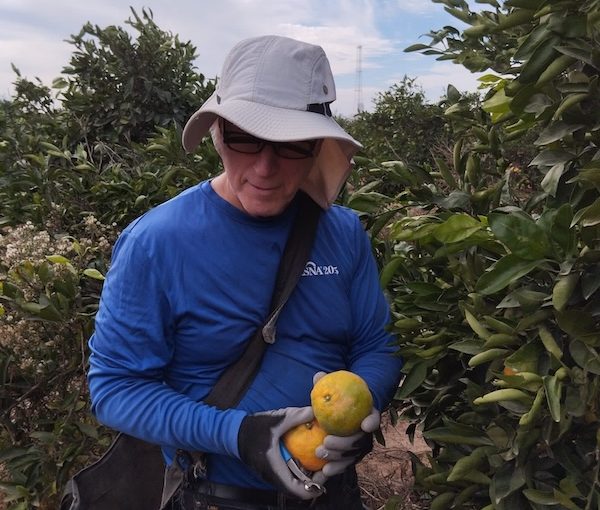
The author’s husband, Dr. Scott Fields, picking tangerines in southern Israel, on Kibbutz Nitzanim. (photo by Deborah Rubin Fields)
I have just returned from laundry brigade duty. Of course, your first question is, what is the laundry brigade? As you may or may not know, in my city of Jerusalem, as well as in other parts of Israel, the hotels are currently filled with people who, for safety’s sake, have left their homes in southern and northern Israel. These moves have created an unprecedented event in Israel’s history. As one friend from Adamit, a far northern kibbutz pointed out, “We are refugees in our own country.”
In my neighbourhood, as well as in other Jerusalem neighbourhoods, residents are volunteering to clean the clothes of those evacuated to hotels. This help is very organized, with a pool of volunteers listed on an Excel file. So, I just returned the laundered clothes of a young family from the northern town of Shlomi.
And, speaking of clothes, there have been clothing drives to help those who left their homes quickly. Books and games have also been donated so that displaced families have some positive way to occupy their time.
But there are so many other noteworthy acts of goodness. One of our sons and other staff from Kfar Saba’s Meir Hospital recently drove south to the Netivot area to help a farmer pick and box watermelon. The farmer’s usual Thai or Palestinian workers are gone. In their place, hundreds, if not thousands of ordinary citizens are in the fields picking – and this is happening all over the country.
One of our daughters spent a week at Jerusalem’s Bezalel Art School sewing uniforms and add-ons for protective ceramic vests, equipment the soldiers currently need. Sewing machines were even delivered to some kibbutzim so kibbutz members could also help with this task.
While there is enough food for soldiers, some people are still providing extra food. One Jerusalem restaurant owner prepared a meal for 70 soldiers (including his son) serving up north. The food was driven to the soldiers by someone else whose partner is serving with this platoon. In my area, one of my older religious neighbours gave his Pesach dishes to observant soldiers who are staying in a university dorm (camping “in” rather than “out” as it were).
There has been a big emphasis on checking people who live alone or who have mobility issues. Volunteers are helping with shopping, picking up medication, or just visiting these solitary individuals.
During this war period, Jerusalem’s branch of Magen David Adom has held more than one blood drive. Each turnout has been unbelievable, as potential donors stood in line for hours waiting their turn. Moreover, in addition to the sandwiches the MDA staff and volunteers regularly eat on their extended 12-hour shifts, volunteers have been cooking and delivering meals (including vegetarian portions) to the staff.
On the kibbutz where one of our sons lives with his family, each family is responsible for the needs of the 100 evacuees who are currently living on the kibbutz. Yad Sarah, the Israeli nonprofit that loans medical equipment, has offered to loan equipment that the evacuees were unable to take with them. In addition, volunteers have given their time to fix up these temporary living spaces while other locals have organized hazit habayit, drop-off sites where furniture and electronics are collected for those who have had to relocate. Another nonprofit, Tenufa Bakehila, is right now fixing up neglected bomb shelters and repairing homes damaged by rockets.
Other nonprofits have opened their doors to evacuees. The Society for the Protection of Nature in Israel has people lodging in its Eilat Field School. For the past month, it has likewise been providing meals.
All over the country, evacuated children have been enrolled in local schools. Even the National Library of Israel has become involved. It just moved into a beautiful new building, but its old building on Hebrew University’s Givat Ram campus has become a temporary school for children from Shlomi.
There is the story of a small family consisting of two sons and the father. When one son, Sgt. Maj. (Res) Gil Phishitz, was killed on Friday, Nov. 3, the word went out on social media. Thousands of people dropped what they were doing to attend the funeral in Hadera. Out of respect and to show support for the tremendous sacrifice of these fallen soldiers, people who don’t personally know the families have also been visiting during the shiva period.
Israeli farmers employ many Thai citizens. On Oct. 7, some of the Thai farm workers witnessed their co-workers being kidnapped. Some even saw their friends brutally murdered by Hamas. Our younger son, along with other volunteers, has been helping Thai workers find necessary food, lodging and medical care. Volunteers organized counselors and translators to help these people deal with what could easily turn into post-traumatic stress disorder, or PTSD. Volunteers advocated for these Thai workers with the Ministry of Agriculture and with local councils. At this point, many (estimates are 8,000 out of 30,000) Thai farm workers have left Israel.
In some places, acupuncturists and massage therapists are offering free sessions to people who have been evacuated. Several social workers and psychologists continue to give voluntary assistance to those put up in Dead Sea hotels.
Volunteerism is not just with people, it is also with animals. Volunteers have gone to the south to rescue pets and farm animals that were left behind. Veterinarians have provided medical care for injured animals. The rescued animals are now in shelters, awaiting foster homes.
Last, but certainly not least. In the big cities such as Tel Aviv and Jerusalem, many have been showing up at memorial services and vigils for the fallen and the kidnapped.
Why are people doing all these things? I think the best answer comes from Hillel in the Ethics of the Fathers (Pirkei Avot), 1:14: “If I am only for myself, who am I? If not now, when?”
Deborah Rubin Fields is an Israel-based features writer. She is also the author of Take a Peek Inside: A Child’s Guide to Radiology Exams, published in English, Hebrew and Arabic.