Skip to content
  • Home
  • Subscribe / donate
  • Events calendar
  • Business Directory
  • FAQ
  • News
    • Local
    • National
    • Israel
    • World
    • עניין בחדשות
      A roundup of news in Canada and further afield, in Hebrew.
  • Opinion
    • From the JI
    • Op-Ed
  • Arts & Culture
    • Performing Arts
    • Music
    • Books
    • Visual Arts
    • TV & Film
  • Life
    • Celebrating the Holidays
    • Travel
    • The Daily Snooze
      Cartoons by Jacob Samuel
    • Mystery Photo
      Help the JI and JMABC fill in the gaps in our archives.
  • Community Links
    • Organizations, Etc.
    • Other News Sources & Blogs
  • JI Chai Celebration
  • JI@88! video

Recent Posts

  • Legal help for students
  • Revisiting myth of Lilith
  • Wrong person rebuked
  • Canada’s mixed messages
  • Questions for museum
  • Symposium on antizionism
  • Making soccer political
  • CJPAC lauds Pulver’s impact
  • City recognizes Vrba’s legacy  
  • Organ donation saves lives
  • Theodore’s March premiere
  • A healing Shabbaton
  • Supplying healthy food
  • A chime of metal tags
  • Yellowknife seder a first
  • Ishai energizes, unifies
  • A Lag b’Omer to remember
  • Expanding the healing
  • Hannah Senesh – a unique hero
  • Community milestones … May 2026
  • Sharing her testimony
  • Fall fight takes leap forward
  • The balancing of rights
  • Multiple Tony n’ Tina roles
  • Stories of trauma, resilience
  • Celebrate our culture
  • A responsibility to help
  • What wellness means at JCC
  • Together in mourning
  • Downhill after Trump?
  • Birth control even easier now
  • Eco-Sisters mentorship
  • Unexpected discoveries
  • Study’s results hopeful
  • Bad behaviour affects us all
  • Thankful for the police

Archives

Follow @JewishIndie
image - The CJN - Visit Us Banner - 300x600 - 101625

Tag: volunteerism

Community planning critical

Community planning critical

Alex Cristall, chair of the board of directors of the Jewish Federation of Greater Vancouver. (photo from JFGV)

Long active in the Jewish community, Alex Cristall started his current volunteer position as chair of the board of directors of the Jewish Federation of Greater Vancouver in June 2019. He spoke to the Jewish Independent about the role, and where he sees the organization as it enters a new decade.

JI: Could you go over your professional background and your work with Jewish organizations?

AC: I grew up in this community and was always surrounded by a culture of volunteerism. My professional background is in real estate investment, and my family’s values always drove our approach to business and to community involvement. From my grandparents to my parents to the way my wife Jodi and I are raising our children, giving back and getting involved with community has always been a priority, both in and out of the office. I started volunteering as a young adult and it’s grown from there.

JI: How did you become chair of Federation?

AC: Before taking on the role of board chair, I held a number of other leadership positions with Jewish Federation and with other organizations. At Federation, I served as chair of the 2016 and 2017 Federation annual campaigns, as chair of major donors, chair of men’s philanthropy and as a member of the board.

Anyone who knows me knows my love of sports, so my previous involvement with the JCC Maccabi Games and with Maccabi Canada came about very naturally. I also chaired the JCC Sports Dinner.

Serving as vice-president and then president of the JCC [Jewish Community Centre of Greater Vancouver] was instrumental in giving me a unique perspective that has been indispensable as chair of Jewish Federation. I got to see firsthand how important the partnerships between the organizations are, and how much partners rely on the community planning and fundraising expertise that Jewish Federation brings. At the time, Jewish Federation organized local missions, where we visited various partners, including the Jewish Food Bank and Tikva Housing Society, and learned about the range of needs in our community – and the range of responses.

It was very eye-opening, and that was when I got involved in men’s philanthropy at Jewish Federation and decided to learn more about the community. That ultimately led to a role on Jewish Federation’s allocations committee, where we were fully immersed in the entire breadth and depth of need – and opportunity for impact – in our community.

In my mid-30s, I was fortunate to travel to Ethiopia with members of Jewish Federation’s National Young Leadership Cabinet to see the work we were doing there with two of our international partners, the Joint Distribution Committee and the Jewish Agency for Israel. That was where I really began to understand the big picture of what we can accomplish for world Jewry in need.

More recently, I was able to visit our partnership region in Israel and learn about the particular challenges of living in the north, and the impact we’ve been able to make there as the result of a long-term strategic focus.

I’ve been in Israel many times, but, in terms of our partnership region and Beit Vancouver, this past spring was my first visit. It’s such a successful country overall, but I really saw the inequity that exists in the periphery. To see the contributions of our community and the future development plans of the region was inspiring, as was seeing what our Israel and overseas affairs committee, through annual campaign funds, and many local families are doing there with their investments…. It was very rewarding.

We need to continue to raise up that entire region…. Every mayor of our region came to greet us and that’s how you know how important our dollars are for youth. So many different things going on. When you see the respect that the different mayors have for the work we do and the people involved, it’s clear that our impact matters.

JI: What are your goals looking ahead?

AC: Our community is growing and changing all the time. As a Federation, we have been changing alongside it, which is positioning us to effect positive change in ways that can make an impact now and into the future.

We have a unique role in the community in terms of our planning function, and it’s a critically important piece that we bring to the table. We are focused on planning strategically to identify and prioritize needs locally, as well as in our partnership region in Israel. Our donors and fund-holders at the Jewish Community Foundation help us meet these needs. The partnerships we have developed over the decades are key to being able to get the work done in ways that are going to create lasting change.

We have made progress on every one of the areas of opportunity we identified in the strategic priorities, from affordability and accessibility, to seniors, engagement and, of course, community security. With big picture issues like these, the outlook is for the long term and so the work is ongoing.

At the end of the day, I would like people in our community to say that we made it easier for them to live Jewishly – whether that’s because we helped make a Jewish program more affordable, because we reached out to them where they live, because their aging parents were able to access a seniors’ program, or what have you.

JI: What challenges do you see before you?

AC: Our community is growing and its needs are constantly evolving, so there is always a lot of work to do, and that makes it exciting. I love a good challenge, and there are challenges everywhere we turn.

This community looks so different from when I was a child here. Even in the last decade it’s changed considerably. We’re more spread out and we’re more diverse.

More than half of our community is comprised of children, youth and young families, many of whom are really crunched by the high cost of living, and many of whom see their Jewish community engagement in ways that are very different from previous generations. At the same time, we have a growing population of Jewish seniors who need to stay connected and supported as they age. These are two of the big challenges facing our community right now. We also need to continue to meet our community’s needs through diverse revenue sources.

And last, of course, is the upcoming redevelopment of the JCC site into a true community hub. It’s still in the early stages, but Jewish Federation is poised to play an important role in this when the time comes. We’re proud to have entered into a memorandum of agreement with the JCC. [See jewishindependent.ca/historic-jcc-fed-agreement.]

JI: What excites you about the role?

AC: I feel very fortunate to work with an incredible group of volunteer leaders and professional staff, all of whom genuinely care about this community and about Israel.

From a personal perspective, some of the best lessons I’ve learned have come from volunteering with different community members and working with the Federation staff…. It’s very rewarding to meet with people in the community and see the reach and the impact of the good work we’re doing.

JI: What accomplishments are you most proud of thus far?

AC: One thing I am very proud of is how our donors have come to rely on Jewish Federation for our breadth of knowledge of community needs, our strategic approach and the strong relationships we’ve developed. Many of them trust us with all of their Jewish community philanthropy, and they come to us first when they have questions about where and how they want to make an impact.

I think we can be very proud of how we have taken a very strategic approach to growing the financial resources we generate, whether that’s through the annual campaign, through special project funding, or through legacy giving at the Jewish Community Foundation. As a result, our partners have more ways to access funding for the vital programs and services that align with high-priority community needs.

Community security is an area where we wish we didn’t have to focus our attention, but the reality is that we do. It was the first thing I really championed as chair of the annual campaign in 2016, and it was one of the first areas of strategic investment that we addressed from our 2020 Strategic Priorities [ourcommunity2020.jewishvancouver.com]. Since then, our community security advisory committee has taken an active role in addressing needs in this area and, on their advice, we hired a director of community security. Together, they are creating a culture of security consciousness.

Sam Margolis has written for the Globe and Mail, the National Post, UPI and MSNBC.

Format ImagePosted on February 14, 2020February 12, 2020Author Sam MargolisCategories LocalTags Alex Cristall, Jewish Federation, philanthropy, tikkun olam, volunteerism

JFS integral to our “village”

In mid-April, I attended the Jewish Family Services (JFS) donor appreciation event. My husband and I have always supported JFS and I have always thought very highly of the organization. But, recently, I became more involved and, this year, I joined the board.

At my first board meeting, I was blown away by the information I received about what just one facet of the organization does for its clients – the family and adult resources program, which includes helping with food vouchers, medical support, housing, etc.

At the next meeting, another group of employees came to discuss their services to seniors, which range from individual home support and care to outreach programs reaching hundreds of vulnerable seniors.

Then followed the employees who took care of assisting clients with employment, and settling new immigrants. The list went on … clinical counseling, the Jewish Food Bank, mental health outreach, emergency and transitional housing support, to name a few. About six months in, I am truly amazed by the breadth of services JFS offers and the number of clients they reach, but that’s not even the story.

I went to the volunteer appreciation evening event with my husband, as a board member and supporter, the first one we have attended. Some of our friends were there, many of my parents’ friends, some employees and some volunteers of the organization, as well as my dad. A JFS recipient spoke about his experiences with the agency and how much they helped him. He spoke about receiving counseling for depression after the failure of a business, support he was given to find work and on how to prepare his resumé after not having done so for decades. He then described the help he was given to prepare for job interviews and on how to present himself. He also praised other JFS services, such as the food bank, help with finding new housing and counseling after his divorce, and said he felt supported through these difficult years. All of a sudden, it hit me!

I looked at my dad, who was standing behind me, hand on my shoulder, and I said to him, “Oh, my G-d! You are my JFS!”

It was true. My mom and dad, throughout my entire life, have been my Jewish Family Services. From putting a roof over my head, feeding me, helping me through school, assisting me in all my university applications, editing my resumés, introducing me to potential employers and coaching me for interviews, to counseling me through difficult times, and the list goes on and on. Not to mention the help they provided other family members. All the services required to care for my four grandparents at various times in their lives closely resemble the ones offered through JFS. My parents drove them to appointments, helped get groceries, provided in-house care when necessary, brought them meals, managed their medications and advocated for them. They drove them to and from our Shabbat dinners and all the events in the community, ensuring they could attend shul, family celebrations, holidays and fundraisers.

We are always reminded that it takes a village to raise a child. When I reflect on my childhood or on my children’s lives thus far, it couldn’t be truer. The people in our lives that we rely on – friends, family members, professionals – all have played such an important role in getting us to where we are today. If we take a minute to reflect on how dramatically different our lives would be without this support system, I think we would be amazed.

So many of us are so blessed to have this network, this “village.” However, many people in our community are not so lucky. Thankfully and fortunately, they can access the village that is Jewish Family Services. If your story resembles mine in any way, I believe it is our good fortune that finds us in a life of comfort and security. I feel privileged to be part of this amazing organization and to be able to donate time and money to help those who aren’t as fortunate, so they can have affordable access to JFS and all the wonderful services they provide.

Posted on May 25, 2018May 24, 2018Author Simone KallnerCategories Op-EdTags Jewish Family Services, JFS, philanthropy, volunteerism
CHILD Foundation honours Marie Doduck

CHILD Foundation honours Marie Doduck

Marie Doduck, left, receives the CHILD Foundation Inspiration Award from the foundation’s Mary McCarthy Parsons. (photo from CHILD Foundation)

On May 2, the Foundation for Children with Intestinal and Liver Disorders hosted their annual fundraising fashion show and luncheon for 250 guests at the Fairmont Hotel Vancouver. The CHILD Foundation (child.ca) raises much-needed research funds for pediatric Crohn’s disease, ulcerative colitis and liver disorders such as biliary atresia.

On presenting Marie Doduck with the CHILD Foundation Inspiration Award, Mary McCarthy Parsons, president and chief executive officer, recounted that Doduck is an active volunteer in many organizations, who has given so much back to her community. As a founding member of the Vancouver Holocaust Education Centre and, being a Holocaust survivor, the CHILD Foundation was very pleased to honour Doduck, an extraordinary ambassador of hope and courage in our world – a true inspiration.

McCarthy Parsons remarked, “You cannot underestimate Marie’s message to young people. When my children were in school, I had to take them out of school to experience hearing about significant world history. Now, because of Marie and the Holocaust Education Centre, speakers travel to schools every day. In this day and age – yes, in 2018, when some governments seem to want to rewrite history, it is important and incumbent upon us to take in and to recommit to Marie’s message of community inclusion, of education and of volunteerism.”

The CHILD Foundation Inspiration Award was presented to Doduck, “who inspires us all to become better, more involved citizens through her dedicated efforts on behalf of children and the warm, uplifting consideration she extends to everyone she meets.” Congratulations!

Format ImagePosted on May 25, 2018May 24, 2018Author CHILD FoundationCategories LocalTags colitis, Marie Doduck, philanthropy, volunteerism
JSA AGM honours volunteers

JSA AGM honours volunteers

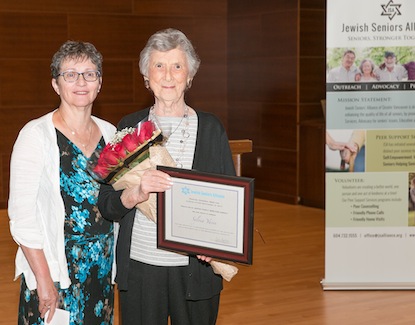
Karon Shear was one of the volunteers honoured at the Jewish Seniors Alliance AGM on Sept. 14. (photo by Alan Katowitz courtesy of Jewish Seniors Alliance)

The annual meeting of the Jewish Seniors Alliance was held on Sept. 14 at Congregation Beth Israel. The business meeting was followed by a dinner and awards ceremony.

The business portion of the evening was called to order by JSA president Ken Levitt. Prior to the presentation of committee reports, a number of organizations offered greetings. A d’var Torah was delivered by Beth Israel’s Rabbi Jonathan Infeld, who emphasized that, according to Jewish law, we are not to cast aside seniors as they are at the heart of the community. And both Ezra Shanken, chief executive officer of the Jewish Federation of Greater Vancouver, and Gudrun Langolf, acting president of the B.C. Council of Senior Citizen Organizations (COSCO), also said a few words.

Following the approval of the agenda and the minutes of last year’s AGM, Larry Meyer delivered the treasurer’s report. He outlined the various funding sources of JSA – government, corporate and private grants, as well as the $18 annual fee from members/supporters. He also listed the programs this money supports, such as peer counseling, Senior Line magazine, the fall symposium, the spring forum and the Empowerment Series, as well as the website, jsalliance.org.

Pamela Ottem, chair of the Peer Support Program, outlined the various aspects of the service. Peer counselors are required to take 55 hours of training prior to being assigned a client. They are given ongoing support in their work by Grace Hann, who is also the trainer, and Charles Leibovitch, who is a social worker. It takes 15 hours of training to become a Friendly Visitor. These volunteers visit shut-ins and lonely seniors; another part of the program is friendly phone calls and service information and referral. The peer support program has 56 trained volunteers serving 70 seniors.

The JSA’s Ambassador Program, whose goal is to raise awareness of elder abuse, started with a one-year grant and has been incorporated into the other offerings. Hann, Leibovitch and some of the volunteers make presentations to other seniors groups about their activities.

Binny Goldman reported that JSA has 596 members/supporters, of whom 320 are individual members, 150 are members of the Most Russian Bridge group and 21 are from affiliate organizations.

photo - Debbie Rozenberg, left, and Sylvia Yasin
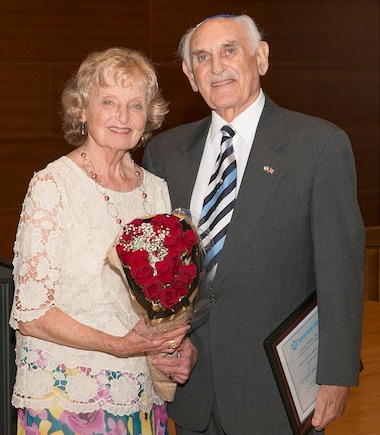
Debbie Rozenberg, left, and Sylvia Yasin. (photo by Alan Katowitz courtesy of JSA)

In Levitt’s president’s report, he briefly reviewed the activities of the JSA, emphasizing that the organization would not exist if it were not for the active involvement of its volunteers. He pointed out that the peer support program alone, if it were carried out by paid staff, would cost much more than JSA’s total budget. He thanked everyone, both staff and volunteers, who have worked so hard and contributed so much over the past year.

Marilyn Berger presented the report of the nominations committee. She read out the slate for the coming year and moved for acceptance. Two former board members were mentioned, Edith Shier, who has passed away and was the previous editor of Senior Line, and Milton Adelman, who has retired from the board but was for many years the treasurer of JSA. Levitt then called for the adjournment of the business part of the evening and everyone was invited to move to the tables for dinner, volunteer recognition and musical entertainment.

Jazz singer Jill Samycia entertained the approximately 150 dinner guests, after which came the awards presentations to volunteers. As has become JSA’s custom, several organizations were asked to nominate senior volunteers who have spent time and energy enhancing the goals of their organizations.

Karon Shear, who was coordinator and administrator of JSA from 2005-16, was nominated by JSA. Her service to seniors, and enthusiastic marketing, played a vital role in the development and growth of the organization. In presenting her with the award, Serge Haber described her as the heart and soul of JSA. He spoke of the countless hours she spent, off the clock, on weekends, working at home; how she produced the Senior Line magazine basically on her own for a time.

photo - Nassa and Arnold Selwyn
Nassa and Arnold Selwyn. (photo by Alan Katowitz courtesy of JSA)

Sylvia Yasin was nominated by the Jewish Family Service Agency. Yasin has volunteered for many years with the Jewish Food Bank and was instrumental in creating relationships with various groups and individuals and obtaining ongoing donations of supplies for school-aged children. She was presented with her award by Debbie Rozenberg, who noted that Yasin began volunteering while still working full time. Yasin has been involved with the Terry Fox Run and with ORT. Among other things, she organized the gift wrapping in shopping malls that raised funds for ORT. She also helps set up and clear for the seniors lunches at the Kehila Society and is still involved with the Jewish Food Bank.

Nassa and Arnold Selwyn were nominated as a couple for their longtime volunteerism at Congregation Beth Israel. Infeld talked about Arnold’s singing for the congregation and Nassa’s beautiful sewing of the parochet (ark curtain) and the siddur covers. Together they bring holiness into the world, said the rabbi. Both of them act as greeters and have been part of many other committees. They are also active in the general community and are part of Showtime, an entertainment group of seniors.

All of the honourees expressed their thanks and appreciation to JSA and the nominating organizations. The message to all was, volunteer whenever you can and wherever you can – it will bring you feelings of fulfilment and joy.

Samycia performed again, during dessert, and a number of the guests got up and danced to the music. The evening ended with a draw for door prizes.

Barbara Bronstein and Larry Shapiro were co-chairs of the event.

Tamara Frankel is a member of the board of Jewish Seniors Alliance. Shanie Levin, MSW, worked for many years in the field of child welfare. During that time, she was active in the union. As well, she participated in amateur dramatics. She has served on the board of the Jewish Federation of Greater Vancouver and is presently on the executive of JSA and a member of the editorial committee.

Format ImagePosted on September 29, 2017September 28, 2017Author Tamara Frankel and Shanie LevinCategories LocalTags Beth Israel, Jewish Family Service Agency, Jewish Seniors Alliance, JFSA, JSA, seniors, volunteerism
Queen Esther in Vancouver

Queen Esther in Vancouver

Goldie Kassen at Louis Brier Home and Hospital’s Purim party last year. (photo from Barbara Taranto)

There are not many news stories in print or online that laud the everyday work of women. Occasionally, studies are published regarding the status of women’s salaries relative to men’s, the position of women’s roles relative to men’s, the division of labour in the household, etc., but very little is published about the everyday life and sacrifices of women. When stories are published, they are most often about how women have contributed, as a female actor in a traditional male role, to the social and economic welfare of the greater community.

I do not have many “heroes.” I never quite got the appeal of adoring a public figure or wanting to model myself after a stranger regardless of his or her qualities. One person I do admire, however, is Justice Ruth Bader Ginsberg – obviously for her remarkable contribution to the U.S. Supreme Court, her leadership and her example to American women – but more for the non-public and under-appreciated value she has added as a mother and a grandmother.

Bader Ginsberg is very much like Queen Esther of Purim – a woman with a private life who serves the greater good in the public sphere. There were not, and are not, many opportunities to have a life like hers. But, ordinary women, women not in the spotlight, have been serving the greater good throughout human history – volunteering in the community, giving time, food, sustenance and support to help their communities not only survive, but thrive.

When I grew up, I often came home from school and stopped at the Jewish community centre to see my mother – Goldie Kassen – who was working in the kitchen with the other women of Hadassah, an organization’s whose name is Queen Esther’s Hebrew name. The women of Hadassah were very active in Saskatoon. There wasn’t a week that went by that they weren’t involved in some sort of social action or charity event. And, on the days they were not busy with Hadassah, they were involved in the sisterhood at Congregation Agudas Israel, performing vital ritual tasks for the mikvah, the chevra kadisha or distributing mishloach manot (loosely translated as gift baskets) on Purim.

This culture of volunteerism that was widespread and common in my youth seems to have disappeared. Many smaller Jewish communities do not have the congregation or the means to support these activities and many services have been taken over by professionals. Frankly, many women understandably do not want to volunteer for no pay.

When my father, z”l, died, my mother left Saskatoon and moved to Vancouver. She immediately volunteered for a seniors group, Hadassah and the sisterhood at Temple Sholom. She became an active member of her new community by giving first and receiving warmth and welcome in return.

For the past 28 years, my mother has volunteered at the Louis Brier Home and Hospital. She started out as a salesperson, one day a week, in the gift shop. Over the years, she took on more and more responsibility. Today, she manages the staff and the staff schedule. She does the buying for the shop, she does the books for the shop and she does special requests for those who have no family or aid. She works four days a week, every week.

The proceeds from the shop have been used to purchase diagnostic medical equipment, hospital beds, a barbeque for the residents and much, much more. She greets all the customers in a quiet and gentle way, and I know she is loved for her patience and her concern.

On the Louis Brier’s website, there is a very brief paragraph about the shop. No mention is made of the women who work there, not that they expect it, but it would be nice. I know that the shop is an integral part of the life of the residents and the staff at the home. I know that there are not many women left like my mother.

So, when my mom called and told me she was going to the Purim party last year as Queen Esther, I was especially proud. She was worrying over what dress to wear. In the end, she chose the evening gown my father bought her in Jerusalem in 1962. It was a beautiful dress then and it is a beautiful dress now. More importantly, the woman wearing the dress is beautiful – as beautiful as Queen Esther and as important as all those women who have kept the traditions alive and without whom we would be impoverished.

Barbara Taranto lives in Tel Aviv. A version of this article was published last year on her blog, btarantoaretz.com.

Format ImagePosted on March 10, 2017March 8, 2017Author Barbara TarantoCategories LocalTags Goldie Kassen, Louis Brier, Purim, Queen Esther, volunteerism, women
Interfaith volunteering

Interfaith volunteering

Among her volunteer work, Heather Fenyes started Think Good, Do Good with her cousin. (photo from Heather Fenyes)

Heather Fenyes is a full-time volunteer. She is actively involved in Saskatoon’s Jewish community, as well as with a number of organizations on the national Jewish scene. In 2011, she and her then nearly retired cousin, Jan Gitlin, started the organization Think Good, Do Good to create opportunities for people to engage in acts to improve their community.

A teacher by education, Fenyes has spent many years volunteering at the local Hebrew school, at Agudas Israel Synagogue. “We’re a pretty small community and we punch way above our weight class,” she told the Independent.

“Even when I do things with respect to the Jewish community, while Think Good, Do Good is absolutely non-political, there is spill-over in both directions,” she continued. “Because things I care about aren’t compartmentalized, so the kinds of philosophies we work with, with respect to coexistence, apply to what I want for Israel and what I want in Think Good, Do Good, and in my own community.”

As Fenyes’ kids were growing older, she recognized they were probably going to leave Saskatoon once they finished high school. Unless she created something more tangible to keep herself busy, it would be a difficult time.

“My Judaism tells me that we’re not bound by thoughts, but compelled toward to action,” she said. “We have to do good things. I’ve always wanted to work with that philosophy. I’ve always been a passionate believer in social justice and collective responsibility and, frankly, good deeds.”

Fenyes decided a good place to begin was to pay a visit to Judge David Arnot, head of the Saskatchewan Human Rights Commission, explaining to him that she wanted to find a way to work with him as a volunteer.

That initial meeting has resulted in some annual activities that incorporate Muslim-Jewish outreach, Holocaust education and school events that often revolve around Raoul Wallenberg and the concept of “the power of one.”

“We have an annual Holocaust memorial event in which we reach out to 2,000 students over a period of time,” said Fenyes. “I’m married to a refugee whose family escaped Budapest in 1956 during the revolution, after having survived the Holocaust.”

Fenyes has been spending a lot of time in classrooms, leading various lessons on citizenship, reminding students that, with all of our rights come just as many, if not more, responsibilities.

“I do a lot of conversations in classrooms about the things we take for granted and the things we are responsible for,” she said. “Part of this is just for the lesson itself, and a part of it is with the hope that teachers get this new curriculum, for K to 12 classes, in the very near future.”

For the past three years, on March 21, which is International Day for the Elimination of Racial Discrimination, Gitlin and Fenyes have chosen 250 elementary students who they work with on citizenship and take them to the university campus – with their Think Good, Do Good buttons on – to speak with students in the halls. “They approach university students and ask if they have done something good today,” said Fenyes. “I learn infinitely more from these K to 12 students than I teach them.”

While teaching one of the classes, Fenyes met a young student who said he was from Gaza. Fenyes suggested they talk about hummus. “I have a lot of friends from the Middle East and we have an ongoing discussion about who makes the best hummus,” she said.

“This young man was enthralled and we had this adorable, non-substantial discussion about hummus … and the teacher was standing looking anxious in the corner…. She said to me about a week later, ‘You cannot believe what happened Heather. Not long before you’d been in the classroom, this young man had been telling me about his family’s discomfort with Jewish people and his strong negative feelings towards Israel. When you left the classroom, he had a change.’ She said if she hadn’t seen it herself, she wouldn’t have believed it.

“He approached the teacher and shared how moved he was by having met me and asked to write a paper … and, it was on coexistence or getting to know our neighbors … something completely opposite to the things he’d been saying before.

“You know how we say, ‘To save one life’? I’m not saying that at all, but, if I changed one young man’s way of thinking, that’s a world.”

Fenyes is very aware of the immigration statistics in Saskatchewan and the challenges they pose. “If we don’t create some infrastructure and have conversations like you and I are having right now, and set up educational opportunities, we are going to be another failed example,” she said. “It’s not just that we need to do it because it’s the right thing to do. We need to do it because, otherwise, we’re going to live in a different kind of community.”

This understanding really hit home when Fenyes’ son received a death threat while studying at Western University. Fenyes did not need that wake up call, but it did remind her of why she was in classrooms and making connections with people of all faiths.

Fenyes said they have learned from experience that, if the Jewish community alone puts on events such as the annual Raoul Wallenberg program – which this year took place on Feb. 5 – they do not have the same impact. Therefore, they have given the Catholic and public schools the mandate to organize the event. This year’s program featured a young man who was born in Congo and lived in Kenya before immigrating to Saskatoon as a refugee; he just graduated from high school last year.

“In a city where we have two separate systems, the Catholic and the public school systems work together,” said Fenyes. “The superintendents from each have been meeting, which is a great image and reality, to plan this event. One year, it’s in a Catholic high school. The next year, it’s in a public one.”

On another front, Fenyes is looking forward to finding ways to work with the Centre for Israel and Jewish Affairs.

“I think that what we are doing in Saskatoon as a city and community is really impressive,” she said. “I hope we can infect others with some great kind of ailment – Think Good, Do Good. My kids tease me that I live my life with rose-colored glasses. They might mean it as an insult, but I take it as a compliment.”

Rebeca Kuropatwa is a Winnipeg freelance writer.

Format ImagePosted on June 10, 2016June 8, 2016Author Rebeca KuropatwaCategories NationalTags Fenyes, interfaith, Saskatoon, tikkun olam, volunteerism
Community’s foundations

Community’s foundations

(photo by Cynthia Ramsay)

With the skyrocketing Vancouver real estate prices the talk of Canadian news media almost daily, less attention has been given to the fate of the many homes whose high property price-tags all but encourage demolition and rebuilds.

One Facebook group has been seeking to draw attention to the disappearing streetscape of Vancouver. With 10,000 followers, Vancouver Vanishes bills itself as “a lament for, and celebration of, the vanishing character homes in Vancouver.” Some houses – like one on West 15th, originally owned by an assistant salesman for the Canadian Pacific Railway – have already met their fate. Others are slated for demolition, with photos posted in the hopes that followers will register their protest with Vancouver City Council.

My late grandfather’s home – on Fremlin Street near West 54th Avenue – was recently torn down to make way for a generous new build. Purchased with my grandmother and their three daughters in the late 1950s, my grandfather lived in his mid-century vernacular bungalow for nearly six decades, until he died three years ago at age 97.

While it was spacious and modern by 1950s standards, my grandfather’s house probably wouldn’t have made it to the pages of Vancouver Vanishes. It was a standard bungalow with four modest bedrooms, generous entertaining spaces, a kitchen large enough to accommodate Passover and everyday dishes, and a spacious rec room with a wet bar for teenage dance parties hosted by my mom and aunts. With more room to spread out, it would have felt excitingly large to the three daughters and, soon, another girl they fostered, compared to the small character home on Quesnel Drive from which they had moved. But theirs wasn’t among the most celebrated Vancouver “heritage home” variety – the Storybook homes, or the Tudor, Georgian or Mission Revival structures.

Still, the Jewish community may want to pause to consider a special type of vanishing as more and more of these homes disappear. That is, the kind of community-building that took place within the four walls of my grandparents’ home, and in the homes of many other community leaders and activists of their generation.

In my grandparents’ home on Fremlin, there was organizing and affiliation with Schara Tzedeck Synagogue, then under the leadership of Rabbi Bernard Goldenberg and Rabbi Marvin Hier. As well, with three growing daughters, there were the activities of many youth groups: NCSY, Young Judea and Habonim. There was the founding and nurturing of Camp Miriam, where my grandmother was the first “camp mother.” There was much work to be done for Pioneer Women, for the Histadrut (Israel’s trade union association) and in the preparation of a weekly radio show my grandparents hosted on Jewish and Israeli themes. In between the many hours devoted to volunteer work, there were their small businesses to run – Clifford’s Jewellers in Kitsilano, and their real estate ventures.

Plus, there were Sunday waffle brunches for the large extended Margolis family – whose members had found their way to Vancouver starting in the 1940s after arriving in Winnipeg from Kiev two decades earlier – and visitors from Russia and Israel.

With their three daughters spread across Vancouver Talmud Torah, Kitsilano, Churchill and Eric Hamber secondary schools, there was a home library to nurture, classical music records to collect, family photos to display and a garden to tend: irises, tiger lilies, azaleas, rhododendrons, peonies and hydrangeas, and fruit trees – apple, pear and cherry.

By the time I was around, spending one memorable summer in the orange bedroom in the late 1970s, there were memories for me to make – like suffering my first wasp sting on the back patio – and hobbies for me to discover: there was a teach-yourself-to-type book and a learn-to-speak Spanish book to read, all while I took up tennis in the shadow of my grandmother’s formidable court skills. By Grade 8, having moved to Vancouver with my parents from Winnipeg, there were weekly dinners prepared for me by my grandfather between my school day at Eric Hamber and my Judaic studies classes at Congregation Beth Israel and at the home of Rabbi Daniel Siegel.

What is lost when a mid-century Vancouver bungalow is demolished? Wood siding, stucco, a large picture window, a tiled porch and a garden lovingly tended. But for communities, there is so much more: memories forged of childrearing, philanthropy and leadership. Luckily for Vancouver’s Jewish community, while the building materials of these homes may be gone, the scaffolding of a vibrant community – generations later – remains.

Mira Sucharov is an associate professor of political science at Carleton University. She is a columnist for Canadian Jewish News and contributes to Haaretz and the Jewish Daily Forward, among other publications.

Format ImagePosted on May 27, 2016May 25, 2016Author Mira SucharovCategories Op-EdTags community, housing, Vancouver, volunteerism

Posts pagination

Previous page Page 1 Page 2 Page 3
Proudly powered by WordPress