In Newfoundland, if you’re not from the island, you’ve “come from away.” On Sept. 11, 2001, after the terrorist attacks in New York, the United States shut down its airspace. As a result, 38 planes – carrying 7,000 passengers – were diverted to Gander, Nfld., population 9,000 or so. The local community quickly mobilized to provide their unique maritime hospitality to the unexpected guests from around the globe, welcoming them to their home, “the Rock,” for five days.
This is the premise for the aptly named musical written by Jewish-Canadian husband-and-wife songwriting team David Hein and Irene Sankoff, that took Broadway by storm in 2017. Now, this made-in-Canada opus comes to the Arts Club’s Stanley Stage, in partnership with Edmonton’s Citadel Theatre.
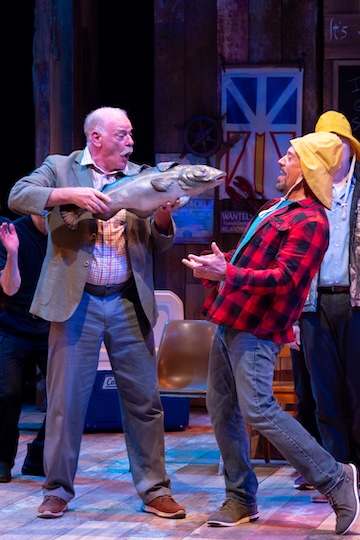
Andrew Wheeler, left, and Vance Avery in Come From Away, which is at the Stanley until Aug. 16. (photo from Moonrider Productions)
The essence of the show is quite simple, with 12actors playing 20 characters on a minimalist set, courtesy of designer Lorenzo Savioni. It consists of 12 mismatched chairs – a metaphor for the eclectic mix of strangers that descended upon the island. The chairs are constantly being reconfigured, morphing from an airplane interior to a bus to a Tim Hortons to a school gymnasium to a pub. These transitions provide the background for the dozens of vignettes that make up the heartwarming story.
The actors move smoothly between their various roles with most costume changes done right on stage. While this is truly an ensemble production, every one of these performers has stand-out moments.
It all starts with veteran actor Andrew Wheeler as avuncular Mayor Claude, who introduces the audience to Gander, its inhabitants and their idiosyncrasies. Jacelyn Gauthier is outstanding as American Airlines pilot Beverley (America’s first civilian female captain) – and, boy, can she sing. Vance Avery and Kamyar Pazandeh play the two Kevins, a gay couple navigating their rocky relationship. Pazandeh also plays Ali, a Paris-trained Muslim chef, who endures the suspicions of his fellow passengers.
Then there is Englishman Nick (Garett Ross) and Texan divorcee Diane (Janet Gigliotti), who find love amid the chaos; take-charge Beulah (Stephanie Wolfe), the quintessential organizer, who bonds with Hannah (Lisa Michelle), a worried mother awaiting the news of her New York City firefighting son; SPCA worker Bonnie (Catriona Murphy), who goes out of her way to care for all the stranded pets; local cub reporter Janice (Daphne Charrois), who gets to break the news to the world; and Bob (Tenaj Williams), who worries about the cost of it all.
Finally, Charlie Gallant plays Oz, the quirky constable, but his real strength comes in his portrayal of the Orthodox rabbi who must cope with both the challenge of keeping kashrut in Gander and taking care of the spiritual needs of a Holocaust survivor’s relative, who is looking to make meaning out of the events of the day. Gallant does an admirable job as the rabbi and delivers a poignant rendition of Oseh Shalom during the multi-faith prayer scene. Community member Josh Epstein is the Hebrew/Jewish consultant for the production.
As their island sojourn comes to a close, the passengers are treated to an East Coast kitchen party replete with Celtic-infused, foot-stomping songs and the chance to become an honorary islander, which is a three-step process that culminates in the kissing of a cod fish (you will have to see the show to find out about the first two steps).
Savioni’s back wall of seven rotating panels/doors frames the actors’ entrances and exits and featuresSophie Tang’s impressive lighting design, which often resembles airport runway lights. Ken Cormier’s seven-piece band and Gianna Vacirca’s energetic choreography complete the effect. Kudos to director Ashlie Corcoran for bringing this production to Vancouver.
These salt-of-the-earth islanders give a master class in what it means to be Canadian. It makes you feel proud to be one.
For tickets to the show, which runs to Aug. 16, go to artsclub.com or call 604-687-1644.
Tova Kornfeld is a Vancouver freelance writer and lawyer.
***
Come From Away’s rabbi
As are many of the vignettes in the musical Come From Away, the rabbi’s story is based on that of British Rabbi Leivi Sudak. Prior to the High Holidays, he was on his way to New York to pray at the Lubavitcher Rebbe’s grave, when his plane was part of the redirected fleet. Under his direction, the islanders scavenged the grounded planes to find kosher meals to feed the 30 or so Jewish passengers among the stranded. A kosher kitchen was set up in one of the schools housing the group and efforts were made for Shabbat to be observed and for the passengers to reach their destinations before Rosh Hashanah.
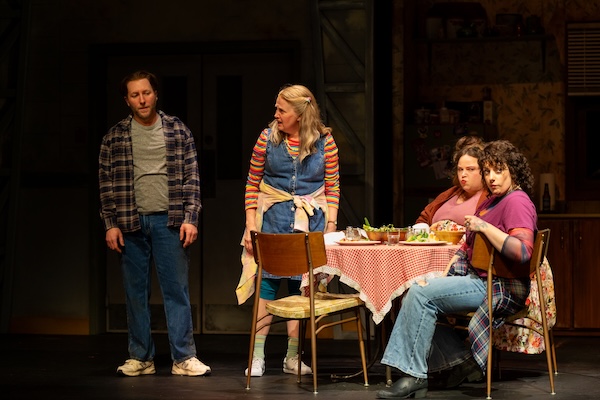
Left to right: Josh Epstein, Lisa Horner, Steffanie Davis and Madeleine Suddaby in the Arts Club Theatre Company’s production of Kimberly Akimbo, now at the Stanley until May 3. (photo by Moonrider Productions for Arts Club)
High school is a time of often-volatile highs and lows, joys and sorrows. Now, imagine you are 16 years old but look 72 because you have a disease that ages you faster than normal – a disease that limits your life expectancy to your teens. How do you cope with the stresses of having to pack a lifetime into a few short years while dealing with an über-dysfunctional family?
This is the premise of the quirky Tony Award-winning musical Kimberly Akimbo (best musical, 2023) now at the Stanley Theatre to May 3, presented by the Arts Club. This is not your traditional big-cast musical with toe-tapping songs you sing on the way out of the theatre. With a cast of only nine, Kimberly Akimbo is a layered and nuanced look at who and what we are as humans. Although it takes time to get into the story, the reward comes at the end.
Kimberly Levaco’s family has just moved to small-town New Jersey and she is starting in a new school. The curtain rises on Skater’s Planet, where four Breakfast Club-type misfits (with assorted gender identification and unrequited love issues) are planning ways to raise money to buy school choir costumes. Tuba-playing, nerdy Seth (Jason Sakaki) works behind the counter and is obsessed with anagrams. Enter new-kid-on-the-block Kimberly (Lisa Horner) and cue the teenage politics and romantic possibilities.
Kimberly’s blue-collar family is made up of alcoholic father Buddy (Jewish community member Josh Epstein); narcissist, hypochondriac mother Pattie (Steffanie Davis); and bombastic in-your-face Aunt Debra (Madeleine Suddaby), an ex-con on parole who devises a mail fraud scheme into which she ropes her niece and her niece’s chums.
Horner, who’s in her 50s, has the daunting task of playing Kimberly, an angst-ridden teen in an adult in body – though, when with her family, Kimberly is the only adult in the room. Horner does a terrific job in this role reversal, and she can sing too! At the end of the day, the characters, as flawed as they are – and they are flawed – are likeable, as they grapple with their trials and tribulations. The message: life is finite, so seize the day.
While the songs are not that memorable, Suddaby and Davis can really belt them out. Epstein pleases with two solos and demonstrates some nifty moves in the skating scenes, as do the rest of the cast – kudos to choreographer Shelley Stewart Hunt.
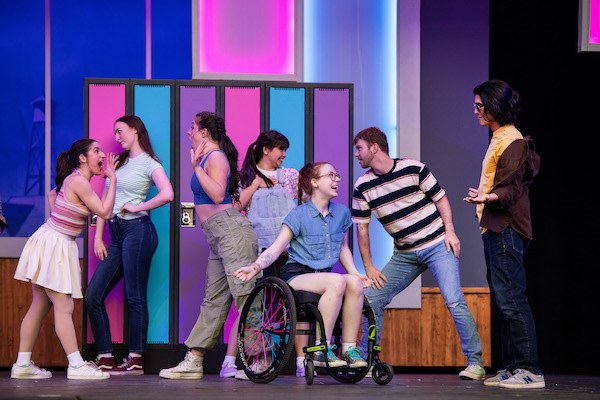
On the design end, the curtain opens on a stark set featuring steel girders and battered school lockers, yet transitions easily from the skating rink to the Levaco home to the school library to the colourful Sweet 16 party and ultimate road trip, the latter backed by large-scale projections. Jewish community member Itai Erdal’s lighting design runs the spectrum to complement each of the changes. To complete the 1990s atmosphere, costumer Stephanie Kong has the teens decked out in grunge and the adults in Value Village-type garb.
Epstein shared his feelings on the show in an email interview.
JI: What drew you to audition?
JE: It’s really an acting role that just happens to live inside a musical, which is my sweet spot. I’ve also loved David Lindsay-Abaire’s writing forever. He has this stream-of-consciousness, offbeat style that I’m really drawn to.
JI: How would you describe your role?
JE: I see him as a deeply loving dad who just doesn’t have the tools or capacity to show up the way he should. He’s overwhelmed, a bit lost in his own fear and vices, and trying to hold onto joy while knowing time isn’t on his side.
JI: What is the message for audiences?
JE: We’re all on a clock, whether we think about it or not, and this show gently forces you to face that. It’s about how beautiful life becomes when you really understand how limited and rare it is.
JI: As far as musicals go, and you have been in many, how would you rank this one in terms of the music, lyrics and choreography?
JE: It’s incredibly smart. Everything has to be precise for it to land and, when it does, it’s kind of genius. The writing, music and movement all support these beautifully strange, nuanced characters in a way you don’t see very often.
JI: What is the energy like with your fellow cast members?
JE: We genuinely love each other and it shows. We’re having a blast even when the material gets dark. There’s a real sense of trust and play, which you need for a show this zany and heartfelt.
JI: Why should people come and see the production?
JE: It’s one of those weird, wonderful shows that only works because it’s so specific and honest, it’ll surprise you, make you laugh, and hit you harder than you expect. Plus, it’s a Tony-winning piece that doesn’t feel like anything else out there, brought to life by an incredible local cast.
For tickets, go to artsclub.com or call 604-687-1644.
Tova Kornfeldis a Vancouver freelance writer and lawyer.
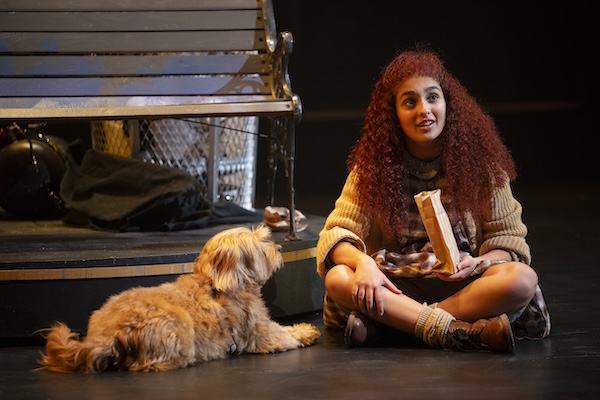
Azaleah Korn plays the title role in Gateway Theatre’s production of Annie, which runs to Jan. 3. Neko is one of three dogs that plays Sandy. (photo by David Cooper)
If you want a warm and fuzzy holiday treat, see Gateway Theatre’s production of Annie. Set in Depression-era New York City, Orphan Annie and Sandy, a rescued dog, embark on a search for Annie’s real parents only to be caught up in a world full of mystery, lovable waifs, a kind-hearted billionaire bachelor, dastardly villains and a nasty headmistress who hates children. Even President Franklin Roosevelt makes an appearance, getting the FBI and Elliot Ness involved in Annie’s quest. All of this plays out against a backdrop of great songs and fancy footwork.
You could not pick a better actor than dashing Charlie Gallant to play billionaire Daddy Warbucks. He exudes charm and sophistication but with a sense of vulnerability. Sarah Cantuba, as Warbucks’ personal secretary, Grace, and ultimate love interest (surprise, surprise), plays the role with calm confidence.
Jennifer Copping as Miss Hannigan, the orphanage’s flask-swigging, whistle-blowing matron, plays it big and in your face. Josh Graetz does a marvelous job as her brother, Rooster, as he conspires with her and his moll, floozy Lily St. Regis (Manuela Palmieri) to win the rewardoffered for information leading to Annie’s parents. Their “Easy Street” number is a showstopper.
The six supporting orphans span the spectrum from sweetly shy to tough as nails. Special mention goes to Elle Hanson, who plays the youngest, Molly, a mischievous little imp if ever there was one.
Even with a 19-person cast, most of the supporting actors have to take on multiple roles and do so admirably.
And, of course, the dogs. Three different dogs will play Sandy over the course of the run, all cute as heck. Opening night showcased Neko, who had the audience oohing and aahing every time he scampered on stage.
Ryan Cormack’s set starts out in the bleak orphans’ bunk room and transitions seamlessly (thanks to the nimble work of the cast) into the orphanage office, the streets of NYC, the Roxy theatre and the Fifth Avenue mansion of Warbucks. Each transition is accompanied by a lighting change courtesy of designer Sophie Tang, from the dark opening scene to the bright and festive final Christmas scene, a metaphor for the optimism that grounds the production and grows as the story unfolds. Nicol Spinola’s choreography is the icing on the cake.
The six-piece orchestra, under Sean Bayntun’s leadership, provides the upbeat and lively sound that drives this production, although sometimes the volume drowns out the actors’ words. Donnie Tejani’s costumes are bang on for the era: simple dresses, pinafores and pantaloons for the orphans, three-piece suits and fedoras for the gents, fancy frocks for the ladies and Shantytown chic for the hobos.
Although there were a few hiccups on opening night, they should work themselves out. Perhaps the best measure of the show’s success is the response of the audience, who leapt to their feet even before the closing notes of the finale.
Director Josh Epstein (also highlighted in the Dec. 5 JI) is to be congratulated for bringing all the elements together in this heartwarming story of love.
Running until Jan. 3, tickets for Annie can be purchased at gatewaytheatre.com or by calling 604-270-1812.
Tova Kornfeld is a Vancouver freelance writer and lawyer.
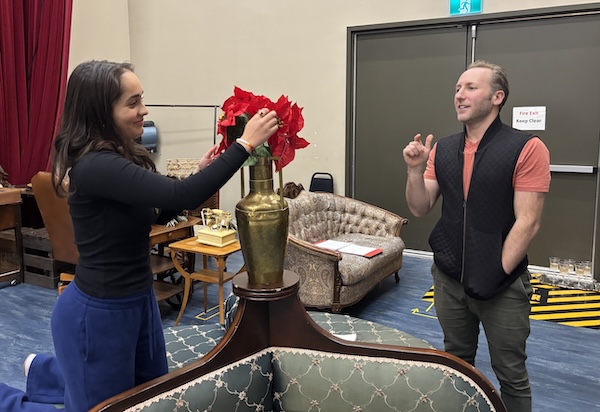
Azaleah Korn, who plays the title role in Gateway Theatre’s production of the musical Annie, takes guidance from director Josh Epstein. (photo from Gateway Theatre)
Vancouver Jewish community member Azaleah Korn plays the title character in Gateway Theatre’s production of Annie, which opens Dec. 11 and runs through Jan. 3. The production is directed by another Jewish community member: Josh Epstein.
“When I found out I got the role of Annie, I cried and screamed and cried some more,” Korn told the Independent. “I was shocked, excited, crazy happy and a little nervous all at once! Being able to play the role of Annie is a huge honour and fills me with so much joy, excitement and inspiration.”
For the few readers unfamiliar with the Tony Award-winning musical, which has had several movie adaptations, Annie is set in New York City in the 1930s. It centres around Annie, an orphan who is eternally positive despite her harsh circumstances. Her luck – and that of her companion, the stray dog, Sandy – changes when she is invited to spend the holidays with billionaire Oliver Warbucks.
“I love singing all the songs in this play and I truly love diving deep into this complex human and figuring out how and why she does what she does and thinks what she thinks,” said Korn, who is a Grade 8 student at Eric Hamber Secondary School.
Azaleah Korn stars in Gateway Theatre’s Annie, which runs Dec. 11-Jan. 3. The role of Sandy is played by three dogs; pictured here is Poco. (photo by David Cooper)
“Playing Annie is challenging for me because it’s not a character that I innately identify with,” Korn said. “Her hope and upbeat attitude, even in her awful situation, isn’t my gut reaction. But playing her has inspired me to find the hope or silver lining in otherwise sad situations. The most fun part of being Annie is exploring the world through her eyes.”
At age 13, Korn has the training and experience to play such an iconic role and make it her own.
“I can’t remember a time when I wasn’t performing; whether it be for my parents, friends, family and/or my stuffed animals!!” she said. “I started training in musical theatre, dance and vocals at the age of 5. Funnily enough, my very first vocal performance, at the age of 5, were songs from Annie: ‘Maybe’ and ‘You’re Never Fully Dressed.’”
Korn played Tomika in School of Rock at Theatre Under the Stars in 2024 and Brigitta in the Sound of Music at Delta Youth Theatre in 2023. She competes vocally and, this past year, won first place in the musical theatre genre at Kiwanis Music Festival. For the last three years, she has been dancing competitively, with the Happening Dance Studio. A couple of years ago, she won a nationwide songwriting contest. She would like to study musical theatre in New York and perform on Broadway.
“I prepare for my roles by learning the backstory of the show and my character. I really try to bring ‘me’ to the character I am playing, so, although I watch the musical or movie, I try not to copy or emulate exactly what I see. It is really important for me to bring my own authentic self to the character, so it feels and looks real,” she explained.
“To memorize my lines, I visualize the scene over and over. This technique helps me feel the beat of the scene and then the lines come more naturally.
“To calm my nerves,” she said, “I think, ‘what would Beyoncé do?’ I channel my inner courage and remember that musical theatre is my biggest passion and love. Reminding myself of my love for being on stage helps ease the nerves.”
Self-care is part of it, too. With Annie, for example, there are shows six days a week, and a matinée and evening performance on Saturdays.
“To have enough energy for the shows, I try to relax – when I’m not at school or rehearsing!” said Korn. “I like to zone out by watching TV or reading a book and keeping my talking to a minimum (which can be hard for me at times!), so I don’t wear my voice out. Luckily, my mum cooks me healthy meals so I have the energy to dance, sing and act my heart out on the stage. I warm up my body and voice. Cheryl Porter’s vocal warm-ups are amongst my favourite and have helped me keep my vocal cords safe throughout my singing years and daily shows.”
It was Korn’s mom who saw that Gateway Theatre was casting for Annie.
“She submitted me for the role of Annie and/or the orphans,” said Korn. “I practised the vocals for the audition with my vocal coach, Frederik Robert. My mum was my reader for the scene I had to practise. I guess she did an OK job! Mentally, I told myself to just go in there with all my confidence and courage and play the role and sing the best I could. And, like my mum always reminds me, ‘have fun!’”
This will be Korn’s first time working with Gateway Theatre. She is grateful to Epstein, choreographer Nicol Spinola, music director Sean Bayntum and the whole Gateway team for the “incredible opportunity.” Her parents have provided “endless support,” she said, also highlighting her vocal coach, Robert, and dance teacher, Kim Stevenson, “for pushing me and believing in me!”
Judaism is a fundamental aspect of Korn’s life.
“My grandfather, David Solomon Korn (he is named after two kings, he likes to remind us), is a Holocaust survivor. He and his brother Yaakov, aged 6 and 7, survived the Nazis as they came through Europe, including Brno, Czechoslovakia, where my grandfather was born. Tragically, his parents died at the hands of the Nazis, leaving my grandfather and his brother orphans. He recently wrote his memoir, in a book called At Great Risk, with the assistance of the Azrieli Foundation. My grandmother, Yona, was born in Afula, Israel. My grandparents met in Montreal and, after marrying, lived in Haifa before immigrating to Canada. It is a story of survival, determination and hope.
“Playing the role of Annie causes me to pause often to reflect upon the injustices inflicted upon my grandfather, who himself was orphaned at a young age, and the resilience of the Jewish people,” Korn continued. “My Jewish identity is strong and it is an important part of who I am today.”
It is easy to see why Epstein told the Independent that everyone who sees Annie will “walk away drawn in to our Annie, rising star Azaleah Korn – she’s got a mix of undeniable star power and acting chops.”
Epstein is a multifaceted talent himself, being an actor, producer, director and writer. The almost-46-year-old is a theatre veteran. For him, directing at Gateway Theatre is special.
“I spent my Hanukkahs doing the seasonal show at the Gateway as a kid – five winters,” he said. “It was a training ground for me, and this is all full circle.”
He directed Gateway’s 2024 production of Oliver! (He was part of Gateway’s 1992 production of the musical, playing young pickpocket Charley Bates.)
“Coming off Oliver! last year was a real awakening for me,” Epstein told the JI. “I didn’t expect how joyful it would be to dust off a classic and rediscover how well these classics hold up when you approach them with imagination and depth. The Gateway encouraged us to dream big and take risks. Barb Tomasic (executive artistic director) is an extraordinary leader, and that attitude trickles through the entire company.
“On opening night, she asked me about returning, I was a quick yes. She had a list, I had a list, and Annie was at the top of both.”
When asked his favourite thing about Annie so far, Epstein said, “We’ve found fresh takes on every character.” As noted, he highlighted Korn. He also said, “I think audiences will see a Warbucks they’ve never seen before. Charlie Gallant brings something impulsive, surprising and emotionally alive. It reinvigorates the role and opens up the whole story.”
He added, “But, who am I kidding, the dog will undoubtedly get the most attention. Everyone loves Sandy.”
Sandy is played by three dogs: Neko, Mylo and Poco. While there is the saying, “never work with kids or animals,” Epstein said, “It’s a myth. We had 70 kids audition. Seventy. Vancouver is full of incredible training programs … so the talent pool was unbelievable and our orphans are exceptional. The challenge is harnessing all that energy and potential inside a big, fast-moving machine.”
It’s been six to 10 months of planning, said Epstein, between “sets, costumes, props, auditions and logistics. Then, three intense weeks of rehearsal into tech. In that window, we have to teach all the music, choreograph huge numbers, stage transitions, build quick changes, run fight direction, intimacy work, dialect coaching, work with three dogs and a dog trainer, squeeze in costume fittings and lift calls, and prep special promo events. When you break it down, the number of actual hours we get for scene work is shockingly small, so my job is to move quickly while still hitting all the moments we want to savour.”
There is nothing like live theatre.
“Look,” said Epstein, “more and more, most of us are at home scrolling, streaming, consuming things alone. Theatre is one of the last places where you sit in a room with hundreds of strangers and feel something together. For this price, with this level of talent and this much energy poured into it, there’s nothing else quite like it.
“At its core, Annie is a story about chosen family, about finding the people who show you that love isn’t just something you give, but something you have to allow yourself to receive – Warbucks learns that, Annie teaches it – and I hope you leave the theatre optimistic about finding that kind of connection with your own chosen family, whoever they may be.”
The cast of Theatre Replacement’s East Van Panto: West Van Story, left to right: Tom Pickett, Ben Brown, Ivy Charles and Meaghan Chenosky. (photo by Emily Cooper Photography)
If you want a ticket to East Van Panto: West Van Story, you’d better move fast. At press time, the show had just opened and most performances at the York Theatre were already sold out.
Theatre Replacement’s romp for all ages is inspired by Romeo and Juliet this year. The annual event is popular for many reasons, including a consistently stellar creative team and talented actors, its local flavour and political bent.
In East Van Panto: West Van Story, written by Marcus Youssef with Pedro Chamale, a tsunami strands West Van influencer Holly and her curling team in East Van, where she falls for Joes – a member of their sworn rivals. Adding to her troubles is her mega-developer “motherfather,” Boberta Rainy. The question is will Holly “follow her heart – and Joes – into a new world of love, dance battles and civic resistance? Or will Boberta’s towers and renovictions crush everything in their path?”
“It’s really fun to be part of a show that takes being silly so seriously,” technical director Daniel O’Shea told the Independent in a recent interview.
O’Shea has been involved with the Panto for a few years now.
“The creative team will come up with such wacky characters and gags, and then we have to earnestly sit around the table and figure them out,” he said. “My first year with Theatre Replacement’s East Van Panto, we had to have the king of the skunks shoot a ‘Stink Canon 9000’ into the audience – who wouldn’t enjoy coming up with that?! Also, because the Panto is a new satire every year, getting to be part of a show that speaks to the current community concerns from a local perspective always feels like a breath of fresh air.”
O’Shea first worked with Theatre Replacement on a show called MINE, which, he said, “was a performance that took place half on stage and half in Minecraft. I was colleagues with a number of the devisors on the show and we needed to build some systems for controlling the projection integrating the video input from multiple gaming computers and building in game cues. As part of that show, we built a tech booth in Minecraft and I had little avatar who would run around and hit in game buttons to teleport people or spawn creatures; it was quite fun. I guess I mention it because the pleasure in working with Theatre Replacement is that I’ll often be solving unorthodox problems or working in novel ways.”
The biggest challenge of working on the Panto, he said, is its size.
“We want East Van Panto to feel like a big show, with clever sets and big costumes and arresting moments, and we often succeed, but all of that has to fit into quite a small container,” he explained. “The York Theatre is a wonderful home and we love being there, but we are often pushing the limit of what we can fit onto the stage. It often requires extremely thoughtful planning and clever technical solutions to achieve this big story book mise en scène in a converted movie theatre. We are grateful to our partners at the Cultch and the tech team there that help to pull it off each year.”
Daniel O’Shea (photo from Theatre Replacement)
O’Shea has a bachelor of fine art from Simon Fraser University, where he majored in theatre performance and film production.
“I’ve always had a love of both film and stage since I was a kid, fostered by my parents taking us out to shows, and a somewhat onerous VHS mail arrangement through which we received dozens of old back catalogue titles. Though they present quite differently now, both film and theatre share so much DNA, going to back to early cinema. That particular artist-alchemy of narrative, imagination, character, emotion, etc., that both seek has always been something I’ve been drawn to create.”
He gave a shout out to his high school, Burnaby North, and to Alison Schamberger and Phil Byrne, who ran the theatre and media arts program. “They were both instrumental to instilling the sense that creating in both fields was possible, valuable and worthy,” he said.
Career-wise, O’Shea has focused on lighting and projection design, filmmaking and technical direction. He has done some performing, but not for about 10 years now. Nonetheless, his acting experience continues to help his work, in that it allows him to have a fuller sense of the world a show creates.
“It’s possible to get overly engrossed in the issues that feel pertinent to one’s role, like the efficiency of technical rehearsal or the familiarity of ‘how things are done’ and miss the chance to allow for creative risk-taking and imagination,” he said. “Having that performance background helps remind me that achieving the desired audienceexperience during a show is the goal rather than whether your plan going into tech looks like what’s on stage opening night.”
O’Shea is also a founding member of A Wake of Vultures, with Nancy Tam and Conor Wylie.
“It’s a vehicle for us to make work that is true to our artistic core,” said O’Shea. “The three of us work as freelance designers/ artists in the broader community and convene together when someone has a juicy idea.
“Working as a freelancer, you are often given creative agency, I mean it’s clearly part of what you are there for, but it’s often within the constraints of the production or the shows’ genre/esthetics. If it’s a play about a character journey, then the design has to serve that. When we work together in A Wake of Vultures, we really get to dream wildly as designers/conceptual thinkers and follow our process…. That freedom to dream and build ways of affecting the audience before serving other elements of the show is deeply enjoyable.”
Currently, A Wake of Vultures is working on a piece called SweatCry, “which will be some sort of structured social experience investigating ecstasy, purgation and dance,” said O’Shea. “I’m also going on tour with Jade Circle, a show on which I did the projection design, made by Jasmine Chen, which is a beautiful show tracing the cascading chain of mother-daughter relationship and stories buried within our own families.”
O’Shea described his own connection to Judaism and Jewish community as “cultural and fostered through the deep networks that I’ve grown up a part of and, yet, it feels most represented by the Groucho Marx line, ‘I wouldn’t want to belong to a club that would have me as a member’ – a belonging and exclusion at the same time. That, or Moses’ line about being a ‘stranger in a strange land.’ There is a tension in being a tribe of the estranged that has meaning to me, both in the way that it seats one in relationship to the world and in how it asks of you to make kinship with ‘the stranger.’
“I think it is also the reason why I have such a love of ritual,” he concluded. “Whether it’s in a show or a meal of special ceremony, the sense that formal choices, of how to do things, can have deep symbolic and historical ties, and be a thread that links people across time really moves me … both of these facets of my Jewish identity shape my life and work.”
For tickets to East Van Panto: West Van Story, which is directed by Chelsea Haberlin, with music by Veda Hille, go to thecultch.com. There are shows through Jan. 4.
Gila Münster, left, Yan Simon and Sarah Freia bring 8 Gays of Channukah: The Musical to the Chutzpah! Festival Nov. 13. (photo by Jamie Marshalls)
At this year’s Chutzpah! Festival, which runs Nov. 12-23, Jewish drag queen entertainer Gila Münster presents the Western Canadian debut of 8 Gays of Channukah: The Musical.
Calling Chutzpah! “one of the city’s most beloved celebrations of music, theatre and culture,” Münster wrote in a recent Facebook post: “What began in Toronto as the largest annual queer Jewish event in Canada is now coming West, bringing music, comedy and unapologetic queer Jewish joy to the stage.
“And it couldn’t come at a more important time,” she adds. “As antisemitism and anti-LGBTQ backlash continue to rise across North America, spaces that celebrate and centre our communities are not just entertainment – they are acts of resilience, visibility and solidarity. This show is about more than laughter: it’s about lighting the menorah together in defiance of hate and letting our joy shine brighter than ever.”
8 Gays of Channukah takes place Nov. 13, 7:30 p.m., at the Rothstein Theatre. “Eight stories are brought to life by the show’s creators, Gila Münster, Sarah Freia and Yan Simon, who reimagine holiday traditions with camp, sparkle and pride,” reads the Chutzpah! blurb. Local artist Joylyn Secunda opens the event with an excerpt from their show, The Routine, and there is a holiday shuk (market) during intermission and after the performances. People can pick up some gifts – made by local artisans – for the holidays.
First performed in December 2019, 8 Gays of Channukah started out as a variety show, said Münster. Last year, it evolved into a full-length musical created by Münster, Freia and Simon, and directed by Hershel Blatt.
“Now, 8 Gays of Channukah: The Musical is a 90-minute theatrical extravaganza with original songs, storytelling and dazzling costumes by queer Jewish designer Dan Dwir of House of Dwir,” said Münster. “The premise is that the three of us – Yan, Sarah and I – find ourselves on stage without a plan. We decide to share our experiences as queer Jewish people, but, as tensions rise, our bickering begins to twist the message. Over the course of the show, we learn how to coexist despite our differences and discover how much we truly share.
“The stories we tell touch on everything from coming out, to losing a loved one, to first crushes – and, of course, the joys and challenges of being an intersectional minority.”
It was from one of those challenges that 8 Gays of Channukah came into existence.
“In 2019, I was an undergrad at York University, getting ready to perform a drag show for the school’s 2SLGBTQIA+ affinity club,” Münster said. “Two days before the show, I got a voicemail from the club’s coordinator saying the event was canceled and I was banned from the club. The reason? I had mentioned that I was planning to go on Birthright to Israel that summer, and some members said it made them uncomfortable.
“I wasn’t given a chance to explain why that reaction was antisemitic, or even to defend myself. It was devastating. I felt erased – like there was no room for me to be both queer and Jewish.
“But I didn’t want to give up,” she said. “I reached out to Hillel Ontario and started a campus group called Rainbow Jews, a space where queer Jewish students of all stripes could show up fully as themselves. At our very first meeting, people asked me if I could put together a holiday party for queer Jews. That’s when the idea hit me: 8 Gays of Channukah. It started as a scrappy variety show with eight local queer Jewish performers – and now, seven years later, it’s grown into a tradition I’m so proud of.”
Over the years, singers, instrumentalists, comedians, dancers, burlesque and visual artists have participated. “Some highlights include legendary performers like 78-year-old drag queen Fontaine and Jamaican-Jewish comic Tamara Shevon, alongside rising stars such as dancing diva Josie and punk rock princess Alissa Brink,” said Münster. “In recent years, the show has found a kind of ‘core cast.’ Yan Simon – a Russian-Israeli singer-songwriter now based in Ottawa – first performed with us in 2019 and has been part of every show since 2023. Sarah Freia – an actress, singer and poet splitting her time between Toronto and London [England] – also joined, in 2023, and has been with us ever since. Together, we’ve built on the variety show tradition while adding our own creative chemistry into the mix.”
With Münster in Kingston, Ont., Simon in Ottawa and Freia in Toronto and London, the building of the musical required tenacity – hours in transit for in-person rehearsals and hours more in digital meetings, including with director Blatt, who traveled back and forth from New York.
“Because the show is rooted in personal storytelling, we had to really learn how to listen to each other and trust each other’s artistic instincts,” said Münster. “We were also lucky to have amazing rehearsal assistants, Olivia Daniels and Jesse Levy, who helped us shape the movement on stage.
“When we premiered the musical in December 2024, it was both thrilling and terrifying. We’d spent a year and $25,000 developing an entirely new format with all original material and we knew our loyal audience was counting on us to deliver. Of course, there were a few inevitable hiccups, but the energy in the theatre was electric. One moment I’ll never forget was after the show, when the non-Jewish partner of a Jewish audience member told us that, for the first time, he truly understood how antisemitism feels. That conversation reminded me that every person in the audience will connect to the show in their own way – and that’s the real magic of it.”
Münster’s first drag performance was at an event organized by the Centre for Israel and Jewish Affairs for Pride. Called Jew-Paul’s Drag Race, it was hosted by drag legend Divine Darlin’, said Münster.
“I had spent weeks putting together my outfit, inspired by the Wicked Witch of the West. On the day of, it took me three hours to do my makeup, and then my friend Diana drove me to the Drink, where the show was happening. She practically had to drag me up the stairs – I was so nervous.
“The first song I ever performed in drag was Carrie Underwood’s ‘Blown Away’ – a nod to The Wizard of Oz – followed by Netta Barzilai’s ‘Toy,’ which had just won Eurovision 2018. The crowd went wild for that second number, and, in that moment, I realized there might be a space for me to bring my queer, Jewish and Israeli identities together on stage,” said Münster, who ended up winning the competition.
“From that night on, I was hooked,” she said.
Some JI readers will know Münster from her having been one of JQT Vancouver’s Hanukkah Hotties in 2022. She’s also on JQT’s Wall of Artists.
“I first connected with JQT’s founder and executive director, Carmel Tanaka, about four years ago,” explained Münster. “She found me online, and we bonded quickly over our intersectional identities.
“Looking back at the Hanukkah Hotties video … always makes me laugh,” she said, “because it takes me right back to the era of ‘Zoom drag.’ That meant getting into full glam, setting up lights and lip syncing in my living room – all to a silent, invisible audience on the other side of the screen. It was bizarre, a little lonely, and yet so wonderfully camp at the same time.”
Drag isn’t just an art form for Münster, but her business.
“It’s helped me pay my way through law school and beyond,” she said. “Having signature events that only I can deliver – especially those built around original music that doesn’t exist anywhere else – sets me apart from entertainers who focus mainly on lip syncing to existing tracks.
“Alongside 8 Gays of Channukah, another one of my signature offerings is Drag Queen Story Time. I’m proud to be the only drag performer officially approved as a vendor for the Toronto District School Board.”
Münster is also adept at cross-stitching, and sells her creations and other artwork on Etsy.
“My mom first taught me to cross-stitch when I was a kid, but I really picked it back up during the pandemic lockdowns,” she said, adding that “stitching became both a way to connect with people when we couldn’t leave our homes and a way to pass time that actually felt productive.”
Münster, Freia and Simon are excited to bring 8 Gays of Channukah: The Musical to Vancouver. “More than anything,” said Münster, “we hope the show helps build bridges between queer, Jewish and allied communities – especially in this moment of deep polarization.”
For the full Chutzpah! lineup and tickets to all the shows, go to chutzpahfestival.com or call 604-257-5145.
People of a certain age will have seen the iconic 1980 comedy 9 to 5, starring Jane Fonda, Dolly Parton, Lily Tomlin and Dabney Coleman. Even more will know the eminently singable title song of the movie, written by Parton, which remains popular today, 45 years later. Those of us who enjoyed the story and like (love!) the song will be happy to know that Royal City Musical Theatre (RCMT) is presenting 9 to 5 The Musical – the score of which Parton wrote – April 25 to May 11 at New Westminster’s Massey Theatre.
“Set in 1979, 9 to 5 The Musical follows three co-workers – Violet, Doralee and Judy – as they endure their mundane and demoralizing office jobs at Consolidated Industries, under the thumb of their sexist and egotistical boss, Franklin Hart Jr.,” reads the press release for the production, which is co-directed by Valerie Easton and Chris Adams. “When the women are suddenly given the chance to turn their wildest revenge fantasies into reality, they hatch a plan to kidnap their nasty boss and step into their full potential – ultimately taking control of the company.”
Keri Smith is in Royal City Musical Theatre’s 9 to 5 The Musical, which runs April 25-May 11 at Massey Theatre. (photo from Royal City Musical Theatre)
The RCMT production stars Irene Karas Loeper as Violet, Maia Beresford as Doralee, Madeleine Suddaby as Judy and Dustin Freeland as Franklin Hart Jr. Jewish community member Keri Smith plays Margaret, a secretary in Hart’s office, who drinks a bit, and she is the understudy for Violet.
RCMT’s 9 to 5 The Musical marks a return to the stage for Smith – who trained at the American Musical and Dramatic Academy in New York City – after a long hiatus, during which time she has taught grades 1-7 at Vancouver Talmud Torah.
The Jewish Independent interviewed Smith in advance of the musical’s opening.
JI: Can you tell me a bit about your general background, how you got into education and theatre, when and why you came to Vancouver? Or did you just study in New York?
KS: After completing my studies at theatre school and spending several years working in New York, my visa expired, prompting my return to Vancouver. Upon arriving, I quickly recognized the challenges of pursuing a full-time acting career in the city. As a result, I sought a position that would allow me to continue engaging with theatre while securing a steady income. I found a role as an early childhood educator at Vancouver Talmud Torah, the elementary school I had attended as a child.
Two years into my position, when an opening for a drama instructor became available, I approached the principal and shared my theatrical background … [and] she entrusted me with the role. I quickly developed a deep passion for teaching anddecided to pursue a teaching certification to further my commitment to education.
Over the past 19 years at Vancouver Talmud Torah, I’ve had the privilege of helping to establish a vibrant musical theatre program for students aged 10 to 13. I am immensely grateful to be in a position where I can combine my love for theatre with the joy of teaching every day.
JI: What role, if any, does Judaism and/or Jewish community play in your life?
KS: Judaism and the Jewish community hold a deeply cherished place in my life, shaping both my personal journey and my work as an actor and educator. In my daily life, Jewish values of compassion, justice and the importance of education are guiding principles.
In my role as an educator, I am reminded every day of the power of knowledge and the responsibility we bear in passing on these values to future generations. Judaism has a long tradition of asking questions, seeking understanding and fostering growth through learning, which resonates deeply in my approach to teaching.
As an actor, I find that storytelling in the Jewish tradition has influenced my perspective, as narratives in Judaism often revolve around struggles, resilience and the pursuit of justice – ideas that transcend time and place. Whether in a classroom or on stage, I strive to embody the deep sense of connection and responsibility that Judaism fosters, with gratitude for the wisdom that has been passed down through generations.
The Jewish community, with its strength, support and shared commitment to growth, reminds me that we are all part of something much larger than ourselves and that, together, we can bring light into the world.
JI: What attracts you to acting?
KS: What I love most about acting is the profound escape it offers – an opportunity to leave behind my own world and immerse myself fully in someone else’s reality. The process of stepping into a character’s shoes, seeing the world through their eyes, and experiencing their emotions and struggles is not just thrilling; it’s transformative. It’s an addicting experience because each new role is a journey of discovery – of understanding, empathy and expression that goes beyond my own personal experiences.
JI: What’s your favourite part of teaching?
KS: What truly deepens my love for acting is the opportunity to teach it. Teaching drama allows me to share that same transformative experience with others, especially young people. Watching students experience the same magic of stepping into a character’s shoes for the first time is incredibly rewarding. There’s something truly special about guiding them through the process of self-expression, helping them find their voice and watching them take risks on stage. Drama gives students a unique platform to explore their own identities and develop their confidence, creativity and empathy – all essential skills not just for acting, but for life.
JI: What motivated you to audition for 9 to 5 The Musical? What was that process?
KS: I felt it was the perfect time to step out of my comfort zone and challenge myself, so when I saw the opportunity, I didn’t hesitate to audition. The process was incredibly enjoyable! I was given a song and a scene to prepare, and I went in with the goal of giving it my all. Afterward, I felt confident and proud of my performance.
JI: How often do you perform, and approximately for how long have you been a performer?
KS: I first discovered my passion for performing as a Grade 7 student at VTT, where I played Hodel in Fiddler on the Roof. That role was my introduction to acting, and I’ve been hooked ever since. While I “perform” daily in my role as a teacher, engaging with my students, I haven’t had the chance to take the stage in over 10 years. This production marks my return to acting, and it feels incredible to be back!
The cast of Bound! The Musical (In Concert), a quirky, character-based show, the story of which is a vehicle for the characters’ journeys and personal growth. (photo by Joelle Wyminga)
For two nights only, Nov. 19-20, Metro Theatre and Bound Musical Theatre Society are presenting the world première of the feel-good comedy Bound! The Musical (In Concert).
Written by longtime friends Wayne Morris and Glen Freedman, their collaboration on Bound! – music and lyrics by Morris, book by Freedman and Morris – began in 2015. Morris had been working on the concept for several months.
The show is a reimagining of Shakespeare’s Love’s Labour’s Lost. Four Olympic-bound male athletes “are tricked into abstaining from vices and ‘romance’ during their high-intensive training, only to find themselves suddenly at the centre of a research study run by a group of attractive, brilliant and highly driven women,” reads the synopsis. “What follows is a hilarious battle of wills as their desires and the binds of their stringent guidelines battle for the win.”
“Glen and I were hanging out at Kits Beach, and I started telling him about the show,” Morris recalled. “Glen peppered me with all kinds of questions about the characters and the story. It turned into a two-hour conversation, after which I said, ‘Glen, you have to write this with me.’”
“To which, without any hesitation, I said, ‘yes,’” Freedman told the Independent. “The idea of working with Wayne on a creative project again (yes, we’ve been down this road before, though many years ago) carried a sentimental nostalgia for me.”
“When we first met, we started writing and performing songs together,” said Morris. “Together, we joined an ’80s band led by one of Glen’s friends. It was the ’80s after all!”
“It was a blast, even though they wouldn’t let me sing,” quipped Freedman.
The pair has lived in Metro Vancouver for more than 25 years, Morris in Maple Ridge, Freedman in Yaletown.
“We met at Marianopolis College in Montreal in our late teens, and became great friends. After university, we backpacked through Europe together,” said Morris.
Morris was an actor before becoming a singer-songwriter and then music producer as well. Freedman, while a keyboardist, took a less musical route and became a psychiatrist. Along the way, he also completed a creative writing program at Simon Fraser University and attended Bishop’s University in Quebec, where he performed in Chekhov’s The Cherry Orchard.
Morris and Freedman formed the Bound Musical Theatre Society earlier this year “as the vehicle forthis and future productions,” said Morris. “Our lawyer recommended a not-for-profit society as the type of entity the local theatre industry is used to working with.”
The Metro Theatre production of Bound! is directed by Hailey Fowler, with musical direction by Kylie Fonacier. It features a diverse ensemble cast in what Morris describes as “a character-based show, and the story is a vehicle for the characters’ journeys and personal growth.
“For me,” he said, “this focus on character was challenging at first as a lyricist, in that the lyrics needed to reflect 10 distinct voices. As the show and characters continued to develop, and the songs were continually rewritten and refined, this process became easier, as both the characters and the lyric-writing process became more familiar.”
“As our show is about resilience and the possibility of change at times of challenge,” said Freedman, “it was my view that we had to create characters, each with their own unique personality quirk that was getting in their way – ‘bounding’ them up, you might say. Each character would then get their own story arc, in which they would overcome these constraints, to a realistic degree. The goal was to induce the audience to see themselves in these characters, such that they would walk away from the show with a feeling of hope and a bounce in their step.”
No doubt the musical’s 16 original songs will contribute to that bounce. Morris said his biggest musical influence is the Beatles, “and so that is a big musical influence for the show, including having a wide variety of musical styles across the show, in the same way the Beatles do.”
In a similar vein, Morris based the story on Shakespeare’s Love’s Labour’s Lost because, he said, “I wanted to have the best possible source material, and what better source than Shakespeare? Using Shakespeare ensured a solid story structure. Love’s Labour’s Lost is a very fun story, with silliness and great wordplay. That’s the type of show I wanted to write. Also, in Love’s Labour’s Lost, I loved the fact that the women in the story consistently have the upper hand over the men; very progressive then, and seems to fit our world today!”
“I couldn’t agree more,” said Freedman, whose day job has helped him in the creation process.
“Due to the nature of my work as a psychiatrist, I have, over time, developed an understanding of the nature of suffering – a human experience that ties us all together – and how personality informs how we suffer,” he said. “I have also had the privilege of having seen firsthand how change in how we think can manifest. This, I feel, has helped in our creating characters that are true to life, and who undergo change for the better, in a manner that we hope will be experienced by the audience as believable and relatable.”
And which will leave audiences feeling positive, though Morris and Freedman differ slightly in their outlook.
The press material describes Morris as a “glass half-full person.”
“It’s part of my nature to look for the good in everyone, and I’ve discovered that almost everyone means well deep down,” he said, acknowledging, “I’ve also been very fortunate that hard work and some good life decisions have led to things working out for the most part in my life.”
As for Freedman, optimism comes a little harder.
“Through my adult life (and with lots of therapy), I’ve gradually moved to a place of being able to recognize what’s in and out of my control, of what I have agency over and what I have to accept, of understanding that, just because I accept something does not mean I have to like it, and of letting go of expectations of how I wish things should go,” he said. “This mindset has fostered within me a capacity to face the events of life, sometimes tumultuous, with curiosity, a sense of humour and presence.”
While neither Morris nor Freedman are religious, Judaism does impact their lives.
“Judaism has shown me the value of a strong sense of community and connection,” said Morris. “The importance of these is a huge theme of the show.”
“I would add,” said Freedman, “that feeling oneself to be part of a community helps to add meaning to our lives.”
School ofRock cast members, left to right: Crosby Mark, Casey Trotter, Colin Sheen, Mya Forrest, Fumi Okochi and Thailey Roberge. Matthew Rossoff is choreographer of the production. (photo by Emily Cooper)
Matthew Rossoff has returned to Theatre Under the Stars – to choreograph his first production for TUTS, School of Rock. The musical, which alternates with Cats at the Malkin Bowl in Stanley Park, previews July 7-8 and opens July 11.
“Over a year ago, I responded to a posting seeking new creative team members to join the upcoming season and thought it would be a great way to reconnect with the TUTS community,” said Rossoff, who grew up in Richmond and performed in TUTS shows in his younger days. “I was actually on my honeymoon when I received the initial call and am thrilled it all worked out!”
Rossoff, who is a member of the Jewish community, has performed in two TUTS productions: South Pacific in 2000 and Joseph and the Amazing Technicolour Dreamcoat in 2002.
“For several reasons, both of these productions and experiences were huge influences in my career as an emerging artist,” Rossoff told the Independent. “After a long performing hiatus, South Pacific was my first musical after I graduated high school and it was a dream to perform at the Malkin Bowl. Joseph was directed and choreographed by my childhood idol, Jeff Hyslop, and this production catapulted me into my professional career as a dancer and actor, making my CAEA [Canadian Actors’ Equity Association] debut in Fiddler on the Roof at the Vancouver Playhouse later that fall.”
While earning his bachelor of arts at the University of British Columbia, majoring in theatre and minoring in English literature, Rossoff was also doing work in film and traveling across Canada performing in theatrical productions. In 2006, he followed through on his dream to move to New York. There, he performed in several shows, and made his Stratford Shakespeare Festival debut in Camelot and Jesus Christ Superstar.
“Jesus Christ Superstar gained critical acclaim and, eventually, the entire Canadian cast transferred to Broadway in March 2012,” Rossoff said. “I was fortunate to make my Broadway debut, as the dance captain and swing. Our production became a Tony Award nominee for best revival, which offered me a once-in-a-lifetime opportunity to perform on the Tony Awards!”
And to think, Rossoff’s career began in elementary school, when he saw one of his sister’s dance classes. “I was amazed,” he said, knowing it “was something I needed to do. Very much in line with the character Mike from A Chorus Line, I told my parents, ‘I can do that!’
“Tap dancing evoked a passion and spark in my soul so bright that I continued on with it all throughout elementary school,” Rossoff said. “During high school, I decided to put up my dancing shoes for a bit and tried other sports and school activities, but it was after my first show at TUTS, South Pacific in 2000, when I bought a new pair of shoes and reignited my passion for tap dancing. Luckily I did because my career took off and I’ve been so fulfilled and blessed with such amazing dance and performance opportunities.”
He got his first theatre work about the time he started tap dancing, in Grade 3. He played an orphan and one of Fagin’s boys, Mouse, in Oliver!
“My sister was in the production with me and I remember getting bit by the theatre bug,” said Rossoff. “There was a sense of community being created with the cast that I loved being a part of and, of course, the excitement of performing and dancing under the lights.”
Matthew Rossoff choreographs his first production for TUTS this summer – School of Rock. (photo from Matthew Rossoff)
After 10 years living and working in New York City, Rossoff decided to follow another impulse – “to go back to school and deepen my training as a performer, artist and educator.”
He moved to Toronto to attend York University, earning a master’s of fine arts in the school’s performance (acting) program, with a specialization in teaching.
“Those two years changed me at the core of my artistry and revealed a new sense of how I wanted to move forward in my artistic journey,” he told the Independent. “Along with my long-time dance background, my focus became voice, speech and mindfulness work. I quickly became a faculty member at several post-secondary schools and universities in Toronto – teaching voice, speech and movement at York University, Randolph College, Sheridan College, Brock University and, most recently, Toronto Metropolitan University.
“Knowing that choreography and dance were at the base of my creative foundation, I stepped onto the creative team side of the table and began my director/choreographer journey. Shortly after my time at TUTS this summer, I will be returning to Toronto and stepping into the world of Disney as a resident creative team/dance supervisor for Disney Cruise Lines.”
Rossoff’s body presence, mindfulness and yoga work are at the core of his artistic practice and choreography.
“This work stemmed from my training and perhaps lack of intersection between dance and how to connect to the breath and emotional journey as an actor and storyteller,” he said. “Dance is an extraordinary universal language of embodiment, but in musical theatre you also have to put the text onto your full voice and hold space in the body to support and reveal the emotional, physical, intellectual and imaginative journey the character moves through.
“I’m always curious how can an actor lead from the internal impulses and connections to what’s happening in the scene and put it fully into their body through external gesture and movement. To play a truthful human experience, an actor must use the breath to spark the imagination, the senses and full range of expression with their whole sense of self.”
While Rossoff puts his whole self into his work, collaboration is the cornerstone of his creative process.
“Working alongside the director and honouring their vision and design of the show, a movement esthetic and point of view is cultivated,” he explained.
“In my own pre-production work, I start with the words off the page from the playwrights, composers and lyricists: the storytelling. I’m curious, What’s the primary narrative being told and how can movement from the actors elevate and further the storytelling in a compelling and exciting way?”
For productions such as School of Rock, Rossoff said, “I listen to the music over and over again and I daydream and imagine ways to bring this … story to life. Once the show is cast and we’re in the rehearsal hall, I come prepared with an overall structure of how the choreography will unfold or, if the story seeks personalized gestures or movement, bring in exercises to draw out embodied movement from the actors. For example, School of Rock has 13 incredible young performers and their energy brings out creative ideas, movements and impulses [and] I try to hold space for them to join in on the collaborative journey. They certainly inform and bring a unique point of view through their personalized storytelling.
“Choreographing a musical is not all about big production dance numbers,” he added, “but also about sorting out the transitions and the moments in between, as they become key to the flow and momentum of the story. As the show gets closer to opening night, it becomes about the details of precision, economy and relaxation in the movement so that each actor feels at ease and ready to perform with unconscious competence and joy!”
For tickets to School of Rock and Cats, which previews July 5-6 and opens July 10, visit tuts.ca. Cats runs to Aug. 21 and School of Rock to Aug. 22. For tickets, visit tuts.ca.
The ensemble of Theatre Under the Stars’ The Prom has energy and talent. Jewish community member Cadence Rush Quibell is third from the right. (Emily Cooper Photography)
This summer, Theatre Under the Stars (TUTS) has brought two stories of individuality and bravery to Stanley Park – The Prom, which opened July 11, and Roald Dahl’s Matilda: The Musical, which opened the following night. Both opening night shows began with a welcome chant from members of the Coast Salish people, who explained the Indigenous history of the park.
At the opening of Matilda, there was hardly an empty seat.
“My mummy says I’m a miracle,” sang the chorus of bright-eyed children as the curtains rose. It is soon revealed that the parents of the show’s heroine – gifted 5-year-old Matilda – do not share this feeling. Matilda’s mother even calls the day of her child’s birth the worst day of her life.
The story follows Matilda’s struggle to embrace her intelligence and natural courage, despite her crude, TV-obsessed parents, who constantly put her down. She begins to find her place at her school, whose motto is “children are maggots,” pushing past the frightening Miss Trunchbull and towards her personal solace of literature and imaginative storytelling.
Matilda seamlessly conveys its titular character’s frustration and joy. Notably, the set consisting of huge books is a clever signal of the constant comfort Matilda finds in books, and how storytelling is what ultimately leads her to a happy ending.
The show’s energetic ensemble executes intricate choreography and vocals with ease. The ensemble is united and contains an array of younger and older performers, which comes in handy to tell the story of “When I Grow Up.”
Siggi Kaldestad brings talent beyond her years to the role of Matilda, providing a solid and confident backbone for the entire production. Kaldestad is a triple threat, and her sweet yet dynamic performance of “Naughty” offers the proof. Paula Higgins, playing the angel-esque teacher, Miss Honey, brought lovely vocals to the character’s journey of self-confidence and connection. Another standout was Jyla Robinson playing Miss Trunchbull – her physical comedy and terrifying demeanour served well in bringing the famously nasty character to life.
While the narrative of Matilda largely centres around its main character, it truly was an ensemble production, where many supporting characters shone. This was also true for TUTS’s production of The Prom.
The Prom opens on the failing careers of four eccentric, selfish Broadway actors – Dee Dee Allen (Caitriona Murphy), Barry Glickman (Greg Armstrong-Morris), Angie Dickinson (Amanda Lourenco) and Trent Oliver (Matthew Valinho). Seeking a cause that will allow them to regain relevance, they choose to help Emma, a lesbian student in Edgewater, Ind., take her girlfriend to prom, despite the parent-teacher association having canceled prom to prevent that from happening. Emma is under scrutiny in her town of apparent homophobes – the worst being the unsuspecting mother of her girlfriend – and the crew of Broadway has-beens is determined to spread tolerance to people they view as closed-minded hicks and come out as heroes. Chaos follows, yet so do lessons of acceptance and generosity.
Murphy and Armstrong-Morris are masterful performers with powerful stage presences who ably transform their characters from self-absorbed and out-of-touch to caring and relatable. Armstrong-Morris’s “Barry is Going to Prom” reveals intriguing dimensions to the well-established spunk of his character, and Murphy’s “It’s Not About Me” is a true showstopper. The power duo is joined by Lourenco’s Angie, who is classy and entertaining to watch, as well as Valinho’s hilarious and cheeky Trent Oliver.
These eccentric personalities are well-balanced by Anna Pontin’s earnest and mature portrayal of Emma. Pontin brings a warm vocal tone and a comfortable stage presence to this emotionally complex role. Emma’s love interest, Alyssa Greene, is brought to life with an equally beautiful voice and authenticity from Brianna Clark. Whether it’s Valihno’s standing back flip in “Love Thy Neighbour,” or Murphy’s soulful belt in “The Lady is Improving,” this cast truly shines.
Anna Pontin, right, plays Emma, and Brianna Clark is Emma’s love interest, Alyssa, in Theatre Under the Stars’ production of The Prom. (Emily Cooper Photography)
The Prom’s ensemble has solid energy and talent, while sometimes wavering in transitions between scenes. It was wonderful to see Jewish community member Cadence Rush Quibell among them (jewishindependent.ca/finding-their-place-in-theatre). The choreography is upbeat and sincere, especially in the show’s finale, “It’s Time to Dance.” The script is hilarious, and its message is uplifting and heartwarming; it is clear that The Prom preaches inclusion for the LGBTQ+ community and beyond, welcoming anyone who seeks the courage to be themselves – similar to the messages of Matilda.
This season of TUTS allows young, local talents to shine, featuring many children and adolescent-age performers between the two productions. They should all be commended for the dedication and professionalism that is often clear in TUTS productions.
Both Matilda and The Prom drive the classic musical theatre message that no one is alone, even when the world appears to have turned its back. While Matilda is ignored by her parents, she connects with Miss Honey; while Emma is shunned by her town and family, she is embraced by the Broadway performers.
Further, both productions inspire embracing individuality in the face of judgment or constraints, whether it be ridiculous parents or the outdated beliefs of an entire community. The message that you can control your own story is entrenched in both productions. When the students revolt against Miss Trunchbull in the glorious “Revolting Children,” it is loud-and-proud self-determination. When Emma stands up for herself, it is a more subdued demonstration, yet no less genuine. Her intimate, acoustic guitar performance of “Unruly Heart” proves equally effective in allowing its heroine to regain control over her narrative.
Don’t miss The Prom and Matilda this summer. Visit tuts.ca for showtimes and tickets.
Alisa Bressler is a fourth-year student at Queen’s University in Kingston, Ont. She is an avid reader and writer, and the online director of the arts and culture publication MUSE Magazine. Bressler is a member of the Vancouver Jewish community, and the inaugural Baila Lazarus Jewish Journalism Intern.