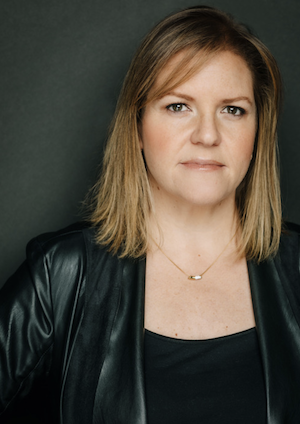
Lise Kirchner, director of education of the Vancouver Holocaust Education Centre, demonstrates the online exhibition Fragments in Focus: A History of the Holocaust (photo by Pat Johnson)
The school year that begins next month is the first in British Columbia to include mandatory Holocaust education in the curriculum. As teachers throughout the province prepare to address this challenging topic in the classroom, the Vancouver Holocaust Education Centre has unveiled a wide-reaching online exhibit to both assist educators and to launch students into independent exploration on the complex network of moral and historical issues the subject raises.
In October 2023, the BC government announced that Holocaust education would be mandatory in the Grade 10 social studies curriculum beginning in the 2025/26 academic year. Many teachers were already addressing the topic as part of Social Studies 10, which covers the Second World War. An elective course, Genocide 12, also exposes students to the history of the Shoah. However, this is the first year that it will be impossible for a student to complete Grade 10 in the province without some exposure to the Nazis’ attempts to destroy the Jewish people and other groups they deemed undesirable.
While mandating that the topic be covered, the ministry of education’s guidelines for learning outcomes are extremely vague. Lise Kirchner, director of education of the Vancouver Holocaust Education Centre, said teachers have great flexibility in how to address the topic – and how much time to give it.
“The teacher can choose to spend four minutes, four hours or four months on the subject,” she said.
Given that many teachers will be seeking trusted resources to teach this material for the first time, the VHEC’s exhibit promises to deliver everything educators need to address the subject effectively, no matter how much class time they allocate to it.
“Over the last 18 months, the VHEC has been working with the ministry of education to articulate this new learning standard for Social Studies 10 and also to develop teaching resources to support educators as they implement Holocaust education in the classroom,” Kirchner told attendees at the VHEC’s annual general meeting in June, where she demonstrated the new online resource.
The exhibition is called Fragments in Focus: A History of the Holocaust. It has been produced with the support of the Digital Museums Canada investment program and the financial support of the Government of Canada. The website is in English and French and meets accessibility standards for people with disabilities.
The online exhibit showcases more than 160 primary sources, including artifacts, survivor testimonies and archival records from the VHEC’s collections, presenting the history of the era through these items.
Fragments in Focus explores Jewish life in Europe before the war, the Holocaust and its impacts, and postwar Jewish life. Users can explore digital 3D models of artifacts, engage with an interactive map and hear from survivors – most of those featured settled in British Columbia after the war – adding human faces and stories to the artifacts and the broader history.
Accompanying the Fragments in Focus exhibit are 20 integrated learning activities and a comprehensive teachers’ guide, providing everything required to navigate the exhibit, construct a complete unit on the Holocaust or supplement existing lessons using unique primary sources, according to the VHEC.
The VHEC’s education team is also available to support educators as they prepare to cover these topics, offering training workshops throughout the province.
Textbooks, which earlier generations might associate with high school, are mostly a thing of the past. Online resources have replaced most hard copy resources, making Fragments in Focus both relevant and accessible.
Historical introductions to each of the exhibit’s sections lead into artifacts, and students can then pursue their own explorations by finding out more about the individual associated with the item, their experience of survival and their life after the war.
For example, students can view a recipe book created by Rebecca Teitelbaum while she was an inmate in Ravensbruck women’s concentration camp. Risking her life, she stole paper, pencils and thread to compile the collection of favourite foods. The tiny booklet became a source of comfort for the women in Ravensbruck, allowing them to imagine a future of well-being and plenty.
The late Alex Buckman, Teitelbaum’s nephew and himself a survivor of the Holocaust, inherited the recipe book, which he eventually donated to the VHEC. During speaking engagements to young audiences, Buckman would share his aunt’s recipe for gâteau à l’orange and some students would make the cake at home, while sharing with their families what they had learned at school.
With the new exhibit, students can explore the recipe book, expand the image to see the stitching that held the book together, and then read transcripts of the recipes. More than this, they can then dig deeper and learn about the family’s story, of Rebecca’s survival and her reunification with her husband, Herman, and daughter, Annie. They can hear Buckman’s story of how he survived but lost both his parents and was raised by the Teitelbaums.
Students also can see the correspondence Rebecca received while in hospital after the war, informing her that both Herman and Annie had miraculously survived.
These artifacts and records help put this almost inconceivable history into context, said Kirchner.
“They now are reading these intimate letters between husband and wife, where they are dreaming of being together again with her daughter,” she said. “I think it brings a whole different dimension to how we understand history, the importance of these primary objects.”
The fact that almost all the objects have a BC connection adds richness to the experience, she said.
As director of education, Kirchner has led a team in bringing Fragments in Focus to fruition. Though the exhibit was in development before the province announced the curriculum change, the shift helped guide the VHEC team to make the resource especially responsive to the needs of educators and students.
Fragments in Focus is based on an earlier physical exhibit developed by former VHEC director of education Ilona Shulman Spaar, former executive director Nina Krieger and others, including Kirchner, who has been involved with the VHEC for about 25 years in various capacities.
“We mounted In Focus – we didn’t call it Fragments in Focus – as the first exhibition in the new renovated space,” Kirchner told the Independent, referring to a major upgrade to the museum in the Jewish Community Centre of Greater Centre, which substantially increased the capacity to display items from the collections. “It was kind of a celebration of the fact that we had just digitized our entire collection – that was a very big project. With the new visual storage facilities, it gave us the ability to actually have multiple artifacts on display, over 100, so that was a pretty big deal for us.”
The ongoing digitization of the VHEC’s entire archives allows global audiences to access its collections. For BC students, starting within days, Fragments in Focus will open doors for self-guided learning.
“We give them just enough information so they can put it in context, but also pique their curiosity a little bit so that they start to see themselves as the ones that ask these questions and start to make sense of this history and to give it meaning. It’s taking ownership of that history,” said Kirchner. “We are just planting seeds and making sure they have enough information to ask the right questions and to see the complexity of that history.”
The online exhibit launched Aug. 20 at fragmentsinfocus.ca and is available to everyone.