Skip to content
  • Home
  • Subscribe / donate
  • Events calendar
  • News
    • Local
    • National
    • Israel
    • World
    • עניין בחדשות
      A roundup of news in Canada and further afield, in Hebrew.
  • Opinion
    • From the JI
    • Op-Ed
  • Arts & Culture
    • Performing Arts
    • Music
    • Books
    • Visual Arts
    • TV & Film
  • Life
    • Celebrating the Holidays
    • Travel
    • The Daily Snooze
      Cartoons by Jacob Samuel
    • Mystery Photo
      Help the JI and JMABC fill in the gaps in our archives.
  • Community Links
    • Organizations, Etc.
    • Other News Sources & Blogs
    • Business Directory
  • FAQ
  • JI Chai Celebration
  • JI@88! video

Recent Posts

  • Sharing her testimony
  • Fall fight takes leap forward
  • The balancing of rights
  • Multiple Tony n’ Tina roles
  • Stories of trauma, resilience
  • Celebrate our culture
  • A responsibility to help
  • What wellness means at JCC
  • Together in mourning
  • Downhill after Trump?
  • Birth control even easier now
  • Eco-Sisters mentorship
  • Unexpected discoveries
  • Study’s results hopeful
  • Bad behaviour affects us all
  • Thankful for the police
  • UBC needs a wake-up call
  • Recalling a shining star
  • Sleep well …
  • BGU fosters startup culture
  • Photography and glass
  • Is it the end of an era?
  • Taking life a step at a time
  • Nakba exhibit biased
  • Film festival starts next week
  • Musical with heart and soul
  • Rabbi marks 13 years
  • Keeper of VTT’s history
  • Gala fêtes Infeld’s 20th
  • Building JWest together
  • Challah Mom comes to Vancouver
  • What to do about media bias
  • Education offers hope
  • Remembrance – a moral act
  • What makes us human
  • המלחמות של נתניהו וטראמפ

Archives

Follow @JewishIndie
image - The CJN - Visit Us Banner - 300x600 - 101625

Month: June 2015

Human rights at fore

One would be hard-pressed to find anyone involved in human rights around the world who has not heard of David Matas.

A Winnipeg-based lawyer, Matas has helped countless victims of human rights violations, and written or co-written numerous books on various atrocities in an endeavor to shed light on them and educate the general public about them. In his latest publication, he aims to explain why he has chosen the work that he has, in the hope of motivating others to get involved in human rights advocacy and create change. Why Did You Do That? The Autobiography of a Human Rights Advocate (Seraphim Editions, June 2015) is his first autobiography.
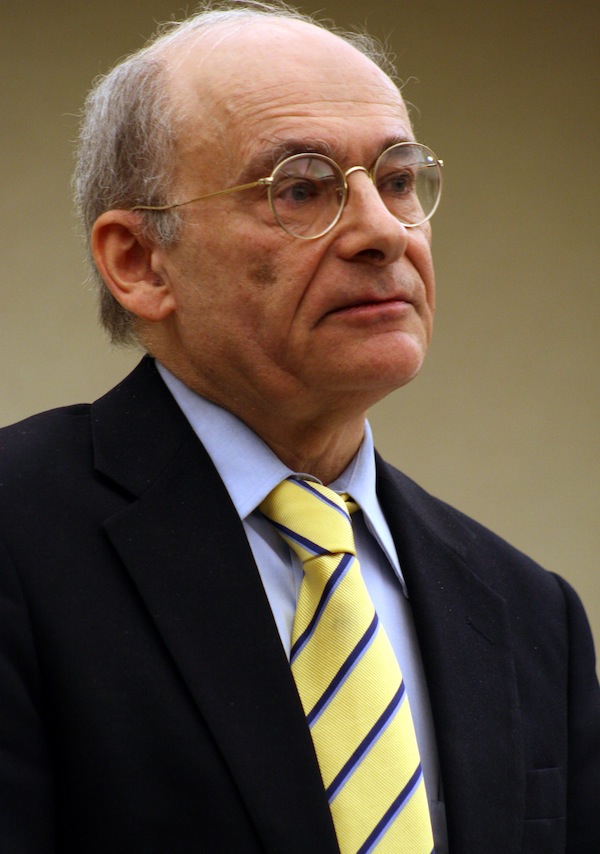
photo - David Matas
David Matas (photo from David Matas)

Matas was moved to pursue a career in refugee, immigration and international human rights law for a number of reasons.

“I started doing it because different people asked me to do it, including people at the law firm,” he explained in an interview. “It’s also something I’m interested in, because I’m interested in politics and human rights. So, I’d say, it was a coincidence of an opportunity to do the work and an interest in it that got me into it.”

Matas had refugees from around the world coming through his doors every day, seeking help. “My immediate effort was to try to get them protection, but the ultimate solution to their problems was the ending of the human rights violations that caused them to flee,” he said. “I felt trying to help them in some sort of systemic way, that I should be directed to that as well.”

Around this time, Matas also ran as a candidate in the federal election for the Liberal party (in 1979, 1980 and 1984) and B’nai Brith Canada approached him, requesting that he chair the local BBC League for Human Rights, largely because of the profile he had developed through his candidacies.

“But, again,” said Matas, “it’s something that, once I got into it, struck a chord of response in me. I got interested in it, involved much more, given the opportunity, because of the resonance it had with me.”

Also around that time, Kenneth Narvey – someone Matas knew from university – was scheduled for a speaking engagement in Manitoba on war-crime issues. Unsure if he would be able to make it, Narvey asked Matas if he would be willing to substitute for him, which Matas agreed to do. As it happened, Narvey ended up being able to attend the lecture, which gave him the opportunity to hear Matas speak and, Matas said, “He [Narvey] really liked it.

“At this time, Irwin Cotler had just become president of the Canadian Jewish Congress [CJC]. Irwin had appointed a chair for a war-crimes committee, as he wanted to do something about the issue himself, and the chair had resigned.”

Narvey lobbied Cotler to have Matas appointed as chair, and Cotler did just that. “So, I got involved in that issue, too, again sort of by coincidence or circumstance,” said Matas.

Another chance encounter was with Harry Schachter, a friend of Matas’ who was involved with Amnesty International, which had been holding meetings throughout the country. Through Schachter, Matas became involved with Amnesty International, which fit well with everything else he was doing.

“The combination of these events, more or less all at the same time, is what really got me into human rights in a very systemic and wholehearted way,” said Matas.

The Holocaust also influenced Matas’ life path. “I, personally, wasn’t affected by the Holocaust, my family wasn’t,” he said. “But, it just struck me. I thought, from an early age, that if the Axis rather than the Allied powers had won World War Two, I nor any other Jewish person would be alive today.”

He explained, “Generally, what I’ve been trying to do is learn the lessons of the Holocaust and act on them, which I saw as protecting refugees, bringing war criminals to justice, combating hate speech and protesting human rights violations around the world wherever one may find them. So, I’ve been trying to act on those four fronts simultaneously throughout my career.”

book cover - Why Did You Do That? The Autobiography of a Human Rights Advocate by David MatasIn his previous books, Matas has focused on specific atrocities or topics related to human rights – from hate speech, to trying to bring Nazi war criminals to justice, to humans rights violations, to refugees, to organ harvesting, and other topics. His autobiography was launched on June 9 at McNally Robinson Booksellers in Winnipeg.

“I go through the various issues I’ve been involved in and explain why I’ve been involved with them, issue by issue,” said Matas about Why Did You Do That? “There’s a chapter on refugees, so I explain what I did in terms of trying to help refugees. And then the rest is why people should help refugees, why everybody should do it. That’s the way it’s structured, chapter by chapter.”

For Matas, this book is a way for him to answer the most frequent question he is asked, “Why are you doing this?”

“I would say the 20th century was a century of genocide,” said Matas. “It wasn’t just the Holocaust. There was one genocide after another. My hope is we will be better, but I don’t think that it comes from hope. It comes from action. So, I’m trying to mobilize people to make things better, so we don’t repeat in the 21st century the vast array of tragedies we saw.”

In Matas’ view, people tend to focus on the problems immediately in front of them.

“People will get really worked up if their neighbor doesn’t mow their lawn, but they get less worked up if people in China are getting killed for their organs,” he explained. “I think there’s a real problem with distance, culture, language and geography, which really makes it difficult to mobilize concern for human rights violations – which is what the Jewish community faced with the Holocaust.”

Why Did You Do That? The Autobiography of a Human Rights Advocate can be purchased online from Seraphim Editions, Amazon and various other booksellers online and in bookstores.

Rebeca Kuropatwa is a Winnipeg freelance writer.
Format ImagePosted on June 26, 2015June 25, 2015Author Rebeca KuropatwaCategories BooksTags David Matas, human rights, immigration, refugees
A millennia-old relationship

A millennia-old relationship

Visitors at the opening of the traveling exhibition at the Schwartz/Reisman Centre in Toronto last month. (photo by Helena Yakovlev-Golani)

The exhibit A Journey Through the Ukrainian-Jewish Encounter: From Antiquity to 1914 opened last month in Toronto. It has since been held in Winnipeg (until June 27), will return to Toronto in July and then head to other cities.

The exhibit is being put on by the Ukrainian Jewish Encounter (UJE), which its website describes “as a collaborative project involving Ukrainians of Jewish and Christian heritages and others, in Ukraine and Israel, as well as in the diasporas. Its work engages scholars, civic leaders, artists, governments and the broader public in an effort to promote stronger and deeper relations between the two peoples.”

Prior to the exhibit’s opening in Winnipeg at the Oseredok Ukrainian Cultural Centre, one of its curators, Alti Rodal, an historian, writer, former professor of Jewish history, and former official and advisor to the Canadian government, spoke with the Jewish Independent.

Rodal was born in Chernivtsi (Czernowitz), Ukraine, and received her early schooling in Israel. Later, she was educated at McGill, Oxford and Hebrew universities in the fields of history and literature.

“UJE was established in 2008 by two people from Canada and the United States, both Jewish and non-Jewish Ukrainian background,” said Rodal. “It’s now a multinational organization with representatives in Ukraine, Israel, the U.S. and Canada.”

UJE’s purpose is to promote greater comprehension of the Ukrainian-Jewish relationship over the centuries, including an understanding of the co-experience of the two peoples and their interactions over the centuries, with a view to the future.

The organization has held many roundtables of scholars from Israel, Ukraine, Canada, the United States and much of Europe, each aimed at understanding a different period in history.

“To have a truthful account of the past, we’ve had a scholarly dimension unfold over the last few years in which we’ve brought together roundtable discussions among scholars of various backgrounds,” explained Rodal. “We’ve identified chunks of the history that need to be explored together and each of these roundtables addressed a different period.” The historical periods explored to date stop at the First World War.

“The exercise is one that leads to a shared historical narrative,” said Rodal. “With this we mean a single text on which the participants largely agree. If there are aspects they don’t agree on, it is stated in the single text, indicating what kind of research would be needed to advance knowledge on these issues.

“By looking to the past, we hope to obtain personal acknowledgement of what happened and to address stereotypes that both Jews and Ukrainians, at the popular level, have about each other. Some of these stereotypes are in the history books, so our aim is to produce more credible accounts and address stereotypes.”

UJE hopes that, with the help of other researchers, some of the information being taught in Ukrainian schools will be amended.

Three years ago, they entered into an agreement with the Government of Canada to do four main projects on the topic, including two publications, developing the content of their website, and the traveling exhibit, the research for which began seven years ago.

The exhibit’s first stop was in Toronto at the Schwartz/Reisman Centre and when it returns to that city, it will be to downtown’s St. Vladimir Institute, the Ukrainian cultural centre.

“These are community exhibits rather than museum exhibits, so we have them at the community centres and try to engage people from the community to participate,” said Rodal, noting that the exhibit will also go to Edmonton and Montreal.

“We’ve been approached by the Jewish community and the Ukrainian community in Ottawa and there’s been interest also from Vancouver,” she said. “We don’t have a commitment to do it, but we’ll consider it…. So, Vancouver and Ottawa are under consideration.”

The exhibit consists of text, images and video. “The first venue in Toronto consisted of 36 panels placed on moveable walls, and four videos that we created ourselves,” said Rodal. “I’m not telling you about the topics, just the physical [aspects] and the number of ethnographic maps.”

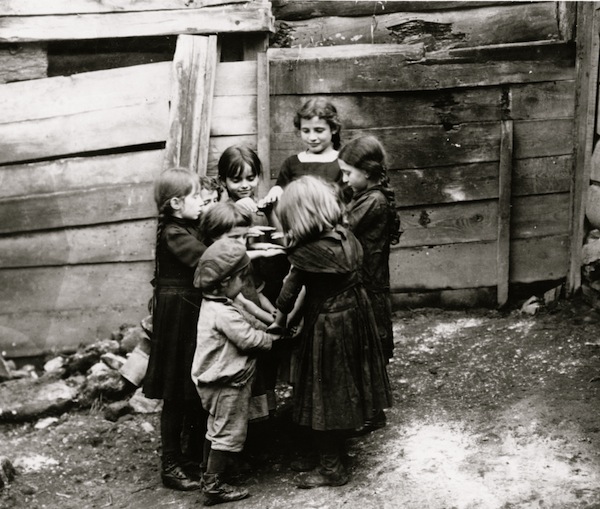
photo - One of the images displayed in the exhibit is this one of Jewish children playing in Kremenets, Ukraine, circa 1913. The photograph was taken during the ethnographic expedition led by S. Ansky in the Jewish Pale of Settlement in 1912-14
One of the images displayed in the exhibit is this one of Jewish children playing in Kremenets, Ukraine, circa 1913. The photograph was taken during the ethnographic expedition led by S. Ansky in the Jewish Pale of Settlement in 1912-14. (photo from YIVO Institute for Jewish Research (New York City) Photograph Collection)

The panels go through history, from antiquity to the First World War chronologically, but there is a segment that deals with the Chassidic movement on Ukrainian lands, one on Hebrew-Yiddish printing, and another on literature and how Jews are depicted in Ukrainian writing and how Ukrainians are depicted in Jewish writing.

The videos also deal with diverse topics. One is marketplaces and taverns, where Ukrainians and Jews encounter each other, and there is a video on Jewish artisans on Ukrainian lands. Another is on ethnographic photographs, largely taken between the 1880s and 1914 on S. Ansky’s expeditions.

“Ansky was an ethnographer who led expeditions around these times, visiting many communities accompanied by a musicologist/photographer, his own nephew,” explained Rodal. “They took pictures and collected folksongs and folklore and objects, which then they put in the museum in St. Petersburg.

“When the Soviets came, it was put in the warehouse and stayed in the warehouse in the 1990s, when the St. Petersburg Historical Centre made these photographs accessible. So, a selection of these photographs of Jewish life from the 1890s to 1914, and also a collection of similar ethnographic photographs of Ukrainian life in various regions, is one of the videos.”

The videos are comprised of photographs with effects accompanied by appropriate music, including a recording made more than 100 years ago on wax cylinders.

UJE’s first objective was to explain that the presence of Jews on Ukrainian land dates back to antiquity. “It didn’t just appear in the 18th century or even the 16th century, but was there in the very first centuries or even earlier, as merchants in colonies co-founded with Greeks,” said Rodal.

“There was also lots of significant cross-cultural interaction between the Jews and the Slavic peoples in the language, folklore, music and cuisine … so that what one thinks is Jewish cuisine, you delve a little and you see the Ukrainians are eating the same things with different names.

“The vast majority of Jews lived in areas where the vast majority of Ukrainians lived. They had more interactions with Ukrainians than with other Slavic peoples…. People who’ve come to North America from what they say [is] Russia, they mean czarist Russia, these places that are coming from Galicia … and the Ukrainian lands that were part of the czarist empire … are now Ukraine.

“Another important message, which is an offshoot of the other, is that the stories of these peoples are intertwined, that we have the motto that the history of one is incomplete without the history of the other. That is the goal – to treat this historical experience in all its complexity – including the periods of crisis and violence.

“We state very clearly that not addressed in this exhibition are the horrible events of the 20th century. And we may do more about this in a different format rather than a visual exhibition. We are certainly doing it in the form of the shared narrative exercise.”

For more information about UJE, visit ukrainianjewishencounter.org.

Rebeca Kuropatwa is a Winnipeg freelance writer.
 

Format ImagePosted on June 26, 2015June 25, 2015Author Rebeca KuropatwaCategories Arts & CultureTags Alti Rodal, UJE, Ukrainian Jewish Experience
Looking for Cape Breton Jews

Looking for Cape Breton Jews

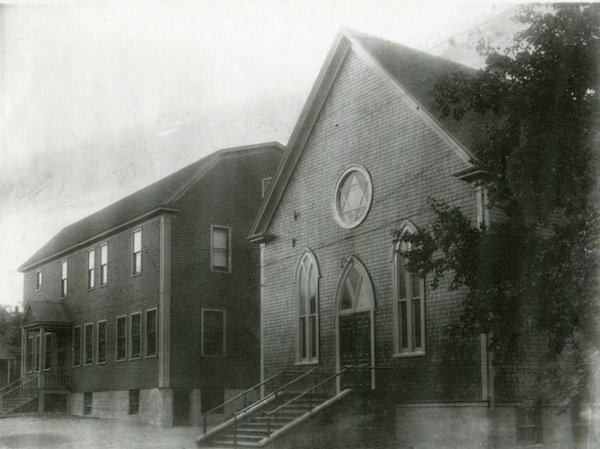
The former Congregation Sons of Israel in Glace Bay. In 1902, the structure was the first purpose-built synagogue in Nova Scotia. It permanently closed in July 2010. To the left of it is what was the Talmud Torah community centre, also now closed. This was the location of the Hebrew school and functions like bar mitzvahs and wedding dinners. (photo by Abebenjoe via commons.wikimedia.org)

PhD candidate Ely Rosenblum is looking for former Cape Breton Jews to interview as part of a research project called Diversity Cape Breton.

The 26-year-old University of Cambridge student is assisting Cape Breton University professor Marcia Ostashewski with a research project that investigates ethnocultural communities, including the Jewish community.

Rosenblum explained that, while his PhD focuses on cultural musicology, he has a background in folklore and ethnographic study. He met Ostashewski, the Nova Scotia university’s Canada Research Chair in Communities and Cultures, and became involved in her research project about three years ago when he worked for a nonprofit organization she was directing, called Friends of the Ukrainian Village Society.

“When I met Marcia and started working with her on a different project and she discovered that my family is from Cape Breton, she got very excited and we started working on this project together,” Rosenblum said. “I have family members who are from Cape Breton. My dad is from Cape Breton, and the entire Rosenblum side of the family is from Glace Bay, N.S.”

Rosenblum said he has been meeting with members of the Jewish community from Cape Breton and collecting oral histories on and off for the past three years.

“I’m collecting oral histories and … talking about their experiences and their family histories, how they arrived in Canada in the first place, why they moved to Nova Scotia, their experiences on Cape Breton Island, both as a Jewish community and how they interacted with other communities, and celebrating some of the multiculturalism on Cape Breton Island that people don’t really know about.”

Last year, Ostashewski and Rosenblum held an event at York University about Jewish life in Cape Breton and in small towns in Canada, and put archival photos on display.

photo - The former Congregation Sons of Israel in Glace Bay in 1932
The former Congregation Sons of Israel in Glace Bay in 1932. (photo from Beaton Institute, Cape Breton University)

“We had a roundtable panel discussion … [about] what immigration patterns look like and what it has meant for these Jewish communities,” he said. “So many of them, especially from Cape Breton, so many people have moved to Toronto, Montreal, Ottawa – bigger cities where their kids have moved. It’s certainly a pattern, but it’s an indicator of the kinds of lives that Jewish parents wanted for their kids.”

He said that, today, there isn’t much of a Jewish community in Cape Breton. According to the Atlantic Jewish Council, Cape Breton’s Jewish community peaked in 1941, when it boasted a population of 939 Jews.

“The few who live there, they have trouble making a minyan … it’s incredibly challenging. Sometimes, people go from city to city so they can have a minyan, but there really aren’t more than 10 Jews on the island still. I believe there is one Jewish child, but that can’t be entirely verified,” he said.

Rosenblum said that, for him, this research project is “deeply personal. It’s a part of my family history, but I also think, for Jewish communities to have a strong sense of what kind of national identity they have, how they fit into the idea of Canada as a multicultural country, as a place where you’re free to be whoever you are, [is important],” he said. “I think the stronger the sense of where our parents came from and the kinds of experiences they had in these small towns, the better we can mobilize communities in these larger cities.”

Rosenblum said he hopes to find more Jewish Cape Breton natives who are willing to share their stories, photos and video or audio recordings, so that they can be archived.

“The most important part for me, the most exciting part, is seeing these amazing collections that families have, these incredible photos and memories that I’m hoping they can preserve.”

Diversity Cape Breton, a web portal launched this month, is available to anyone who wants to learn more about the history of the Jewish community and other communities in Cape Breton. Visit diversitycapebreton.ca.

For more national Jewish news, visit cjnews.com.

Format ImagePosted on June 26, 2015June 25, 2015Author Sheri Shefa CJNCategories NationalTags Cape Breton, Ely Rosenblum, Marcia Ostashewski
U.S.-Israel relations

U.S.-Israel relations

U.S. Secretary of State John Kerry, right, with Michael Oren, then the Israeli ambassador to the United States, at Ben-Gurion International Airport in Tel Aviv on April 9, 2013. (photo from U.S. State Department via jns.org)

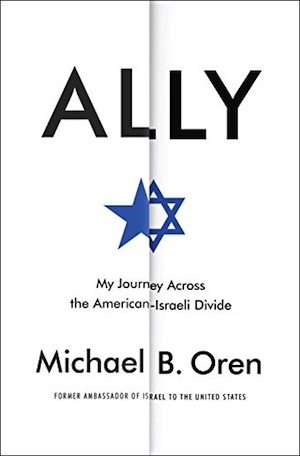
It’s safe to say that in the coming weeks you’ll be reading a great deal about the memoir Ally: My Journey Across the American-Israeli Divide (Random House, June 2015), authored by Israel’s former ambassador to the United States, Michael Oren.

book cover - Ally: My Journey Across the American-Israeli Divide by Michael OrenOren spent the years 2009-13 as Israel’s envoy in Washington. Once a dual national of both the United States and Israel, the New Jersey-raised Oren had to surrender his U.S. passport at the American embassy in Tel Aviv before taking up his ambassadorial post – an emotionally wrenching episode that he describes in detail. Oren’s complicated identity as an American and an Israeli is a theme that runs throughout the book, and his treatment of this subject is a welcome tonic to the dreary and rather smelly charges of “dual loyalty” that too often accompany examinations of the relationship that Jews in the Diaspora have with the Jewish state.

The main attraction of the book, of course, is its account of the Obama administration’s Middle East policies, and Oren’s candor has already gotten him into trouble. Dan Shapiro, the current U.S. ambassador to Israel, who makes several appearances in Oren’s memoir, told Israel’s Army Radio that Ally is “an imaginary account of what happened,” belittling Oren for having, as a mere ambassador, a “limited point of view into ongoing efforts. What he wrote does not reflect the truth.”

This is a serious charge, and it remains to be seen if Shapiro will attempt to substantiate it. In the meantime, it should be pointed out that what makes Ally such a fascinating read is that it provides, from Oren’s perspective, a detailed sense of the bitter atmosphere in both Washington and Jerusalem that underlay diplomatic efforts on the issues we are all intimately familiar with, from the negotiations over Iran’s nuclear program to the stalled Israeli-Palestinian peace process. Unlike other diplomats, Oren didn’t wait 20 years to publish his story – most of the key individuals in his book, most obviously U.S. President Barack Obama and Israeli Prime Minister Binyamin Netanyahu, are still in power, and the bilateral tensions that Oren agonizingly explains haven’t been lessened since his departure from Israel’s Washington embassy. Diplomats aren’t supposed to be this transparent, which is why Oren will be regarded in many circles as a man who broke “omertà,” the code of silence which ensures that we ordinary mortals are kept in the dark about what our leaders are saying in private.

While it’s true that Obama comes in for heavy criticism, Oren rubbishes the claim that the president is “anti-Israel.” The reality is more complex; as Oren writes, “the Israel [Obama] cared about was also the Israel whose interests he believed he understood better than its own citizens.” One might add that this paternalistic approach has informed Obama’s stance on the entire region, resulting in a sly policy that presents itself to Americans as a much-desired withdrawal from the Middle East’s endless bloodshed while, at the same time, fundamentally redistributing the region’s balance of power in favor of Iran, whose rulers have spent almost 40 years chanting, “Death to America.”

Read more at jns.org.

Format ImagePosted on June 26, 2015June 25, 2015Author Ben Cohen JNS.ORGCategories BooksTags Barack Obama, Binyamin Netanyahu, Israel-U.S. relations, Michael Oren, Middle East

The JI wins two Rockowers

Earlier this month, the American Jewish Press Association announced the winners of this year’s Simon Rockower Awards for Excellence in Jewish Journalism, which honor achievements in Jewish media published in 2014. In its division (newspapers with 14,999 circulation and under), the Jewish Independent garnered two first places.

image - 2015 Rockower Winner  First Place SealPublisher and editor Cynthia Ramsay won the first place award for excellence in writing about Jewish heritage and Jewish peoplehood in Europe for her article “World Musician at Rothstein” (Nov. 21, 2014), about the work of Lenka Lichtenberg. The group Art Without Borders was bringing Lichtenberg to Vancouver from her home base of Toronto for a solo performance at the Norman and Annette Rothstein Theatre. The article includes reviews of Lichtenberg’s three most recent CDs and how, in all of her music, “the memory and traditions of those who have lived before can be heard – they are celebrated, and merge with the memories, traditions and passions of Lichtenberg and the artists with whom she collaborates.”

The JI editorial board – Pat Johnson, Basya Laye and Ramsay – won the paper’s other award: first place for excellence in editorial writing. The three editorials that comprised the winning entry were “The message is universal” (March 7, 2014), about plans for the Canadian National Holocaust Monument to be constructed in Ottawa; “The spirit of Limmud” (Feb. 14, 2014), about how the vision and passion of one woman, Ruth Hess-Dolgin z”l, significantly enriched our community by initiating the movement to bring Limmud here; and “Uniquely set apart for exclusion” (May 9, 2014), about the Conference of Presidents of Major American Jewish Organizations decision to exclude J Street from the group.

The Rockower awards will be presented at AJPA’s annual conference, which, for the second year in a row, is scheduled around the Jewish Federation General Assembly being held in Washington D.C. Nov. 8-10. AJPA sessions will be held Nov. 9-11. The entire list of Rockower winners can be found at ajpa.org/?page=2015Rockower.

Posted on June 26, 2015June 25, 2015Author The Editorial BoardCategories From the JITags AJPA, American Jewish Press Association, Basya Laye, Conference of Presidents of Major American Jewish Organizations, Cynthia Ramsay, Holocaust, J Street, Lenka Lichtenberg, Limmud, Pat Johnson, Rockower, Ruth Hess-Dolgin
Helping kids, entertaining

Helping kids, entertaining

Jerry Maslowsky, executive director of Variety, the Children’s Charity of Manitoba. (photo from Jerry Maslowsky)

Jerry Maslowsky, executive director of Variety, the Children’s Charity of Manitoba, has a long history with the organization.

Maslowsky, 57, started off in performing arts as a teenager, in Rainbow Stage productions. Coming from a musical family, the stage was where he felt most at home.

He later became a member of a band called Special Blend and, for 18-19 years, he was with them, playing for many weddings, bar mitzvahs and graduations. He came across Variety in his early 20s, singing on the charity’s telethon in the 1980s. However, his work with them was yet to come.

Maslowsky was approached by CJOB radio station to take on the role of marketing director, with a major aim being to bring the Winnipeg Blue Bombers and the Winnipeg Jets to the station. Then, in 1999, he was hired as director of sales by the Winnipeg Blue Bombers, becoming their vice-president of marketing and sales, and working with the team for 15 years.

A year ago, Maslowsky felt it was time to move on, as an opportunity with Variety came up. The organization’s previous executive director, who Maslowsky knew very well, was retiring.

Since Variety started as an entertainer’s charity, it was something in which Maslowsky was very interested – working with kids and giving back, as well as “ensuring that all kids are having a childhood just made sense,” he said.

The original chapter started in Pittsburgh in 1927 as an international children’s organization, the initiative of a group of 11 men involved in show business, who set up a social club, which they named the Variety Club.

Maslowsky explained, “On Christmas Eve 1928, a small baby was left on the steps of the Sheridan Square Film Theatre, with a note. The note read, ‘Please take care of my baby. Her name is Catherine. I can no longer take care of her. I have eight others. My husband is out of work. She was born on Thanksgiving Day. I have always heard of the goodness of show business people and pray to god that you will look after her.’ Signed, ‘A heartbroken mother.’

“Since efforts to trace the mother failed, the members of Variety Club named the child Catherine Variety Sheridan, after the club and the theatre on which steps she was found. They undertook to fund the child’s living expenses and education. Later, the club decided to raise funds for other disadvantaged children.”

Today, there are more than 44 Variety “tents” (described as “tents” for its circus component) throughout the world. Manitoba’s Variety started in 1978, and it has helped more than 800,000 children throughout the province, raising more than $30 million. The B.C. chapter celebrates its 50th anniversary this year; over that time, it has raised more than $170 million, every year assisting more than 1,200 children. There are other tents in Canada, with a new one slated to open in Montreal.

Maslowsky credited Gene Telpner with bringing a Variety tent to Winnipeg. He got the idea, “then called his good friend, Monty Hall of Let’s Make a Deal, and they were able to formulate a tent in Winnipeg that was really run by a lot of the people from the Jewish community in the entertainment and hotel industry – people like Mickey Levine from the International Inn and Harvey Nairn. A lot of people in the entertainment industry took a hold of this and created the organization and telethons.”

Variety’s mission is to meet the tangible needs of children with all abilities. “This means that every child does have an ability,” explained Maslowsky. “Some children’s abilities are different than others’. We basically look at every child, the abilities they have, and other abilities maybe they lack. That’s where Variety comes in, in how we can support the child as well as the family.

“When children belong here, we call them part of Variety family, because it’s just not always the immediate need we look after. We also look after ensuring the child’s and family’s needs throughout those years, before they come into 18 years old, that Variety stays a part of their life.”

Part of Maslowsky’s mandate at Variety is to reach out to alumni, “kids” who are now 36- and 37-years-old, to see how they are doing, and to bring them back as mentors for younger Variety children.

“One of the things we did that was important for me when I came back was going back to our roots of showbiz, circus and entertainment,” said Maslowsky.

He went to work, calling on his friends from his entertainment past. “So, we were able to plan a Come One, Come All – Under the Big Top event,” said Maslowsky. “I wanted it to be entertaining and I wanted people to come to an event where they could see it through the eyes of kids. And we’ve all grown up with the circus … we can relate to it. It was important to then get talent, not just dancers and speakers.” The event was held May 9.

Reflecting on his younger days, Maslowsky said, “My sister and I, we’ve always been teased as ‘the Jewish Donny and Marie.’ My sister does a lot of performing in the city and we did Folklorama [multicultural festival] for many, many years (at Shalom Square, the Israeli pavilion).”

He added, “Growing up in a Jewish family, knowing how to give and that you’re not always the best, that you just do what you can, you just be sure that you’re a giving person, that was certainly instilled into us by our parents.”

Rebeca Kuropatwa is a Winnipeg freelance writer.

Format ImagePosted on June 26, 2015June 25, 2015Author Rebeca KuropatwaCategories NationalTags children's charity, Gene Telpner, Jerry Maslowsky, Variety Manitoba
Cancer survivor chooses life

Cancer survivor chooses life

Michael and Francine Permack (photo by Bernie Bellan)

Winnipeg-born Michael Permack has lived 22 years with a brain tumor. That makes him Canada’s longest-living brain cancer survivor – by far.

Now a resident of Calgary, where he and his wife Francine have made their home since the late 1980s, Permack has been “giving back” to the Canadian Cancer Society by serving on the board of the Alberta Cancer Society for the past seven years (and as chair this past year). Permack has also been spreading the message: “You have to keep moving forward to maintain hope.”

When Permack was 29 years old, his future looked bright. Back in 1993, he had already married and had two young daughters, aged 1 and 3. He had an MBA from the University of Western Ontario and a successful career in commercial real estate. Then one day, as he was driving to a business meeting in

Edmonton with a colleague, he couldn’t talk. He continued to the meeting, but felt that something wasn’t right. “I started feeling really bad. I took a cab alone to the hospital and vomited at the reception desk. At first, they thought I was on drugs.”

When his wife Francine arrived at the hospital, he couldn’t even remember her name. Routine tests showed nothing, so his wife insisted on an MRI, which revealed a tumor in Michael’s brain. (Francine added that she has been an aggressive lobbyist on behalf of Michael throughout his struggle with cancer – something that she recommends to anyone finding themself stymied by the medical system.)

Although it was benign, the tumor had the potential to grow quickly. However, doctors did not want to operate or use radiation treatments because it was benign. They told Permack that his life expectancy was one or two years. “I stopped working so that I could spend as much time with my wife and kids as I could.… I bought into what the doctors told me about life expectancy,” he said.

Initially, he was devastated. He and his wife had always hoped for a family of three children but, with the prognosis, they put away those plans, as well as other dreams. Then he spoke to a psychologist who told him that he had two choices: to act as if he was going to die or to act as if he was going to live. “I chose life,” said Permack, “and decided to make a 180-degree turn in how I was going to live my life.”

At one point, he was just about to go to San Francisco to see about having the tumor removed, much to the dismay of the doctor who was treating him in Calgary. He was advised by the San Francisco surgeon, however, that the likelihood was that he would emerge from the operation a “vegetable.”

Faced with the prospect of having only a very short time to live or the alternative of a longer life in a highly incapacitated state, Permack was torn. In the end, he decided not to go to San Francisco. Instead, he relied upon the advice of his Calgary doctor, Peter Forsyth, to decline any surgery.

As it turns out, the pessimistic diagnosis that Permack had been first given was wrong. After a long period of recovery, during which he was off work for almost four years, he was able to resume working again.

Three years after his diagnosis, the Permacks fulfilled one of their family’s dreams when Peter, their third child, was born. However, in 2002, the family received more bad news. Francine was diagnosed with breast cancer and had a double mastectomy. “She had an amazing attitude that she was going to live life fully no matter what,” said her husband. She is now clear of cancer.

Then, in 2004, Michael had a “really bad” seizure, the first in 11 years since his diagnosis. An MRI showed that the tumor had become malignant. Surgery removed only 30% of it to protect his quality of life. “They took out as much as they could,” he explained.

Radiation and chemotherapy treatments followed. By June 2005, another MRI showed that the rest of the tumor appeared to be gone. By September of that year, Permack was back at work.

A few years ago, he had another scare. When the entire family was holidaying in Gimli, Man., Michael suddenly developed a severe headache when he was out on a jog and he was rushed to the hospital in the small town on Lake Winnipeg. From there he was taken to Winnipeg, where doctors decided to remove the rest of the tumor. The result was positive and Permack now is completely free of cancer. Does he have any explanation for his incredibly good fortune?

“None at all,” he said, admitting that he’s not at all religious, nor does he attribute his having survived to anything particularly spiritual. Yet, as one might expect, his experience has endowed him with a determination to remain positive – and to communicate the importance of remaining positive to anyone else suffering from cancer with whom he comes in contact.

This past March, Permack was awarded the Alberta Cancer Society’s Volunteer of the Year medal, something he deeply treasures. No doubt it’s a cliché, but if anyone can be said to be “paying it forward,” it’s Michael Permack.

Bernie Bellan is the editor of the Jewish Post & News, where a longer version of this article was originally published.


Format ImagePosted on June 26, 2015June 25, 2015Author Bernie BellanCategories NationalTags Alberta Cancer Society, Francine Permack, Michael Permack

Sacred task of Canada

Canada has changed dramatically in the past half-century. In two years, we will mark the 150th anniversary of Confederation. When we last celebrated such a momentous landmark birthday – in 1967 – it was a time of perhaps unprecedented optimism and belief that the world was better for having Canada in it. Yet, even in that celebratory year, the culmination of a decade of upheaval both positive and negative, no one could have predicted the Canada we would build in the next generation.

It was in that decade that Canada’s immigration laws – which since the 1920s had been notoriously stringent and oriented almost exclusively to white migrants – became part of the multi-hued world. A royal commission on bilingualism and biculturalism opened the door to viewing Canada outside the British colonial and cultural prism through which it originated in 1867. Within a few short years, the ethnic mix of the country would expand the concept of multiculturalism, opening up an exciting new amalgam of peoples from around the world, though not without some significant social challenges. Even so, for a country whose demographic face has changed so dramatically in a relatively short amount of time, we have adapted to it in ways that should inspire pride.

It has been said that Canadians, polite and welcoming to strangers by reputation, are also self-critical in ways almost unknown in other countries. When there have been incidents of which Canadians should be ashamed – and, as in any country, there have been plenty – we do have a tendency to self-castigate.

On the other hand, sometimes not quickly or adequately enough. As we wrote in this space last week, the Truth and Reconciliation Commission report on the catastrophic history and legacy of the Indian residential schools program highlights one of this country’s worst open sores – and that confronts only one portion of this country’s treatment of indigenous peoples. It took too long to reach this point of truth and reconciliation and it remains to be seen if action and genuine reconciliation will be the result. It is worth repeating, in this Canada Day edition of the paper, that it is our responsibility as Canadians to ensure that the recommendations of this report are not ignored or dismissed.

And Canada has a legacy of racism and antisemitism. Not just a legacy, but an active problem in many places and in many contexts. But, in a country as diverse as ours, in the year 2015, we as a collective are doing pretty well at getting along.

It has not only been the comparatively speedy and dramatic shift in ethnic demographics that has changed Canada. The Canadian Charter of Rights and Freedoms has been the lynchpin for judicial and legislative changes that have altered the face of the country and the day-to-day lives of its citizens. From the start, the entrenched equality of women was a significant constitutional right. By the 1980s, when the Charter took effect, it may have seemed ludicrous that a woman would not be considered legally equal – but let us not forget that the country to our south had spent a chunk of the previous decade arguing over precisely that point and the effort to entrench in the U.S. Constitution an equal rights provision failed, leaving women constitutionally unequal to men.

Court interpretations of the Charter have led to some of Canada’s most stunning progressive steps, including marriage equality. Yes, it was the courts (successive provincial decisions and then the Supreme Court of Canada) that made marriage equal, but Parliament quickly acceded (not that they had much choice) and public opinion is now overwhelmingly on side. Numerous less prominent cases have swung on the Charter’s provisions and while our American cousins fret over judicial “overreach” or “activism” when courts interpret the laws of the land (as is their constitutional role in both countries), Canadians seem to accept and even admire our Charter and its impact on the country. Polls, reliable as they may or may not be, suggest that 82% of us like the Charter.

Canada has sometimes been seen as an unnatural country, not one united by language or race or even geography, because we’ve got too much diversity for any of these to be a unifying factor. But we have found things to unify us.

In a world where diverse people stuck within random national boundaries seem to have too often sought out differences, accentuated them and fought over them, Canadians have accepted our lot as destined to share this space – and found our own ways to coexist, to identify the things that unite us, even celebrate the things we do not share in common, and make the best of it.

We are not perfect. No country is. Jewish tradition says that God created an imperfect world and it is humanity’s responsibility to strive to repair it. Perhaps, in a constitutionally mandated non-denominational way, this is also the role of successive generations of Canadians: inherit a country and strive to make it better. On Canada Day this year, may we rededicate ourselves to this sacred task.

Posted on June 26, 2015June 25, 2015Author The Editorial BoardCategories From the JITags Canada, Confederation

Teaching on the Holocaust

One of the most powerful books I read as a preteen was Fran Arrick’s Chernowitz. A young adult novel about bullying and antisemitism, I recently revisited it as I read it aloud to my own kids. Told mostly in flashback form, the novel leads up to an episode of revenge by the victim to the antisemitic bully, followed by a school assembly about the Holocaust led by the school principal as an attempted antidote. While the victim goes through tremendous personal growth as he realizes the limits of vengeance, his tormenter is portrayed as blinded by bigotry and beyond redemption.

I wondered how the themes would hold up a generation later and in the context of my own kids’ lives. Given that at the time I first read it I attended Jewish day school and was surrounded by almost all Jewish friends, I wondered how my kids – who are one of only a few Jewish kids at their large public elementary school – would react. I like to think that their Jewish identity is solid and their friendships nurturing enough to feel secure from the ignorance from which racism and prejudice stems. On this, time will tell.

The theme of revenge is also apt in today’s political climate, where cycles of violence are all too prevalent on a global scale. While it can taste sweet at the time, revenge – rather than justice-seeking – all too often leaves a bitter aftertaste. The book succeeds in mining this ethical complexity. I also appreciate the author’s unvarnished treatment of bigotry and the lesson around how important and sometimes challenging it is to keep parent-child communication open and flowing.

But the book’s final scene – that of the school assembly where graphic Holocaust footage is shown to the students – left me wondering. Assuming empathy and awareness are good antidotes to all kinds of prejudice including antisemitism, how much exposure is too much, particularly when it comes to images of Nazi atrocities?

My own kids know that their paternal grandfather was a survivor of Auschwitz. They have heard of Hitler – he is a common word in their vocabulary, for better or worse, and they know something of the Holocaust. But, as I read the final pages of Chernowitz to them aloud, I found myself omitting much of the excruciatingly graphic imagery, which included references to Mengele’s victims.

When it comes to Holocaust education, the consensus now seems to be that graphic imagery should be used “judiciously,” in the words of the U.S. Holocaust Memorial Museum – and “only to the extent necessary to achieve the lesson objective. Try to select images and texts that do not exploit the students’ emotional vulnerability or that might be construed as disrespectful to the victims themselves,” the museum advises educators on its website.

Julie Dawn Freeman, a professor of history, has warned that exposing students to too much graphic imagery can backfire in multiple ways: it can desensitize students to the subject, it can provide students with a sense that classroom trust has been violated, it can unwittingly provide a voyeuristic experience and it can dehumanize as well as stereotype the victims.

On all of these counts, the fictional principal’s shocking assembly, while well-intentioned, probably failed.

For these and other reasons, many of us have tended to focus on individual perspectives. In this vein, Anne Frank’s diary has, of course, had great impact. And many educators have made wonderful use of direct survivor testimony. When my father-in-law Bill Gluck was younger, he made a point to visit Vancouver schools and community centres to share his tale of survival. I have been fortunate to host Ottawa’s David Shentow in my course at Carleton. But, as we know, and as my own family experienced firsthand this year with the loss of my father-in-law, our own loved ones in the form of Holocaust survivors won’t be around forever.

Prejudice, hatred, suffering and revenge are heady themes for kids and preteens. Whatever our methodology for getting students to think ethically, at the very first, we can work our hardest to get them to think about basic impulses like kindness.

Mira Sucharov is an associate professor of political science at Carleton University. She blogs at Haaretz and the Jewish Daily Forward. This article was originally published in the Ottawa Jewish Bulletin.

Posted on June 26, 2015June 25, 2015Author Mira SucharovCategories Op-EdTags Bill Gluck, Chernowitz, David Shentow, Fran Arrick, Holocaust

Writers Fest appoints Nozick

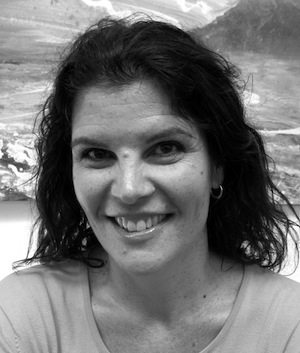
photo - Nicole Nozick
Nicole Nozick (photo from Nicole Nozick)

The board of directors of the Vancouver Writers Fest has appointed Nicole Nozick as executive director, effective June 22.

“Nicole brings to the Writers Fest extensive experience in festival management, journalism and communications, a collaborative approach to her work, and many business skills. We are excited to welcome her to our team,” said board chair Sandy Jakab. Nozick takes over from the Vancouver Writers Fest’s current executive director, Camilla Tibbs, who will move to her new role as executive director of the Richmond Gateway Theatre.

“I am honored to be joining the team at the Vancouver Writers Festival – a festival whose accomplishments I have long admired,” said Nozick. “With its sterling international reputation as one of North America’s premier literary events, the VWF is a cornerstone of Vancouver’s festival scene, well reflecting the energy, curiosity and vibrancy of our city. I am looking forward to working with the VWF board and artistic director Hal Wake, in co-leading this remarkable literary showcase that enriches the lives of so many.”

Nozick holds a BA in English from University of Cape Town and a post-graduate diploma in journalism from Tel Aviv University. Most recently, she was director of the Cherie Smith JCC Jewish Book Festival.

Posted on June 26, 2015June 25, 2015Author Vancouver Writers FestCategories Arts & CultureTags Cherie Smith JCC Jewish Book Festival, Nicole Nozick, Sandy Jakab, Vancouver Writers Fest, VWF

Posts pagination

Page 1 Page 2 … Page 6 Next page
Proudly powered by WordPress