בול לחנוכה

קנדה פוסט תנפיק לראשונה בול לחנוכה. (צילום: canadapost.ca)

רשות הדואר הקנדי קנדה פוסט תנפיק לראשונה בול לחג החנוכה שיחול השנה ב-12 בדצמבר. זאת במסגרת המדיניות החדשה של קנדה פוסט להנפיק בולים עבור חגים שאינם רק נוצריים. עד כה הנופקו השנה בולים עבור החגים המוסלמים ועבור החגים של ההודים. עד השנה במשך 150 השנה להיווסדות קנדה כל הבולים בנושא החגים היו קשורים רק לנצרות.

קנדה פוסט הדפיסה שלושה מיליון בולים לחנוכה ולפי התוכנית מצפים כי כמחציתם ימכרו לציבור הרחב תוך כשנה. הבולים ימכרו בחבילה של עשר יחידות במחיר 8.50 דולר. הבול לחנוכה צבעו כחול חציו כהה וחציו בהיר לסמן חושך ואור. הוא כולל ציור של חנוכיה גדולה ועל השמש מוצב מגן דוד. את הבול עיצבה אנג’לה קרטר מטורונטו, לאחר שהתייעצה מטבע הדברים עם רבנים ואנשי מפתח בקהילה היהודית.

יצויין כי ב-2011 קנדה פוסט הנפיקה שני בולים לחנוכה ועליהם תמונות של מנורה וסביבון, במסגרת הפרוייקט תמונות דואר. אז היה מדובר בניסוי והבולים הונפקו בכמות מוגבלת. ואילו ב-2010 קנדה פוסט ורשות הדואר של ישראל הנפיקו במשותף בול במלאת שישים שנה לייחסים בין קנדה לישראל.

נהיגה בהפרעה: המשטרה תפסה נהג שסלולר וטאבלט מחוברים להגה של רכבו

במשטרת ונקובר לא זוכרים מקרה כל כך חמור של נהג שהיה כל כך עסוק בדברים אחרים, בזמן שנהג. לפני מספר ימים שוטרי מחלקת התנועה עצרו נהג שנהג ברכבו רחוב קמבי לכיוון דרום, ונראה טרוד מאוד כאשר אוזניות צמודות לראשו. השוטרים הורו לו לעצור בצד הכביש וניגשו לרכבו ולתדהמתם הם ראו שמכשיר סלולר של אייפון ומחשב טאבלט של סמסונג, היו מחוברים בכבלים להגה של רכבו. עם זאת ציינו השוטרים ידיו של הנהג היו חופשיות ושתיהן הונחו על ההגה.

השוטרים הטילו על הנהג קנס של שמונים ואחד דולר בלבד לאחר שנכשל להציג להם את רשיון הנהיגה שלו (שלא היה עימו). במקום להטיל עליו קנס גדול יותר על נהיגה תוך כדי הסחה, שגובהו נאמד בכארבע מאות דולר, החליטו שוטרי התנועה כי זה יהיה הרבה יותר יעיל, להעביר את הנהג המכובד סדרת חינוך קצרה, ולהסביר לו עד כמה זה מסוכן לנהוג תוך כדי התעסקות בסלולר וטאבלט, במקום להתרכז בנהיגה ובמה שקורה בכביש שלפניו. האם הנהג האלמוני (המשטרה לא חשפה את זהותו) למד את הלקח? כלל לא בטוח.

מחלקת התנועה של המשטרה פירסמה בחשבון הטוויטר שלה את התמונה של שני המכשירים האלקטרונים הקשורים להגה רכבו של הנהג המדובר, והעניקו לה את הכותרת: “לא יכולים להמציא את זה”.

במשטרת התנועה מציינים כי לאחרונה הם תפסו מספר נהגים שנהגו תוך כדי הסחה, בהם אחד ששיחק פוקימון בסלולר שלו וקיבל קנס של כארבע מאוד דולר. לאחר מספר בלוקים אותו נהג שהמשיך שוב לשחק בפוקימון, קיבל פעם נוספת קנס דומה על אותה עבירה. במקרה אחר נהגת שיחקה פוקימון בטלפון שלה עם חברתה שישבה לידה, וגם היא קיבלה קנס בגובה כארבע מאות דולר. במשטרה אומרים עוד כי במספר מקרים ההסחה בנהיגה גרמה כבר לתאונות ולפגיעה בנפש וברכוש. לכן אגב בקורפוריישן הביטוח של בריטיש קולומביה (אי.סי.בי.סי) מעלים כל הזמן את מחירי ביטוחי הרכב. התובע הכללי של מחוז בריטיש קולומביה, דיוויד איבי, אומר כי אנו צריכים לגרום לשינוי תרבותי כאן כדי שהנהגים יבינו שנהיגה בכביש תוך כדי הסחה, דומה בחומרתה ובסכנות שצפונות בה כמו לנהיגה בשכרות, או לנהיגה במהירות מופרזת.

Drawing on identity, Judaism

Artist and graphic novelist Miriam Libicki is currently Vancouver Public Library’s writer-in-residence. (photo from VPL)

“I think that a lot of my stuff does end up having to do with identity, through both the books I’ve published and the one I’m in the process of starting to draw right now, as well. I’m very interested in identity and I’m interested in identity as something that can change,” Miriam Libicki told the Independent in a phone interview.

Libicki is Vancouver Public Library’s writer-in-residence this fall. Her first event was Sept. 14 and her teaching sessions have been consistently full. At her finale event Dec. 7, attendees will get a preview of her new work. Libicki will also be making appearances at the Cherie Smith JCC Jewish Book Festival, Nov. 26 and 30.

Both of her published books – jobnik! an american girl’s adventures in the israeli army (real gone girl studios, 2008) and Toward a Hot Jew (Fantagraphics Books, 2016) – have received acclaim. The former, which was based on the diary she kept during her service in the Israel Defence Forces, was a finalist for the Gene Day Award for Canadian self-publishing. The latter, a collection of graphic essays, won the 2017 Vine Award for Canadian Jewish Literature in the non-fiction category.

She attributes her curiosity about identity to her upbringing. “Part of it is the idea that I grew up in a very strong and defined community, which was Modern Orthodox Judaism, in the suburbs of the U.S., and yet, I always kind of felt that we were not the platonic ideal of Modern Orthodox American Judaism,” she said. “I guess, partially, because my mother was a convert, which, in some thought, is still kind of taboo, although, in the U.S., it’s very common … and that she was not ashamed or disparaging of where she came from at all, we were still very close with everyone in her family…. She was never somebody who preached that Modern Orthodoxy was the only way to live a moral life.”

This led to some tension, said Libicki, who went to an Orthodox day school. “Also, in my teens, being very attuned to hypocrisy – as many teens are – when people are doing things so much differently than what they preach,” it was challenging. “And then, going to Israel and finding that the social categories were completely different again, that Orthodox was a certain other thing,” raised other questions, such as, “Is religion a belief or is it a social category?”

Libicki spent four years in Israel “trying to be an Israeli.” But, she said, “I was constantly judging, with my over-analytical and insecure mind, whether I was succeeding at being an Israeli or whether I was doing something wrong. And then, I ended up leaving Israel and felt very ambivalent about that…. I think that that has driven a lot of my comics.”

Now living in Coquitlam and a mother of two, Libicki said, “I’m sending my kids to school and that involves a whole other declaration of identity.”

She and her partner, Mike, have a daughter, who just started kindergarten at Vancouver Talmud Torah, and a son, who is 2. “I’ve always … wanted to send my kids to Jewish school – I’m not ambivalent about it,” she said.

Libicki’s current project – the one people will get a peek at on Dec. 7 – focuses on the exodus of Jews from the Soviet Union as it was collapsing in the late 1980s and early 1990s. She has finished the script, she said, which is about “232 pages at this point. And now I’m starting to break it down into thumbnail drawings and starting to draw the first few pages of it.”

Of those Jews who emigrated, she said, about half went to Israel and just under half came to the United States, with the rest going to Canada, Australia and elsewhere. “My town – Columbus, Ohio – which was not a huge Jewish community, although we had five synagogues and a private day school, got a big influx of families … so my little Jewish day school, which was very small, was about a third to two-fifths Russian-speaking by the time that I was in high school. When I was in kindergarten, there were no Russians and then, by the time I was in middle school, there were lots. Growing up, my community was not very diverse and it was interesting to see this whole other community fall into the middle of my community.”

Libicki conducted the initial research for this project for her master’s in creative writing, which she recently completed at the University of British Columbia. For her thesis, she said, “I went back to Columbus and I interviewed a lot of people that I went to high school with, that I’d lost touch with, most of them immigrants, kids who came in the ’90s.

“My parents had moved to Ashkelon … in a community in Israel that I thought was somewhat analogous [to Columbus] in that it’s not a big or culturally important town, but it also absorbed a lot of immigrants in a short time. I tried to find a sociologically equivalent sample of Russian immigrants in Israel, who had come at the same time and had all gone to the same high school together in Ashkelon, and I interviewed them.

“Those interviews, and other people’s flashbacks, make up a big part of the book. And then, in with that, I also have the part where I’m analyzing it and deconstructing it through different lenses, and I also have my current-day life of trying to figure out what I am and what my family is, and children are.”

While jobnik! is mainly autobiographical, Toward a Hot Jew – a collection of essays written over the space of about 10 years, starting in 2005 – is a mix of autobiography, cultural commentary and analysis. In both books, Libicki doesn’t shy away from difficult topics, and is quite candid about her feelings, sexuality and other sensitive issues.

“A lot of my favourite writers do that and a lot of my favourite cartoonists, so that’s why I felt from the beginning that I should do this. I like reading memoir, and you can tell when people are trying to let themselves off easily or inflate something or avoid talking about something,” she said. “Obviously, nobody talks about everything, but I think you can tell in some memoirs when there’s a certain topic that really is germane and it’s being avoided or it’s being glossed over versus when somebody tries to confront something with honesty and openness. Since I liked reading that stuff, that’s what I wanted to write.

“I don’t think I’ve had too many regrets about doing that. One thing is that it does help to write about people who are far in the past, although this current book, it will have scenes from my current-day life, so I’m going to have to – I’ve been avoiding, actually, showing pages to my partner, but I’m going to have to do that before submitting it to publishers.”

When Libicki was discharged from the IDF, she applied to a few art schools and universities, in Israel and the United States, as well as a non-art-related university in Seattle, which she chose because she had friends in the city. She and her now-husband, who was based in Vancouver, had mutual friends. After about a year of dating, seeing each other on weekends, he suggested she apply to art school in Vancouver.

Libicki enrolled at Emily Carr in 2003 and now teaches at her alma mater, though her main job at the moment is being VPL’s writer-in-residence. “It’s a temporary thing but it’s a full-time job,” she said.

Writers-in-residence spend about 60% of their time on their own writing, she explained, and about 40% interacting with the public, in workshops, lectures and advising people on their writing projects. She has a studio at VPL, to which she commutes from her home in Coquitlam.

As to what led her to the graphic novel form, she said, “It’s something that just kind of happened. It happened while I was in undergrad. I always read comics. I was a big fan of comics, and I was a fan of more alternative and literary comics that started to come out, essentially, in the ’90s and beyond. But I never thought I’d make comics because whenever I had an idea, I didn’t follow through, and the idea of drawing the same character over and over and over was not something I thought I could do. But, I really wanted to be an artist. I drew a lot of portraits…. I thought I might be a children’s book illustrator. So, when I went to art school, I was just thinking of doing a drawing major but then I did one comics art class.”

In that class, she said, she used one of the entries from the diary she kept while in the Israeli army – “I’d had a particularly eventful and bad week, and adapted that into a five-page comic.”

The response to that work – which grew into jobnik! – was positive. “People were curious, they said they wanted to see more of my army stories, and it seemed like a better way to talk about my experience,” she said.

During undergrad, she started doing more comics, and the title essay in Toward a Hot Jew – about “the Israeli soldier as fetish object” – was created as her senior project in art school. Not only did she want to write a research essay that people would actually read, she said, “I wanted to do something that I could use pictures … as part of my argument that I was making, add a nuance through the drawings, as well.”

Libicki said she writes “in a pretty systematic way,” starting with brainstorming, “then I’ll do an outline, then I’ll break down my outline into pages and do a map of it that way, then I’ll do a script and then I’ll do thumbnails and then I’ll move on to art.

“I guess that a lot of people who do any creative endeavour have a lot of anxiety around it and fear that, every time you start a new project, perhaps you’ve forgotten how to do this, so I try to break down my practice into as many small steps as possible, so each one will not be as scary,” she said.

And, a shorter project is something she can put together for a comicon. For example, she created The Quotable Mered – based on tweets she had written about cute things her daughter had said – specifically for VanCAF (Vancouver Comic Arts Festival), a free, annual two-day event that has taken place at the Roundhouse since 2012.

The genre – which she described as “daily journal comics or comics about a small theme” – was something she had never done before, and she wanted to try the style, as well as drawing a bit more loosely and “writing to a punchline.”

“It was an experiment, and I did learn things from it,” she said. “I might do one of those again but I just have so many things to do.”


Granirer exhibit, book linked

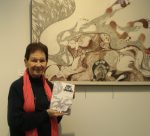
Pnina Granirer’s current art exhibit, which is at the Zack Gallery until Dec. 12, features work highlighted in her memoir, Light Within the Shadows. (photo by Olga Livshin)

Pnina Granirer has always been an experimenter. She enjoys trying new artistic techniques, forms and directions. Consistently ignoring the trends, she has forged her own path towards meaning and beauty.

Granirer’s memoir, Light Within the Shadows, was launched on Nov. 16, as part of the Cherie Smith JCC Jewish Book Festival. The event was held in conjunction with the opening of her solo show at the Zack Gallery. As the exhibit includes some of the same paintings and drawings Granirer highlighted in the memoir, it serves as a mini-retrospective of her artistic life.

“People often told me, you had such an interesting life, you should write about it,” she said in an interview with the Independent. So, she did. “I wrote bits and pieces over the years, but my painting always interfered. I’d get distracted by a painting or a series and I would forget what I wrote before. I realized that I couldn’t paint and write at the same time.”

The concept of time is significant. “Time is what differentiates visual art from any other creative expression, like writing or music,” she explained. “According to some research, people in a museum spend an average of three seconds in front of a painting. But, to read a book or listen to a symphony or watch a movie, they have to spend hours. The same is true from the creator’s point of view. When I look at my painting, I see everything at once, all the details. I know what and where I have to fix. But, when I looked at my manuscript, I needed to read from the beginning to remember the details I had written in the previous chapters. I needed time.”

To solve this dilemma, she stopped painting about four years ago to concentrate on writing. “I wanted to tell my story and, for that, I needed words. Painting wasn’t enough anymore,” she said.

Granirer started by reading a number of memoirs. She took creative writing classes. She delved into history and studied old family photographs, while researching her family roots. And she wrote.

“By 2015, I had a very long manuscript, but I still didn’t have the ending. Then, in June 2015, we visited Romania, the country of my birth, for the first time in 65 years. When we came back, I ended up in a hospital. Had two surgeries. Suddenly, I knew what the ending was. I was fortunate. Serendipity is the new motto of mine. Of course, my life was not all roses, but I cherished everything good that happened to me.”

A consummate professional in everything she does, Granirer knew that finishing a manuscript was only half the job. “I needed to structure it in a way that would make sense,” she said. “I decided on a story in three acts to highlight the three stages of my life, three languages, three countries: Romania, Israel, North America.”

She also had to deal with one of the most important considerations for any memoir writer: the people who feature in the book, especially the ones who are still alive. Granirer was very sensitive about the issue. “When you write a memoir,” she said, “you have to think about other people’s feelings, of course, but it was my book, my life. I tried to avoid offending anyone, but I felt I had to be as honest as possible. I didn’t lie. If I couldn’t say anything nice about someone, I often skipped that person. I did mention some disappointments in the book but, mostly, I focused on how lucky I was.”

After that, it was time for test readers. “I asked a few people to read the manuscript, and the feedback was very encouraging. Then I found a wonderful editor – Pat Dobie. She did a stellar job. She cut off about half the text, everything that wasn’t my story, but rather historical background or stories of the other members of my family. Pat said it takes the reader away from my story. She also rearranged some sections and paragraphs to make the flow better.”

The next step – publication. Again, Granirer embarked on a period of extensive research. “I thought about traditional publishing and contemplated looking for an agent, but I didn’t have the time,” she said. “I’m in my 80s. When you send a book to an agent or a publisher, you have to wait for a year to get an answer, and it might not be a yes. But, even if it is, and they accept it, it would take another year or two until publication.”

To skip that waiting time, she published the book herself, with the help of Granville Island Publishing. “They were great,” said Granirer.

Yet more research was needed to choose the right title and the right cover. Of course, the cover would be one of her paintings; that was never in question. It was an artist’s memoir after all. But which painting? After browsing through her archives, Granirer finally picked the painting that became the cover. “It has my son’s footprints, when he was young, like a child’s journey. It seemed fitting,” she explained.

Selecting which illustrations should accompany each of her story’s three phases was another crucial task. “Some of the paintings I included are still in my studio, others have been sold, but I have the JPG files,” she said.

Now, she is deeply involved in the next stage of the publishing business – promotion. As she does everything in her life, she approaches it with panache and determination. In her publishing endeavour, like in her art, she is aiming for total success.

Granirer’s art is at the Zack until Dec. 12.

Olga Livshin is a Vancouver freelance writer. She can be reached at olgagodim@gmail.com.

Volumes in the silence

Jewish Voice for Peace held a discussion on antisemitism recently at the New School in New York City and the panel included Linda Sarsour, whose associations and opinions, particularly about Israel and Jews, are controversial.

The school defended its choice by saying that there are “differing views on the issue of antisemitism,” a Trumpian formulation on par with the idea that there are good people on both sides of every issue.

Sarsour, a daughter of Palestinian-American immigrants, rose to national prominence as a co-chair of the Women’s March earlier this year and was dubbed by Politico as “the face of the resistance” to Donald Trump.

She is also highly controversial. When she got into a public spat with ex-Muslims Ayaan Hirsi Ali and Brigitte Gabriel, Sarsour tweeted, “I wish I could take their vaginas away – they don’t deserve to be women.” (Hirsi Ali was subjected to female genital mutilation at the age of 5 in her native Somalia.)

Sarsour is particularly opinionated about Israel. She claims that Israel has a right to exist, but does so in the context of a “one-state solution” that would eliminate Israel’s Jewish identity. She supports the boycott, divestment and sanction movement and has defended sharing a stage with Rasmea Odeh, a terrorist involved in murdering two Israelis and wounding nine others. She has tweeted that “nothing is creepier than Zionism” (nothing?!) and said it is not possible to be a Zionist and a feminist.

So it was a point of contention when Sarsour was invited to join a panel on the subject of antisemitism. Yet Sarsour has something to say that everyone should listen to closely.

She says that antisemitism is “different than anti-black racism or Islamophobia because it’s not systemic.” As one commentator noted, what was more “systemic” than the Holocaust? But Sarsour was making a legitimate case: Jews in 21st-century North America do not suffer systemic economic disadvantage due to their Jewishness. Jews are no longer precluded from housing, universities or any place in the public realm because of their identity. Jews are not randomly pulled over and shot by police. Jews do not experience lower wages or lesser positions of employment because of their identity.

Antisemitism isn’t routinely expressed in the same ways as most other common forms of prejudice and discrimination. However, this doesn’t mean it doesn’t exist or should be dismissed.

Whether left, right or centre, most of us now accept an economic definition of discrimination: lower standards of housing, employment, opportunity and outcome. But antisemitism doesn’t manifest in these ways. However, it can manifest in hate speech, attacks on synagogues and other Jewish institutions, and physical assault. It can lead to genocide, as it has within the memory of the living generation. It can result in the ethnic cleansing of Jews from almost every Muslim-majority country on earth over the course of a couple of decades.

So, antisemitism is not a benign force, even if it does not fit the parameters we now widely use to identify and measure discrimination. In fact, it is, in itself, a form of discrimination to ignore the uniqueness of antisemitism.

Antisemitism can also take the form of a movement to eradicate the national homeland of the Jewish people. There are reasons to criticize Israel, but to argue that Jewish people are the only people in the world not deserving of national self-determination is problematic.

At the heart of the anti-Zionist movement is an imagined firewall between antisemitism and even the most extreme condemnation of Israel, including calls for it to be eliminated. It is fair to make the case that criticism of Israel is not necessarily influenced by anti-Jewish animus. But this is not the case being made by people like Sarsour. Their position is that there is effectively no connection at all between anti-Zionism and antisemitism and that any suggestion of a connection is a strategy to “silence” or discredit criticism of Israel.

The idea that opinions, stereotypes or prejudices about Jews play no role in perceptions of the Jewish state is unreasonable. If there is anything that should cause skepticism toward Sarsour and those like her, it is the stalwart refusal to even consider the presence in their worldview of prejudice about Jews. If any other group of people in the world so much as suggested that they were affected by bigotry or discrimination, people like Sarsour would take these concerns seriously. When Jews make this suggestion, it is rejected outright and labeled a ploy to win a political argument. This, in itself, speaks volumes.

Balfour is but one milestone

This year marks the 100th anniversary of the Balfour Declaration, a cause for commemoration and even celebration on the part of Jewish activists worldwide.

The Balfour Declaration refers to a short letter from Lord (Arthur) Balfour, former U.K. prime minister and then-foreign secretary, to Lord (Lionel Walter) Rothschild. In it, Balfour declared that the British cabinet had approved a statement that the government favoured the establishment of a Jewish national home in what was soon to become the British Mandate of Palestine.

The implications of the declaration have been debated by pro- and anti-Israel activists for, well, an entire century. For many in the pro-Israel community, the declaration is akin to a Magna Carta for the Zionist movement: an affirmation – from the very authority that would oversee the territory – that Zionism was indeed a worthy enterprise.

Without diminishing this sentiment, I offer my interpretation of the Balfour Declaration and what it teaches us about pro-Israel advocacy today.

The Balfour Declaration was a strategically vital recognition of the right of the Jewish people to self-determination – and one that clearly affected the course of history. But Balfour did not establish our national rights, which pre-existed the declaration. These rights have always been rooted in the natural right of every nation to shape its own identity and achieve self-determination in its ancestral land.

This is not a minor distinction. We dare not confuse the validation of our rights with the source of our rights. Indeed, our detractors falsely do so. In their minds, if the Balfour Declaration can be dismissed as a “colonial” statement, the rights of the Jewish people to which it speaks can be similarly undermined.

It’s this sort of nonsense that suggests Jewish history in the land began in 1917. To believe it, one would have to ignore the mountains – and caverns – of archeological and historical evidence that confirm a Jewish presence in the land for millennia. In addition to various non-biblical documents confirming Jewish indigenous roots in Israel, the Bible itself is widely recognized – even by ardent atheists – as a historical chronicle of a particular people in a particular land.

As Shimon Koffler Fogel, chief executive office of the Centre for Israel and Jewish Affairs (CIJA), recently observed, the Balfour Declaration was “one milestone among many that confirm the moral, historic and legal right of the Jewish people to self-determination in our ancestral land. Just as many states endorsed the Balfour Declaration at the time, the international community’s support for the national liberation of the Jewish people after centuries of exile has been expressed time and again.”

Fogel further noted that, in a similar vein, November also marks “the 70th anniversary of the UN partition resolution of 1947, which expressly called for the creation of a Jewish state.”

The Balfour Declaration matters today precisely because it is more important than ever that we show how our fundamental rights as a people are backed by international consensus. The declaration is not the linchpin of this recognition but rather a signpost on the road to achieving widespread affirmation of our rights.

Every year, CIJA brings approximately 200 Canadian leaders and future leaders (almost all of whom are non-Jewish) on fact-finding missions to Israel. As someone who heads an annual trip of post-grad students, I can tell you that most Canadians – including those sympathetic to Israel – are not particularly interested in what a British lord had to say about the region a century ago.

But what they do care about, and what makes them more receptive to understanding the strong legal and moral foundation for Israel’s existence, is that many global figures and organizations (including the United Nations) have echoed these rights. In this regard, Balfour is an important thread of the historic fabric.

The importance of non-Jewish validators applies to many pro-Israel advocacy issues, such as Israel’s right to define itself as a Jewish homeland, the dangers of BDS (the movement to boycott, divestment from and sanction Israel) or the threat posed by Israel’s neighbours. On these and other topics, our target audience is generally more receptive to our perspective when we can demonstrate that it is one shared by others, including governments and leaders around the world.

Balfour matters, but we should remember why. The declaration serves not as the basis for modern Israel’s existence but as a key witness to the abundant evidence – irrefutable, millennia-old proof – of the right of the Jewish people to self-determination.

Steve McDonald is deputy director, communications and public affairs, at the Centre for Israel and Jewish Affairs. Follow him on Twitter at twitter.com/koshermcdonald.

JI gets Rockower, Shore a WIBA

The Jewish Independent is among the winners of this year’s American Jewish Press Association Rockower Awards for Excellence in Jewish Journalism. The awards were presented at the AJPA annual conference, held in conjunction with the Jewish Federations of North America’s General Assembly in Los Angeles, Nov. 13-15.

The JI won first place for excellence in editorial writing for a trio of opinion pieces: “Let’s talk about Nini …” (Feb. 26, 2016), “Much more yet to learn” (Oct. 7, 2016) and “Inspired by Standing Rock” (Dec. 9, 2016). Placing second in the same circulation category (14,999 and under) was Intermountain Jewish News, based in Denver, Colo.

About the Independent’s “Let’s talk about Nini …” submission, the AJPA’s Rockower jury commented that it demonstrated “great writing, clear intent and galvanized a call to action in support of Jewish Federation’s decision to host an Israeli singer with controversial political views. Readers took heed.”

The editorial “Much more yet to learn” was about the need for Holocaust education and “Inspired by Standing Rock” connected the story of Chanukah, “of standing for one’s beliefs (and existence) and triumphing in the end,” with that of the protesters in North Dakota, who stood up against the U.S. government’s plans to run an oil pipeline through a cemetery and under a water reservoir near the Standing Rock Sioux Reservation.

***

Jewish community member Paul Shore of Whistler won this year’s Whistler Independent Book Awards (WIBA) non-fiction prize for his memoir Uncorked, set within the rampart walls of a village in Provence. Farida Somjee of Vancouver won the WIBA fiction prize for her novel The Beggar’s Dance, set in the streets of coastal Africa.

The winners were announced by WIBA organizers Lynn Duncan and Kilmeny Denny at the Whistler Writers Festival’s improvisational Literary Cabaret at the Maury Young Arts Centre. Two-time winner of the Stephen Leacock Medal for Canadian Humour Terry Fallis said, “It is wonderful to see talented, up-and-coming, independent authors recognized. It is a challenging process to start out on your own and work to have your creativity discovered.”

“In Uncorked, Shore’s use of the game of pétanque as a point of entry to address areas of personal alienation is a great literary and narrative choice,” said J.J. Lee, one of the judges for the non-fiction award, and CBC radio host, author and Governor General’s Literary Award finalist. “This memoir made me laugh; especially Paul’s foil Hubert, who is a star. And its funny and illuminating stories contain a soul that is touching, too!”

[For the Independent’s review of Uncorked, click here.]

Why I collect

I never set out to be a collector. Whenever I read about millionaires with fabulous private collections of art and sculpture, I thought, why not just keep a few pieces you really love and give the rest on loan to a museum or gallery so that others can share their beauty?

Yet, I find now that I do have collections. They’re not worth any money and probably no one else would want them. Most people in my age group have accumulated possessions they can’t bear to part with, despite moving homes and maybe even countries several times in their lives.

Who remembers that song of yesteryear: “Among My Souvenirs”? Part of the lyrics were: “Some letters tied with blue, a photograph or two, I find a rose from you, among my souvenirs.”

What we are collecting are memories. There are moments we want to hold on to forever and, when we handle these mementoes, they bring a smile, a tear, a bittersweet wave of nostalgia.

I have more than a thousand books, and nowhere to put them all. Many are paperbacks, yellowed pages and tattered covers. But, to throw them out would be like disposing of dear friends. Lots of poetry – some by almost-forgotten writers like Alice Duer Miller, Rupert Brooke, A.E. Housman, Dorothy Parker. Novels by Somerset Maugham, Evelyn Waugh, Hemingway, Steinbeck. Volumes of Jewish essays, which provide great divrei Torah. Books on philosophy, psychology, the craft of writing. They all represent my youth, when I discovered the world and the wonders it contained. No, I can’t throw them away!

Then there are the photos. They started out in albums, but there are too many and I’m too lazy. Beloved family no longer with us. Friends from long ago. Weddings. Babies, bright-eyed and dimpled. Rites of passage – first day at kindergarten and school, b’nai mitzvahs, graduations. Grandchildren. Holidays. They are all cherished, and overflow from drawers and cabinets.

Bric-à-brac. One earring (the other lost), given by my first boyfriend. Small children’s drawings. Their clumsy efforts at making you things from wood or papier mâché. A challah cloth with crooked stitches. A letter on a torn page that proclaims in shaky Hebrew letters, “Savta, I love you.” How could you ever toss those?

I also have a collection of shells and rocks. Most were gifts from grandchildren who wanted to give me something in return for the toys I gave them. There is a pinecone. There are stones I gathered at the Dead Sea on my sister’s last visit, when we spent a perfect, quiet day together, exchanging memories of our parents and siblings, our childhood, the dreams we realized and the ones we lost along the way. All precious. All irreplaceable.

“Get rid of the clutter,” we’re told. Not me. I shall go on collecting mementoes and memories until I die. And I hope my children, even then, will save a few of them. Because some things are worth more than money.

Dvora Waysman is a Jerusalem-based author. She has written 14 books, including The Pomegranate Pendant, which was made into a movie, and her latest novella, Searching for Sarah. She can be contacted at dwaysman@gmail.com or through her blog dvorawaysman.com.

Much is new at VHA

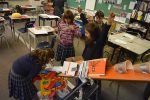
Teacher Lisa Altow’s Grade 5 students at Vancouver Hebrew Academy build a machine, using a variety of household treasures. (photo by Shula Klinger)

Vancouver Hebrew Academy has a new principal of general studies this year. As well, the school site is being upgraded, with new classrooms and a brand new playground on their way.

Rabbi Don Pacht, head of school, works with two under-principals, one for secular and one for Jewish learning. Rabbi Tzvi Goldman is principal of Judaic studies and the new principal of general studies, Adam Zalba, rounds out the team.

Zalba’s role is to ensure that the students’ work meets the requirements of British Columbia’s provincial curriculum. Pacht describes Zalba as “incredibly personable. He’s one of those people that are just meant to work with children – you can tell right away.”

Zalba told the Independent he has had a “busy and eventful couple of months” at VHA. This is the first Jewish school he has worked at, and he said he has been impressed by “the professionalism, dedication and work ethic” of the teachers, as well as the support of the parents. He finds the children to be a “bright, inquisitive and joyful student body, with a thirst for knowledge.” In taking an active interest in the students’ social and emotional development, he looks forward to helping them on their way to becoming “caring, respectful and thoughtful citizens.”

“Our vision for VHA is excellence in both Judaic and general studies,” said Pacht. “We want students to be ready for whatever they choose next. For some, it’s intensive Judaic studies; for others, it’s King David or Pacific Torah Institute.” For example, Grade 7 students Chaya Yeshayahu and Devorah Leah Yeshayahu are considering Vancouver’s Shalhevet Girls High School, but are also looking at some out-of-town options, as well.

Of the two strands to the curriculum, Pacht said, “We’ve taught them to read and decode the Chumash, but we’ve also taught them to be analytical learners, for Talmud, for social studies. We strive to give them the tools they need to grow and connect with the outside world, through independent study. At 12, they leave VHA with a really solid set of foundation skills.”

VHA has been at its current site for 15 years, during which time the only upgrade has been the addition of portable classrooms. The property is owned by the Vancouver School Board, said Pacht. “For the last four years, we’ve been on a year-to-year lease,” he said. Recent lobbying at the VSB and the ministry has resulted in a new, eight-year lease. “That’s a generation in the life of an elementary school, where kids coming into preschool now can graduate from this building.”

The portables will be replaced with new modular buildings that are set up with a fast, efficient internet network. Construction for the buildings will start off-site within the next few weeks and the structures will be brought onto the property after school ends in June.

The old wooden playground structure will be dismantled at the end of this month, to be replaced shortly afterward by new, wheelchair-accessible equipment.

To fund these improvements, the school has fundraising plans, including its annual garden party, held in the summer. Pacht describes the party – which is hosted at a private home – as “a very relaxing and enjoyable event.”

Speaking of the funds needed to complete the necessary upgrades, the rabbi said, “We want to use them for the best purpose, to create the best learning environment possible.”

Shula Klinger is an author and journalist living in North Vancouver. Find out more at shulaklinger.com.

Canadian Jewish history

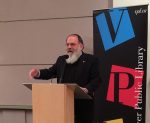
Rabbi Dr. Yosef Wosk was the keynote speaker at the Vancouver exhibit. (photo by Cynthia Ramsay)

The Canadian Jewish Experience traveling exhibit opened at the central branch of Vancouver Public Library on Nov. 16. The display is presented by the Jewish Museum and Archives of British Columbia, the Centre for Israel and Jewish Affairs, Jewish Federation of Greater Vancouver and VPL.

The opening event was hosted by Michael Schwartz, JMABC director of community engagement. Kayla Epstein, VPL board chair, and Karen James, Jewish Federation board chair, said a few words, as did Tova Lynch, who led the committee that created the exhibit, which opened in April in Ottawa. The multi-panel display celebrates the history of Jews in Canada and was made for the occasion of the 150th anniversary of Confederation. The set that is on display at VPL has an additional panel dedicated to the B.C. Jewish community.

“To date, we have created 15 various sets [of the exhibit] that are traveling around the country,” said Lynch. To date, it has been to 35 places, and is scheduled for more, including a push to have it on university campuses. Among the major supporters of the exhibit, she said, are Fred Belzberg and Sam Belzberg. She thanked the Belzbergs, who couldn’t attend the event, as well as Rabbi Dr. Yosef Wosk, whose contributions, she said, made the event possible.

Wosk was also the keynote speaker. He spoke of the importance of books, of stories, of the relative youth of Canada as a nation and about the Jewish community’s participation in national life. He expressed gratitude for living in a country that is safe for Jews and other minorities, but also recalled that it wasn’t always so and that immigrants today still face problems.

The Hon. Dr. Hedy Fry, member of Parliament for Vancouver Centre, offered greetings from Prime Minister Justin Trudeau, as well as her own comments on the contributions of Jewish and other immigrants to Canadian society.

The Canadian Jewish Experience is on view at VPL until Nov. 30.

Seniors are a growing force

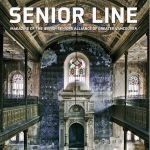
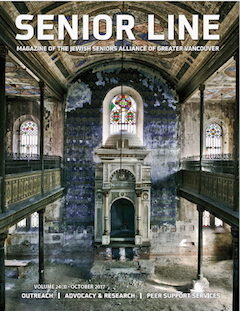
Jewish Seniors Alliance of Greater Vancouver publishes its own magazine, Senior Line, three times a year.

During the 20th century, thanks to advances in medicine, technology and quality of life, average life expectancy in the Western world increased by 30 years. Adults of the retiring age are now the fastest-growing segment of the population. The 2016 Canadian census showed more seniors (5.9 million) than school-age children (5.8 million). And the majority of these seniors are healthy and active, willing and able to share their knowledge and experience with the wider world.

Unfortunately, many people still apply the same negative stereotypes to older folks as we did decades ago: wrinkled, grumpy, fragile, forgetful, out of touch with reality, a burden and so on. Although “wrinkled” is mostly true, the rest is not, overall. We, society at large, need to change our views and policies towards the elderly, and how we treat the senior population.

“The most pressing issues seniors face are loneliness and isolation, retaining financial independence, staying involved and being physically active,” Ken Levitt, president of the Jewish Seniors Alliance of Greater Vancouver (JSA), told the Independent. He added to that list the lack of affordable or subsidized housing for seniors, inadequate nutrition, and the need to successfully manage personal health problems. He talked about protecting seniors from financial predators, including greedy relatives and unscrupulous investment counselors.

“This broad scope of issues affects all seniors, not just Jewish,” he said, “And the solutions should be all-encompassing, on the federal level. Poverty is a symptom of a greater problem, and we must address the cause. What we do now is just patchwork, temporary solutions.”

magazine cover - Senior LineJSA does what it can to ease seniors’ problems, given the limits of its budget. It has about 400 registered members and publishes its own magazine, Senior Line, three times a year. “The articles deal with issues and challenges relating to seniors,” Levitt explained. “These issues are not only discussed, but we make recommendations for their amelioration.”

The alliance also offers outreach programs, advocacy and research into the problems of seniors, and peer support services. “JSA advocates senior issues through a number of organizations, including the Council of Senior Citizens Organizations of B.C., the B.C. Health Coalition and the B.C. Poverty Reduction Coalition,” said Levitt.

About JSA’s peer support services, Levitt said, “We have 150 trained volunteers in the peer support services. Each one of them undergoes 55 hours of special training – 11 five-hour sessions. These volunteers offer friendly visits to seniors who are lonely. They answer phone calls. They can’t solve all the problems by themselves but they can help others to solve a variety of problems. They help those in need to reconnect with community. They provide bereavement support, when necessary. That they are seniors themselves adds credibility to their recommendations.”

Of course, there is always more to be done. “We have more demands for our services than we can meet,” said Levitt. “If we secured more funding, we could train more volunteers and expand the peer support services. We could hire more staff.”

He added, “We could, perhaps with a partner agency, create something similar to the Cumming Centre in Montreal. It is a dedicated community centre for seniors. Such a centre could offer comprehensive services, recreational and social programs, and rehabilitation after a stroke. It could offer a wide range of programs for persons with Parkinson’s, aphasia, arthritis, mental illness, etc. The aim would be restorative and maintenance or prevention.”

JSA is engaged in networking to start something similar in Vancouver. “We don’t have to start all these programs at once. We can start small and build up from there,” said Levitt. “Bits and pieces of such programs are already in place at different locations and organizations – we should concentrate them in one place. But, to establish such a centre in Greater Vancouver, there would need to be more cooperation amongst agencies, a willingness to share their services and resources.”

JSA’s funding comes from a variety of sources, from private donations and foundations, plus government grants. About 10% of its funding comes from the Jewish Federation of Greater Vancouver.

Shelley Rivkin, Federation’s vice-president of planning, allocations and community affairs, said that 14% of Federation’s allocations go to seniors. “We fund agencies, not individuals,” she said. “In 2016, all our partner agencies received an increase in their allocation as a result of an increase in the overall campaign. The increase to seniors was approximately two percent, which was consistent with the other increases…. Federation funding for seniors goes to the following agencies: Jewish Family Services Agency (JFSA), contribution toward their seniors department; JCC [Jewish Community Centre of Greater Vancouver], contribution toward the JCC seniors programs [and] we also cover the rent for the JCC L’Chaim program; Kehila [Society], contribution toward their seniors wellness program and the Richmond bus, which takes Richmond seniors to programs; and JSA, contribution toward their advocacy and peer counseling programs.”

Rivkin added, “We provide JFSA with funding for financial support to clients, including assistance with food vouchers and rents. A growing number of those clients are seniors.”

She explained that, while 14% of the funds “are specifically directed toward programs serving seniors, approximately 30% of our funding goes to social services. Seniors who are recipients of social services benefit through these programs also.”

And Federation is trying to help local seniors who face poverty. “According to the 2011 National Household Survey,” Rivkin said, “there are approximately 4,500 seniors in our community, and 16% of them have been identified as living below the low-income cut-off. The majority of them are older, unattached women. We are looking at issues of seniors and poverty through the Food Security Task Force and we intend to hold a forum on seniors in 2018 to gather community priorities.”

Olga Livshin is a Vancouver freelance writer. She can be reached at olgagodim@gmail.com.