Skip to content
  • Home
  • Subscribe / donate
  • Events calendar
  • News
    • Local
    • National
    • Israel
    • World
    • עניין בחדשות
      A roundup of news in Canada and further afield, in Hebrew.
  • Opinion
    • From the JI
    • Op-Ed
  • Arts & Culture
    • Performing Arts
    • Music
    • Books
    • Visual Arts
    • TV & Film
  • Life
    • Celebrating the Holidays
    • Travel
    • The Daily Snooze
      Cartoons by Jacob Samuel
    • Mystery Photo
      Help the JI and JMABC fill in the gaps in our archives.
  • Community Links
    • Organizations, Etc.
    • Other News Sources & Blogs
    • Business Directory
  • FAQ
  • JI Chai Celebration
  • JI@88! video

Recent Posts

  • Story of Israel’s north
  • Sheltering in train stations
  • Teach critical thinking
  • Learning to bridge divides
  • Supporting Iranian community
  • Art dismantles systems
  • Beth Tikvah celebrates 50th
  • What is Jewish music?
  • Celebrate joy of music
  • Women share experiences 
  • Raising funds for Survivors
  • Call for digital literacy
  • The hidden hand of hate
  • Tarot as spiritual ritual
  • Students create fancy meal
  • Encouraging young voices
  • Rose’s Angels delivers
  • Living life to its fullest
  • Drawing on his roots
  • Panama City welcoming
  • Pesach cleaning
  • On the wings of griffon vultures
  • Vast recipe & story collection
  • A word, please …
  • מארק קרני לא ממתין לטראמפ
  • On war and antisemitism
  • Jews shine in Canucks colours
  • Moment of opportunity
  • Shooting response
  • BC budget fails seniors
  • Ritual is what makes life holy
  • Dogs help war veterans live again
  • Remain vital and outspoken
  • An urgent play to see
  • Pop-up exhibit popular
  • An invite to join JWest

Archives

Follow @JewishIndie
image - The CJN - Visit Us Banner - 300x600 - 101625

Month: June 2023

איך משיגים ויזה להגר לקנדה – חלק ב

כידוע ישראלים רבים מבקשים לנסוע לקנדה עבור לימודים או כדי למצוא עבודה. אשרותהכניסה לקנדה משתנות לפי המטרה שלשמה אתם מעוניינים להיכנס למדינה

עבור כל מבקש ויזה הדבר החשוב ביותר לרשות ההגירה המקומית הוא להבין שהוא לא מעוניין להישאר בקנדה מעבר לזמן המוגדר שאותו הוא ביקש. בין אם מדובר בלימודים, עבודה או טיול, חשוב להציג הוכחות שמראות שיש סיבות מספיק טובות מדוע המבקש מעוניין לחזור בחזרה לישראל. ככל שהמבקש יציג הוכחות טובות יותר לכך שהוא אכן מתכננים לחזור לישראל, כך יגבר הסיכוי שרשות ההגירה תעניק לו את האשרה הרצויה. לאור זאת, הצגה של מסמכים המציגים מקום עבודה בארץ, מוסד להשכלה גבוהה שבו המבקש מתכנן ללמוד וכיוצא בזה, מגבירים את הסיכוי לקבלת האישור המיוחל

מי שמעוניין להישאר בקנדה מעבר לחצי שנה – מוטל עליו להציג מסמכים רפואיים . המבקש נדרש להציג מסמכים שבהם המצב הבריאותי שלו מפורט. הממשלה הקנדית לא מעוניינת בכניסה של אנשים חולים אליה, בין אם מדובר בחולים שיכולים לפגוע באחרים ובין אם בחולים שעלולים ליפול לנטל על בתי החולים המקומיים ומערכת הבריאות. בנוסף ממשלת קנדה מעוניינת לוודא שיש למבקש יכולת להתקיים כלכלית במשך כל תקופת השהייה שלו במדינה. יהיה עליו להציג הוכחות ליכולת הזו, לרבות כלכלה של כל המשפחה שעימה הוא מגיע לקנדה. עבר פלילי עשוי להוות בעיה לקבלת ויזה ואפילו לקבלת אישור ראשוני. על כן, במידה והמבקש הוא בעל עבר פלילי, מומלץ להתייעץ עם עורך דין בעל ניסיון בתחום כדי לוודא שזה לא מהווה מכשול בתהליך

כדי לקבל את הויזה בשלב הראשוני,  יש להגיש את בקשה בטופס מקוון באתר של שגרירות קנדה בישראל. השגרירות נמצאת בתל אביב אולם אין צורך להגיע אליה. אם המבקש מתקשה בשפה האנגלית, מספר אתרים יכולים לעשות עבורו את השירות של הגשת הבקשה תמורת סכום צנוע. בעת הגשת הבקשה יש להצטייד בדרכון בעל תוקף וכרטיס אשראי בינלאומי לטובת תשלום אגרה בגובה שבעה  דולרים

הגשת הבקשה תיקח מספר דקות ספורות. מהירות התגובה מצד המערכת לבקשות מקוונות היא גבוהה, ולעיתים תוך מספר דקות האישור כבר יופיע אצל המבקש במייל. גם במקרים שבהם הדבר אורך זמן רב יותר, הוא לא לוקח יותר ממספר ימים

חיסכון הגשת בקשה באופן מקוון חוסכת מהמבקש את הצורך לשלם על שירותי דואר ומאפשרת לו להסתפק בתשלום האגרה בלבד

ההליך של קבלת האישור אינו מורכב במיוחד, ולא אמורה להיות בעיה להשיג אותו גם בלי איש מקצוע. עם זאת, אם יש למבקש חריגות באחד הנתונים האמורים לעיל ,כגון מצב בריאותי חריג או עבר פלילי מסוים שימוש באיש מקצוע יוכל לעזור לו לגשר על הפערים הללו ולהגביר את הסיכוי שיוכל לקבל את האישור ללא קושי מיוחד

בכל מקרה, גם אם קיבל המבקש אישור וגם אם הוא בעיצומו של התהליך, אין להסתיר אף מידע שיכול לעניין את רשויות ההגירה המקומיות. מוטב שלא לקבל את האישור מאשר להתעמת עם רשויות ההגירה של מדינה זרה

קבלת ויזה לקנדה היא תהליך פשוט באופן יחסי. יהיה על המבקש להוכיח בעיקר את העובדה שהוא לא מתכננים לשהות בקנדה מעבר לזמן של המטרה שעליו הוא מצהיר. אם ברצונו לשהות לזמן שנמוך משישה חודשים הוא לא זקוק כלל להוצאת ויזה ויוכל להסתפק באישור כניסה למדינה בלבד. מעבר לזמן זה הוא יאלץ לקבל ויזה

Posted on June 28, 2023June 12, 2023Author Roni RachmaniCategories עניין בחדשותTags Canada, immigration, Israel, visa, הגירה, ויזת, ויזת עבודה, ישראל, קנדה
Going beyond numbers

Going beyond numbers

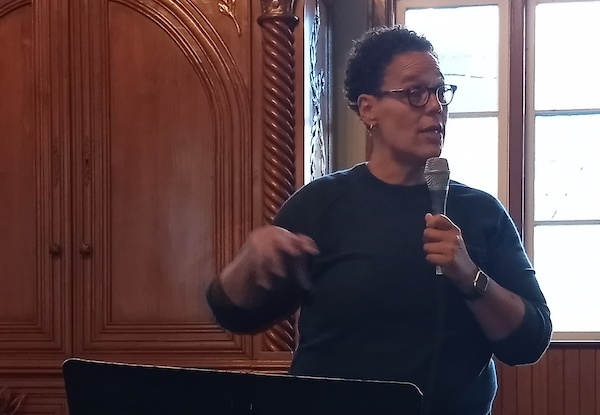
Jews of Colour Initiative chief executive officer Ilana Kaufman speaks at Or Shalom on June 6. (photo by Cynthia Ramsay)

On June 6 at Or Shalom, Jews of Colour Initiative chief executive officer Ilana Kaufman spoke about Beyond the Count: Perspectives and Lived Experiences of Jews of Colour. She said JoCI commissioned the survey to find out how many Jews of Colour there are in the United States, “what are our experiences, what are our perspectives, what are our beliefs, and then, how do you parlay that information into making the Jewish community, quite frankly, less racist, more inclusive.”

Kaufman was in Vancouver from Berkeley, Calif., where she is based, to share the survey results with “congregational rabbis, agency professionals, educators, board members, Jewish Federation staff, community members of colour and allies,” said Shelley Rivkin, vice-president of local and global engagement at the Jewish Federation of Greater Vancouver, which organized and funded the series of meetings. “Jewish Federation had been in conversation with Ilana about the work of the JoCI for over a year,” she said.

Or Shalom’s Rabbi Hannah Dresner introduced Kaufman at the shul talk, and Kaufman dove into the data.

“Depending on the age range you’re thinking about … between eight to 20% of the U.S. Jewish community are community of colour,” with the higher numbers being in the younger age groups, she said. “Every day in the U.S., the number of Jews of Colour is increasing, not decreasing. In terms of the data for multiracial families … 20% of U.S. Jewish families identify as multiracial. You may not see the family members of colour, but we’re there. And, if you’re on the coast, that number goes up to 25%, or one in four families. And that number, of course, is getting bigger every day, too.”

Kaufman is working with colleagues to figure out how many Jews of Colour there will be about 20 years from now. By 2042 or 2043, she said, “depending on immigration patterns, the U.S. will become half People of Colour. The majority of those folks will be multiracial and, in the U.S. Jewish community, we don’t know the date [that will happen], but those patterns map onto the U.S. Jewish community as well.”

While Beyond the Count is not a truly representative survey, as that would have cost about a million dollars, which was beyond JoCI’s capacity, the organization “cast the net as far as we could from the Jews of Colour Initiative perch,” said Kaufman. “We were able to have 1,118 qualified survey respondents in our study. It’s the largest dataset of Jews of Colour in the U.S., maybe anywhere in the world, and it’s not representative at all.” The interviewees over-represented in many areas, such as level of education attained and engagement in Jewish activities.

Regarding the methodology, Kaufman said the survey “is unapologetically framed with Critical Race Theory.”

“From our perspective,” she said, “we can’t do this work without framing it in a context where racism is real, and the effects of racism are real. And it doesn’t implicate white people, it doesn’t marginalize People of Colour, it just reveals the infrastructural truth that allows us then to leverage that truth to make change.”

Feminist pedagogy also informed the work, said Kaufman, and “we used a counter-storytelling approach, which means, instead of white folks saying, People of Colour, tell me your story … we had Jews of Colour, our community, centre the conversation and the work to create shape around that.”

JoCI doesn’t define the term “Jews of Colour,” both because race is a social construct and because identity “has to be owned and carried by the self and so we don’t want to be in the business of telling people how to self-identify,” said Kaufman. The organization uses “Jews of Colour” as an admittedly imperfect conceptual framework, she said, pointing out that, while race may be a fiction, racialization is real, and JoCI operates from that space. For those who self-identify as Jews of Colour, JoCI wants to be a space for resources and support.

Kaufman spoke about “whiteness,” also a social construct. Citing historian Karen Brodkin, Kaufman said the G.I. Bill – which offered home loans, college loans and other benefits to veterans after the Second World War – was one of the moments “when European Jews became white.” Instead of rejecting the benefits until their “black and brown family members in uniform” were offered the same opportunities, “there were moments of passive acceptance of the tools of upward mobility that were offered to Jews of European background that were not offered to People of Colour in the United States at that time,” said Kaufman. “And that’s one of the ways that Jews moved into whiteness, from being a highly ethnicized people in the United States.”

But it is a conditional whiteness, she said, and Jews who had lived with a passive acceptance of privilege had that comfort destroyed in 2016 with Charlottesville, “when white supremacists and neo-Nazis reminded Jews who had enjoyed the benefits of whiteness that they’re not safe…. And, in fact, that white identity is not seen as white in the eyes of white supremacists and neo-Nazis.”

Kaufman said one of the ways we can have a more dynamic and thoughtful conversation is to recognize the extent to which racism harms white people. “Even the concept of whiteness is such a flattened idea of who we’re talking about,” she said. “And so, when you think about Jewish ethnicity and you think just about Jewish European ethnicity, it is vast and it is diverse and, at least in the United States, it’s been boiled down to bagels … this caricature of who the Jewish people are.” When we celebrate diversity and grapple with intercultural dynamics, she said, “white folks have a stake in the conversation that’s not about being the target of opposition, but a collaborative part of the conversation” and, to do that, “we certainly have to recognize the privilege that comes with whiteness or being perceived as white…. When we get past our understanding of privilege, we need to get into who we are as ethnic, racial beings, and everybody has an equal stake in that conversation,” she said.

Almost half of survey respondents (45%) selected two or more racial categories. “And that’s the fastest growing population of People of Colour in the U.S., multiracial people, and that also maps onto the Jewish community,” said Kaufman.

One finding of the survey was that most JoCs feel more comfortable in an environment that’s multiracial. “Jews of Colour feel a tremendous amount of stress when [they’re] the only one in a situation…. We have to help people feel welcome without [them] feeling like we’re singling them out,” she said.

Respondents participated in a wide variety of Jewish activities and organizations, including formal Jewish education, attending synagogue, being part of a Jewish youth group and traveling to Israel: 63% of respondents participated in two or more Jewish activities. Yet most JoCs report having had a range of negative experiences in Jewish communal settings. At the top, 75% of respondents agreed or strongly agreed with the statement, “Others have made assumptions about me based on my skin tone,” and 74% with the statement, “I have felt burdened with explaining myself/my identity.” At the lower end, 60% agreed or strongly agreed that “I have felt tokenized” and 58% that “I have been treated as if I don’t belong.”

“A tip on that,” said Kaufman. “Of course, we want to welcome Jews of Colour into our committees to do things that matter…. If we’re reaching for someone because of what we think they look like, we have to stop ourselves. We just have say, we’d love to have you on our committee, but we want to know what you want to be on our committee for, instead of telling them … what we want them on our committee for.”

As an example, when she was asked to be on board, she made it a condition that she not have to talk about diversity. “And so,” she said, “how do you bring people in for why they want to be there, what they’re good at, how they want to grow? You just ask, how do you want to grow professionally, personally? Maybe I can give you that community opportunity if you join us, which is way better than saying, I don’t know you, I don’t know what you like, but I want you on my committee because of how I think you look.”

Overwhelmingly, survey respondents did not feel that American Jewish leaders are adequately addressing “the specific needs of members/participants who are Jews of Colour,” “the need for greater racial/ethnic diversity in Jewish organizational leadership” or “racism/white supremacy within the American Jewish community.” The numbers improve with regards to how these leaders are addressing “racism/white supremacy outside of the American Jewish community.”

“There’s deep comfort in helping those people outside,” said Kaufman. “What happens when those people are in all of us? And how do we collectively adopt a ‘those people’ identity so that we can actually dissolve this barrier between us and them?”

The study focused on racism, not antisemitism, said Kaufman. “Historically, when the U.S. has talked about antisemitism, they haven’t been including Jews of Colour in that conversation. And so, generally, when you hear about who’s being supported by the organizations fighting antisemitism in the U.S., you never see Jews of Colour included in that conversation.”

JoCI has had to be very careful, she said, so that the survey doesn’t become a tool to fight antisemitism among People of Colour. “The Jewish community and our colleague organizations who deal with antisemitism in the U.S. often use a dynamic of anti-Black racism to create support to fight antisemitism, and this has split People of Colour from Jewish people who [are] white.” She talked about the importance of taking on white supremacy. “Inside of white supremacy is both racism and antisemitism,” she said. “And I think it’s incumbent upon the U.S. Jewish community to look at racism and antisemitism side by side and, in our context, the container that holds that is white supremacy. So, I’m very interested in fighting antisemitism, I’m very interested in fighting racism and, I have to say that, in my family’s life and the lives of a million Jews of Colour in the United States, is for us to talk about white supremacy and to target racism and antisemitism in the same breath, at the same time. Because the piece is, we need to be in a relationship with our Muslim brothers and sisters, our Christian brothers and sisters, our family members all in between, because we’re all under threat from the white supremacists…. I’m very interested in fighting antisemitism but I’m not interested in fighting antisemitism if it only means we’re fighting for white, Jewish people.”

Beyond the Count makes four recommendations: support organizations and initiatives led by and serving Jews of Colour; shift organizational leadership to more accurately reflect the diversity of American Jews; prioritize creating spaces and places for discourse and dialogue with and among Jews of Colour; and promote further research by and about Jews of Colour.

Kaufman “helped us better understand the nuances and diversity of the JoC community and how systems of inequality are perpetuated in our own community,” said Rivkin in an email to the Independent. “The issues identified in Beyond the Count must be taken seriously, we can’t offer token solutions. We have to be intentional and first engage Jews of Colour to find out what they see as the key priorities and what path should be taken going forward.”

To do that, Rivkin said, “A key role of Jewish Federation is to bring stakeholders from across the community together to address critical issues and facilitate discussions…. One of our next steps is to explore the feasibility of conducting either a B.C. or Canada wide survey to gain a better understanding of the local JoC perspective.”

To read the full text of Beyond the Count, visit jewsofcolorinitiative.org.

Format ImagePosted on June 23, 2023June 22, 2023Author Cynthia RamsayCategories LocalTags diversity, equality, Ilana Kaufman, inclusion, Jewish Federation, Jews of colour, JoCI, racism, Shelley Rivkin, surveys, United States
Beautiful life despite illness

Beautiful life despite illness

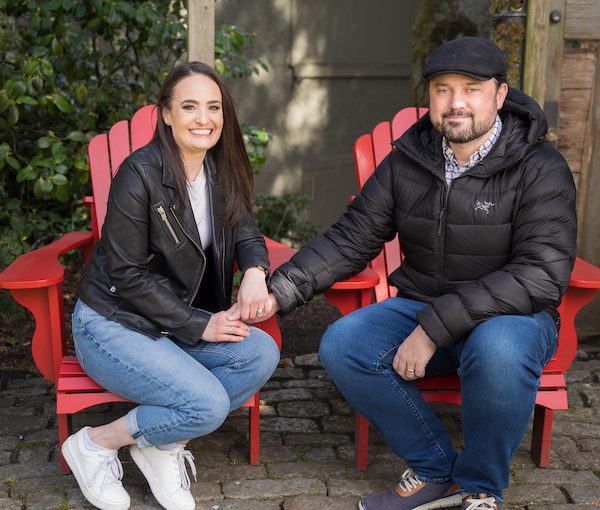
Rachel Goldman and her husband, Geoff McLennan. (photo by Avi Dhillon)

Rachel Goldman is this year’s Courage to Come Back Award winner in the medical category. She couldn’t be there in person at the Vancouver Convention Centre June 9, but she did accept the honour virtually.

After introducing herself, Goldman said, “Forty months. Forty months! That’s 1,216 days or 29,200 hours. That’s the total amount of time I have spent secluded from the world, due to COVID. Can you even imagine? So, here I am, speaking before 1,700 of you, sharing my story. It’s a surreal and humbling experience, but one that I am striving to embrace with courage and gratitude.”

Goldman explained what it has been like to have been born with CVID, common variable immune deficiency.

“For 40 years, I have caught and recovered from thousands of illnesses – lived through years of isolation and endured the roller coaster that is chronic illness,” she said.

“A common cold is never just a cold. It’s a sinus infection that leads to intravenous antibiotics. It’s a kidney infection that leads to weeks or months in an isolated hospital room. It’s my body triggering anaphylaxis to the antibodies being infused into me. Challenging? Absolutely.

“Not being able to be with you tonight to receive this amazing award in person is just one more of these challenges. I have my incredible father [Paul Goldman] there to accept this award on my behalf. Now, due to his attendance in my place, we will have to stay apart for at least 72 hours in hopes of minimizing my infection risk.

“Life altering? Most definitely,” she said.

“What it hasn’t done is stopped me from doing the best I can to live my life within the realm of what I can make possible, not what seems impossible.”

Goldman and her husband, Geoff McLennan, live in New Westminster and have two young children. A typical day for her starts at 6 a.m. to get their kids ready to go to Vancouver Talmud Torah.

“Once they leave, I am pretty exhausted, so I have to go back to bed and lie down for a couple hours,” she told the Independent. “I try to get outside every day and go for walks around our neighbourhood. With the weather becoming nicer, sometimes I will see a friend very distanced outside on our patio. I get my kids’ stuff ready for the next day for school … try to exercise and rest. I often write and usually have lots of doctors’ appointments, for the most part, over the phone or via Zoom. Then I get ready for my kids to come home. We try to have a normal evening of homework, dinner, bedtime and then time with my husband. Then rest again.”

That’s if she’s feeling OK. “If I am unwell,” she said, “then antibiotics and the meds I have to take to ensure I don’t have an allergic reaction to the meds keeps me mostly in bed. The meds make me feel very ill.

“If the infection is severe, then the antibiotics will require hospitalization, either inpatient or day treatment, to be delivered intravenously through a PICC [peripherally inserted central catheter] line.

“In terms of treatment,” she said, “I give myself weekly subcutaneous intravenous immunoglobulin infusions, which I infuse into my stomach through four needles.”

Because of her health, Goldman, a sports radio and television producer, had to stop working in 2017. She also has had to adapt how she volunteers at VTT, something she loved doing in-person. Unable to go into the school anymore, she said, “I have spent a lot of time volunteering virtually and helping out at home. I think I have become a master at cutting out projects for the school.

“Our Jewish community has been integral to our family,” she said. “Our children’s school has been the one constant in their life when everything else has been very chaotic. We travel 45 minutes each direction every day to bring our kids into Vancouver to attend VTT. We are eternally grateful for the love, support and kindness that the Vancouver Jewish community and Vancouver Talmud Torah has shown our family. They have lifted us up when things couldn’t have been more difficult. In turn, my kids could not feel safer, more well-loved and more connected with the Vancouver Jewish community.”

Goldman is a lifetime member of CHW, formerly known as Canadian Hadassah-WIZO, and has been a supporter of Jewish Federation of Greater Vancouver’s Choices event. In her younger days, she attended VTT and went through the entire Young Judaea summer camp system.

Her parents, Paul and Claudia Goldman, are also involved in the local and national Jewish communities. Her mother has been a volunteer with CHW for four decades, in many capacities, including becoming a national president and its lead representative internationally. Her father has served on synagogue boards and as a member of the Federation task force that led to the establishment of the Richmond Jewish Day School; as well, he has been involved with the Centre for Israel and Jewish Affairs and its predecessor, the Canada-Israel Committee, including as a member of CIJA’s national board.

During the pandemic, said Rachel Goldman, “The only way I could maintain close contact with my parents and my extended family was for them to limit their own activities in compliance with my specialist’s immunological protocols in order to protect me from potential infection. Those precautions are only now being partially loosened by my specialists.

“I had to home-school my two kids for 22 months during the pandemic as per my medical team’s instructions,” she said. “The kids only returned to full in-person schooling in March of 2022.

“If anyone goes into a high-risk environment or is exposed to anyone with COVID, then there is an isolation period of at least 72 hours, as has happened since the gala.

“I am still not able to attend anything at my kids’ school, their birthday parties, dance recitals, etc., any situation that occurs indoors,” she said. “Also, I am not able to travel via commercial airlines currently, which is very difficult since my sister [Naomi] and her family made aliyah eight years ago.”

Goldman wears a mask anytime she leaves her home, which is rarely, unless she is outside with her kids.

“If anyone in the house is sick, masks go on and I am double-masked,” she said. “If anyone is COVID positive, as happened in the last week, I have to leave the house for an extended period of time and we will have to isolate. I have not been inside in public since the beginning of the pandemic outside of medical appointments. I am just starting to have very distanced visits with a few friends now that the weather is getting better. Outside is the best and safest place for me.”

Her immediate family only recently started to take their masks off and, if they go into crowded places, they continue to mask.

Goldman has been to Israel twice for treatment, most recently in January 2020, after two years of constant hospitalizations for infections that stemmed from a sinus surgery she had in the hope of reducing infections. She said her medical team concluded “that the complexity of my condition required highly specialized expertise to determine a plan for continuing treatment, but none was available in Canada…. I conducted an intensive investigation for the relevant expertise, both in the U.S. and internationally, and determined that my best choice was Jerusalem’s Hadassah Hospital. I chose Hadassah because of its reputation as one of the world’s best research hospitals and, in particular, its multidisciplinary approach to diagnosis and treatment.”

Unfortunately, the medical tests – including many not typically available in Canada, as well as a complete set of genome sequencing and genetic testing – were interrupted by COVID. Goldman was urged to return home immediately. “At the time, they did not divulge why but, as time progressed, it became clear that the reason was due to the start of the COVID-19 pandemic,” she said.

Next steps for Goldman would involve establishing a new baseline. Because her current treatment includes the introduction of immunoglobulins extracted from the blood cells of others to boost her immune system, she said many of the tests that look at antibodies give false readings, as they aren’t interpreting her own system. “As a result,” she said, “it will be necessary to take me off all medications in a closely monitored hospital setting to be able to zero in on precisely what is going on with my immune system, in order to determine the best course of treatment going forward.”

The risk of doing this during COVID – and an increase in other respiratory diseases being treated in hospitals – has been too high and Goldman’s medical team is not comfortable with her flying on a commercial flight.

“I am now in the process of working towards re-setting a timetable with Hadassah to continue the process that was interrupted in 2020,” she said. “The logistics are complicated, but I am hopeful that I’ll have some clarity on that very soon so I can restart this process in the hopes of regaining some of my life and freedom back.”

It had been five years that Goldman’s aunt had been wanting to nominate Goldman for a Courage to Come Back Award.

“Finally, while hospitalized over the winter holidays, I agreed,” said Goldman. “I got the call from [chair] Lorne Segal and the Courage to Come Back Awards about winning a few months later … right before my kids’ spring break. I was shocked at first because this was the first time I had ever shared anything about my illness publicly. Even people closest to me didn’t really know the details and extent of my health condition.

“I didn’t realize that the way in which I have dealt with my health condition was something to be celebrated. Once I started thinking about it some more, I was truly humbled and very grateful to be recognized. I realized that this process, for me, was really about giving me a voice and the ability to hopefully help and inspire others with complex chronic medical conditions who are suffering in silence.

“By getting my voice back, it has allowed me to do more than just survive,” she said. “I decided that courage is absolutely something to be celebrated. I want to show my kids that, despite all of the obstacles being thrown at me and our family, we can rise above it all and have a beautiful life.”

Format ImagePosted on June 23, 2023June 22, 2023Author Cynthia RamsayCategories LocalTags chronic illness, common variable immune deficiency, Courage to Come Back, COVID, CVID, family, health, Rachel Goldman

An unwelcome precedent

An Israeli cabinet minister visited Canada recently and, with due respect, some of our journalistic colleagues buried the lede.

In journo parlance, the “lede” is the most important and, therefore, first item mentioned in a conventional news story. To “bury the lede” is to (intentionally or unintentionally) downplay the most important thing that happened by talking about other things first.

This was the case when Amichai Chikli, Israel’s new minister for Diaspora affairs and combating antisemitism, visited Canada recently. Some of our colleagues reported on Chikli’s condemnations of Canada’s government for not following some other countries in moving our embassy to Jerusalem from Tel Aviv and commended the Conservative party for “unwavering support for Israel and Jerusalem.” The minister’s abandonment of international diplomatic protocols appeared lower in the coverage.

It seems to us that there is a bigger story than an Israeli pol backslapping overseas allies and criticizing the government in power – although that is not unrelated from the bigger problem here. The main thing – the lede, as it were – is that an Israeli government minister came to Canada, sidestepped conventional protocols around meeting with commensurate-level officials, hung out instead with an ad hoc group of mostly opposition members of Parliament, spoke to an evangelical Christian audience and then scooted back to the Middle East.

Canada and Israel have deep, historic bilateral bonds. The Jewish community in Canada is tied to Israel emotionally, spiritually and familially. There have been diplomatic disagreements between our governments – and, indeed, there are some very basic divergences right now between Canadian Jews and what is happening in the Jewish state – but there are ways that things are done. And there are ways that things are just not done.

For four years, what many people view as the highest political office in the world was held by a man who betrayed every diplomatic nicety and convention imaginable. It may be that, among the countless ways the former U.S. president’s smashing of standards has lowered the collective bar, an Israeli politician sees it as acceptable to barge into Canada and behave as though he is a free agent rather than an official representative of the Israeli people. Canadians should not see it as acceptable. Canadian Jews should be particularly concerned.

An elected official who is not a member of a cabinet is free to travel to foreign lands and meet with ideological cohorts. A member of the government is expected to represent his (or her) country, not their own narrow interests.

The Canadian group that hosted Chikli – a new entity called the Israel Allies Caucus – is also to blame. Apparently operating outside the more formalized parameters of the longstanding official Canada Israel Interparliamentary Group, the new body appears to be made up of evangelical Christians and political conservatives, and it is abandoning protocols in favour of its own agenda. This should be particularly concerning to Canadian Jews who care about our country’s relations with Israel, as well as being overshadowed by groups that may not represent our interests.

Presumably, the new group views Canada’s official approach to Israel as not the right kind of support – but the specifics of government policy are not the biggest issue here.

Let us not forget that there are activists in Canada who recently tried to prevent former Israeli prime minister Naftali Bennett from entering Canada, accusing him of being a “war criminal.” Other voices, critical of policies of the current government, want to ban representatives of that government based on political disagreements.

Diplomatic protocols exist to create a space where representatives of countries can keep lines of communication open even when we have grievous disagreements, as we do, for example, with the worst human rights violators in the world. Indeed, Canada has carved out a role in the world as a “soft power” that uses words, rather than weapons, to bring sparring parties closer together.

If we diverge from diplomatic protocols and allow activists on any side to subvert these carefully constructed channels of communication, we risk further politicizing issues that should be above politics. More to the point, making Canada’s relations with Israel a political football is to risk long-term gain for someone’s perception of short-term gain. It may have made partisan ideological activists feel good to shmooze with an Israeli cabinet minister. It will feel less good for all concerned when policies that strengthen the Canadian-Israeli bond become viewed through a prism of which Canadian political parties benefit from their adoption.

Further, if we accept, from apparently “pro-Israel” activist MPs, a flouting of protocol, we will be hard pressed to complain when MPs host other overseas visitors we might view as troubling. If an opposition MP invites an Israeli, Palestinian or other speaker that many or most Canadian Jews view as deeply problematic and rolls out the red carpet on Parliament Hill as the Israel Allies Caucus did for Chikli, we will have no moral pedestal from which to complain.

Chikli should have known better. Higher-ups in his government should dress him down for his breach of protocol. But it was the leader of his government – the prime minister of Israel – who first and most egregiously breached such protocols, accepting an invitation several years ago from the U.S. Congress, rather than the U.S. president. (Of course, it was the Congress that broke the protocol first by extending the invitation, so we are addressing a larger pattern of inappropriate behaviour.) But Canadian Jews, even – perhaps especially – those who most enthusiastically welcomed Chikli, his undiplomatic behaviour and his impolitic remarks (whether we agreed with them or not!), should be aware of the unwelcome precedent they may have set.

Posted on June 23, 2023June 22, 2023Author The Editorial BoardCategories From the JITags Amichai Chikli, Canada, diplomacy, governance, Israel, Israel Allies Caucus, politics

Witnessing as relationship

We’re experiencing a transformation in Winnipeg – one that holds hands with truth and reconciliation. Recently, a statue of Queen Elizabeth II, newly restored, was put back on a plinth in front of the Manitoba Legislature. The media showed it, fixed and shiny, and reported on the cost of repair. The next day, it was vandalized again.

Two years ago, on Canada Day, protesters knocked down two statues, those of Queens Victoria and Elizabeth II. The statue of Queen Victoria was too damaged to repair; its pedestal was covered with the protesters’ red handprints, like the blood of all the Indigenous children lost. It was both vandalism and art installation, a painful reminder of the clash between colonialism and Indigenous suffering in our country.

This struggle is ongoing and Winnipeg spells it out through violence, poverty and discrimination. Much of the time, the discrimination appears invisible to those who don’t witness it, but it’s there. I’ve admired the strength of one Indigenous activist, Vivian Ketchum, who described being followed around in a drugstore on June 11, 2023, by a security guard – an older woman, she didn’t hesitate to discuss this fact with the much younger security guard and then resolved the issue with the manager. A day later, the CBC featured a story that also included Ketchum, this time describing how, when an Indigenous woman goes missing, the friends and family must go looking for her themselves because, even after reporting, the police don’t appear to be listening or helping.

Being a witness is something I’ve been learning as I study Daf Yomi, a page of Babylonian Talmud a day. In Gittin, the Tractate about divorce, there’s an extended discussion among the rabbis about the get (a Jewish divorce document), how it should be written, delivered and witnessed for a valid divorce. It turns out that practically anyone can write the document, but the divorce is not valid unless specific parts are personalized, delivered and witnessed in front of the right people. The witnesses and the act of witnessing the document being signed are the important parts.

As a writer, it doesn’t matter what I write if no one reads and “witnesses” it. Having an audience offering the right kind of respect or interest matters for those who produce content. The written word, on its own, doesn’t automatically have importance. It’s the relationship between the readers and the words that matters.

This notion of “being in relationship” is also part of what it means to be a treaty people, bound by the agreements made between Indigenous peoples and Canadian settlers. Relationships are a two-way stretch. It takes work on both sides to change and make a difference.

Here’s a personal example of “being in relationship.” Years ago, I had a traumatic experience with a close long-time friend. The friend ghosted me. She disappeared, without explaining why. It caused harm. I spent years trying to reach out, apologize and mend things. I couldn’t understand what had happened. I was deeply hurt.

Eventually, I realized that it takes two people to be friends. One person cannot do it on her own. A friendship is a relationship. If only one person is relating, there is no friendship. This realization enabled me to stop trying to fix things. Instead, I mourned the loss and moved on. To my surprise, about 15 years after this “break up,” this friend sought my forgiveness. We’ve worked towards a new relationship ever since. It will never be the same, but we’re both trying.

Although this wasn’t a marriage breakup, it contained enough parallels that it helped me gain a deeper understanding of failed relationship and the need for Jewish rituals to cope with it. The Jewish rituals around divorce and the giving or receiving of a get are far from perfect. They are deeply flawed in the ways that men can maintain power and control over their wives – only men can give women a divorce in this religious model. Yet, for many, the ritual has deep value.

In Winnipeg, there are individual efforts to make relationships and try to push reconciliation forward. It’s a difficult process. It’s not happening with enough speed. Like other relationships in our lives, it takes work. We must fix broken systems to acknowledge the ongoing racism around us. When the government mended the statue of Queen Elizabeth and erected it back on the Manitoba Legislature grounds, it wasn’t done with the necessary relationship work in place. Almost immediately, the statue was labelled with spray painted words like “Colonizer” and “Killer.” While some find this disgraceful vandalism, others see it as no less than the truth. Queen Elizabeth reigned over Canada during a time in which residential schools still held control over many Indigenous peoples, harming and sometimes killing their children and families.

If we’re in relationship with others, we have to be open to seeing others’ worldviews. This is only possible when we witness others’ needs and stand ready to serve others as part of a bigger community. Yes, someone needs to write a get, a Jewish divorce, but, without appropriate witnesses, it cannot become a valid divorce. When we witness others’ needs at their most painful moments, giving them validity, together, we’re in a meaningful relationship.

In past years, the Winnipeg Canada Day celebration at the Forks included fireworks. After the news about the deaths of so many children at residential schools, the Forks changed its Canada Day focus. While there are still July 1 events at the centre of our city, they’re now more attached to Indigenous practices and meaning. This year, elders will open the event with a ceremony and a sacred fire. The day’s activities will be full of diverse cultural programming. Instead of fireworks, there’s a drone show, with 100 drones, to honour Indigenous teachings and tell stories about the stars.

It takes healing, ritual and forgiveness to get through serious trauma or to mend fractured relationships. Canada Day is still an important part of who we are as a country. Standing witness is an essential part of Jewish practice. Remembering how we Canadians got here, as a treaty people, in a relationship, can make our celebration more meaningful for everyone.

Joanne Seiff has written regularly for CBC Manitoba and various Jewish publications. She is the author of three books, including From the Outside In: Jewish Post Columns 2015-2016, a collection of essays available for digital download or as a paperback from Amazon. Check her out on Instagram @yrnspinner or at joanneseiff.blogspot.com.

Posted on June 23, 2023June 22, 2023Author Joanne SeiffCategories Op-EdTags First Nations, reconciliation, relationships, Winnipeg
Honouring ancestors’ stories

Honouring ancestors’ stories

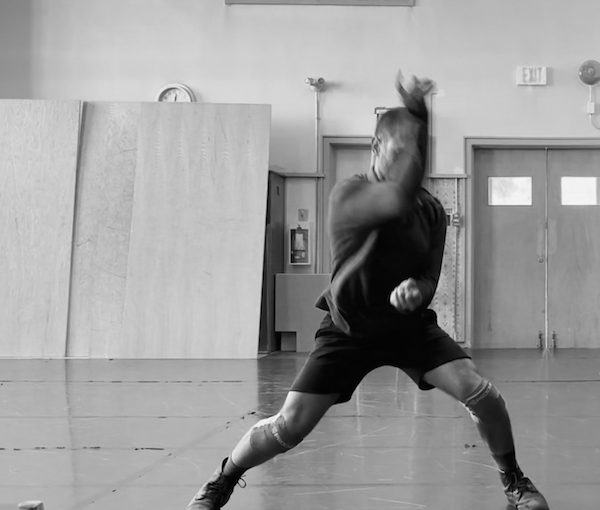
Juan Villegas rehearsing Edictum, choreographed by Vanessa Goodman, which is about Villegas’s Sephardi ancestry. The work is part of Dancing on the Edge’s EDGE One July 6 and 8 at the Firehall Arts Centre. (video still from Vanessa Goodman)

“I am very happy to be able to share my work and talk about Sephardic Jews, as I am doing a lot of research and I am discovering a lot about my own culture and where it comes from,” Juan Villegas told the Independent about Edictum, a new work with Vanessa Goodman about his family heritage, an excerpt of which he will perform at this year’s Dancing on the Edge July 6 and 8. “Throughout history, the Jewish community has suffered a lot and I am very happy to be able to pay respect, honour, shed some light and help tell the story of my ancestors,” he said.

Villegas and Goodman had already started their collaboration when Villegas found out that his ancestors were Spanish Jews who, following the Alhambra Edict of Expulsion in 1492 and the persecution of Jews by the Spanish Inquisition, sought refuge in Colombia.

In 2015, Spain passed legislation to offer citizenship to members of the Sephardi diaspora, but the window of opportunity to apply was only a handful of years and Villegas’s family missed it. However, they did apply to Portugal, which passed a similar law, also in 2015. Given the number of applicants, it could be several years before the family finds out. For the application, certified records were needed, so Villegas’s siblings hired a genealogist.

“They did both of my parents’ family trees and both ended up having the same ancestor – Luis Zapata de Cardenas, who came to Antioquia, Colombia, from Spain in 1578 and whose family had converted to Catholicism in Spain,” he said. “What is unclear to me is whether Luis Zapata de Cardenas was a practising Jew and was hiding it or if his family back in Spain became Catholic and raised him Catholic. I find it very hard to believe that people fully converted to Catholicism, as religion is so embedded in one’s culture and must be very difficult to switch by obligation. So, this is probably when they started disguising some Jewish rituals as Catholic, which happened a lot in Colombia.”

Villegas left Colombia in 2003, at the age of 18, concealing from his family his real reasons for leaving.

“I told them that I was going to only be in Canada for eight months to study English and then come back to Colombia,” he shared, “but deep inside I knew that I wanted to find a way to stay in Canada. I am gay and had a hard time growing up in Colombia – without realizing it, I was also escaping from a traumatic childhood, as I had been sexually abused and bullied at school. I was lucky enough that my parents helped pay for ESL studies in Canada and then I was able to do my university studies in Vancouver at Emily Carr University.”

After getting a bachelor’s degree in design from Emily Carr, Villegas worked at a design studio but was let go when the economy collapsed in 2008. He took about a year to figure out what he wanted to do next.

“I had a lot of unresolved trauma and I think it was a combination of having the time and (unconsciously) wanting to be healed from trauma that I started taking yoga and dance classes,” he said. “I met a dance artist named Desireé Dunbar, who had a community dance company called START Dance and she invited me to join her company. Vanessa [Goodman] had just graduated from the dance program at SFU and she was in the company also, this was back in 2009. Then, in 2010, I joined the dance program at SFU and Vanessa came to choreograph for us a couple of times. I always loved working with her and I felt like I connected with her.”

Graduating from SFU with a diploma in dance, Villegas moved to Toronto, where he danced for a few years. When he returned to Vancouver in 2017, he started following Goodman’s work. Intrigued, he asked if she would choreograph something for him and she agreed.

“And that piece that we created was about family,” he said, “but we left it at that, because I did not get the grants I needed to continue the work. So, when I discovered about my Sephardic Jewish ancestry, I pitched the idea to her and she agreed (without me knowing that she also has a Jewish background).”

video still - Juan Villegas rehearsing Edictum
Juan Villegas rehearsing Edictum. (video still from Vanessa Goodman)

Everything fell into place, he said, including some funding, so they took up work again this year on Edictum, which is Latin for order or command. The project was always intended to be a solo for Villegas, and they had started by “diving into his family history and the names of his ancestors to build movement language,” said Goodman.

“Since his family found that they have Jewish ancestry and were a part of the diaspora from Spain and Portugal in the 1400s, we found it very relevant to revisit the starting material and expand on this history inside the work,” she said. “I was raised Jewish culturally and we found, through conversations about our family rituals in relation to culture, food and celebration, there were some very interesting links between his family’s expressions of their identity and mine. We have woven these small rituals into the piece and have found a very touching cross-section of how this can be shared through our dance practice in his new solo.”

Goodman is also part of plastic orchid factory’s Ghost, an installation version of Digital Folk, which will be free to visit at Left of Main July 13-15. It is described on plastic orchid factory’s website as “a video game + costume party + music and dance performance + installation built around the desire to revisit how communities gather to play music, dance and tell stories.”

“I began working with plastic orchid factory on Digital Folk in the very early days of its inception,” said Goodman. “James [Gnam] and Natalie [Purschwitz] began researching the work in 2014 at Progress Lab, and I was a part of that initial research for the piece. Since then, the work has been developed over a long period of time with residency creation periods at the Cultch, at Boca del Lupo, at the Shadbolt, at SFU Woodward’s, and it has toured Calgary and northern B.C. This work lives in several iterations, but the Ghost project is a beautiful way for the work to live in a new way one more time. The cast got together at Left of Main in December of 2022 and filmed the piece for this upcoming iteration…. It is exciting to see a work have such a rich life with so many incredible artists who have been a part of this project.”

Dancing on the Edge runs July 6-15. It includes paid ticket performances at the Firehall Arts Centre, where Edictum will be part of EDGE One, and offsite free presentations, such as Ghost. For the full lineup, visit dancingontheedge.org.

Format ImagePosted on June 23, 2023June 22, 2023Author Cynthia RamsayCategories Performing ArtsTags ancestry, Catholicism, Colombia, dance, Dancing on the Edge, DOTE, Edictum, family, history, Juan Villegas, Judaism, Portugal, Spain, Vancouver, Vanessa Goodman
Immerse yourself in music

Immerse yourself in music

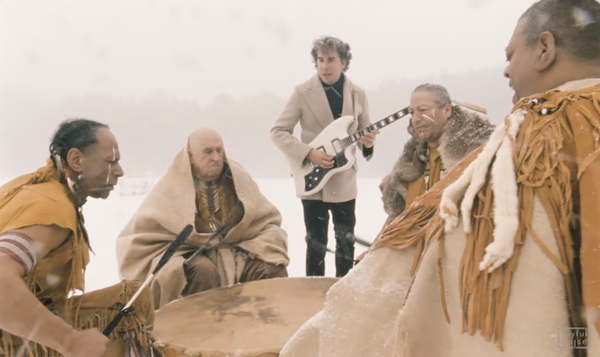
Screenshot from the video for the song “Medicine,” made by Gigi Ben Artzi, featuring Yonatan Gat and the Eastern Medicine Singers. “Medicine” comes off Gat’s album Universalists.

You never know when a life-changing moment will happen. For musician Yonatan Gat and members of the Eastern Medicine Singers, a chance encounter at the 2017 South by Southwest (SXSW) Music Festival in Austin, Tex., has led to a unique continuing collaboration that melds experimental and powwow music in a way that is simultaneously ancient and contemporary, energizing and hypnotic.

Fans of Gat and the Medicine Singers will be happy to know they are performing at this year’s Vancouver Folk Music Festival, which runs July 14-16 at Jericho Beach Park. They will be joined by Daniel Monkman (Zoon), an experimental Anishinaabe musician from Toronto (Tkaronto), and local oud player and guitarist Gord Grdina, who also mixes multiple musical styles. For newcomers to Medicine Singers’ music, definitely go down the internet rabbit hole. Chances are that you’ll want the in-person experience, to be immersed in the sound.

The Eastern Medicine Singers are an Algonquin drum group from Rhode Island “dedicated to keeping the eastern woodlands American Indian culture alive.” They sing and drum in the language of Massachuset and Wampanoag dialect, and have produced several CDs together. To differentiate from their traditional powwow style, they call themselves Medicine Singers for collaborative projects with musicians of other traditions, like Gat. Their debut full-length album in this capacity is the self-titled Medicine Singers, which came out in 2022 on Stone Tapes, a sub-label of Joyful Noise, and Mothland in Canada.

“The result is a spellbinding musical experience, cycling through a kaleidoscope of sounds, from psychedelic punk to spiritual jazz and electronic music,” reads the description on Joyful Noise’s website. “But the genre-smashing album remains firmly rooted in the intense physical power of the powwow drum and the Medicine Singers’ connection to their ancestral music, creating a daring and ambitious record that celebrates tradition, while boldly breaking away from its restrictions or, in the words of Medicine Singers’ leader Daryl Black Eagle Jamieson: ‘These two cultures can work together, and blend together, to show people how we can work together and make something beautiful.’”

Gat is accustomed to these kinds of partnerships and musical innovation. In Israel, he was part of the punk band Monotonix. In the United States, he has released a few full-length albums, each more varied than the last, with the latest being American Quartet (Stone Tapes, 2022), described as a “punk slash-and-burn reimagining of one of the defining works of the Western classical canon – Antonín Dvořák’s legendary string quartet – written while Dvořák was, like Gat, an expatriate living in New York City.”

A good place to start your exploration of Gat and the Medicine Singers is by watching the video of the 2018 track “Medicine,” which was included on Gat’s second album, Universalists (Joyful Noise, 2018). The fruit of an impromptu recording session, this release caught a larger public’s imagination and the rest, to be cliché, is history – yet continues to be groundbreaking.

The Jewish Independent had the chance to talk with Gat via email this week.

JI: What was it about the Medicine Singers’ performance/repertoire at SXSW 2017 that so mesmerized you?

YG: I was playing a show in a club during SXSW and Eastern Medicine Singers were playing outside. I didn’t know them personally and my band were watching them outside just before we went on. I thought their style (six people powerfully hitting a drum and singing call-and-response vocals) could mesh well with my trio and, also, just like them, we played on the floor in the middle of the audience. So, after they were done playing, I invited them to sit in with us. They famously said no at first and then changed their mind after they heard our music.

Our improvisation style leaves a lot of room for new musicians to join and freely do their thing. I think Eastern Medicine Singers noticed that, too, and when they joined us – it quickly became one of the most incredible shows we’ve ever played. The audience was feeling that as well. When I looked up, I noticed everyone in the crowd was crying, and that’s how our collaboration began, and we’ve been touring nonstop around the world since 2017.

JI: In an interview, you talked about taking piano lessons as a kid and, even then, improvising. What do you love about improvising?

YG: I took piano lessons as a kid but I never cared about learning to read sheet music. I just wanted to improvise. At some point, I started playing bass, but when we did Monotonix, we wanted a trio of guitar-drums-vocals, so I moved to a 77 Fender Mustang tuned two tones down to C with bass strings running through a custom-made humbucker pickup to make it sound more low-endy. I learned to play the harmony on the open strings while doing the lead on the highs.

We played 1,000 shows that way with Monotonix and I discovered myself as a guitarist along the way. I never practised or cared about technique, but being the only instrument except drums made me work hard and grow as a player. When I started my own band, I was able to build it around improvisation, which helped me learn even more about myself as a musician and human. Improvisation doesn’t have to be confined to jazz, long solos or anything like that – it’s more a way to live life, to respond to the world around you, get to know yourself better every night.

JI: From where do you draw inspiration for your compositions?

YG: When we record, we like to create a zone that’s radically free, where it’s all about the musician’s self-expression as it relates to the collective and we just let the tapes roll and have fun with it. Our studio days are very fun and wild and free. We also record other situations – practices, soundchecks, hangs. Sometimes, we record in some of the best or most interesting studios in the world, sometimes we record on iPhones or broken tape machines someone left behind.

It doesn’t matter what it is, we just gather material (usually hours of music) and then the process of editing begins, which is when the “composition” happens. In that way, most of the writing is actually the editing. Everything else is just about having a good time and making sure every musician gets documented the way they envisioned.

JI: You have played in Vancouver before. What are you most looking forward to on this upcoming visit?

YG: I was always lucky to play inspiring shows in Vancouver. My first time in town was a wild DIY punk show in a place called Emergency Room back in ’08. People were going crazy, falling on the band (we were playing on the floor). That vibe just continued to Biltmore Cabaret, where we played so many times after that. Just a sweaty haze with everyone losing their minds and melting into one another.

The last time I was in town was for Vancouver Jazz Fest back in 2019 with Medicine Singers. That was fun. I’m not used to playing jazz fests (they probably think we’re too loud or something) but it was so cool to play to an audience that was following the instrumental parts and appreciating the playing that comes with the freedom and energy.

Vancouver Folk will be a special one for sure. We don’t often play on the floor nowadays, but Medicine Singers transcend the stage. This show really creates a kind of connection between audience and musicians I’ve never seen before. It still has all the magic we discovered in 2017, the first time we played together.

My experience working and learning from Medicine Singers led us to start a label together, Stone Tapes, which is more like a community of musicians, or a collective. I think that represents what we do in the best way possible, and I’m looking forward to coming back to Vancouver and backing Medicine Singers along with other musicians from that collective.

For the full Vancouver Folk Music Festival lineup and tickets, visit thefestival.bc.ca.

Format ImagePosted on June 23, 2023June 22, 2023Author Cynthia RamsayCategories MusicTags Medicine Singers, Vancouver Folk Music Festival, Yonatan Gat
Art Downtown at Lot 19

Art Downtown at Lot 19

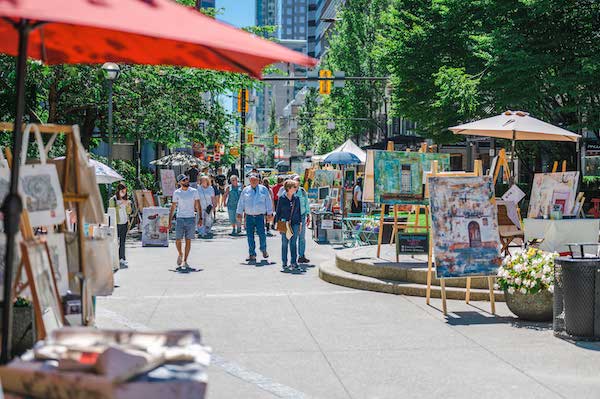
Art Downtown festival runs to Sept. 15 in Lot 19 downtown. (photo from Vancouver Visual Art Foundation)

On June 21, Vancouver Visual Art Foundation and Downtown Van (formally, Downtown Vancouver Business Improvement Association) launched the fourth edition of the outdoor summer festival Art Downtown. Every Wednesday and Friday from 11 a.m. to 5 p.m. until Sept. 15, people can drop by Lot 19 to see a diverse array of artwork from both emerging and established artists, while enjoying live music.

“Art Downtown is more than just an exhibition – it’s a catalyst for artistic expression, fostering an environment where artists can thrive and connect with a broader audience,” said executive director Lisa Wolfin, a member of the Jewish community. “We want to inspire the public to appreciate and engage with the power of art.”

To meet the participating artists virtually and for more information, visit vanvaf.com/art-downtown. 


Format ImagePosted on June 23, 2023June 22, 2023Author Vancouver Visual Art FoundationCategories Visual ArtsTags Art! Vancouver, Lisa Wolfin
JQT history exhibit launched

JQT history exhibit launched

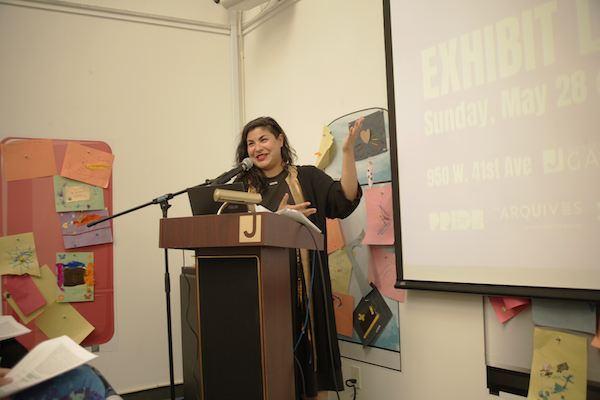
Carmel Tanaka, JQT Vancouver executive director, speaks at the May 28 launch of the B.C. Jewish Queer &Trans Oral History Project online exhibit. (photo by Brianne Nord-Stewart)

The B.C. Jewish Queer &Trans Oral History Project online exhibit went live amid the cheers of those gathered in the standing-room-only Zack Gallery May 28.

With a total of 38 interviews, the project is “one of, if not the, largest Jewish LGBTQ archives in the world,” said Carmel Tanaka, JQT Vancouver executive director, after she guided attendees – both online and in-person – through the website, jqtvancouver.ca/jqt-oral-history-bc.

The project had its beginning in 2019, when Tanaka approached the Jewish Museum and Archives of British Columbia (JMABC) asking if there was any queer and trans content in the archives. When the answer was no, JMABC and JQT Vancouver joined as partners to train volunteers in interview procedures, identify and connect with interviewees and record the stories of Jewish queer and trans elders throughout the province.

Alysa Routtenberg, archivist at JMABC, shared with the Independent how the collection of oral histories, proceeded. “We approached our funding partners, to fund the training of 13 volunteer interviewers in best practices and how to ensure consent from the interviewees, as the information would be archived and accessible to all, with each contributor identified and ‘out’ as Jewish and LGBTQ. The energy of Carmel Tanaka positively influenced the framing of the interview questions and our understanding of the Jewish queer community and ensured the inclusion of all willing community members in the oral history archives,” she said, welcoming the volunteers who were trained to participate in other oral history projects with the JMABC.

The target group for the B.C. Jewish Queer & Trans Oral History Project was identified as Jewish, trans and queer and age 65 years and older. The intention was to gather interviewees’ lived experiences in community as Jewish and LGBTQ. It was an intergenerational effort, with many of the interviewers being younger than the storytellers. When the pandemic hit, the interviews moved onto Zoom accounts already in place with the museum, and everyone learned new technical skills and continued collecting the stories. Funding for the project was provided by the Jewish Community Foundation, Isaac and Sophie Waldman Endowment Fund, Live Educate Transform Society, and the Vancouver Heritage Foundation’s Yosef Wosk Publication Fund, along with private donors.

The B.C. Jewish Queer &Trans Oral History Project was a catalyst for two other JQT initiatives: Twice Blessed 2.0 and The B.C. Jewish Queer and Trans Seniors Resource Guide.

When Tanaka interviewed Jacqueline Walters for the oral history project, Walters shared that she had conducted a community needs assessment in 2004 while working in the counseling department of what was then called the Jewish Family Services Agency (and is now just Jewish Family Services). Walters had kept a copy of the full report and offered it to Tanaka. Thus, the Twice Blessed 2.0 project took flight. A new needs assessment took place and data points were compared to get a sense of what has and hasn’t changed in the past two decades. Twice Blessed 2.0 – with its 13 calls for community action – is available on JQT’s website. Walters flew in from Salt Spring Island to be at the launch.

“Also, during these interviews,” said Tanaka at the event, “we began to hear firsthand the fears of our community members when it comes to aging, particularly homophobia, transphobia and antisemitism upon entering assisted living and long-term care. This led to the creation of the JQT Seniors Initiative, a community response network, and this initiative just released a seniors resource guide, basically a report card on what you can and cannot prepare for as you get older in the Jewish community, in the LGBTQ community, and in the healthcare system in B.C. in 2023.” The guide is also available on JQT’s website.

With the formal JMABC interviews completed, the online exhibit was the next step undertaken by JQT, with Tanaka as project coordinator, and a team of volunteers. “I am thankful for the wisdom and resilience of everyone involved with this project,” Tanaka told the Independent.

photo - Some of the many people who contributed to and/or supported the B.C. Jewish Queer &Trans Oral History Project online exhibit
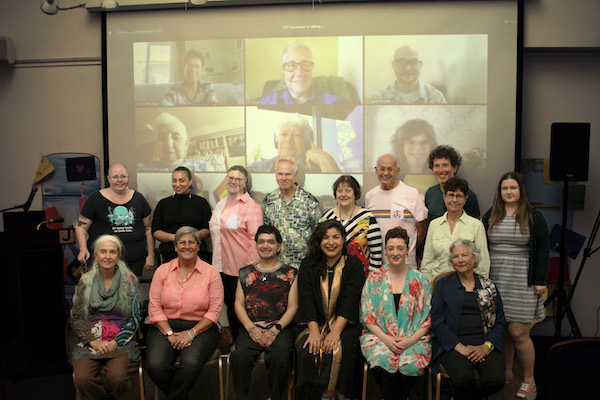
Some of the many people who contributed to and/or supported the B.C. Jewish Queer &Trans Oral History Project online exhibit. (photo by Brianne Nord-Stewart)

The online exhibit features an interactive timeline of B.C. Jewish queer and trans activity from the 1920s to 2020s; an essay weaving together the stories that emerged from the interviews; an article on the Klezbians music group; video excerpts from the oral history interviews; interviewee statistics; and more. Three of the interviewees spoke with the Independent.

Syd Lapan lives in Comox and was “absolutely” enthusiastic about being included. Lapan said she has been out since 1971. Living in the United States at the time, she said she was, as a lesbian, considered illegal and insane. She was active in the women’s liberation movement, then in the gay rights movement in Colorado. Excited about JQT’s oral history project from the beginning, she was glad to share her story, to have it noted, and she joined the launch via the Facebook livestream. When she saw the video on the oral history site of herself being interviewed, she confessed that she cried a bit, finding it emotionally striking. She was thankful for the care Tanaka displayed while interviewing her.

Ira Rogers attended the launch, but, unlike Lapan, he was not initially keen about being included in the project – Tanaka’s enthusiasm won him over, he remarked. Rogers said he felt good sharing his story, he liked going back to earlier chapters of his life. He grew up in New York and moved to Nashville, Tenn., to pursue a career in songwriting – among other things, he contributed to a Grammy-nominated Reba McEntire album, helping create the songs “All Dressed Up (With Nowhere To Go)” and “For My Broken Heart.” Even with such successes, living in Tennessee became too much, though, and Rogers set out to find a gay-friendly city, eventually relocating to Vancouver. Rogers currently is associated with the Vancouver Men’s Chorus.

Finally, Marc Gelmon, who transitioned at age 19, discovered JQT while searching online for information related to his work at TransCareBC. He made a note to himself and got on with life. When contacted to participate in the oral history, he was interested right from the start. “I’m a Vancouverite, I’ve lived my adult life as a trans person. I love telling my story, as it is always cathartic for me,” he said. “I hope it is also cathartic for others.” At the time of his interview with the Independent, Gelmon had not seen his oral history interview online, as he was traveling in the United Kingdom.

In addition to Tanaka and Routtenberg, also speaking at the May 8 launch were emcees Aviva Rathbone, chair of JQT, and Sophie Macdonald, JQT vice-chair. Mack Paul of Musqueam First Nation gave the land acknowledgement. Alison Cristall, assistant executive director of the Jewish Community Centre of Greater Vancouver, shared a few words, as did Allison Dunne, co-executive director of Vancouver Pride Society. Carol Herbert, past chair of the JMABC, spoke and Raegan Swanson, archivist and executive director or the ArQuives: Canada’s LGBTQ2S+ Archives, joined the proceedings virtually, from Toronto. JQT ethnographer Maxa Sawyer, speaking from Winnipeg, closed out the proceedings.

To view the JMABC oral history collection catalogue, including all the interviews conducted for this project, go to archives.jewishmuseum.ca and enter JQT or the name of the interviewee. To access any of the full interviews, contact the museum at [email protected] or 604-257-5199. Go to jqtvancouver.ca to view the online exhibit, a video of the launch event and learn more about JQT.

Trude LaBossiere Huebner is a Vancouver freelance writer.

Posted on June 23, 2023June 23, 2023Author Trude LaBossiere HuebnerCategories LocalTags 2SLGBTQIA+, Alysa Routtenberg, B.C. Jewish Queer & Trans Oral History Projec, Carmel Tanaka, Ira Rogers, JQT Vancouver, LGBTQ+, Marc Gelmon, Syd Lapan
Remembering Alex Buckman

Remembering Alex Buckman

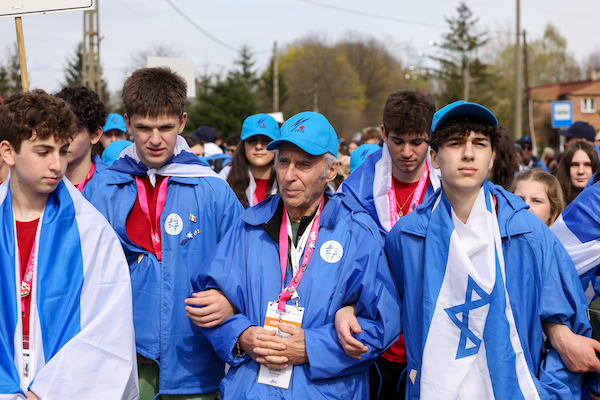
Alex Buckman with students on the March of the Living. (photo from thecjn.ca)

Alex Buckman, a tireless stalwart for Holocaust education in British Columbia and a steadfast advocate for his fellow child survivors, died in Warsaw on April 21. He was 83. Buckman had been on a trip to Poland accompanying the Coast-to-Coast Canada March of the Living delegation.

Described by those who knew and worked with him as a caring and gentle person, Buckman was president of the Vancouver Child Survivors Group, served as treasurer of the World Federation of Jewish Holocaust Survivors & Descendants and had, in recent decades, spoken to thousands of students in the province through the Vancouver Holocaust Education Centre.

In his 2017 memoir Afraid of the Dark, Buckman wrote that he felt compelled to share his story as a Holocaust survivor for two reasons: “First, I want others to know the price of hate. Hate destroys the lives of innocent people. It breaks families apart and its effects are felt for a lifetime. Second, and most importantly, I share my story to honour the memory of my parents. Talking about our stories gives them a chance to live again and gives me the opportunity to remember them.”

Born in Brussels, Buckman was seven months old when Germany invaded Belgium on May 10, 1940. At age 2, his parents sent him into hiding, and he would find shelter in a dozen different non-Jewish homes over the course of the following two years.

Buckman was next handed over to Andrée Geulen, a 20-year-old teacher, for safekeeping. Geulen, who helped to save many other Jewish children during the Holocaust and was later named one of the Righteous Among the Nations, moved Buckman to an orphanage in the town of Namor.

Buckman’s parents would ultimately be sent to Auschwitz-Birkenau, where they perished.

Under the care of his aunt, Rebecca Teitelbaum (Aunt Becky), Buckman immigrated to Canada in 1951. They settled in Montreal. As a young man, Buckman got his first job as a cost accountant for the bakery and delicatessen at a Steinberg grocery store. He went on to attend night school before entering Sir George Williams University to obtain a degree in accounting.

In 1962, he married Colette Roy, and they embarked on what he called a “normal life.” Their son Patrick was born in 1964 and, in 1967, he took his family west to Vancouver, where Buckman found a job as a housing officer for the Canada Mortgage and Housing Corporation. The position entailed developing homes for Indigenous people across British Columbia.

“It felt so good helping people move into their own homes. It really changed their lives and I loved meeting and working with the First Nations bands. I felt connected to them,” Buckman would write.

Concurrently, he developed an interest in running, competing in both half and full marathons.

Buckman had made a previous excursion to Poland to join the March of the Living in 2010, which he described as one of the “most meaningful” trips of his life. Speaking to the students traveling with him at that time, he reflected, “What will happen when we will go home? How will we deal with injustice? How will we continue to do all the things we have to do? How will you continue the legacy? How will you remember? I know I will remember you always. We spent a week in Poland together. I don’t think I would have made if it wouldn’t be for you. Some people tell me I was there for them – but most of you were there for me.”

He would further ruminate on that trip to Poland in his memoir, writing: “We Holocaust survivors, accompanied by students from around the world, silently walked the three kilometres that separate Auschwitz from Birkenau in tribute to all the innocent lives that were ended there. I walked into the shower room/gas chamber where my mother once stood, her arms most likely tightly holding onto her sister, in 1943. I wept, surrounded by people who truly understood my loss.”

Prior to that trip, Buckman had avoided speaking about his mother’s experiences to, as he said, “protect the kids from the grim reality of the death camps” – not wanting to tell young people that up to 2,500 people were killed at a time in the gas chambers. “But after I had stood in her place, I decided her death deserved to be spoken about.”

During his talks to young people, Buckman would often share the story of the recipe book his aunt created in a dangerous and defiant act while a prisoner at the Ravensbrück concentration camp, where she held an office job at a Siemens factory.

As a means to keep her mind off the dire conditions at a concentration camp, Rebecca Teitelbaum would reminisce about the family meals she prepared before the war. One evening while working at Siemens, she found some brown paper that she concealed in her dress. Later, after stealing a pencil and scissors, she went to her barracks and started cutting the paper into the little squares onto which she would write her recipes.

Buckman held on to the recipe book and, at his speaking engagements, he would leave his young audience members with a copy of Aunt Becky’s gâteau à l’orange (orange cake). He would ask the students to invite their families to make the cake together and to share his story with their mothers, fathers and siblings.

As he detailed in the final section of his memoir, by bringing families together through the recipe and having them share his story, Buckman’s hope was to stop the spread of hate and honour the memory of his own family.

“As a group, we thrived in his care,” said Vancouver author and child survivor Lillian Boraks-Nemetz. “He was a great speaker and carried an important message to masses of students against hate, intolerance and bigotry. Alex is and will be missed by all. May his soul continue to watch over us. May he rest in peace knowing that he is loved.”

Buckman is survived by his wife Colette; son Patrick and his wife Elsi (née Towes); grandchildren Alexander, Jameson and Rachael; and sister Annie Kidorf. Patrick Buckman had accompanied his father to Poland for the March of the Living.

Sam Margolis has written for the Globe and Mail, the National Post, UPI and MSNBC. This obituary was originally published in the Canadian Jewish News, thecjn.ca.

Format ImagePosted on June 23, 2023June 22, 2023Author Sam MargolisCategories LocalTags Alex Buckman, Holocaust, March of the Living, survivor

Posts pagination

Page 1 Page 2 … Page 4 Next page
Proudly powered by WordPress