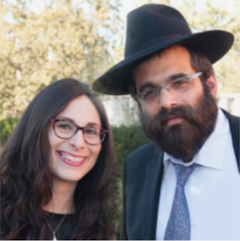
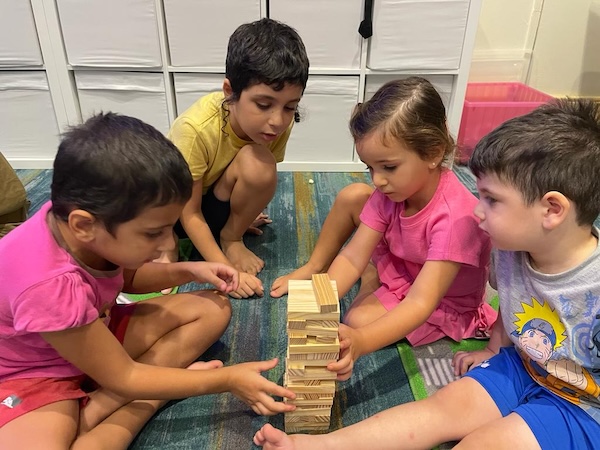
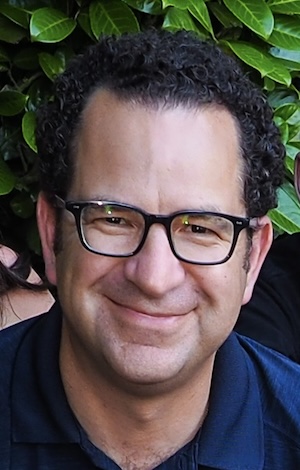
Kineret Tamim Academy founders Dr. Elior and Leah Kinarthy. Kineret Tamim is Victoria’s first Jewish day school. (photo from Chabad)
Kineret Tamim Academy, just steps from the Chabad of Vancouver Island’s Centre for Jewish Life and Learning, is now officially an independent school.
Easily reaching the 10-student minimum before any classes could be taught, Kineret Tamim is looking forward to enrolling more students when it opens in September. The school will be kindergarten to Grade 2 at the start, but hopes to expand to more grades in the future.
For many local Jewish parents and grandparents, the need for a day school has been pressing. Victoria is the fastest-growing Jewish community in Canada, with a population of 4,385, according to the 2021 census (up from 2,630 a decade earlier).
“The fact that, for the first time in the 160 years of Jewish history in Victoria, the first Jewish day school is opening is a testimony to the growth of Jewish life on Vancouver Island,” said Rabbi Meir Kaplan, the director of Chabad of Vancouver Island.
“Victoria is now a destination for families who would like to raise their children in a community with robust Jewish education,” he said.
Chabad of Vancouver Island was established in September 2003 when Kaplan and his wife, Chani, arrived in Victoria. At first, the living room of their home was used as the shul and children’s play area. Their programs, and the interest they drew, expanded over the years and more space was needed to accommodate the community. On Aug. 24, 2016, the Verrier Family Chabad Centre for Jewish Life and Learning was opened.
“Rabbi Kaplan has been a mover and shaker, and his wife, Chani, has also been a major reason the school is happening,” said Leah Kinarthy, an active member of the local Jewish community and president of Jewish Family Services Vancouver Island. “The preschool she runs is incredible. Having a successful preschool is a major requirement for the Tamim Academies to support a new school opening.”
Kinarthy and her husband, Elior, were instrumental in enabling the school to become a reality and Leah Kinarthy will serve on the school’s board. Cathy Lowenstein, who was head of Vancouver Talmud Torah for 17 years, is now a professional advisor who helps launch private schools and works to establish them as certified independent schools in the province – she was also pivotal in bringing Kineret Tamim into being.
Principal Kristen Lundgren, who holds a bachelor’s of education specializing in French immersion and French second language instruction, has 27 years of experience in childhood education. Hebrew and Judaic studies will be taught by Viviana Finkelstein, who has taught elementary Hebrew for more than 30 years.
“The school has an incredible headteacher/principal and a Judaic/Hebrew teacher,” said Kinarthy. “It’s a community school that will be a unifying force for quality Jewish education for our children and grandchildren. Opening a Jewish day school was our lifelong dream; now is the time to make our legacy a reality.”
Kineret Tamim will offer secular education, with both French and Hebrew immersion, along with Judaic studies. The organizers of the school stress their objective is to facilitate the “unbounded potential” and “innate desire to learn” within every child.
Further, they aim to “prioritize long-term social-emotional and spiritual health in order to fulfil our mission of developing kindness, self-efficacy and purpose in each student.” This approach, they believe, will enable students to make their own positive imprint on the world.
Kineret Tamim Academy is run under the auspices of Chabad of Vancouver Island, which is led by Rabbi Meir and Chani Kaplan. (photo from Chabad)
The school will be inclusive. Every Jewish child, regardless of background, affiliation or level of observance, will be able to attend. No Jewish child, their website states, will be denied a Jewish education due to financial circumstances. All students must wear a uniform. Kineret Tamim has partnered with a security company to ensure the safety of children and staff.
The school is part of Tamim Academies, an international organization of schools, and is one of many located around the world. The name stems from Tomchei Temimim, the first formal yeshivah system of the Chabad-Lubavitch movement, which was founded in 1897 in Russia by Rabbi Sholom Dovber Schneerson. Each student was referred to as “tamim,” pure, perfect or complete – the assumption being that each child is inherently holy and good, with “wholeness” being the foundation of the education model.
For several years, Chabad of Vancouver Island has been operating CTots, a licensed early childcare centre, situated on the upper level of the Centre of Jewish Life and Learning on Glasgow Street. Kineret Tamim Academy will be located on Quadra Street.
The Chabad centre in Victoria is one of two on Vancouver Island. There is also Chabad Nanaimo and Central Vancouver Island, which launched in January 2015.
On Lag b’Omer (May 26) at 4:30 p.m., there will be a groundbreaking for Kineret Tamimn Academy, coinciding with a community barbecue. The event will take place at the CTots Adventure Park. Admission is $10 for adults and $5 for children. Sponsorship is $180.
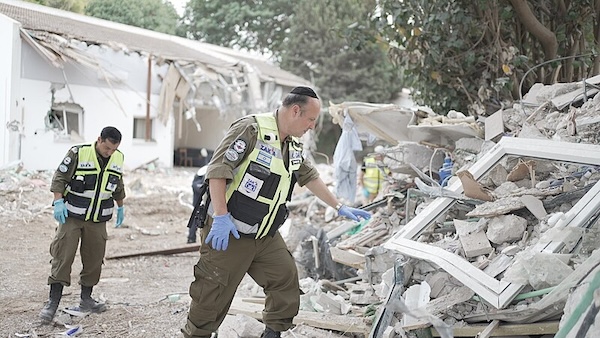
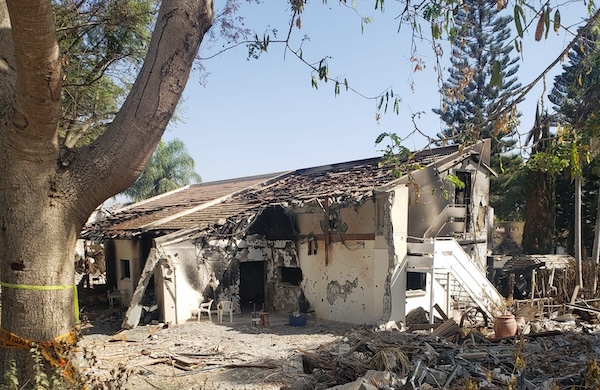
Members of ZAKA identification, extraction and rescue team search through the destruction in a Gaza Envelope community following the Oct. 7 attacks. (photo from ZAKA)
The annual Yom Hazikaron ceremony, marking Israel’s day of remembrance for fallen soldiers and victims of terrorism, took place May 12 at Temple Sholom. It was an unprecedentedly poignant ceremony, with hundreds of in-person attendees and hundreds more attending virtually, many of whom lost loved ones on Oct. 7 and in the war that began that day.
Dikla and Etsik Mizrachi, parents of Ben Mizrachi, the young Vancouver man murdered while heroically providing medical aid to others at the Nova music festival, both spoke.
“This Yom Hazikaron is different,” said Dikla Mizrachi. “This Yom Hazikaron, I can’t think of the many lives that we’ve lost. My heart can’t take the burden. The weight of my grief is too heavy to bear. This Yom Hazikaron, I can only think of one special boy, a boy who had big dreams, life ambitions.”
Ben grew up in Vancouver, she said, attended Vancouver Hebrew Academy and then King David High School.
“Ben was so proud of who he was,” his mother told the packed synagogue. “He was proud to be a Jew, he was proud to be Israeli. He had his mind set that, after high school, he would go to Israel and learn in a pre-army Mechina program to prepare him for the IDF. He couldn’t imagine himself doing anything else. And he didn’t. He did it all.”
Ben Mizrachi served three years in the parachute unit and completed a paramedic course.
“On Oct. 7, at the young age of 22, Ben was brutally taken from this world at the Nova festival in Re’im,” his mother said. “But he was not taken without a fight. His personality and moral core would not allow it. He did not run away to save himself when he had the chance. He showed tremendous courage and bravery as he tried to save others.
“We do not know everything about the last hours of Ben’s life. But we have been able to piece together some of them. What we know is that, from 6:30 a.m. to 8:10 a.m., Ben was under attack. We know that he and Itai Bausi, a friend from his kibbutz who went with him to Nova, made a choice to leave the safety of their car and their chance to flee. We know they made this choice in order to render aid to the injured,” she said.
Two brothers who survived the music festival attack have shared the story of how Ben used his medical skills to attend to the injuries of a young woman and then, with three other young men, transported her on a stretcher to the medical tent, holding her at hip level to avoid snipers.
“We know after they deposited the woman the boys then separated to run in different directions to escape their attackers,” said Dikla Mizrachi. “We know from the last voicemail message Itai’s girlfriend received from him that he was shot in his back and his leg. We know from both the phones that Itai called Ben multiple times but there was no response and we know that Ben died a hero, as did Itai.
“This past Oct. 7, our life as a family and our life as a Jewish nation changed forever,” she said. “Our collective hearts are completely shattered. Today, we are all in mourning. We all have soldiers in Gaza. We all have 132 hostages in Gaza. We all have evacuees from the north scattered all over the country. We are all suffering together.”
She told the audience that, at her son’s shiva, an army friend of Ben’s told her that he had lost a cousin in 2021, in Operation Guardian of the Walls.
“That year, on Yom Hazikaron, Ben had called him and said, ‘I know it’s your first Yom Hazikaron, so if you need or want to talk to someone, I’m here for you,’” she recounted. “This was Ben, thinking about others at every moment and being so sensitive.”
Addressing her late son, she said: “Ben, this is my first Yom Hazikaron and I need you.
“I need you to help our family choose life each day and give us strength. I know that you are still with us, but can you please send us a sign very soon, a sign that you are OK and in a good and peaceful place? Ben, we will do our best to live our lives according to your values, to be there for others, as you always were, and to cherish the things you loved. We love you. We think about you and we miss you every day a bit more.”
Later in the evening, Ben’s father, Etsik, said Kaddish for his son.
Geoffrey Druker, who has led the annual event for years, noted that this year was different.
“We have within our community families who lost loved ones in the past seven months, lost a son, a father, a brother, a sister, cousins, extended family, and friends,” he said. “Tonight, with our bereaved families here and worldwide, we remember our fallen in the establishment and the defence of the state of Israel, and all who have been murdered in terrorist attacks. We remember them all.”
Members of the BC Jewish community lit candles and spoke about those they have lost. A montage of photographs remembered friends and family of locals, from 1948 to recent months. Druker shared individual stories, a microcosm of the many stories of tragedy and heroism from Oct. 7 and the months since.
He told of the five members of the Kutz family of Kfar Aza – father Aviv, 54, mother Livnat, 49, and sons Rotem, 19, Yonatan, 17, and Yiftach, 15 – who were found hugging each other on a bed, father Aviv trying to provide a protective embrace.
In all, 64 members of Kfar Aza were murdered, and 13 soldiers killed in the battles on Kfar Aza. Among these residents was Mordechai Modi Amir.
“Modi was a creative person, always thinking outside the box,” Druker said. “So, when they built his secure room, he decided to add a small shower room, a room within a room, with its own door. At 6:30 a.m. on Oct. 7 – when the red alert siren went off, Modi, his two daughters and granddaughter entered the safe room.
“When they heard shots close by, and voices speaking Arabic, he told his daughters and granddaughter to enter the tiny shower room and to remain quiet as he closed the door behind them. He then stood waiting in front of the shower room door,” Druker said. “He most likely thought, when the terrorists enter the safe room, they will see a man standing by the wall, they will shoot him, and move on. A member of Kfar Aza later said: ‘Modi was shot several times and fell to the floor. He most likely, in his last seconds alive, saw the terrorist leave, knowing he saved his family.’ And,indeed, 13 hours later, his three family members left the tiny shower room alive, and survived.”
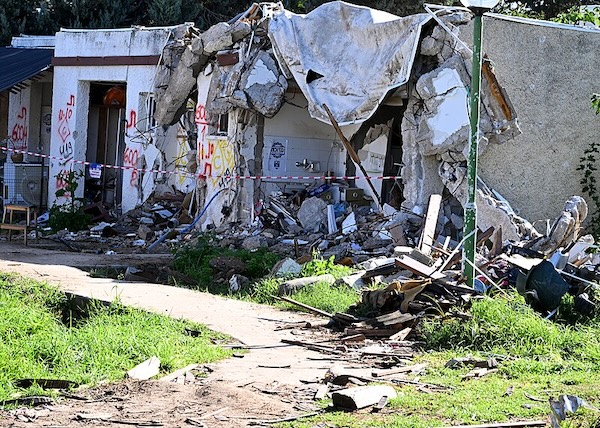
Destruction at Kibbutz Kfar Aza. (photo from US Embassy Jerusalem)
Vancouverite Amnon Kones and his family lived on Kfar Aza for 20 years and knew many of those killed. He lit a candle of remembrance, as did Sam Heller, who lived there during his military service as a lone soldier.
Adi Vital-Kaploun, an Israeli-Canadian who lived on Kibbutz Holit, was a relative of Vancouver residents Jason Rivers and Helen Heacock Rivers.
“Her husband was away that weekend,” Druker explained. “When Adi realized terrorists had infiltrated her kibbutz, she phoned her husband and asked how to operate his weapon, to defend her children.
“By some miracle, Adi persuaded the terrorists to allow her two young boys, Negev, 3-and-a-half, and Eshel, 6 months old, to be kept by her neighbour, Avital. Adi was shot and murdered in her home, and her body booby-trapped by the terrorists,” said Druker. “The Hamas terrorists then marched Adi’s neighbour, Avital, who was carrying Negev and Eshel, towards Gaza. At the Gaza border, for some unknown reason, they were released, and they survived, though 3-and-a-half-year-old Negev had been shot in the foot.”
Noam Caplan and Kessem Keidar, members of Habonim Dror Camp Miriam, lost family members and a friend on Oct. 7. Caplan spoke of his cousin, Maya Puder, 25, who was murdered at the Nova festival. Keidar remembered her cousin’s uncle, Amit Vax (Wachs), who was murdered in Netiv HaAsara.
“When he was killed, he was not aware that his brother Igal Vax was murdered earlier, while he too was fighting the terrorists on the other side of the moshav,” said Keidar.
The pair lit candles in memory of these victims, as well as Vivian Silver, another Canadian-Israeli, who lived on Kibbutz Be’eri.
It is estimated that about 120 people were murdered on Kibbutz Be’eri, among them Sylvia Ohayon. Dalia Ohayon lit a candle in memory of her sister.
Five members of the Bira family were murdered on the kibbutz: Oron Bira, 52, and his wife, Yasmin Laura Bira, 51, and their daughters Tahir, 22, and Tahel, 15, along with Oron’s elder brother, Tal, 62. Yahav, Oron and Yasmin’s son, was in another house, and is the sole survivor.
Navah Jacobs, a member of the extended Bira family, lit a candle in their memory.
Vancouverite Hofit Sabi recalled her cousin, Yinon Tamir, a 20-year-old paratrooper killed in action in the Gaza Strip in November, having earlier served among the first responders at Kibbutz Be’eri.
“Before going into Gaza, a few weeks after the battle of Be’eri, another comrade told of how Yinon comforted and guided him through his fears and anxieties to go into Gaza,” said Sabi. “Yinon promised that he would stay by his side and protect him, and he did, until his death. Yinon’s courage and leadership qualities shone through.”
Tamir had told his mother that he saw things at Be’eri that he could never unsee and that he felt a profound sense of privilege to serve and protect the right “to live as free people in our homeland.”
Itzhak Ben Bassat, a colonel nicknamed Benba, had just returned from vacation abroad at the end of a storied military career when he received a message to head for Be’eri on Oct. 7. He fought there for two days, securing the kibbutz, and survived. He died in battle two months later, age 44. His sister, Hamutal Ben Bassat, lit a candle in memory of her brother.
Nicky Wasserman Fried, whose uncle Aaron Fried died in the 1948 War of Independence, lit a candle in his memory and told the audience of casualties in Vancouver’s partnership region in northern Israel.
“Three IDF soldiers from our region were killed fighting Hamas as they infiltrated our communities surrounding Gaza on Oct. 7,” Fried said. “Since Oct. 7, an additional seven soldiers and three civilians have been killed.”
Cantor Yaacov Orzech chanted El Moleh Rachamim. The Clore & Roll Ensemble, who were the featured entertainers at the next evening’s Yom Ha’atzmaut event, performed, as did singers Mayan Molland, Shir Barzel and the Meitar Choir. Shir Barzel played piano.
The ceremony was presented by the Jewish Federation of Greater Vancouver, the Centre for Israel and Jewish Affairs, the Rabbinical Association of Vancouver and the Jewish Community Centre of Greater Vancouver.
Every year, the sun goes down on Yom Hazikaron, Israel’s national day of remembrance for victims of war and terrorism, and the celebratory day of independence, Yom Ha’atzmaut, begins.
It’s a stark juxtaposition. The parallel of the two national days, of course, make perfect sense historically. The country was born in war. At the moment Israel became independent, it was attacked, with the intent of annihilation, by the military forces of all neighbouring countries. As a result, it is impossible to consider or celebrate the joy of that moment – the rebirth of Jewish national self-determination after nearly 2,000 years – without considering the human costs associated with that achievement, and not only Jewish or Israeli lives, but those of peoples whose leaders have refused to accept the existence of Israel since that rebirth. While reestablishing the Jewish homeland displaced Arabs living there, whether by being forced out or told to leave by their leaders, Israel has been a home for Jews displaced from surrounding Arab countries, Russia and elsewhere.
For the average attendee arriving at Vancouver’s celebration of Yom Ha’atzmaut, it was hard to know what to expect. Given the Oct. 7 Hamas terror attacks and the ensuing war, the remembrance commemoration, 24 hours earlier, was perhaps one of the most emotional, intense and moving this community has experienced. Could the next night’s audience, many of them the same people, make the emotional transition?
Under the circumstances, the event’s planners struck an appropriate balance in what must have been among the most difficult challenges organizers of this annual event have faced.
When Israel’s early leaders set these dates consecutively, they knew the nature of their neighbourhood. They would likely have foreseen the possibility of further wars, and yet they made the decision to mark the joy of independence immediately following the somber acknowledgement of the high cost of freedom. This was not a coincidence. Nor, presumably, was it a contrast they thought appropriate only in years that are relatively calm and peaceful. They recognized that, come what may, independence and freedom would come with a cost – and the deeply conflicting emotions these realities evoke will inexorably exist together.
Like the smashing of the wine glass at a Jewish wedding, joy is never absent of grief – and grief cannot eclipse the joy brought into the world by those we lost on Oct. 7, and since. Those murdered and kidnapped that day, the soldiers who have been killed in the war and the Palestinians who have been killed in the conflict as Hamas continues to hold them and Israel hostage.
In Jewish tradition, the various markings of time after the passing of a loved one – shiva, shloshim, yahrzeit, for example – each come with their specific obligations and expectations. These periods formally guide us through process of grieving.
Unlike that relatively slow process of mourning, the closing of Yom Hazikaron and the opening of Yom Ha’atzmaut is abrupt and immediate. Life in Israel has, in some sense, condensed time, requiring a speedier processing of even life’s most challenging realities, including loss and grief.
It is often said that Israelis have been in too much of a hurry to be polite about things. Stereotypes, often accurate and amusing, portray Israelis as sharp-elbowed, impatient and determined. If there was not some truth to this, they would not have built, in a mere three-quarters of a century, one of the most extraordinary nation-states on earth – all while confronted by existential threats.
The Israelis who chose to set the remembrance day immediately before the celebration of independence must have understood that, in some years more than others, the transition from one emotion to the other would be especially difficult. Perhaps we should trust their judgment that, even in the most difficult years,the juxtaposition is both manageable and appropriate.
Noam Caplan, who lit a candle at the Yom Hazikaron commemoration and spoke about his cousin, Maya Puder, who was murdered at age 25 at the Nova music festival, remembered his cousin’s love of dancing and looked ahead to happier times.
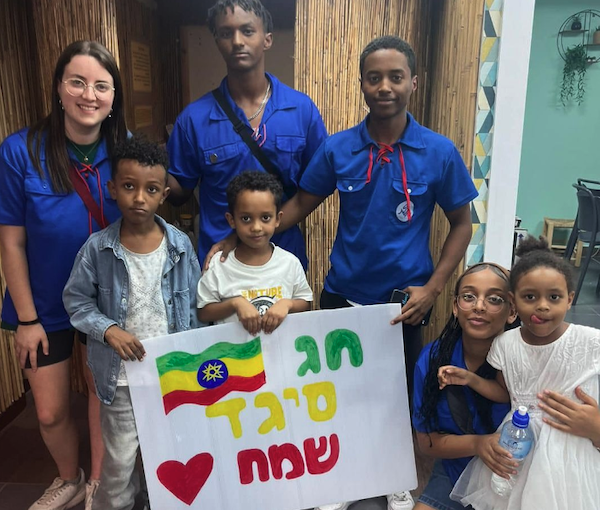
Last November, Dror Israel helped evacuees from northern Israel celebrate the holiday of Sigd. (photo from Dror Israel)
Noam Schlanger of Dror Israel is returning to British Columbia to discuss the group’s emergency response after the Oct. 7, 2023, Hamas terror attacks in Israel. He will speak at Congregation Emanu-El in Victoria on May 28, at 7 p.m., and at Congregation Beth Israel in Vancouver on June 2, at 5 p.m.
“We had been working with many of the affected communities for a long time before the attacks, so, when the war broke, we had the connections and the know-how to immediately set up educational frameworks for evacuated communities, with an emphasis on therapeutic and empowering platforms,” Schlanger the Independent.
“I will also be talking about our work with the tens of thousands of evacuees from the north, who still haven’t returned to their towns and homes. We have been providing day camps, leadership training courses and social-emotional support to many children and teens who have been living in cramped hotel rooms with their parents for seven months.”
Schlanger is an engagement director with Dror Israel, an Israeli organization that teaches leadership and responsibility for both individuals and community. Comprised of 1,300 trained educators in 16 communities on the social and economic periphery of the country, the organization promotes social activism to drive positive change. Educators live in the neighbourhoods they serve to bridge gaps and solve local problems. Through its youth movement, schools and programming in Israel, it helps an estimated 150,000 people a year.
Dror Israel educators have supported children traumatized by previous wars, the COVID lockdowns and the war in Ukraine. During the current war, the organization, in cooperation with local municipalities and the Israel Defences Forces Home Front Command, has established programs to help evacuees and residents who have been hardest hit.
Schlanger shared several stories of how Dror Israel has played a crucial role in allowing life and events in the country to continue as normally as possible under the circumstances. In November last year, they helped evacuees celebrate Sigd, a holiday celebrated by Ethiopian Jews that falls 50 days after Yom Kippur.
This past March, students from Dror Israel’s Tel Aviv high school used their skills in urban agriculture to create community gardens. The portable gardens were made at several evacuee centres for displaced communities and not only provide fresh produce but therapeutic spaces that give solace and connection.
In April, 400 children from the evacuated city of Kiryat Shmona were supplied structure and some fun through a Passover day camp. The children, from grades 1 to 6, who are presently housed in Tel Aviv hotels, went bowling, visited an amusement park and had a picnic near the Alexander River.
Dror Israel has been giving evacuees the chance to have some semblance of a normal life. (photos from Dror Israel)
Dror Israel works with animals as well. Following the Oct. 7 attacks, many dogs ran away or were leftbehind. With the help and care of students in the Dog Training Vocational Course at Dror Israel’s high school in Karmiel, dogs went from being fearful and hesitant to curious and loving, and many are now ready for adoption.
Besides being an engagement director, Schlanger’s involvement with Dror Israel has included leading a youth centre in Kafr Manda, an Arab town in Lower Galilee, and working at the community garden in Akko (northern Israel).
From Schlanger’s standpoint, the essence of Dror Israel is one of an inclusive vision of Zionism that yearns to create space for everyone, and the dream of a just and equal Israel. He believes it is a welcome message amid the polarized discourse that has been prevalent in the country for many years.
Schlanger last visited British Columbia in the summer of 2022 and has maintained a close relationship with both Congregation Emanu-El and Congregation Beth Israel. In October 2023, only a couple of weeks after the Hamas attacks, he wrote to his friends in Victoria, “We will do our best to better people’s lives during these terrible days. Our educators across the country are continuing to assess the safest and most necessary next steps in our communities.”
“The sense of connection goes deep into our community and we have people there, too,” said Susan Holtz, executive director of Emanu-El, about the synagogue’s ties with Dror Israel.
Rabbi Adam Stein of Congregation Beth Israel said, “We are very excited to have Noam come here. Dror Israel is a wonderful organization that has been doing great work for Israeli civil society, especially for those who were evacuated after Oct. 7.”
“I visited Dror Israel in Akko and was very impressed at the programs they offered and the process they undertook,” Beth Israel member Penny Gurstein added. “Their commitment to social justice and partnerships between Jews, Arabs, and all sectors of Israeli society is even more needed now.”
Dror Israel was started in 2006 by graduates of the Israeli Youth Movement, Hanoar Haoved Vehalomed, who served together in the IDF and shared a belief in the founding principles of Zionism.
After his talk in Vancouver, Schlanger will travel to Portland to speak at the annual federation meeting there. For more information about Dror Israel, visit drorisrael.org.
Sam Margolishas written for the Globe and Mail, the National Post, UPI and MSNBC.
Spending a night in late March at Kibbutz Erez in southwestern Israel was an unforgettable experience. Visiting friends, it was somewhat eerie. Most residents have not returned since the Hamas terror attacks on Oct. 7, and the absence is profound.
The area is like a Canadian suburb. A group of houses surrounds a large grassy area, which has children’s playgrounds and lemon, orange and kumquat trees. This type of living is a rarity in Israel, where most people live in apartment buildings.
While the environment was scenic and comfortable, explosions could be heard in the distance and puffs of smoke periodically arose from Gaza, the border of which is less than a kilometre away. The Israel Defence Forces were entrenched nearby.
Kibbutz Erez fared better on Oct. 7 than many other kibbutzim and towns in the region because they received advanced warning from a neighbouring kibbutz that an attack was underway. Their neighbours had seen hang gliders from Gaza soaring overhead.
The security team of Kibbutz Erez quickly assembled to try to prevent the invaders from entering the kibbutz through the main gate. First, they called the IDF to make sure that the army wasn’t conducting an exercise. Receiving confirmation that it was a terrorist attack, the kibbutzniks asked how long it would take for the army to come – they were told they were on their own.
A firefight involving rifles, grenades and RPGs ensued. According to one of the kibbutzniks, “we fought like lions.” This was no ordinary military engagement, but a battle to protect their children and other family members from the Hamas terrorists. If they failed, they knew that Hamas would hurt their children.
Amir, one of the kibbutzniks, whose wife was expecting their first baby, was killed in the encounter. Danny received a bullet to the neck and Uri suffered wounds to his head and leg.
Liora, a nurse described as having nerves of steel, recognized that neither Danny nor Uri would survive without immediate medical attention. Both were bleeding profusely, and their level of consciousness was decreasing. With the help of a friend, she packed them into a car, drove out of the kibbutz amid a hail of bullets and got them to a nearby hospital, where they received lifesaving treatment. Both survived in relatively good physical shape.
After a fight of close to two hours, the terrorists decided that Kibbutz Erez was too difficult to overcome, and moved on to wreak havoc on the next village. The IDF did not arrive until later that day.
The whole kibbutz was evacuated to Mitzpe Ramon. Many of the families moved into hotel rooms there. After several weeks, makeshift schools were established and members of the kibbutz achieved some measure of normality, as much as it can be normal living in a hotel,totally dependent on caring neighbours, a supportive community and government help. Since then, some of the kibbutzniks have relocated to Kiryat Gat, which is much closer to their home. Some, including my friend, have returned home.
What is the future of Kibbutz Erez? People are slowly trickling back. The telling test will be in the summer, if families return in preparation for the start of the school year in September.
Kibbutz Hatzerim and Kibbutz Be’eri
Earlier in March, we visited extended family who live on Kibbutz Hatzerim, and heard about their experiences on Oct. 7.
People on Kibbutz Hatzerim awoke that day to sirens and multiple WhatsApp messages from friends and relatives, letting them know that Israel was under attack by Hamas terrorists, who were infiltrating the settlements close to the border. Were the attackers coming to Kibbutz Hatzerim, 20 kilometres west of Beer Sheva? Rumours circulated that they were on their way to Tel Aviv. People were reluctant to turn on their TVs, to protect their children from seeing the horrors that were happening. People received no directives from government sources or from the army. It was an information vacuum.
Some visitors at the kibbutz, who had arrived for Simchat Torah, decided to return to their homes in central Israel, but was it safe to drive there? Nobody knew.
Would the kibbutzniks be able to defend themselves? They did not have many weapons and the kibbutz could be easily infiltrated from several locations. But people on Kibbutz Hatzerim ended up being the fortunate ones. The terrorists were planning to move in that direction but didn’t make it that far. Apparently, they had killed and kidnapped enough people by then – 364 people killed and 44 kidnapped at the Nova music festival alone, mainly young people.
After Oct. 7, life returned to some degree of routine on Kibbutz Hatzerim. However, there were frequent missile attacks, necessitating trips to the bomb shelters. People were called up to do army service (miluim). The IDF was fighting in Gaza and soldiers were being killed. The plight of the more than 240 hostages was on everybody’s minds.
The death and destruction of some of Kibbutz Hatzerim’s neighbours is indescribable. Of special note is Kibbutz Be’eri: approximately 70 terrorists entered the kibbutz. Of the 1,000-plus residents, 97 kibbutz members were killed, 11 people were abducted and one-third of the houses were severely damaged.
Kibbutz Be’eri and Kibbutz Hatzerim have a lot in common. Hatzerim is famous for having developed the drip-irrigation technique and has a large production facility at the kibbutz. Be’eri houses one of the largest printing companies in Israel. Both kibbutzim resisted privatization, which many others had adopted as additional sources of revenue.
Hatzerim and Be’eri were both established in 1946 and both were comprised mainly of people on the left of the political spectrum. They looked forward to a peaceful future with the residents of Gaza. Many were involved in a program that transported sick people from Gaza to hospitals in Israel for advanced treatment. One of the residents of Be’eri, Vivian Silver, originally from Winnipeg, had learned Arabic to better communicate with her Palestinian neighbours, but that didn’t save her life on Oct. 7.
Currently, most residents of Kibbutz Be’eri are being housed in temporary locations, such as hotels in the Dead Sea area. They are safe and relatively free from missile attacks, but life is far from normal. Trying to reestablish a kibbutz lifestyle, while living in a crowded hotel with none of the amenities that glue kibbutzniks together, is challenging.
A house in Kibbutz Be’eri after the Oct. 7, 2023, Hamas terror attacks. (photo by Tomer Persico)
A massive building project is now underway adjacent to Kibbutz Hatzerim. A whole new temporary kibbutz to house the residents of Be’eri is under construction. The plan is to have the temporary kibbutz finished by the summer, so that families can move in before school starts in September.
Some facilities, such as medical clinics and administrative offices, will be shared by the two kibbutzim. Otherwise, the temporary Kibbutz Be’eri will have its own houses, schools and offices. Hatzerim will expand its present dental clinic, seniors lounge and grocery store to accommodate the increased needs from the larger population. In typical kibbutz fashion, members of both kibbutzim have met many times to jointly plan this project.
The ultimate plan is to rebuild the original Kibbutz Be’eri, which was mainly destroyed on Oct. 7. It is hoped that this will be accomplished within the next two years.
Kibbutz Yiron
Look at the label on your kosher wine from Israel. Most likely it comes from Kibbutz Yiron. Next year will probably be different, as the kibbutz is on the Lebanese border and has been evacuated – no one is allowed into the area. As a result, according to one kibbutz member, the pruning of the vines, which usually takes place in the spring, did not happen this year. The same kibbutznik informed me that $20,000 worth of his favourite apple, Pink Lady, was left to rot.
Kibbutz Yiron is an oasis in the desert. We have visited because we have friends who live there, but people come from many other places in Israel and elsewhere to enjoy the mountain scenery, go for hikes and rest in a peaceful environment. Lebanon is visible in the background, but the border was quiet. It is heartbreaking to see this piece of paradise abandoned.
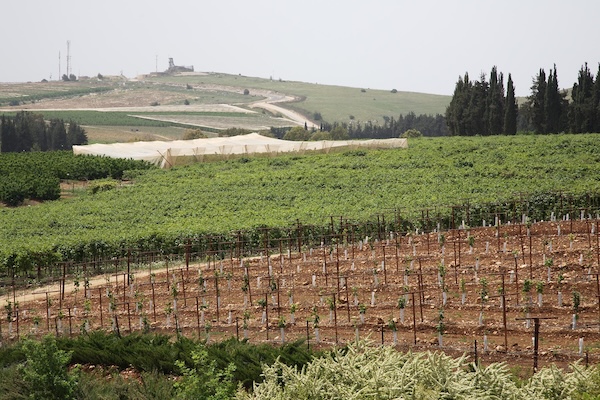
Spring pruning hasn’t been possible at Kibbutz Yiron’s vineyards because of the evacuation. (photo by B. Negin / flickr)
The jewel of Yiron was its Pinat Chai, a literal oasis consisting of a zoo with multiple animals, including a python, which would be taken out on non-feeding days and draped around the necks of unsuspecting visitors. Peacocks, ducks and geese roamed freely. Deer would run around their enclosed area, frequently escaping into the wider area, trying to evade recapture. A lake in the middle of the zoo was a star attraction. Row boats and paddleboats navigated the small artificial lake in a region with no natural lakes.
Kibbutz members looked forward to the day when Pinat Chai would serve as a meeting place for children and families of different origins. They anticipated a day when Lebanese children would enjoy themselves at Pinat Chai together with Israeli children.
But the zoo is now gone. The government also ordered them out of the kibbutz. The animals have been relocated to other places in Israel, and even to other countries.
The evacuation was part of a larger one that included all settlements close to the Lebanese border, like the city of Kiryat Shmona, with 22,000 inhabitants; and the town of Metulla, home of Canada Centre and one of only a few skating rinks in Israel. This area of northern Israel has special significance to the Jewish community of Vancouver, as our partnership region. Since the mid-1990s, Jewish Federation of Greater Vancouver has worked closely with Etzba HaGalil (the Galilee Panhandle).
Kibbutz Yiron was not attacked on Oct. 7. However, the northern border has heated up since then. Hezbollah has been firing many missiles into the region, sometimes 30 per day, killing several Israelis.
Villages, especially in the Gaza Envelope, are receiving government compensation and many have relocated so that they are all living as a group, whether in Mitzpe Ramon or Eilat or the hotels at the Dead Sea. People in the north have not received the same compensation, so they are widely scattered. The kibbutznik with whom I spoke is living in a village close to Haifa. When I asked him when he’s going back to his home, he said anywhere from six months to maybe a couple of years.
There are many in Israel, including government ministers, who think that a war with Hezbollah is imminent. Hezbollah’s arsenal of weapons is much larger than that of Hamas, so a war with them could be even more destructive. The IDF has been stationing additional troops in the north, as tensions rise. Many people are strengthening their bomb shelters.
Looking to the future
Oct. 7 changed Israel in dramatic ways. Stories of neglect, abandonment and destruction are legion. At the same time, Israelis have shown incredible resilience to plan and rebuild for the future.
For many years, kibbutzim have defined Israel’s borders and acted as a protective barrier, both in the north and surrounding the Gaza Strip. But will the kibbutzim be able to rebuild their lives with some semblance of security? Can they ever again trust a government and an army that so dramatically let them down?
People are slowly returning to the kibbutzim surrounding Gaza, but many may never return. For the people along the Lebanese border, the situation in some sense is more dire. They have been exiled from their residences for more than seven months. The agricultural and industrial bases of the kibbutzim economies have been shattered. When will they be able to return? Will the small-scale conflict in progress along the Lebanese-Israel border become a major war?
It’s a very challenging time to be an Israeli, especially a kibbutznik living close to Israel’s borders. Hopefully, their future will include some degree of peace and normality.
Larry Barzelai is a semi-retired Vancouver family physician, who travels to Israel frequently to visit his three grandchildren there. He is presently co-chair of the Jewish Medical Association of British Columbia.
Dina Goldstein stands in front of two of the 10 works that comprise her In the Dollhouse series featuring Barbie and Ken.(photo from Dina Goldstein)
Dina Goldstein had her work pulled from a Vancouver exhibition just days before it was set to open – in what she has described as “a blatant act of antisemitism.” But the gallery is claiming its decision to cut the Israeli-Canadian artist from the show was based on financial considerations, despite a recent news report and documentation from Goldstein that suggest there may have been other reasons.
An internationally acclaimed artist, Goldstein was scheduled to have her works shown at the Vancouver Centre of International Contemporary Art (CICA) from May 9 to June 29 as part of a group exhibition titled Toy Story, a look at the world of toys as seen through the eyes of artists from around the world. Goldstein, who received widespread attention for her Fallen Princesses and In the Dollhouse series of tableaux, was listed as recently as late April on the CICA website among the artists whose works would appear in the exhibit.
According to a report on Stir, a Vancouver website covering art news, Goldstein was notified by the gallery’s curator, Viahsta Yuan, on April 30 that her works – three pieces from the 10-image In the Dollhouse series – would not be shown during the exhibition. (Goldstein earlier had arranged for the gallery to pick them up on May 2.)
Regarding her agreement with CICA after a studio visit by the curator on April 26, Goldstein said, two large pieces and two medium pieces were confirmed, available at the studio, framed and ready to be installed.
“One medium piece had to be produced because it is a diptych with a missing partner. This she requested I get going on. The other selections would be printed in small format. I was waiting to hear about the production of the small version. [The curator] wanted to show all 10 images if possible,” Goldstein said.
But then, in Goldstein’s account, which was sent to the CJN, Yuan disclosed to her that the gallery had received an email from a small group of Vancouver artists who wanted her excluded because she supported Israel. The unnamed artists, in Goldstein’s words, felt that she did not deserve to exhibit her work during this time of war. Goldstein was offered an alternate solo exhibition within a year or two, or when the situation in Israel and Gaza might subside.
Yuan had, as Goldstein recalled, agreed that punishing an artist because of their Jewish identity was unjustifiable. Goldstein asked the curator to relay this message to the gallery committee, as well as the importance of standing up to discrimination. When she reached out to Yuan for an update on her meeting with the gallery committee, Goldstein received an email that cited, as she says, “a sudden budgetary issue as the reason for her removal. This explanation contradicted the previous acknowledgment of discrimination, with the decision now framed as a last-minute ‘creative choice.’”
“This experience takes me back to the times we may have had in our youth and being bullied. This is part of what antisemitism feels like,” Goldstein told the CJN, noting that the works in question have nothing to do with Gaza or Israel.
Goldstein, too, recounted that, unlike most people associated with the exhibition, she had been to Gaza and the West Bank while on an assignment in 1999, photographing Palestinians alongside her pictures from Jerusalem and Tel Aviv. She has shared those memories on Instagram in recent months.
In the Dollhouse, which was created by Goldstein in 2012, features a pink, adult-size dollhouse in which Barbie and Ken reside. The series offers satirical situations around the house, sometimes with a risqué approach to social commentary. Notes about the images on Goldstein’s website say that, in them, Barbie represents the notion that beauty is the ultimate trait and is necessary “to attain power and happiness.” Meanwhile, Ken discovers and expresses his true self after four decades of being “trapped in an imposed marriage.”
In the invitation to participate in the exhibition, CICA wrote that Goldstein’s dollhouse series “offers an intricate exploration of identity, conventional values, gender equality and beauty. The inclusion will not only enrich the depth of the exhibition but also provide viewers with a fresh and unique reflection on the toy that has influenced a generation of people.
“We believe that the inclusion of In the Dollhouse will offer a unique perspective and contribute significantly to the exhibition’s dialogue on the transformative power of toys as symbols within our lives.”
In Yuan’s version of events, as reported by Stir, after consultation with others at the gallery, CICA had originally selected five pieces from the series. After visiting Goldstein’s studio, she said only three of the pieces were ready.
Yuan then had another discussion with the gallery committee, and it was decided that CICA did not have the budget for production costs. Further, another artist was showing a piece about a dollhouse, and the gallery believed showing two works in dollhouses would be excessive.
CICA released a statement on May 4 in which it denied its decision to pull Goldstein’s work from the exhibition was based on “religious and cultural affiliation” but rather was related to financial considerations. Works by two other artists, Roby Dwi Antono and Aya Takano, CICA said, were also removed from the lineup. The organization emphasized its desire “to cultivate artistic dialogue and community engagement while emphasizing inclusivity and representation.”
“As a woman and BIPOC-led organization, prioritizing diversity is not just a goal but a guiding principle that informs every aspect of our work,” the statement from CICA read. “Since our inception, we have been dedicated to showcase a pluralistic range of contemporary art and ideas through our multidisciplinary exhibitions and programming.
“We are grateful to have collaborated with a distinguished group of over 35 local and international artists, with more than two-thirds from visible minority backgrounds. These cross-cultural collaborations are a testament to our commitment to platforming diversity while fostering a safe and accessible environment for all.”
CICA stressed that, like many nonprofit arts organizations, it faced budgetary constraints and, with limited resources, it needed to make difficult decisions. As a result, three artists were not shown because of limited finances, a short time frame and “curatorial direction.”
The cultural and religious background of an artist would never warrant exclusion from the gallery, CICA went on to say, and that decisions were made only on artistic merit and how a work would fit into an exhibition.
“Discrimination of any kind has no place within our organization, and we remain steadfast in our commitment to platforming
diversity and ensuring equitable representation in everything we do. Looking ahead, we will continue to embed the values of equity, inclusion and diversity into every facet of our operations,” CICA said.
Established in 2021, CICA is a nonprofit, multidisciplinary arts organization. According to its website, it provides “a forum for everyone to step into the art and learn while having fun” and aims “to enhance public engagement in the arts and bridge local and international artists for idea exchange, knowledge sharing, and collaboration.”
Sam Margolishas written for the Globe and Mail, the National Post, UPI and MSNBC. This article was originally published on thecjn.ca.
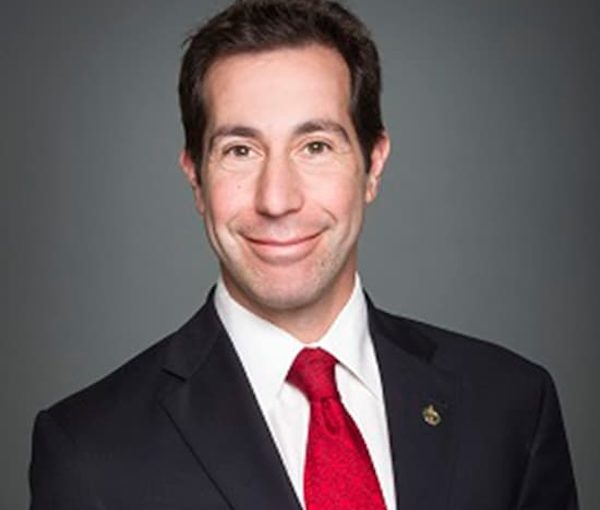
MP Anthony Housefather was in Vancouver last week. (photo from Government of Canada)
Anthony Housefather, the Liberal MP who openly considered joining the Conservatives, made an urgent plea during a presentation in Vancouver last week for Jews and pro-Israel voters to keep a foot on both sides of the political divide.
Housefather, member of Parliament for the Montreal riding of Mount Royal, was on the West Coast for a series of meet-and-greets with Jewish organizations and individuals. At Temple Sholom just before Shabbat on May 17, Housefather was open about the disappointments some Jewish Canadians – including himself – have felt with the current Liberal government.
“We’ve seen a government that has had an excellent record on Israel for the past eight years turn away from that excellent record that we all cherish so much,” he said before going into examples he said show his party has been a voice for Jews and Israel.
Since Justin Trudeau and the Liberal party came to power in 2015, Housefather said, Canada has had a better voting record at the United Nations than the previous Conservative government had.
“We voted against 87% of the anti-Israel resolutions at the UN, comparable only to the United States, at about 90%,” he said. “Most European countries were between zero and 10%.”
On antisemitism, Housefather said it was his party that appointed a special envoy on Holocaust remembrance and antisemitism – first Irwin Cotler and now Deborah Lyons – and adopted the International Holocaust Remembrance Alliance Working Definition of Antisemitism. The federal government apologized for this country slamming the doors on Jewish refugees before and during the Holocaust, initiated Jewish Heritage Month, and made antisemitism one of four pillars of the federal antiracism strategy, he said.
“I’ve been proud of the record of my party while we have been in government on these issues,” he said.
“Since Oct. 7, I think the Jewish community across the country has felt somewhat abandoned,” he said. In January, the government was “not able to articulate that Israel was not committing genocide,” he said. The decision to restore funding to UNRWA – the UN’s Palestinianrelief agency some of whose employees, evidence shows, were involved in the Oct. 7 terrorism – was a blow to many Jewish Canadians. The turning point for Housefather was the New Democratic Party motion that was widely seen as condemning Israel, including calling for an end to military trade with the country.
“Unfortunately, the decision was made to amend [the motion], which made the resolution better, but it was still bad,” Housefather said. In the end, only he and two other Liberals voted against the motion. What really hurt, said Housefather, was when the NDP member who moved the motion was given a standing ovation, including by Liberal MPs.
This combination of events led Housefather to question his place in the party and to publicly acknowledge he was considering crossing the floor. He decided to stay with the Liberals, in part because the prime minister tasked him with new responsibilities to address antisemitism, but also, he said, because he realized that his voice – and those of other Jewish and pro-Israel Canadians – is needed in the governing party.
“I need to be there to make our voices heard in the party,” he said. “Once you place all your eggs in one basket and you have no allies in the other party when it comes to power, then you’re screwed.”
Housefather has a list of actions he wants from the government and others. He is urging Criminal Code amendments to add “bubble legislation,” which would prevent protests within a certain distance from synagogues, Jewish schools and community centres, after protesters laid siege to a Jewish community building in Montreal and people inside were prevented from leaving for hours.
Police need to be told that they must enforce the law around harassment and hate speech, and university administrations need to act to keep students safe, he said.
Housefather pushed for parliamentary hearings on campus antisemitism, which have now begun.
He urged Jewish Canadians to develop relationships with their elected officials, and he passionately urged them to leave their hatred aside.
Housefather said he gets barraged by hate messages from antisemites and anti-Zionists – including death threats – but it’s the hate from Jews that really upsets him. No matter how much some voters agree with him on issues that are important to the Jewish community, he said, they nevertheless condemn him in extreme terms – “traitor,” “quisling” – for being part of the Liberal party.
“If our community wants MPs to support our community, you have to deal with them in a way that doesn’t send them hate, that doesn’t treat them like dirt.”
Above all, Housefather said, Israel and Jewish issues shouldn’t be a partisan issue.
“We should all fight for them and we shouldn’t be trying to create wedge issues that divide the Jewish community,” he said.
Howard Kallner is being honoured at Schara Tzedeck’s MOSAIC gala on June 4 (photo by kenneth88/wikimedia)
“I have been very lucky in my life to be surrounded by lifelong volunteers and builders of community, both my parents, my in-laws and multiple other role models, and it just seemed natural to volunteer and be involved,” Howard Kallner told the Independent.
Kallner is being honoured by Congregation Schara Tzedeck at MOSAIC, the synagogue’s annual gala, on June 4.
“The first thing that came to my mind was discomfort,” said Kallner about finding out he was being recognized. “I was hesitant to accept because there are so many long-time shul volunteers, donors and community-builders who would be deserving of being honoured.”
Kallner has been a part of the congregation since he was 13 years old.
“My family had emigrated from South Africa when I was very young and their synagogues in South Africa were very similar to Schara Tzedeck,” he explained. “My parents, and now my family, have been members for over four decades. On my wife’s side, her great-grandfather, David Davis, was a founding member of Schara Tzedeck, and her grandfather, Charlie Davis, was a past president.”
Howard Kallner (photo from Howard Kallner)
For his part, Kallner was on the board for seven years before becoming president. He served three years as president and three more as past president, for a total of 13 years. He was serving as president when the pandemic hit.
“When the COVID pandemic hit, we needed to pivot immediately to online programming, online services where applicable, continue live services with restrictions and make sure our community members, particularly our vulnerable ones, were connected and taken care of,” he said of how his role was affected. “One of the programs that came out of this was Shabbat in a Box. We recognized a need amongst our members and others in our community and delivered over 450 meals a week at the height of the pandemic. For the Jewish holidays, we were delivering over 650 meals accompanied by holiday-specific items so they could celebrate the holidays.
“Additionally, Schara Tzedeck, being an Orthodox synagogue, could not have Shabbat services online,” said Kallner. “With the exception of a few weeks when the government would not allow any public gatherings, we continued services in person with some significant modifications. When limited to 50 people per gathering, we moved services outside, in a tent in our parking lot. At times, services were held in sub-zero temperatures, with most attendees wearing ski jackets, toques and gloves. For the High Holidays that year, we had nine services a day for a maximum of 50 people. We had to find three sets of Torah readers, shofar blowers and leaders of the services.
“While, during COVID, it was undoubtedly the hardest I worked as president of the shul, it was also the most rewarding,” he said.
Now officially “just” a member and supporter of the synagogue, Kallner continues to be part of the Schara Tzedeck Cemetery Board and is a governor of the Jewish Community Foundation, as well.
“Giving back to a community that has given me and my family so much was very important,” he said. “With different experiences in my life and my relatives’ lives, including immigrating to a new country with little means and losses during the Holocaust, strong Jewish institutions ready for whatever the world would throw at them seemed crucial, and I wanted to do my part.”
Schara Tzedeck’s senior spiritual leader, Rabbi Andrew Rosenblatt, described Kallner as representing the beginnings of a new generation of leadership. At the time Kallner was getting involved, said the rabbi, “There weren’t a lot of people in their 40s who were stepping up to the highest levels of leadership at Schara Tzedeck.”
Kallner helped take the synagogue from being a 20th-century organization into being a 21st-century organization, said Rosenblatt.
”The backbone of an Orthodox synagogue, certainly in the Pacific Northwest, certainly in Vancouver, is people who have come from much more traditional Jewish communities,” he explained. “For example, Schara Tzedeck has a lot of Holocaust survivors. These are people who came from very traditional Eastern European communities, but you could also have people from Winnipeg or Toronto or Montreal, New York, those places you associate with very traditional, very committed Jewish communities. For a long time, we were able to be a community of people who grew up in that kind of tradition, but there was a recognition at Schara Tzedeck that we needed to be able to be a place which translated topeople who did not have that kind of traditional upbringing.”
Kallner had the analytical, organizational and people skills to help the synagogue do that, said Rosenblatt, highlighting Kallner’s leadership during the pandemic.
“He was practically a paid member of the staff at that point, in terms of generating and developing policy,” said the rabbi. “He was involved in helping us make sure that we were operating on the next level. And he also understood that our organization had to be structured in a way where we could have the manpower to be able to do that, and that outreach. Part of that was that the information technology had to be updated.”
Describing Kallner as “a very humble person but also very hard working,” Rosenblatt said, “one of the things that he was strongest at was helping us transition into a place where we were reaching out more…. One of the programs we developed under his watch was Shabbat in a Box. There were some pre-iterations before that, but it came to its full maturity under him.”
Among the other programs that will benefit from the funds raised at MOSAIC are the synagogue’s education initiatives, some of which reach beyond the shul to the broader Jewish community, such as the series Rosenblatt gave on the history of the Marranos.
“I recognize,” he said, that “one of the great sources of inspiration in Jewish identity is Jewish history.”
Since the Oct. 7, 2023, terror attacks and the subsequent war, his education efforts have been more focused on Israel.
“When Oct. 7th hit, and people started to hear immediately just garbage about colonialization, I realized that there was just so much that people didn’t know or understand,” he said.
The Zionist story most of us have been taught is the inspirational one, he said. “Not that it’s wrong, it’s just not complete, and all histories have complexities. I didn’t want people to be caught flat-footed on these things and be surprised by them.”
He gave the example of a sign he saw on an overpass on the way into Whistler Village recently.
“It says there can be no peace on stolen land. And I’m thinking to myself who stole the land from whom? At what point do you decide that the land belongs to someone? Are you willing to say that 638 is where we’re going to start everything, when Omar ibn al-Khattab conquered Jerusalem, is that the right time? Should we ask ourselves when the Abbasids or the Fatimids or the Umayyads, which one of them? Were the Ottoman Turks? Which one becomes the real owner? At what point do you decide that these things happen? People don’t know – maybe now they do more, but certainly on October the 8th they didn’t know – when was Israel first called Palestine, when did Muslims come to Jerusalem, when were Jews forced out, which empires conquered it … what really happened at Deir Yassin, what were the stages of the War of Independence, what happened? These things, there are a lot of resources on them … and, I thought, Jews didn’t know these things – not to mention that there are libraries full of evidence on Jewish indigenous life in Israel that is far, far older than anything having to do with the name Palestine, and I wanted Jews to be able to know that. I wanted Jews to be able to articulate it. I want Jews to understand a stronger connection to Israel. And I think that has been something that has been a real value added to people’s knowledge base.”
The congregation has several individuals who have gone to do military service in Israel. “They are primarily Israelis who are here for various purposes, as shlichim [emissaries] or for educational reasons, and we’ve had real success in having them share their experiences and stories over the past number of months,” said the rabbi.
These types of programs have been a priority, said Rosenblatt, “to make sure that our communityreally stays close and understands the nuances and the issues. Every time we have the opportunity to give further insight, we do that.”
One of the people from Schara Tzedeck who has gone to serve was Assistant Rabbi Ishay Gottlieb. “He’s a major in the reserves in the IDF, and he left on Oct. 9th and wasn’t really back until the beginning of January,” explained Rosenblatt. “You’re essentially funding a staff member, like many Israeli organizations [are having to do], but there’s lots that had to be compensated for in that context.
“In some ways,” added Rosenblatt, “we’ve doubled our programming – run a regular program plus an Israel program. Not that we’re that different from the other synagogues [in that respect] but everything costs money and this is part of a case for giving. Since Oct. 7th, we really have been prioritizing the connection with Israel.”
He said, “When you walk into Schara Tzedeck, we want you to feel like you’re in a little embassy of Israel in this building. And participating in MOSAIC means that’s what you’re doing, you’re helping to support that – you’re helping to support a branch of Am Yisrael that is in Vancouver.”
Chutzpah! Festival acting managing director Jessica Gutteridge. (photo by Tallulah Photography)
After nearly 25 years at the forefront of Jewish arts and culture in Western Canada, Vancouver’s international performing arts festival, Chutzpah!, faces an urgent financial crisis. And it needs your help to keep the stage lights on.
Shifting priorities in government arts funding, as well as the impacts of Oct. 7 and the war in Gaza, have created a perfect storm resulting in a dramatic drop in revenue.
How did this happen?
Chutzpah! depends significantly on government grants. Presently, the stagnant pool of arts funding, alongside a growing number of applications, means fierce competition for fewer dollars. In addition, Jewish arts programming officially falls outside of funders’ “designated priority groups.” Funders have told the festival that, this year, only 15-20% of proposals will be approved, and Chutzpah! has already been declined for several grants that it has received historically.
“The arts community, generally, is facing difficulties with sustainable government arts funding, as the funding pool has returned to pre-pandemic levels with more applicants seeking funding,” explained artistic managing director Jessica Gutteridge. “But there are compounded challenges that Jewish performing arts and artists are facing, especially as tensions escalate locally in response to the war inIsrael. Jewish organizations and events require additional security and access to funding is hampered by the fact that Jewish artists areexcluded from funding prioritycategories, due to a misunderstanding that Jews are a marginalized ethnocultural group, and not solely a religious group.”
Adding to the financial challenges, Chutzpah! opened last year within weeks of the Hamas attacks and war in Gaza, within an atmosphere of rising anti-Jewish hate that has been felt both globally and locally. Despite the festival’s efforts to ensure the safety of performers, audience and staff, ticket sales suffered dramatically. With Jewish arts organizations and events in Vancouver, across Canada and elsewhere targeted with petitions and protests, the erasure of Jewish language, art and culture is, once again, a real threat. As a community, we cannot allow this to happen.
This is why Chutzpah! urgently needs support. The challenges the festival faces are serious, but not insurmountable, and organizers are taking several steps to try and secure its future.
Chutzpah! is speaking with new philanthropic foundations, exploring capacity-building needs in the short- and long-term. Increasing its capacity would give the organization more resources to diversify and grow revenue through grants, audience development plans,sponsorships, private donations, and more.
As well, the festival has established a circle of advisors – a few community members who are passionate about the arts, the Jewish community and Chutzpah! With their help, the festival hopes to strengthen its base of individual donors and identify prospective program sponsors and partners.
Chutzpah! is also reaching out directly to its community of patrons and supporters to share the challenges it is facing and ask for support.
“We’ve been so heartened by the response to our campaign to date. We’ve nearly reached 50% of our goal,” said Gutteridge.
The goal is to raise $60,000 by May 31. There are five ways people can help:
1. Contribute to the campaign. You can donate online directly and securely through CanadaHelps (or by cheque to Vancouver West Side Theatre Society).
2. Help Chutzpah! grow its network of support by sharing information about the situation with like-minded friends/colleagues. Add a brief note explaining why you support the festival and ask them if they might consider doing the same.
3. If you or your contacts donate before May 31, campaign co-chair Emet Davis will match all gifts, up to a maximum of $10,000.
4. Increase your own impact by offering a formal or informal matching gift challenge within your personal or professional networks. Simply direct friends and colleagues to the festival’s donations page, confirm gifts, then issue your matching gift. Let the festival know if you do this.
5. Be a sponsor. Sponsorships subsidize production and associated costs for festival performances. There is a range of giving levels, recognition and other benefits.
“With rising costs for artists, staff and production expenses, all needed to bring the high-quality work that Chutzpah! audiences are accustomed to, we are looking to gather a small but mighty group of philanthropists and arts lovers to support us – producer-level supporters,” said Gutteridge. “This group will help offset the challenges we’re facing with limited government arts funding and rising costs, by financing specific content for the festival and joining us to share those programs with their networks. We can match their artistic interests to our programming – for example, help produce a series of Israeli artists, or step up to support an evening of klezmer music.”
“Until several years ago, I only attended Chutzpah! occasionally,” said Davis. “To be honest, I think I took for granted that it was a permanent fixture in our community. But, when I made a decision a few years ago to engage more meaningfully in Jewish community, the festival became part of my journey – it has deepened my knowledge and my sense of pride in my identity. Chutzpah! is about something much more than entertainment – it’s about the preservation and celebration of our language, art and culture. Now more than ever, I’m reminded we can’t take that for granted.”
Donate via chutzpahfestival.com or save Chutzpah! the processing fees and give by cheque to Vancouver West Side Theatre Society, mailed to 950 West 41st Ave., Vancouver, BC, V5Z 2N7.
Fay and Ken z”l Golden, whose support has allowed Jewish Family Services to offer two education scholarships. (photo from JFS)
Thanks to the generosity of Fay and Ken (z”l) Golden, Jewish Family Services Vancouver has introduced the Fay and Ken Golden Annual Scholarship fund, aimed at supporting the educational endeavours of individuals entering accredited post-secondary institutions.
“We are delighted to support the educational aspirations of Canadian students through the Fay and Ken Golden Annual Scholarship Fund,” said the Goldens. “Education is a cornerstone of personal and societal growth, and we hope these scholarships will empower talented individuals to pursue their academic dreams.”
JFS will offer two scholarships yearly, each valued up to $2,500. These funds will be disbursed as a one-time lump sum per academic year, providing financial assistance to qualified recipients.
The 2024 application period started May 15 and goes until June 30. Successful applicants will be notified no later than Aug. 1, 2024.
To be considered for the Fay and Ken Golden Annual Scholarship Fund, applicants must meet the following requirements:
• Be a Canadian citizen or a permanent resident of Canada.
• Be 40 years old or younger at the time of application.
• Be a first-time post-secondary student.
• Have an annual household income below $60,000.
• Currently be attending or planning to enrol in a post-secondary academic program provided by an accredited, certified educational institution in Canada.
This yearly scholarship fund embodies JFS’s commitment to fostering education and opportunity within the community. JFS is grateful for the Goldens unwavering support and belief in education. For application instructions, visit jfsvancouver.ca/golden.