
Skip to content
  • Home
  • Subscribe / donate
  • Events calendar
  • News
    • Local
    • National
    • Israel
    • World
    • עניין בחדשות
      A roundup of news in Canada and further afield, in Hebrew.
  • Opinion
    • From the JI
    • Op-Ed
  • Arts & Culture
    • Performing Arts
    • Music
    • Books
    • Visual Arts
    • TV & Film
  • Life
    • Celebrating the Holidays
    • Travel
    • The Daily Snooze
      Cartoons by Jacob Samuel
    • Mystery Photo
      Help the JI and JMABC fill in the gaps in our archives.
  • Community Links
    • Organizations, Etc.
    • Other News Sources & Blogs
    • Business Directory
  • FAQ
  • JI Chai Celebration
  • JI@88! video

Recent Posts

  • האלימות בישראל מורגשת בהרבה מגזרים
  • טראמפ עוזר דווקא לנושא הפלסטיני
  • New rabbi settles into post
  • A light for the nations
  • Killed for being Jewish 
  • The complexities of identity
  • Jews in time of trauma
  • What should governments do?
  • Annie will warm your heart
  • Best of the film fest online
  • Guitar Night at Massey
  • Partners in the telling of stories
  • Four Peretz pillars honoured
  • History as a foundation
  • Music can comfort us
  • New chapter for JFS
  • The value(s) of Jewish camp
  • Chance led to great decision
  • From the JI archives … camp
  • עשרים ואחת שנים להגעתי לונקובר
  • Eby touts government record
  • Keep lighting candles
  • Facing a complex situation
  • Unique interview show a hit
  • See Annie at Gateway
  • Explorations of light
  • Help with the legal aspects
  • Stories create impact
  • Different faiths gather
  • Advocating for girls’ rights
  • An oral song tradition
  • Genealogy tools and tips
  • Jew-hatred is centuries old
  • Aiding medical research
  • Connecting Jews to Judaism
  • Beacon of light in heart of city

Archives

Follow @JewishIndie
image - The CJN - Visit Us Banner - 300x600 - 101625

Tag: Adam Stein

Helping the displaced – Dror Israel’s Noam Schlanger gives two BC talks

Helping the displaced – Dror Israel’s Noam Schlanger gives two BC talks

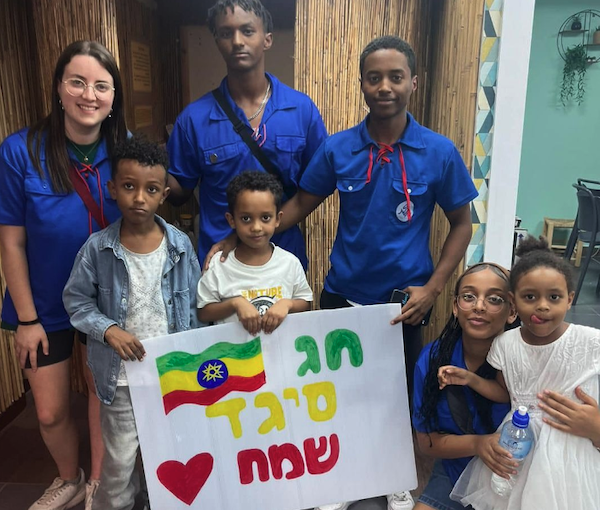
Last November, Dror Israel helped evacuees from northern Israel celebrate the holiday of Sigd. (photo from Dror Israel)

Noam Schlanger of Dror Israel is returning to British Columbia to discuss the group’s emergency response after the Oct. 7, 2023, Hamas terror attacks in Israel. He will speak at Congregation Emanu-El in Victoria on May 28, at 7 p.m., and at Congregation Beth Israel in Vancouver on June 2, at 5 p.m.

“We had been working with many of the affected communities for a long time before the attacks, so, when the war broke, we had the connections and the know-how to immediately set up educational frameworks for evacuated communities, with an emphasis on therapeutic and empowering platforms,” Schlanger the Independent.

“I will also be talking about our work with the tens of thousands of evacuees from the north, who still haven’t returned to their towns and homes. We have been providing day camps, leadership training courses and social-emotional support to many children and teens who have been living in cramped hotel rooms with their parents for seven months.”

Schlanger is an engagement director with Dror Israel, an Israeli organization that teaches leadership and responsibility for both individuals and community. Comprised of 1,300 trained educators in 16 communities on the social and economic periphery of the country, the organization promotes social activism to drive positive change. Educators live in the neighbourhoods they serve to bridge gaps and solve local problems. Through its youth movement, schools and programming in Israel, it helps an estimated 150,000 people a year.

Dror Israel educators have supported children traumatized by previous wars, the COVID lockdowns and the war in Ukraine. During the current war, the organization, in cooperation with local municipalities and the Israel Defences Forces Home Front Command, has established programs to help evacuees and residents who have been hardest hit.

Schlanger shared several stories of how Dror Israel has played a crucial role in allowing life and events in the country to continue as normally as possible under the circumstances. In November last year, they helped evacuees celebrate Sigd, a holiday celebrated by Ethiopian Jews that falls 50 days after Yom Kippur.

This past March, students from Dror Israel’s Tel Aviv high school used their skills in urban agriculture to create community gardens. The portable gardens were made at several evacuee centres for displaced communities and not only provide fresh produce but therapeutic spaces that give solace and connection.

In April, 400 children from the evacuated city of Kiryat Shmona were supplied structure and some fun through a Passover day camp. The children, from grades 1 to 6, who are presently housed in Tel Aviv hotels, went bowling, visited an amusement park and had a picnic near the Alexander River.

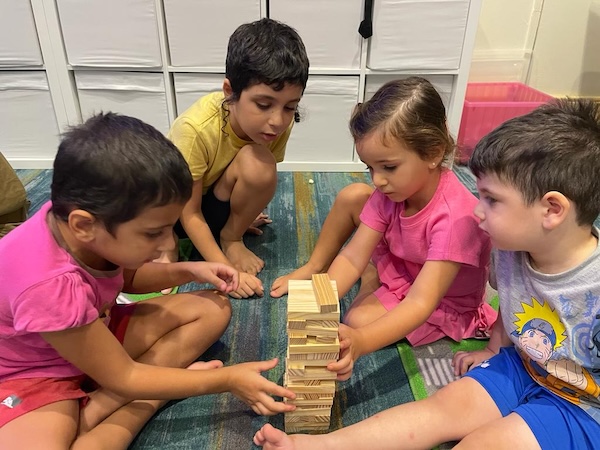
photo - people gardening
photo - kids playing Jenga
Dror Israel has been giving evacuees the chance to have some semblance of a normal life. (photos from Dror Israel)

Dror Israel works with animals as well. Following the Oct. 7 attacks, many dogs ran away or were left behind. With the help and care of students in the Dog Training Vocational Course at Dror Israel’s high school in Karmiel, dogs went from being fearful and hesitant to curious and loving, and many are now ready for adoption.

Besides being an engagement director, Schlanger’s involvement with Dror Israel has included leading a youth centre in Kafr Manda, an Arab town in Lower Galilee, and working at the community garden in Akko (northern Israel).

From Schlanger’s standpoint, the essence of Dror Israel is one of an inclusive vision of Zionism that yearns to create space for everyone, and the dream of a just and equal Israel. He believes it is a welcome message amid the polarized discourse that has been prevalent in the country for many years.

Schlanger last visited British Columbia in the summer of 2022 and has maintained a close relationship with both Congregation Emanu-El and Congregation Beth Israel. In October 2023, only a couple of weeks after the Hamas attacks, he wrote to his friends in Victoria, “We will do our best to better people’s lives during these terrible days. Our educators across the country are continuing to assess the safest and most necessary next steps in our communities.”

“The sense of connection goes deep into our community and we have people there, too,” said Susan Holtz, executive director of Emanu-El, about the synagogue’s ties with Dror Israel.

Rabbi Adam Stein of Congregation Beth Israel said, “We are very excited to have Noam come here. Dror Israel is a wonderful organization that has been doing great work for Israeli civil society, especially for those who were evacuated after Oct. 7.”

“I visited Dror Israel in Akko and was very impressed at the programs they offered and the process they undertook,” Beth Israel member Penny Gurstein added. “Their commitment to social justice and partnerships between Jews, Arabs, and all sectors of Israeli society is even more needed now.”

Dror Israel was started in 2006 by graduates of the Israeli Youth Movement, Hanoar Haoved Vehalomed, who served together in the IDF and shared a belief in the founding principles of Zionism. 

After his talk in Vancouver, Schlanger will travel to Portland to speak at the annual federation meeting there. For more information about Dror Israel, visit drorisrael.org. 

Sam Margolis has written for the Globe and Mail, the National Post, UPI and MSNBC.
Format ImagePosted on May 24, 2024May 23, 2024Author Sam MargolisCategories LocalTags Adam Stein, Beth Israel, Dor Israel, Emanu-El, evacuations, Israel-Hamas war, Noam Schlanger, Oct. 7
Burying sacred books

Burying sacred books

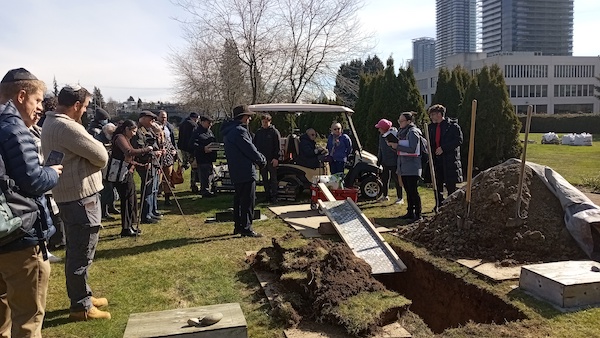
On March 9, community members gathered to bury sacred Jewish texts at Beth Israel Cemetery. (photo by Cynthia Ramsay)

According to Jewish law, no sacred texts and objects are allowed to be thrown out. This includes anything with God’s name printed on it. These texts and objects must be buried in a respectful way,” explained Rabbi Jonathan Infeld of Congregation Beth Israel in an email to the Jewish Independent about the March 9 Genizah Project ceremony at the synagogue’s cemetery. “Since a burial spot is not always convenient, people store their sacred material in a special place called a genizah until they can be buried.”

A few months ago, Infeld received a phone call from Eugene Barsky, a librarian at the University of British Columbia. Barsky was looking for a place to bury a considerable number of sacred books that were beyond repair. Infeld “immediately said yes.”

“But I wanted to do much more than just bury the materials,” the rabbi said. “I asked if he would be interested in a community-wide program, and Eugene also agreed. After that, we sought other interested parties including UBC Jewish studies, Hillel BC, King David High School, Peretz Centre and the Waldman Library.”

Representatives of these organizations were present on March 9, including students from KDHS and UBC. Infeld spoke about how sacred objects and texts not only give Jews a connection to our spiritual existence, but a social connection as well.

“And, no matter what differences we may have as a people, we are brought together within a rubric of study, of prayer, all connected to the written word,” he said. “For us, as a Jewish people, the book is sacred. For us, as a Jewish people, study is a sacred task, a sacred opportunity. And so, it only makes sense that, when we have studied, have brought a book to its conclusion, that’s literally falling apart, we don’t just throw it away, but the book, or the sacred object, has become our friend and become part of us. And so, according to Jewish tradition, we bury it.”

Barsky highlighted one of the many books being buried: a Pentateuch (the Five Books of Moses) published in Furth, Germany, in 1805. “I wish we could preserve these books, but some of them are molding,” he said. “We have a preservation lab at UBC but they reviewed them and some of them just could not be preserved.”

Barsky asked two members of the Vancouver Jewish Folk Choir – Stephen Aberle and Aurel Matte – to sing a couple of songs. The pair led “Hinei Ma Tov,” about how pleasant it is when sisters, brothers, all of us, gather together; and “Al Sh’loshah Devarim,” about the three things on which the world stands (Torah, divine service, acts of love) and by which the world endures (truth, justice, peace).

For UBC student Ellie Sherman, the burial ceremony was particularly meaningful, “as someone who spends every day reading more and more information, paying close attention to authors and narrators, and focusing on crafting assignments with correct references, to give credit where credit is due.”

She said, “The need for the genizah recognizes that the significance of words is beyond two-dimensional figures on a page, that the lessons we learn and the knowledge we gain from our books can be infinite, just as the meaning behind the words.”

Gregg Gardner, associate professor and Diamond Chair in Jewish Law and Ethics at UBC, shared how the name genizah came about. “The ancient rabbis of the first centuries tell a story about a king,” he said. “The king’s name is Munbaz. This king travels to Jerusalem, where there is drought and a famine. To provide relief, Munbaz gives away his fortune to the needy. Munbaz bizbez, Munbaz spends. His brothers confront him and demand an explanation as to why he’s giving away the family fortune…. Munbaz says that he does not bizbez the fortune … but rather he ganaz the fortune, he stores it, he saves it…. Munbaz explains that, by giving your money to charity here on earth, you do not waste your money … you save it in the world to come, in the afterlife.

“The word genizah literally means ‘storing’ and, in doing so, it can denote hiding from view,” he said. “Ancient Jewish traditions going back to the first centuries, the Second Temple period, talk about hiding many things, even the holy vessels from the Jerusalem Temple, and there are traditions in which the word ganaz is associated with storing valuables.”

Gardner said, “We are here at a cemetery, essentially taking these books out of use, laying them to rest, and yet, at the same time, going back thousands of years, the genizah has been a story not only about death, but about Jewish life.”

Richard Menkis, associate professor of medieval and modern Jewish history at UBC, picked up on this last aspect. During the planning for the burial, he said, there was a feeling towards solemnity, even mourning. But, he said, “there was a whole other sensibility that we could be bringing to it.”

He spoke of the Jews of Algeria, who would place items wherever they could around the synagogue and “several weeks later, they would carry them, the books, the other objects, in sacks. They’d escort them to the cemetery and bury them and, on that day, there would be a feast and special hymns for the occasion. There were similar customs in the community in Morocco of Meknes.

“The Sephardic Jews of Jerusalem had a custom of placing sacred objects and texts in the walls of the synagogue and, every three to seven years, would … joyously take them from the synagogues to a special section in one of the cemeteries in Jerusalem.”

The joy would come, said Menkis, from knowing that “the respect and honour that they were giving to these items would bring down upon them a variety of divine segulot, a variety of blessings. For some, it might be, we can call down rain. For others, it might be to prevent a plague.”

Menkis said, “I embrace the Genizah Project as the moral opposite of a horrible feature of modern life – the book burning. While the book burning denigrates ideas and discussion, the genizah shows reverence for ideals and aspirations.”

Those gathered were reminded of this reverence by Rabbi Kylynn Cohen, senior Jewish educator of Hillel at UBC, who led the service by the gravesite. As in the burial of a human body, she said, it is up to us to do the carrying when a person – or, in this case, the books – cannot go forth themselves.

Everyone helped transport the books from the chapel to the gravesite. Maiya Letourneau, head librarian of the Waldman Library, held up a book with gold embossing, another with lace embroidery. She said, “When we’re thinking about the memories that books create and the importance that they have in our lives, as a librarian, it can be really, really hard to take a book out of the collection, but it’s part of maintaining a healthy library, it’s part of making sure the library is useful for years to come, and it’s just an important part of what we do.”

After those gathered recited the Kaddish d’Rabbanan, the prayer that is said whenever a minyan of Jews finishes studying, Rabbi Stephen Berger, head of Judaic studies at KDHS, spoke about the class he brought to the ceremony, which has been studying Malachi, the Book of Kings. “It’s not just that we study to know,” he said. “The studying itself, opening the book and learning the book is a religious act in Judaism. And that’s why we treat it so carefully and so succinctly and sanctify it…. All these acts [serve to remind us] this is who we are, and we should live up to the title of the People of the Book.”

BI Rabbi Adam Stein concluded the ceremony with Eitz Chayim Hi, which most congregations sing when putting the Torah scrolls back in the ark at the end of a Torah service. It describes the Torah as a tree of life.

Format ImagePosted on March 24, 2023March 22, 2023Author Cynthia RamsayCategories LocalTags Adam Stein, Aurel Matte, Beth Israel, books, Ellie Sherman, Eugene Barsky, genizah, Gregg Gardner, Hillel, JCC, Jonathan Infeld, Judaism, KDHS, Kylynn Cohen, Maiya Letourneau, Richard Menkis, Stephen Aberle, Stephen Berger, UBC, Waldman Library

Ray of light, warmth

In a story that is positive and uplifting, Rabbi Adam Stein, associate rabbi of Vancouver’s Congregation Beth Israel, wrote a piece in Canada’s Anglican Journal, which describes itself as the largest faith-based publication in North America. In the article, Stein describes his engagement with national leaders of the Anglican movement as the church has reviewed its liturgy around Judaism and Jewish people. Stein was representing the Canadian Rabbinical Council, a cross-denominational group under the auspices of the Centre for Israel and Jewish Affairs. (Click here for article.)

While the slow machination of the church’s processes means it won’t be official until at least 2022, the recent General Synod of the church approved the replacement of a prayer for the conversion of the Jews with a prayer for reconciliation with the Jews. The move is monumental in the context of Jewish-Christian relations. The idea that Christianity is a replacement theology to Judaism – and that Jews should convert or disappear, with all that implies – prevailed for nearly 2,000 years. At heart, it is a negation of the Jewish people’s right to exist and, indeed, at times in history, conversion or death were the two choices Jews were offered.

The two-millennia history of conflict, supercessionism and religious-based antisemitism went almost unchallenged until the 1960s, when the Roman Catholic church underwent a revolutionary reconsideration of many aspects of its theology, including its relations with Jews. Since then, other branches of Christianity have taken leads of varying sorts in addressing their own histories of oppression directed at Jews, as well as at women, indigenous people and communities, LGBTQ+ people and others.

The generosity of spirit evidenced by Canadian Anglicans – and the obviously heartfelt expression of gratitude in Rabbi Stein’s written reflections on the issue – are a welcome ray of light and warmth in a world that too often seems lacking in these elements.


Posted on August 30, 2019August 29, 2019Author The Editorial BoardCategories From the JITags Adam Stein, Anglicans, Beth Israel, CIJA, Jews
Proudly powered by WordPress