Skip to content
  • Home
  • Subscribe / donate
  • Events calendar
  • News
    • Local
    • National
    • Israel
    • World
    • עניין בחדשות
      A roundup of news in Canada and further afield, in Hebrew.
  • Opinion
    • From the JI
    • Op-Ed
  • Arts & Culture
    • Performing Arts
    • Music
    • Books
    • Visual Arts
    • TV & Film
  • Life
    • Celebrating the Holidays
    • Travel
    • The Daily Snooze
      Cartoons by Jacob Samuel
    • Mystery Photo
      Help the JI and JMABC fill in the gaps in our archives.
  • Community Links
    • Organizations, Etc.
    • Other News Sources & Blogs
    • Business Directory
  • FAQ
  • JI Chai Celebration
  • JI@88! video

Recent Posts

  • האלימות בישראל מורגשת בהרבה מגזרים
  • טראמפ עוזר דווקא לנושא הפלסטיני
  • New rabbi settles into post
  • A light for the nations
  • Killed for being Jewish 
  • The complexities of identity
  • Jews in time of trauma
  • What should governments do?
  • Annie will warm your heart
  • Best of the film fest online
  • Guitar Night at Massey
  • Partners in the telling of stories
  • Four Peretz pillars honoured
  • History as a foundation
  • Music can comfort us
  • New chapter for JFS
  • The value(s) of Jewish camp
  • Chance led to great decision
  • From the JI archives … camp
  • עשרים ואחת שנים להגעתי לונקובר
  • Eby touts government record
  • Keep lighting candles
  • Facing a complex situation
  • Unique interview show a hit
  • See Annie at Gateway
  • Explorations of light
  • Help with the legal aspects
  • Stories create impact
  • Different faiths gather
  • Advocating for girls’ rights
  • An oral song tradition
  • Genealogy tools and tips
  • Jew-hatred is centuries old
  • Aiding medical research
  • Connecting Jews to Judaism
  • Beacon of light in heart of city

Archives

Follow @JewishIndie
image - The CJN - Visit Us Banner - 300x600 - 101625

Tag: mourning

Celebrate, share light

Hanukkah is a holiday made joyous by its origins in the victory of the Jewish people over our oppressors and the liberation by the Maccabees of the Second Temple in Jerusalem. Now, thousands of years later, over eight nights, we light candles to honour our brave ancestors and to recognize the fortitude, across the millennia, of the Jewish people.  

The meaning of Hanukkah has acquired a new relevance: the bravery demonstrated by the people of Israel – especially since Oct. 7, 2023. 

It has been more than 15 months since, in the most shameful and grievous fashion imaginable, Hamas deliberately started a war, placing the people of Israel – and of Gaza and the entire region – in jeopardy. Israel continues to defend its residents and citizens from terror on multiple fronts, facing both assaults from Hamas and unprecedented attacks by hundreds of rockets from Iran-backed Hezbollah. Israelis and the global Jewish community continue to call for the release of 101 hostages who remain captive in Gaza. Families across Israel and the world continue to adjust to life without the 1,200 Israelis – and victims from 30 other nations – systematically murdered on Oct. 7. 

Yet, amid the chaos and terror of daily rocket attacks, the spirit and fortitude of the people of Israel remains as strong as ever. 

This year, as we light our candles over the eight nights of Hanukkah, we contemplate the history and symbolism of our Jewish traditions, and we have an opportunity to consider their meanings in our current reality. Just as we light our hanukkiyah with its eight, equally proportioned candles, we remember Jews have an admirable track record in fighting for social equality, and we consider where, today, there are inequalities to be addressed. 

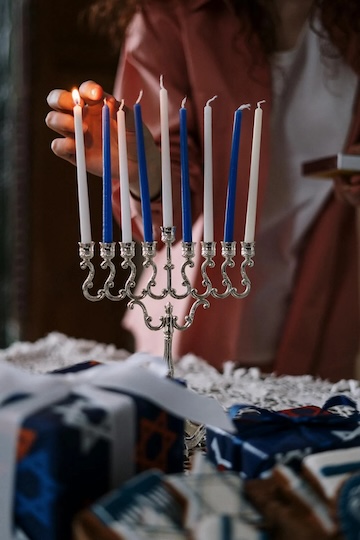
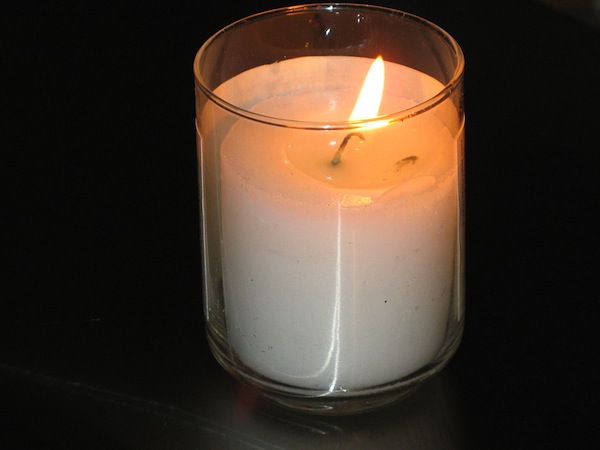
photo - This year, as we light our Hanukkah candles, we contemplate the history and symbolism of our Jewish traditions, and we have an opportunity to consider their meanings in our current reality
This year, as we light our Hanukkah candles, we contemplate the history and symbolism of our Jewish traditions, and we have an opportunity to consider their meanings in our current reality. (photo from pexels.com)

As we add candlelight to our homes, we remember our age-old obligation to bring light to our families, friends and neighbours. We encourage well-rounded education, free from hate, for all children; we advocate for a safe and welcoming learning environment for our post-secondary students and faculty; and we support the most vulnerable among us. 

There is much to do – what will your focus be over the coming year? To what cause will your efforts be directed? 

Can we hope that Gaza will be freed from the terrorist influence of Hamas? Will Lebanon emerge from under the sway of Iran-backed Hezbollah? Will Israel’s adversaries stop their war against the Jewish state?

Will our focus be on our own family, our close friends, our community, a charitable cause? Will we share the Jewish values we cherish, the triumph of light over darkness, freedom over oppression, and the importance of upholding one’s identity and beliefs?

And can we help our fellow Canadians uphold the values we hold dearest? How much light can we share this Hanukkah season? 

Let’s find out. 

Chag sameach. 

Judy Zelikovitz is vice-president, university and local partner services, the Centre for Israel and Jewish Affairs (CIJA).

Posted on December 13, 2024December 11, 2024Author Judy ZelikovitzCategories Op-EdTags candlelighting, CIJA, Gaza, Hamas, Hanukkah, Hezbollah, Israel, mourning, Oct. 7, reflections, terrorism
Renewing a commitment to hope

Renewing a commitment to hope

If you were to write a personal “book of life” to express your aspirations for growth in the year ahead, what would its title be? (photo from thisenchantedpixie.org)

In the face of the immense sadness and devastation of the past 11 months, and the suffering that seems to know no bounds, I find it difficult to even register that Elul, the last month on the Jewish calendar, has arrived. But, as the Jewish year inevitably advances, I seek solace and meaning in two practices that have helped me prepare for new years past.

The first is writing my “book title,” for a family ritual we created years ago to facilitate the work of reflection, forgiveness and imagination that are core to themes of the High Holidays. The Rosh Hashanah and Yom Kippur liturgies tie our teshuvah, our annual returning to our best selves, to our desire to be inscribed in a celestial “Book of Life.” Using this image, my family gathers around the Rosh Hashanah lunch table each year to share the titles of our personal “books of life” and to express our aspirations for growth and desires to be held accountable by one another in the year ahead.

The second is to dust off my shofar and sound the first blast, as I will continue to do, in keeping with tradition, each morning of the month of Elul, until the holidays arrive. Each day, I will I close my eyes and coax out the sounds that the shofar has been compared to: Sarah weeping for Isaac, a call to battle, the blasts that signal God’s presence on Mount Sinai, the call of justice that cracks open the hardness of the universe, the hardness in our hearts and in the hearts of our political leaders and awakens in us a renewed sense of purpose and possibility. By doing this, I hope I will be prepared, both physically and spiritually, for the full complement of 100 blasts, short and long, that will sound over the holidays themselves.

In the past, each of these rituals has given me hope, hope that change is possible, that I can do better, that collectively we can do better and that a better future is possible.

This Elul, I am finding it more difficult, as I imagine many of us are, to muster a feeling of hope. Last Elul, we could not have imagined the challenges of the past year: the slaughter of Oct. 7; the long and devastating war in Gaza; the plight of the hostages; the loss of friends and allies; the fractious polarization within the Jewish community; the rise in antisemitism. All of this on top of the many issues we continue to work on globally, from hunger to homelessness to climate change. Hope feels at best elusive; in our most cynical moments, it feels naïve.

Hope requires of us that we allow for the possibility of a variety of better futures, futures that are as yet unexperienced and perhaps even unimaginable. Hope requires that we acknowledge that a catastrophe that may feel imminent is not a forgone conclusion. Hope demands the humility to recognize that we just don’t know what will be, and the audacity to own our role in shaping it. Human imagination, intention and action forge a line between this present and the better future for which we long.

“People often confuse optimism and hope,” said Rabbi Jonathan Sacks, z”l. “They sound similar. But, in fact, they’re very different. Optimism is the belief that things are going to get better. Hope is the belief that, if we work hard enough together, we can make things better. It needs no courage, just a certain naïvety to be an optimist. It needs a great deal of courage to have hope.… And hope is what transforms the human situation.”

In Hope in the Dark, Rebecca Solnit describes a commitment to hope as essential to the work of activism toward social change. She shares example after example of times when the future (now history) unfolded because of the powerful imagination, agency and organizing of people who held on to hope. “Hope locates itself in the premises that we don’t know what will happen,” she writes, “and that in the spaciousness of uncertainty is room to act.”

Elul reminds us that we don’t know what will happen but that we have the tools individually and collectively to shape the future. The practices of reflecting on the year past and imagining the year ahead that are built into the Jewish holiday cycle offer us the “spaciousness of uncertainty” we need that can spark hope and move us to action. I rely on my two Elul rituals to facilitate this process of reflection and imagination. Whether it’s journaling, reading, speaking to a colleague or friend, or listening to music, I’m sure that each of us has tools for creating space for the kind of reflection and imagination that makes hope, and the attendant action it demands, possible. And our hopefulness has the potential to inspire others. We can hold possibility for them when they feel discouraged and they can do the same for us.

Elul reflection pushes us to awaken ourselves to new possibilities even in the face of despair, fatigue, anger and overwhelm. And this awakening of hope makes it possible to act.

I consider my book title as I blow the shofar each morning in Elul. I’m leaning toward making it “Hope.” 

Questions for reflection

• What practices or rituals will help awaken you to new possibilities this month and coming year?

• What is your book title for the coming year, and who do you want to share it with?

Rachel Jacoby Rosenfield is chief executive officer of the Shalom Hartman Institute of North America (hartman.org.il). Earlier this month, the Hebrew month of Elul, Olam (“a network of Jewish individuals and organizations committed to global service, international development and humanitarian aid” – olamtogether.org) asked her to share her thoughts as a profoundly challenging year for the Jewish people ended.

Format ImagePosted on September 20, 2024September 18, 2024Author Rachel Jacoby RosenfieldCategories Celebrating the HolidaysTags Elul, High Holidays, hope, intention, mourning, Oct. 7, Olam, Rosh Hashanah, Shalom Hartman Institute, shofar, trauma, Yom Kippur
Ways to commemorate Oct. 7

Ways to commemorate Oct. 7

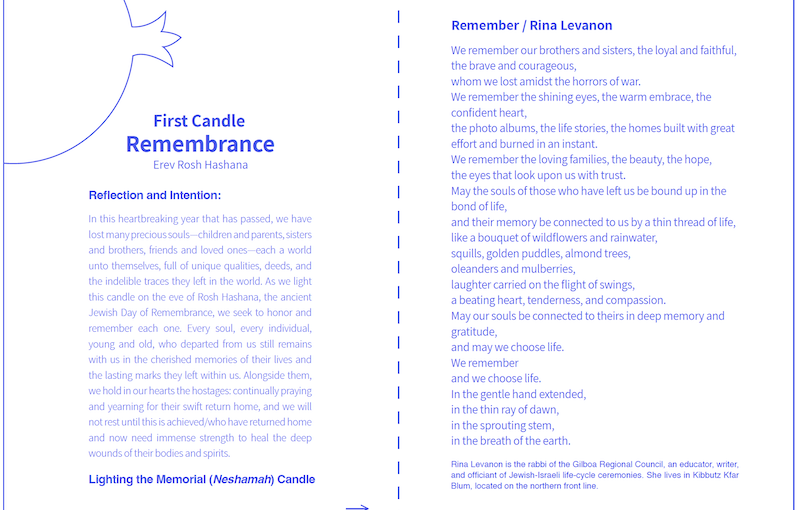
Erev Rosh Hashanah, from Shalom Hartman Institute’s Memory and Hope. For each holiday and Shabbat evening in Tishrei, the institute suggests we light a memorial candle before kindling the holiday and Shabbat lights, and offers an intention to recite before lighting this candle and a text to read afterward (both in English and in Hebrew).

Each year during Elul, the month leading up to the High Holidays, the women of medieval Ashkenaz would measure each of the graves in their community cemeteries with string. They would then dip these lengths of string in melted wax that had been collected from candles lit throughout the year in the synagogue when the community gathered to pray, to study, to cook and to connect. They would light these new candles, each made from string representing the dead and wax representing the living, on Yom Kippur as yahrzeit candles, a way of honouring and remembering deceased relatives.

On Rosh Hashanah, we will welcome a new year. And then, in the midst of the 10 days of repentance that lead up to Yom Kippur, we will reach the one-year anniversary of Oct. 7 and, with it, the anniversary of the day on which at least 1,139 people were killed by Hamas terrorists and more than 240 people were taken hostage. We will pray for the return of the remaining captives, and we will mark the start of the war that has since killed so many in Israel and Gaza.

We have struggled to fully mourn these losses as this war continues to unfold and expand; as not all the hostages have yet returned home; as, in North America, many of us navigate antisemitism in our communities and shifting relationships with local allies. And yet, we feel the need to grieve. The chaggim (holidays) offer us a pause in which we can reflect, cry and pray.

The Shalom Hartman Institute has developed two rituals for the anniversary of Oct. 7, one that spans most of the month of Tishrei, for individuals to use at home, and one for communal gatherings on Oct. 7 or on Shemini Atzeret and Simchat Torah.

Commemorating Oct. 7 at home

Every week, we begin Shabbat by lighting candles. Every Tishrei, we usher in Rosh Hashanah, Yom Kippur, Sukkot, Shemini Atzeret and Simchat Torah by lighting candles. Our ritual for commemorating Oct. 7 at home is woven into these traditions.

More specifically, for each holiday and Shabbat evening in Tishrei, we suggest that you light a memorial candle before kindling the holiday and Shabbat lights. We offer an intention to recite before lighting this candle each night and a short text to read afterward. These materials – inspired by the work of Hagit Bartuv and Rivka Rosner of the Shalom Hartman Institute’s Ritual Centre in Israel and in collaboration with Maital Friedman, Masua Sagiv and me from the Shalom Hartman Institute of North America – connect us with some of the central themes of the last year. Our hope is that the light of the memorial candle, the ner neshamah, literally a soul candle, and light of the festive candles flickering together will connect the strands of our grief and celebration.

Like the candles dipped by the women of Eastern Europe, this ritual honours both the dead and the living. It brings us back to the devastation of Oct. 7, and it also celebrates the artists, soldiers, teachers and ordinary people who helped us through a difficult year. Similarly, while memorial candles are traditionally lit to remember the dead, the ritual invites us to use these candles to light the way for the living – for peace, healing and hope.

While many Israeli Jews light candles on seven evenings from Rosh Hashanah through Simchat Torah, many diaspora Jews light candles on nine, the two additional candles marking the second night of Sukkot and for the start of Simchat Torah. As a statement of Jewish peoplehood, this home-based ritual is for seven nights of candlelighting, so that it will be used in Jewish homes around the world on the same days. If you want to use this ritual to accompany your candlelighting on the second night of Sukkot or on erev Simchat Torah, you might repeat an intention and text or offer an intention and reflection of your own.

Developing this ritual led us to ask about the meaning of memorializing Oct. 7. Is this ritual only about Oct. 7 or is it about everything that occurred that day and since? What do we mean by “heroism” at this time? Are we referring to military bravery or to the ways civilians stepped up to support and protect one another this year as well? Can the entire Jewish world share this one ritual, or have our experiences of this year been too different? What is the right balance between particularistic and universalistic yearnings?

For many of these questions, we looked to our Israeli colleagues to set the tone in creating a ritual that met their needs for their grief and vulnerability this year, as well as their sources of hope and comfort. For other elements, we offer suggestions to adapt the framing or created a slightly different version in the English that we thought might be better suited for those outside of Israel. You may want to use this resource exactly as is, but you may also find yourself adding different texts or focusing on different themes. We encourage creativity and would love to hear from you about how you adapt it to meet your needs for this moment.

Commemorating Oct. 7 in community

Many communities in North America will gather to mark the anniversary of Oct. 7, whether in synagogues, JCCs, Jewish federations, Hillels, schools or other Jewish centres. Our second resource is a collection of texts and prayers to be used in a communal ritual context, including suggestions of three different ways to use these rituals in your community.

The supplement also gave us the opportunity to add more texts, prayers, songs and perspectives, including texts with expressions of grief for the suffering of Palestinian civilians, which did not fit in the more particularistic framework of the home ritual above.

This Elul, as we reflect on the past year and gather up the wicks that measure our lives and our communities, may we continue to find ways to bind our wicks together, to find strength in community and ritual, and may all who mourn this tragic anniversary find comfort among the mourners of Zion and Jerusalem. Shanah tovah. 

Rabbi Jessica Fisher is the director of rabbinic enrichment at the Shalom Hartman Institute of North America. To read and download various Hartman Institute resources, including Memory and Hope: Rituals for Tishrei 5785 and accompanying resources for commemorating Oct.7 in community, visit hartman.org.il.

Format ImagePosted on September 20, 2024September 18, 2024Author Rabbi Jessica FisherCategories Celebrating the HolidaysTags candlelighting, celebrating, High Holidays, hope, Judaism, mourning, Oct. 7, prayers, ritual, Shalom Hartman Institute, yahrzeit

Allowing for joyful holidays

My house smells like chicken soup. That is one of the surefire ways to tell that holidays are on the horizon. It’s a cooler summer day. I have two slow cookers “working” to make that all important broth for autumn days to come. Chicken soup is a little thing but it’s one of those small details that I do in advance to make our family holidays special.

I recently read an introduction to a page of Talmud on My Jewish Learning by Dr. Sara Ronis. It examines Bava Batra 60. This page of the Babylonian Talmud resonates with what many of us are wrestling with during this past year of war. To summarize, Rabbi Yehoshua comes upon Jewish people, who, after the destruction of the Second Temple, in 70 CE, chose to become ascetics. They give up eating meat and drinking wine, because these things could no longer be offered in sacrifice at the Temple in Jerusalem. The ascetics suggested that, given the loss of the Temple, life could no longer be as spiritually rich or as physically nourishing.

Rabbi Yehoshua tries to reason with them, asking if they should stop eating bread, since the meal offerings at the Temple have also stopped. The ascetics suggested they could subsist on produce.

Rabbi Yehoshua asked if they would give up eating the seven species of produce offered at the Temple. They said they could eat other produce.

So, Rabbi Yehoshua says, I’m paraphrasing here: “We’ll give up drinking water, since the water libation has ceased.” To that, the ascetics responded with silence – of course. You can’t give up drinking water and stay alive.

Rabbi Yehoshua encourages the people to make space for mourning but to avoid extremes; he suggests that choosing to be an extremist is dangerous. Making space in our life for other things like daily pleasures and regular foods is important. Devoting all our energies to mourning will rob us of life, too.

This story came to mind when I saw the celebratory photos of Noa Argamani, a rescued hostage. She wore a yellow bikini and danced with her father atop others’ shoulders at a party. In addition to having been a hostage, her mother had passed away from brain cancer, only three weeks after Noa’s rescue on June 8. The pure, almost ecstatic joy of the images clashed in a difficult way with the ongoing war, the hostages still in Gaza, and all those suffering in the conflict. Some immediately sought to criticize this behaviour. There are those who said, “if only Jewish women were more modest, the hostages would be returned.” On the other side, some said, “Look at these Israelis celebrating even while Gazans suffer.”

I remember being told at a long ago Simchat Torah celebration that mourners, after a death of a family, shouldn’t dance or sing. Yet, maybe 10 years ago, when my twin preschoolers asked a Moroccan Jewish family in mourning for their mother, to sing with them Mipi El (a Jewish acrostic song, a piyyot, with a traditional Sephardi tune loved by my sons), these older men held up my kids, danced and sang with the Torah. It was a meaningful moment. It was full of emotion. Maybe one can dance with the Torah and celebrate a little – even while mourning. I almost felt their mother, who I never knew, who raised them to be committed and involved Jewish adults, would approve.

Rabbi Yehoshua’s logical argument and suggestion that we hold onto joy even while mourning is important. Making space for all these feelings in our lives is both powerful and hard. Smelling the chicken broth aroma filling my house makes me anticipate the New Year and holidays to come. Also, like many others, I will never be able to celebrate Simchat Torah the same way again. Yet, nothing made me happier than seeing Noa Argamani and her father make the most of every moment they have together. They deserve every happiness.

In this past year, finding ways to be grateful, to anticipate rituals, holidays and joy has felt really heavy at times. Twice in recent weeks, my family has returned home from a fun summer outing to see antisemitic graffiti in our neighbourhood. There is nothing like having to take photographs of a hate crime, call the police to make a report, and send off the photos to B’nai Brith and CIJA as well to turn a sunny family adventure into a downer. I struggle with processing all this and going on with daily life.

So, when someone I follow on Instagram showed off her Instant Pot chicken soup process, I started up my serious chicken broth production. Here’s to getting new batches of chicken soup, that liquid gold, into the freezer, ready to make new positive memories and associations for the fall holidays to come. 

Joanne Seiff has written regularly for the Winnipeg Free Press and various Jewish publications. She is the author of three books, including From the Outside In: Jewish Post Columns 2015-2016, a collection of essays available for digital download or as a paperback from Amazon. Check her out on Instagram @yrnspinner or at joanneseiff.blogspot.com.

Posted on September 13, 2024September 11, 2024Author Joanne SeiffCategories Op-EdTags choosing life, cooking, Judaism, lifestyle, living, mourning, Oct. 7, Rosh Hashanah, Talmud

Grief and joy intertwined

Every year, the sun goes down on Yom Hazikaron, Israel’s national day of remembrance for victims of war and terrorism, and the celebratory day of independence, Yom Ha’atzmaut, begins.

It’s a stark juxtaposition. The parallel of the two national days, of course, make perfect sense historically. The country was born in war. At the moment Israel became independent, it was attacked, with the intent of annihilation, by the military forces of all neighbouring countries. As a result, it is impossible to consider or celebrate the joy of that moment – the rebirth of Jewish national self-determination after nearly 2,000 years – without considering the human costs associated with that achievement, and not only Jewish or Israeli lives, but those of peoples whose leaders have refused to accept the existence of Israel since that rebirth. While reestablishing the Jewish homeland displaced Arabs living there, whether by being forced out or told to leave by their leaders, Israel has been a home for Jews displaced from surrounding Arab countries, Russia and elsewhere.

For the average attendee arriving at Vancouver’s celebration of Yom Ha’atzmaut, it was hard to know what to expect. Given the Oct. 7 Hamas terror attacks and the ensuing war, the remembrance commemoration, 24 hours earlier, was perhaps one of the most emotional, intense and moving this community has experienced. Could the next night’s audience, many of them the same people, make the emotional transition?

Under the circumstances, the event’s planners struck an appropriate balance in what must have been among the most difficult challenges organizers of this annual event have faced.

When Israel’s early leaders set these dates consecutively, they knew the nature of their neighbourhood. They would likely have foreseen the possibility of further wars, and yet they made the decision to mark the joy of independence immediately following the somber acknowledgement of the high cost of freedom. This was not a coincidence. Nor, presumably, was it a contrast they thought appropriate only in years that are relatively calm and peaceful. They recognized that, come what may, independence and freedom would come with a cost – and the deeply conflicting emotions these realities evoke will inexorably exist together.

Like the smashing of the wine glass at a Jewish wedding, joy is never absent of grief – and grief cannot eclipse the joy brought into the world by those we lost on Oct. 7, and since. Those murdered and kidnapped that day, the soldiers who have been killed in the war and the Palestinians who have been killed in the conflict as Hamas continues to hold them and Israel hostage.

In Jewish tradition, the various markings of time after the passing of a loved one – shiva, shloshim, yahrzeit, for example – each come with their specific obligations and expectations. These periods formally guide us through process of grieving.

Unlike that relatively slow process of mourning, the closing of Yom Hazikaron and the opening of Yom Ha’atzmaut is abrupt and immediate. Life in Israel has, in some sense, condensed time, requiring a speedier processing of even life’s most challenging realities, including loss and grief.

It is often said that Israelis have been in too much of a hurry to be polite about things. Stereotypes, often accurate and amusing, portray Israelis as sharp-elbowed, impatient and determined. If there was not some truth to this, they would not have built, in a mere three-quarters of a century, one of the most extraordinary nation-states on earth – all while confronted by existential threats.

The Israelis who chose to set the remembrance day immediately before the celebration of independence must have understood that, in some years more than others, the transition from one emotion to the other would be especially difficult. Perhaps we should trust their judgment that, even in the most difficult years, the juxtaposition is both manageable and appropriate.

Noam Caplan, who lit a candle at the Yom Hazikaron commemoration and spoke about his cousin, Maya Puder, who was murdered at age 25 at the Nova music festival, remembered his cousin’s love of dancing and looked ahead to happier times.

“The Jewish people will dance again,” he said. 

Format ImagePosted on May 24, 2024January 16, 2025Author The Editorial BoardCategories From the JITags commemoration, grief, independence, Israel Canada, mourning, Noam Caplan, Yom Ha'atzmaut, Yom Hazikaron
Dance as an act of solidarity

Dance as an act of solidarity

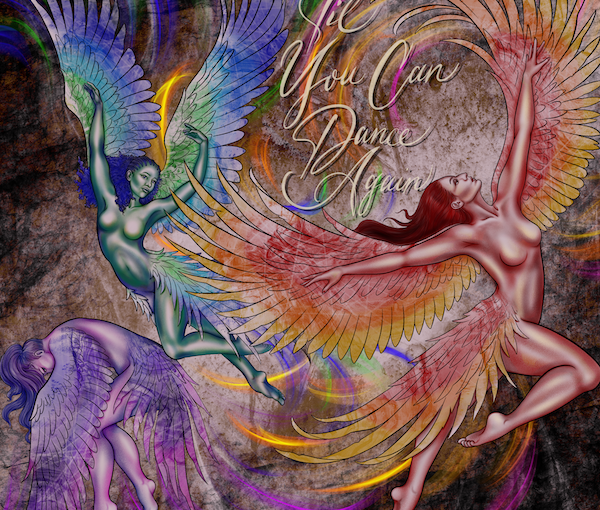
Iraqis in Pajamas’ new album is a tribute to the victims of the Oct. 7 massacre.

In the wake of the Oct. 7 massacre of Israelis…. And the celebrations that followed worldwide – glorifying the raping, burning and decapitating of my people…. 

And the subsequent mass destruction of posters raising awareness of Israeli hostages being tortured in captivity by Hamas…. 

And the simultaneous call for a violent uprising against Jews worldwide…. 

And the astronomical spike in hate crimes against Jews – among other things, leading to incessant harassment, assaults and death threats of students at my alma mater, Columbia University, and additionally leading to the murder of a kind Jewish man I knew in Los Angeles….

And the international mob chants of “From the river to the sea,” harkening back to the harrowing cries my father heard on Arabic radio stations as a child in Iraq, “We will throw the Jews into the sea.”…

And the palpable terror I then felt as a Jew, whose family had seen this before, had fled this before, in a pro-Nazi uprising in Baghdad, where a similar massacre had taken place during my father’s childhood….

And the deafening silence in the wake of all this – not even one word of care or kindness from the vast majority of non-Jewish people I had loved, had lived with, had broken bread with….

And I felt as if I had died.

I stopped journaling, stopped writing poetry, stopped writing music, stopped singing, stopped playing bass, stopped dancing. I got sick repeatedly and continuously over the course of two months, even ended up in the emergency room with symptoms of a possible stroke at 2 a.m. one night – this, after years and years of never getting sick, not once, not even when my ex got COVID and I nursed him back to health. 

I couldn’t sleep, had nightmares, woke up in the middle of the night, lying awake for hours, my mind circling around and around, imagining the horror and terror the hostages must be suffering through. I was haunted by the video image I accidentally had seen of a young Jewish woman who was naked and chained, publicly being dragged around by Hamas, as they filmed her – one of the many Jewish women they gang raped and mutilated that day, often next to the dead bodies of these women’s friends – filming that violence, too, in something akin to snuff porn. 

I could feel it in my body.

I couldn’t breathe.

I couldn’t move.

Despite the impact on me, I felt that, somehow, by energetically experiencing and, by extension, by physically experiencing the pain that my people were enduring, I was communicating a telepathic message to them: I will not forsake you, I will not forget you. 

No, I will not frolic on the beach beneath the misty grey soothing skies. No, I will not enjoy the quiet, peace and comfort of the vast rainforest just outside my door. No, I will not detach myself from something “happening on the other side of the world,” as a non-

Jewish acquaintance kindly advised, because there is no “other side of the world” when it comes to Jews. You are me, and I am you, and we are connected. I cannot control the world’s response, but I can control mine. I will face, see, hear and feel your pain, until it is gone.

But wait…. That’s exactly what Hamas wants, isn’t it? To demoralize and destroy Jews. To suffocate us, hijack our imagination. To strip us of our dignity, safety, peace and, perhaps most of all, joy.

So, to reclaim my joy is, in fact, a radical act of Jewish power and solidarity. To flip imagination on its head – instead of visualizing all the horrors and shrinking in my body, to instead expand in my body and visualize all the hostages, injured people and 

grieving families as resilient, grounded, surrounded by love, and the dead as soaring freely and peacefully, wrapping their loved ones in comfort.

Nothing is black and white, but this is an article, not a book, so I’m trying to keep it short and sweet. Suffice it to say, I actively and repeatedly attempted to turn the images around over the course of two months – to send white light, to bless the hostages, to emit some kind of protective energetic shield, but it kept seeming silly, foolish, without actual impact, perhaps just making myself feel better, like a hollow New Ager. My prayers would not stop a psychopathic Hamas gunman with absolute control over a hostage, I reasoned, because G-d gave humans both the gift and curse of free will. 

But then….

But then I went to a concert of Yemen Blues, which was more of a primal howl of freedom than a “performance,” and which featured an Israeli woman dancing with a defiant, raw ferocity that brought back to life the sanctity, dignity and power of the Jewish female body – and, with that, permission to dance.

And, after that, I started dancing again. And, after that, I started singing again. And, after that, I started frolicking with my beautiful dog beneath the misty grey, soothing skies on the beach, and through the vast rainforest just outside my door.

And I came back to life.

In this very difficult but transformative journey, I learned that life begets life begets life, and artistic self-expression is not an indulgence, but rather, a superpower. 

As I danced on the beach with my dog over a couple of days, a vision emerged – a global movement of Jews and our allies taking videos of ourselves dancing joyfully, and sending those videos to the people wounded in the Oct. 7 massacre, the families of those who died, the families of those taken hostage, and the young women and men on the frontlines defending Israel from further attack – turning “we will dance again” into “we will dance for you until you can dance again” – sharing whatever strength, freedom and joy we have to uplift those who are in the thick of it, struggling and suffering.

Having snapped out of an emotional coma of sorts, I then picked up my bass, and out poured both the melody and lyrics of a new song, “’Til You Can Dance Again.” That same day, I finally finished the song I had started a few weeks after Oct. 7, “Dear Hostages.” Not having touched my bass for the better part of three months, I played until my fingers were blistered and almost bleeding. Over the next 24 hours, I wrote two additional songs, and then worked with my band on developing a full album, ’Til You Can Dance Again, offering both my journey and my joy as a catalyst for healing and transformation.

It is through song, dance, story, prayer and food that Jews historically have not only overcome tragedy, but have taken that very experience and transmuted it into an vehicle for joy – the ultimate “f*** you” to those who have tried to destroy us. For this reason, my band released our new album on March 23, at the start of Purim, a holiday marking one of many historical traumas that the Jewish people have turned on its head and morphed into a cause for celebration. My heartfelt prayer for this album is that, as broken as we may feel right now, we shall once again rise up, sing and dance ourselves back to wholeness, and honour the victims of Oct. 7 not only through our grief and pain, but also through our fierce and irrepressible Jewish joy – emerging, once again, like that unstoppable phoenix, soaring up and out from the ashes. 

Loolwa Khazzoom (khazzoom.com) is the frontwoman for the band Iraqis in Pajamas and editor of The Flying Camel: Essays on Identity by Women of North African and Middle Eastern Jewish Heritage (theflyingcamelbook.com). She has been a pioneering Jewish multicultural educator since 1990, and her writing has been featured in the Washington Post, Marie Claire, Rolling Stone and other top media worldwide. This article was originally published in the Times of Israel.

More about the album

On March 23, Iraqis in Pajamas released the album ‘Til You Can Dance Again, as a tribute to the victims of the Oct. 7 massacre.

Its creation served as a vehicle for Khazzoom’s processing and healing, and the tone of the songs evolved as Khazzoom herself evolved from feeling despair to outrage to core power.

“Dear Hostages” is a love song to those held in captivity, in which Khazzoom pledges, I will not forsake you, I will not forget you, as she explores what it means to act in solidarity from afar. 

“’Til You Can Dance Again” is a spin on the Israeli promise, “We will dance again” – vowing to spread the life energy of dance, to help uplift the spirits of those who were shattered by the massacre. 

“Bataween” draws from a conversation with an Iraqi Muslim friend, exemplifying the healing imperative of Arab Muslims recognizing and caring about the history of indigenous Middle Eastern Jews, including the experience of Arab Muslim oppression. 

“Kids from the Sandbox” builds on that imperative, holding out a vision for Arabs and Jews to embrace the complexity of shared history, using art to express love and hate in healthy ways, effectively co-creating a new reality. 

“I’m a F***-You Jew” fuses ancient and contemporary stories of Jewish defiance and soul power in an unabashed expression of Jewish pride and strength amid an onslaught of global accusation and condemnation. 

“These Boots” is a campy spin on “never again,” calling out the left’s hypocrisy and betrayal in the wake of Oct. 7, and refusing to contribute Jewish energy and resources to those who do not offer the same in turn. 

“Bloody Cross” is a scathing critique of the Red Cross’s racism and hypocrisy in its failure and refusal to properly care for the Israeli hostages in Gaza.

For the full press release, and to listen to the recordings, visit khazzoom.com/blog and click on ’Til You Can Dance Again – New Album Release.

– Courtesy Iraqis in Pajamas

Format ImagePosted on April 12, 2024April 10, 2024Author Loolwa KhazzoomCategories MusicTags creativity, Iraqis in Pajamas, Israel, mourning, Oct. 7, terror attacks

Mitzvah to return lost items

During the winter and spring in Winnipeg, sometimes one sees a child’s toy or a colourful mitten attached to a tree or hedge along a sidewalk. These are lost items. The neighbourly thing to do when you see something in a snowbank or on the packed snowy sidewalk is to pick it up and prop it up at adult eye level. It helps others. Maybe it will stop toddlers’ tears. 

Our household found somebody’s bike lock key last fall. This was harder to post. We took a piece of paper and wrote “Is this your key?” on it in large capital letters. Using clear tape, we attached the key and the sign to a powerline pole. A long time passed. One day, someone finally found their key. Relieved, we took down the sign.

I’ve been studying the Babylonian talmudic tractate of Baba Metzia, which covers civil law, including the rules around how to deal with lost items. It examines details that I often ponder. For instance, if a person finds an inanimate object, it has different obligations attached than if one finds an animal. We must return lost animals. If we don’t know how to return them, the finder must care for the animal, including feeding and watering the animal. If the animal’s upkeep is a burden, provisions exist for selling the animal and keeping the money to compensate the person who lost their animal. The particulars can be complex.

I became interested in a category that isn’t easy to describe – an object that isn’t alive or animate but still needs care. Things like books, which, in the days of the Talmud, were scrolls made of parchment made from animals. The finder had to rotate the scrolls occasionally to maintain them until they could return them. The finder couldn’t use the scrolls for study in a way that might cause undue wear on these hand-scribed texts. 

Another thing in this category, in Bava Metzia 29b, says: “If one found a garment, he shakes it once in thirty days and he spreads it out for its sake, to ventilate it, but he may not use it as a decoration for his own prestige.” As someone who makes and cares for natural fibre textiles (handspun and knit sweaters, for instance), I understood this immediately. Clothing wasn’t mass produced then. There were no factories. Everyone used spindles and spun and wove clothing. It wasn’t fast fashion. Clothes took skill and a lot of time to make. So, if someone found a garment, he knew its value. It wasn’t disposable. He must keep it well-aired, to be sure it was clean and cared for, and not attracting destructive pests like moths. Since he didn’t own or make it, he also couldn’t use the garment himself. 

Bava Metzia also explores when someone loses a garment and “despairs” of its return. That is, when one gives up entirely on getting it back.

For anyone who has seen images of the destroyed cars, homes and belongings left after Oct. 7 on the kibbutzim in southern Israel or from the Nova festival, these details hit hard. Some Israelis from these areas escaped with their lives but have “despaired” of ever getting back what they lost, they don’t want to return and try to reclaim things. Others asked for help or sifted through the remains of their homes to find precious items. Still others have managed to return home to their belongings and restart their lives.

This despair and reclamation reminded me of my in-laws and their stories of displacement after the Second World War. Their possessions, buried or left behind years earlier in Poland, were impossible to claim. Non-Jews had moved into their homes and taken their things. After four years in five different displaced persons’ camps, my father-in-law, his sisters and parents moved to the United States. Decades later, my husband’s grandmother would describe her family’s bakery in Mezritch and what they lost. Even in her despair, there was an acknowledgement that she worked daily to let go of that loss, and be grateful for a new, rich life for her family. 

This family refugee story, of loss and rebuilding, contrasts sharply with the UNRWA concept of intergenerational Palestinian refugee status. As Jewish communities have been forced to move over thousands of years, we have, perhaps, been lucky to have these talmudic guidelines, now 1,500 to 2,000 years old, on how we can claim lost items and how we can accept loss and move on. As we tell the Passover story, we remind ourselves of the many times our people have had to leave everything behind and start again. 

Teaching how to navigate lost items starts young. A PJ Library book sent to our children, called Sara Finds a Mitzva, helped us with this. Sara, the protagonist, follows through with the mitzvah (commandment) to return lost items when she finds a toy duck. She tours her Orthodox New York City neighbourhood to find the duck’s owner. My kids loved this book and its beautiful illustrations, which offered glimpses of my mother’s childhood, as well as taught a valuable lesson.

We also work with our children to help them understand that sometimes things go missing, and how to move on. After all, we say, it’s just a thing. People matter more than things. With war on our minds, we must focus on what counts most. I am praying for the safe return of the Israeli hostages. We cannot fall prey to despair – our tradition teaches that, when we despair, we have given up hope of an eventual return. Further, we must make sense of a situation where thousands of Israelis have lost their physical belongings but must now make a new life for themselves. Across the border, there are civilians in Gaza who must also rebuild their homes and lives after the war.

It’s one thing to study the rabbis’ ancient debates as an intellectual exercise. It’s another thing altogether to return pets and livestock, find belongings, and make new households amid this destruction. We have a history of past loss that offers guidance, as those affected by war are physically finding their way through this difficult experience. 

We must work together to find new paths after loss. Even if it’s familiar territory, as Jews, it doesn’t mean it’s easy. Perhaps each of us, like Sara in the children’s book, can be lucky and find something – whether it’s physical or intangible. Then we, too, can do the mitzvah of returning lost things, and observe Passover, too. Creating a joyful holiday after trauma also offers a third mitzvah, that of tikkun olam, or “repairing the world” – bringing a bit of joy back to someone who needs it. 

Joanne Seiff has written regularly for the Winnipeg Free Press and various Jewish publications. She is the author of three books, including From the Outside In: Jewish Post Columns 2015-2016, a collection of essays available for digital download or as a paperback from Amazon. Check her out on Instagram @yrnspinner or at joanneseiff.blogspot.com.

Posted on April 12, 2024April 10, 2024Author Joanne SeiffCategories Op-EdTags Bava Metzia, education, Hamas terror attacks, Israel, loss, mourning, Oct. 7, Talmud
Mourning, then celebration

Mourning, then celebration

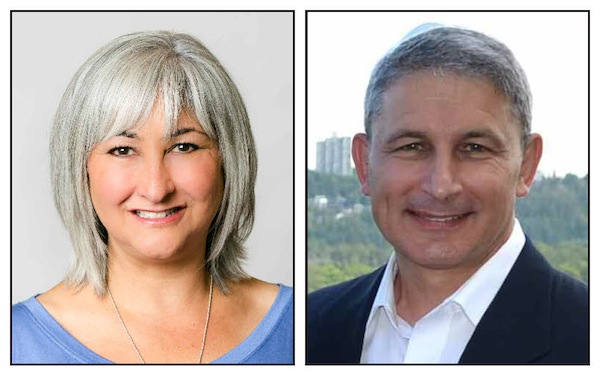
Pam Wolfman is chair of the Yom Ha’atzmaut committee and Geoffrey Druker leads the Yom Hazikaron committee. (photos from Jewish Federation)

For many years, Vancouver has been home to North America’s largest celebration on erev Yom Ha’atzmaut. While Israel’s Independence Day is marked in many cities around the world, Vancouver is unusual in that it marks the occasion on the day it occurs – many bigger communities celebrate on an adjacent weekend or later in the spring. The event is usually the largest Jewish community gathering of the year in British Columbia, which is a statement about the connection between Vancouver’s Jewish community and the state of Israel, say organizers.

Last year, with the pandemic declared mere weeks before Israel’s anniversary, the tough decision was made to cancel the local event and join an international celebration convened virtually by Jewish Federations of North America.

While Pamela Wolfman, chair of the Yom Ha’atzmaut committee of the Jewish Federation of Greater Vancouver, wishes the community could come together in person, being online does have a silver lining – it allows the program to be more expansive. Every Yom Ha’atzmaut features an Israeli musical performer or group. This year, the committee has arranged for five performers who have joined the Vancouver celebrations in years past to return in a virtual “best of” concert.

“We decided to bring back five of the favourite artists from recent years who performed here already, so they already had a connection with Vancouver, they’d already visited us and gotten to know us and vice versa,” said Wolfman, who has chaired the event since 2014.

She credits Stephen Gaerber, who preceded her as event chair, and his brothers and father, as the impetus for the focus on Israeli talent at the annual get-together.

“Our community really responds to that,” said Wolfman. “A majority of our community really does feel connected to Israel, wants to celebrate all the positive things about Israel. We want to take a break from the news and we want to celebrate Israel, the miracle of Israel – Israeli art, Israeli culture, Israeli music – and to do that together is just really fun for everybody, really positive.”

Wolfman herself became involved via an earlier involvement with Festival Ha’Rikud, the Jewish Community Centre of Greater Vancouver’s festival of Israeli dance for young people. Since the festival began 18 years ago, the kids have participated in Yom Ha’atzmaut celebrations every year.

“This year, especially, there’s a lot to celebrate, with everything positive that’s going on with Israel … with the Abraham Accords, with the vaccine rollout, it’s a really good year to get together and celebrate – and lots and lots of great music has come out of Israel this year, too.”

In addition to the “five favourites,” Wolfman promises “cute kids and a few surprises.” Lu Winters and Kyle Berger will emcee, and keep an eye out, as well, for many other familiar faces, as scores of community members have come together virtually for a community song – the iconic 1970 Israeli ballad “Bashana Haba’ah” (“Next Year”).

Since the community event always sells out, this year’s virtual version will turn no one away – plus, it’s free. (Donations are welcome during registration at jewishvancouver.com. Food can also be ordered online via links at the same time.)

There can be no Yom Ha’atzmaut without Yom Hazikaron. Israel’s Independence Day is celebrated the day after Israel’s national day of remembrance for those lost defending the country or killed in terror attacks. This year’s commemoration of Yom Hazikaron will also be online, but the committee, led by Geoffrey Druker, has experience at a virtual version of the solemn commemoration – they delivered a virtual commemoration last year.

Like Yom Ha’atzmaut, Yom Hazikaron holds a special place in Vancouver’s Jewish community. Many other cities in North America mark the occasion, but ours is somewhat unusual, said Druker. Gaby Peled, an Israeli-Canadian who passed away in 2019, was pivotal in structuring our commemoration along the lines of the Yom Hazikaron he knew on his kibbutz, Givat Haim.

When Druker, also from Israel, arrived here in 1988, he was surprised to discover how many members of the Vancouver Jewish community had lost loved ones – family and friends – in Israel’s various conflagrations. A slide show every year remembers the individuals who are connected to British Columbians – and, every year, more faces are added. Often, local people have not shared their stories of loss, and so, as they come forward with their experiences with bereavement, their people are added to the ceremony. Druker invites anyone to contact Federation to add a loved one to be acknowledged and mourned communally.

This year’s gathering will share the story of, among others, Shaul Gilboa, a pilot shot down in 1969 and a cousin of Vancouverite Dvori Balshine. Shimi Cohen will remember his brother, Shlomo Cohen, by reciting Yizkor.

“The ceremony itself is for the bereaved families,” Druker said. “That’s how I see it. We want to remember their loved ones and we want to give them a community hug to recognize their loss and their pain. Everything is geared toward that.”

The event has grown significantly over the years, partly because the Israeli population in Metro Vancouver has grown significantly. Many or most of the participants in the annual Yom Hazikaron commemoration have Israeli ties and it is a hugely significant day in Israel.

The virtual format does not allow the person-to-person interaction that a regular gathering does, where people can share condolences and commiserate, said Druker. But virtual is absolutely preferable to no commemoration at all.

“It’s a significant date for many,” he said, “so that’s why we have to keep going.”

To join the ceremonies, visit jewishvancouver.com.

Format ImagePosted on March 19, 2021March 18, 2021Author Pat JohnsonCategories LocalTags entertainment, Geoffrey Druker, Israel, Jewish Federation, mourning, Pam Wolfman, terrorism, war, Yom Ha'atzmaut, Yom Hazikaron

An unfair funeral

This article was posted on medium.com on May 20 with the title “Bouncing from a COVID funeral,” and is reprinted with permission.

I had a loss in my family this weekend. It was not related to COVID. Nonetheless, it has been an exceptionally challenging time to lose a loved one. There are no mourning rituals, or figurative closures or moments to console the ones who are hurting the most. There are no hugs or shmoozing or recounting memories or poring over old picture albums around a coffee cake and a cup of tea (you get the idea: insert any of your traditions or rituals here).

Loss and death are concepts I struggle with, like most people. I always feel like I cannot say the right thing and feel awkward in the presence of those hurting the most. I am not “good” at funerals or mourning phases. I generally show up, pay my respects, and bounce.

What makes losing life during this unique time in history so hard is that we are mandated to be socially distant. However, when death hits the one we know and love, it is so heartbreaking, I want to so badly be socially closer, more than ever before. I would not have bounced. I would have stayed and been present.

Today, at 2 p.m., I will sit on a Zoom call to pay my respects. I will send a meal to the homes of the mourners. My father will be one of 10 that is allowed at the graveside service. He will wear his masks and gloves and stand six feet apart from his sister and nieces.

This seems grossly unfair, for a person whose funeral would have attracted people counting in the hundreds.

I cannot show up at this funeral even if I wanted to. I can sit in my house and watch it all go down on a live stream. It feels so cheap and lame and gross. Not the tribute that this person deserves.

The learning for me – as we sit together, alone, living a socially dis-social lifestyle for the foreseeable future, what small acts of kindness, generosity, pay it forward, TLC and tenderness can I express to just one other person to enrich their lives?

When I close my eyes and I imagine the eulogy recited at the end of my time on this earth, I wonder, what will I be remembered for?

I challenge you: what will you be remembered for?

Are you proud of the life you have lived?

How would you want to go down in the books?

What is your legacy, big or small?

It’s a morbid thought – not a place I often go but feel compelled to address, given the nature of the planet and the nature of my family’s pain.

My heart aches for anyone who has lost anyone during this truly f*cked up moment in time.

May your memory be a blessing.

Alana Kayfetz Kantor is founder and chief executive officer at MomsTO and MOMFEST, and co-host of Moms That Say F*ck the Podcast.

Posted on May 29, 2020May 28, 2020Author Alana Kayfetz KantorCategories Op-EdTags coronavirus, COVID-19, funeral, Judaism, mourning
A tribute to my father

A tribute to my father

Was it really 17 years ago that my sweet, beloved father, Sidney Civkin, passed away? The long row of empty Yahrzeit candles in my closet confirms it. The date was March 13, 2003. Dad was 86 years old. It was indisputably the saddest day of my life.

If you have a good one, you’ll know that there is something unique about a father-daughter relationship. There are secrets and bonds that no mother-daughter relationship can come close to. Don’t ask me why, I just know it’s true.

It’s no secret that my sister Linda and I spent more time with our father in the last three years of his life than we had up until that point – and he was always a very present, involved father. He’d been suffering with end-stage renal failure and was on dialysis for those last few years. And we were his primary caregivers, since our mother was not well by that point.

Our dad often said that, ironically, those were the best years of his life – precisely because he got to spend so much time with Linda and me. He loved to just hang out with us. Whether we were sharing a meal, having a coffee at Granville Island, or sitting in the den shmoozing, he was all in. Flattering to think that he loved our company above everything else.

There was no one who didn’t have an opinion about our father. Some knew him as argumentative, loud and assertive. Others remember him as compassionate, caring and erudite. I knew him as all of those things, and loved him more for it. He was my secret-keeper, my biggest fan, my adoring, supportive father. If anyone has ever loved me unconditionally, it was him.

Dad adored his work (he was an ear, nose and throat surgeon); devoured books; loved to golf; loved to cook; and took great enjoyment in playing bridge with his buddies. But, most of all, he loved his family. And he had a quirky, magnificent sense of humour. He was playful, outspoken and hardworking. And he adored off-colour jokes.

Dad was born in Winnipeg (“the Old Country”) in 1916, served in the Canadian Army as a medical officer, then moved to Vancouver in 1949, determined to escape the brutal prairie winters. He set up his medical practice in New Westminster and, even though we lived in Vancouver, he continued to make the commute for the next 37-odd years. He loved the small-town feel of New Westminster, his working-class patients and his colleagues. He’d found his place as a well-respected doctor who spent his life helping others.

I’ll never forget the night Dad passed on. My life shattered, not just momentarily, but for a few years. I was 47 years old, single, and I’d just lost my best friend. I know that sounds odd, but our relationship was everything to me. I grieved as though I’d invented the concept. I felt like no one’s heart could be broken quite like mine. It wasn’t just an emotional pain. It was intensely physical for me. In the blink of an eye (it wasn’t really, because he had been sick for three years, but death never seems inevitable, even in the very second before it happens), my world splintered into a billion pieces. I was inconsolable.

My grief consumed me, at home and at work. The mere thought of my father set me to tears. It was like a floodgate had not merely opened, but exploded. Seventeen years later, I still think of my father regularly, but the tears are no longer a daily occurrence. Yet, I still can’t believe he’s no longer here with us, physically. He certainly is in spirit. They say that, when the soul leaves the body, it can still connect with loved ones, except it’s in a spiritual way. And we have lots of that. Naturally, I miss the physicality of giving my dad a hug and kiss. I miss looking at his smiling face. But we still connect mightily and often. I can feel his presence in my dreams and, when I see or hear particular things, I just know it’s my dad sending me a message. I know he’s always checking in on me, looking out for how I’m doing.

Grief is a funny thing. It ebbs and flows. It intrudes at the most inopportune times, and announces its presence with a deafening blast. It creeps into your consciousness when you least expect it, and always takes its sweet time getting comfortable. Grief never gets an invitation – it always just crashes the party. Grief never gets easier; it just gets different. The edges blur, the points soften, but the tangible sense of loss never goes away. Seventeen years later, at age 64, I still feel like an orphan.

There is much truth to the adage by Maya Angelou: “People will forget what you said, people will forget what you did, but people will never forget how you made them feel.” My father always made me feel loved and supported. His pride in me was a source of great comfort. Naturally, there were times when he said or did things that angered or upset me, but they never eclipsed his unconditional love for me. I have always been sure of that.

If I had to distil my dad’s legacy into a nutshell, it would be this: be kind to people and help them when you can. Give graciously of your heart, and always try to do the right thing. It’s a tall order. But I’m up for the challenge. Thank you, Dad, for everything.

Shelley Civkin is a happily retired librarian and communications officer. For 17 years, she wrote a weekly book review column for the Richmond Review. She’s currently a freelance writer and volunteer, including with Chabad Richmond.


Format ImagePosted on March 20, 2020March 17, 2020Author Shelley CivkinCategories Op-EdTags health, Judaism, memoir, mourning, philosophy, Sidney Civkin
Proudly powered by WordPress