Skip to content
  • Home
  • Subscribe / donate
  • Events calendar
  • Business Directory
  • FAQ
  • News
    • Local
    • National
    • Israel
    • World
    • עניין בחדשות
      A roundup of news in Canada and further afield, in Hebrew.
  • Opinion
    • From the JI
    • Op-Ed
  • Arts & Culture
    • Performing Arts
    • Music
    • Books
    • Visual Arts
    • TV & Film
  • Life
    • Celebrating the Holidays
    • Travel
    • The Daily Snooze
      Cartoons by Jacob Samuel
    • Mystery Photo
      Help the JI and JMABC fill in the gaps in our archives.
  • Community Links
    • Organizations, Etc.
    • Other News Sources & Blogs
  • JI Chai Celebration
  • JI@88! video

Recent Posts

  • Legal help for students
  • Revisiting myth of Lilith
  • Wrong person rebuked
  • Canada’s mixed messages
  • Questions for museum
  • Symposium on antizionism
  • Making soccer political
  • CJPAC lauds Pulver’s impact
  • City recognizes Vrba’s legacy  
  • Organ donation saves lives
  • Theodore’s March premiere
  • A healing Shabbaton
  • Supplying healthy food
  • A chime of metal tags
  • Yellowknife seder a first
  • Ishai energizes, unifies
  • A Lag b’Omer to remember
  • Expanding the healing
  • Hannah Senesh – a unique hero
  • Community milestones … May 2026
  • Sharing her testimony
  • Fall fight takes leap forward
  • The balancing of rights
  • Multiple Tony n’ Tina roles
  • Stories of trauma, resilience
  • Celebrate our culture
  • A responsibility to help
  • What wellness means at JCC
  • Together in mourning
  • Downhill after Trump?
  • Birth control even easier now
  • Eco-Sisters mentorship
  • Unexpected discoveries
  • Study’s results hopeful
  • Bad behaviour affects us all
  • Thankful for the police

Archives

Follow @JewishIndie
image - The CJN - Visit Us Banner - 300x600 - 101625

Month: December 2022

Community tree of life

Community tree of life

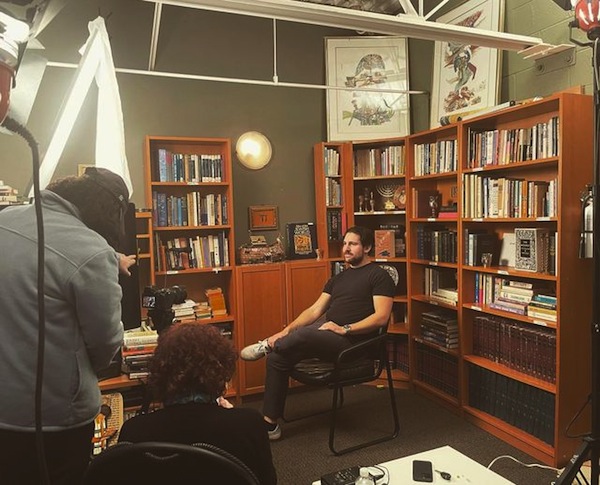
Daniel Shalinsky being interviewed and filmed as part of White Rock South Surrey Jewish Community Centre’s oral history project, which will form part of the community’s Feb. 5 Tu b’Shevat Gala, along with singer Tania Grinberg, speaker Karen James and more. (photo by Helen Thomas Mann)

The White Rock South Surrey Jewish Community Centre Tu b’Shevat Gala will take place on the evening of Sunday, Feb. 5, the start of the holiday. With the theme “Strengthen Our Roots,” a main component of the event will be community members’ oral histories.

“The idea for the project came about in a very multidirectional way,” Helen Thomas Mann, WRSSJCC president, told the Independent. “First, we wanted to host an annual fundraising event and, with our membership drive being around the High Holidays, Tu b’Shevat seemed like a good time for it.”

Tu b’Shevat, the 15th of the Hebrew month of Shevat, is the New Year of Trees. 

“Naturally,” said Thomas Mann, “the theme for a Tu b’Shevat event would be trees, so we began focusing on our ‘tree of life’ as a community. But we were coming back together after a three-year lull from the pandemic – we needed people to remember why this place is important, and why it should continue to exist. The idea became, let’s honour our roots, our history as a community of nearly 30 years; remember the branches that connect us to our Jewishness and the WRSSJCC, and celebrate our leaves, the future of our community.

“As a new president and newer member of the community,” she said, “I felt sensitive to the fact that, although I was playing a leadership role in the organization, there were many people who had worked hard before me to create this warm Jewish space. Our new board didn’t have to reinvent the wheel. I made it my mission to learn those stories.”

A therapist by profession, Thomas Mann is naturally interested in people’s stories, she said. “I had a conversation with Alysa [Routtenberg] from the Jewish Museum and Archives of British Columbia, and that’s where collecting life stories of people in our community came about. She provided me with a recording device. Then it occurred to me that these life stories and the stories of the JCC itself could be incorporated into our celebration.

“I was scrolling the WRSSJCC Instagram account, and I saw a person we follow, and who follows our organization back, who had beautiful fine art photos. Their website said they were passionate about storytelling. I took a chance and reached out, and the person happened to be Yaacov Green, who participated in the JCC as a child and whose father was a president of the JCC for many years! Yaacov generously offered to donate his time to record and edit these interviews to make a short presentation for the Tu b’Shevat event, and a longer version to be submitted to the Jewish Museum and Archives of B.C.”

During the project, Thomas Mann said, “Marcy Babins from the museum mentioned this may be the first representation of Jews from our outlying community in the archive, so I’m thrilled we will be represented. There’s such a rich history here of creative, scrappy and very grassroots Jewish community-building efforts. It’s been very inspiring to learn about. We have interviewed 23 people so far, plus we are having two make-up days…. We are also completing a few Zoom interviews for those who are no longer local.”

Everyone in the community was invited to participate, whether new to the community or having been a part of it for a long time. One of the participants was Daniel Shalinsky, who was interviewed for the project by his grandmother, Helen Lynn Lutterman.

“He attended Hebrew school at the JCC and spent lots of time there as a child,” said Thomas Mann. “There are pictures of him as a child with a hammer, literally building our WRSSJCC alongside his family. His parents are Hertha and Steve Shalinsky, who we are honouring at the Tu b’Shevat event. Their family, including Steve’s brother and his wife, Ken and Andrea Shalinsky, were integral in acquiring our physical space. Steve was a president for many years. For more on the fascinating story of how the space was acquired, you will have to attend the event to find out!”

In addition to the community histories, award-winning Yiddish singer Tania Grinberg will be featured at the celebration. And the night’s keynote speaker will be Karen James, who will share the story of her experience at the 1972 Olympics in Munich. James was there with the Canadian Olympic swim team, and witnessed a group of people climbing over the wall of the Olympic village. Only later would she find out that those people held hostage and then murdered 11 Israeli athletes. “She will share how witnessing this event impacted her life, her connection to her Jewish identity, and her relationship with the WRSSJCC,” said Thomas Mann of James’ presentation.

The Tu b’Shevat fundraiser is for specific programming, as well as operating expenses of the WRSSJCC.

“We are fundraising to generally pay our bills, and our hope is to be able to hire a part-time employee to support our admin needs and flourishing programming,” Thomas Mann explained. “We also have a list of ‘wishing tree’ items that range in dollar amounts from new oven mitts to computer monitors, and open amounts for specific purposes such as donating towards a child in need’s Hebrew school tuition. Long term, we would love to be able to find a new building space where we could have a stand-alone building, as opposed to being in a strip mall, with an outdoor area for a sukkah and community garden. That would be our pie-in-the-sky donation! We are a 100% volunteer-run organization, so every contribution counts.”

The entire community is welcome to the Feb. 5 event, which will be held at the White Rock South Surrey Jewish Community Centre, 32-3033 King George Blvd., in Surrey. “We considered the ease of hosting in a different location for space restrictions, but it seemed too important to centre the space,” said Thomas Mann. “Plus, our tree of life is on the wall, and we will be unveiling the new additions at the event.”

Tickets will soon go on sale – keep an eye on Instagram (@wrssjcc) and Facebook (White Rock South Surrey JCC).
Format ImagePosted on December 23, 2022December 21, 2022Author Cynthia RamsayCategories LocalTags community centre, fundraising, gala, Helen Thomas Mann, JCC, oral histories, South Surrey, synagogues, Tu b’Shevat, White Rock, WRSS, WRSSJCC
Building bridges to inclusion

Building bridges to inclusion

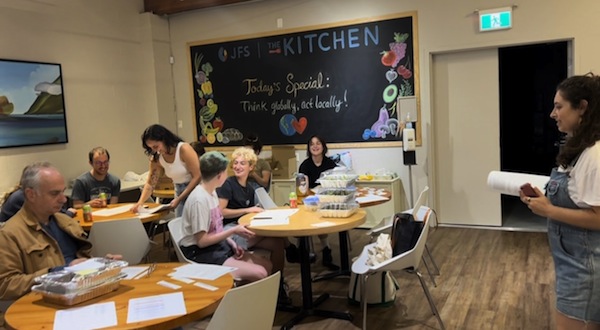
Volunteers from the Jewish community turn up each June to prepare, label and deliver freshly cooked meals to Black families as a sign of community support. (photo by JFS photo by Madison Slobin)

How do you build a more inclusive Jewish community, one that thrives on diversity? For Vancouver’s Jewish Family Services, says chief executive officer Tanja Demajo, resilience starts with building bridges. And it flourishes with finding common links between cultures.

During the last few years, JFS has been expanding the programs it offers to Jewish communities throughout Metro Vancouver, and looking for new ways to enrich conversations around diversity and inclusion. 

Projects like the Shiva Delivers partnership with Vancouver’s Black community and Twice Blessed 2.0: The Jewish LGBTQ2SIA+ Initiative are helping forge alliances and cultural understanding.

Sharing home-cooked meals

Shiva Delivers, which provides traditional home-cooked meals to Black families dealing with loss and grief, was started by Madison Slobin and Becca Schwenk in 2020 following the death of George Floyd, who was killed on May 25 of that year during a routine traffic stop by Minneapolis police. His death ignited protests in cities across North America, including Vancouver. According to Demajo, Shiva Delivers emerged as “a response to the social injustice and the grief that the Black community were experiencing.” (See also jewishindependent.ca/providing-comfort-and-hope.)

Slobin and Schwenk ran the program independently the first year with a cadre of volunteers from the local Jewish community. In 2022, JFS jumped on board, offering its kitchen as an operation centre for the project, which takes place every June. According to Slobin, Jewish families from across Vancouver signed up to cook full-course meals and carry out the deliveries, inspired by the very Jewish tradition of responding to tragedy and mourning with food.

“When someone in our community is grieving, we support them with food and with showing up and saying, ‘we’re here for you,’” Slobin said, noting that the concept was popular with volunteers from the start. “We had young Jews participating, we had Orthodox Jews participating, we had [people] from all spectrums [of the community].”

According to Demajo, news about the program arrived at the right time for JFS.

“JFS was going through this exploration of how do we work with and reach out to different communities,” Demajo said. “What we really learned was, first of all, a large Jewish community was interested in making this connection and intercultural exchange … with the Black community and showing their solidarity. And, on the other hand, the Black community was just touched by the fact that another cultural group offered that support.”

Demajo said she received many expressions of thanks from Black community members stunned by the gesture – and the elaborate dishes. “Are all Jewish people such good cooks?” one person called to find out. “Your food is amazing!”

But the project also helped JFS confirm that there were members of the Black community who were Jewish but not affiliated with the Jewish 

community. Demajo said she realized this when a young woman who had received one of the dinners contacted her to ask why the Jewish community was doing this. 

“Well, you know,” Demajo told the woman, “we have Black people in [our] community as well, and we want to build bridges and reach out [and] learn from each [other’s communities].” A moment later, Demajo said she heard the woman’s child calling to her. The child was speaking in Hebrew. “And that kind of took me back a little bit,” Demajo admitted. 

It turned out the woman had moved here from Israel some years earlier but wasn’t participating in the Vancouver Jewish community. “Even though I lived in Israel,” she told Demajo, “I’ve never felt part of the community here.” 

“And I realized at that moment,” Demajo said, “how important this [program] is, because we don’t know who the people are that we seem to support, until we actually do reach out and hear these stories.”

Slobin said the project not only inspires more opportunities for sharing between the two communities, it’s helping convey an important message to Black Jews that they are indeed a welcome part of the Jewish community. “Every single year that we have done it, we have had Black Jews participate and express how meaningful it is for them to see their own community recognize them in this way,” said Slobin.

Being more welcoming

Twice Blessed 2.0: The Jewish LGBTQ2SIA+ Initiative formed in response to a survey that JFS and JQT Vancouver (a volunteer-run Jewish queer and trans nonprofit) compiled in 2021 to determine the needs of the local LGBTQ2SIA+ community. The results were released earlier this year.

Some respondents said they feel unwelcome in the greater Jewish community, while others stated they feel ostracized by the LGBTQ2SIA+ community because they are Jewish. Most respondents felt that clear “‘indicators of support’ for the LGBTQ2SIA+ community would make them more inclined to participate in the Jewish community.”

“Our commitment to diversity and inclusion must speak through our actions, and not only our words. 

Although not an easy task, it is an imperative one,” wrote Demajo and JQT executive director Carmel Tanaka in the report, which can be found at jqtvancouver.ca/twice-blessed-2. (See also jewishindependent.ca/thirteen-calls-for-action.)

“One of the lessons we need to learn is, how do we make our agency more welcoming for different people?” Demajo said, “And, very simply, how do we do that in a dignified way?”

These questions are also helping JFS reexamine how it’s interacting with other cultures and communities when it’s providing social and economic support to Jewish families.

“I think it’s important for us as a community to understand the clients that we support live in very diverse neighbourhoods, which means that probably, on a daily basis, they see a lot of diversity and they live in those circles. When we as an agency provide certain supports to one targeted group and exclude their neighbours … that creates a lot of tension that gets reflected in their day-to-day life. So, at the end of the day, we all go home but they have to deal with the aftermath of the way we provided services … and this is why, on our end, it became really clear that, in order to support our clients, it’s not just a question of providing services directly to them,” explained Demajo. “It’s also ensuring that they have a safe community, a community of allies, a community that they can rely on when we’re not around. By building these bridges between all these different groups, I believe that we can create that.”

Learning from the past

JFS is currently exploring a number of new projects focused on diversity and social inclusion, both within the Jewish community as well as forming relationships outside its cultural space. JFS’s the Kitchen is often the meeting space.

“I think the beauty of having a kitchen is having a space for, again, sharing the stories and experiences through food,” Demajo said.

Recently, JFS has been partnering with organizations like CIJA and the Jewish Federation of Greater Vancouver to explore ways in which different cultures can share their culinary traditions, stories and passions.

Demajo said JFS is also doing a review of some of the programs it has offered in the past. “We really want to learn from things that went well, things that did not go well, and we understand in this space that there will be a lot of road [to travel], which is not easy. But it takes a lot of courage to step outside of that comfort zone as well.”

About tikkun olam, repairing the world, she said, “Conversation may start with a handful of like-minded people, but it takes diversity and acceptance to build an inclusive community.

Jan Lee is an award-winning editorial writer whose articles and op-eds have been published in B’nai B’rith Magazine, Voices of Conservative and Masorti Judaism and Baltimore Jewish Times, as well as a number of business, environmental and travel publications. Her blog can be found at multiculturaljew.polestarpassages.com.

Format ImagePosted on December 23, 2022December 21, 2022Author Jan LeeCategories LocalTags diversity, Jewish Family Services, JFS, Madison Slobin, Shiva Delivers, Tanja Demajo

A first step to solutions?

Among other things, Hanukkah is about bringing light into the darkness. There is plenty of darkness in the world and a vast range of concerns calling for radiance.

Mainstream media seem to have taken the cue that Hanukkah is the moment to discuss the alarming and rising phenomenon of antisemitism. Time magazine declares: “Amid antisemitism, Hanukkah celebrations carry new weight.” USA Today explained a new tradition: “On Hanukkah, the ninth candle reflects how anyone can fight antisemitism by sharing truth.” Here in Canada, both Prime Minister Justin Trudeau and Opposition Leader Pierre Poilievre highlighted antisemitism in their annual Hanukkah messages. Expect to see similar expressions of concern in a few days, as the end-of-2022 reflections on the good and bad of the year just passed and hopes for the fresh new year fill pages and airtime during the slow news days of the winter holidays.

We are not complaining. This issue needs thorough and ongoing coverage. It just seems, somehow, that writing and talking about what is often called the world’s oldest bigotry lacks new insights. Many agree that this is a problem. Few, though, have solutions beyond platitudes. 

Finding innovative ways to think and talk about “the world’s oldest” anything is, by definition, a challenge. Some of the greatest scholars in the world have studied the problem, vast networks of activist organizations and Jewish communal agencies devote themselves to defeating it, and still it grows. If we had the definitive explanation or the silver bullet to solve it, you would not be reading it here – we would be sharing our wisdom from the dais of the Nobel Prize ceremony and as the lead story on the world’s media. Undaunted, a few thoughts:

The very phrase “antisemitism” may be problematic. The term was invented in the late 1800s by a proud antisemite to describe his orientation. But while there is a great deal of conscious and visible antisemitism in the world today that rightly raises alarms, there has always been an equally, perhaps more, worrying phenomenon in the form of unconscious bias about Jews that permeates many societies and individuals. This is more insidious and, therefore, more difficult to challenge. 

It is worth noting that antisemitism is often most prevalent where no or few Jews exist, making it easier to project onto a largely imaginary enemy the fears and hatreds carried by the individual or the society. Similarly, we see a projection of Jewishness onto any unpopular phenomenon, an example being the “Great Replacement” theory, a paranoid fantasy in which whatever the perpetrator despises (in this case immigration) is cast as a problem with Jewish roots.

Both of these phenomena touch on what we suspect is the nut of antisemitism: it is a problem that affects Jews but it is not a problem of Jews. That is, if Jews did not exist, the antisemites would have to invent them – which is, in essence, precisely what they have done with the caricatured “Jew” that is demonized by antisemites. 

This understanding, of course, does nothing to resolve the problem. And, again, a problem known as “the world’s oldest hatred” is not going to be solved in one generation with one easy antidote. It is encouraging, though, to see the range of responses to the problem, from more in-depth coverage in mainstream media to the statements of top leaders in Canada, as well as in the United States, where a major presidential effort against antisemitism is being led by Doug Emhoff, the second gentleman of the United States, who recently led a roundtable of leading thinkers, and in a host of other undertakings worldwide.

As is said in a different context, the first step to recovery is admitting you have a problem. As a society, we have a consensus that antisemitism is a growing problem. As we approach 2023, we hope those thoughts will turn to even more action in confronting this confounding blight. 

Posted on December 23, 2022December 21, 2022Author The Editorial BoardCategories From the JITags antisemitism, Hanukkah, history, politics
Sacre premières here

Sacre premières here

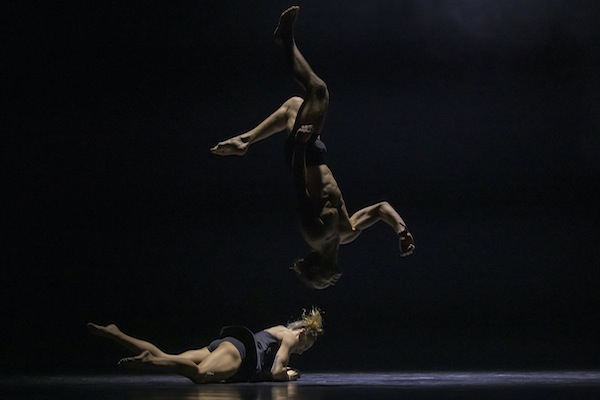
Circa’s Sacre is an exploration of humanity’s interconnectivity, our inherent sexual desire and our complex relationship with divinity. (photo by Pedro Greig)

DanceHouse and the Cultch present the Canadian première of Circa’s acrobatic Sacre, on stage Jan. 17-21, 8 p.m., at the Vancouver Playhouse. Directed by Jewish community member Yaron Lifschitz, artistic director and chief executive officer of Circa, Sacre is an exploration of humanity’s interconnectivity, our inherent sexual desire and our complex relationship with divinity. Inspired by Igor Stravinsky’s seminal production The Rite of Spring, the full-length work from Australia’s leading contemporary circus company is a blend of balletic lines and athletic feats, infused with pulsating and dissonant elements of a reimagined Stravinsky score.

“This is a work of powerful juxtapositions, blending the sacred with the profane; the ethereal with the visceral. On one level, Sacre is a work of mesmerizing beauty, drawing on the lyrical movement of contemporary dance and the intense physicality of the circus arts,” said Jim Smith, artistic and executive director of DanceHouse. “At the same time, the work offers a raw and bracing social commentary, drawing upon the ancient pagan traditions referenced within Stravinsky’s transgressive work – in which a virginal young woman dances herself to death. This offers an intriguing and gritty contrast to the pure spectacle of the performance, and invites reflection on the nature of humanity’s responsibility toward one another in a world on the brink of disaster.”

Stravinsky’s The Rite of Spring was so scandalous that it incited a riot at its Parisian première in 1913. Despite – and partly because of – this incendiary start, the work is now considered one of the most impactful compositions of the 20th century. Circa’s new interpretation of the haunting work premièred in January 2021 at the Illawarra Performing Arts Centre in Wollongong, Australia. Sacre features 10 acrobats interwoven in ceaseless motion, as they deftly move in and out of technically complex grouping structures, lifts, tumbles and leaps.

Set to a pounding musical score by Philippe Bachman, full of fast-paced tempo and mood changes, and echoed by a lighting design by Veronique Benett that moves through intense flashes of light and darkness to dim lighting that slowly brightens, the work methodically builds into a crescendo with heart-pumping intensity.

Circa’s Lifschitz is a graduate of the University of New South Wales, University of Queensland and National Institute of Dramatic Arts (NIDA), where he was the youngest director ever accepted into its graduate director’s course. Since graduating, Lifschitz has directed more than 60 productions throughout his career, including opera, theatre, physical theatre and circus. He was founding artistic director of the Australian Museum’s theatre unit and head tutor in directing at Australian Theatre for Young People, and has been a regular guest tutor in directing at NIDA. He was creative director of Festival 2018: the arts and cultural program of the 21st Commonwealth Games.

Lifschitz has served as artistic director and CEO of Circa, based in Brisbane, since 2004. The company has performed in more than 40 countries across six continents to more than 1.5 million people. Circa has presented at major festivals and venues around the world, including Brooklyn Academy of Music, the Barbican Centre, les Nuits de Fourvière and Chamäleon Theatre Berlin.

For tickets and further information about Sacre, visit dancehouse.ca.

– Courtesy DanceHouse and the Cultch

Format ImagePosted on December 23, 2022December 21, 2022Author DanceHouse & the CultchCategories Performing ArtsTags choreography, Circa, Cultch, dance, DanceHouse, Rite of Spring, Sacre, Stravinsky, Yaron Lifschitz
Opening gates of kabbalah

Opening gates of kabbalah

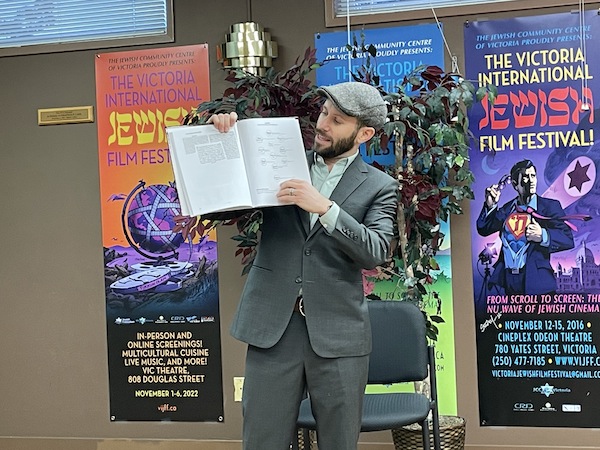
Rabbi Matthew Ponak recently released his latest book, Embodied Kabbalah: Jewish Mysticism for All People. (photo by Marilyn Wolovick)

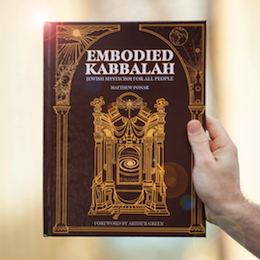
Rabbi Matthew Ponak introduced his new book, Embodied Kabbalah: Jewish Mysticism for All People, this month both in a Zoom event and in-person at the Victoria Jewish Community Centre.

According to the book’s description, the objective of Jewish mysticism is to “touch infinity with your feet planted in everyday, ordinary reality.” The book contains universal teachings that Ponak believes are necessary to the world at this time.

Delving into a millennium of Jewish writings, Ponak hopes his approach will serve as a counterweight to the focus in modern spirituality on bliss and transcendence. Throughout the centuries, Ponak argues, Judaism – including Jewish mysticism – has held “being a good person” as the ideal.

image - Embodied Kabbalah book coverEmbodied Kabbalah, written in the talmudic style, in which commentary surrounds the original texts, looks to the mystic teachings for finding a healthy balance between one’s spiritual life and external commitments to family, work and community. Many of the book’s sources have been translated into English for the first time.

During the launch at the Victoria JCC, Ponak spoke of the personal journey that led to the creation of the book. In his initial studies, he observed two different paths. “One was a path of transcendence,” he said, “a path of bliss, that all is well in the world and we should be celebrating all day. On one level that appealed to me, but I felt there was something missing in it.”

The other path, he said, is one of transformation. “This is one of deep self-knowledge: that I could get to know who I was inside, and new parts of me would start to come forward. There is a deep, radical honesty that can liberate parts of who we are. Those parts can enter into our outer lives as we become more whole.”

Upon further exploration, he discovered there was a way to incorporate both paths into one’s life.

“I found a particular teaching that says there is a time to transform – the work week – and a time to rejoice – Shabbat. One day a week, it is time to celebrate all that we have and focus on the positive, to not get weighed down by the negativity,” Ponak said. “There is a time for the deep personal transformation of working on ourselves, the spiritual work week. On Shabbat, however, everything is whole and we are, too. We feed ourselves delicious food and take an extra nap to help our bodies know the world is complete.”

Ponak emphasized that it is not necessary to choose between the paths of rejoicing and of transformation. There is a time for working and a time for celebrating. If all one has is work, then there is the risk of missing out on the beauty of life, he said. Alternatively, if one is in a prolonged state of transcendent joy, then a spiritual leader, for example, might become unable to help others grow because they have “left the world, so to speak, unable to relate to people.”

He said, “It is good to come off the mountain. It took me a long time to understand the value of that. If I had a trauma or a difficulty in my earlier years as a seeker, it was with the bliss. The transformation stuff was hard, but I was able to get it once it was taught to me in an accessible way.”

Ponak retraced various aspects of his spiritual journey. He studied transpersonal psychology (or spiritual psychology) and other religions. Through this, he found he could be both a spiritual person and grounded.  “But there was a deeper part of me that knew there was something else,” he said. “There must be something in Judaism.”

After several years of study at the Rabbinical School of Hebrew College, he was able to decode the texts on his own. He discovered the hidden treasure of grounded Jewish spirituality that had been there all along in lesser-known mystical writings.

“If I had access to Embodied Kabbalah as a teenager, it could have saved me a lot of headaches and heartaches, to say nothing of my family’s stress,” he said. “This is why this book is so close to my heart.”

Among those who would benefit from the book, Ponak pointed to those interested in Jewish mysticism, those who have Jewish ancestry but feel alienated from Judaism, and those who want to learn about universal Jewish teachings as part of the global spiritual landscape.

Yet, for him, “the call to action that feels most urgent is to help people who are ‘ungrounded,’ who are finding mystical writings or going to spiritual retreats but are not connected to the earth: to the body or to their emotions. It’s time to open up the gates of Jewish wisdom to all who can benefit from it,” he said. “I hope this effort will help spiritual seekers to be responsible, relatable, whole and healthy – along with spiritually connected – so that we can be of our greatest service to humanity.”

For more information or to order the book, visit matthewponak.com.

Sam Margolis has written for the Globe and Mail, the National Post, UPI and MSNBC.

Format ImagePosted on December 23, 2022December 21, 2022Author Sam MargolisCategories BooksTags kabbalah, Matthew Ponak, spirituality, Victoria
Ukraine’s complex past

Ukraine’s complex past

Elissa Bemporad (photo from Elissa Bemporad)

During a Dec. 4 Zoom lecture organized by Kolot Mayim Reform Temple in Victoria, historian Elissa Bemporad offered a nuanced look at the Jewish experience in Ukraine, as well as perspective on the Russian invasion of Ukraine

“It was a history marked significantly more by coexistence between Jews and non-Jews than it was by violence,” said Bemporad, a professor at Queens College and CUNY Graduate Centre in New York City. “I am saying this not only in response to the genocidal war that Russia has launched in Ukraine, justifying it by manipulating the past and demonizing Ukrainians as quintessentially violent. We should resist the view of the Jewish experience in the region, as tragic as it might have been, as if it was doomed from the very beginning and enveloped in perpetual violence.”

The current war, she underscored, has brought about the worst refugee crisis in Europe since the Second World War, with cities destroyed and civilian populations terrorized. “The aim of this war seems to be putting an end to Ukrainian sovereignty and identity,” she said. “As a historian, one of the most painful moments was reading about how the Russian occupiers were seizing and destroying books. As Jewish historians, we know all too well what happens when a society destroys books.”

Showing images of the destruction of Jewish buildings in Ukraine, such as a synagogue in Mariupol and the Hillel building in Kharkhiv, Bemporad spoke to the irony of one of Russia’s stated goals of the conflict: to rid the country of Nazis. Most of the Jews in these bombed-out cities have left, she said, and there is uncertainty as to whether they will return; many have either fled to Israel or settled in the West.

Bemporad discussed the pre-Second World War period, when 1.5 million Jews lived in what is today Ukraine, the largest community being in Kyiv, where 226,000 Jews resided, or one-third of the city’s population. Addressing the anti-Jewish violence in the region, she spoke about – among other uprisings, dating back to the 17th century – the Russian Civil War (1918-21) and the resulting atrocities committed against the Jewish population by both military units and the civilian population. Many of the pogroms took place in Ukraine and tens of thousands of Jews were killed.

“Jews were thought of as interlopers in the national body and imagined as forces connected to Bolshevism that would tear apart the nation’s fabric,” Bemporad said. “The fact that Trotsky was the leader of the Red Army did not play in favour of the Jews.”

But Bemporad highlighted a history of coexistence as well, stories in which some Ukrainians heroically stepped in to save the life of Jews, notably the writer Rakhel Feygenberg, who, along with her infant son, was hidden by non-Jews during a 1919 pogrom.

About the post-First World War era, she noted the ambivalent attitude the Soviet state had toward antisemitism. “While the state condemned antisemitism on paper, it was often eager to ignore antisemitism or to weaponize it in its best interest,” she said. “With regard to the pogroms, the Soviets shifted between acknowledging and downplaying the anti-Jewish violence. They were ambiguous in their treatment of the Jews, and they were the ambiguous in their treatment of the perpetrators, creating a state-controlled memory. However, when the discussion of the pogroms was perceived as at odds with the regime’s interests and priorities of building socialism based on the brotherhood of peoples, then the memory of anti-Jewish violence was silenced and the Soviets preferred not to investigate and punish the perpetrators.”

In other examples, she said the Soviets would use antisemitism among Ukrainians as a means to demonstrate they were prone to nationalism. And both Ukraine and Russia have provided recent examples of reviving the memories of and glorifying national heroes who were responsible for carrying out pogroms.

In a final slide, Bemporad displayed the results of a Pew Research Centre survey on antisemitism in Europe. Despite Russia’s attempts to portray Ukraine as a hotbed of antisemitism, more Russians had an unfavourable opinion of Jews than Ukrainians. And, in Bemporad’s view, Ukraine, despite its corruption, has become the most democratic of the post-Soviet states, excluding the Baltic countries. Further, as has often been mentioned in referring to the present situation of Jews in Ukraine, the country elected a Jewish president, Volodymyr Zelensky, with more than 73% of the vote.

“Siding with Ukraine today does not entail dismissing or forgetting the dark pages of anti-Jewish violence in the region,” Bemporad said. “It is rather a reminder that we can start turning those pages and writing new ones in the book of the Jews of Ukraine.”

Bemporad, a two-time winner of the National Jewish Book Award, is the author of Becoming Soviet Jews: The Bolshevik Experiment in Minsk and Legacy of Blood: Jews, Pogroms and Ritual Murder in the Lands of the Soviets. She is the co-editor of two volumes: Women and Genocide: Survivors, Victims, Perpetrators and Pogroms: A Documentary History.

The next speaker in Kolot Mayim’s Building Bridges series will be Sari Shernofsky, a retired community chaplain from the Calgary Jewish community, on Stories from the Narrow Bridge: Meeting People in Their Time of Need. She will speak on Jan. 8, 11 a.m. Visit kolotmayimreformtemple.com.

Sam Margolis has written for the Globe and Mail, the National Post, UPI and MSNBC.

Format ImagePosted on December 23, 2022December 22, 2022Author Sam MargolisCategories LocalTags antisemitism, atheism, Elissa Bemporad, history, Kolot Mayim, religion, Russia, Ukraine, war
Research in community living

Research in community living

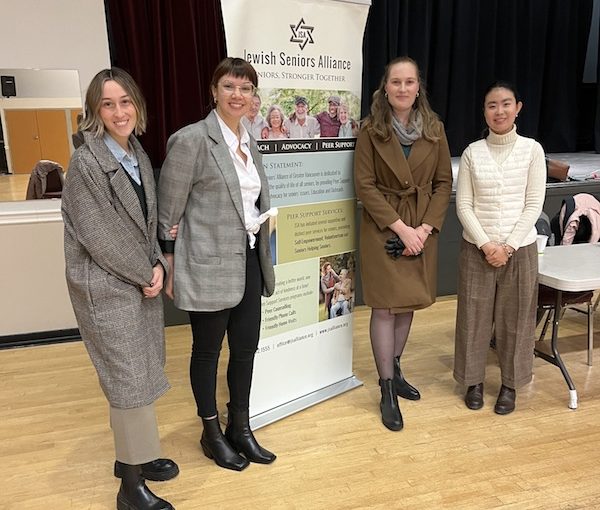
Left to right: Rachelle Patille, Cari Randa, Eireann O’Dea (Jewish Seniors Alliance board member and event moderator) and Boah Kim. (Courtesy JSA)

On Dec. 4, Jewish Seniors Alliance presented their fall symposium: Aging in Place: Gerontology Research in Community Living. The speakers – Rachelle Patille, Cari Randa and Boah Kim – and the moderator, Eireann O’Dea, are all graduate students in gerontology from Simon Fraser University and they shared their research on intergenerational connections, dementia-friendly communities and the role of informal caregivers for older adults.

The event took place at the Peretz Centre but was also available by Zoom. Aside from the JSA annual general meeting, this gathering was the first event presented in a dual format since the outbreak of COVID. Fifty participants joined online and about 20 were present in person.

Tammi Belfer, president of JSA, explained that the JSA’s fall symposium focuses on an educational theme and offers a more serious discussion than other programs. She said JSA wishes to provide outreach, advocacy and education services for all seniors, with the goal being “Seniors Stronger Together.” She then introduced the speakers and turned over the mic to O’Dea, who is a PhD candidate in gerontology at SFU. O’Dea’s interests are in social participation among older adults, particularly in volunteering and intergenerational activities; experiences among ethnocultural minority groups; and generativity. She has been a board member of JSA for three years.

The first speaker, Patille, conducts research focused on “intergenerational opportunities in bridging the gap between generations in Metro Vancouver.” She said she grew up having a lot of contact with her grandmother, and she believes that this fact led to her interest is this field. She defined intergenerational contact as a social benefit that facilitates mutual interaction and exchange between generations, and she discussed factors in society that have impeded such contact; for example, age segregation and geographic divisions among generations that lead to ageism.

Older adults living alone is the number one risk factor for isolation and loneliness, she said. These factors underline the need for connections through programming that will bring older adults into contact with other people, including other older adults. This can be accomplished through such things as home sharing, community programs, tutoring and art projects. These projects allow older adults to be part of the community through participation and mentoring, increasing the person’s feeling of self-worth. For some young people, this may be their first contact with older adults and can lead to reciprocity of social networks.

Patille spoke about generativity, which is the passing down and transfer of knowledge and information 

between generations. She will also be looking at “voluntary kin”; that is, having younger members of society replace missing family for older adults.

The next speaker, Kim, focuses her research interests on integrated care, formal and informal caregiving, continuity of care and healthy aging. One of the difficulties for older adults is navigating complex community and healthcare systems. Two-thirds of older adults have health limitations and thus need a close connection with the healthcare system, she said. A geriatric care manager could be helpful in bridging gaps in services and helping to predict difficulties, she added. Many factors such as age, background or health issues, cannot be changed, but a care manager and caregivers could help with these situations.

The third speaker, Randa, is the project manager of the Public Health Agency of Canada-funded research project titled Dementia-Inclusive Streets and Community Access, Participation and Engagement (DEMSCAPE). The focus is on inclusion of those living with dementia in the 

general community, as 70% live in their own homes. Planned inclusion in neighbourhood design is paramount in creating areas of accessibility, especially outdoor spaces, she said. Randa will be interviewing participants mostly in an outdoor setting to learn their feelings about public spaces with regard to safety and comfort. She is planning a documentary about these issues and the tools available to help, and DEMSCAPE is developing a design and planning guide to aid dementia patients in the community.

In the discussion that followed the presentations, someone noted that many countries are further ahead of Canada in a number of these areas raised. One of these is the availability of affordable home care, which would further facilitate aging in place. Jackie Weiler, a member of the JSA board and also a member of the Senior Advisory Committee for the City of Vancouver, mentioned the idea of a senior planner to promote accessibility. 

Gyda Chud, chair of the program committee, brought the afternoon to a close with a quote from her 99-year-old mother, Gallia, expressing a hope for world peace, diversity, inclusion and social justice for all.

Shanie Levin is a Jewish Seniors Alliance Life Governor. She is also on the editorial committee of Senior Line magazine.

Format ImagePosted on December 23, 2022December 22, 2022Author Shanie LevinCategories LocalTags aging, Boah Kim, Cari Randa, community living, Eireann O’Dea, gerontology, Jewish Seniors Alliance, JSA, Rachelle Patille, science, seniors

Emotional support vital

On Nov. 30, as part of the Fraser Health Virtual Geriatric Educational Session entitled The Importance of Emotional Support for Seniors, Grace Hann, Jewish Seniors Alliance peer support services supervisor and trainer of volunteers, made a presentation that featured recorded remarks from JSA president emeritus Serge Haber.

Haber pointed out in his remarks how life changes for many older seniors once they retire. They often cease to be valued and become invisible, he said. The JSA’s Peer Support Services (PSS) program has trained seniors to provide emotional support to other seniors – active and reflective listening, encouraging the senior to talk about their issues and finding solutions on their own, but with support.

When Haber took the training course, he learned how crucial the PSS program is for the well-being of seniors. The support provided helps them deal with tremendous changes in their lives, such as loss of family, loss of position in society and health issues. Haber argued that these needs are not usually recognized. The gains made by the clients of PSS, he said, are phenomenal.

Hann pointed out that the training and volunteering also helps the seniors who become volunteers.

The second half of the presentation consisted of an explanation by Hann of the training process and a description of the PSS program, as well as other JSA activities, including education and advocacy. Charles Leibovitch, PSS coordinator and the social worker for the program, spoke about Haber’s passion for the work they are doing and how his passion has inspired many of the staff and the volunteers.

Older seniors can remain alone at home longer, if they would like to, as a result of the government’s Better at Home program. However, there is little in emotional support offered; it is not just a gap in this area, but a chasm.

Alvarez thanked everyone and mentioned the summit Fraser Health is planning in June for further discussion of these topics.

Shanie Levin is a Jewish Seniors Alliance Life Governor. She is also on the editorial committee of Senior Line magazine.

Posted on December 23, 2022December 22, 2022Author Shanie LevinCategories LocalTags Charles Leibovitch, Grace Hann, Jewish Seniors Alliance, JSA, mental health, peer support, seniors, Serge Haber
Reflecting on life of creativity

Reflecting on life of creativity

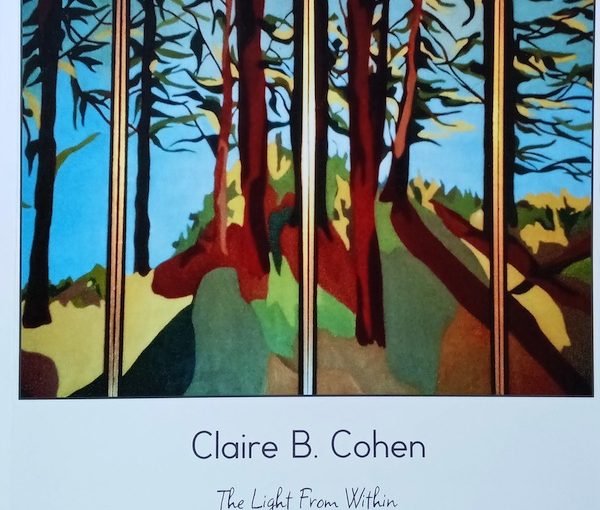
Earlier this year, Claire B. Cohen published a book of her 30-plus years as an artist. She made it for family and friends, as a record of her artistic legacy.

“Art is a powerful and a creative force of self-expression. To create art is to develop an ability to communicate visually what cannot be expressed in words.

“By creating the process of art, we change the way we see the world,” Claire B. Cohen told the Independent. “In understanding ourselves, we find areas where we feel limited. In understanding ourselves, we stand up for ourselves and can present ourselves authentically to others. An artist’s creation is unique and original to their work.”

Earlier this year, Cohen published a slim volume, mainly with images that burst from the pages, outlining her 30-plus years creating art. We glimpse the range of her work – landscapes, portraits, semi-abstracts, flowers, multimedia collages and a compartmental series, in which colourful abstract canvases were “connected sequentially in a zigzag for using piano hinges.” Flow and fun describe this series, her portraits – both colour and black and white – capture the personalities of her subjects, her landscapes and collages are bold and full of movement but also balance. The book touches on her work as an art therapist.

Originally from Israel, Cohen came to Canada in 1964. She studied fine arts at York University in Toronto and the University of Ottawa, and later earned her master’s in art therapy and counseling from U of O in 1987. She had many solo exhibits and group shows in Ottawa, and elsewhere, over the years. The book takes readers to 2006, with an exhibit list to 2009. She moved to Vancouver in 2012.

“I continued to paint after moving to Ottawa, but my move to Vancouver changed my focus, since joining my family had taken much of my time, being richly involved with newborn grandchildren,” said Cohen. “However, I still continued painting and showing new work in Vancouver galleries, as well as donating paintings to different organizations in Vancouver, such as hospitals, Louis Brier [Home and Hospital], friends, and creating more collages and multimedia-based work. I participated in group art shows and sold some to the public.”

Cohen said her reason for producing the book “was to create a place to keep all of my art as a legacy to leave to my family in remembrance of my story. COVID times were affecting my spirit, my mood was down and … the idea came about to focus on creating the book for my family and friends.”

During the pandemic, Cohen said she started to lose her connection to creativity. 

“Friends cut off from each other, as much as children and family,” she said. “I slowly lost my energy and interest, as well as the need I once had to be close to my easel. The paints, the brushes, the colours all lost their meaning and the need I had to paint slowly deteriorated.”

She began to look back at her past, which, she said, “led me to wake up from my dormancy and questions such as ‘what is my meaning of life?’ I discovered my paintings in storage and wanted to create a book.

“I reflected further on my body of work and questioned: why did I dedicate my years to painting? Was there any purpose to it? The answer eventually arrived – yes. There are many purposes to be alive, and work as an artist, investing my life in art. In my case, most of it was to leave a memory to my next generation.”

Cohen’s most recent exhibit and sale was at Britannia Community Centre in 2021. Art can be cathartic, whether one is making it or experiencing it.

“The process of creating art has a great intensity and full force of emotions that lead to a freedom and release when the piece is complete,” she explained. “Looking at these pieces that I created many years ago leads to a sense of nostalgia and a softening of that intensity. These pieces have followed me through many moves and lives, and have a story of their own that has evolved with the emotions that once created them. The language of art cannot be explained in words, the language of these emotions is form, line, colour and brush strokes.”

This language can help heal, as Cohen well knows from her art therapy practice.

“The more we know about ourselves, the more we learn to grow and develop our abilities to stand our ground,” she said.

Describing art as “a powerful and unique way to explore our creative forces,” she explained that people who participate in art therapy use the “materials to express the self and communicate visually,” composing stories. In a group setting, they “collaborate and share with others … connect and integrate parts of his/her inner self, gain confidence and reduce stress in a supportive environment, with the aid of the instructor.”

It was both a dream and a need for Cohen to do art therapy and counseling.

“I realized that art is not just for selling and decorating homes, rather it was a way to find myself, to grow and see who I am, and to help others with their healing.”

To see Cohen’s body of work, go to clairebcohen.wixsite.com/portfolio/home.

Format ImagePosted on December 23, 2022December 22, 2022Author Cynthia RamsayCategories Books, Visual ArtsTags art, art therapy, Claire Cohen, family, health, memoir, painting
Lights shine united at RJDS

Lights shine united at RJDS

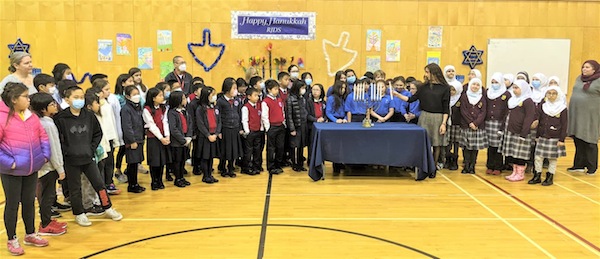
On Dec. 12, Richmond Jewish Day School hosted Cornerstone Christian Academy, Richmond Christian School and Az-Zahraa Islamic Academy. (photo from RJDS)

For the second year in a row, Richmond Jewish Day School hosted a holiday celebration at the school to promote community care, empathy and understanding.

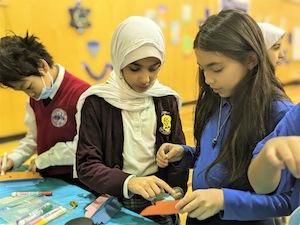
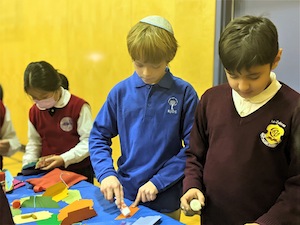
On the morning of Dec. 12, the Shine a Light project saw three schools joining RJDS to share their winter traditions. The posting on RJDS’s Facebook page reads: “Cornerstone Christian Academy made 3-D stars to signify the star of Bethlehem, Az-Zahraa Islamic Academy made lanterns to represent light in Islam, Richmond Christian School made a stained-glass craft and talked about the advent season and, finally, our school taught the others how to play the dreidel game! We all have a role to play. Today, we dispel the darkness on antisemitism and hatred.” 

“Last year, we did an evening event during Hanukkah called A Celebration of Light and invited members of the Highway to Heaven community,” RJDS principal Sabrina Bhojani told the JI.

The No. 5 Road area in Richmond, which is home to RJDS, is also home to some 20 different religious and/or cultural institutions, hence the moniker “Highway to Heaven.” Richmond Mayor Malcom Brodie and Ezra Shanken, chief executive officer of Jewish Federation of Greater Vancouver, were among the attendees last year – and this year – along with several city councilors and others.

“This year, we changed the name and format to create a more kid-friendly celebration, and invited various schools to attend,” said Bhojani. “Activities of the students included those that showcased their personal winter-themed traditions and included singing and arts and crafts.”

photo - This year's Hanukkah celebration featured several activities for the kids
This year’s Hanukkah celebration featured several activities for the kids. (photo from RJDS)

The Shine a Light program was made possible by a grant from the Jewish Federations of North America, said Bhojani.

In addition to her land acknowledgement on Dec. 12, Bhojani said, “We also acknowledge the Elders, the keepers of traditional knowledge, wisdom and Indigenous ways of knowing. We have much to learn about resilience and responsibility. We commit to asking questions, being open to learning from others and acknowledging that that which we do not know.

“We also commit to make the community we share with you a more peaceful, loving and safe place through the First Peoples’ principles of learning.”

photo - kids doing arts and crafts
(photo from RJDS)

With regard to the day’s program, she said, it was “designed to help each of us develop our understanding and respect for one another’s faith and culture while growing in appreciation, understanding and commitment to our own faith traditions and their meanings. We hope that, through education and events like this one, we will collaboratively encourage people to work together, sharing the responsibility for addressing stereotyping, prejudice, racism, discrimination, antisemitism and social exclusion.”

She noted, “Today, as we gather together, we celebrate the unity and the unique religious coexistence of where we live. I hope you are reminded that is up to each and every one of us to be a ‘Shine a Light’ in the darkness of racism and discrimination.”

One parent who saw the event photos on Facebook wrote Bhojani an email. Having experienced antisemitism, they wrote: “What RJDS is teaching, its values, and [the] education the children are receiving, it’s world changing. It’s hope. It’s proof of a better future.”

Format ImagePosted on December 23, 2022December 22, 2022Author Cynthia RamsayCategories Celebrating the Holidays, LocalTags diversity, Hanukkah, Highway to Heaven, interfaith, RJDS, Shine a Light

Posts pagination

Page 1 Page 2 … Page 6 Next page
Proudly powered by WordPress