Skip to content
  • Home
  • Subscribe / donate
  • Events calendar
  • Business Directory
  • FAQ
  • News
    • Local
    • National
    • Israel
    • World
    • עניין בחדשות
      A roundup of news in Canada and further afield, in Hebrew.
  • Opinion
    • From the JI
    • Op-Ed
  • Arts & Culture
    • Performing Arts
    • Music
    • Books
    • Visual Arts
    • TV & Film
  • Life
    • Celebrating the Holidays
    • Travel
    • The Daily Snooze
      Cartoons by Jacob Samuel
    • Mystery Photo
      Help the JI and JMABC fill in the gaps in our archives.
  • Community Links
    • Organizations, Etc.
    • Other News Sources & Blogs
  • JI Chai Celebration
  • JI@88! video

Recent Posts

  • Legal help for students
  • Revisiting myth of Lilith
  • Wrong person rebuked
  • Canada’s mixed messages
  • Questions for museum
  • Symposium on antizionism
  • Making soccer political
  • CJPAC lauds Pulver’s impact
  • City recognizes Vrba’s legacy  
  • Organ donation saves lives
  • Theodore’s March premiere
  • A healing Shabbaton
  • Supplying healthy food
  • A chime of metal tags
  • Yellowknife seder a first
  • Ishai energizes, unifies
  • A Lag b’Omer to remember
  • Expanding the healing
  • Hannah Senesh – a unique hero
  • Community milestones … May 2026
  • Sharing her testimony
  • Fall fight takes leap forward
  • The balancing of rights
  • Multiple Tony n’ Tina roles
  • Stories of trauma, resilience
  • Celebrate our culture
  • A responsibility to help
  • What wellness means at JCC
  • Together in mourning
  • Downhill after Trump?
  • Birth control even easier now
  • Eco-Sisters mentorship
  • Unexpected discoveries
  • Study’s results hopeful
  • Bad behaviour affects us all
  • Thankful for the police

Archives

Follow @JewishIndie
image - The CJN - Visit Us Banner - 300x600 - 101625

Month: December 2022

Hanukkah in the Diaspora

Hanukkah in the Diaspora

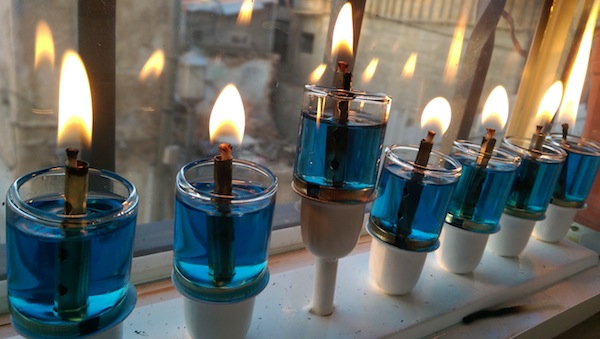
The reason that is ascribed to the House of Hillel for the custom that we follow in lighting the candles is that we go upwards in holiness. (photo by Maor X)

Hanukkah lives in the sweet spot where there is one story that claims it is “historically true” and yet there is very little contemporary evidence to back this up – the earliest account being written generations after the events – and there is another story, a miracle story whose earliest recording is centuries after its supposed occurrence. We go with the miracle story.

There was no love lost between the rabbis and the Hasmoneans. There are several legends about rabbis (i.e. Shimon ben Shatah) confronting the Hasmonean king Yannai (e.g. Sanhedrin 19a-b) and Yannai killing sages (Kidushin 66a). So, it is not surprising that the rabbis did not glorify the Hasmonean victory, and chose to centre a different legend, which seems to have arisen in the first centuries of the common era. The additional prayer (called Al Hanisim) that is added to the central prayer does not mention the miracle of the oil. The earliest mention of the miracle of the oil is in the commentary (the “scholion”) to a first-century list of holidays called Megillat Ta’anit. This commentary is not mentioned in the Palestinian Talmud. Its first appearance is in the Babylonian Talmud many centuries later.

While this may point to a choice for the miracle story over the martial story, the martial story did not fade away. It arose from time to time, gaining full rehabilitation with the birth of the Zionist movement, whose adherents looked to the Maccabees for ancestral precedent. However, this is not my point.

The earliest rabbinic legal discussion of the obligations of Hanukkah (as opposed to mentioning Hanukkah in passing) is not in the Palestinian Mishnah. It is in a supposed Palestinian baraita (“outside” teaching) quoted in the Babylonian Talmud and not in the Palestinian Talmud. This is the famous debate between the House of Hillel and the House of Shammai as to whether one lights one candle on the first night and then adds a candle each night (Hillel); or, conversely, one lights eight candles on the first night and then subtracts a candle each night (Shammai). This is followed by the obligation to light the candelabrum in the doorway, outside or, if one lives on an upper floor, in the window.

These are the earliest legal discussions of Hanukkah. There are others. The salient point is that many of the laws have to do with the placement of the candelabrum in order to publicize the miracle (pirsumei nisa). One might have thought that a holiday whose legend included the purification of the Temple would have had a Temple-like ritual at its centre. Instead, even the candelabrum does not replicate the seven-branched Temple candelabrum. The focus of the holiday obligations is marking Jewish space. Facing outward at the moment that people return from the market. If one has two entrances, the Talmud asks, does one have to light in both places?

Hanukkah is a diasporic holiday that celebrates place. This place where we are now is the place in which we announce the miracle. This is not a second-rate reminder of a ritual whose better form would have been and will be ensconced in the Temple. It is a diasporic ritual that lays claim to diasporic Jewish space.

This places Hanukkah on the same axis as Purim, again a holiday that is about and in Diaspora, and would not make sense in the Land of Israel. However, the difference is Purim posits that redemption is impossible and that, as long as the king is maliciously or foolishly evil, there will be a never-ending drama in which first Haman succeeds and then Mordecai succeeds. Hanukkah celebrates the fact of being here. Light in whatever many religious or secular metaphors it is clothed is brought into these Jewish spaces. The reason that is ascribed to the House of Hillel for the custom that we follow in lighting the candles is that we go upwards in holiness and not the opposite. We light the candles and increase the holiness. Here.

Hanukkah is a diasporic holiday in that it is portable. The celebration of Hanukkah defines the space that is celebrated as a Jewish space – like a mezuzah on a doorpost or an eruv (ritual boundary) in a city. Like these other markers, it creates Jewish space that is non-exclusive. Jewish space that has permeable boundaries. Jewish space that lives in proximity to others, despite the fact that this proximity is risky. From the start, the halakhah (Jewish law) of Hanukkah decided that, in a time of danger, one need not light the candelabrum on the outside or facing out, rather one may light inside on a table.

When we light candles today, we again announce that we live in Jewish spaces that are proximate to other spaces and, while we embrace this proximity, we are aware that it is risky – and yet still we increase the holiness, the light, from day to day. Here, in this time, and in this place.

Rabbi Aryeh Cohen is a fellow of the Kogod Research Centre at the Shalom Hartman Institute of North America and professor of rabbinic literature at the Ziegler School of Rabbinic Studies of the American Jewish University, where he teaches courses in Talmud. He is also the rabbi in residence for Bend the Arc: Jewish Action in Southern California. For more articles by Cohen, visit jewschool.com, where the original of this article can be found. For articles by other Shalom Hartman scholars, visit hartman.org.il.
Format ImagePosted on December 9, 2022December 8, 2022Author Rabbi Aryeh CohenCategories Celebrating the HolidaysTags candlelighting, Chanukah, Diaspora, Hanukkah, Judaism

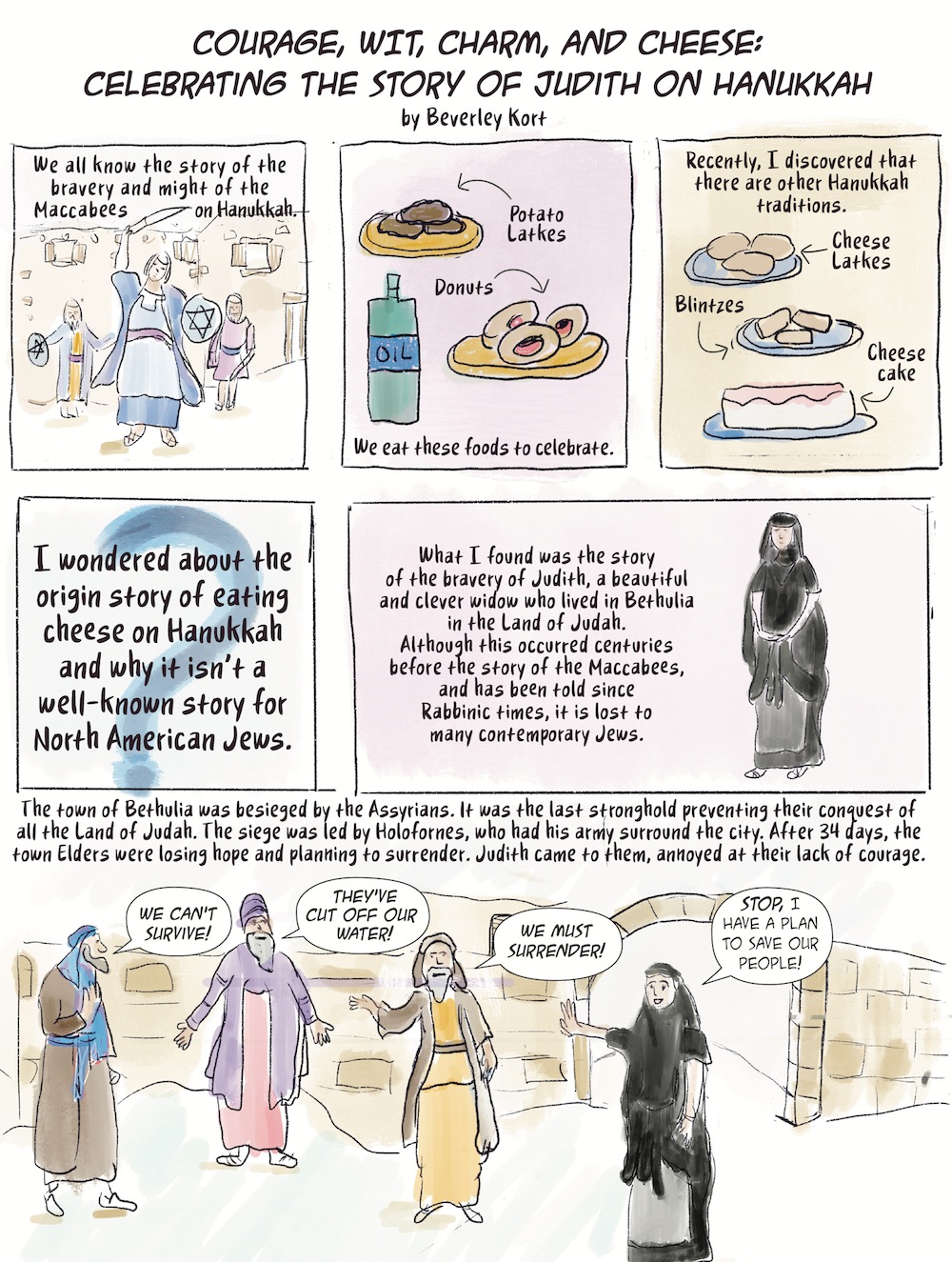
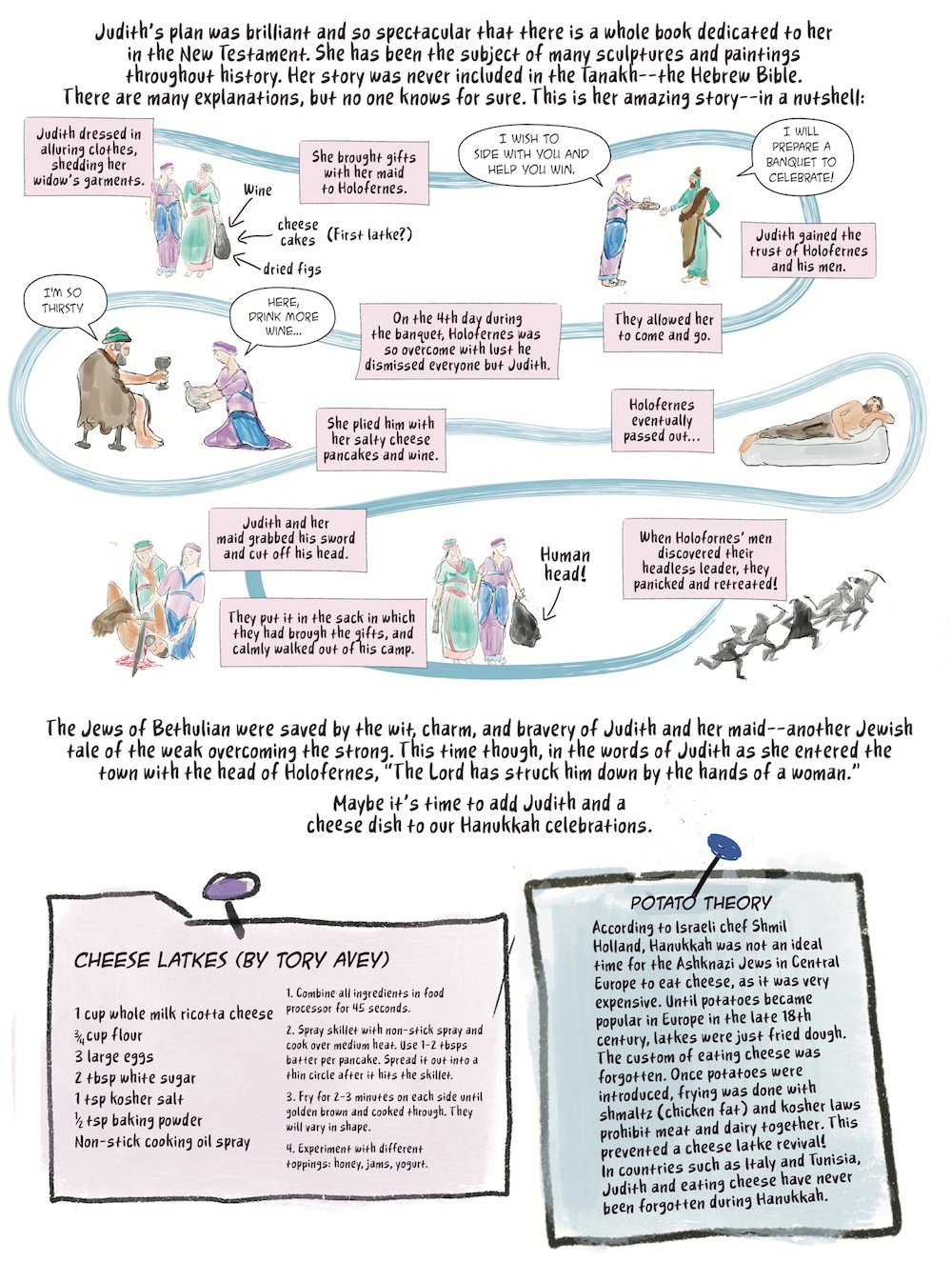
Courage, wit, charm and cheese …

image - Judith story intro (text and images by Beverley Kort)image - Judith story and recipe (text and images by Beverley Kort)

Beverley Kort is a registered psychologist by day and a cartoonist in her off hours. She has a private practice in Vancouver.

Posted on December 9, 2022December 8, 2022Author Beverley KortCategories Celebrating the HolidaysTags Chanukah, Hanukkah, history, Judith, latkes, recipes
Ideas for your holiday meals

Ideas for your holiday meals

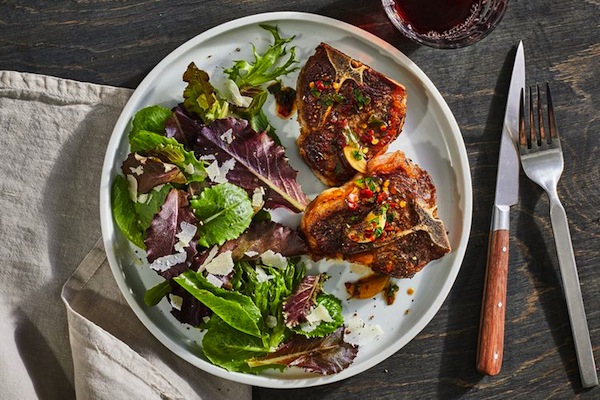
Lamb Chops Sizzled with Garlic by Janet Mendel. Photo by Jennifer Causey, food styling by Emily Nabors Hall, prop styling by Claire Spollen.

When Hanukkah arrives, there will be more family and friends to feed. Or, maybe just the “excuse” (not that we need one) to make a special meal for ourselves! However you celebrate, here are a few main dishes – meatballs, lamb chops and a vegetarian gratin – and a couple of vegetarian side options.

TOMATO MEATBALLS
(makes 18)

1 lb ground beef
1/3 cup bread crumbs
1 egg
1 finely grated medium onion
salt and pepper to taste
2 tbsp olive oil
2 crushed garlic cloves
16-ounce can crushed tomatoes
6-ounce can tomato paste
1 cup water
1 1/2 tsp dry basil

  1. In a bowl, mix together ground beef, breadcrumbs, egg, onion, salt and pepper. Shape into 18 meatballs.
  2. Heat oil in a frying pan. Brown meatballs and remove.
  3. Add tomatoes, tomato paste, water and basil to pan. Bring to a boil, reduce heat and simmer, stirring when necessary.
  4. Add meatballs and continue simmering 10-15 minutes.
  5. Serve on their own, in a bun or on noodles, rice or any other base of your choice.

SWEET AND SOUR MEATBALLS
(This came from a Heinz ad, and I’ve made it kosher. It makes 40 balls.)

1 lb ground beef
1 cup breadcrumbs
1 egg
2 tbsp minced fresh onion
2 tbsp pareve non-dairy creamer
1 minced garlic clove
salt and pepper to taste
1 tbsp vegetable oil
2/3 cup chili sauce
2/3 cup currant jelly

  1. Combine beef, breadcrumbs, egg, onion, non-dairy creamer, garlic, salt and pepper. Form into 40 bite-size meatballs (about one teaspoon each).
  2. Heat oil in a frying pan. Place meatballs in pan, cover and brown lightly for 10 minutes.
  3. Combine chili sauce and jelly and pour over meatballs. Heat on low heat 10-12 minutes, until sauce has thickened, basting occasionally.

GRILLED HERBED LAMB CHOPS
(6 servings)

1/2 cup olive oil
1 cup white wine
1/2 cup minced fresh parsley
1/2 tsp marjoram
1/2 tsp oregano
1/2 tsp basil
1 tbsp minced shallots or white onion
1 minced garlic cloves
6 lamb chops

  1. In a bowl, combine olive oil, wine, parsley, marjoram, oregano, basil, shallots or white onion and garlic. Add chops and coat well. Marinate two to three hours, turning chops often.
  2. Grill chops five to six inches from heat, five minutes per side or until medium rare.

LAMB CHOPS SIZZLED WITH GARLIC
(Janet Mendel is an American-born journalist who has lived in Spain for many years. Las Pedroneras is considered the garlic capital of Spain and this recipe on Food & Wine’s website is Mendel’s “homage to the village.” It makes 4 servings.)

8 lamb chops
salt and pepper to taste
thyme
3 tbsp olive oil
10 halved garlic cloves
3 tbsp water
2 tbsp fresh lemon juice
2 tbsp fresh minced parsley

  1. Season lamb chops with salt, pepper and thyme. Heat olive oil in a large frying pan.
  2. Add lamb chops and garlic and cook over high heat for three minutes. Turn over chops and garlic and cook two minutes longer. Transfer to a plate.
  3. Add water, lemon juice and parsley, scrape bottom of pan and cook for one minute.
  4. Pour pan sauce over lamb chops and serve immediately.

OMBRÉ POTATO AND ROOT VEGETABLE GRATIN
(This is a recipe by TV personality and chef Carla Hall, with my changes to make it kosher. You can find the original on Food & Wine’s website. Both make 12 servings.)

unsalted pareve margarine
2 cups non-dairy creamer
3 minced garlic cloves
1 small minced shallot
1/2 tsp nutmeg
salt and pepper to taste
1 pound peeled beets, sliced 1/16-inch thick
1 pound peeled sweet potatoes, sliced 1/16-inch thick
1 pound peeled small white potatoes, sliced 1/16-inch thick
1 pound peeled turnips, sliced 1/16-inch thick

  1. Preheat oven to 375°F. Grease a rectangular baking dish.
  2. In a bowl, whisk non-dairy creamer with garlic, shallot, nutmeg, salt and pepper.
  3. In a large bowl, toss beets with a quarter of the cream mixture. Arrange beets in baking dish, overlapping them slightly. Scrape any remaining cream from the bowl over the beets.
  4. Repeat the process with the sweet potatoes, potatoes and turnips, using a quarter of the cream mixture for each vegetable. Then cover dish with foil.
  5. Bake for about one hour and 45 minutes. Let cool 15 minutes.

Note: If pareve grated cheese is available, measure one cup and stir it into the whisked cream mixture. After baking, add another 3/4 cup of the grated cheese to the top.

SPAGHETTI SQUASH WITH PEPPER SAUCE
(6 servings)

1 approx 3-pound spaghetti squash
1/4 cup olive oil
1 onion, slivered
2 red peppers, cut into 1/2-inch lengthwise strips
2 yellow peppers, cut into 1/2-inch lengthwise strips
2 chopped tomatoes
1/2 tsp sugar
1/4 cup fresh basil leaves, coarsely torn
salt and pepper to taste

  1. Preheat oven to 375°F. Place pierced squash in a baking pan. Bake for 40 minutes. Turn over and bake another 15-30 minutes, until tender. Turn off oven and let squash remain.
  2. Heat olive oil in a pot. Add onion and cook 10 minutes.
  3. Add peppers, season with salt and pepper. Cover and cook 20 minutes.
  4. Add tomatoes, sugar and basil. Cook uncovered 20 minutes.
  5. Cut the squash in half and discard seeds. Pull apart strands with a fork. Place in a bowl and add pepper sauce.

QUINOA SALAD WITH SWEET POTATOES AND APPLES
(This is a Food & Wine recipe by food stylist and author Grace Parisi. It makes 10-12 servings.)

8 tbsp olive oil
1 1/2 cups quinoa
salt and pepper to taste
1 1/2 pounds peeled sweet potatoes, cut into 3/4-inch cubes
1/4 cup apple cider vinegar
2 apples, cut into 1/2-inch cubes
1/2 cup chopped parsley
8 cups packed baby greens, such as arugula and kale

  1. Preheat oven to 400°F.
  2. Heat one tablespoon of oil in a saucepan. Add quinoa and cook two minutes. Add three cups water, season with salt and bring to a boil. Cover and simmer 16 minutes. Remove from heat and let stand 10 minutes. Fluff quinoa, spread on baking sheet and refrigerate 20 minutes.
  3. On another baking sheet, toss sweet potatoes with one tablespoon of oil, salt and pepper. Toast in oven 25 minutes, stirring once. Let cool.
  4. In a large salad bowl, whisk six tablespoons of oil with vinegar. Season with salt and pepper. Add quinoa, sweet potatoes, apples, parsley and greens and toss. Serve right away.

Sybil Kaplan is a journalist, lecturer, book reviewer and food writer in Jerusalem. She created and leads the weekly English-language Shuk Walks in Machane Yehuda, she has compiled and edited nine kosher cookbooks, and is the author of Witness to History: Ten Years as a Woman Journalist in Israel.

Format ImagePosted on December 9, 2022December 8, 2022Author Sybil KaplanCategories Celebrating the HolidaysTags Chanukah, cooking, Hanukkah, Jewish holidays, recipes
Try cookies for dessert

Try cookies for dessert

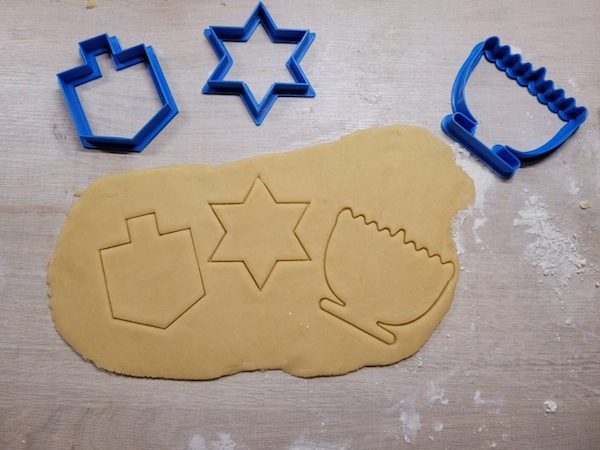
(photo from etsy.com/ca/shop/MaaminShop)

We in Israel are already seeing bakeries displaying sufganiyot for Hanukkah. No doubt the situation is the same in Vancouver and you’ll have plenty of jelly doughnut options, so here are some other sweets for the holiday.

HANUKKAH PUFFS
(makes 3 dozen)

2 cups flour
1/4 cup sugar
1 tbsp baking powder
1 tsp nutmeg
1/4 cup vegetable oil
3/4 cup milk or nondairy substitute
1 egg
oil
cinnamon sugar or confectioner’s sugar

  1. Warm a substantial amount of oil in a deep pot.
  2. In a bowl, combine flour, sugar, baking powder and nutmeg. Mix well. Add oil, milk or nondairy substitute and egg. Mix thoroughly.
  3. Drop by small teaspoonfuls into deep hot oil. Fry three minutes or until golden brown. Drain on paper towels.
  4. Roll in cinnamon sugar or confectioner’s sugar.

COOKIE DREIDELS
(makes 5 dozen)

1 cup butter or margarine
8 ounces cream cheese
1/4 cup sour cream
2 1/4 cups flour
2 cups finely ground walnuts
1/2 cup sugar
1 tsp ground cinnamon
1 egg
1 tsp grated orange rind

  1. Preheat oven to 350°F. Grease two cookie sheets.
  2. In a bowl, beat butter or margarine and cream cheese with electric mixer. Beat in sour cream. Stir in flour until dough forms. Form into a ball, wrap in plastic wrap and chill overnight.
  3. In a bowl, combine nuts, sugar, cinnamon, egg and orange rind.
  4. The next day, divide dough in half, flour a surface, roll out to an eight-inch square, a quarter-inch thick. Spread half of filling on square, roll up jelly-roll style. Wrap in foil, chill for at least one hour. Repeat with other half of dough.
  5. Cut rolls in quarter-inch thick slices. Place half-inch apart on cookie sheets. Reshape into rounds. Bake for 15-20 minutes or until firm and brown.

CUT-OUT HANUKKAH COOKIES
(makes 6 dozen)

2/3 cup margarine
2 cups flour
1 egg
3/4 cup sugar
1 tbsp milk
1 tsp baking powder
1 tsp vanilla

  1. Preheat oven to 375°F.
  2. Cream margarine. Add half the flour, egg, sugar, milk, baking powder and vanilla. Beat in remaining flour.
  3. Divide dough in half. Cover and chill three hours.
  4. Roll out half dough on a floured surface. Cut in Hanukkah shapes with cookie cutters. Place on ungreased cookie sheets. Add coloured sugar on top. Bake for seven to eight minutes.

Sybil Kaplan is a journalist, lecturer, book reviewer and food writer in Jerusalem. She created and leads the weekly English-language Shuk Walks in Machane Yehuda, she has compiled and edited nine kosher cookbooks, and is the author of Witness to History: Ten Years as a Woman Journalist in Israel.

Format ImagePosted on December 9, 2022December 8, 2022Author Sybil KaplanCategories Celebrating the HolidaysTags bakery, Chanukah, cookies, Hanukka
Weather … an eternal subject

Weather … an eternal subject

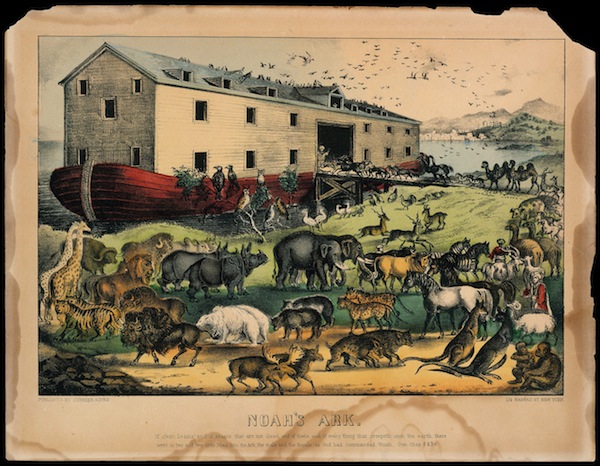
While the flood in Noah’s time, and his building of the ark, may be one of the more famous biblical weather incidents, along with the wind that battered the ship in which the prophet Jonah was hiding, they certainly are not the only ones (Metropolitan Museum of Art: Adele S. Colgate bequest, 1962)

It seems that everybody talks about the weather. Has it always been the case? While it’s admittedly impossible to prove whether it has, weather was certainly talked about in ancient times. The Hebrew Bible, or Tanakh, contains many weather references.

Right off the bat, in Genesis 2:6, we find mention of mist. In this context, G-d has spent the week creating the world. On the seventh day, He fashions the first man: “but there went up a mist from the earth, and watered the whole face of the ground. Then the Lord G-d formed man of the dust of the ground….”

Five chapters later, we get to the flood story. We read about heavy, sustained rain and catastrophic flooding – “and I will cause it to rain upon the earth forty days and forty nights; and every living substance that I have made will I blot out from off the face of the earth. And the waters prevailed, and increased greatly upon the earth; and the ark went upon the face of the waters. And He blotted out every living substance which was upon the face of the ground … and Noah only was left, and they that were with him in the ark.” (Genesis 7:18,23)

Rain, however, functions as both a positive and a negative force. In Leviticus 26:4, G-d states that He will bring the rain at the proper time, enabling the trees and the land to be harvested: “I will give your rains in their season, and the land shall yield her produce, and the trees of the field shall yield their fruit.”

When the flood in Noah’s time ends, G-d promises to refrain from ever again bringing such a destructive deluge. He does this symbolically with the rainbow: “I have set My bow in the cloud, and it shall be for a token of a covenant between Me and the earth. And it shall come to pass, when I bring clouds over the earth and the bow is seen in the cloud and the waters shall no more become a flood to destroy all flesh.” (Genesis 9:13-15)

The same duality that applies to rain also applies to wind. It is a positive force, as seen in parting the Red Sea, allowing the Hebrews to safely depart from Egypt (Exodus 14:21-22). But, it is also a punishing power that drowns the Egyptian soldiers who are in pursuit.

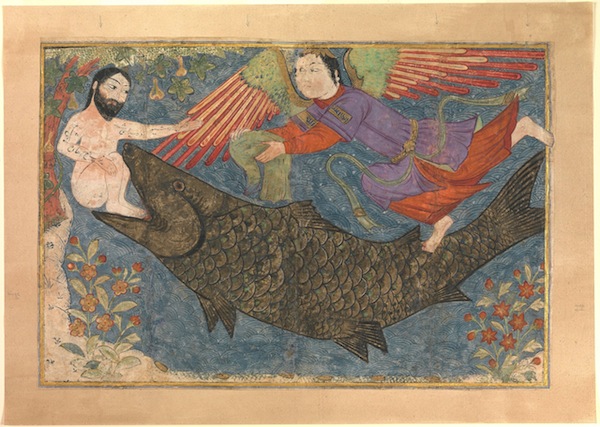
In the Book of Jonah, G-d brings a tremendous wind with the intention of smashing apart the ship in which the reluctant prophet Jonah is hiding: “… the Lord hurled a great wind into the sea, and there was a mighty tempest in the sea, so that the ship was like to be broken.” (Jonah 1:4)

image - Jonah and the Whale
Jonah and the Whale. (Metropolitan Museum of Art: Joseph Pulitzer bequest, 1933)

While we generally consider a whirlwind to be violent but brief, it has a different meaning in the Tanakh. In Hosea 8:7, it symbolizes ineffectiveness: “they shall reap the whirlwind; it hath no stalk, the bud that shall yield no meal.” Nonetheless, the whirlwind is also a blessing, which carries the prophet Elijah to heaven: “Elijah went up by a whirlwind into heaven. And Elisha saw him no more.” (2 Kings 2:11-12)

Other storm-related phenomena appear in the books of the Hebrew Bible. Both thunder and lightning, for example, are mentioned in the Book of Job, chapters 36 and 37: “He covereth His hands with the lightning and giveth it a charge that it strike the mark. G-d thundereth marvellously with His voice.” Likewise, the prophet Isaiah warns that G-d plans to bring thunder: “There shall be a visitation from the Lord of hosts with thunder.” (Isaiah, 29:6)

Hail is also written about in a few places. In Ezekiel 13:11 and 13, G-d threatens to bring a hailstorm. Significantly, in the Book of Exodus (9:18,25-26), hail is one of the 10 plagues G-d casts down upon the Egyptian people because of Pharaoh’s intransigence against freeing the Hebrew slaves: “Behold, tomorrow about this time I will cause it to rain a very grievous hail, such as hath not been in Egypt since the day it was founded even until now. And the hail smote throughout all the land of Egypt all that was in the field, both man and beast; and the hail smote every herb of the field and broke every tree of the field. Only in the land of Goshen, where the children of Israel were, was there no hail.”

The Tanakh likewise has references to snow in a few places, though there is practically no mention of snow having fallen – almost always, snow is used metaphorically. Thus, in Exodus 4:6, someone with leprosy has “skin white as snow.” Later, this phrase is repeated in Number 12:10 when Miriam, Moses’ sister, has leprosy.

The lack of precipitation is likewise an issue. Similar to hail, drought is used as a threat or as an actual way of punishing the Hebrews. As the

Hebrews were an agricultural society, a drought meant crop failure: “And if ye will not … hearken unto Me, then I will chastise you seven times more for your sins. I will make your heaven as iron and your earth as brass … your land shall not yield her produce, neither shall the trees of the land yield their fruit.” (Leviticus 26:18-20)

Meteorology has certainly advanced since ancient times, of course. Back then, there were no radar, satellites, radiosondes, supercomputers or advanced multidisciplinary weather graphs to interpret or predict the weather. In the Tanakh, the chief forecaster, G-d, is also the creator of these weather situations. As such, He has a considerable edge over everyone and everything.

Deborah Rubin Fields is an Israel-based features writer. She is also the author of Take a Peek Inside: A Child’s Guide to Radiology Exams, published in English, Hebrew and Arabic.

Format ImagePosted on December 9, 2022December 8, 2022Author Deborah Rubin FieldsCategories LifeTags history, Jonah and the Whale, Judaism, Noah and the Ark, Tanakh, weather

Posts pagination

Previous page Page 1 … Page 5 Page 6
Proudly powered by WordPress