Skip to content
  • Home
  • Subscribe / donate
  • Events calendar
  • News
    • Local
    • National
    • Israel
    • World
    • עניין בחדשות
      A roundup of news in Canada and further afield, in Hebrew.
  • Opinion
    • From the JI
    • Op-Ed
  • Arts & Culture
    • Performing Arts
    • Music
    • Books
    • Visual Arts
    • TV & Film
  • Life
    • Celebrating the Holidays
    • Travel
    • The Daily Snooze
      Cartoons by Jacob Samuel
    • Mystery Photo
      Help the JI and JMABC fill in the gaps in our archives.
  • Community Links
    • Organizations, Etc.
    • Other News Sources & Blogs
    • Business Directory
  • FAQ
  • JI Chai Celebration
  • JI@88! video

Recent Posts

  • טראמפ עוזר דווקא לנושא הפלסטיני
  • New rabbi settles into post
  • A light for the nations
  • Killed for being Jewish 
  • The complexities of identity
  • Jews in time of trauma
  • What should governments do?
  • Annie will warm your heart
  • Best of the film fest online
  • Guitar Night at Massey
  • Partners in the telling of stories
  • Four Peretz pillars honoured
  • History as a foundation
  • Music can comfort us
  • New chapter for JFS
  • The value(s) of Jewish camp
  • Chance led to great decision
  • From the JI archives … camp
  • עשרים ואחת שנים להגעתי לונקובר
  • Eby touts government record
  • Keep lighting candles
  • Facing a complex situation
  • Unique interview show a hit
  • See Annie at Gateway
  • Explorations of light
  • Help with the legal aspects
  • Stories create impact
  • Different faiths gather
  • Advocating for girls’ rights
  • An oral song tradition
  • Genealogy tools and tips
  • Jew-hatred is centuries old
  • Aiding medical research
  • Connecting Jews to Judaism
  • Beacon of light in heart of city
  • Drag & Dreidel: A Queer Jewish Hanukkah Celebration

Archives

Follow @JewishIndie
image - The CJN - Visit Us Banner - 300x600 - 101625

Tag: Ukraine

Children in the Shoah

Children in the Shoah

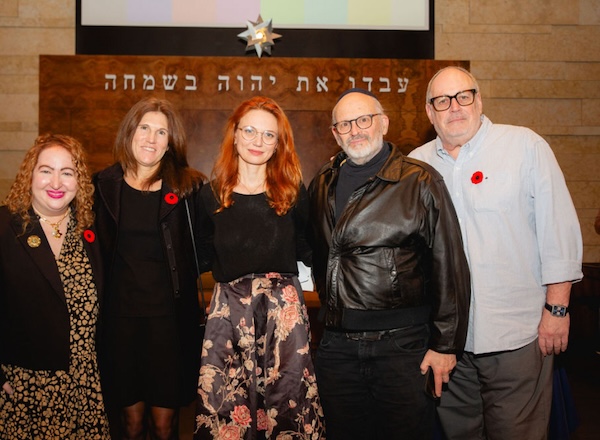
Left to right: Abby Wener Herlin, Lise Kirchner, Dr. Nataliia Ivchyk, Prof. Richard Menkis and Al Szajman at the community commemoration of Kristallnacht Nov. 7. (photo by Rhonda Dent)

The experiences of three Vancouver women who survived the Holocaust as children in Ukraine were highlighted at the community commemoration of Kristallnacht Nov. 7.

The event, which took place at and was co-presented by Congregation Beth Israel, marked both the 86th anniversary of the Kristallnacht pogrom and the 30th anniversary of the founding of the Vancouver Holocaust Education Centre (VHEC), which presents the annual commemoration. The Jewish Federation of Greater Vancouver and the Robert and Marilyn Krell Endowment at the VHEC were co-presenters.

The keynote address was by Dr. Nataliia Ivchyk, associate professor in the department of political science at Rivne State University for the Humanities, in Ukraine. Ivchyk is a visiting scholar at the University of British Columbia and has been studying the narratives of child survivors in the province.

About 1.5 million Ukrainian Jews were murdered in the Holocaust, while another million managed to flee before or near the beginning of the German-Soviet war, Ivchyk said.

“Genocide is ruthless, regardless of age or gender, and children are a special group of its victims,” she said. “Since children cannot fight back against their killers, they become a helpless and vulnerable group. The Holocaust claimed six million Jewish lives, 1.5 million of which were tragically children. Age became a vital marker of life or quick death for children during World War II and the Holocaust. Children were not seen as a separate group of victims, they were dependent on their parents, fathers, mothers and relatives, and so suffered and died with them too.”

Ivchyk quoted Malka Pischanitskaya, who was 10 years old when the Germans invaded her town of Romanov (now Romaniv), in Ukraine.

“I was brought into this world not by chance but I believe by destiny,” Pischanitskaya has said. “My destiny was to be born, to endure the sufferings that were yet to come.”

“During the genocide,” Ivchyk said, “Malka had no choice but to become an adult in order to survive.”

Another local survivor whose story Ivchyk told is Ilana, who asked that her last name not be shared. Ilana was born in 1938, just two years before Germany invaded the Soviet Union. Her father managed to evacuate the family, including Ilana, her sister, her mother and her maternal grandparents, to a Central Asian republic of the Soviet Union.

“Unfortunately, my father’s parents stayed in Kyiv and perished in Babyn Yar,” Ivchyk quoted Ilana, referring to the mass killing site that has become synonymous with the genocide in Ukraine. On Sept. 29 and 30, 1941, more than 33,000 Ukrainian Jews were killed, part of the genocide in eastern Europe known as the “Holocaust by bullets.”

Ilana has only fragmentary memories of the evacuation years. However, she remembered her sister, who cared for her, and her mother, who tirelessly worked to provide food, said Ivchyk. 

A third local woman who survived is Esfira Golgheri.

“Esfira does not recall the journey from one ghetto to another, but she remembers her mother feeding her, which was crucial for her survival as an infant,” Ivchyk said.

“There is something that the Holocaust could not take away: memory, personal memories and stories of relatives and friends and our collective memory [that] remind us by honouring the memory of those who are no longer with us. Those who lost their lives and those who fought to defend us, we keep them alive in our hearts,” Ivchyk said. “The stories of these women are stories of childhood, family and survival in the face of genocide and displacement. Each narrative is unique and personal, yet the memories of Esfira, Malka and Ilana … are like pieces of a puzzle that help reconstruct this tragedy. In addition to piecing together the events of the war in Ukraine during the Holocaust, we have the chance to understand the tragedy through the eyes of these adult child survivors. We can touch their memories and experience their truth for ourselves.”

At the commemoration, Taleeb Noormohamed, member of Parliament for Vancouver Granville, brought greetings from the federal government.

“The fight against antisemitism is not one for Jews alone,” said Noormohamed. “Quite the opposite. It is a fight that all of us have to take on together.”

Nina Krieger, until recently the executive director of the VHEC and elected as member of the BC Legislature on Oct. 19, brought greetings from the provincial government. 

“I know the premier of British Columbia and my colleagues in government join me in gratitude for the Vancouver Holocaust Education Centre and Congregation Beth Israel for presenting this evening’s program to mark the 86th anniversary of Kristallnacht,” Krieger said.

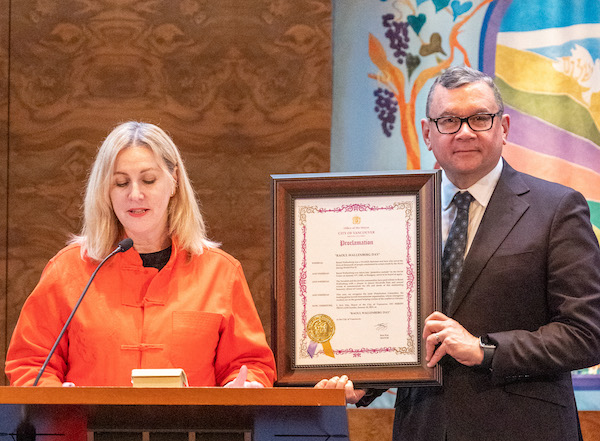
Vancouver Mayor Ken Sim, accompanied by Councilor Lenny Zhou, presented a proclamation from the city marking Kristallnacht Commemoration Day.

Sim spoke of how his home had been recently vandalized and how many people at that evening’s event had expressed sympathy. 

“The Jewish community sees this all the time and I should really be asking you how you are doing,” he said. “I obviously loved the community before, but you’ve captured my heart even more.”

He said his presence at Jewish community events is not about politics.

“If everyone was against us, we would still have your back. We are still here because we stand for what’s right,” Sim said.

Lise Kirchner, director of education at the Vancouver Holocaust Education Center, spoke on behalf of acting executive director Hannah Marazzi, who was out of the province, read greetings from Prime Minister Justin Trudeau and acknowledged elected officials from all levels of government, including incoming and outgoing members of the BC Legislature.

“As we come together this evening to commemorate the 86th anniversary of the Kristallnacht pogrom, we contemplate the dangers not only of state-instituted persecution and violence, but maybe more importantly the dangers of indifference,” said Kirchner. “We are reminded of the consequences of antisemitism which is not publicly condemned, especially at a time when we have seen the proliferation of this most pervasive and pernicious form of hatred around the world, across the country and in our own backyards.”

Prof. Richard Menkis, associate professor of Jewish history at the University of British Columbia, contextualized Kristallnacht as a turning point between the legislated antisemitism of the Nazi regime, notably the Nuremberg Laws of 1935, and the murderous violence of the Holocaust.

“The persecutions during and immediately after Kristallnacht resulted in the deaths of at least 90 Jews, the destruction of hundreds of synagogues, the vandalization of thousands of Jewish businesses and the imprisonment of over 30,000 Jewish men in concentration camps and elsewhere,” said Menkis.

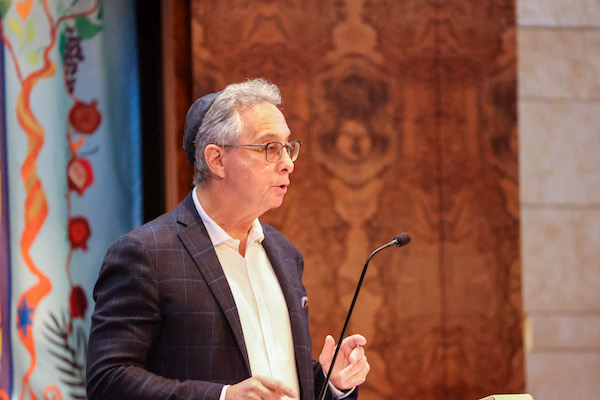
Al Szajman, president of the Vancouver Holocaust Centre Society board, emceed the evening. Abby Wener Herlin, associate director of programs and community relations at the VHEC and granddaughter of survivors, introduced Ivchyk. Rabbi Jonathan Infeld thanked Ivchyk and reflected on her remarks. Cantor Yaacov Orzech chanted El Moleh Rachamim. Holocaust survivors lit candles at the beginning of the commemorative event.

Ivchyk spoke movingly of being welcomed into the community during her time in Vancouver.

“Coming from a wartorn country myself, you accepted me, understood me, opened the doors of your community and your homes, creating an incredibly warm and family-like environment that gave me a home away from home,” she said. “You have entrusted me with your history and the history of your families and your childhood experiences that you have kept in silence for many years. Every time you shared your stories, I could feel the sadness and pain in your eyes. You still feel for those who were taken by the Holocaust.” 

Format ImagePosted on November 29, 2024November 28, 2024Author Pat JohnsonCategories LocalTags Beth Israel, commemoration, history, Holocaust, Kristallnacht, memorial, Nataliia Ivchyk, Ukraine, Vancouver Holocaust Education Centre, VHEC
Unique in style, rich in culture

Unique in style, rich in culture

Kommuna Lux (photo by Maria Dmytrenko)

[Editor’s Note: Due to unforeseen circumstances related to flight restrictions, the Chutzpah! Festival must postpone Yamma Ensemble’s performances to March. However, the festival has found a vibrant alternative for Nov. 5: Itamar Erez Trio and special guests. Click here for more.]

Original music that honours the culture and traditions of its creators. Unique songs that you’d have to travel thousands of kilometres to see and hear live. Or, you could buy tickets to Chutzpah! The Lisa Nemetz Festival of International Jewish Performing Arts, which runs Nov. 1-10.

Kommuna Lux from Ukraine brings its unique “Odesa Gangsta Folk” – which they describe as “thrilling klezmer music and common gangster folk songs from their hometown, all with a dose of rocket fuel” – to Vancouver to open the festival Nov. 2, 7 p.m., at the Pearl. The event is presented in partnership with Caravan World Rhythms. The group will also travel to Victoria, for a Nov. 1 show at the Edelweiss Club.

Kommuna Lux’s music is specific to their part of the world, Volodymyr Gitin (clarinet) told the Independent. 

“What I like most about this style is the special energy that charges both us and our listeners,” he said. “But I also really like how diverse our music is, because it includes almost everything related to the cultural heritage of Odesa.”

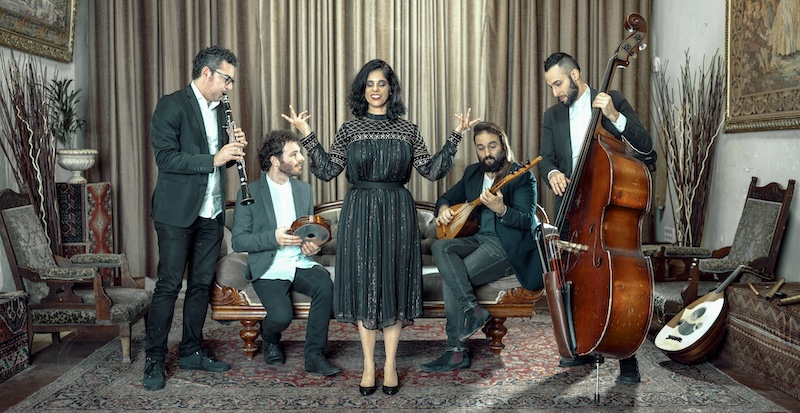
Similarly, Yamma Ensemble from Israel brings its unique heritage-rich music to Chutzpah! – on Nov. 5, 7 p.m., at Rothstein Theatre. They also give an intergenerational matinee performance Nov. 4, geared to school and seniors groups, in which they will “include as many explanations as possible about the ancient musical instruments, about the Jewish communities around the world, about the songs,” lead vocalist Talya G.A Solan told the Independent.

“We wish to celebrate and enjoy the richness and the immense beauty of the Jewish culture and our origins,” she said. “We mainly bring out the mix of Jewish cultures, the mix of our different backgrounds and the fact that we came together into an organic and whole music ensemble…. So, in our music, you can hear the music of Spanish Jews from Thessaloniki and Spanish Jews from Turkey, the singing of psalms by the Jews in Iraq and the singing of religious poems from Yemen.”

photo - Yamma Ensemble
Yamma Ensemble (photo by Zohar Ron)

On the group’s website, they note that Yamma means “toward the sea” in Hebrew and “mother” in Arabic.

“The connection between Hebrew and Arabic is not only a connection between two very similar Semitic languages, but also a connection between the countries of origin of the Jews who lived in Arab countries and their descendants, who were born here and grew up in Israel,” explained Solan. “Our musical heritage, like our origins, is connected to the Jewish communities in the Middle East who immigrated to Israel with the language they spoke, the Arabic language in its many dialects (Yemeni, Iraqi, Moroccan, etc.). They came to Israel and had to speak the local language – Hebrew.”

Hebrew is a central element of the ensemble’s repertoire, directly tied to the members’ identity as Israeli musicians.

“Hebrew is our mother tongue, the language we were born into and the language in which we dream and communicate,” said Solan. “It is an ancient, gorgeous and special language that became extinct and was revived in the 20th century. We try to perform mostly in Hebrew. We mix between our own original creations (always Hebrew) and traditional music (Sephardic, Yemenite).

“There is no Israeli music group that performs out of Israel and has been active for a long time [mainly] performing Hebrew music,” she continued. “This fact is odd and crazy, since Hebrew is the spoken language in Israel, but none of the Israeli musicians active abroad focus on this magnetizing and beautiful ancient language.

“One of the reasons that Yamma Ensemble’s YouTube channel is the most viewed channel of Hebrew music for foreign audiences,” she said, is “the accessibility of Hebrew for foreign audiences who do not speak it. We translate all the songs, so people can watch them with English translation. We receive daily messages from all over the world from people who write us that they learn Hebrew with the songs, that they get closer to their Judaism through the songs. It feels like a serious task that we didn’t ask to take on, and it happened naturally.”

Yamma Ensemble has four albums – Yamma (2011), Basket Full of Stars (2017), Rose of the Winds (2020) and To Awaken Love (2023) – the last of which comprises entirely original music, inspired by traditional sounds, said Solan.

The group is working on an album of psalms. Their performance of Psalm 104 is “the most viewed Jewish chant on YouTube, [in the] category of live and traditional music,” she said. “It has already passed 10 million views! So, we need to record this psalms album.”

However, to produce a recording is an expensive undertaking, and that’s one thing when the music will have a relatively large market. For music “that is not commercial and does not carry profits or compensation, there must be a budgetary basis or significant support,” said Solan. People who are interested may support the psalms project via the ensemble’s website, yammaensemble.com.

Coincidentally, Kommuna Lux’s original name also has to do with the financial side of the music business. 

“Dengi Vpered means ‘Money Forward’ or ‘Cash in Advance,’” explained Gitin. “This name appeared before I was in the group. One day, the guys didn’t get paid for a performance and, since then, they started taking money in advance. At the same time, they named the group that way, with a bit of Odesa humour, and also so that it would be immediately clear how they do business.

“After six incredible years of being together, it so happened that our vocalist decided to go his own way and we needed to figure out how and with whom to continue our journey. Also, for various reasons, we felt that it was necessary to change the name…. So, first we found [singer] Bagrat [Tsurkan], who quickly became a valuable member of our team, and then the name itself came along, which resonated with us very much.

“Kommuna Lux has several meanings,” he said. “One of them is ‘the Commune,’ which is united by the common idea of bringing light and joy to people. But ‘Kommuna’ can also mean a communal apartment in which several families live. In such apartments, there is a shared kitchen and sometimes a bathroom, and people need to agree with each other to live in peace and harmony. And ‘Lux’ in this case has another meaning, as a sign of the quality of how we look and sound on stage, the quality of the luxury level.”

Gitin joined the band, which has one album to date (OdesaFM), in 2014.

“I was attracted by the idea of reviving Odesa songs and Jewish folklore in a new, modern way,” he said. “Everything was created and performed with great enthusiasm and a desire to share positive emotions with people. We felt that we were doing something special.”

And they do something extra special in some of their performances – they raise money for Ukrainians affected by the ongoing war with Russia. 

“Mostly, we collect money for 110 Brigade, they always need different vehicles for different goals,” said Gitin. “Also, during our last tour, we [participated in a] joint initiative of Rotary E-Club of Ukraine to buy beds for burn victims, for a hospital in the city of Kramatorsk in Donetsk region.

“Our whole life is connected with our home and we feel that every Ukrainian joined to help our people,” he said. “So, our reasons are the same, we can’t just watch, we feel that we should do what we can.”

He added, “Music is very important, especially in such periods, because, through it, it is possible to express the whole spectrum of feelings. Music can raise the spirit, unite everyone around a common idea, and also help people experience deep feelings, especially when they lose loved ones.”

Rounding out the musical offerings at Chutzpah! this year is New Orleans multi-instrumentalist Mark Rubin, “offering Southern Americana from a Jewish, socially conscious point-of-view.” Jacob Samuel headlines a comedy night hosted by Kyle Berger, and Jeremy Goldstein’s Truth to Power Café includes stories from Vancouverites in response to the question, “Who has power over you and what do you want to say to them?” A dance double bill features Fortress (Rebecca Margolick and Livona Ellis) and About Time (Ne.Sans Opera & Dance, Idan Cohen). Canadian Yiddishist Michael Wex brings The Last Night at the Cabaret Yitesh (di letste nakht baym yitesh) to the festival, and the Vancouver Jewish Film Festival and Chutzpah! co-present the screening of Gimpel the Fool Returns to Poland by Nephesh Theatre artistic director Howard Rypp, which “follows the show’s journey throughout different towns of Poland, while tracing [Gimpel writer Isaac Bashevis] Singer’s escape from the Holocaust, finally finding refuge in the USA.” 

For tickets to any of the festival events, visit chutzpahfestival.com or call 604-257-5145.

New this year for the Chutzpah! Festival: Jewish Community Centre of Greater Vancouver members receive discounted ticket prices and concession purchases at the theatre. Select Student/Senior/JCC Member tickets and ChutzPacks and bring your membership card to the theatre.

Format ImagePosted on September 20, 2024October 24, 2024Author Cynthia RamsayCategories MusicTags Arabic, arts, Chutzpah! Festival, culture, Hebrew, Israel, Kommuna Lux, Odesa Gangsta Folk, psalms, Talya G.A Solan, Ukraine, Volodymyr Gitin, Yamma Ensemble

A harrowing survival story

Almost every Holocaust survivor’s narrative involves some combination of extraordinary coincidence, righteous humanity amid dystopia or a series of chance events that astonishingly result in survival against all odds. The number of such flukes in the life of Vancouver woman Malka Pischanitskaya may convince readers of the author’s conclusion that survival was her destiny.

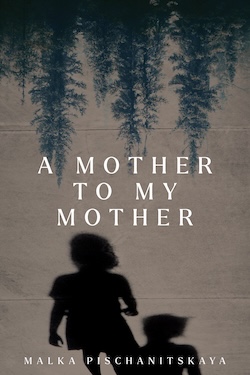
image - A Mother to My Mother book coverPischanitskaya’s memoir, A Mother to My Mother, is one of the latest releases in the Azrieli Foundation’s Holocaust Survivor Memoirs Program. Begun in 2005, the program has now published scores of firsthand testimonies of Canadian Holocaust survivors, many in both official languages, and all of them available free of charge to educational institutions.

Pischanitskaya’s Ukrainian Jewish family knew its share of misery before the emergence of Nazism and war. Her father abandoned her mother before Malka was born, in 1931, and she was raised in grinding poverty by her grandmother and great-aunt while her mother worked in a nearby village and saw Malka some weekends. 

The Stalinist-induced Ukrainian famine of the 1930s killed between three and five million people. The Nazi invasion of the Soviet Union, and its perpetration of the “Holocaust by bullets,” killed 1.5 million Jews, mostly shot at close range and buried in mass graves.

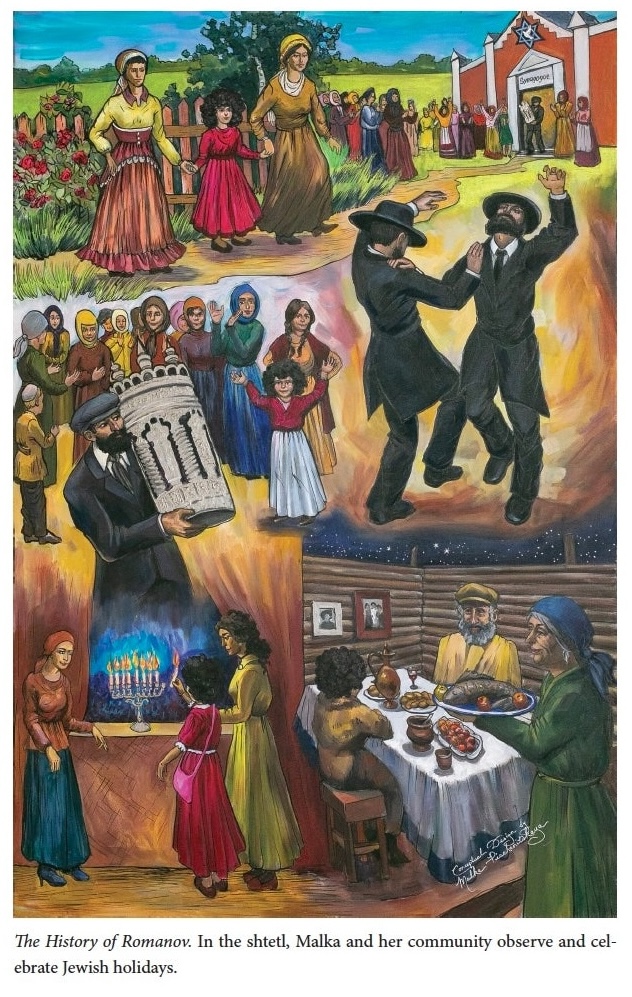
Young Malka’s earliest life, despite hardships, was not without happy memories of Jewish holidays and the changing of the seasons. These are tempered with stark recollections. Without electricity or anything but firewood for heat, she recalls Ukrainian winters so cold the ink at school would freeze solid.

image - A page from Malka Pischanitskaya’s memoir A Mother to My Mother, which includes paintings that she created for a 2019 exhibition
A page from Malka Pischanitskaya’s memoir A Mother to My Mother, which includes paintings that she created for a 2019 exhibition.

After the Nazi invasion of Poland and the beginning of the war, in 1939, five refugee families from Poland arrived in Romaniv (alternatively: Romanov). 

“I have often wondered how much my community found out from these refugee families about what was happening under the Nazis in Poland and whether this made them more aware of the disaster that was to come,” writes Pischanitskaya. 

What was to come was beyond imagining – which may help explain why Malka and her family remained in Romaniv when some other Jews fled further east into the Soviet Union.

“We were not ready – there had been no mental preparation for this moment – so we did not accept the offers to escape,” she writes.

Soon, the Nazis arrived and young Malka witnessed Jews being killed in the streets. The randomness of those murders was replaced with methodical mass executions. The story, starkly told, is predictably shocking, and differs significantly from what happened further west. Rather than ghettos and concentration camps, the Holocaust in the east was typified by summary roundups and mass killings of entire communities, usually in adjacent forests. 

On Aug. 25, 1941, Ukrainian police gave Romaniv’s Jews 30 minutes to congregate in the centre of town.

“Those who were unable to walk had been taken out of their homes on stretchers,” she writes, disabusing Jews of the desperate idea they were being assembled to perform forced labour.

“We walked toward the beautiful park located a couple kilometres from the centre of town,” writes Pischanitskaya. “The crowd of close to 2,000 walked with visible sadness, expressions of disbelief.

“Men were rounded up, separated from their families, and then marched deeper into the forest where, previously, pits both massive and deep, had been dug. Women, children and the elderly were forced into rooms in the military building. Crowded in, there was hardly space to stand. Windows were locked. No fresh air; no water; no washrooms. People screamed, fainted, losing their minds; children were scared and restless.

“One by one, several groups of Jewish people were taken to slaughter. While we were kept in the building, waiting our turns, the heavy ring of machine gun fire instilled extreme fear and terror in all. The slaughter of the Jews from the Romaniv community continued from early morning until dusk – the sun had faded from our lives forever.” 

Then: the first of the miracles that spared the life of Malka and her mother.

“Eventually, mothers with children were let go from the building,” she writes. “Perhaps the murderers were tired from their orgy of death and torture, or perhaps there was no room in the pits for the rest of us, but those who had to remain were slaughtered. We left them, still alive, when we had the chance to run for our lives.”

Here, Pischanitskaya catalogues the names of the many family members killed that day. She goes into grim detail about what witnesses reported from the pits.

Thus began years of hiding – and a succession of near-misses, any one of which would likely have been fatal.

The relationship that gives the book its title, of young Malka mothering her mother, is a story of a parent so paralyzed by events that she becomes almost incapacitated. Malka’s astonishing and perilous actions to ensure their survival form the bulk of the book. She begs door to door in the villages where they hide, often receiving small portions of food. At one home, she sees her own portrait on the wall, apparently pillaged from Malka’s family home after they fled – an uncanny and grotesque coincidence.

When, after the war, they returned to Romaniv, “Almost nothing remained except for memories.”

“Adult survivors went to the mass graves to pray for and memorialize their loved ones, and to bear witness,” writes Pischanitskaya. 

Of all the people who survived and showed up alive after the war was Malka’s “so-called father,” as she calls him, a man whose sadistic cruelty Malka and her mother would have been better off without.

In a twist, the mother who had been “a dependent child” transformed into a courageous woman who pursued Polish and Ukrainian police for war crimes.

Like so many survivors, Pischanitskaya demonstrated improbable resilience, marrying, becoming a teacher, becoming a mother, escaping the Soviet Union, migrating to Canada and raising a successful family that continues to contribute to Vancouver’s Jewish and broader community. 

A Mother to My Mother is illustrated with harrowing, moving paintings that Pischanitskaya created for an exhibition titled Romanov: A Vanished Shtetl, which was presented at the conference of the World Federation of Jewish Child Survivors of the Holocaust and their Descendants, held in 2019 in Vancouver.

To order a copy of A Mother to My Mother in print or ebook format, or any other survivor memoir, visit memoirs.azrielifoundation.org.

Posted on September 20, 2024September 18, 2024Author Pat JohnsonCategories BooksTags A Mother to My Mother, art, Azrieli Foundation, history, Holocaust, Malka Pischanitskaya, memoir, painting, Ukraine

Double book launch

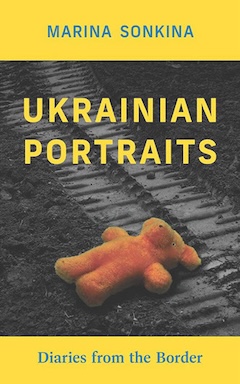
image - Ukrainian Portraits book coverJoin writer Marina Sonkina in celebrating the release of her two new books: Ukrainian Portraits: Diaries from the Border and Rupture and Other Stories. About Ukrainian Portraits, she writes: “At the end of March of 2022, I traveled to the Ukrainian-Polish border to volunteer at a refugee evacuation centre. Much as I tried to prepare myself psychologically, what I encountered face-to-face didn’t fit any of my expectations: I saw a disaster on a massive scale. I went to volunteer as someone who speaks Russian, Ukrainian and other languages; someone who had been a refugee herself.

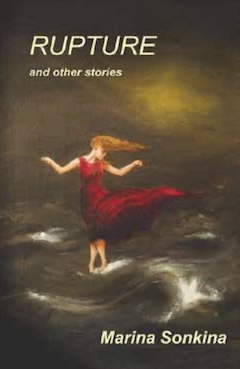
image - Rupture book coverI soon realized that what the Ukrainian refugees needed most (apart from practical advice) was to talk about their experiences. They needed to be heard.”

The double book launch takes place Sunday, Dec. 10, 1:30 p.m., in the Aceman Seniors Lounge at the Jewish Community Centre of Greater Vancouver. Nibbles and light refreshments will be provided.

– Courtesy Marina Sonkina

Posted on November 24, 2023November 23, 2023Author Marina SonkinaCategories BooksTags Marina Sonkina, memoir, short stories, Ukraine
Settling Ukrainian newcomers

Settling Ukrainian newcomers

With the help of Jewish Family Services, Belmont Properties and others, the Zubrys family – Alexander, holding Artem, Sophie and Katrina – are getting settled in Vancouver. (photo from JFS)

For Oleksandra Liashyk and her family, who fled the Ukraine-Russia war last year, resettling in Vancouver was an opportunity for a new, though unexpected start. The family of three, who have an apartment and have enrolled their son in public secondary school, are learning English and navigating the ropes that come with resettlement. Still, Oleksandra admitted that it hasn’t been easy, that simply adjusting to a new culture, community and language has been a challenge. “This is absolutely another world,” she said.

It’s a sentiment shared by many of Vancouver’s newest immigrants from Ukraine. Fedor and Yulia, who came from wartorn Chernihiv with their two children, had good jobs as a real estate broker and a fitness instructor. While their children aren’t yet old enough to attend school, the kids are struggling with socialization. “The hardest thing to adjust for our children here was lack of communication with children of their age,” they said. “[E]verything looks quite unusual here.”

Like Fedor and Yulia, many others have left behind established businesses and jobs, professions that will be hard to restart in Vancouver. Lawyers, real estate brokers, accountants, social workers and business owners will need licences, education and a practised familiarity with Canada’s certification processes. But first, they need a place to live and a way to support their families.

According to Tanja Demajo, chief executive officer of Vancouver’s Jewish Family Services, the Ukrainian resettlement program was already in the planning stages when Russia formally announced its intended occupation of Ukraine in February 2022. Well-versed in creating programs to assist new immigrants, JFS knew the program would have to be versatile and able to address the many challenges faced by refugees on the move. Not all immigrants would be able to plan ahead before leaving Ukraine; many would arrive unprepared for their new home.

“Families reach out in many different ways,” Demajo explained. “Sometimes they call us from abroad and they are trying to understand the Canadian systems and how to actually come here. Sometimes we receive a call from other [Canadian] cities when families have already left [Ukraine] and they are thinking about relocating to the Lower Mainland. And sometimes we receive calls from families that are already here and are trying to navigate their next steps.”

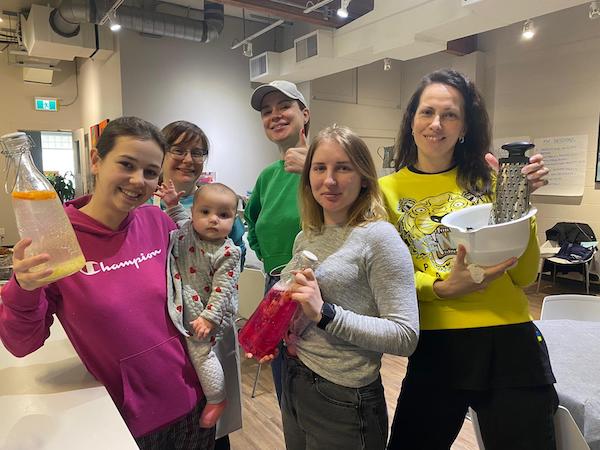
According to Demajo, more than 80% of Ukrainian refugees enrolled in the resettlement program have advanced educations, but lack fluency in English, so JFS partnered with the B.C. Centre for Disease Control to provide its Food Skills program. In it, participants learned how to read labels in grocery stores and purchase food, which then became the ingredients for new Western-style dishes, which they cooked in the JFS Kitchen. “Throughout the cooking, they were also learning English,” Demajo said. “We also had childcare provided as well.” The classes were so successful that JFS is looking at expanding the program.

But the greatest challenge facing new immigrants to Vancouver has been the city’s housing shortage. Residential vacancy rates, which now stand at less than 1%, and the disproportionate cost of rental apartments have made it harder to find housing.

photo - JFS partnered with the B.C. Centre for Disease Control to provide a Canadian food education and cooking class that doubled as an English class for new immigrants
JFS partnered with the B.C. Centre for Disease Control to provide a Canadian food education and cooking class that doubled as an English class for new immigrants. (photo from JFS)

JFS settlement worker Tanya Finkelshtein helps connect new immigrants with “welcome circles” of volunteers that can help get them settled. “Housing is the number one problem in the Great Vancouver area, especially for newcomers. We [are] able to support some of our clients, but it is a serious issue,” said Finkelshtein, who works with about 70 Ukrainian families in JFS’s settlement program.

Affordable housing is key to creating adequate living conditions, including suitable employment.

“We have a family that was initially living outside of Vancouver,” Demajo said by way of example. The family’s efforts to connect with the Vancouver Jewish community were hampered by distance, as was their effort to find suitable employment. By connecting them with Tikva Housing and Temple Sholom Synagogue’s volunteer network, JFS was able to help the family resettle closer to employment opportunities and Jewish community programs. Tikva has since set aside two other units for JFS’s resettlement program.

But the search for housing continues to be a problem for new arrivals, so Demajo reached out to a property management company with well-known connections in the Jewish community. Shannon Gorski, whose family owns Belmont Properties, said JFS was looking for a couple of apartments that could provide temporary housing for Ukrainian immigrants. Gorski, who also serves on the JFS board and is the managing director of the Betty Averbach Foundation, reached out to Belmont’s board of directors “and then I learned … that they had been approached by someone in the rental world, Bob Rennie, and they had already stepped up to the plate.” Gorski said the board agreed to provide four units free of charge for four months.

The offer couldn’t have come at a better time for Alexander and Katrina Zubrys, who had been living out of a hotel since arriving from Kherson. The 1,200-square-foot apartment meant the couple could enrol their two children in a Jewish day school close by.

“The school is located 10 minutes from our house,” said Alexander, who acknowledged that, for his 5-year-old son Artem, “the biggest problem is English.” With the school’s help, Alexander said Artem and Sophie, 13, are adapting to their new surroundings and new language.

According to Gorski, the Zubrys family is the only one so far to request temporary housing from Belmont. “My concern is there are so many other families out there that don’t know that the Jewish community is here to help them,” she said. Thus, the challenge isn’t just finding available housing for current clients, but getting the word out to those arriving who don’t know who or how to ask for help.

As for finding new housing for the program, Gorski encourages other companies to get involved. “We are proud to be able to help the Zubrys family and we would like to help other families once identified,” she said. “And we challenge other property management families to step up as well.”

She is confident that, once alerted that Belmont Properties has donated temporary accommodations to the program, other property owners “would answer the call. I have no doubt that they would.”

Demajo said the settlement program wouldn’t have gotten off the ground without the assistance of the Jewish Federation of Greater Vancouver, which sent out an emergency appeal to the community to fund the project.

“Our community and our Federation have a history of responding quickly and generously whenever and wherever help is needed and we can be incredibly proud of the way our community responded to the crisis in Ukraine,” said Federation chief executive officer Ezra Shanken. “We didn’t spring into action the day the war broke out – we work year-round building communities and partnerships around the world and here at home so that we have the systems in place to make an impact.”

Demajo said Temple Sholom and Congregation Schara Tzedeck are playing a role in supporting new immigrants. Both run their own programs and have collaborated with JFS to make sure new arrivals are supported, she said.

“We continue to support these families now, helping some find vehicles, others looking for new jobs,” said Temple Sholom’s Rabbi Dan Moskovitz.

For the Zubrys family, the support system is what made the 9,100-kilometre migration possible. It’s Gorski’s “big heart” and the help of JFS and other volunteers that made it possible to finally find a new home, said Alexander.

For information about how to offer temporary housing and other help for Ukrainian refugees, contact Tanya Finkelshtein at 604-257-5151.

Jan Lee is an award-winning editorial writer whose articles and op-eds have been published in B’nai B’rith Magazine, Voices of Conservative and Masorti Judaism and Baltimore Jewish Times, as well as a number of business, environmental and travel publications. Her blog can be found at multiculturaljew.polestarpassages.com.

Format ImagePosted on May 26, 2023May 25, 2023Author Jan LeeCategories LocalTags Belmont Properties, housing, immigration, Jewish Family Services, Jewish Federation, JFS, Liashyk, refugees, Schara Tzedeck, Shannon Gorski, Temple Sholom, tikkun olam, Ukraine

Holocaust by bullets

The harrowing history of Ukraine’s past was recounted recently in the annual lecture honouring Rudolf Vrba, the late Vancouver scientist whose 1944 escape from Auschwitz brought the most concrete proof of the Nazi “Final Solution” to the world.

Dr. Nataliia Ivchyk delivered the 2023 Rudolf Vrba Memorial Lecture, titled The Holocaust in Ukraine: Violence, Gender and Memory. Ivchyk is at the University of British Columbia on a visiting fellowship that was created by Dr. Richard Menkis and Dr. Heidi Tworek to bring to Vancouver a Ukrainian scholar at risk. Ivchyk is associate professor in the department of political sciences at Rivne State University for the Humanities in her hometown of Rivne, Ukraine, and her work is focused on public history and memory politics.

Ivchyk’s presentation was based on survivor testimonies held at the USC Shoah Foundation, and narrowed in on the experiences of Jews in the western Ukrainian region of Volhynia and Podilia. Of the approximately 27,000 Jews who lived in Rivne (then known as Rovno) in 1937, it is estimated that just around 1,200 survived to the 1944 liberation by the Red Army. In a single day, on Nov. 6, 1941, about 21,000 Jews were murdered by Einsatzgruppe C and Ukrainian collaborators. The surviving Jews were imprisoned in the Rovno Ghetto, which was created the following month. In July 1942, remaining Jews, about 5,000, were transported to a stone quarry and murdered.

About 1.5 million Jews died in Ukrainian territory during the war years, most of them shot in what has been called the “Holocaust by bullets.”

“The Holocaust has long remained on the margins of collective memory in Ukraine,” said Ivchyk. Babyn Yar, a ravine outside Kyiv where more than 33,000 Jews were murdered over two days in 1941, has become a national symbol of Holocaust remembrance, she said. “However, the local level of remembrance remained low.”

There are many other sites of atrocities that were committed in Ukraine. “Some are marked by monuments, others are still forgotten and lost,” she said.

Of the several thousand Jews who survived the initial mass executions, anyone over the age of 13 was forced into slave labour.

“Nobody wanted to work for the Germans,” Ivchyk quoted one survivor, “but we had to. We hoped it would somehow balance our relationship with the Germans and would help us survive.”

Violence against women was mainly carried out by Ukrainian collaborators, she said, though Nazis also took part.

“I remember many times Germans came at night, knocked on the windows, took away beautiful girls,” Ivchyk quoted a survivor. “Sometimes, they raped and killed them right away. Sometimes, they said we will come again.”

Rabbis became a particular target of violence against men, given their social and symbolic status, and their role as spiritual leaders.

In the Soviet era, historical memorialization was subordinated to the priorities of the regime.

“The Holodomor [the deliberate Soviet famine that killed millions of Ukrainians], the deportation of Crimean Tatars, the Holocaust and the genocide of the Roma – all of these events were suppressed in collective memory by the Soviet regime,” she said.

Today, support in Ukraine for Holocaust memorialization is ambivalent.

“The activities of the state today do not prohibit academic, educational or public activities in the field of Holocaust remembrance, but neither does it act as a financial or ideological initiator,” she said.

The Vrba event was funded by the Holocaust education committee of UBC’s department of history, which is responsible for the annual lecture, as well as a number of other organizations, including the Vancouver Holocaust Education Centre and the Diamond Chair in Jewish Law and Ethics.

Menkis, associate professor of modern Jewish history at UBC and chair of the Holocaust education committee, noted that the event recognizes Vrba’s contributions to two primary areas to which Vrba’s life was devoted: Holocaust education and science, particularly pharmacology. The annual lectures alternate between these topics.

Menkis told the audience how Vrba and his friend Alfréd Wetzler made the momentous decision to escape from Auschwitz after overhearing conversations around the planned deportation of Hungarian Jewry. After a difficult and dangerous trek, the pair reached northern Slovakia, where they compiled a report documenting the layout of Auschwitz and the extermination process there.

“Although the report is credited with saving many lives,” said Menkis, “Vrba and Wetzler were keenly aware that more decisive action could have saved more. After the war, Dr. Vrba continued to speak about Auschwitz and his experiences. His book, I Cannot Forgive, written with Alan Bestic, was first published in 1963 and has been issued in a number of translations and re-editions since. He is also well known for his unforgettable testimony in Claude Lanzmann’s [documentary film] Shoah and perhaps less well-known but also important was his effective testimony in the Canadian trials against Holocaust denier Ernst Zundel.”

Vrba’s widow, Robin, attended the event virtually. Vrba died in 2006.

Posted on April 14, 2023April 12, 2023Author Pat JohnsonCategories Local, WorldTags gender, genocide, history, Holocaust, Nataliia Ivchyk, Richard Menkis, Rudolf Vrba, UBC, Ukraine, University of British Columbia, violence

Opportunity for healing

This article was originally presented as a d’var Torah called “Healing our relationship, as Jewish Canadians, with Ukraine and Ukrainians.” It was delivered at Or Shalom Synagogue on Shabbat, 14th of Tevet, 5783; Jan. 7, 2023. It is intended as a beginning of a conversation about how we, as Canadian Jews, can heal our relationship with Ukrainians and Ukraine.

When many of us Canadian Jews think about Jewish experience on Ukrainian territory, we think of antisemitic violence. We think of pogroms, of rape, of plunder. And, ultimately, of either escape or death. For those of us with personal ancestral history in the territory of Ukraine, this pairing of the land with violence is particularly acute. One Or Shalom member told me, with raw emotion, about his father’s experiences at the hands of brutal Ukrainian guards in various Nazi concentration camps. My Uncle Leo referred to Easter as pogrom season in the town of Yavorov, the town presently in western Ukraine, called Yavariv in Ukrainian, where he lived until the age of 11. He spoke to me of his childhood as a past from which he had, thankfully, escaped.

It is not uncommon for individuals to seek escape from a painful childhood past. However, we are learning from contemporary trauma theory that, as much as we may want to leave the past behind us, it lives on within us. Ukraine lives on in the deep psychic life of many of us and in the psychic life of the Canadian Jewish community with its extensive roots on Ukrainian territory.

As we are all aware, the Ukrainian people are heroically resisting a brutal assault by Russian forces. As well as eliciting fear, horror and outrage, this situation presents us with an invitation to move beyond our feelings of separation from our history on Ukrainian soil and from the Ukrainian people. The war provides us with the opportunity to claim our own legacy and place in the new, complex, multiethnic, multiracial, democratic Ukraine, with all its triumphs, challenges and contradictions. This is an opportunity for healing.

I want to share some of what I have learned that has helped me on this healing path.

If we look at the historic record of Jewish life on Ukrainian territory, we see that Jewish-Ukrainian coexistence was deep, complex and multi-dimensional. Demographically, Ukrainian territory was one of the main centres of Jewish life for more than 400 years. On the eve of the Holocaust, there were more than two-and-a-half million Jews in that area.

There were periods of horrific violence and crippling antisemitism against Jews on Ukrainian territory, as well as periods of ongoing systematic prejudice. These realities must not be overlooked or minimized. But we also see many examples of interconnection between Ukrainian Jews and ethnic Ukrainians. We see many examples of shared music with similar melodies and even bilingual songs; of similar folk stories; and of similar folk remedies and folk healing practices, with Jewish Ukrainian and ethnic Ukrainian folk healers sharing their remedies with each other and tending to both populations.

And there is considerable similarity in those quintessential Jewish activities – food preparation and consumption. This past summer, I made pickles with my Ukrainian-Canadian friend Beverly Dobrinsky, using an old family recipe of hers. The next day, I discovered the exact same recipe, grain of salt per grain of salt, in my own disordered family recipe collection.

Looking at literary translation, one of my passions, we find many examples of the translation of works between Yiddish and Ukrainian and between Ukrainian and Yiddish. In the late 1920s, Ukrainian writer Yuriy Budiak wrote two bird-themed children’s books that have been described as delightful and playful. Shortly thereafter, the books were published in Yiddish translation and enjoyed by Yiddish-speaking Jewish children. These books were recently published by Naydus Press in the United States in a trilingual edition – Ukrainian, Yiddish and English – to raise funds for the Ukrainian war effort.

During the 1930s, both Yiddish and Ukrainian writers experienced repression by the Stalinist Soviet government and experienced difficulty publishing their own writing. In response, they began translating one another’s work and the work of Soviet-sanctioned writers from one another’s cultures. The esteemed Yiddish poet Dovid Hofshteyn translated the work of Taras Shevchenko, known as “the national bard of Ukraine.” The Yiddish writer Leib Kvitko taught Yiddish to the Ukrainian writer Pavlo Tychyna, who went on to translate a number of Yiddish writers into Ukrainian.

As Prof. David Fishman from the Jewish Theological Centre in New York points out, all these similarities and interconnections‚“only happen with close contact.”

Moving into the present, by focusing solely or predominantly on past violence and persecution, we fail to take into account the cataclysmic changes Ukraine has undergone, notably since the breakup of the Soviet Union and the country’s emergence in 1991 as an independent nation with a sizable contemporary Jewish population. David Klion estimated, in Jewish Currents, that the Jewish population of Ukraine at the time of the Russian invasion in February of 2022 was more than 100,000 people.

Since independence, Ukrainians have been redefining what it means to be Ukrainian, moving from an ethnic category of belonging based on ethnic and religious identity to a civic category based on citizenship. This is an important issue for all Ukrainians, but particularly for the many individuals, including Jews, who are not ethnically Ukrainian.

Last April, I had the enormous privilege of hearing a Zoom talk organized by the Vancouver Holocaust Education Centre and given by Dr. Magda Havryshko, a Ukrainian academic. Havryshko spoke of two different national narratives in Ukraine, an ethnocentric narrative focusing on the country as the homeland of the Ukrainian people, and a multiethnic narrative “that priorizes examining Ukraine’s difficult history in relation to Jews.” Havryshko shared information about several inspiring initiatives undertaken in Ukraine in relation to its Jewish population. I will outline three of these initiatives here: during the celebration of Ukrainian independence in 2021, Holocaust history and memory was central; the history of the Holocaust on Ukrainian territory is now taught in all schools beginning at the elementary level; and, lastly, President Volodymir Zelensky and his government have set out a definition of antisemitism, introducing legal punishments for antisemitic acts.

Prof. Amelia Glaser, who studies and teaches comparative literature and translation, has spoken about a desire among contemporary Ukrainian writers to “look very closely at past moments of history and of ethnic violence as Ukrainian tragedies‚” rather than solely as Jewish tragedies. The book-length poem “Babyn Yar in Voices‚” by Marianna Kiyanovska, a non-Jewish Ukrainian, about the 1941 slaughter of Jews in a ravine outside Kyiv, was recently published in English translation by Oksana Maksymshuk. Further, several works by Ukrainian Yiddish writers have been recently translated into Ukrainian, including the fabulous avant-garde Yiddish poetry of Debora Vogel and Sholem Aleichem’s Tevye, which many of you know as Fiddler on the Roof. By the way, Sholem Aleichem lived most of his adult life in Kyiv, a city that he loved.

Without in any way discounting the violence and antisemitism against Jews on Ukrainian territory, I hope I have provided a little forshpayz, an appetizer, about areas of cooperation and interconnection between Ukrainian Jews and ethnic Ukrainians. I have focused on translation and literature, two of my passions, but I encourage you to look for examples of interconnection in the areas of your own interest.

When I think about healing my relationship with Ukraine, it helps me to think about the complexity of my own identity and experience. I am the granddaughter of Jewish immigrants who fled poverty and persecution in different parts of the former Russian Empire, including Ukrainian territory, at the beginning of the 20th century. My maternal grandparents settled in Montreal; my paternal grandparents, in New York. It is telling that I do not know the specific history of the Indigenous nations in the areas in which my grandparents settled but I think I can assume that the lands had been forcibly taken from the Indigenous inhabitants. Two generations later, I continue to live on unceded (that is – stolen) territory, that of the Squamish (Sḵwx̱wú7mesh), Tsleil-Waututh (səlilwətaɬ), Musqueam (xʷməθkʷəy̓əm) and Kwikwetlem (kʷikʷəƛ̓əm) First Nations.

Canadian society is involved in a collective process of teshuvah, of redefining the relationship between us settlers and the Indigenous peoples on this land. Like all settlers, as Canadian Jews, we are challenged to take responsibility for our active involvement or silent complicity in the ongoing Canadian genocidal project against our country’s Indigenous inhabitants. Can we see our commonality with Ukrainians as we both address our brutal oppression of “the other”? Are we, as Canadian Jews, willing to embrace the complexity of our lived experience, to look both at our privilege, especially when it is experienced at the expense of others, as well as at our own painful experience of victimization? Can we hold both at once with integrity?

I finish by sharing the wisdom spoken by an Indigenous man, whose name I unfortunately did not get, at Grandview Park at this past year’s Orange Shirt Day. “When you take a step to heal, you also heal the ancestors. You heal the ones behind and the ones ahead.”

I welcome ongoing dialogue on the issues raised in this talk. Thank you for your kind and open attention.

Helen Mintz’s translation of Vilna My Vilna: Stories by Abraham Karpinowitz (Syracuse University Press, 2016) garnered three literary awards, and her translation of Janusz Korczak: Teacher and Child Advocate by Zalmen Wassertzug is under consideration by the University of Poznan Press. Mintz’s translations have appeared in In Geveb, Jewishfiction.net and Pakn Treger, and her writings about translation in Words without Borders and BC Studies. Her website is helenmintz.net.

Posted on February 10, 2023February 9, 2023Author Helen MintzCategories Op-EdTags healing, history, Holocaust, Ukraine
JDC’s Ukraine efforts

JDC’s Ukraine efforts

Marina Sonkina shares her experiences as a volunteer with the JDC in Poland last year, helping Ukrainian refugees. (photo by Masumi Kikuchi)

This year’s annual Raoul Wallenberg Day in Vancouver honoured the American Jewish Joint Distribution Committee (JDC) for “its courageous support for Ukrainian refugees.”

“In addition to vast internal displacement, from a population of 41 million Ukrainians, eight million (mostly women and children, and some seniors) have fled to Europe and other parts of the world,” said Alan Le Fevre in his opening remarks.

Le Fevre is on the board of directors of the Wallenberg-Sugihara Civil Courage Society, which hosts the Wallenberg Day commemorations. This year, the event was presented in partnership with Congregation Beth Israel, and it took place at the synagogue on Jan. 22.

The JDC’s work helping Ukrainian refugees “continues its illustrious history,” said Le Fevre, noting that, “since its founding in 1914, the JDC has provided support for refugees whenever and wherever needed, propelled by Jewish values and a commitment to mutual responsibility.”

The City of Vancouver’s proclamation of this year’s Wallenberg Day was read by Deputy Mayor Sarah Kirby-Yung, attending on behalf of Vancouver Mayor Ken Sim. She was joined by Councilor Mike Klassen.

Kirby-Yung had helped celebrate the start of the Lunar New Year that morning, and still had on the red jacket she had worn for that event because the Asian community “has suffered much in the past few years, [with] anti-Asian hate and, sometimes, that plight has been very analogous to what our Jewish community has suffered” and one of the best things about the city, and what she sees in the work of the JDC, is “communities and cultures, and people of different faiths and backgrounds, who come together to stand against injustice and to support each other.”

photo - Vancouver Deputy Mayor Sarah Kirby-Yung reads the city’s proclamation of this year’s Wallenberg Day, the framed copy of which is being held by Councilor Mike Klassen
Vancouver Deputy Mayor Sarah Kirby-Yung reads the city’s proclamation of this year’s Wallenberg Day, the framed copy of which is being held by Councilor Mike Klassen. (photo by Masumi Kikuchi)

WSCCS board member George Bluman introduced the afternoon’s guest speaker, Dr. Marina Sonkina, a local educator and writer. “Soon after Russia attacked Ukraine, Marina applied to volunteer with the Jewish Joint Distribution Committee, as someone who speaks Russian, Ukrainian and other languages and as someone who has been a refugee herself,” he said. “Almost immediately, she was accepted and flew to Poland at the end of March.

“After arriving in Warsaw, about five hours later, Marina was at the Polish-Ukrainian border, where she served in a camp as a frontline responder, offering fleeing refugees medical and psychological support.”

Sonkina, who has relatives in Russia and Ukraine, said most of her family is out of Russia at this point.

“If we are talking about why didn’t Russians resist,” she said, “I think those more than one million people who left Russia when the draft, conscription, was announced, that is the only accessible form of not revolt, but saying no to Putin. Otherwise, it is pretty much a fascist state.”

While Putin is the person who launched the war, she wondered about others’ culpability: all those who overlooked Putin’s actions over the 22 years of his being power, which has seen him poison his opponents and annex Crimea, among other things. What was the West’s role, she asked, as they worked with Putin as a business partner first, putting his authoritarianism second?

In Warsaw, Sonkina was one of the people who met Holocaust survivors being extracted from Ukraine, to be housed in Germany. The next day, she worked in a refugee camp, where there were already more than two million refugees. (For more on Sonkina’s experience in Poland, read her account at jewishindependent.ca/helping-ukrainian-refugees.)

JDC helped everybody, said Sonkina. A moral responsibility to repair the world, tikkun olam, is part of JDC’s mandate and she saw this responsibility in action. She remarked on the goodwill of people from around the world, of a range of ages, who were helping in different ways, including taking refugees into their homes. The strength and independence of the refugees also left an impression on Sonkina – they didn’t want to take handouts, she said, and they wanted to know whether they could get jobs in the country that harboured them.

“One of the things that I quickly realized – a part of persuading them to go to this country or that was just the human contact that was so important,” she said. The refugees she met had experienced such trauma, and her acknowledgement of what they had gone through allowed some of them to cry. “It was sometimes hard,” Sonkina admitted, visibly emotional. “But there were also funny stories,” she added, sharing a couple of those stories before WSCCS board member Gene Homel took the podium.

An historian teaching about Europe in the 20th century for many years, Homel had been in Ukraine eight or nine years ago, and he echoed what Sonkina had said about Ukrainians’ “intense loyalty” – “the attachment to the land, culture and language” – but, he said, “I want to make the point that, in Ukraine today, the focus of loyalty is a civic one, it’s on the national state rather than ethnicity, it’s a pluralistic and multiethnic society that’s being created, forged largely as a result of Russia’s criminal attack on Ukraine.”

Homel provided a brief overview of the JDC’s work from its founding in 1914 to its current work with Ukrainian Jews and non-Jews, and he introduced businessman and philanthropist Gary Segal, who became familiar with JDC’s work in 2007, on a Jewish Federation of Greater Vancouver trip to Ethiopia, led by JDC professionals. He’s been a board member since 2012.

“I marvel at the compassion, intelligence, resourcefulness and resolve with which the dedicated staff and volunteers carry on their sacred work,” said Segal, noting that JDC helps communities of all backgrounds and faiths, and doesn’t just respond to acute situations, but also to endemic poverty, food insecurity and the plight of refugees, as well as antisemitism.

“Since 1914, we’ve rescued more than one million Jews in danger, from places like Ethiopia, Yemen, Bosnia and Herzegovina, and Ukraine,” said Segal, who spoke about various JDC initiatives, including its medical programs in countries like Ethiopia.

photo - Gary Segal, a board member of the American Jewish Joint Distribution Committee, speaks about JDC’s history and his involvement with the organization
Gary Segal, a board member of the American Jewish Joint Distribution Committee, speaks about JDC’s history and his involvement with the organization. (photo by Masumi Kikuchi)

It was on that 2007 trip that Segal met Dr. Rick Hodes, JDC’s medical director in Ethiopia, whose care for kids with severe spinal deformities (with Ghanaian spine surgeon Dr. Oheneba Boachie-Adjei) inspired Segal to get involved, too. He brought a young Ethiopian to Vancouver for back surgery and established in Vancouver the organization Bring Back Hope, which has raised some $3 million to support spine surgeries, preventative screening, and more. (See jewishindependent.ca/oldsite/archives/jan11/archives11jan14-02.html and several articles on jewishindependent.ca.)

Returning to JDC’s work in Ukraine since the war began, Segal noted that, to date, the organization “has cared for 35,000 vulnerable and elderly poor; it evacuated 13,000 Jews from Ukraine; provided over 40,000 refugees with food, medicine, trauma support; received over 19,000 incoming calls at the emergency centre; and provided over 1.3 million pounds of humanitarian assistance.”

Segal then brought his talk around to Raoul Wallenberg, Sweden’s special envoy to Hungary in 1944, who saved tens of thousands of Jews from deportation and death. “The original fund of $100,000 that [Wallenberg] received from the War Refugee Board came from the American Joint Distribution Committee and, when that was finished, he received additional funds from the JDC,” said

Segal, who concluded, “I would say, so much of what JDC does is giving hope. Hope is a powerful word, an essential element in everyone’s life…. Hope can give us the strength and the will to continue in our darkest moments, to aspire and believe that things can and will be better.”

On behalf of the JDC, Segal accepted, with thanks, the Wallenberg-Sugihara Civil Courage Award from Le Fevre.

Other components of the afternoon included a few words from Beth Israel’s Rabbi Jonathan Infeld, a short documentary on Norwegian Fridtjof Nansen, who received the 1922 Nobel Peace Prize for his work on behalf of displaced persons after the First World War, and a compilation of JDC’s work in Ukraine since the Russian invasion.

WSCCS board member Judith Anderson introduced the videos, giving more of Nansen’s background and achievements, including “the repatriation of 450,000 prisoners of war, mostly held in Soviet Russia” and “[in] response to a severe famine in Soviet Russia, Nansen directed relief efforts that saved between seven million and 22 million people from starvation.”

Anderson said, “The Nansen story is directly relevant to Ukraine. The headquarters for Nansen’s mission to Russia was in Ukraine’s Kharkiv, and Nansen donated part of his Nobel Peace Prize money to establish a major agricultural project in Ukraine.”

She thanked the Norwegian Refugee Council and the Nobel Peace Centre for permission to show the videos about Nansen and JDC staff members and directors – Shaun Goldstone, Solly Kaplinski and Alex Weisler – for compiling the material for the Ukraine Crisis video.

The Wallenberg-Sugihara Civil Courage Society is named after Wallenberg for his actions during the Holocaust, and Chiune Sugihara, who, as vice-consul in Lithuania for Japan during the war, issued transit visas that allowed thousands of Jews from Poland and Lithuania to escape. For more information on the society and to see videos of the Jan. 22 event, visit wsccs.ca.

Format ImagePosted on February 10, 2023February 9, 2023Author Cynthia RamsayCategories LocalTags Alan Le Fevre, American Jewish Joint Distribution Committee, Gary Segal, Gene Homel, George Bluman, JDC, Judith Anderson, Marina Sonkina, refugees, Sarah Kirby-Yung, Ukraine, Wallenberg-Sugihara Civil Courage Award, Wallenberg-Sugihara Civil Courage Society, war
Ukraine’s complex past

Ukraine’s complex past

Elissa Bemporad (photo from Elissa Bemporad)

During a Dec. 4 Zoom lecture organized by Kolot Mayim Reform Temple in Victoria, historian Elissa Bemporad offered a nuanced look at the Jewish experience in Ukraine, as well as perspective on the Russian invasion of Ukraine

“It was a history marked significantly more by coexistence between Jews and non-Jews than it was by violence,” said Bemporad, a professor at Queens College and CUNY Graduate Centre in New York City. “I am saying this not only in response to the genocidal war that Russia has launched in Ukraine, justifying it by manipulating the past and demonizing Ukrainians as quintessentially violent. We should resist the view of the Jewish experience in the region, as tragic as it might have been, as if it was doomed from the very beginning and enveloped in perpetual violence.”

The current war, she underscored, has brought about the worst refugee crisis in Europe since the Second World War, with cities destroyed and civilian populations terrorized. “The aim of this war seems to be putting an end to Ukrainian sovereignty and identity,” she said. “As a historian, one of the most painful moments was reading about how the Russian occupiers were seizing and destroying books. As Jewish historians, we know all too well what happens when a society destroys books.”

Showing images of the destruction of Jewish buildings in Ukraine, such as a synagogue in Mariupol and the Hillel building in Kharkhiv, Bemporad spoke to the irony of one of Russia’s stated goals of the conflict: to rid the country of Nazis. Most of the Jews in these bombed-out cities have left, she said, and there is uncertainty as to whether they will return; many have either fled to Israel or settled in the West.

Bemporad discussed the pre-Second World War period, when 1.5 million Jews lived in what is today Ukraine, the largest community being in Kyiv, where 226,000 Jews resided, or one-third of the city’s population. Addressing the anti-Jewish violence in the region, she spoke about – among other uprisings, dating back to the 17th century – the Russian Civil War (1918-21) and the resulting atrocities committed against the Jewish population by both military units and the civilian population. Many of the pogroms took place in Ukraine and tens of thousands of Jews were killed.

“Jews were thought of as interlopers in the national body and imagined as forces connected to Bolshevism that would tear apart the nation’s fabric,” Bemporad said. “The fact that Trotsky was the leader of the Red Army did not play in favour of the Jews.”

But Bemporad highlighted a history of coexistence as well, stories in which some Ukrainians heroically stepped in to save the life of Jews, notably the writer Rakhel Feygenberg, who, along with her infant son, was hidden by non-Jews during a 1919 pogrom.

About the post-First World War era, she noted the ambivalent attitude the Soviet state had toward antisemitism. “While the state condemned antisemitism on paper, it was often eager to ignore antisemitism or to weaponize it in its best interest,” she said. “With regard to the pogroms, the Soviets shifted between acknowledging and downplaying the anti-Jewish violence. They were ambiguous in their treatment of the Jews, and they were the ambiguous in their treatment of the perpetrators, creating a state-controlled memory. However, when the discussion of the pogroms was perceived as at odds with the regime’s interests and priorities of building socialism based on the brotherhood of peoples, then the memory of anti-Jewish violence was silenced and the Soviets preferred not to investigate and punish the perpetrators.”

In other examples, she said the Soviets would use antisemitism among Ukrainians as a means to demonstrate they were prone to nationalism. And both Ukraine and Russia have provided recent examples of reviving the memories of and glorifying national heroes who were responsible for carrying out pogroms.

In a final slide, Bemporad displayed the results of a Pew Research Centre survey on antisemitism in Europe. Despite Russia’s attempts to portray Ukraine as a hotbed of antisemitism, more Russians had an unfavourable opinion of Jews than Ukrainians. And, in Bemporad’s view, Ukraine, despite its corruption, has become the most democratic of the post-Soviet states, excluding the Baltic countries. Further, as has often been mentioned in referring to the present situation of Jews in Ukraine, the country elected a Jewish president, Volodymyr Zelensky, with more than 73% of the vote.

“Siding with Ukraine today does not entail dismissing or forgetting the dark pages of anti-Jewish violence in the region,” Bemporad said. “It is rather a reminder that we can start turning those pages and writing new ones in the book of the Jews of Ukraine.”

Bemporad, a two-time winner of the National Jewish Book Award, is the author of Becoming Soviet Jews: The Bolshevik Experiment in Minsk and Legacy of Blood: Jews, Pogroms and Ritual Murder in the Lands of the Soviets. She is the co-editor of two volumes: Women and Genocide: Survivors, Victims, Perpetrators and Pogroms: A Documentary History.

The next speaker in Kolot Mayim’s Building Bridges series will be Sari Shernofsky, a retired community chaplain from the Calgary Jewish community, on Stories from the Narrow Bridge: Meeting People in Their Time of Need. She will speak on Jan. 8, 11 a.m. Visit kolotmayimreformtemple.com.

Sam Margolis has written for the Globe and Mail, the National Post, UPI and MSNBC.

Format ImagePosted on December 23, 2022December 22, 2022Author Sam MargolisCategories LocalTags antisemitism, atheism, Elissa Bemporad, history, Kolot Mayim, religion, Russia, Ukraine, war

מסחר עולמי

הישג ישראלי: ‘איי.טו.זד’ מדורגת בין עשר חברות הטכנולוגיות של בורסת טורונטו

החברה הישראלית לעגלות סופרמרקט חכמות ‘איי.טו זד’ התברגה בין עשרת החברות הטכנולוגיות המובילות בבורסה הקנדית. החברה נכנסה לרשימת המדדים המובילים בבורסה בזכות ביצועיה האיכותיים מאוד

קבוצת הטכנולוגיה הישראלית – חברת הטכנולוגיות החכמות ‘איי.טו.זד’ יכולה לרשום לעצמה הישג משמעותי נוסף, בענף העגלות החכמות, עם כניסתה לממד החמישים של חברות בינלאומיות מובילות, של הבורסה לניירות ערך בטורונטו שבקנדה. על חמישים החברות נמנות אלה שיש להן ביצועים איכותיים יוצאי דופן בחמישיה מגזרים עיקריים: טכנולוגיה, אנרגיה, תעשייה, כרייה ומדעי החיים. וזאת על פי על פי מספר קריטריונים שעליהם נמנים: צמיחת החברה ביחס לענף שלו היא שייכת, וכן ביצועי המניה של החברה בשנה האחרונה

בנוסף למסחר בבורסה לניירות ערך של טורונטו חברת הטכנולוגיות החכמות ‘איי.טו.זד’ נסחרת במקביל גם בבורסת ‘נסד”ק’ האמריקנית, שמיועדת לחברות היי טק טוכנולוגיה. ‘איי.טו.זד’ זוכה אפוא להמלצות קנייה חמות וטובות לאור איכות המוצרה שלה – העגלות החכמות

חברת הטכנולוגיות החכמות ‘איי.טו.זד’ שממציאה ומפתחת פתרונות חדישים לאתגרים מורכבים שונים, היא זו שעומדת מאחורי העגלה החכמה. בשלב זה העגלה החכמה היא מוצר הדגל שלה והוא זוכה לחשיפה גדולה. מדובר במוצר המתקדם מסוגו בעולם בשלב זה. העגלה החכמה מתפקדת גם כקופה עצמאית לכל דבר, וכן יש לה אף מסך מגע ומערכת ראייה ממוחשבת. העגלה החכמה שנקראת ‘קסטומייט’ מייעלת את חוות הקנייה על ידי שימוש באלגוריתם חכם והיא נחשבת מאוד ידידותית למשתמש. בעזרת העגלה שיש, לה מסך מגע ומערכת ראייה ממוחשבת, אפשר לסרוק את המוצרים שנרכשו וכן יש אף אפשרות לשלם באמצעותה. וחאיר כן יכולים הקונים לעקוף פשוט את התור הארוך בקופה ולצאת עם העגלה החוצה. או רק עם המוצרים שנרכשו. ובכך נחסך זמן רב מצדם של הקונים שכידוע בדרך כלל מתלוננים על התורים הארוכים בקופות. כן נחסך כוח אדם רב, בזמן שלמנהלי החנויות יש שליטה ובקרה מלאים על כל התהליך של הרכישה והמכירה

העגלה החכמה ‘קסטומייט’ מאפשרת למנהלי החנויות להפעיל גם פרסום ממוקד למי שמשתמש בה, כולל שיווק ישיר וכן מבצעים מיוחדים. כך שהכנסות חנויות יכולות לעלות בזמן ששהוצאות שלהן יקטנו שמעותית

לדברי מנכ”ל פרוייקט ‘קסטומייט’ של חברת הטכנולוגיות החכמות ‘איי.טו.זד’, רפי ים, העגלה החכמה נמצאית בתהליכי שיפור מתמיד, מבחינת החומרה והתוכנה. זאת כדי להשיג פתרונות משלימים, אפלקציות ויכולות שונות שיתנו ערך מוסף ללקוחות, לחנויות ולמשקיעים בחברה הנסחרת בבורסאות כאמור של טורונטו ‘ונסד”ק’ האמריקנית. ים מוסיף כי פלטפורמת העגלה החכמה ‘קסטומייט’ תופץ ותשווק בחנויות שונות בכל רחבי העולם. ים מציין עוד שהחברה גאה להיות בימים אלה חלק ממדד החברות האיכותיות של בורסת טורונטו שבקנדה

הישג קנדי: ביקושי ענק לדגנים ותבואות מכל העולם

המלחמה הבלתי נתפסת של נשיא רוסיה, ולדימיר פוטין, באוקראינה המיסכנה, שינתה משמעותית את מפת אספקת הסחורות העולמית. רבים במערב לא האמינו שפוטין הדיקטטור יחרחר מלחמה ברמה כזו ויחליט שיום אחד הוא רוצה לחסל את אוקראינה על תושביה. מקביל מדינות המערב בהן קנדה יעשו מעט עבור אוקראינה וזה מצער

ולפיכך משבר חמור זה יצר מחסור עולמי גדול בדגנים ותבואות, בין היתר כיוון שרוסיה מקשה על אוקראינה ליצא חיטה באמצעות חסימת המעבר בים השחור. רוסיה עצמה אף נתקלת במחסומים קשים ביותר לייצא את החיטה שלה, לאור הסנקציות הכלכליות הקשות שהוטלו עליה מצד מדינות המערב השונות. המרוויחה הגדולה מכך היא קנדה שהפכה לספקית חילופית טובה למדינות רבות בעולם

העולם מגיע לקנדה לאור המשבר הארוך הזה, וקנדה מצידה שולחת דגנים ותבואות של החקלאים המקומיים לכמאה ועשרים מדינות שונות. על רשימת המדינות שפנו לאחרונה לקנדה לקבל את התוצרת החקלאית שלה נמנות: טורקיה, אלגי’ריה, תוניסיה וברזיל. במקביל מדינות אחרות שלא סובלות בשלב זה ממחסור ביבולים השונים, פונות כל הזמן לקנדה ומבקשות להגדיל את היבוא החקלאי. זאת, כדי לבסס את מאגרים שלהן לשעת חירום כי כידוע משברים לא חסרים בעולם: מגיפת הקוביד, פגעי אקלים שונים, סיכסוך ומתיחות בין מדינות שונות ועוד ועוד

ההתחממות הגלובלית העולמית לא פוסחת על קנדה וגם היא יוצאת נפסדת מכך משמעותית ביותר. הבצורת הקשה בקנדה בשנה שעברה, פגעה קשה ביצוא של חיטה וקנולה למדינות העולם השונות. בשלב זה קשה לקנדה לסגור את החוזים בהיקפים שהיא רגילה להם. זה יקרה רק אם אספקה של היבולים השונים תחזור לרמות הרגילות בשנה הנוכחית

בנוסף למשבר הגלובלי הנוכחי שנולד ממלחמתה הקשה של רוסיה באוקראינה, גם מגפת הקוביד הנמשכת כבר כשנתיים ויותר “עזרה” ליצור שיבושים קשים באפסקת סחורות בכל רחבי העולם. עתה מכולות ריקות במספר גדול מאוד נשלחות לסין כדי לסייע בסגירת העיכובים באספקה, שנוצרו במהלת המגיפה. לכן מובילי דגנים קנדיים מתקשים להשיג מכולות להעביר את סחורותיהם למדינות שונות ברחבי העולם

חרף האתגרים הקשים הללו, קנדה ויצרני הסחורות והחקלאים שלה עדיין נמצאים בעמדת יתרון. מחירי הנפט והאשלג הגואים כל הזמן הגדילו את הרווחים וסייעו באיזון התקציב הציבורי של קנדה. מחוז אלברטה שבמערב המדינה, שרוב הכנסותיו מגיעות מתעשיית הנפט והגז, צופה עודף תקציבי בשנה הפיסקאלית הנוכחית, לראשונה זה שמונה שנים. זאת לאחר שנים של מיתון קשה באלברטה, שגרם לרבים להפוך למובטלים ובמקביל חברות רבות בתחום האנרגיה הפסיקו את פעילותן במחוז

לאחר המחסור הגדול בנפט בעיקר בגלל הסנקציות הכלכליות שהופנו כנגד רוסיה, הסכימה קנדה כמו ארה”ב, להגדיל משמעותית את יצור משלוחי הגז הטבעי והנפט שלה. מדובר על גידול ביצור של כמאתיים אלף חביות נפט ביום, וכן גידול ביצור של כמאה אלף חביות גז טבעי ביום

במדינות המערב סוף סוף הגיעו למסקנה שיש “להיגמל” מרכישת אנרגיה מרוסיה, שנחשבת ליצואנית הנפט והגז הגדולה ביותר למדינות ביבשת אירופה. המשבר הנוכחי עם הרוסים מויח שוב ושוב, שכדאי ואף מומלץ למערב לנתק כל תלות ברוסים. השאלה המשמעותית עתה כי כמה זמן זה יקח למדינות אירופה השונות ובעיקרן גרמניה, למצוא תחליפים לנפט ולגז של הרוסים

קנדה נחשבת לאחת מיצרניות האשלגן הגדולות בעולם. חברת נוטריין הקנדית שהיא יצרנית האשלגן הגדולה בעולם, הגדילה רק לאחרונה את הייוצר שלה בעשרה אחוזים לרגל פניות רבות מברזיל

השר למשאבי הטבע בממשלה הפדרלית הליברלית, ג’ונתן ווילקינסון, מציין כי כי גורמים רשמיים מטעם מדינות שונות פנו אליו במהלך כנס סוכנות האנרגיה הבינלאומית ,שנערך לאחרונה בפריז, כדי לבחון היתכנות להחלפת האשלג, אורניום וסחורות חקלאיות רוסיות, בקנדיות. במהלך הפסגה הבינלאומית אמר ווילקינסון, כי קנדה, שהיא הרביעית בגודלה בעולם מבחינת עתודות נפט, תוכל להגדיל בהדרגה את המשלוחים בשלוש מאות אלף חביות ביום. בנוסף גם יצרנית האורניום הגדולה במדינה ‘קמקו’ (בסיסה במחוז סיסקצ’ואן) צפויה להגדיל את ייצור האורניום במכרות שלה, בקנדה ובארה”ב. ‘קמקו’ הנחשבת ליצרנית האורניום השנייה בגודל בעולם, מפיקה כשמונה עשר אחוז מכמות האורניום שבעולם

במסגרת הסנקציות נגד רוסיה, הודיעה קנדה לאחרונה כי היא מטילה סנקציות נגד האוליגרך רוסי-ישראלי, ויקטור וקלסברג, הנחשב למקורב לפוטין

Posted on June 8, 2022June 1, 2022Author Roni RachmaniCategories עניין בחדשותTags agricultural goods, Canada, global shortage, grains, Israel, Russia, stock exchange, technology, Ukraine, אוקראינה, חסור עולמי, סחורות חקלאיות, קנדה, רוסיה, תבואות

Posts pagination

Page 1 Page 2 Page 3 Next page
Proudly powered by WordPress