Skip to content

  • Home
  • Subscribe / donate
  • Events calendar
  • News
    • Local
    • National
    • Israel
    • World
    • עניין בחדשות
      A roundup of news in Canada and further afield, in Hebrew.
  • Opinion
    • From the JI
    • Op-Ed
  • Arts & Culture
    • Performing Arts
    • Music
    • Books
    • Visual Arts
    • TV & Film
  • Life
    • Celebrating the Holidays
    • Travel
    • The Daily Snooze
      Cartoons by Jacob Samuel
    • Mystery Photo
      Help the JI and JMABC fill in the gaps in our archives.
  • Community Links
    • Organizations, Etc.
    • Other News Sources & Blogs
    • Business Directory
  • FAQ
  • JI Chai Celebration
  • JI@88! video
image - Weizmann Canada Physics Tournament 2025
image - The CJN - Visit Us Banner - 300x600 - 101625

Recent Posts

  • Vrba monument is unveiled
  • Music to build bridges
  • A better future possible
  • Anne Frank exhibit on now
  • Human rights in sport
  • Telling the story of an icon
  • Crawl bigger than ever
  • JCC Maccabi in Toronto
  • A way to meet fellow Jews
  • Time to include
  • Add Jewish joy to the mix
  • Reminder of humanity’s light
  • From the archives … editorials
  • Year-round holiday recipes
  • מדוע עזבתי את ישראל ואינני חושב לחזור ארצה
  • OJC hosts Oct. 7 memorial
  • A journey beyond self
  • Antisemitism a problem
  • Young man is missed
  • Orr action sparks complaint
  • Prison sentence for hate
  • Etgar Keret comes to Vancouver
  • New fall lecture series
  • Series explores music
  • Doc on Zapiro screens Nov. 6
  • Joy of shared existence
  • Community milestones … October 2025
  • MAID vs Jewish values
  • Cheshvan a great month, too
  • Bull, bear or bubble?
  • From the archives … a coin, etc.
  • מדוע האנטישמיות הולכת וגואה בעולם
  • New bio gives Vrba his due
  • Joy brighter than ever
  • When approaches differ
  • New leadership at the JCCV

Archives

Follow @JewishIndie

Tag: psalms

A journey beyond self

A journey beyond self

“The Valley of the Shadow” by Michal Tkachenko.

Songs of Deliverance, a solo exhibit by Michal Tkachenko, opened last month at the Zack Gallery and is on display until Nov. 10. While its title is inspired by the lyrics of a Bethel Music song – “You unravel me, with a melody / You surround me with a song / Of deliverance, from my enemies / Till all my fears are gone” – its focus derives from three psalms.

“I really wanted to have a subject for the exhibition that would bind communities together and so I came to rest on the psalms, which span both Judaism and Christianity, but are also used in secular society as a means to reach out to a greater being beyond ourselves,” Tkachenko told the Independent. “For me, this is a huge departure from previous work in both subject and vulnerability. It is my most honest work so far and, as the exhibition falls on the two-year anniversary of everything I saw with my spirit, I feel myself rising from the anguish and am ready to speak about my experience now, to move towards creating what I saw was possible.”

Lacking the exact words to describe it, Tkachenko said she had a near-death, or mystical, experience two years ago, and she was in that state for more than a week.

“It instantly changed my entire outlook on life and death and it completely changed me,” she said. “I was so excited about it until I began to realize how isolated it made me and how those I reached out to didn’t always have a helpful response. I quickly spiraled into the dark night of the soul and have been traveling that road…. Two very deep things came to rest in me during this time. The first was a deep longing in my spirit for something greater than myself, to draw and stay extremely close to God. The second was a deep grief that all that I had seen with my spirit, particularly an unseen solid force of love that is everywhere and how we are meant to love and be vulnerable with each other as our primary purpose in life, were things I could not make happen however hard I tried.”

Psalm 23 – “As I walk through the valley of the shadow of death, I will fear no evil” – was with Tkachenko throughout this two-year period. “For me,” she said, “it was a psalm about my journey and how, in the midst of the darkness, God was always with me and more vivid than I had ever experienced outside of that extraordinary week.”
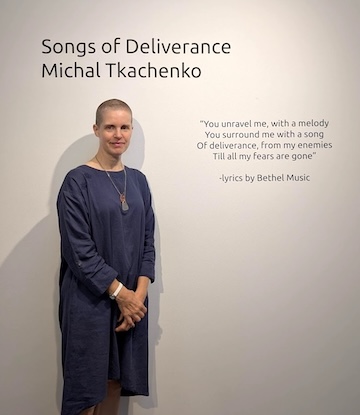
photo - Michal Tkachenko’s solo exhibit, Songs of Deliverance, is at the Zack Gallery until Nov. 10
Michal Tkachenko’s solo exhibit, Songs of Deliverance, is at the Zack Gallery until Nov. 10. (photo by Andrea Lee)

As she approached the one-year anniversary of that week, Tkachenko asked two people to write her a blessing, as she made a vow to God and shaved her head. “One of the blessings,” she said, “included Psalm 63 and it reflected my own deep longing for God, ‘I thirst for you, my whole being longs for you, in a dry parched land where there is no water.’… My hair that I shaved off is part of the exhibition in an aged box that is meant to suggest a holy relic of the past, when people had more vivid experiences with God.

“Psalm 139 is such a beautiful expression of God’s love and absolutely full of beautiful imagery as an artist,” she continued. “It is a psalm that has also kept me company on my two-year journey and moves me every time I read it. 

“For this psalm,” she said, “I made a pile of sketches of different verses and the images that came to me. Of those, I chose seven to do larger pieces on mylar. In many of the pieces, the spirit of God is represented by the white negative space. In ‘You Hem Me in Behind and Before, You Lay Your Hand Upon Me,’ the image of a human is abstracted in a long, dark column down the centre of the page, but the figure is not the focus. Instead, the white empty space is the representation of God hemming that figure in from ‘behind and before.’”

Songs of Deliverance marks Tkachenko’s return to drawing and painting after this two-year period, during which she spent a lot of time writing. “My goal is to make short, layered videos using these writings,” she said.

She also took a break from painting during COVID, making art out of dollhouses that people were getting rid of in the decluttering that took place then. In these dollhouses, she created COVID lockdown scenes in miniature.

“My interest is not held by one medium or one style alone, although I do have a style that often emerges naturally,” she said. “The older I get, the less interested I am in creating what I think others will like or want to buy and more about what I want to say and what I am excited about making and expressing through the medium that seems best suited to that particular message.”

Tkachenko was born in Victoria but grew up in Vancouver. Her dad, an architectural technician, builder and musician, was a Ukrainian immigrant to Canada after the Second World War, while her mom, a teacher, music teacher and musician, was a second-generation Canadian with a Scottish/British background.

“My parents were part of the hippy movement in the ’60s and ’70s and, when I was young, we lived in communal housing,” said Tkachenko, who is the oldest of four sisters.

“Growing up in a big creative household, there were always guests and cooking parties (Ukrainian food), live music and all sorts of art projects going on,” she said. “My parents didn’t push the academics as much because they wanted to make sure we found what gave us excitement and joy and they invested in building our self-esteem instead.”

That said, Tkachenko has a bachelor’s and a master’s in fine arts. For her schooling, she has lived in Vancouver, Victoria, Calgary, Toronto, Florence and London (England). She has lived and volunteered in Haiti, Kenya, Malawi and Liberia, among other places. She has studios in both Vancouver and Manchester, as she, her husband and kids travel between Canada and the United Kingdom.

Despite knowing from a young age that she was going to be an artist, it took time for Tkachenko to recognize her skill and justify making art – “I considered it a luxury item, when the poor existed in the world,” she said.

“My hippy parents had driven us down to Mexico a number of times when my sister and I were young children (we are the oldest two) and we had been taken to the slums to understand how most of the world lived and how, despite our modest life in Canada, we were rich compared to rest of the world. It had made a huge and lasting impression on me as a child.”

At 18, she moved to Haiti to volunteer for a year, she said, “but before the year was out, I was in a life-altering car accident in which a friend died, my skull was shattered and my face smashed in on one side. I was flown back to Canada for reconstructive surgery and to recover.”

She volunteered for a spell in Kenya a few years later, but then finally decided to follow her calling in art.

Tkachenko works out of Parker Studios in Vancouver. She is also on the advisory committee for the DTES Small Arts Grant. “Being on this committee and working out of Carnegie [Community Centre] in the Downtown Eastside joins two things I value – the arts and working among the less fortunate,” she said.

Tkachenko’s husband is Jewish on his mother’s side – “her parents fled Czechoslovakia and Germany for the UK during WWII,” Tkachenko shared.

“Although they purposefully lost a lot of their Jewish heritage during the shift for safety reasons, my kids and I have become interested in it,” she said. “I came from a very open faith background because my parents were hippies that were part of the Jesus People Movement. They always encouraged us to find our own way to God and faith and, as a result, the people I am drawn to with my spirit are varied, from Jewish to Muslim, from Buddhist to Eastern Awakenings. The value of community does go beyond a single group [an idea she explores in one of The Journey series videos she is currently working on] and the more open and loving we become with each other, the more we can appreciate the differences that we each were gifted. And the more we see the bigger picture and what we all have in common.” 

Format ImagePosted on October 24, 2025October 23, 2025Author Cynthia RamsayCategories Visual ArtsTags Michal Tkachenko, painting, psalms, spirituality, Zack Gallery
Unique in style, rich in culture

Unique in style, rich in culture

Kommuna Lux (photo by Maria Dmytrenko)

[Editor’s Note: Due to unforeseen circumstances related to flight restrictions, the Chutzpah! Festival must postpone Yamma Ensemble’s performances to March. However, the festival has found a vibrant alternative for Nov. 5: Itamar Erez Trio and special guests. Click here for more.]

Original music that honours the culture and traditions of its creators. Unique songs that you’d have to travel thousands of kilometres to see and hear live. Or, you could buy tickets to Chutzpah! The Lisa Nemetz Festival of International Jewish Performing Arts, which runs Nov. 1-10.

Kommuna Lux from Ukraine brings its unique “Odesa Gangsta Folk” – which they describe as “thrilling klezmer music and common gangster folk songs from their hometown, all with a dose of rocket fuel” – to Vancouver to open the festival Nov. 2, 7 p.m., at the Pearl. The event is presented in partnership with Caravan World Rhythms. The group will also travel to Victoria, for a Nov. 1 show at the Edelweiss Club.

Kommuna Lux’s music is specific to their part of the world, Volodymyr Gitin (clarinet) told the Independent. 

“What I like most about this style is the special energy that charges both us and our listeners,” he said. “But I also really like how diverse our music is, because it includes almost everything related to the cultural heritage of Odesa.”

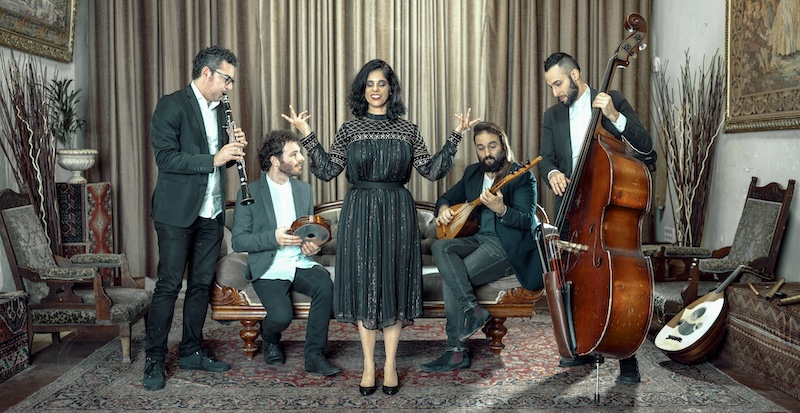
Similarly, Yamma Ensemble from Israel brings its unique heritage-rich music to Chutzpah! – on Nov. 5, 7 p.m., at Rothstein Theatre. They also give an intergenerational matinee performance Nov. 4, geared to school and seniors groups, in which they will “include as many explanations as possible about the ancient musical instruments, about the Jewish communities around the world, about the songs,” lead vocalist Talya G.A Solan told the Independent.

“We wish to celebrate and enjoy the richness and the immense beauty of the Jewish culture and our origins,” she said. “We mainly bring out the mix of Jewish cultures, the mix of our different backgrounds and the fact that we came together into an organic and whole music ensemble…. So, in our music, you can hear the music of Spanish Jews from Thessaloniki and Spanish Jews from Turkey, the singing of psalms by the Jews in Iraq and the singing of religious poems from Yemen.”

photo - Yamma Ensemble
Yamma Ensemble (photo by Zohar Ron)

On the group’s website, they note that Yamma means “toward the sea” in Hebrew and “mother” in Arabic.

“The connection between Hebrew and Arabic is not only a connection between two very similar Semitic languages, but also a connection between the countries of origin of the Jews who lived in Arab countries and their descendants, who were born here and grew up in Israel,” explained Solan. “Our musical heritage, like our origins, is connected to the Jewish communities in the Middle East who immigrated to Israel with the language they spoke, the Arabic language in its many dialects (Yemeni, Iraqi, Moroccan, etc.). They came to Israel and had to speak the local language – Hebrew.”

Hebrew is a central element of the ensemble’s repertoire, directly tied to the members’ identity as Israeli musicians.

“Hebrew is our mother tongue, the language we were born into and the language in which we dream and communicate,” said Solan. “It is an ancient, gorgeous and special language that became extinct and was revived in the 20th century. We try to perform mostly in Hebrew. We mix between our own original creations (always Hebrew) and traditional music (Sephardic, Yemenite).

“There is no Israeli music group that performs out of Israel and has been active for a long time [mainly] performing Hebrew music,” she continued. “This fact is odd and crazy, since Hebrew is the spoken language in Israel, but none of the Israeli musicians active abroad focus on this magnetizing and beautiful ancient language.

“One of the reasons that Yamma Ensemble’s YouTube channel is the most viewed channel of Hebrew music for foreign audiences,” she said, is “the accessibility of Hebrew for foreign audiences who do not speak it. We translate all the songs, so people can watch them with English translation. We receive daily messages from all over the world from people who write us that they learn Hebrew with the songs, that they get closer to their Judaism through the songs. It feels like a serious task that we didn’t ask to take on, and it happened naturally.”

Yamma Ensemble has four albums – Yamma (2011), Basket Full of Stars (2017), Rose of the Winds (2020) and To Awaken Love (2023) – the last of which comprises entirely original music, inspired by traditional sounds, said Solan.

The group is working on an album of psalms. Their performance of Psalm 104 is “the most viewed Jewish chant on YouTube, [in the] category of live and traditional music,” she said. “It has already passed 10 million views! So, we need to record this psalms album.”

However, to produce a recording is an expensive undertaking, and that’s one thing when the music will have a relatively large market. For music “that is not commercial and does not carry profits or compensation, there must be a budgetary basis or significant support,” said Solan. People who are interested may support the psalms project via the ensemble’s website, yammaensemble.com.

Coincidentally, Kommuna Lux’s original name also has to do with the financial side of the music business. 

“Dengi Vpered means ‘Money Forward’ or ‘Cash in Advance,’” explained Gitin. “This name appeared before I was in the group. One day, the guys didn’t get paid for a performance and, since then, they started taking money in advance. At the same time, they named the group that way, with a bit of Odesa humour, and also so that it would be immediately clear how they do business.

“After six incredible years of being together, it so happened that our vocalist decided to go his own way and we needed to figure out how and with whom to continue our journey. Also, for various reasons, we felt that it was necessary to change the name…. So, first we found [singer] Bagrat [Tsurkan], who quickly became a valuable member of our team, and then the name itself came along, which resonated with us very much.

“Kommuna Lux has several meanings,” he said. “One of them is ‘the Commune,’ which is united by the common idea of bringing light and joy to people. But ‘Kommuna’ can also mean a communal apartment in which several families live. In such apartments, there is a shared kitchen and sometimes a bathroom, and people need to agree with each other to live in peace and harmony. And ‘Lux’ in this case has another meaning, as a sign of the quality of how we look and sound on stage, the quality of the luxury level.”

Gitin joined the band, which has one album to date (OdesaFM), in 2014.

“I was attracted by the idea of reviving Odesa songs and Jewish folklore in a new, modern way,” he said. “Everything was created and performed with great enthusiasm and a desire to share positive emotions with people. We felt that we were doing something special.”

And they do something extra special in some of their performances – they raise money for Ukrainians affected by the ongoing war with Russia. 

“Mostly, we collect money for 110 Brigade, they always need different vehicles for different goals,” said Gitin. “Also, during our last tour, we [participated in a] joint initiative of Rotary E-Club of Ukraine to buy beds for burn victims, for a hospital in the city of Kramatorsk in Donetsk region.

“Our whole life is connected with our home and we feel that every Ukrainian joined to help our people,” he said. “So, our reasons are the same, we can’t just watch, we feel that we should do what we can.”

He added, “Music is very important, especially in such periods, because, through it, it is possible to express the whole spectrum of feelings. Music can raise the spirit, unite everyone around a common idea, and also help people experience deep feelings, especially when they lose loved ones.”

Rounding out the musical offerings at Chutzpah! this year is New Orleans multi-instrumentalist Mark Rubin, “offering Southern Americana from a Jewish, socially conscious point-of-view.” Jacob Samuel headlines a comedy night hosted by Kyle Berger, and Jeremy Goldstein’s Truth to Power Café includes stories from Vancouverites in response to the question, “Who has power over you and what do you want to say to them?” A dance double bill features Fortress (Rebecca Margolick and Livona Ellis) and About Time (Ne.Sans Opera & Dance, Idan Cohen). Canadian Yiddishist Michael Wex brings The Last Night at the Cabaret Yitesh (di letste nakht baym yitesh) to the festival, and the Vancouver Jewish Film Festival and Chutzpah! co-present the screening of Gimpel the Fool Returns to Poland by Nephesh Theatre artistic director Howard Rypp, which “follows the show’s journey throughout different towns of Poland, while tracing [Gimpel writer Isaac Bashevis] Singer’s escape from the Holocaust, finally finding refuge in the USA.” 

For tickets to any of the festival events, visit chutzpahfestival.com or call 604-257-5145.

New this year for the Chutzpah! Festival: Jewish Community Centre of Greater Vancouver members receive discounted ticket prices and concession purchases at the theatre. Select Student/Senior/JCC Member tickets and ChutzPacks and bring your membership card to the theatre.

Format ImagePosted on September 20, 2024October 24, 2024Author Cynthia RamsayCategories MusicTags Arabic, arts, Chutzpah! Festival, culture, Hebrew, Israel, Kommuna Lux, Odesa Gangsta Folk, psalms, Talya G.A Solan, Ukraine, Volodymyr Gitin, Yamma Ensemble

The knowledge that we die

Shabbat, Oct. 26
B’reishit, Genesis 1:1-6:8
Haftarah, Isaiah 42:5-43:10

One Yom Kippur, a rabbi was warning his congregation about the fragility of life.

“One day, everyone in this congregation is going to die,” he thundered from the bimah.

Seated in the front row was an elderly woman who laughed out loud when she heard this.

Irritated, the rabbi said, “What’s so funny?”

“Well!” she said, “I’m not a member of this congregation.”

Membership and affiliation aside, the most important lesson we learn in life is that one day it will end: one day we are going to die.

This is the great lesson and gift of the parashah B’reishit, with its iconic tale of Adam and Eve in the Garden of Eden.

Amid all the lush greenery, flowing rivers and natural beauty of the garden, at its centre stood two trees. All of the trees and their fruits were permitted to human beings as food, except for the Tree of All Knowledge and the Tree of Life. We read: “God Eternal then commanded the man, saying, ‘You may eat all you like of every tree in the garden – but of the Tree of All Knowledge you may not eat, for the moment you eat of it you shall be doomed to die.’” (Genesis 2:16-17)

When they eat from the Tree of All Knowledge, the knowledge they get is that, one day, they are going to die. Before the forbidden fruit, they didn’t even know death was part of the equation. Now they know and it scares them – to death. They like the garden: life there is beautiful, they don’t want it to end and, standing right next to the Tree of All Knowledge, is the answer to their anxiety – the Tree of Life. One bite from that fruit and they will live forever. This terrifies God. We read: “God Eternal then said, ‘Look, the humans are like us, knowing all things. Now they may even reach out to take fruit from the Tree of Life and eat, and live forever!’ So the Eternal God drove them out of the Garden of Eden to work the soil from which they had been taken.” (Genesis 3:22-23)

God kicks them out of the garden – not as punishment, but as a blessing. If they think they will never die, then how will they truly live? If you have eternity, then there is no urgency for anything; with unlimited tomorrows, everything can wait.

The German existentialist Martin Heidegger, in his masterwork Being and Time, taught this: he said that, in order to truly live authentically, we have to confront death head-on. In other words, knowing that I am going to die is what allows me to truly live. Heidegger wrote: “If I take death into my life, acknowledge it and face it squarely, I will free myself from the anxiety of death and the pettiness of life – and only then will I be free to become myself.”

But, as Ernest Becker wrote in his Pulitzer Prize-winning masterwork The Denial of Death, even though we objectively know that we are all going to die, we don’t actually believe what we know to be true.

Becker’s work is important because of his astute observation that our obsession with not dying actually gets in the way of our fully living.

We are so focused on outwitting, outlasting and outplaying death, staying in our own Garden of Eden, that we make amazingly selfish choices in life. We set up what Becker calls “immortality systems” – non-rational belief structures that give way to the belief that we are immortal.

For example, we try to buy immortality by accumulating possessions and wealth, as if our things will somehow protect us when death comes knocking. We take on heroic roles in our business or our household: we think that, if we make ourselves indispensable, death can’t touch us. “I can’t die this week; I have a sales meeting on Thursday.”

Judaism suggests a different approach to death and to life. Rather than deny death, Jewish tradition instructs us to embrace it. Judaism teaches that we should live each day as if it is our last because we don’t know, it very well may be (Babylonian Talmud, Shabbat 153a).

Imagine, as God does in this parashah, if human beings directed all the energy they focus on not dying toward the more sacred goal of truly living. How would you fill each moment of every day if you truly knew and understood that you will never get that moment back once it has passed; that it is gone forever?

The psalmist declares: “The span of our life is 70 years or, given the strength, 80 years … and they pass by speedily and we are in darkness; teach us to count our days rightly, that we may attain a wise heart.” (Psalm 90:10, 12)

The wise person, our rabbis teach, counts each day and makes each day count. Knowing that our days are numbered helps us clarify our priorities and our purpose. Our most precious possession is not money or things: you can always get more of those. No, our most precious and finite possession is time.

Henry David Thoreau wrote: “I went to the woods because I wished to live deliberately…. I wanted to live deep and suck out all the marrow of life, to put to rout all that was not life, and not, when I had come to die, discover that I had not lived.” (Walden, reissue edition, Princeton University Press, 2016)

When Adam and Eve are kicked out of the garden, the Torah records the very first thing they do. “And Adam knew his wife Eve and she bore him a son.” (Genesis 4:1) They have a child: the very realization of “I’m not going to live forever” is answered with our best attempt at immortality – progeny.

And so, a final question remains. Where is the true paradise? Is it in the Garden of Eden where no one ever dies and time is limitless? Or is it East of Eden, outside the garden, where every moment is precious, every decision is life-changing and the fruit, sometimes bitter, compels us to appreciate the sweet?

Rabbi Dan Moskovitz is senior rabbi at Temple Sholom and author of The Men’s Seder (MRJ Publishing). He is also chair of the Reform Rabbis of Canada. His writing and perspective on Judaism appear in major print and digital media internationally. This article originally appeared on reformjudaism.org.

Posted on November 1, 2019October 30, 2019Author Rabbi Dan MoskovitzCategories Op-EdTags dying, Ernest Becker, Henry David Thoreau, lifestyle, Martin Heidegger, philosophy, psalms, Reform Judaism, Talmud, Torah
Proudly powered by WordPress