Skip to content
  • Home
  • Subscribe / donate
  • Events calendar
  • Business Directory
  • FAQ
  • News
    • Local
    • National
    • Israel
    • World
    • עניין בחדשות
      A roundup of news in Canada and further afield, in Hebrew.
  • Opinion
    • From the JI
    • Op-Ed
  • Arts & Culture
    • Performing Arts
    • Music
    • Books
    • Visual Arts
    • TV & Film
  • Life
    • Celebrating the Holidays
    • Travel
    • The Daily Snooze
      Cartoons by Jacob Samuel
    • Mystery Photo
      Help the JI and JMABC fill in the gaps in our archives.
  • Community Links
    • Organizations, Etc.
    • Other News Sources & Blogs
  • JI Chai Celebration
  • JI@88! video

Recent Posts

  • SFU honours Gloria Gutman
  • Lifting people’s spirits
  • Wedding a ray of light
  • Indigeneity and Zionism
  • Rule of law broken: councilor
  • Football and its roles
  • The burden of defence
  • Fish Café returns after fire
  • All right in what goes wrong
  • Nuns & mermaids at TUTS
  • Camp offers holiday retreat
  • Students and mentors inspire
  • Once-in-a-lifetime trip
  • 100 dancers, one heart
  • Money for the sciences
  • What “Jewish food” means
  • Have a cookie, schnitzel too
  • Federation now across BC
  • Israel fighting for its existence
  • Deal strengthens Iran
  • Patriotic belonging diminishes
  • A campaign to engage
  • Upstanders’ first live event
  • Responding to Carney
  • Having your own home
  • Music a family tradition
  • Musical to warm heart
  • Community milestones … June 2026
  • Sharing her passion for Israel
  • Or Shalom reopens its doors
  • JFS from past to future
  • Need holistic approach
  • Sharing stories, advice
  • Journalist shares fears
  • Skills to live together
  • Road to independence

Archives

Follow @JewishIndie
image - CJN box ad Rockowers 2026

Tag: gerontology

SFU honours Gloria Gutman

SFU honours Gloria Gutman

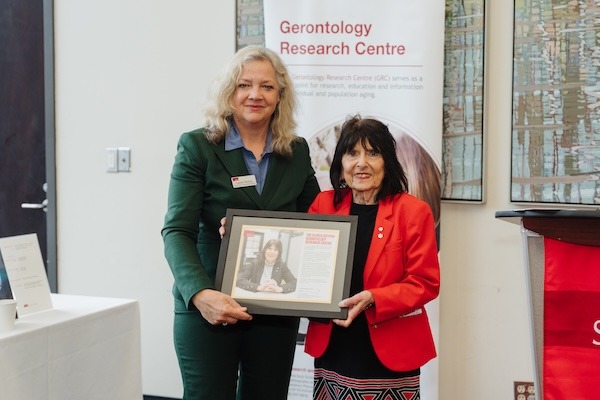
Laurel Weldon, dean of Simon Fraser University’s faculty of arts and social sciences, and Dr. Gloria Gutman at the April 22 reception celebrating the naming of the university’s Gerontology Research Centre in honour of Gutman’s service and lasting impact. The event was held at SFU Harbour Centre. (photo from SFU)

Simon Fraser University has honoured Dr. Gloria Gutman, a pioneer in the field of aging, by naming the Gerontology Research Centre, which she founded, after her. They have also bestowed upon her an honorary doctor of laws. 

This is not the first recognition of Gutman’s work in her areas of research, which include, but are not limited to, seniors housing, health promotion, elder abuse, LGBTQ+ aging, age-friendly hospitals and communities, and advance care planning. She has been awarded the Order of British Columbia and a Queen Elizabeth II Diamond Jubilee Medal, and been appointed to the Order of Canada, the country’s highest civilian honour.

“I really feel grateful for the opportunities that SFU gave me, and the honorary degree in particular – universities very seldom honour their own,” she told the Independent in a recent interview. “Usually, if you look at who are the recipients of honorary degrees, it’s people from elsewhere.”

Almost as a proof of point, Gutman received an honorary doctorate from the University of Western Ontario in 2010 for her work “as an international authority in the field of gerontology.”

Part of the appreciation for such awards is that they highlight her field, said Gutman. “That’s the important thing for me, that it puts the word gerontology, or aging, or the concepts that I’ve worked on, or areas that I’ve tried to work on, brings them forward, gives them visibility. So, the honours are really a way of continuing to promote the organizations, the academic units, that I work for.”

Laurel Weldon, the dean of SFU’s faculty of arts and social sciences, which includes the gerontology department, has known Gutman for a few years. “But,” Weldon told the JI, “I first heard her on the radio being interviewed about Martha Stewart’s cover for Sports Illustrated!”

In 2023, Stewart became the oldest model to be featured on the magazine’s cover. In her convocation address last month, Gutman expressed the goal of a future of “aging without ageism,” which “involves making assumptions about a person’s abilities, values or role in society based solely on age rather than their individual characteristics.”

While their research areas overlap, including on gender and age discrimination, Weldon said, “the real way I’ve got to know Gloria has been as dean of the faculty in which she is a very active retired faculty member, applying for grants, running conferences, giving me her input and background on the department of gerontology and the Gerontology Research Centre.”

By the time the JI reached Gutman for a 10 a.m. Zoom interview on June 18, she had already been a panelist in an international webinar on witchcraft (in the larger context of financial abuse of the elderly) and attended a webinar on the Canadian Longitudinal Study on Aging. It was a typical start to the day for Gutman, who was heading to a FIFA watch party in the afternoon.

“I’m essentially a curious person, and I attend a lot of different webinars, some where I know nothing about the topic, mainly because I want to learn,” she said.

In her convocation address, Gutman talked about “not being afraid to undertake work in an area or sub-area that is unfamiliar. In my case, it was being invited to lead a research project on seniors’ housing. When offered that job,” she recalled, “I blurted out, ‘But I don’t know anything about seniors’ housing.’ I was told, ‘You have 90 days to learn.’ I read everything I could lay my hands on and became a 90-day expert.”

After having been invited to the FIFA watch party, Gutman told the JI she used AI to learn all the fundamentals of soccer and how the World Cup worked – she became “a three-day expert,” she said.

In her knowledge on aging, however, Gutman is a decades-long expert, though she attributes her career choice to happenstance.

“It was serendipitous,” she said of becoming a gerontologist.

Gutman lived in Calgary for some of her childhood – though she was born in Seattle – and her late husband, Gary, was from the city. Because of these connections, she did part of her post-secondary schooling there, at the University of Alberta’s satellite campus (which became the University of Calgary in 1966).

Gutman, who had majored in English and psychology at the University of British Columbia, said she went to the U of A English department and was told, basically, “Why don’t you go home and have a baby?” (She and her husband would have three children.) Her experience with the psychology department went differently. 

Faculty member Dr. A.E. David Schonfield, a pioneering figure in gerontology and the psychology of aging, suggested Gutman do a master’s in the field – and she did.

After about five years in Calgary, the Gutmans moved back to Vancouver. Her husband continued to build his practice as an accountant and Gutman started her PhD at UBC. “At that time, nobody was doing aging, so I had to do it in social and developmental psychology,” which then covered ages 0 to 14, she said.

After finishing her PhD in 1971, Gutman taught Psych 100 for 10 years at UBC. She developed the first psychology of aging course ever to be taught in the province. She was a part-time assistant professor when she asked her dean for a full-time position. He refused, describing the study of aging as a “flash-in-the-pan phenomena.”

“The next day, I called out to SFU, made an appointment with Jack Blaney, who, at the time, was the dean of continuing education, and I went to see him,” said Gutman. “I was called the coordinator of programs in aging, but my first job was to create a program to coordinate.”
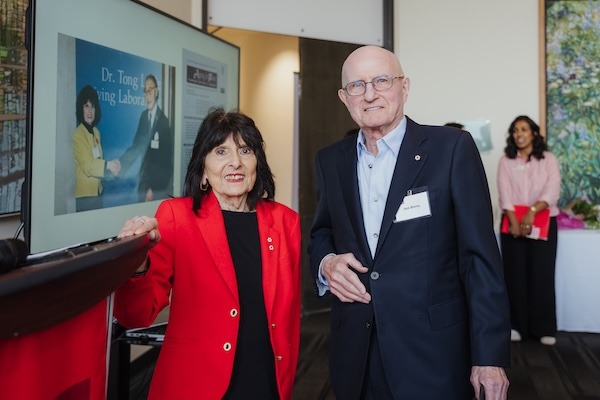
photo - Dr. Gloria Gutman with Dr. Jack Blaney at the April 22 reception at SFU Harbour Centre. Blaney hired Gutman when he was dean of continuing studies at Simon Fraser University
Dr. Gloria Gutman with Dr. Jack Blaney at the April 22 reception at SFU Harbour Centre. Blaney hired Gutman when he was dean of continuing studies at Simon Fraser University. (photo from SFU)

While still at UBC, Gutman had written a proposal for the development of a research centre on aging in response to a call for proposals from the Social Sciences and Humanities Research Council of Canada. The competition was delayed, and there was a second call for proposals when she was at SFU, so she wrote one – the Gerontology Research Centre at SFU was established in 1982.

Gutman also wanted to create a gerontology department, and she did. It began as a post-baccalaureate diploma, grew to a master’s program, followed by the addition of a minor and a PhD.

“I would define myself as an academic entrepreneur,” Gutman told the JI. “The people that have developed research centres, or who have developed a teaching program, tend to have similar kinds of characteristics and part of it is curiosity. And the other is identifying a gap and leaping in.”

And yet another, she identified in her convocation address, is: “You can’t be a one-person show if what you develop is to be sustainable. If it takes a village to raise a child, it takes a team to develop successful academic and research units.”

Despite all her successes, Gutman had to retire after she turned 65, as mandatory retirement was a widespread policy in that era. She was director of the GRC and the department of gerontology until 2005.

“The way the Gerontology Research Centre is structured is that it has a director and it has research associates, so I stepped down as director, but could still be a research associate of the centre,” she explained. “And, having been a full professor in the department, could be a professor emeritus…. But I never used the term for the first 10 years after age 65, because people roll their eyes sometimes when they see it. They figure you’re passé.”

When Gutman wrote the proposals for the research centre, she identified three areas in which it would specialize.

“The first one was housing for the elderly, which is what I had started and where I became the expert at UBC,” she said. “The second one, I looked around the campus, [and asked] who’s doing what? And there was a professor in the criminology department who was interested in crime and victimization of the elderly … and the third one, there was a professor in sociology who was interested in changing demography and lifestyles.

“We started out with those three and, gradually, then I added health and aging when I realized I was a health promoter,” said Gutman. “And, subsequently, I got interested in technology, so we added a fifth theme to the research centre, which was gerontechnology.”

Currently, Gutman – who has held many high-profile roles in national and international associations – is the vice-president of the International Society for Gerontechnology, is on International Longevity Centre-Canada advisory committees and is a member of the Research Management Committee of the Canadian Frailty Network. She has a long list of monographs, articles and books.

“What I said in my convocation address,” she said, “is there are the people that retire and are happy to sit in their rocking chair; the people who unretire themselves and go back to work, but in something different; and then there’s the never-retires.”

She’s in that last category. “It’s still interesting,” she says of her work, “and these issues come up, new issues, every day.”

That said, she makes sure she leaves the house every day. Up at 6 a.m., she usually shuts off the computer by 3 p.m. and goes out to do her 6,000 steps. She watches TV in the evenings. Her six grandchildren, ranging in age from single digit to university-age, don’t live in the city, “so I don’t have access to grandkids here,” she said.

In the Jewish community, Gutman (née Chertkow) was on the original advisory committee to develop the L’Chaim Adult Day Centre. She noted that Leah Deslauriers, who heads the program, is an SFU gerontology grad.

Gutman’s father attended L’Chaim, which brought Gutman back onto the board. “And,” she said, “when my husband [was] in his last years, that was a lifeline for me, as I cared for him at home in his last six months. It was one of the few places that I felt it was safe to leave him…. It gave me respite.”

She also has been on the board of the Louis Brier Home and Hospital, consulted with JQT (Jewish Queer Trans) Vancouver and other organizations. Notably, B’nai B’rith was a family endeavour of sorts.

Weldon, the SFU dean, describes Gutman as “an impressive, energetic, brilliant person. She is great at identifying important research topics and themes and has incredible persistence.”

“I am so happy that SFU was able to recognize and elevate Gloria Gutman in this way,” said Weldon. “It is so well deserved and, in this day and age, it’s wonderful to see someone who has worked hard, been a conscientious contributor and mentor, and who has done so much for her students, colleagues, the university, discipline and community, be recognized.” 
Format ImagePosted on July 10, 2026July 9, 2026Author Cynthia RamsayCategories LocalTags gerontology, Gerontology Research Centre, Gloria Gutman, milestones, SFU, Simon Fraser University
Research in community living

Research in community living

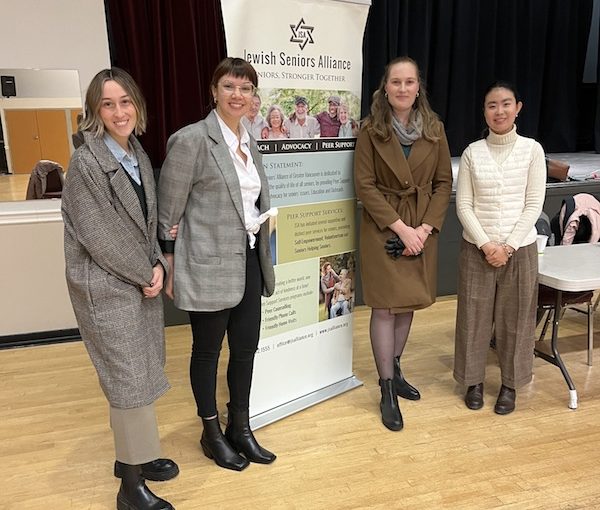
Left to right: Rachelle Patille, Cari Randa, Eireann O’Dea (Jewish Seniors Alliance board member and event moderator) and Boah Kim. (Courtesy JSA)

On Dec. 4, Jewish Seniors Alliance presented their fall symposium: Aging in Place: Gerontology Research in Community Living. The speakers – Rachelle Patille, Cari Randa and Boah Kim – and the moderator, Eireann O’Dea, are all graduate students in gerontology from Simon Fraser University and they shared their research on intergenerational connections, dementia-friendly communities and the role of informal caregivers for older adults.

The event took place at the Peretz Centre but was also available by Zoom. Aside from the JSA annual general meeting, this gathering was the first event presented in a dual format since the outbreak of COVID. Fifty participants joined online and about 20 were present in person.

Tammi Belfer, president of JSA, explained that the JSA’s fall symposium focuses on an educational theme and offers a more serious discussion than other programs. She said JSA wishes to provide outreach, advocacy and education services for all seniors, with the goal being “Seniors Stronger Together.” She then introduced the speakers and turned over the mic to O’Dea, who is a PhD candidate in gerontology at SFU. O’Dea’s interests are in social participation among older adults, particularly in volunteering and intergenerational activities; experiences among ethnocultural minority groups; and generativity. She has been a board member of JSA for three years.

The first speaker, Patille, conducts research focused on “intergenerational opportunities in bridging the gap between generations in Metro Vancouver.” She said she grew up having a lot of contact with her grandmother, and she believes that this fact led to her interest is this field. She defined intergenerational contact as a social benefit that facilitates mutual interaction and exchange between generations, and she discussed factors in society that have impeded such contact; for example, age segregation and geographic divisions among generations that lead to ageism.

Older adults living alone is the number one risk factor for isolation and loneliness, she said. These factors underline the need for connections through programming that will bring older adults into contact with other people, including other older adults. This can be accomplished through such things as home sharing, community programs, tutoring and art projects. These projects allow older adults to be part of the community through participation and mentoring, increasing the person’s feeling of self-worth. For some young people, this may be their first contact with older adults and can lead to reciprocity of social networks.

Patille spoke about generativity, which is the passing down and transfer of knowledge and information 

between generations. She will also be looking at “voluntary kin”; that is, having younger members of society replace missing family for older adults.

The next speaker, Kim, focuses her research interests on integrated care, formal and informal caregiving, continuity of care and healthy aging. One of the difficulties for older adults is navigating complex community and healthcare systems. Two-thirds of older adults have health limitations and thus need a close connection with the healthcare system, she said. A geriatric care manager could be helpful in bridging gaps in services and helping to predict difficulties, she added. Many factors such as age, background or health issues, cannot be changed, but a care manager and caregivers could help with these situations.

The third speaker, Randa, is the project manager of the Public Health Agency of Canada-funded research project titled Dementia-Inclusive Streets and Community Access, Participation and Engagement (DEMSCAPE). The focus is on inclusion of those living with dementia in the 

general community, as 70% live in their own homes. Planned inclusion in neighbourhood design is paramount in creating areas of accessibility, especially outdoor spaces, she said. Randa will be interviewing participants mostly in an outdoor setting to learn their feelings about public spaces with regard to safety and comfort. She is planning a documentary about these issues and the tools available to help, and DEMSCAPE is developing a design and planning guide to aid dementia patients in the community.

In the discussion that followed the presentations, someone noted that many countries are further ahead of Canada in a number of these areas raised. One of these is the availability of affordable home care, which would further facilitate aging in place. Jackie Weiler, a member of the JSA board and also a member of the Senior Advisory Committee for the City of Vancouver, mentioned the idea of a senior planner to promote accessibility. 

Gyda Chud, chair of the program committee, brought the afternoon to a close with a quote from her 99-year-old mother, Gallia, expressing a hope for world peace, diversity, inclusion and social justice for all.

Shanie Levin is a Jewish Seniors Alliance Life Governor. She is also on the editorial committee of Senior Line magazine.

Format ImagePosted on December 23, 2022December 22, 2022Author Shanie LevinCategories LocalTags aging, Boah Kim, Cari Randa, community living, Eireann O’Dea, gerontology, Jewish Seniors Alliance, JSA, Rachelle Patille, science, seniors

What’s up in gerontology?

At the second program of the season in the Jewish Seniors Alliance Snider Foundation Empowerment Series, a few Simon Fraser University graduate students shared their research interests with the 70-plus participants who tuned in via Zoom on Jan. 15.

Jointly sponsored by the JSA and Sholem Aleichem Seniors of the Peretz Centre for Secular Jewish Studies, the Gerontology Research Panel: Eager to Share our Interests and Help our Community – What’s Up With Seniors event featured master’s students Lindsay Grasso and Kishore Seetharaman, and PhD student in gerontology Eireann O’Dea.

Grasso became interested in exploring the impacts of separating couples in long-term care settings when her own family experienced it. She said this problem of separation will become more severe as more couples age together. Current long-term care settings separate couples, depending on each partner’s individual needs.

The effects of dementia on couples is profound and, often, one partner ends up as the caregiver for the other, she said. When the point is reached that institutional care is required, being together would alleviate a lot of the pain, believes Grasso, who has received a grant to look into the long-term effects of separating couples, as well as the effects on visiting spouses, when only one partner is in care. In both scenarios, there is the loss of a shared life, shared memories and the beginning of mourning. It is important to continue the relationship through visiting, sharing activities and eating together, she said. The healthier spouse would need to monitor care and advocate for their partner. For her research, Grasso will be conducting in-person interviews with couples, and will also meet with staff to review their understanding of the issues surrounding separation.

The second presenter, Seetharaman, has a background in architecture and is interested in planning and designing dementia-friendly neighbourhoods, especially in Metro Vancouver.

Worldwide, 70% of dementia-affected adults live at home, so dementia is more than an individual health issue, it is a community issue. Communities must be more inclusive, he said. He would like them to focus on eliminating stigma, raising awareness, social engagement, accessibility to services, improving planning and design of public spaces and support given to caregivers.

In terms of design, he said, familiarity and easy recognition are important. Signs should be clearly visible and easy to read. Distinctive landmarks are helpful for finding the way, he added. There is some work being done in Vancouver in this area but it is not clear as yet how it will be implemented. Seetharaman would like to create a body of knowledge for designers. He is hoping to interview both dementia patients and public servants.

O’Dea is looking into volunteerism and cultural generativity. She became interested in these topics as an undergraduate, when she was volunteering at the Jewish Community Centre of Greater Vancouver and its L’Chaim Adult Day Centre. There, she encountered seniors who were volunteering with other seniors, and she is looking into the benefits on health and sense of purpose in life, as they move away from former roles. The strengths and capabilities of these older adults motivated other seniors to become involved, she noted, adding that each person’s aging process is unique.

O’Dea already has interviewed a number of senior volunteers regarding their motivation. She said many spoke of being motivated by the values of tzedakah (charity) and tikkun olam (repairing the world), and the passing on of Jewish culture. These responses led her to the exploration of cultural generativity, i.e., the desire or need to keep cultural identity alive and pass it down to future generations. This is especially relevant to ethno-cultural minorities, she said, and O’Dea will be researching four minorities: Jewish, Chinese, South Asian and Iranian. She will be studying the effects on both the volunteers and the members of the communities.

During the Q&A session, there were queries about dementia villages; the design and cost of facilities for couples in long-term care; and retention and recruitment of volunteers. The City of Vancouver is apparently looking into an age-friendly action plan that could include persons with dementia.

JSA co-president Gyda Chud reminded everyone about the evaluation questionnaire, then Shanie Levin, program coordinator for JSA, thanked the presenters. The entire program, including the PowerPoint images, is available via the JSA website, jsalliance.org.

Shanie Levin is program coordinator for Jewish Seniors Alliance and on the editorial board of Senior Line magazine.

Posted on February 12, 2021February 11, 2021Author Shanie LevinCategories LocalTags culture, dementia, Eireann O’Dea, gerontology, health, Jewish Seniors Alliance, JSA, Kishore Seetharaman, Lindsay Grasso, minorities, science, seniors, Sholem Aleichem Seniors
Community milestones … Order of Canada, Indspire, SFU Gerontology, JCC Jewish Book Awards

Community milestones … Order of Canada, Indspire, SFU Gerontology, JCC Jewish Book Awards

Rabbi Dr. Yosef Wosk speaks at a Vancouver Public Library event in 2017. (photo by Cynthia Ramsay)

The Order of Canada is one of our country’s highest civilian honours. Its companions, officers and members take to heart the motto of the order: “Desiderantes meliorem patriam” (“They desire a better country”).

Created in 1967, the Order of Canada recognizes outstanding achievement, dedication to the community and service to the nation. Appointments are made by the governor general on the recommendation of the Advisory Council for the Order of Canada. This year, among the 114 new appointees, are Vancouver Jewish community members Dr. Carol Herbert and Rabbi Dr. Yosef Wosk. Each recipient will be invited to accept their insignia at a ceremony to be held at a later date.

photo - Dr. Carol Herbert
Dr. Carol Herbert (photo from schulich.uwo.ca)

Herbert was appointed a Member of the Order of Canada for her contributions to the fields of clinical and academic medicine, as a family physician, medical educator, researcher and administrator. She and three colleagues were appointed.

“The appointment of Drs. B. Lynn Beattie, Joseph Connors, Carol Herbert and Roger Wong to the Order of Canada is a demonstration of their incredible commitment to the health and well-being of all Canadians,” said Dr. Dermot Kelleher, dean of the University of British Columbia’s faculty of medicine and vice-president, health, at UBC, said in a press release. “We are very proud of each of their contributions, and deeply moved by their passion for improving the lives of patients and families here in B.C., and across the nation.”

Herbert, an adjunct professor in the School of Population and Public Health, “is internationally known for her leadership in primary care research, and for her work in clinical health promotion, patient-physician decision-making, and participatory action research with Indigenous communities, focused on diabetes and on environmental effects on human health,” notes the UBC release. “She was formerly head of the department of family practice, founding head of the division of behavioural medicine and a founder of the UBC Institute of Health Promotion Research.”

This only touches on Herbert’s extensive experience. She also was dean of medicine and dentistry at Western University in London, Ont., from 1999 to 2010, was a practising family physician from 1970 to 2013, and has been involved in medical education since 1971.

Yosef Wosk, PhD, was appointed Officer of the Order of Canada for his far-reaching contributions to his community as a scholar, educator and writer, and for his generous philanthropy. BC Booklook (bcbooklook.com/2020/11/27/41941) cites the governor general: “Yosef Wosk is a Renaissance man of the 21st century. A rabbi, scholar, businessman and art collector, he is a revered educator and community activist who inspired many to become engaged in global issues and local challenges. Former director of interdisciplinary programs in continuing studies at Simon Fraser University, he founded the Philosophers’ Café and the Canadian Academy of Independent Scholars. A poet, explorer and dedicated philanthropist involved with museums, the arts, social services, publishing, nature and heritage conservation, he has endowed hundreds of libraries worldwide.”

Wosk has established more than 400 libraries, including 20 libraries in remote Himalayan villages and 37 in Jewish communities throughout the world. (See jewishindependent.ca/many-milestones-for-wosk-in-2019.) He has supported a range of local building preservation, public garden and other civic enhancement projects. He has helped fund the production of more than 250 books and videos, and has written numerous works, most recently Memories of Jewish Poland: The 1932 Photographs of Nachum Tim Gidal and the forthcoming GIDAL: The Letters of Tim Gidal and Yosef Wosk (Douglas & McIntyre, 2021). He supports several literature, writing, poetry, art and design initiatives, and is founding benefactor of the Dance Centre.

In addition to other honours, Wosk has received the Queen’s Golden and Diamond Jubilee Medals and a Mayor’s Arts Award, as well as the Order of British Columbia.

***

As part of its belief in and commitment to supporting emerging architecture practitioners, the Arthur Erickson Foundation and the Yosef Wosk Family Foundation recently announced a $110,000 donation to Indspire – Canada’s national, award-winning Indigenous registered charity – in support of Indigenous youth in Canada. The donation will fund an awards program focused on increasing Indigenous student success by growing the number of Indigenous architects and landscape architects in Canada.

Central to Arthur Erickson’s work as an architect and theorist was his belief in and commitment to education and research. Having served on the faculties of architecture at the University of Oregon and the University of British Columbia, Erickson understood the need of each generation to contribute to the training of the next. One of the ways the foundation honours Erickson’s belief is by working with donors to develop prizes and scholarships intended to reward and assist students studying architecture and landscape architecture.

“The Arthur Erickson Foundation and Yosef Wosk Family Foundation, along with Indspire, are pleased to announce the establishment of an awards program supporting Indigenous education in architecture and landscape architecture,” said Michael Prokopow, vice-president (East) Arthur Erickson Foundation. “The organizations recognize the profound importance of the shared work of decolonization and reconciliation in Canada for the transformation of society. These awards recognize the deep power of Indigenous thinking and wisdom around the making of habitation and space for well-being across generations and the vitally important stewardship of the natural world.”

Mike DeGagné, president and chief executive officer of Indspire, stated, “This new investment is a significant step in supporting First Nations, Inuit and Métis architecture and landscape architecture students to achieve their potential through education and training. They can in turn enrich their communities and create positive change in Canada. We are grateful for the support of the Arthur Erickson Foundation and the Yosef Wosk Family Foundation for investing in Indigenous achievement and education.”

***

photo - Dr. Gloria Gutman
Dr. Gloria Gutman (photo from sfu.ca)

Simon Fraser University Gerontology Research Centre (GRC) founder Dr. Gloria Gutman and her team – Avantika Vashisht, Taranjot Kaur, Mojgan Karbakhsh, Ryan Churchill and Amir Moztarzadeh – received the Best Paper Award at the International Conference on Gerontechnology, held Nov. 25-27. SFUGero tweeted the news Dec. 1, noting that the paper was a “[f]easibility study of a digital screen-based calming device for managing BPSD [behavioural and psychological symptoms of dementia] during bathing in a long-term care setting.”

A brief biography for Gutman, PhD, appears on the conference website. She is president of the North American chapter of the International Society for Gerontechnology, vice-president of the International Longevity Centre-Canada, past-president of the Canadian Association on Gerontology and the International Association of Gerontology and Geriatrics. She is co-editor (with Andrew Sixsmith) of Technologies for Active Aging (Springer, 2013) and has published widely on seniors housing, long-term care, health promotion, prevention of elder abuse, and seniors and disasters. She is on the advisory of MindfulGarden Digital Health and is the principal investigator on the first feasibility clinical studies for MindfulGarden, which is a digital treatment of hyperactive dementia in long-term care setting. She established the GRC and department of gerontology at SFU and is recipient of many awards and honours, including the Order of Canada.

***

The third edition of the Western Canada Jewish Book Awards, presented by the Cherie Smith JCC Jewish Book Festival in Vancouver, took place Dec. 6. Daniella Givon, chair of the awards committee, opened the evening on Zoom and the five honours were awarded by five different presenters.

Winning the Nancy Richler Memorial Prize for Fiction was Rhea Tregebov for Rue des Rosiers, in which a young Canadian woman’s search for her own identity brings her to Paris in 1982, and face-to-face with the terror of an age-old enemy. Tregebov (Vancouver) is the author of fiction, poetry and children’s picture books. She is associate professor emerita in the University of British Columbia creative writing program.

The Pinsky Givon Family Prize for nonfiction went to Naomi K. Lewis for Tiny Lights for Travellers. When her marriage suddenly ends, and a diary documenting her beloved Opa’s escape from Nazi-occupied Netherlands in the summer of 1942 is discovered, Lewis decides to retrace his journey to freedom. Lewis (Calgary) is the author of the novel Cricket in a Fist and the short story collection I Know Who You Remind Me Of.

Ellen Schwartz was awarded the Diamond Foundation Prize for children’s and youth literature for The Princess Dolls, a story about friendship between a Jewish girl and a Japanese girl, set against the backdrop of 1942 Vancouver. Schwartz (Burnaby) is the author of 17 children’s books, including Abby’s Birds and Mr. Belinsky’s Bagels.

The Lohn Foundation Prize for poetry was given to Alex Leslie for Vancouver for Beginners. In this collection, the nostalgia of place is dissected through the mapping of a city, where readers are led past surrealist development proposals, post-apocalyptic postcards and childhood landmarks long gone. Leslie (Vancouver) is the author of two short story collections and the winner of the 2015 Dayne Ogilvie Prize for LGBTQ Emerging Writers.

The Kahn Family Foundation Prize for writing about the Holocaust was given to Olga Campbell for A Whisper Across Time, a personal and moving story of her family’s experience of the Holocaust through prose, art and poetry, creating a multi-dimensional snapshot of losses and intergenerational trauma. Campbell is a visual artist whose media include photography, sculpture, mixed media painting and digital photo collage.

The jury for the 2020 Western Canada Jewish Book Awards comprised Shula Banchik, arts and culture manager of the Calgary JCC; Judy Kornfeld, former librarian at Langara College; Els Kushner, author and librarian; Norman Ravvin, writer, critic and Concordia University professor; and Laurie Ricou, professor emeritus of English at UBC.

After short acceptance speeches and readings from the authors, Dana Camil Hewitt, director of the JCC Jewish Book Festival, concluded the evening thanking the sponsors, the judges, the awards committee and the extended virtual audience, and inviting everyone to purchase and enjoy the books.

Format ImagePosted on December 18, 2020December 16, 2020Author Community members/organizationsCategories LocalTags Alex Leslie, Arthur Erickson Foundation, Carol Herbert, Ellen Schwartz, gerontology, Gloria Gutman, Indspire, JCC, Naomi K. Lewis, Olga Campbell, Order of Canada, philanthropy, Rhea Tregebov, science, SFU, tikkun olam, Western Canada Jewish Book Awards, Yosef Wosk
Constructing age-tech maps

Constructing age-tech maps

Keren Etkin (photo by Pazit Oz)

Keren Etkin, a 32-year-old Israeli master’s student, has been working on what she calls the Age Tech Market Map. This small but full link library is a place for older adults to find the latest news about technology.

“I am a gerontologist by training and tech enthusiast by nature,” said Etkin, who was born and raised in Israel and currently lives in Tel Aviv. “Gerontology is the study of various aspects of aging and gerontologists are either scientists researching the various aspects of aging or professionals working in the aging business.”

While working on her undergraduate degree in the sciences, Etkin began volunteering with Holocaust survivors, which she found a stark contrast to working in the lab. After graduating, she continued further along this path, finding work in the nonprofit sector. But she soon realized that, without a relevant degree, it would be challenging for her to advance her career, which is why she is currently studying for a master’s in gerontology.

“I work at the intersection of tech and aging, which is a very interesting place to be right now, professionally,” said Etkin. “I also run The Gerontechnologist [thegerontechnologist.com], which allows me to explore different aspects of the age-tech ecosystem and talk to many interesting people who do interesting and impactful work.”

Etkin’s first job in the industry was with Intuition Robotics, where she helped develop and build ElliQ, a friendly sidekick for older adults.

“ElliQ was the first big project I was involved with,” said Etkin. “I was recruited to Intuition Robotics in 2016 as the company’s first employee and only gerontologist. That was a very hands-on project that I feel fortunate to have had the opportunity to work on for several years.

“I know there are other gerontologists out there working in or with start-ups or investing in start-ups, and I think that’s a good thing – to have professionals from the aging industry come work inside the tech industry and help build tech solutions for the aging population.”

ElliQ makes it easier to connect to family, friends and the digital world, and helps users stay active and engaged. With it, people can read and respond to messages, share pictures, get reminders about medications, respond to questions and even receive surprise suggestions throughout the day.

“I think incorporating technology into any field of work is beneficial, specifically when it comes to the aging industry,” said Etkin. “There’s a lot to gain, since it’s very labour intensive. Some of the work currently being done by humans could be done by machines – like paperwork and some physical tasks – hence, freeing up humans to perform tasks that require uniquely human skills, such as empathy, critical thinking and creative problem-solving.”

The biggest hurdle Etkin sees in the industry is that most tech companies do not view older adults as potential users. In her opinion, they are missing out on a huge sector.

“Studies show that older adults are adopting technology more and more,” she said. “Internet use is rising steadily and many older adults own smartphones. From my experience, older adults are willing to use technology as long as they find that it’s useful and brings value to their lives.”

According to Etkin’s website, “The global spending power of people 60+ years old is expected to reach $20 trillion by 2020. Americans over 50 are expected to spend $84 billion annually on tech products by 2030.

“Contrary to common belief, most older adults hold a positive perception of technology. Many are eager to learn new tech skills as long as they find them useful. However, most of them admit they require some assistance in setting up and learning to use new devices.

“A report by the Pew Research Center found that 42% of older adults in the U.S. own smartphones and that 67% use the internet. Baby boomers spend an average of 27 hours a week online.”

Etkin began working on The Gerontechnologist in 2017. At the time, she was just looking for was a snapshot of the ecosystem and she was curious to learn what other people in the field were working on.

“After spending many, many hours doing online research, I came to the conclusion that there was no age-tech market map out there and so I decided to create it myself,” said Etkin. “After publishing it online, I got a lot of feedback and realized that other people were also interested in this. I also realized that I enjoyed creating content about age tech, and it sort of took off from there. The blog today serves anyone who’s interested in tech for older adults.”

This past summer, Etkin started posting podcasts and video series on thegerontechnologist.com, and she plans to keep working on projects that she is passionate about and that she thinks bring value to the world.

Etkin is working on the 2020 Age Tech Market Map. In the process, she will evaluate more than 2,000 service providers and choose the top 200 for the map.

“I would love to hear about Canadian start-ups developing tech for older adults,” said Etkin. “You can reach me through the contact page on my website or message me on LinkedIn and Twitter.”

Rebeca Kuropatwa is a Winnipeg freelance writer.

Format ImagePosted on December 20, 2019December 18, 2019Author Rebeca KuropatwaCategories IsraelTags business, ElliQ, gerontology, internet, seniors, technology
Proudly powered by WordPress