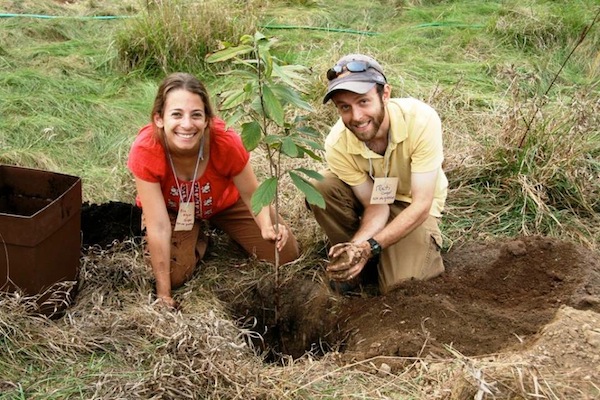
Shoresh executive director Risa Alyson Cooper and Mati Cooper plant a tree. (photo from Shoresh)
Risa Alyson Cooper, who was raised in the Toronto suburb of Thornhill, was road-tripping across the country with a friend about 20 years ago when they ran out of cash in Nelson, B.C. That misfortune changed the course of her life – and is making a big impact in Canada’s Jewish community.
“We were invited to a free church dinner for homeless and struggling individuals and we decided to go,” Cooper said of the adventure. “That was, for me, one of those aha moments. It was the first time that I thought religion might have what to say about the food that we eat.”
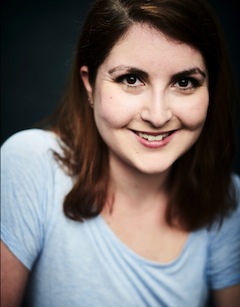
Cooper is now executive director of Shoresh, a Toronto-area charity that “inspires and empowers our community to take care of the earth by connecting people, land and Jewish tradition.” Cooper is one of four speakers at FEDtalks Sept. 9, the annual campaign opening event for the Jewish Federation of Greater Vancouver.
The church supper made her think about something that hadn’t really struck her before.
“I wondered if Jewish tradition has anything to say about food,” she recalled with a laugh in a recent telephone interview. “It was the first time that I really started thinking about food ethics. I’d grown up Jewish, I knew that food was so much of an anchor of Jewish observance, [that] my family’s Jewish identity was about meals to celebrate holidays, but I never really thought about the moral values that we can express through the food that we eat.”
She quickly discovered that Jewish tradition has a great deal to say about food and the moral, social and ethical issues around it. Agriculture is so intrinsic to the ancient texts that, Cooper said, a friend refers to Torah as “the Jewish Farmer’s Almanac.”
“It has very clear rules for how we farm, what we plant, where we plant, when we plant, and it also has rules beyond that,” she said. “It has rules for how we celebrate the harvest, how we hold gratitude for that which we receive from the land, and it also has very, very clear rules about how we share our resources with others in our community.”
There have been a number of Jewish “back to the land” movements – the most consequential being Zionism – but, on the shoulders of all this history, there is something new happening today.
“The idea of there being a Jewish way of thinking about food security is as old as Jewish tradition,” she said, “but what we are seeing now are really innovative ways of addressing food insecurity and also building vibrant Jewish communities”
Shoresh (the name is the Hebrew word for “root”) operates Kavanah Garden, adjacent to the Jewish Community Campus in suburban Vaughan, Ont., and invites children and adults to “participate in experiential programs rooted in Jewish text, tradition and values, and [is] designed to elicit experiences of awe in response to the wonders of the natural world.” Food grown at the garden is used in programming or donated through tzedakah partnerships.
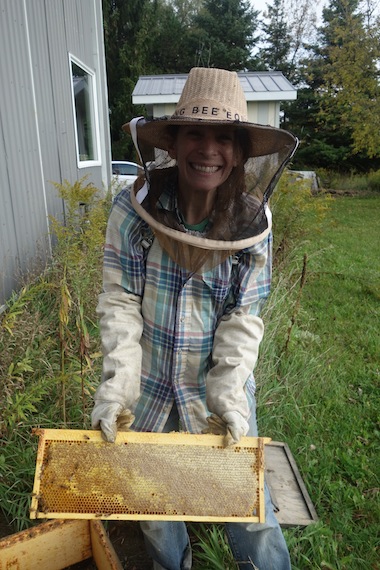
Risa Alyson Cooper beekeeping. Shoresh’s Bela Farm, in Hillsburgh, Ont., is home to an apiary and bee sanctuary. (photo from Shoresh)
Shoresh also operates Bela Farm, in Hillsburgh, Ont., a little further outside Toronto. This 100-acre farm, home to Shoresh’s apiary, bee sanctuary and native reforestation efforts, offers “deep, immersive experiences for land-based Jewish learning and living, creating for participants sustained connections with self, community and the earth.”
Their third location is Maxie’s Garden, a partnership between Shoresh and Jewish Family and Child, located in the Kensington Market yard of a Shoresh member. Here, an urban sanctuary in the heart of Toronto’s historic Jewish neighbourhood is “a haven for people, plants and pollinators.” It was envisioned to empower, educate and inspire clients of the social service agency through the power of nature connection and food production.
Beyond these three sites, Shoresh runs programs out of schools and camps, and in green spaces, parks and ravines throughout Toronto.
Cooper’s own agricultural journey, which began here in British Columbia, led her to a master’s degree in which she looked at religious food and environmental ethics. Then she went to Connecticut, where she worked for three years as a Jewish environmental educator at the Teva Learning Center, the only full-time, year-round program dedicated to innovative, experiential Jewish education taught through the lens of the natural world.
She got her hands even dirtier in small-scale organic farming as a member of the Adamah Jewish Farming Fellowship. She grew vegetables on a four-acre farm, worked in a raw goat-milk dairy and dabbled in the art of fermentation.
“I was so deeply in love with the community that I discovered in the States I probably would have stayed there but I had my visa revoked and I got sent back to Canada,” she said, laughing again.
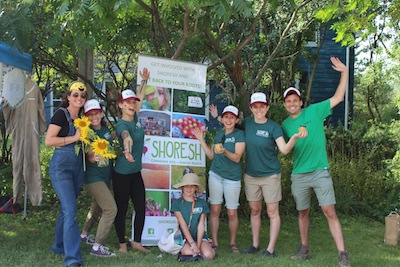
The Shoresh team. (photo from Shoresh)
Living out Jewish values on the land in the Diaspora raises particular issues, Cooper said.
“What does it mean to be holding a tradition that is in many ways land-based,” she said. “So much about the Torah, so many of our holidays, have agricultural connections. What does it mean to be having these land-based traditions and to be practising them in Canada? How do we honour the elements of our tradition, while honouring the fact that not only are we in the Diaspora – so not on the land where many of these traditions are rooted – but we are also specifically here on Turtle Island, this land that has been stewarded by indigenous communities for thousands and thousands of years?”
In Vancouver next month, Cooper said, she will talk about contemporary Jewish food insecurity issues and will share something about the model that Shoresh has developed, as well as ideas spawned from similar organizations across North America.
Everything she shares at the event will owe a debt back to that fateful visit to British Columbia’s Kootenay region.
“That was the moment that I can trace all this back to,” she said.
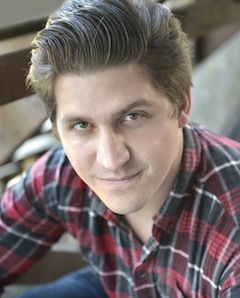
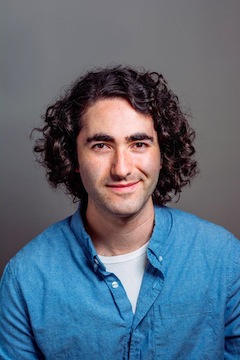
Other speakers at FEDtalks, which takes place at the Vancouver Playhouse on Monday, Sept. 9, at 7 p.m., are National Young Leadership Cabinet member Dr. Gillian Presner, who will offer “hard-earned wisdom about the power of community and the nature of our true legacies”; Rabbi Brian Strauss, whose Houston, Tex., synagogue and home were flooded by Hurricane Harvey and who subsequently witnessed an outpouring of support from Jewish federations across the continent; and Isaac Herzog, chairman of the Jewish Agency for Israel and former longtime politician, who led Israel’s Labour party and was opposition leader from 2013 to 2018 (featured in the other cover story in this issue).
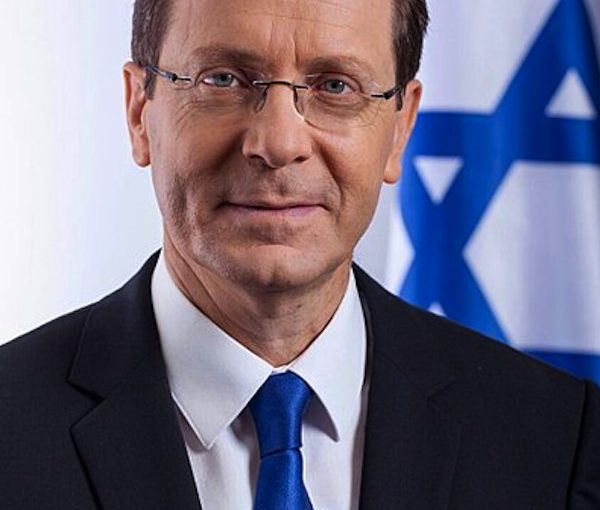
Isaac Herzog, chairman of the Jewish Agency for Israel. (photo from JFGV)
Isaac Herzog was elected chair of the Jewish Agency for Israel in August 2018. The past year has seen him hit the ground running in the unique role as head of the sprawling organization whose mission is to “inspire Jews throughout the world to connect with their people, heritage and land, and empower them to build a thriving Jewish future and a strong Israel.”
In Vancouver Sept. 9, Herzog will share some of his experiences in this new role. He joins three other speakers at FEDtalks, the opening event of the Jewish Federation of Greater Vancouver’s annual campaign.
“I’m looking very much forward toward my visit, especially in Vancouver, where I for a long time wanted to meet the community,” Herzog told the Independent in a telephone interview from Israel. “I hear wonderful [things] about the strong stance of Jewish purpose and Zionist feeling in this community.”
Founded in 1929, the Jewish Agency is, said Herzog, “a great Jewish story.”
“We are the biggest Jewish organization in the world. We founded the state of Israel. We brought millions of olim, immigrants, to Israel,” he said.
In this generation, the agency has focused heavily on issues of safety and well-being for Jews worldwide, as well as encouraging aliyah and advancing Jewish identity and continuity through education, youth exchange programs and partnerships between the Diaspora and Israel.
Part of his role, he said, is to impress on Israelis the reality of the diversity of the Jewish world. He tells political leaders and rabbis in Israel that they have a “huge lack of knowledge” about the Diaspora and its pluralistic nature and the commitment of Diaspora Jews to Jewish knowledge, writing and education. Similarly, he said, he wants Diaspora Jews to have a realistic view of Israel.
“I expect world Jewry to know that Israel is not what you read in the New York Times, for example, or in Ha’aretz. It is a much more elaborate, developed, interesting, multifaceted, multicultural and incredible place that needs to be nurtured,” he said. “All these challenges are something that I have focused heavily on as a major leader of the Jewish people.”
An important focus of the Jewish Agency’s work right now is with young Diaspora Jews who are disaffected or disengaged from Israel or Judaism, or both.
“That’s a major challenge, of course,” he said. “We are developing programs that will rekindle the Jewish identity within alienated millennials, such as the whole idea of tikkun olam, healing the world, whereby we have programs all over the world where we take young Jews to volunteer, also in non-Jewish communities, in inner cities and Third World countries, as a venue for those who don’t want to be involved directly with Jewish activities.”
Herzog took the helm at a critical juncture.
“We are now in a major change process in the Jewish Agency,” he said, an ongoing development that will see a shift in priorities, changes in the organizational structure, some different areas of focus and new programs.
He added that this is not a path the agency is taking by itself.
“We can’t do everything alone,” said Herzog. “We work with partners and partnerships for specific purposes. This is a very exciting process in the 90-year-old organization.”
He stressed that the Jewish Agency has got a great number of things right over its nearly a century of activity.
“This is another chapter in the life of this organization,” he said. “It’s an exciting new chapter because of the challenges of the era.”
In addition to challenges presented by the younger generation, Herzog cited the need for dialogue that involves all streams of Judaism and all kinds of practices.
“We believe in the right of every Jew to live as a Jew wherever they want to live and [to] practice whatever kind of Judaism they want to practice,” he said.
Prior to assuming the leadership of the Jewish Agency, Herzog was a leading political figure, having served in five Knessets, having held five cabinet roles, including ministry of Diaspora affairs and ministry of welfare, and, from 2013 to 2018, being leader of the opposition as chair of the Labour party.
“I’m going to be in Vancouver just about a week before the election, 10 days before the Israeli election,” he said, acknowledging that sitting this one out feels different. “I cannot say that the bug is not with me. I’m fully attentive to what’s going on in the Israeli elections. People consult with me, but I took upon myself a new historical role of serving my nation, my people, in a different way.”
His priority now, he said, is to ensure that the Israeli body politic realizes the importance of the Jewish Agency’s mission and that these priorities are priorities for the next government, whoever forms the government after Sept. 17.
Herzog’s lineage of history-making Jewish leaders is widely known – his grandfather, Rabbi Yitzhak Halevi Herzog, was chief rabbi of Ireland and then Ashkenazi chief rabbi of Israel; his father, Chaim Herzog, served two terms as president of Israel. But, in speaking with the Independent, Herzog stressed his Canadian bona fides.
His uncle, Yaakov Herzog, was ambassador to Canada in the 1960s. His cousin, Shira Herzog, who passed away five years ago, served as head of the Canada Israel Committee for a decade and was involved in a range of Jewish and non-Jewish philanthropic works across Canada. Herzog’s wife, Michal, who is joining him on this summer’s trip, graduated school in Canada.
The Vancouver stop is part of a cross-Canada tour, in which he will also visit Montreal, Toronto and Calgary. In each place, he said, he will visit schools and federations and meet with leaders and communities. The Jewish Agency, he said, supports Jewish organizations, youth movements and infrastructure, beyond the shlichim, emissaries, the agency facilitates in sending from Israel to Diaspora communities.
Janoah Bailin in SpinS. (photo from Janoah Bailin)
In anticipation of this year’s Vancouver Fringe Festival, which runs Sept. 5-15 at various locations throughout the city, the Jewish Independent interviewed some of the Jewish community members participating in the festival – Janoah Bailin, Erika Babins, Jed Weiss, Zach Wolfman, Melanie Gall, Susan Freedman and Shane Adamczak. They hail from as far away as Australia and their shows are vastly different, but they all have the same goal: to draw you into their world, perhaps allowing you new insights into yours.
* * *
SpinsS, at the Nest:“A wildly dizzying whirl of juggling, giggling, magic and movement, puppetry, PJs, circus and socks, totally tangled together! A unicyclist careens on stage, unpacking a quirky world of clothespin towers, erratic toothbrushes and gargantuan grins. Objects swirl into chaotic creation as Janoah constructs a performing-partner puppet from piles of props!”
Clothespins are “a recurring object in the performance,” Janoah Bailin told the JI. And so are, from the looks of it, some dangerous manoeuvres. But looks are intentionally deceiving, in order to entertain.
“I’ve actually never been seriously injured doing my work!” said Bailin. “Some stubbed toes and scraped elbows, sore wrists from catching myself, but nothing major. The worst is taking a pedal to your shin. When you learn unicycle, you learn falling. It just happens, you develop an innate sense of what you can and can’t comfortably do. I know how to fall and it happens all the time and I get up, shake it off, try again.
“This show plays with limits and bringing the skills to their limits – I expand or contract juggling patterns until I physically can’t hold them anymore and there’s a spin I do on the unicycle that spirals in on itself until I fall. So, falling is inherent in the show and I need to know how to do it well.
“I think I forget that audiences don’t know this,” he said about his being safe during his act. “So they are a lot more scared for me than I am, which is part of the magic of circus: faking instability, making something seem more chaotic than it is. The most dangerous stuff is long-term: keeping your body healthy through the strain of performing every day, the bipolar energy of performance – being totally on for an hour, all your energy focused on that one thing. The solutions to this are getting really good at physical self-care: know how and when to rest and stretch. The hardest work is taking care of my body in the long run.”
Bailin understands the use of the word “escapism” to describe his show, but said his goal is to bring audiences into his world for an hour, and “that seems like incredible presence, not escaping.”
Playful is another common description of SpinS.
“One of the aspects of my show that I’m incredibly proud of is that even fellow performers find the show playful,” said Bailin. “A lot of circus can start to look similar in the tricks and how they’re presented and, in certain ways, I aim to break those forms and I think I’m successful.
“Play is so important, and I mean play in the sense of creating space, pushing boundaries, trying things out. In my opinion, getting locked in routines is quite dangerous and play is a solution to this. Circus can seem quite playful, but it’s incredibly repetitive, the tricks are so hard they take an incredible amount of practice, so, by learning them, we make ourselves routine. I try to counterbalance this by choreographing at the edge of my ability – I can’t comfortably do all the things I do on stage, so they remain alive because I need to concentrate and there’s a very real danger that they won’t work and then I need to find a different solution – and also by choreographing through games, playing games on stage – how can I unpack a suitcase without getting off the unicycle?”
Bailin started juggling when he was 10, so he’s been at this for some 20 years now.
“I’m at the point in juggling and unicycling where I’ve mastered the basics and get to develop my own style,” he said. “So, I’m watching and feeling myself do the skills and how I can integrate my personality into them…. Also, I am continually excited about the challenge of piecing together shows, taking all the bits and fitting them together into something cohesive through all the disciplines I work with: circus, dance, puppetry, storytelling, magic.”
* * *
Lift, at Firehall Arts Centre:“Lift is a contemporary musical set in London’s Covent Garden Tube Station. The elevator ride takes one minute, but the journey inside takes us through eight lifetimes, allowing the characters to see and say things that might not otherwise … come up.”
“As a company, Awkward Stage is always looking to tell stories that haven’t been heard yet and, like many of our productions, Lift will have its Canadian première with us at the Fringe,” choreographer and Awkward Stage Productions artistic associate Erika Babins told the JI.
Erika Babins (photo from Awkward Stage)
“I think what drew us all into this story was the way that it was told. It intrigued us, the way the play bends reality and imagination. Our setting never changes but changes constantly, the characters are all rich relationships yet are strangers. We are constantly playing with those dichotomies in rehearsal.
“The script leaves a lot of room for interpretation and we’re so lucky to be working with a cast of brave and intelligent actors who are making discoveries with us as we build this show. Plus, the music is beautiful; it’s been stuck in my head for months.”
Choreography is integral to the show. It helps delineate the imagined settings to which the elevator riders take us. “The jostling of a train, warming up at a ballet studio, being at a strip club. It also helps to blend the lines between reality and the imaginings in the Busker’s mind,” said Babins. “The choreography in this show is quite integrated into the storytelling – there aren’t any ‘dance sequences’ per se, the movement weaves itself into the text and music.”
Jed Weiss plays the Busker, who he describes as “the quintessential introspective artist.”
Jed Weiss (photo from Awkward Stage)
“This leaves him both capable of deep insight as well as myopic self-centredness,” explained Weiss. “His arc is largely around learning and accepting that he has to be more considerate of the needs and lives of the people around him, leading him to a profound personal growth that his self-centred introspection could not achieve. This connects with the theme of the piece as a whole, highlighting the need to be brave in the face of vulnerable social interaction, to make meaningful connections with those that are important to you.”
The character, he added, “shines light on the shortcomings of the artistic male archetype we so often see in rom-coms and other media. Instead of following the stereotypical path of a tortured artist pining after a muse until she falls for him, it shows that real growth comes instead from practising sympathy towards the needs of others, not a commitment to romantic obsession.”
“I am playing Tall Dark and Handsome (TDH), a psychiatrist, and an American tourist,” said Zach Wolfman. “TDH is the dating avatar for Bright Young Thing (BYT) and represents BYT’s online persona. The American tourist is lost and looking for directions in London, hoping to bump into the Queen and visit Buckingham Palace.”
Zach Wolfman (photo from Awkward Stage)
For Wolfman, the character he plays allows him “to explore the dissonance between the face we show online versus how we act in real life. Getting to embody that daily interaction we all engage in online is fun for me.
“The play as a whole is very dynamic,” he said, “and I really enjoy the fast pace and shifts we make between different settings. One minute, we’re in a lift; the next, we’re in a club or a chat room. Lift definitely highlights the different masks we wear at work, online and in our relationships. How vulnerable are we and how willing are we to open ourselves up to those who are close to us, or simply strangers in a lift?”
“I hope the audience leaves the theatre with a little wonder,” said Babins. “I hope they wonder about what happens to the characters after the moments we meet them in, but I also hope they wonder about themselves, and the connections and disconnections they have every day.”
* * *
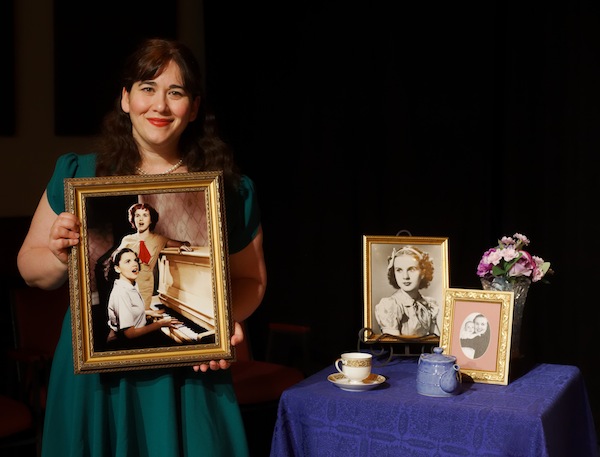
Melanie Gall brings Ingenue: Deanna Durbin, Judy Garland and the Golden Age of Hollywood to Vancouver. (photo from Melanie Gall)
Ingenue: Deanna Durbin, Judy Garland and the Golden Age of Hollywood, at Firehall Arts Centre: “Judy is an icon – loved as Dorothy in The Wizard of Oz. But, in the 1930s, Deanna Durbin was a far bigger star. A favourite of Roosevelt, Churchill, even Mussolini, her first kiss was front-page news. At 27, she disappeared to a life of obscurity in France. The true tale of the lifelong friendship and rivalry of two great stars of Old Hollywood.”
“I’ve always loved Deanna’s music and her movies. We have similar voices and look vaguely the same. Also, Deanna is a Canadian movie star who has almost completely been forgotten,” said Melanie Gall. “Her legacy is one well worth saving, and I hope that my show will help preserve her memory for old fans, and will introduce her and her music to a new generation.”
Always fascinated with history and with historic music, Gall has written and performed shows about Vera Lynn, Edith Piaf, Jacques Brel, George Gershwin, and First and Second World War knitting songs. In creating a new work, she said, “First off, I think about the music. What are the songs I’d like to sing, and which songs will stay interesting and relevant to me after over a year of touring?
“I then look at marketability and if a topic I’m considering will have commercial appeal. I then ensure that it has not been done before, or that it has not been done in a similar way to how I plan to present the topic.
“I also try to find a topic I feel passionate about and that I’d like to share through a theatrical piece.
“Finally, I try to judge if I’m the best person to present the topic. Do I sing in the correct style? Can I do the topic justice?”
For Ingenue, said Gall, “I was performing another show of mine, Opera Mouse, Off-Broadway in New York. After performing each day, I went to the New York Performing Arts Library and dug through historic clippings, notes and scrapbooks. I spent days combing through crumbling articles and building a comprehensive biography of Deanna Durbin. Researching Deanna’s mannerisms and speech involved tracking down and watching all of her movies, most of which are actually very hard to find.
“Researching the music involved listening to and playing through dozens of songs to choose the tunes for the show. Then, with the help of pianist and recording engineer Bennett Paster, I arranged and recorded the backtracks, maintaining historic integrity, while creating original arrangements. Much of the script is taken directly from interviews and articles about her life, and several sentences are accurate historic quotes. So, it’s a lot of work, but it’s work I love doing.”
Preserving history is a passion. “So much wonderful music and stories are in danger of being lost or forgotten, and I have devoted my life to preserving them. Although Deanna Durbin wasn’t Jewish, the producer and director who made her a star, Joe Pasternak and Henry Koster, were Jewish – they arrived in Hollywood after years of working in the Berlin Universal studio, fleeing in 1933 when Hitler came to power. Also, the composers of most of Deanna Durbin’s songs were Jewish. So, there is a strong connection.”
* * *
Old-ish, at the Havana Theatre:“It’s about aging and death only WAY funnier! Susan’s fifth one-woman comedy travels the hilarious, rocky road from denial to grudging acceptance of getting older.”
“I guess I’ve been ‘collecting data’ for this show for a long time,” said Susan Freedman, 77. “For about the last five years, whenever I hear news about my contemporaries, it is mostly not happy! The realization finally dawned that people do get really sick at my age and, yup, they die at my age too. I always write about issues and events that are important in my life and I always hope that my stories will resonate with audiences who may be experiencing similar events and feelings.”
Old-ish is Susan Freedman’s fifth one-woman comedy. (photo by Alan Silverman)
The show is structured around events in Freedman’s life that lead into one another thematically and more or less chronologically.
“I have had so much fun working with my son (Alan Silverman) on this show,” she said. “This is the first time he has directed me, though he is an experienced film director. He is smart, he’s a great writer and he has a terrific sense of humour. Do I sound like I’m his mother?
“I have worked with my husband (Bill Galloway) on all five of my shows. He is stage manager – calling the lights and music – on this show and he has been stage manager or slide projectionist on the others. He’s a huge help and support for me and, as I travel across the country with my shows, I get to have him as a roommate on the road! We have a great time traveling together.”
This Fringe marks Freedman’s 20th year of writing, producing and performing solo Fringe shows. When she did her first show, in 1999, she said, “my mother was still alive and I was sure she would live forever, so I certainly didn’t think of myself as old. I am frankly shocked that I’m the age I am. Like most of my friends, I have no idea how the years could have raced by so fast! There are lots of changes as we age, but there are still so many things we can do and enjoy and so much that makes life worthwhile. I am enjoying the good luck of being healthy, although I’m aware that can change on a dime.”
Admitting that she was nervous “about doing a show on aging and death,” she said, “but we are all aging and, if we’re lucky, we will get old. Critics are saying the show is uplifting. So, even though getting old can certainly present us with plenty of problems, it’s always good to laugh – right?”
* * *
Zack Adams: Love Songs for Future Girl, at Revue Stage:“… love, loss, heartbreak, growing bad ginger beards and everything in between. Think of it as a cross between a rock concert and group therapy.”
Shane Adamczak shares his heartbreak in Zack Adams. (photo from Shane Adamczak)
Shane Adamczak actually has two shows in this year’s Fringe. “Zack Adams got through because I won the lottery and The Ballad of Frank Allen is a one-off performance that the Fringe asked us to do as part of their Pick Plus season, where they bring back popular shows from previous years,” he explained.
The Ballad of Frank Allen, which is on one night only, at Performance Works, is “about a janitor named Frank who is accidentally shrunk in a science lab and ends up living in another man’s beard,” said Adamczak. “Yes, that is really what it’s about. It’s an exploration of masculinity in these modern times and what it means to be a ‘good man.’”
Adamczak uses music to tell his stories.
“I find it is such an accessible medium for people,” he said of that choice. “You’re so hard-pressed to find someone who doesn’t love some music at least. It’s also a way for me to live a rock star wannabe fantasy out on stage but using music as a theatrical device to tell stories.”
Both of these shows, he said, “are labours of love and very close to my heart for different reasons. If you love music, good storytelling and to laugh your ass off, please do come along.”
Okanagan Jewish Community Association president Steven Finkleman explains Jewish prayer books. (photo by Don Plant)
It sounds like a joke – a Muslim and a Jew walk into a Tim Hortons. But there’s no ethnic punch line in this story. As representatives of their congregations, Rehan Sadiq and Philippe Richer-Lafleche met over coffee several times to arrange a get-to-know-you gathering of their communities. After decades of living in Kelowna, B.C., but seldom rubbing shoulders, members of the Muslim and Jewish faiths decided to learn about each other’s history and culture by visiting their respective places of worship.
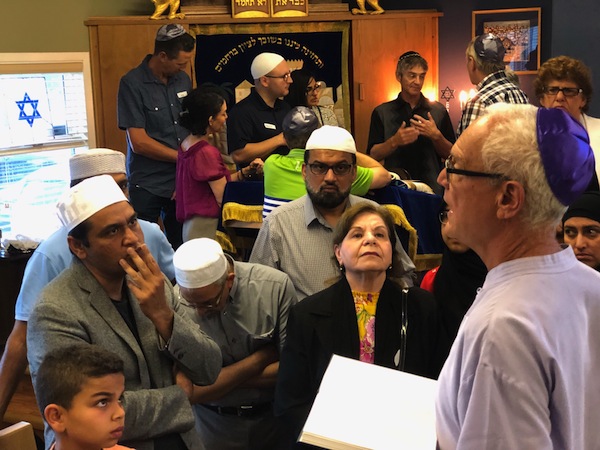
Their latest encounter in Kelowna’s main synagogue included a briefing on the Jewish faith and a close-up look at the Torah. Sixty people, more than half of them members of the Kelowna Islamic Centre, listened to a Hebrew psalm as they sat in the sanctuary of the Okanagan Jewish Community Centre in June. In exchange, board member Hassan Iqbal recited from the Holy Quran and his teenage son Musab Hassan sang prayers in Arabic.
The gathering followed a similar event in February, when Muslim members hosted a contingent of Jewish visitors at a get-to-know-you function in their new mosque in Kelowna. Both communities share the will to look past the history that divides them and forge a longstanding friendship. [See jewishindependent.ca/okanagan-interfaith-initiative.]
“The last thing I want our children to learn [about our relations] is from the news,” Sadiq, the mosque’s interfaith director, told both congregations in June. “This kind of meeting is extremely important. We should talk about building bridges.”
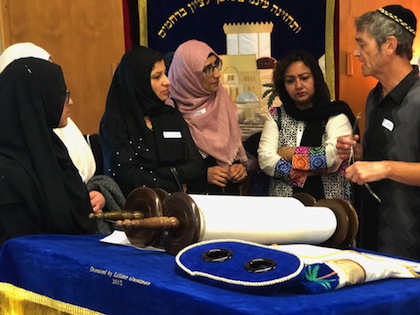
Organizers circulated the visitors through three stations at the synagogue to inform them about the basics of Judaism. OJC members showed them the Torah, explained the prayer books, interpreted symbols of the synagogue and demonstrated artifacts.
Members of the Muslim community in Kelowna listen to Evan Orloff explain the Torah. (photo by Don Plant)
Once everyone sat down, lay leader Evan Orloff sang a psalm to the tune of Leonard Cohen’s “Hallelujah.” OJC president Steven Finkleman discussed the importance of loving your neighbour as yourself. Grant Waldman and Annik Moyal-Waldman sang Shalom Aleichem, the Hebrew phrase for “peace be upon you.”
Once Islamic Centre president Mostafa Shoranick made a few remarks, Finkleman announced, “Let’s eat,” and everyone lined up for a lavish buffet of Middle Eastern dishes. People mingled as they ate and at least one group of Muslim and Jewish women agreed to meet again. Over dessert, Sadiq and Finkleman led a discussion on which charities both faith groups could jointly support.
“I really think peace in the world will come on a one-to-one basis. It’s not governments [that generate it],” Richer-Lafleche, whose Jewish and Muslim grandparents married in Morocco, said in February. “It’s within small communities that you actually get to know people…. We make choices. We can choose to be loving or otherwise.”
The Muslim community is trying to educate the public and its own members about what true Islam is, said Shoranick, who grew up in Lebanon. Many in his Muslim community are new to Canada and want to assimilate, he said. “We come from different countries and different sects. We believe that, in this country, we’re lucky that we’re able to do our religion…. The religion is for God but the country is for everybody.”
Both groups have discovered they share several monotheistic beliefs. Among them:
the greetings “salaam” and “shalom” are virtually the same;
Islam and Judaism regard Abraham, Isaac, Jacob and Moses as prophets;
neither religion proselytizes or compels anyone to adopt their beliefs; and
both agree it’s wrong to judge people, and how you worship is up to you.
“It’s not our differences that get in the way; it’s how we perceive our differences,” Orloff said.
Don Plantis a retired journalist and member of the Okanagan Jewish Community in Kelowna. This article was originally published in the CJN, cjnews.com.
The sentencing of a notorious hate promoter in Toronto last week is, in some ways, evidence that our country’s laws and norms against targeting identifiable groups are working.
James Sears, editor of Your Ward News, a propaganda sheet distributed periodically to 300,000 households in Toronto and area, was sentenced to two consecutive six-month terms in jail. His paper is filled with bigotry and hatred, especially targeting Jews, women and LGBTQ+ people. He is obsessed with the Rothschild family, denies the Holocaust, dabbles in bizarre racial theories and celebrates rape. One issue invited volunteers to join an Adolf Hitler Fan Club. He and a co-conspirator, publisher LeRoy St. Germaine, were found guilty in January of promoting hatred against women and Jews. St. Germaine is yet to be sentenced.
The Centre for Israel and Jewish Affairs, among others, praised the judge’s sentence. In fact, the judge openly expressed his wish that he had the legal power to hand down a harsher sentence.
Unlike the United States, where constitutional freedoms make it legal to express almost anything but overt death threats or yelling fire in a crowded hall, Canada’s laws place limits on acceptable discourse. This is, it has seemed, a consensus position that we as a society have accepted as justifiable limits on our freedoms for the greater good. In practice, convictions on the basis of hate speech are exceedingly rare. More common are hearings and decisions via our network of human rights commissions, which provide a quasi-judicial recourse for victims. Neither of these systems is perfect. But cases like Sears’ indicate that, when necessary, they can have the appropriate outcomes.
We hesitate to call this good news, however. Justice may be served but, in the long run, what is gained? A happy ending would have been a society in which ideas like Sears’ are nonexistent. A more realistic world might be one in which some form of restorative justice is the sentence, some construction in which Sears and St. Germaine learn from their victims about the harm they have inflicted and perhaps come to see the humanity of the people they vilify. Instead, Sears will spend a year (or four months, depending on parole) stewing over what he doubtlessly interprets as some heinous injustice perpetrated against him by the imagined forces of evil. Justice is served, probably, but is the larger cause of social cohesion and mutual understanding?
In a story that is positive and uplifting, Rabbi Adam Stein, associate rabbi of Vancouver’s Congregation Beth Israel, wrote a piece in Canada’s Anglican Journal, which describes itself as the largest faith-based publication in North America. In the article, Stein describes his engagement with national leaders of the Anglican movement as the church has reviewed its liturgy around Judaism and Jewish people. Stein was representing the Canadian Rabbinical Council, a cross-denominational group under the auspices of the Centre for Israel and Jewish Affairs. (Click here for article.)
While the slow machination of the church’s processes means it won’t be official until at least 2022, the recent General Synod of the church approved the replacement of a prayer for the conversion of the Jews with a prayer for reconciliation with the Jews. The move is monumental in the context of Jewish-Christian relations. The idea that Christianity is a replacement theology to Judaism – and that Jews should convert or disappear, with all that implies – prevailed for nearly 2,000 years. At heart, it is a negation of the Jewish people’s right to exist and, indeed, at times in history, conversion or death were the two choices Jews were offered.
The two-millennia history of conflict, supercessionism and religious-based antisemitism went almost unchallenged until the 1960s, when the Roman Catholic church underwent a revolutionary reconsideration of many aspects of its theology, including its relations with Jews. Since then, other branches of Christianity have taken leads of varying sorts in addressing their own histories of oppression directed at Jews, as well as at women, indigenous people and communities, LGBTQ+ people and others.
The generosity of spirit evidenced by Canadian Anglicans – and the obviously heartfelt expression of gratitude in Rabbi Stein’s written reflections on the issue – are a welcome ray of light and warmth in a world that too often seems lacking in these elements.
At the recent General Synod [of the Anglican Church of Canada in July], I had the pleasure of speaking from what we in Judaism call the bimah; literally, the “stage.” I sat next to extremely kind and welcoming incoming and outgoing primates, Archbishop Linda Nicholls and Archbishop Fred Hiltz, and the Rev. Gordon Maitland, national chairman of the Prayer Book Society of Canada. As Bishop Bruce Myers stood at the podium explaining the prayer he was proposing to change, I looked out at the rapt audience at the synod and smiled.
I had spent several weeks working with Bishop Myers to plan our presentation, and I was aware that it was a truly amazing moment. A bishop inviting a rabbi to share his thoughts on a prayer “for the conversion of the Jews” – offensive content for Jews throughout our historical relationship with Christianity – and the proposed replacement: a “prayer for reconciliation with the Jews.” Wow. When I took the podium and shared some words, a few meaningful images and even a laugh or two, I felt truly welcomed by the dedicated Anglicans gathered in Vancouver.
I was there on behalf of the Canadian Rabbinic Caucus, representing my fellow rabbis from around Canada. The Canadian Rabbinic Caucus (CRC) is the only national organization that unites rabbis from across the spectrum of Jewish practice in Canada. As an affiliate of the Centre for Israel and Jewish Affairs (CIJA), the CRC plays a key role on behalf of the organized Jewish community of Canada in fostering interfaith relations – including with our Anglican friends.
During the process of seeking to replace this prayer, the CRC was approached by the national leadership of the Anglican Church of Canada to provide guidance and constructive feedback on the details of the church’s revised prayer, which we were very pleased to offer. We are humbled to have played a role in this historic development, which is a natural and logical culmination of decades of growing Jewish-Anglican ties.
The Anglican church has made a significant effort, particularly since the 1980s, to acknowledge and tackle the issue of Christian antisemitism. Examples include the removal of a supercessionist Good Friday collect from the Book of Common Prayer in 1992 and the powerful document “From Darkness to Dawn” (Christian post-Holocaust reflections on antisemitism), published in 1989 and reprinted and disseminated again in 2015 through the active leadership of Bishop Myers. The decision to transform the prayer for the conversion of Jews into a prayer for reconciliation with the Jews, which repents for historical antisemitism among Christians, is a testament to this wonderful trend.
The church has spoken out strongly about the rise of antisemitism, including the neo-Nazi rally at Charlottesville (when the Anglican church partnered with the Jewish community on an interfaith statement of solidarity against hate), as well as the horrific attack at Pittsburgh’s Tree of Life Synagogue, following which the church spoke out and stood with us to mourn the victims. That attack hit home for so many of us in the Jewish community; my synagogue’s senior rabbinic colleague is from Pittsburgh, and I have friends and colleagues who live shockingly close to where the attack took place. Interfaith support was thus all the more significant.
We were very grateful that the church’s leadership brought the upsetting prayer’s removal to a vote at the 2016 General Synod. Unfortunately, while it received majority support, it was one vote short of reaching the critical mass needed to pass that year. However, we understand the complexities involved in that vote and, in a way, it was a blessing in disguise. While the original proposal was simply to remove the older prayer, the new proposal, after a deep and fruitful process, led us to the beautiful and powerful new prayer.
The church leadership’s steadfast work in advancing this issue just goes to show how important it is to them – past and current primates, Bishop Myers, Fr. Maitland – and, for that, we are exceptionally grateful. It is incredibly heartening to see that the 2019 General Synod offered near-unanimous support for the new prayer. While this work will not be complete until the 2022 General Synod votes on a second reading of the proposed change, we are confident the new prayer “for reconciliation with the Jews” will be ratified at that time.
The timing of this decision is poignant. A recent Tel Aviv University study found that last year saw the highest number of Jews murdered in antisemitic attacks in decades. The Jewish community is experiencing a sense of vulnerability that, at least here in North America, is perhaps unprecedented – due in no small part to the two fatal shooting attacks on synagogues in the United States in the past 10 months. By replacing the prayer for conversion with one of reconciliation and acknowledgement of the history of Christian antisemitism, the Anglican church has sent a compelling message to the Jewish community that you stand with us at this worrisome time. As both a rabbi and a Jewish parent who is concerned for the kind of society in which my children will live, this is deeply appreciated.
The Anglican Church of Canada’s decision to revise this prayer in such a significant way is just one piece of evidence among many that this is a warm and growing relationship, one which will only enable our communities to further engage on other issues of common cause in a fruitful manner.
Rabbi Adam Steinis associate rabbi of Congregation Beth Israel. This article was originally published in the Anglican Journal, the national newspaper of the Anglican Church of Canada.
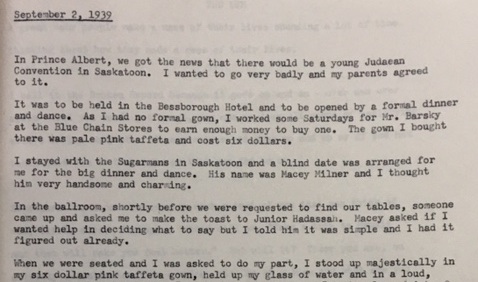
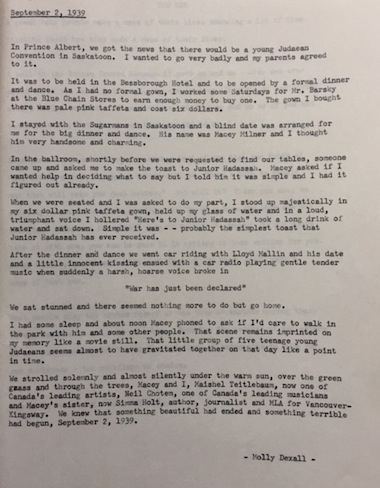
This diary note from Molly Dexall, recalling events from Sept. 2, 1939, was found by her son, Fred Dexall, and Alex Krasniak, community support worker at Yaffa House, in one of Dexall’s old binders. It was written by his mother, who was 19 at the time; she died in 1977. It is reprinted here with permission, marking 80 years since the outbreak of the Second World War on Sept. 1, 1939.
September 2, 1939
In Prince Albert, we got the news that there would be a young Judaean Convention in Saskatoon. I wanted to go very badly and my parents agreed to it.
It was to be held in the Bessborough Hotel and to be opened by a formal dinner and dance. As I had no formal gown, I worked some Saturdays for Mr. Barsky at the Blue Chain Stores to earn enough money to buy one. The gown I bought there was pale pink taffeta and cost six dollars.
I stayed with the Sugarmans in Saskatoon and a blind date was arranged for me for the big dinner and dance. His name was Macey Milner and I thought him very handsome and charming.
In the ballroom, shortly before we were requested to find our tables, someone came up and asked me to make the toast to Junior Hadassah. Macey asked if I wanted help in deciding what to say but I told him it was simple and I had it figured out already.
When we were seated and I was asked to do my part, I stood up majestically in my six dollar pink taffeta gown, held up my glass of water and in a loud, triumphant voice I hollered “Here’s to Junior Hadassah” took a long drink of water and sat down. Simple it was – probably the simplest toast that Junior Hadassah has ever received.
After the dinner and dance we went car riding with Lloyd Mallin and his date and a little innocent kissing ensued with a car radio playing gentle tender music when suddenly a harsh, hoarse voice broke in
“War has just been declared”
We sat stunned and there seemed nothing more to do but go home.
I had some sleep and about noon Macey phoned to ask if I’d care to walk in the park with him and some other people. That scene remains imprinted on my memory like a movie still. That little group of five teenage young Judaeans seems almost to have gravitated together on that day like a point in time.
We strolled solemnly and almost silently under the warm sun, over the green grass and through the trees, Macey and I, Maishel Teitlebaum, now one of Canada’s leading artists, Neil Chotem, one of Canada’s leading musicians and Macey’s sister, now Simma Holt, author, journalist and MLA for Vancouver-Kingsway. We knew that something beautiful had ended and something terrible had begun, September 2, 1939.
Left to right are Shirley Barnett, Michael Schwartz, Sam Sullivan, Julian Prieto, Margaret Sutherland and Alysa Routtenberg. (photo from Jewish Museum and Archives of British Columbia)
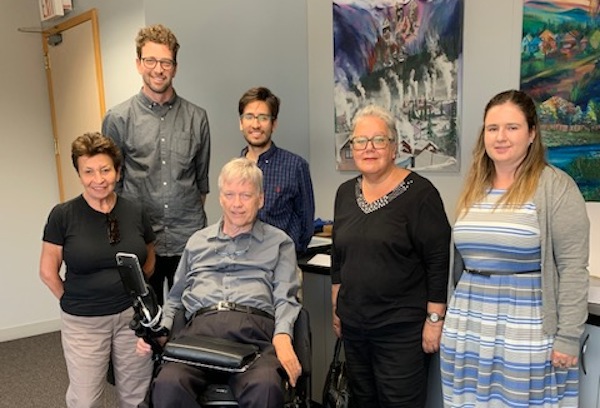
The Jewish Museum and Archives of British Columbia was pleased to welcome Sam Sullivan, MLA for Vancouver-False Creek, for a tour of the B.C. Jewish Community Archives on Aug. 15, 2019. Archivist Alysa Routtenberg and director of community engagement Michael Schwartz shared highlights of the archival collection and explained how JMABC staff and volunteers work to preserve and share these important documents.
Among his many accomplishments, Sullivan is a former mayor of Vancouver and the founder of Transcribimus, an online service dedicated to transcribing early Vancouver city council meeting minutes and publishing them online. Transcribimus was an essential resource in the JMABC’s efforts to restore the Jewish section of Mountain View Cemetery in 2013-2015, an initiative led by former JMABC board member Shirley Barnett.
***
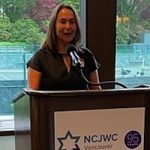
President Cate Stoller gives an overview of the year.
Jane Stoller reports on Operation Dress-Up.
Vancouver musician Babe Coal entertains (photos from NCJW Vancouver)
National Council of Jewish Women of Canada celebrated its 95th year in Vancouver with a birthday party June 4, 2019, at the Vancouver Lawn Tennis and Badminton Club.
* * *
Ben Etkin-Goulet (photo by Cheralyn Chok)
Ben Etkin-Goulet beat all the other cyclists in his category at the GranFondo Axel Merckx Okanagan on July 14. The 24-year-old Vancouverite completed the 92-kilometre Mediofondo in two hours and 30 minutes, beating out hundreds of competitors. It was only his second competitive race.
“I’ve been commuting for as long as I can remember,” said Etkin-Goulet, “but I started cycling more as a sport in 2016 and I’ve been ramping up since then. This last year was my first year training throughout the winter.”
Etkin-Goulet graduated last year with a degree in commerce from the University of British Columbia and works in data analytics at Boeing. He is the son of Fabienne Goulet and Alan Etkin and grandson of Leonor Etkin.
* * *
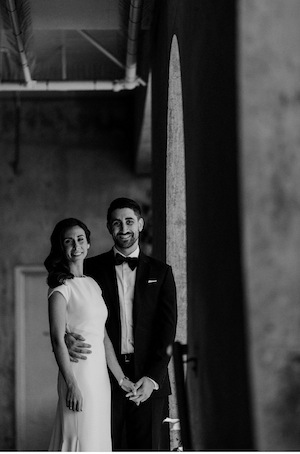
Newlyweds Jaclyn and Alex
Parents Cyndi and Max Mintzberg and Ricki and Mark Kahn and grandparents Evelyn, Gloria and Irwin are delighted to celebrate the marriage of Jaclyn and Alex.
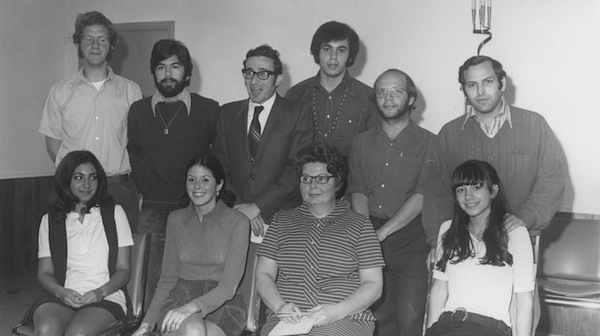
A group of people at a Hillel gathering, 1970. Back row, left to right: unidentified, Richard Bass, Rabbi Marvin Hier, Bob Golden, unidentified, unidentified. Front row, from left: unidentified, unidentified, unidentified, Hildy Groberman. (photo from JWB fonds, JMABC L.11673)
If you know someone in these photos, please help the JI fill the gaps of its predecessor’s (the Jewish Western Bulletin’s) collection at the Jewish Museum and Archives of B.C. by contacting archives@jewishmuseum.ca or 604-257-5199. To find out who has been identified in the photos, visit jewishmuseum.ca/blog.