Bedside visit

(photo from Ashernet)

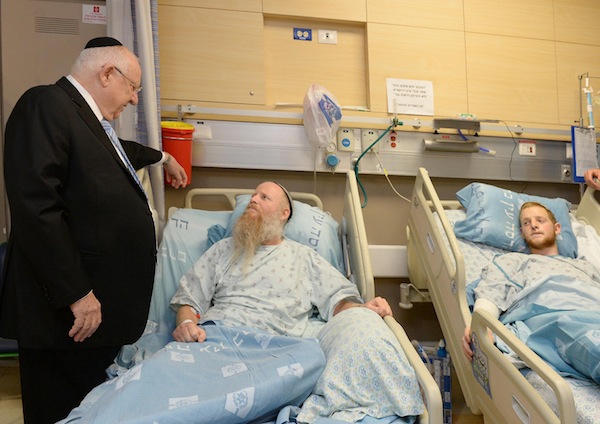
Israeli President Reuven Rivlin talks to Rabbi Eitan Shnerb at Hadassah Medical Centre in Ein Kerem on Aug 26. On the right is Shnerb’s son, Dvir, 19, who was also seriously wounded in a bomb blast near the settlement of Dolev. The rabbi’s 17-year-old daughter Rina was killed instantly. The three were hiking when the bomb was detonated. Rina’s funeral was held in the family’s hometown of Lod on Aug. 23. The blast was the latest in a series of terrorist attacks and clashes recently in Jerusalem and the West Bank.

Visit complexities of Nablus

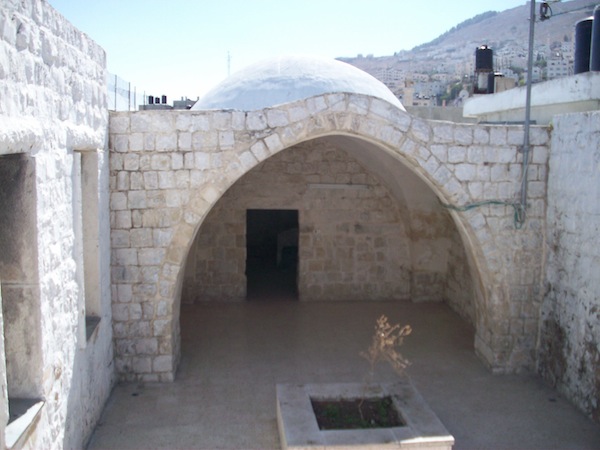
Joseph’s Tomb, inside the gate. (photo by Gil Zohar)

“The bones of Joseph, which the Children of Israel brought up from Egypt, were buried in Shechem in the portion of the field that had been purchased by Jacob.” – Joshua 24:32

 “‘And he bought the field where he pitched his tent.’ (Genesis 13:19) Said Rav Yudan bar Simon, ‘This is one of the three places regarding which the nations of the world cannot slander Israel and say, “You stole them!” The places are the Cave of Machpelah [in Hebron], the Temple [in Jerusalem] and the Tomb of Joseph [in Shechem/Nablus].” – Bereshit Rabba, 79:4

There’s little inspiration to be found in the unadorned tomb of Joseph, the favourite of Jacob’s 12 sons. The holy site, located in the gritty eastern outskirts of Nablus among parched olive groves and graveyards of wrecked cars, is today a flashpoint between those who revere the site – Israeli Jews, Palestinian Muslims, Christians of all stripes, and the 600-member Samaritan community living on Mount Gerizim overlooking this West Bank city of 160,000. The traditional anniversary of Joseph’s death on Tammuz 27 (which fell on July 31 this year) is considered an especially auspicious pilgrimage time.

The group of 1,200 pious Jews, armed with permits and prayer books, arrived at the shrine in a convoy of bulletproof buses protected by the Israel Defence Forces. Most were Bratslaver Chassidim, who set great store in their practice of praying at the graves of tzadikim (righteous ones).

The IDF-escorted pilgrimage on the first Tuesday of every month often leads to riots. IDF sappers neutralized a pipe bomb hidden at Joseph’s Tomb prior to the visit of the 1,200 pilgrims and 12 Palestinians were injured during clashes with the IDF. The list of security incidents, arson and terrorism is long and bloody.

In the secular West, the story of Joseph – whose 11 jealous brothers sold their 17-year-old sibling into slavery in Egypt – has been popularized by the rock opera Joseph and the Amazing Technicolor Dreamcoat. Librettist Tim Rice and fellow Academy Award-winning composer Andrew Lloyd Weber, along with actor Donny Osmond as Joseph, captivated audiences from Broadway to the West End with their account of Joseph’s rise to become the vizier, second only to Pharaoh in the Egyptian empire.

But Joseph, the hero of Bible and Quran stories, has hardly been given the royal treatment by Middle East politics. Dotan, where Joseph was thrown into a pit, called Jubb Yussef (Joseph’s Well) today is a ruined caravanserai that collapsed in an earthquake in 1837. Joseph’s tomb, enshrining the bones brought back from Egypt by the Children of Israel some 3,300 years ago together with the remains of Joseph’s sons Ephraim and Manasseh, has fared better.

The plain one-storey is called Qabr an-Nabi Yúsuf (Tomb of the Prophet Yúsuf) in Arabic and is revered by Jews as Kever Yosef ha-Tzadik (Tomb of Yosef the Righteous). The whitewashed limestone building is capped with a cupula and protected by a massive black gate. Barbed wire crowns the looming walls. Signposts in Arabic and English indicate the nearby sites of Tel Balata and Jacob’s Well. None directs visitors to Joseph’s Tomb.

photo - Balata refugee camp
Balata refugee camp. (photo by Gil Zohar)

Tel Balata is the nondescript Canaanite/Israelite Iron Age stratified archeological mound that few tourists bother to visit. Jacob’s Well is covered by a 20th-century Greek Orthodox basilica marking where the patriarch camped when returning to Shechem (ancient Nablus) from Paddan Aram in today’s Iraq. In one of the Torah’s three real estate deals – along with Abraham’s purchase of the Cave of Machpelah in Hebron and David’s acquiring of Mount Moriah in Jerusalem – Jacob bought the plot of land from the sons of Hamor, the father of Shechem. There, Jacob pitched his tent and erected an altar (Genesis 33:18-20).

Some 1,500 years later, Jesus “came to a city of Samaria called Sychar, near the field which Jacob gave to his son Joseph. Jacob’s Well was there.” (John 4:5-10) Drinking water, he chatted up a Samaritan woman, known in Greek as Photine (the luminous one; hence, the church’s name, St. Photini). Christian pilgrims flock to the site to reverently drink drafts of cool water from the deep well in the church’s vault.

Across the street is Balata Refugee Camp, administered by the United Nations Relief and Works Agency for Palestine Refugees in the Near East (UNRWA). Today the largest camp in the West Bank, it houses 27,000 people in a quarter-square-kilometre site that was designated for 5,000 refugees when it was established in 1950.

photo - Ottoman Sultan Abdul Hamid II’s clocktower, erected in 1906
Ottoman Sultan Abdul Hamid II’s clocktower, erected in 1906. (photo by Gil Zohar)

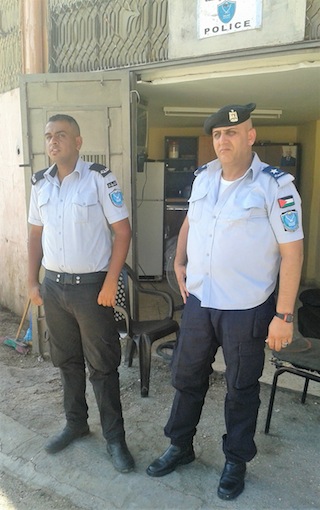
Even for an intrepid, multilingual tour guide like this writer, it is daunting to find the unmarked way to the holy site. The drab building is located next to the Qadari Tuqan School, along a dusty unnamed road where only recently were sidewalks laid. The easiest way to find the landmark is to look for the Palestinian Authority police vehicle parked outside the locked gate. Then, one must locate the pair of PA police officers loitering in the shade nearby, smoking cigarettes and nervously fidgeting with their rifles. Ask politely in Arabic and they’ll let you in, no questions asked, no baksheesh (tip or bribe) required – just don’t mention that you’re Jewish.

Inside the locked gate, you’ll find a simple barrel tomb and the stump of a column of indeterminate age. There’s no evidence of the repeated vandalism that has punctuated the tragic history of Joseph’s Tomb since 1995, when Israel withdrew from the West Bank city, ending the occupation that began in 1967 with the Six Day War.

A photo from 1900 shows the well-maintained compound around Joseph’s Tomb. A carriage road facilitated the pilgrimage of pious Jews from the Old Yishuv who regularly came to pray there. The holy site stood in isolation. Nearby was the Arab hamlet of Balata, with eight houses.

The name Nablus is a corruption of the Latin Colonia Julia Neapolis, which was founded by the Roman emperor Vespasian in 72 CE. In the old city, in 1906, Ottoman Sultan Abdul Hamid II erected a clocktower to celebrate 30 years on the throne of the Sublime Porte.

In the Six Day War, Israel captured the territory, which had been occupied by the Hashemite Kingdom of Jordan since 1948. Once-somnolent Nablus experienced a burst of prosperity, though today, under PA self-rule, the Palestinian economy is floundering. Expanding from a population of 30,000, the city spread out to swallow the nearby villages, including Balata. Joseph’s Tomb became entangled in urban sprawl.

Jewish settlers began to frequent the mausoleum. By 1975, Muslims were prohibited from visiting the site, which some claimed was the tomb of Sheikh Yúsuf Dawiqat, an 18th-century Sufi saint. In 1982, St. Louis, Mo.-born kabbalist Rabbi Yitzchak Ginsburgh established the Od Yosef Chai (Joseph Still Lives) yeshivah at the site.

photo - Palestinian Authority police by Joseph’s Tomb
Palestinian Authority police by Joseph’s Tomb. (photo by Gil Zohar)

Conflict mounted following the Oslo Accords. Tensions boiled over in September 2000, in the wake of then-prime minister Ariel Sharon’s controversial visit to Jerusalem’s Temple Mount. A full-scale battle broke out.

On Oct. 1, 2000, Border Police Cpl. Madhat Yusuf, 19, of Beit Jann in the Upper Galilee, was wounded in the neck in a clash with Palestinians at Joseph’s Tomb. Over the course of four hours, the Druze warrior bled to death because the IDF considered it too risky to evacuate him without a ceasefire.

A week later, on Oct. 7, 2000, the site was handed over to PA police. Within hours, Joseph’s Tomb was pillaged by Palestinian protesters. Using pickaxes, sledgehammers and their bare hands, they demolished the holy site. It was rebuilt by Italian stonemasons.

In the Bible, Joseph – the chaste and handsome prisoner – is wooed by an unnamed would-be lover only identified as Potiphar’s wife. Though many midrashim about Joseph are incorporated in the Quran’s 12th chapter, known as Surat Yusuf, the lady’s name is similarly omitted. However, within several centuries, various Islamic sources identified her as Zuleika. Among these medieval texts, the most popular was the epic Farsi poem “Yusuf and Zulaikha,” composed in 7,000 Persian couplets by 15th-century poet Jami.

The Sufi master regarded the story of Joseph’s temptations as an allegory for the mystical striving after divinity. In Nablus today, pilgrims continue to come to Joseph’s Tomb seeking that union. Alas, Israelis and Palestinians have not found a coat of many cultures to fit them both equally.

Gil Zohar is a writer and tour guide in Jerusalem, Israel.

ונקובר: העיר מספר אחת

אחד המקומות הפופולריים בה הוא סטנלי פארק, שהוא אתר היסטורי לאומי. (flickr)

ונקובר: העיר מספר אחת ביבשת אמריקה – חלק א’

במרץ שנה שעברה פרסמה חברת הייעוץ הבינלאומית מרסר את דירוג הערים הכי טובות לגור בהן בעולם ואף אחד בוונקובר לא הופתע. כבר ידוע זה שנים שוונקובר היא העיר שהכי טוב לגור בה ביבשת אמריקה. עיר איכותיתת, תחבורה לא רעה, די נקייה, חינוך טוב, אטרקציות טבעיות וביטחון אישי לא רע. אין כמעט תחום שהיא לא טובה בו. ובעיקר היא עיר יפה. מצד אחד מפרץ עצום וירוק שעוטף את חצי האי בו שוכן הדאון טאון. ומצד שני מי האוקיאנוס השקט. ומסביב הרים מיוערים בעלי אוויר נקי וצונן. בחורף ונקובר אפורה, שותקת ודי ישנה, אך בקיץ העיר פורחת ותוססת. ולא רק כיף וטוב לגור בה, אלא מומלץ מאוד לבקר ולטייל בה. ונקובר שוכנת בקצה המערבי של קנדה ומספיקים יומיים או שלושה לטייל בה כדי להבין מדוע תיירים כל כך אוהבים אותה.

לקנדה יש דימוי של ארץ ענקית וריקה שבה הטבע הפראי שולט והאנשים בה רגועים ואדיבים. ובכן זה באמת די נכון. מספיק כדי לטייל מדינה כמה ימים או מספר שבועות כדי להבין שמתרגלים לזה מהר ואם העולם היה טוב יותר, אז הוא היה כנראה עולם יותר קנדי. מטרו ונקובר היא מטרופולין של קרוב לשניים וחצי מיליון איש שלא מעט מתושביו הם מהגרים מרחבי העולם, היא עיר די שונה גם בקנדה, מיוחדת, ירוקה ואולי וסוערת בחודשי הקייץ שהולך ומתחמם כאן.

חברת המחקר מובהב שמספקת מידע עבור אלה שמעוניינים לעבור ולגור בחו”ל, מדרגת את העיר ונקובר כעיר עם חיי הלילה המסעירים ביותר בקנדה. האמת? בכלל לא! ונקובר נחשבת לעיר ישנה לחלוטין ובמספר חודשי הקייץ החמים היא מתעוררת. טורונטו ומונטריאול הן הנחשבות לערים התוססות ביום ובלילה.

ונקובר הצעירה שהוקמה בתקופת תור הבהלה לזהב באמצע המאה התשע עשרה על ידי מחפשים שהתיישבו בשפך נהר פיירזר, צמחה במהירות בשנות הארבעים והחמישים של המאה הקודמת בעקבות גלי הגירה, והפכה כאמור לעיר מספר אחת באמריקה.

אחד הדברים שבולטים בוונקובר הוא שהיא ירוקה כחולה, בזכות הטבע שעוטף אותה. אחד המקומות הפופולריים בה הוא סטנלי פארק, שהוא אתר היסטורי לאומי. מדובר בפארק גדול שנמצא בקצה הדאון טאון. יש בו מסלולי ריצה, רכיבה על אופניים, רכיבה על סוסים, חופי רחצה, מספר קטן של סעדות וציוני דרך היסטוריים בהתפתחותה של העיר. זה מקום טוב להתחיל להכיר בו את העיר, גם בגלל הנוף היפהפה הנשקף ממנו. בפארק יש גם כמה נקודות ציון חביבות כמו העץ החלול – גזע של עץ ארז כבן שמונה מאות שנה שנפגע בסופה בשנת אלפיים ושש. במקום לכרות אותו הוא הפך לסמל לשימור הטבע בעיני תושבי העיר. גן שייקספיר שהוקם בהשראת יצירתו של המחזאי ברוקטו והמפורסם ואזור עמודי הטוטם – תשעה עמודים צבעוניים בעלי עיטורים אינדיאניים מקומיים בנקודת ברוקטון. תמונה שלהם על רקע ההרים והמפרץ היא חלק מהזיכרונות שתספק לכם ונקובר. בפארק נמצא האקוואריום העירוני, שבו תוכלו להתרשם ממגוון עצום של דגים ויונקים ימיים. האקוואריום הוא אחת האטרקציות המפורסמות של העיר, וקיימים בו מינים נדירים של דולפינים ולווייתנים.

זהו לא המקום היחיד שבוונקובר מספקת לחובבי הטבע. בדאון טאון של העיר תמצאו את מרכז עולם המדע, שבו תערוכות משתנות וקבועות, כולל היכל החלל שבו תקבלו מענה או לפחות כיוון חשיבה לגבי חייזרים, אסטוראידים וכוכבי לכת אחרים, כולל טיול בתחנת חלל.

A dialogue on human rights

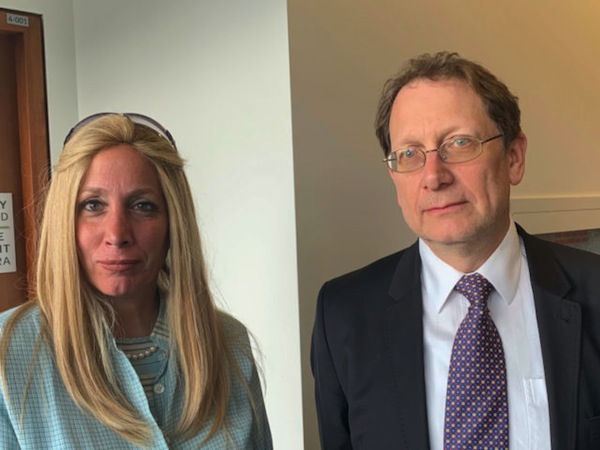
Zena Simces and Simon Rabkin (photos from organizers)

A first-annual event next month aims to mobilize individuals and groups to tackle issues of human rights in a comprehensive way.

The Simces and Rabkin Family Dialogue on Human Rights, on Sept. 12, will feature Kasari Govender, British Columbia’s incoming human rights commissioner. A number of invited guests will offer comments from the audience and a reception will follow for less formal interactions. The free event has already reached full capacity.

Govender is the province’s first human rights commissioner since 2002, when the government, under the B.C. Liberals, abolished the position, making this the only province in the country without a human rights commission. Currently, Govender is the executive director of West Coast LEAF (Legal Education and Action Fund), which advances gender equality through involvement in equality rights cases at all levels of court. Govender assumes her new position in September.

The dialogue event, intended to be replicated each year, is the brainchild of Vancouver couple Zena Simces and Simon Rabkin. The series is presented in partnership with Simon Fraser University’s Morris J. Wosk Centre for Dialogue, where the event is to take place, and the Canadian Museum for Human Rights. The topic of this year’s forum is From Hate to Hope in a Digital Age.

“Human Rights has been an interest of mine for many years,” said Simces, a health and social service policy consultant who has worked with minority communities. She is also a former Pacific region chair of the now-defunct Canadian Jewish Congress. “Simon and I felt that there was not one overall organization in Vancouver that was devoted to human rights issues.”

When Simces lived in Fredericton, N.B., she set up a lecture series in conjunction with the Atlantic Centre for Human Rights. It has continued for 30 years and Simces travels there annually for the event.

“In the last year or so, there’s just been so much going on about hate and abuse of human rights, violence, far-right groups and antisemitism, so we both felt there was a void in Vancouver with respect to a dedicated program on human rights,” she said. “There are a lot of different interest groups – women’s groups, specific minority groups – that have different programs, but there isn’t one group really now in Vancouver that is looking at the whole area of human rights broadly for the whole community. When we approached Simon Fraser’s Wosk Centre for Dialogue, they felt the same and thought it was a great idea.”

Rabkin is a cardiologist, a professor of medicine at the University of British Columbia and president of the medical staff at Vancouver Hospital. He also does investigative research in cardiology and has led numerous organizations.

“I’ve been involved for years with looking after individuals in either under-serviced areas in Canada or in Africa and have looked after disadvantaged peoples as patients and have seen the impact of problems of human rights affecting individuals’ lives, and so I wanted to see about doing something that might alter the attitudes towards minimizing or denigrating human rights, which have affected people that I’ve been involved with,” he said.

With SFU, the pair set up an advisory group that includes thought leaders in the field, including a legal expert in international human rights; a former ambassador who has dealt with peace, security and human rights issues; a representative from the Canadian Museum for Human Rights; and representatives from the Wosk Centre.

“We also brought together a multicultural group of young leaders for a one-time focus group,” Simces said. It was out of this group that the idea arose to prioritize the issue of human rights in the digital age.

In addition to opening the event up to the public, specific invitations were made to multicultural organizations, indigenous groups, police, members of the legal community, health workers, educators and representatives of different religious communities, including Rabbi Laura Duhan-Kaplan, director of inter-religious studies at the Vancouver School of Theology, among others.

“What we wanted to do is to create a venue and an opportunity for people to start talking together … not just to complain about problems, but also to be able to start formulating approaches to solve problems and address them and solve them,” said Rabkin. “We don’t have a political mandate to change things. But we believe that by dialoguing and by having the community speak to and hear from the newly appointed commissioner and to have people such as the Canadian Museum for Human Rights involved and other groups involved … then there will be a lot of important ideas created and a lot of opportunities for exchange of information and thoughts and we believe that this will be a catalyst moving forward.”

Simces added that she expects antisemitism to come up in the discussions, as statistics indicate that the Jewish community is one of the most targeted groups for hate crimes. However, she added: “We wanted this to be broader than just the Jewish community. I think it’s educating the broader community on antisemitism and other issues, so we wanted to make sure that this was a dialogue within the broader community.”

“If we can reduce hate generally, then that impacts a reduction in antisemitism,” said Rabkin. “That’s the objective.”

“We hope people will come and participate in the dialogue and really think about how to follow-up in terms of addressing the issue of hate from a legal, social media, education and community perspective,” Simces said.

How can we be happy?

Left to right are Canadian Friends of the Hebrew University Vancouver president Stav Adler, CFHU Vancouver executive director Dina Wachtel and Hebrew U’s Prof. Yoram Yovell. (photo from CFHU Vancouver)

The happiest time in the average person’s life is when the last grown child leaves home and the dog dies. That was the tip of the iceberg in happiness advice from one of world’s foremost experts and researchers on the subject.

Prof. Yoram Yovell, a psychiatrist, brain researcher, psychoanalyst, author and media phenomenon in Israel, spoke to an overflow crowd at Beth Israel Synagogue July 25. An associate professor in the division of clinical neuroscience, Hadassah Ein Kerem Medical Center, at the Hebrew University of Jerusalem, Yovell is author of two bestsellers: Brainstorm and What is Love? He hosted the award-winning primetime TV show Sihat Nefesh (Heart-to-heart Talk) for 10 years. His visit was presented by Canadian Friends of the Hebrew University of Jerusalem and made possible by the Dr. Robert Rogow and Dr. Sally Rogow Memorial Endowment Fund in Support of Academic Lectures.

Yovell speculated that the audience was so large because of a sad fact about Vancouver.

“Now I understand why all of you are here,” he said. “I didn’t know this before I came here – you are considered to be the unhappiest city in Canada.”

He supposes this status might have to do with the combination of rainy days and the proportion of new Canadians, because “immigrants, for very important reasons, happen to be less happy than people who live in the same place where they were born,” he said.

But advancing happiness (or ameliorating unhappiness) requires us to define it, he said. He asked the audience to raise their hands if they were happy – most did – but then he demanded to know how they knew they were happy.

“That question sounds silly,” he said. “Because happiness is a subjective mental state. It’s something that I feel inside.… You probably did with yourself something that you would have done had I asked you, are you hungry or not hungry? Are you hot or cold? Are you tired or awake? In all the circumstances, people look inside and try to get a certain feeling and then that’s what they report. By doing so, we are treating happiness as if it’s something we feel. I’m not saying it’s bad that happiness is something we feel, but I think we have lots to gain by really questioning whether happiness is something that we feel or something that we do.”

Aristotle, who wrote a lot about happiness, differentiated hedonia, pleasure, from eudaimonia, a much more complex concept that has more to do with achieving one’s potential in every aspect of our lives.

Instead of asking, “Are you happy?” Aristotle would ask, “Are you the best doctor you can be, the best husband, the best parent?”

Yovell said, “And, if the answer is yes, or almost yes, to most of those questions, then, for Aristotle, I’m eudaimonia and he doesn’t care how I feel.”

Tal Ben Shahar, an Israeli who wrote the book Happier about 2,400 years after Aristotle’s ponderings on happiness, developed a simple equation: happiness equals pleasure plus meaning. This dictum is, Yovell said, the only thing that every school of philosophy and every religion agrees on. Pleasure does not equal happiness. Meaning is the additional ingredient that turns fleeting pleasure into lasting happiness.

“The contribution of pleasure to happiness is there, but it’s small,” said Yovell. “And what’s even more important is it does not last, whereas the contribution of meaning to our happiness is huge and it’s stable. That makes an enormous difference to how we should conduct our lives if we want to be happier.”

One example he discussed was a study showing that most parents say, in retrospect, that child-rearing is the thing that made them happiest. But ask them when they’re changing diapers, doing laundry or settling squabbles, and they’ll tell you their happiness level is in the basement.

“It doesn’t really matter what you felt in the meantime,” he said. “What matters is what is kept in your memories. We live in our memories.”

Having children, for most people, is the most meaningful thing they’ve ever done, said Yovell.

“Pleasure is good. Have a good dinner, have a vacation abroad, upgrade your car model – all these things are going to make you happier. But not to a great degree and not for very long,” he said. “The things that are going to make us happy long-term are the things that give our lives meaning.”

Still, the road to happiness can be arduous.

“If you take a regular couple and ask, ‘When are these two people going to be at the top of their marital happiness?’ the answer is a short time after they get married and, with every child they have, their level of happiness decreases. And when their first child hits adolescence …” at this point his words were drowned out by the laughter and applause of the audience. “You know what I’m talking about, right?” he said.

“But there is light at the end of the tunnel,” he continued. “For those of us who manage to bypass this ‘Death Valley,’ there is going to come a time in our marital life where our happiness level [improves]. The vast majority of you are going to get happier … the older you become, the happier you’re going to be.”

A study of 340,000 American men and women looked at the correlation between their well-being and their age.

“At 18, they’re pretty happy – before they’ve realized what’s going to happen,” said Yovell. “Soon, they go off to college and there goes their happiness and they keep going down and down and down and it gets worse and worse and then they hit rock bottom here, in the 40s and 50s,” he said, pointing at a slide on the projection screen. “But, it gets better as they get older, sicker, less attractive, closer to death – and happier.”

Yovell’s academic work has often focused on reducing extreme unhappiness so that, for example, suicidal people are improved enough to be brought back from that brink.

He cited Sigmund Freud, a founding board member of Hebrew University, noting that “many things that Freud hypothesized were proven wrong, but many were proven right.” One example, he said, was Freud’s observation in his first book that “Much will be gained if we succeed in transforming hysterical misery into common unhappiness.”

The science of happiness has advanced dramatically in just the past two decades, Yovell said. We now know that the parts of the brain that register physical pain overlap with those that register emotional pain.

“This is something that 20 years ago we knew absolutely nothing about and now we do. In the last two decades, we’ve gradually learned that it is true that mental suffering is encoded in our brains using the same neural pathways, the same neurotransmitters that also mediate the extremes of physical pain.”

If you ask a friend about the most painful thing they’ve experienced in their life, they are unlikely to tell you about a ski accident or an operation, he said.

“They’re going to tell you about the loss of a first-degree relative. They’re going to tell you of how they felt when a father, a mother, a sibling, a spouse or, God forbid, a child has died and has left them bereaved,” said Yovell. “That, for most of us, is going to be the most painful thing in our life.”

Similarly new research indicates that emotional pain is something we can quantify, that it is more than subjective. With this knowledge, Yovell said, the follow-up question is: “Can we make it better and, if so, how?”

First, it is important to understand what we can control and what we cannot.

In 2014, a study looked at the relationship between happiness and genetics and concluded, the professor said, “that our genetics do influence our happiness but they are responsible for about 32% of our happiness, which means that 68% of our happiness – more than two-thirds of how happy or unhappy we’re going to be – has something to do with us. Part of it is the circumstance into which you were born, but the rest is how we conduct our lives – both our real lives out in the world and our inner world, our mental lives. This is what we have to work with and that ain’t bad.”

Yovell described a study of university students, in which a control group was given a placebo and another group regular-strength Tylenol and participants were then asked to journal about how they felt with their ongoing lives on campus.

“Those who got Tylenol instead of placebo actually experienced those mental pains to a lesser degree,” he said. “That’s nice, but that ain’t going to do the job when things get more difficult when someone, God forbid, loses a spouse or when someone sinks into a big depression. Tylenol will not be the answer. But what about opioids? What about narcotics? What about those drugs that mitigate the effects of endorphins. Do they make mental suffering better? And, if so, at what price?”

Opioids were used in the treatment of depression for at least 100 years, he said, between the mid-19th and mid-20th centuries.

“Drugs like morphine and codeine were the first drugs of choice in the treatment of mental depression and they actually worked,” he said. But the problems were threefold. These drugs induce tolerance, meaning a patient has to increase the dose in order to achieve the same effect. Narcotics or opioids also cause addiction and that’s a huge problem. And they are easy to overdose on.

Recently, scientists have begun investigating the use of the opioid buprenorphine.

“It’s less addictive and it’s much less dangerous in overdose because, if you give it in high doses, it actually blocks its own effect, so it’s very, very hard to overdose on,” Yovell said. “Even though it’s 40 times more potent than morphine, it’s actually a lot less dangerous to overdose and also less addictive.… We took people in Israel who are not only incredibly depressed but also suicidal. In addition to existing treatments for their depression and suicidality, the experiment added buprenorphine to their regimen.… Those who received the active drug, unbeknownst to them and to us as well, continued to improve. So there is hope, which is very nice.”

A drug-free way to marginally increase one’s happiness, he said, is simple goodness, generosity and philanthropy. Making others happy makes us happy, he said.

“People who contribute their time and money, who volunteer, will not only be happier, they will live longer,” he said. He then directed audience members to donation forms on their tables and asked them to consider contributing to scholarships for graduate students who are working with him.

“I leave it up to you,” he said, “whether you want to save your lives.”

Election date remains

Conservative candidate Chani Aryeh-Bain, left, and activist Ira Walfish at Federal Court in Toronto on July 16. (photo by Ron Csillag/CJN)

Last month, Elections Canada announced that it will not recommend that the date of the next federal election be changed, despite pressure to do so because it clashes with the Jewish holiday of Shemini Atzeret.

Moving the date “is not in the public interest,” Chief Electoral Officer Stéphane Perrault said in a statement on July 29. Only a few days earlier, the Federal Court of Canada ordered Perrault to reconsider his earlier refusal to move the date of the election – Oct. 21 – after it heard from observant Jews who pointed out that they cannot drive, campaign or vote on a holy day.

Lawyers for Chani Aryeh-Bain, the Conservative candidate in the Toronto riding of Eglinton-Lawrence, and Ira Walfish, an activist and voter who lives in the York Centre riding, had argued before the court that Perrault’s refusal to move the date to Oct. 28 was unreasonable and that they, along with 75,000 other Orthodox Jews in Canada, faced discrimination under the Charter of Rights and Freedoms. The court gave Perrault a deadline of Aug. 1 to strike a balance between election laws and the rights of Orthodox Jews to vote and campaign. He was not empowered to move the date himself, but could recommend that cabinet do so.

However, “after having carefully considered the impact of holding the election on Oct. 21 on the ability of observant Jews to participate in the electoral process, and having balanced that with my mandate to ensure accessible voting opportunities for all Canadians, I conclude that it would not be advisable to change the date of the election at this late stage,” Perrault stated. It was “not a decision that I make lightly, but with a view to providing the broadest possible range of accessible voting services to the population at large.”

In a written statement to the CJN, Aryeh-Bain, who had argued that, as an observant candidate she was prevented from getting out the vote on election day, said she was “extremely disappointed” with Perrault’s decision.

“We do not believe he balanced the democratic and religious rights of Jewish voters and candidates,” she said. “He has 85 days to prepare for this election – almost triple the amount of time than he has to prepare for a snap election. Why Perrault has dug his heels in is mystifying to me.”

Perrault acknowledged that, in the case of Aryeh-Bain, the effect of not moving the election date “is very significant.” He conceded that “no arrangement can be made that would truly allow her to meet her religious obligations and compete on equal terms with non-observant candidates.”

At a press conference at B’nai Brith Canada’s offices on the day of the decision, Walfish said, “We are obviously very disappointed. We do not agree that the [chief electoral officer] balanced the relevant interests in his further decision to not move the election.”

Walfish said that Orthodox Jewish-Canadians “will not participate in this election on an equal footing with other Canadians, not by design or choice, but because their conscience prevents them from doing so.”

Aryeh-Bain and David Tordjman, an observant Conservative candidate in Montreal, “are both seriously disadvantaged with an election on Oct. 21,” said Walfish.

In an 11-page statement, Perrault referenced a detailed “action plan for observant Jewish community voting,” which was launched in April. The statement noted that the Orthodox Jewish population is primarily located in urban areas in 36 of the 338 federal ridings. It said that those ridings range from one to 13.4% Jewish, according to the 2016 census, “which makes it possible to design local solutions … to ensure that Elections Canada’s services are targeted and responsive to local needs.”

Perrault took note of the argument presented in court that the four days of advance polls, from Oct. 12-15, reduce the ability of religiously observant Jews to cast ballots because they coincide with Shabbat and Sukkot. However, Perrault pointed out that there are many days during the election period in which observant Jews can vote, including by mail-in ballot, at an Elections Canada kiosk, or at one of roughly 115 post-secondary campuses from Oct. 5-9.

Moving the election date “will not remove all of the barriers that Jewish electors face in voting this election cycle,” Perrault stated. And if the date were moved, “the new dates for the advanced polls will also overlap with Jewish holidays,” he said. “There is no such thing as a perfect election day, especially in a country as diverse as Canada.”

Michael Mostyn, B’nai Brith’s chief executive officer, said Perrault’s decision was “just as wrong” as his initial refusal to move the date. He said Perrault’s admission that observant candidates cannot compete equally with non-observant ones is “a red line” for B’nai Brith. But Elections Canada has “run out the clock” because of the Aug. 1 deadline for setting an election date, he noted.

Mostyn called on “every Canadian Jew who is capable of doing so [to] cast a ballot via advanced polls or special ballots” and on Jewish voters to ask candidates whether they support changes to elections laws, to ensure that voting does not fall on a Jewish holiday again.

The Centre for Israel and Jewish Affairs (CIJA), on the other hand, said it “respects” Perrault’s decision.

“While mindful of the inconvenience that some will experience and the clear disadvantages faced by a religiously observant candidate, we trust that those challenges can and will be mitigated by the measures put into place by Elections Canada,” said CIJA chief executive officer Shimon Koffler Fogel in a statement.

CIJA said it, too, will focus on changing election dates, which have been fixed since 2007, so they no longer clash with Jewish holidays.

Perrault said he is “committed to continuing to work with the Jewish community to maximize voting options within the existing calendar in ways that are convenient and consistent with their religious beliefs.”

– For more national Jewish news, visit cjnews.com

We are one people, one heart

As a teenager in the United States, I was in a public high school marching band. My parents worked to make sure our family was together for an early Friday night Shabbat dinner, even when football games were on Friday night. We did a careful balancing act of observance and negotiation. I wanted to play in the jazz ensemble – and I did – but, in order to do that, I also had to commit to marching band. Sometimes, during the High Holidays, it was a precarious compromise.

One week, there was a Friday night without a football game. My parents planned to have a “normal” Shabbat dinner and attend services as a family. My band director had us all in a line formation on the field. He asked if we could substitute a practice during that time. He said, if you had a conflict, to step out of line and explain.

In front of the whole marching band, I had to step out of line. I spoke as loudly as I could (just short of shouting) so that the director and his assistants could hear me in the stands. I said my parents expected me at Friday night dinner at home, and to attend services. I needed to go. This was a religious obligation I’d been skipping for band. In true teenage bluntness, I noted that he wasn’t proposing an alternate rehearsal on Sunday morning instead, was he?

There was silence, and the band director nodded and said, “Right, no rehearsal Friday night.” While I recovered, shaking, I was set upon by other band members. A couple of non-Jewish friends supported me and mentioned how brave I’d been. To my surprise, the few other Jewish members – all slightly less observant than my family – weren’t so kind. They were angry at me for being “too Jewish” and drawing attention to them, too.

This experience came to mind when I read the news last month. The Canadian federal election is scheduled for Oct. 21 and this date conflicts with Shemini Atzeret. An Orthodox Jewish candidate in Ontario, Chani Aryeh-Bain, and another Orthodox activist, Ira Walfish, brought up this concern a year ago – in August 2018. It was ignored.

The advance polling dates are also problematic because they fall on Shabbat and Sukkot. Yes, there are ways for observant Jews to vote, despite these scheduling conflicts. However, this schedule interferes with the Orthodox candidate’s ability to campaign, as well as affecting her entire community in Toronto’s Eglinton-Lawrence riding.

Shemini Atzeret is not a big deal observance for many of us, and one news article demonstrates this by proclaiming it is the “Orthodox” Jewish community that has an issue. However, I was first struck by this candidate’s bravery in confronting this issue. That admiration was reinforced by the thousands of comments at the bottom of the article.

Some would say these comments are downright antisemitic, but I saw the majority of them as ignorant. There were many who derided religion, commented specifically on Judaism, and even one believing Christian who bemoaned how Canada had become a heathen country. (Say what?!)

In some ways, we are lucky in Canada. Our children can go to public or private schools in which they can experience Jewish community, culture and religious practices. We can relish the rich diversity of our particular community, as well as maintain our citizenship on equal footing with other Canadians. However, this opportunity to isolate ourselves comes at a cost.

When we separate ourselves, we lose the opportunity for everyday interactions with non-Jewish Canadians. The informal education that comes from attending school, sports, work and social activities with all kinds of people is invaluable. While I found it a burden to be the token Jew in my school classroom, it gave me a great chance to educate myself and explain our holidays and our traditions. Most of my classmates and bandmates knew about Judaism because they knew me.

Many get upset about ignorance or intolerance. That’s understandable, but I was taught that basic education makes a big difference. When a church or organization asked for someone to speak about Passover or Chanukah or Jewish practice, my family stepped up. I was the kid explaining the seder to the Methodists, or the sole Jewish teenager who invited all her friends to Shabbat dinner each week. My parents had an open door policy and a lot of extra dessert for whomever came over on a Friday night.

We’re lucky to live in a country that celebrates diversity. However, we should offer educational outreach whenever it’s helpful, so that we can live in peace with our neighbours. We can explain why there are obstacles to voting or campaigning in the middle of the fall holiday season, and why this is an issue. Also, instead of forcing some of us to feel uncomfortable and “too Jewish,” we can embrace each other as “Am Echad,” “One People.”

Even though the election date will not change, the situation is a learning moment for us as Jews and Canadians.

Reggae may not be everyone’s cup of tea, but I end this as I began it, with music. If we’re truly one people, with “one love, one heart,’” we should love all of our Jewish community. We stand up for what we need both to practise Judaism and our voting rights, as each of us sees fit. In Bob Marley’s religious (but not Jewish) words, “Let’s get together, and feel all right.”

Joanne Seiff has written regularly for CBC Manitoba and various Jewish publications. She is the author of three books, including From the Outside In: Jewish Post Columns 2015-2016, a collection of essays available for digital download or as a paperback from Amazon. See more about her at joanneseiff.blogspot.com.


Israel is not a political toy

The U.S. president accused Representative Rashida Tlaib of a political stunt when the American politician of Palestinian descent rejected Israel’s offer of permission to visit the West Bank on humanitarian grounds.

Israel’s government had first announced that it would permit visits to Palestine by Tlaib and fellow congresswoman Ilhan Omar, another of the four members of the “squad” of progressive women of colour elected to Congress as Democrats in last November’s U.S. midterm elections. Then, apparently after Donald Trump intervened with his continued vendetta against the women, the government of Prime Minister Binyamin Netanyahu changed their minds and declared that the congresswomen would not be permitted to go to Palestine. Then, in another twist, Israel decided to allow Tlaib admission based on “humanitarian” grounds to visit her grandmother and other relatives in the West Bank. Tlaib rejected the offer.

“Silencing me & treating me like a criminal is not what she wants for me,” Tlaib tweeted about her grandmother. “It would kill a piece of me. I have decided that visiting my grandmother under these oppressive conditions stands against everything I believe in – fighting against racism, oppression & injustice.”

Putting ideology over seeing a nonagenarian grandparent seems a tad distorted, but she’s probably correct that Israel’s actions were over-the-top.

The idea that Israel should ban members of the United States Congress from entering the country (en route to the West Bank, which is occupied by Israeli forces, which means Israel controls who can enter and move around there) is a highly dubious move. Given Tlaib’s and Omar’s unrelenting condemnation of Israel and its policies, including support for the BDS movement, some people argued that Israel should ban them. But almost every mainstream Jewish and Zionist organization in the United States that spoke up argued that they should be permitted to go.

In fact, it would have been smart to invite the two as guests of the Israeli government and give them the VIP tour of Israel. Then, they would have at least have heard the Israeli side of the story, take it or leave it. More to the point, had they refused the invitation to see the modern miracle that is the Jewish state, they might have looked closed-minded.

Instead, the two Democrats have come out of it looking righteous, while Netanyahu looks like Trump’s puppet and Trump looks like, well, like he usually does. Especially when he tweeted that the only winner in the scenario is Tlaib’s grandmother because “She doesn’t have to see her now!” One wonders about what goes through the minds Trump’s grandchildren when he blusters into the room.

On the one hand, the recent vote in Congress to criticize the BDS movement was massively lopsided and indicates that Israel’s special relationship with the United States remains steadfast. But among grassroots Democratic voters and some other Americans, the Netanyahu-Trump bromance is repellent and makes some people naturally less amenable to the bilateral relationship – specifically because it has been so spectacularly and cynically politicized by both leaders.

There are serious and legitimate fears that the solid bipartisanship that has defined this relationship for 71 years is fraying, possibly irrevocably.

It doesn’t matter what one thinks of Trump. It doesn’t matter if you agree with the board member of the Republican Jewish Coalition who told the New York Times, “When I look at what he’s done for Israel, I’m not going to take issue with anything he’s said or done.” The day-to-day cut-and-thrust of politics means we will agree and disagree with our leaders in Canada, or those in the United States or Israel or elsewhere. But the deterioration of the nonpartisanship around the foundational importance of the bilateral relationship between Israel and its most significant ally is a grave concern.

We have an election campaign about to launch here in Canada. There will be moments when Middle East policy comes up and we will disagree. What we should strive to ensure is that, regardless of our opinions about Israel’s leader – and what position he may hold after next month’s Israeli elections – or our thoughts about our own political leaders, one thing we should avoid at all cost is turning Israel into a partisan tool. Let’s just not. And let’s not reward politicians who try.

Segal aims for Ottawa

Zach Segal will represent the Conservative party in the Oct. 21 federal election in the riding of Vancouver Granville. (photo from Zach Segal)

While Conservatives across Canada will spend the weeks leading up to the federal election reminding voters of Jody Wilson-Raybould’s excoriating of her former leader, Prime Minister Justin Trudeau, one Tory candidate will likely be downplaying the Vancouver MP’s star turn before a parliamentary committee.

In July, Zach Segal won the nomination to represent the Conservative party in the Oct. 21 federal election in the riding of Vancouver Granville. The incumbent, Wilson-Raybould, was elected there in 2015 and immediately was appointed minister of justice and the attorney general of Canada. In January of this year, she was shuffled to minister of veterans affairs and, less than a month later, resigned from cabinet.

Wilson-Raybould was thrown out of the Liberal caucus after testifying before the House of Commons justice committee about pressure she said she experienced from the prime minister’s office over an ongoing investigation into Quebec-based SNC-Lavalin, the largest construction company by revenue in Canada. The resulting scandal sent the governing Liberals tumbling in opinion polls, and they are now generally neck-and-neck with the Conservatives in most surveys. Wilson-Raybould is seeking reelection as an independent.

Segal said that a vote for the incumbent is a protest vote, but that a vote for him offers the chance to change the government.

“If you are upset with Justin Trudeau and you want to kick the Liberals out of Ottawa, the only way to do that is to vote for Andrew Scheer and, if you live in Vancouver Granville, to vote for Zach Segal,” he told the Independent.

The riding cuts a swath through the city, from the Fraser River almost to False Creek and roughly from West Boulevard to Cambie, also encompassing the area north of 41st Avenue west of Main Street and west of Ontario Street to 2nd Avenue. Almost all of the city’s Jewish communal organizations are located in the riding and many of the city’s Jewish residents live there.

Segal graduated from the University of British Columbia in 2011, with a major in political science and a minor in history. He went to Ottawa on an internship arranged through the Centre for Israel and Jewish Affairs.

“At the time, I was conservative-leaning, but I wasn’t partisan,” he said. “I was certainly conservative but I wasn’t affiliated like other young folks are at university.”

After the internship, Segal continued working with Manitoba Conservative MP James Bezan, who was parliamentary secretary to the minister of defence. He later became spokesperson for then-transport minister Lisa Raitt.

When the Conservatives lost the 2015 election, Segal opted to return to Vancouver. He got a job with the Canada Mortgage and Housing Corporation, which has a mandate to help Canadians access affordable housing options.

“I was very interested in housing but still interested in the government and policy world,” Segal said. “I wanted to learn more about housing so I thought a job at the Canada Mortgage and Housing Corporation would be a good opportunity because it was a Crown corporation – it wasn’t part of the federal public service, it was separate – so I thought that would be a good opportunity to get into the housing world and learn more.”

On leave since he announced his candidacy for the nomination in the spring, Segal is part of the CMHC marketing team, publicizing programs and opportunities for nonprofits, the private sector, developers and others, such as low-interest loans.

Faced with a splintered group of candidates in what will probably be one of the most closely watched races in the country, Segal is confident he can win.

“I really think I can actually win and I think that’s the most important thing,” he said, adding that the agenda in the city has largely been dominated by the left.

“I want to show that maybe we have some conservative solutions to some of these big problems that Vancouver is facing,” he said. “My big issues are all packaged into one. I think they all go together. I think everyone’s very interested in housing, in transportation, affordability and the economy. If we can solve transportation infrastructure, maybe it could help reduce pressure on housing because we could build further out and, if we could grow our economy and have better opportunities, people here could make more money and that would solve some of the issues around affordability. Certainly housing, I think we need to look at different ways of solving this, rather than the current proposals. Vancouver’s average wages are some of the lowest in Canada but we have some of the highest average home prices in Canada. I think that’s where one of the problems lies. We need to start looking at how we can grow our whole economy, and Vancouver subsequently, with better jobs and higher wages.”

He said his four years in Ottawa equip him to be an effective MP.

“A lot of people have this idea that, if you’re on the backbench, you can’t do anything, but the MP I worked for was so diligent and committed to issues that he was able to bring them to the floor of the House of Commons,” said Segal. “He was constantly tabling motions, private member’s bills, he was constantly getting his foot in the door of the prime minister’s office and he made sure that, even though he was a backbencher, he got all these prominent issues to the forefront of public policy. That was very inspiring. It’s a good message that you can accomplish things as a member of Parliament.”

As a Jewish candidate, Segal has been hearing from voters that they respected former prime minister Stephen Harper’s approach to Israel.

“Jews and non-Jews alike tell me that they deeply respected how Stephen Harper and the Conservative government stood up for Israel on the world stage,” he said. “They just liked seeing a politician stand on principle and not be bullied and stand up – quite frankly – stand up to the world, stand up to the UN. People really liked seeing that and I think they like leaders who show their true colours, and want to see that back in Ottawa.”

Segal, who attended Richmond Jewish Day School and graduated from Steveston High, went to Israel on a Birthright trip in 2008.

“You always know Israel is small but, until you’re there and you travel the country in a short period of time, you don’t realize how small it is,” he said. “When people talk about Israel’s security concerns, it’s not just a platitude. It’s a tiny country. When you visit Israel, you take tours of the Golan Heights. You can see Hezbollah outposts. Now, if you are there, you can see maybe even ISIS outposts in Syria. It’s this remarkable, tiny country, this outpost of vibrancy and Western democracy that somehow is bordering some of the most extreme elements of the world right there on its border and you really appreciate its security concerns being there.”

Back on local doorsteps, Segal said voters are asking whether they can trust their leaders.

“They see Justin Trudeau taking care of his friends. He had this big gift to Loblaws for retrofitting some fridges and they’re taking care of Irving and SNC, but, if you’re a small business owner, you’re left to fend for yourself,” said Segal.

In addition to Segal and Wilson-Raybould, Vancouver Granville voters will consider the Liberal candidate, tech entrepreneur and investor Teleeb Noormohamed, the NDP’s Yvonne Hanson, a climate activist, and Green candidate Louise Boutin, a realtor. The fledgling People’s Party of Canada has nominated Naomi Chocyk, who, at one point, was employed as a constituency assistant in Wilson-Raybould’s office. More candidates could enter the race before the close of the writ period.

Belong at Bayit and beyond

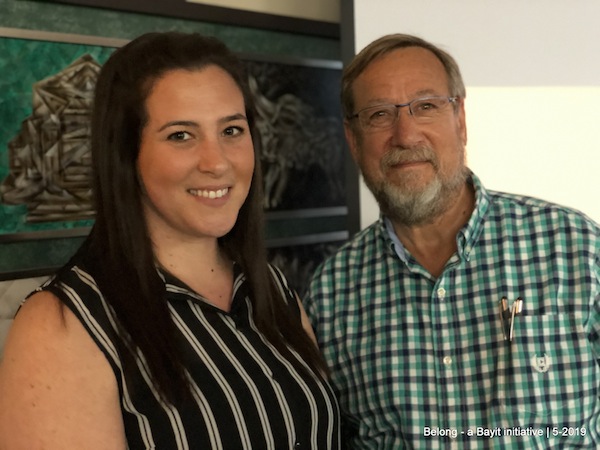
Shira Sachs and Dan Shmilovitch at the Bayit’s Belong launch May 12. (photo from facebook.com/thebayit)

Earlier this year, the Bayit in Richmond launched Belong. The goal of the program is “to create a community where belonging grows and isolation disappears.”

Belong was developed by a committee of six Bayit members: Mel Bauer, Matti Feigelstock, Shelley Goldberg, Shira Sachs, Dan Shmilovitch and Rabbi Levi Varnai.

“There are people that you know you should be connecting to, [or] they should be connecting to you as an organization, but, for whatever reason, they’re not. So, we started talking about how we could address that issue as the Bayit,” explained Shmilovitch, who has been active in the Jewish community for more than 30 years.

There is never just one reason why people feel isolated, he said. “People are isolated for a whole range of reasons – health issues, economic circumstances, mental health issues, maybe they are recently widowed or divorced.”

It is easy to assume that Jewish communities are inherently so strong as to make isolation impossible, but this is not the case. Shmilovitch spoke of the need for “deepening Jewish connections … because isolation is a huge problem in every community and it affects the Jewish community as well, for all age groups.”

There are challenges in combating isolation. “As a Jewish organization, as a synagogue, you’re always looking to invite people in,” he said. “But, when you have people who are isolated and really disconnected, your approach has to be different to get that connection because that’s not their mindset. At that moment in time, that’s not where they’re at.”

photo - Left to right: Mike Sachs, Dan Shmilovitch and Rabbi Levi Varnai at the Bayit’s Belong launch May 12
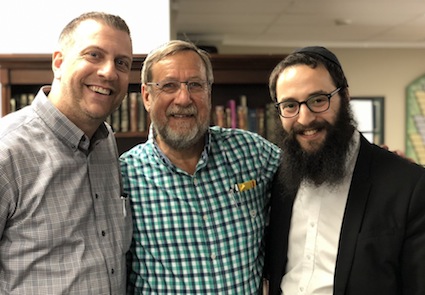
Left to right: Mike Sachs, Dan Shmilovitch and Rabbi Levi Varnai at the Bayit’s Belong launch May 12. (photo from facebook.com/thebayit)

The Belong committee started their planning by examining the obstacles that prevent people from making contact. There is more to being a community member than simply going to shul, explained Sachs, who is a teacher at Vancouver Talmud Torah.

She noted that people can still feel “uncomfortable or isolated” attending social gatherings outside regular services. She talked about how loneliness has a profound effect on a person’s health and can lead to depression. Using her own childhood story as an example, she described arriving in Canada when her mother, now deceased, was pregnant with twins; Sachs is the oldest of four.

“Community became so important to us,” she said. “We didn’t have the language and, within a couple of months, we went from a family of four to a family of six. My mom was a new mother in a new country, with twins.”

Going to shul helped the family make connections, learn about which schools the family wanted for the children. As a parent herself now, Sachs described how this ethos has shaped her own approach to family life. “When we came back from L.A., it was the number one thing to do – find a community and slowly grow with it. Now, how do we do that for others?”

The Belong committee determined multiple strategies for community development, the first of which was through Friday night dinners. The Belong team sought Bayit members who were willing to invite people to meals at home. They also reached out to Jewish Family Services for help locating people in Richmond who needed help.

“If you have a lady who is a single parent, you match them with another single parent,” said Sachs. “If you have a person who is passionate about literature, you sit them with someone who has the same passion. It was all assigned seating.” She added, “It’s comforting to know, ‘I don’t have to worry about that.’ Maybe that anxiety is why people haven’t come to a dinner.”

Belong is also working to offer food deliveries to families in need. “Food security is an issue in the Jewish community,” said Shmilovitch. The program has been running for awhile now but he hopes that deliveries will become more frequent in future.

“There are vulnerable people in the Jewish community – whether they don’t have enough food, feel isolated for a short time or in the longer term. Regardless, it’s hard to come out at the other end. That’s what drives us.”

In addition, Belong has created a support structure for new mothers. Inspired by and in partnership with Mamatefet, a support organization for Hebrew speakers in Vancouver, Mama Belong will work to diminish the feelings of isolation that often follow the birth of a baby. (See jewishindependent.ca/mothers-embrace-mamatefet.) Mama Belong started delivering baskets to Jewish mothers this summer.

The future of Belong came into focus at the May 12 launch. Current members of the Bayit were invited to learn about the new program. Guests were given a card with tear-off tabs that suggested a wide range of ways in which people could contribute, including hosting Friday night dinners, Russian language conversation groups and cash donations, among other ideas. Between 90 and 95% of the attendees folded over a tab.

From Mama Belong to food bank deliveries and Shabbat dinners, the program is striving to create a warm sense of community for those in need. “You never know what’s going to happen at what point in your life,” said Shmilovitch, but “something’s going to happen to connect you.”

Shula Klinger is an author and journalist living in North Vancouver. Find out more at shulaklinger.com.