Billinkoff runs in record time

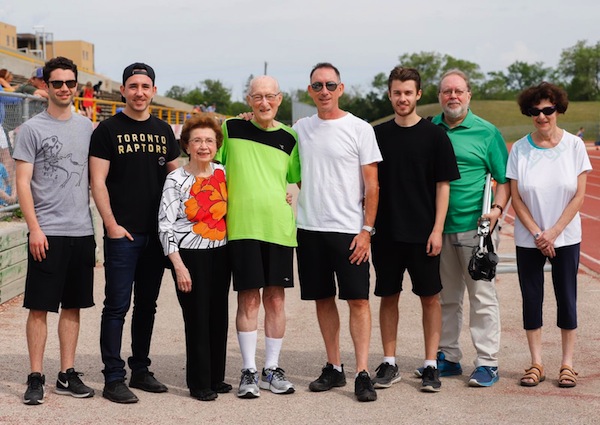
With Lou Billinkoff, fourth from the left, are, from left to right, his grandson Asher, grandson Jordan, wife Ruth, son Errol, grandson Mitchell, son Lorne and daughter-in-law Marilyn. (photo from Lou Billinkoff)

Growing up in Winnipeg’s North End, Lou Billinkoff, 96, was never into sports, though, in his 20s, he did enjoy going for a jog once in awhile. Today, he is one of the fastest short-distance runners in his age group.

“I used to do some running but I never thought of it as competitive,” Billinkoff told the Independent. “I just ran for the pleasure of it when I was younger.”

Billinkoff worked as an engineer with Winnipeg Hydro (now called Manitoba Hydro) for 40 years, designing power lines. When he was well into retirement, at the age of 89, he had a heart attack.

“When I was recovering, the doctor suggested I take some rehab physical therapy at a centre they have here, a program specially suited for people recovering from heart attacks,” said Billinkoff. “Part of the program is to walk on a track. I did that for maybe a year and, when I recalled how much pleasure I got when I ran earlier in life, I thought I’d just try it out and see what I still could do.”

The first time Billinkoff tried, he could only run 40 metres but, more importantly, he liked it. Two days later, he ran 45 metres, and kept on adding distance with each try. Eventually, he was running well over 100 metres and loving it. So, he decided to set up a training program and reached the point at which he could run 100 metres 10 times in one session – a feat he refers to as “running a kilometre.”

“I did that for about two years,” said Billinkoff. “After that, I found it was getting too hard, so I went down to five times 100. Gradually, I found this too was getting too hard, so this past year or two, I’ve been running 50 metres.

“When I was running the 100 metres, my son, Errol, clocked me and said, ‘You know, you’re running in championship speed rankings?’ This was a surprise to me. Errol suggested I get into competition. I wasn’t really interested to pursue it, but Errol entered me into a competition here and, the first time I ran, I ran quite well.”

Nowadays, Billinkoff runs 50 metres three times per workout session at the Reh-Fit Centre, where he goes three times a week. While he ran outdoors when he was younger, he feels that, at his age, it is wiser to run at the centre.

“Going outside has limitations,” he said. “The weather is not always good. You can fall and break your neck and nobody would see you. It’s not a good idea to be running outside.”

Once Billinkoff hit the competitive circuit, he began sending his running times to Athletics Canada.

“The way the rankings work is that age groups go in five-year periods,” he explained. “So, when I started out, I was in the age group of 90-94. They call that the M90. Now that I’m 96, for the last year and this year, I’m in the M95 group, which is 95 to 99.

“In the M90 group, I had the fastest time in Canada, at 29.73 seconds. And, in the M95 group, in the 50-metre record, my time indoors was 14.58 seconds; a good speed. Later, I ran the outdoor in 15.68 seconds, and I had strong wind against me. It took me a second longer and I attribute that to the wind.”

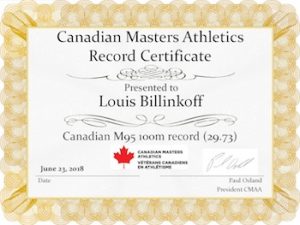
In most races, Billinkoff has been the only runner in his age category, often running with people half his age.

“There are so few people my age running that you very seldom – unless you live in New York or Chicago – get more than three or four people running in my age group,” said Billinkoff. “I don’t think it’s worth the effort for me to spend several days of discomfort and hardship [traveling] to run for a couple of seconds. They have a Canadian registry where all the Canadians who are competitors send in their results and they set up their rankings. Then, they send it to a world organization that sets up the rankings throughout the world.”

A few years ago, Billinkoff hired a coach for a few months. “He gave me some tips about getting away fast from the start,” said Billinkoff. “And he explained that running is just as much psychological as it is physical. He helped me, psychologically, to have confidence, and that’s very important.”

For now, Billinkoff is keeping up with his training, hoping to compete again next summer. He will continue to do so, he said, “as long as I’m able, and I get pleasure out of it.”

Rebeca Kuropatwa is a Winnipeg freelance writer.
The art of conversation

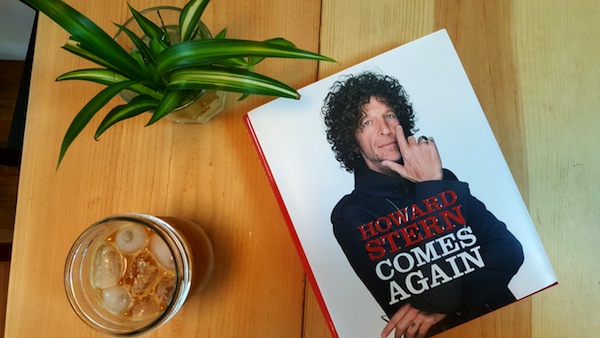
Howard Stern Comes Again highlights 37 interviews from Howard Stern’s show, and much more. (photo by Adam Bogoch)

Conversation is almost a dead art. Technology, ludicrously divisive politics and sheer laziness have almost entirely killed it. How often do you see true connection happen through dialogue anymore? Most people talk at each other, not to each other. Heck, most of the time they’re more interested in their phone. And I can’t say I’m guiltless in this department. Nor would radio talk-show legend Howard Stern, at least for the first 30 years of his epic career. This is a theme that’s intentionally threaded throughout his masterful new book, Howard Stern Comes Again (Simon & Schuster, 2019).

Not a fan of Howard Stern? Many people see him as a crude entertainer willing to insult and demean others in order to win a laugh. Well, as a die-hard fan of his, I can say that’s an accurate observation – at least partially. Ever since he moved his extraordinarily successful radio show to satellite in 2006, he’s become so much more than that. His level of insight and tolerance has grown exponentially. He’s learned to see beyond himself. And he attributes this shift to his new platform, meditation and, most importantly, extensive psychotherapy. Because of these changes, he’s regarded as “the greatest celebrity interviewer of all time.”

Don’t believe it? If you’re not willing to purchase a full SiriusXM subscription, a copy of Howard Stern Comes Again will suffice as proof. Don’t worry, this book isn’t meant for those who know what “Baba-Booey” means. It’s for anyone and everyone who loves actual communication.

The New York Times bestseller highlights 37 edited transcripts of interviews from Stern’s show. Each features a guest, such as Sir Paul McCartney, Chris Rock, Joan Rivers, Bill Murray, Jerry Seinfeld, Steve Martin, Lady Gaga, Larry David – and Stern’s mom. They contain fascinating revelations from these individuals, as well as from Stern, who has written an eloquent foreword to each chapter.

Every topic under the sun is covered. Nothing stays in a “safe space,” unless it’s honest to the individual he’s interviewing. The conversations are revealing, genuine, hilarious, and even pretty upsetting at times. It’s astounding how Stern is able to extract such information from celebrities who often try to maintain a level of secrecy to protect themselves, their families, and sometimes their art. They clearly feel comfortable with him. Maybe because there’s no question he asks that he’s unwilling to answer himself. He injects his own personal experiences, opinions and shtick into his interviews, making them real dialogues. The conversations are intimate and almost seem to be taking place privately – the opposite of interviews on shows like Late Night, 60 Minutes or Oprah.

Stern’s approach has influenced countless podcasters and radio hosts. In a May 8 interview with the Hollywood Reporter this year, Stern described his style as “the dinner party approach.” This is an apt description. And, thanks to his new book, it is not only his listeners who get to be flies on the wall.

Howard Stern Comes Again is 130 mini-biographies in less than 600 pages. It’s not just the 37 that are included. The beautifully bound and well-formatted book also features short exchanges between Stern and a variety of other comedians, actors, news anchors, mobsters, filmmakers and musicians. These snippets are compiled in special chapters where the likes of Dave Chappelle, James Taylor, Tina Fey and Vancouver’s own Seth Rogen speak on topics like sex, religion and death.

Which brings me to Trump.

Unfortunately, I can’t get away without mentioning the current president of the United States. He features heavily in the book thanks to several chapter breaks entitled, “And Now a Word from Our President.” They present fragments of Stern’s now-famous interviews with “the Donald” before he became leader of the Free World. Although Stern has revealed he isn’t a supporter of Trump – a fact that put Stern in Trump’s bad graces – not every interaction with him is negative. Stern shows that he’s capable of doing something Trump clearly is not able to do – having a conversation, even a light-hearted one, with someone of a different opinion. Having said that, there are certainly some cringe-worthy moments here that maybe even Stern regrets. But, honestly, it wouldn’t be a Howard Stern book without them.

Because of Stern’s approach to conversation, as well as his outrageous comedy, he’s been described as “divisive.” I actually thought he was a monster before I was turned onto him by another member of the Jewish community who encouraged me to listen. And, guess what? I laughed. I learned to take things less seriously – especially the darkest aspects of society. Confronting them the way he does makes them more manageable.

I also became aware of Stern’s enlightened stance on equal rights, the environment, freedom of speech, Israel, and animal rights. Even when I disagree with him, I love him. Because he comes from an authentic place. A place of experience. Of flaws. A place with passion and desire. And never has this been more obvious than in a book focusing on – gasp – actual human interaction.

It’s apparent that Howard Stern Comes Again is meant to be considered as Stern’s legacy. Whether you’re an active listener or completely unfamiliar with him, it is something to appreciate and, maybe, just maybe, from which to learn.

Adam Bogoch is a Vancouver-based screenwriter and content writer.

Enter focaccia, stage right

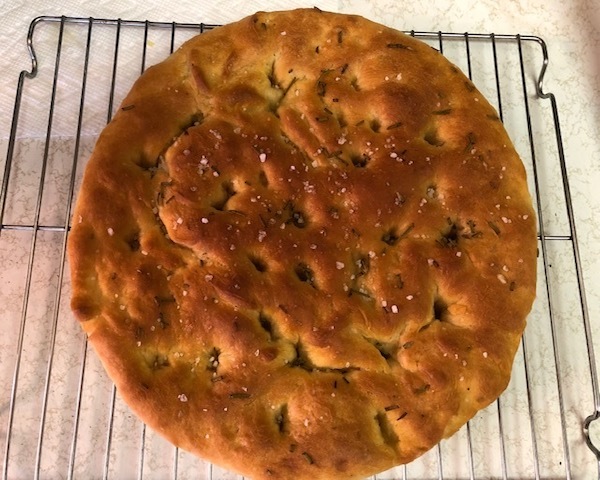
Focaccia straight from the oven. (photo by Shelley Civkin)

Ladies and gentlemen, start your engines, please. Or, in this case, your yeast. From zero to focaccia in one hour.

My unpremeditated transformation from water-burner to bread-baker is shocking even to me. Or especially to me. When hubby Harvey came home one day with a cast-iron pan, I got über excited, thinking I could now fry like my father used to. Though, when frying became a dirty word in the 1990s, he called it sautéeing. But, somehow, sautéeing seemed too prosaic for the mighty cast iron, so I started investigating what else I could do with the skillet.

Thanks to Google and Pinterest’s cookies, they now know that I like baking bread. I automatically get links to recipes for cast-iron bread-baking. Every. Five. Minutes. Enter focaccia, stage right. Or, if you’re Italian … entra nella scena della focaccia a destra.

I perused the myriad recipes and took a few of them on a test drive. Or test bake, as it were. The following recipe overtook the others by a mile, and won in the finest focaccia category. Here’s a link to the winning One-hour Rosemary Focaccia Bread I’ve come to love: flavorthemoments.com/one-hour-rosemary-focaccia-bread. (It actually takes an hour-and-a-half, if you include the time it takes to preheat your oven.)

It’s my go-to quick bread recipe. It’s truly no-fail. Feel free to ditch the garlic and Parmesan, or add more rosemary. You can’t screw up this bread. After my first try, I was hooked. I let the gorgeously golden focaccia cool, sliced it into small rectangles, like they do in Italian restaurants, and dipped it in EVOO (shorthand for extra virgin olive oil). Which made me wonder what an “extra virgin” is? Something to ponder another time. Never mind. Not relevant. Anyway, I’ve made this focaccia several times. Needless to say, I am not getting thinner. But my Italian is improving.

Now that I’ve pretty much nailed down challah and focaccia, I decided to branch out and try making a no-knead round crusty bread. You know, like sourdough. Minus the sour. The kind that requires you to have a Dutch oven. Google and Pinterest are way ahead of me, so they’ve been sending me nonstop recipes and pix of Dutch oven bread. All I had to do was think about crusty bread and they were on it.

I recently learned that not all Dutch ovens are created equal. They’re mostly made from cast iron covered in enamel, but not all of them can withstand the high heat you need to use. Thing is, for crusty bread, you have to heat the Dutch oven to about 450 degrees – empty. Then you put the dough in it. You don’t want to ruin a fancy shmancy Dutch oven over a loaf of bread. Even though my Dutch oven isn’t one of those $400 Le Creuset ones – it’s a $65 one from Costco, which works perfectly for pot roast, chicken and everything in between – I’m loathe to risk ruining it over bread. Sure, I could go buy one of the fancy Dutch ovens but, seriously, $400 for a crusty loaf? Not in this lifetime. I worked too hard to fritter my money away like that. And, like I always say, just because you can afford to buy something, doesn’t mean you should.

So, I improvised and used an ancient Magnalite aluminum-magnesium alloy Dutch oven that belonged to my friend’s late mother. I’m hoping I don’t get Alzheimer’s, what with the aluminum connection, but it’s not like I’m going to be making every single meal in it. Anyway, the bread was a marginal success. The outside looked gorgeously crusty but, once I cut into it, parts were doughy and uncooked. Bake and learn. I’ll try it a few more times, tweaking the temperature, increasing the rising time, etc., and hope for the best. If at first you don’t succeed, well, suck it up and try again.

I can hear some readers wondering why I would want to waste half a day baking bread from scratch, when I could just go out and buy a loaf. Well, there’s something indescribable about the smell of fresh baked bread wafting through my home. It’s a little like a comestible aphrodisiac. It makes me weak at the knees, thinking about the butter melting slowly over the hot bread, as I sniff it lovingly with anticipation. Wait, this is becoming a little X-rated. I need to get a grip. Sorry. Suffice to say that my husband and I adore fresh bread and appreciate the effort it takes to make it. And, since I’m a notorious multi-tasker, I busy myself with other things while the dough is rising, so there’s no wasted time. Like now, for instance. I’m writing this article while waiting for my rosemary and Kalamata olive bread dough to double in size.

Never having been one to let grass grow under my feet, my next culinary foray will be gravlax. Ever since tasting my friend Roxanne’s heavenly gravlax last Pesach, I’ve been itching to give it a go. Since salmon season is upon us, there’s no time like the present. Harvey’s on board too, but not as a cook as much as a taste-tester. From what I can tell, it’s a ridiculously easy thing to make, as long as you have truckloads of salt, sugar, dill and time. No, not thyme. Once I perfect the recipe, I’ll share it with you. But not until then.

You can try till you’re blue in the face to convince me that store-bought food is just as good as homemade, but I’m not buying it. Literally or figuratively. There’s just something about the laying on of hands, the investment of love and effort, and the satisfaction at the end of it all, that makes homemade food so very worth it.

I suspect I might have made a very dedicated homesteader. As long as I had an electric stove and oven, and a good refrigerator. Oh, and maybe somewhere close by where I could get a good decaf, low-foam, lactose-free latte while I was growing my own food, baking bread and churning butter. Am I country girl at heart? Hell, no! I am about as cityfied as they come. To wit, my idea of camping is a Motel 8. And outhouses? They should be outlawed.

Enough said.

Shelley Civkin, aka the Accidental Balabusta, is a happily retired librarian and communications officer. For 17 years, she wrote a weekly book review column for the Richmond Review, and currently writes a bi-weekly column about retirement for the Richmond News.

Looking forward, back

Kierkegaard Kierkegaard Kierkegaard Kierkegaard Søren Kierkegaard once observed that we begin life by only looking forward, and end by looking back to understand it. The existentialists leave me cold with their nihilism and I find their approaches hard to digest, but I consider Kierkegaard’s comment very much an accurate description of life’s dynamic.

I can remember how my early thoughts were very much about what my future was going to look like. In my mind, all my presents were events that I would have to get through to get to the really important stuff. I knew we had to put up with living with the people we found ourselves tied to by the happenstance of birth. We had to follow the rules we learned from those around us to traverse this period, but our secret focus was on the future, on that time when we would be able to organize our world in a way it would better serve us.

Yes, we had to do what we were told. Yes, we sometimes formed attachments because it was expected, and even convenient. Yes, there were programmed behaviours that had to be followed faithfully. But we knew, didn’t we, that the real stuff would begin when we were in a position to be fully in charge. It sounds bloody-minded now, but those were really my thoughts. All I was living through at the time was just the price of admission, wasn’t it?

And the school years. Were we really going to need all this knowledge we were cramming? Everybody knew that this material was ancient history and that the real world was going to make it all irrelevant. Were any of the teachers people we could respect? I was cleaning out the shelves of the library with the books I was reading. That’s where my education came from, from the stories of real lives that people were leading, that people had led. I was finding my heroes there, and imagining the wonders I would realize when I finally broke free. Until then, I knew to play the game, do the work, pass the exams, collect the admission cards I was going to need. There was the brightly shining future ahead of me. I would accomplish wonders!

Then, there I was. Off on my own. Now I would remake the world. But I was a father, supporting a family. And the “membership cards” I had earned were the only things I had that were going to help pay the bills. I could see then that the stories I told myself and that I read in the library were just fairy tales – the parent who slogged away at work for many years to support us was the model I was going to have to follow. And the parent who took care of my creature comforts was the one who taught me I was valuable and that I could accomplish whatever I set my mind to. And the family members I took for granted were the only ones in the world who took me at face value, no questions asked.

Could I measure up to the hero I believed I was? Could I leave a mark, or marks, that would have the kind of impact I had always assumed I would realize in my life’s work? I am now looking back and trying to understand. I am looking back to appreciate what I have come to believe are the things that have value, and which may have escaped me when I was so focused on looking forward into the glare of a bright future.

I am evaluating what I offered, what I left for the generation I helped usher into the world. When they were able to free themselves from the burden of my stewardship, did they come away with anything that proved useful to them for their lives? I hope so. It was something I didn’t appreciate enough in my growing up.

I am evaluating what I offered, what I left to others, as I was serving to glorify my own image to myself. Am I satisfied that, while I was seeking to realize the potential I believed I had, some of the things I accomplished also helped others? I hope so. That was at the heart of the fairy tales I dreamed for myself when I fantasized about the future all those years ago.

What I now appreciate is how radically the looking-forward person I was has been altered by the living experience. The inexplicable arrogance and self-indulgence of the creature who was cast forward into the world is revealed and, looking back, he has learned to eat and relish humble pie.

Hopefully, we learn how much of what we earn for ourselves in life flows from the generosity of others, in the form of love, attention, time and materials. Hopefully, we learn that, if we are to be happy, we in turn have to be willing to share what we have to offer. Hopefully, we become eager to share, if only to taste the psychic rewards such actions yield.

Nowadays, I spend my time looking back, trying to understand my life more fully. Am I that much different from you?

Max Roytenberg is a Vancouver-based poet, writer and blogger. His book Hero in My Own Eyes: Tripping a Life Fantastic is available from Amazon and other online booksellers.


Tolerance via playing soccer

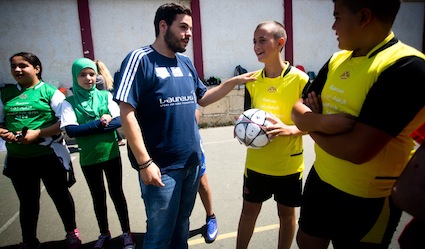
A participant in Playing Fair, Leading Peace in Jaffa. (photo from Peres Center)

“I did not know I could play with Jews or talk to them. Now I want to and I can,” wrote an Arab middle school student whose school was one of 10 – five Jewish, five Arab – to participate in Playing Fair, Leading Peace, created by the Jaffa-based Peres Center for Peace and Innovation to unite Jewish and Arab Israeli children through soccer.

In 2018-2019, Playing Fair, Leading Peace engaged 300 fifth- to seventh-graders in Arab and Jewish sectors of Jerusalem, Tel Aviv, Jaffa, Kalansua, Kfar Saba, Beersheva and Tel Sheva. In each participating school, one class is matched with one class from the corresponding nearby school. Kids and their teachers are guided by two specially trained university students (one Jewish, one Arab) in five tolerance education and prep sessions held at their own school, and in five joint soccer matches on one another’s turf.

In these games, Arabs don’t play against Jews; each team mixes children from the hosting and visiting schools. And there are no referees; the children are given the responsibility of determining rules and mediating disputes.

“They need to communicate to solve issues during the game by themselves. This is a smart component of the program,” said Tamar Hay-Sagiv, director of the education for peace and innovation department at the Peres Center.

photo - Children in the Arab village of Kalansua with a poster stating, “We need diversity” and “We are all equal” in Hebrew and Arabic
Children in the Arab village of Kalansua with a poster stating, “We need diversity” and “We are all equal” in Hebrew and Arabic. (photo from Peres Center)

But it’s not an easy component, because one side speaks Hebrew and the other speaks Arabic. “We tackle the language issue by teaching through sports. They learn the language of ‘the other’ while they play,” said Hay-Sagiv.

Nor is it a simple matter to convince parents to allow cross-visits.

“There are fears and stereotypes to overcome,” acknowledged Hay-Sagiv. “We had one child in the south whose family was afraid for him to travel to a Bedouin school. It was a trust-building process between his parents and the head of the school, who gave us full support and made the family comfortable in allowing the visit. It’s always a challenge for Jewish schools to agree to travel to Arab communities, but the hospitality they receive is unbelievable.”

One child wrote on the evaluation form after the first visit: “Even after they prepared us, I was still afraid of them, but when I met them, they looked like us, only with different clothing.”

As for stereotypes, it’s not only about the Arab-Jewish divide but also about gender. “We’ve had girls thinking they are not allowed to play soccer,” said Hay-Sagiv. “We have to overcome that, too. We try to create a safe space for everyone that is fun and interactive.”

For the last 18 years, the Peres Center has used sports, specifically soccer, as a tool to break down barriers between youth, Hay-Sagiv told Israel21c.

The centre’s flagship project, Twinned Peace Sports Schools (TPSS), involves leadership training and mixed teams led by professional coaches. Britain’s Prince William kicked around a ball with the TPSS team in Jaffa during his visit to Israel last summer.

photo - Playing Fair, Leading Peace soccer match at a Jerusalem school
Playing Fair, Leading Peace soccer match at a Jerusalem school. (photo from Peres Center)

TPSS, started in 2002, is the first and longest-running initiative of its kind in the region. Hay-Sagiv said it “significantly influences Arab and Jewish, Israeli and Palestinian girls and boys to become agents of positive change in their community and around the world.”

The Peres Center sought a way to scale up this successful, but limited, peace-building-through-sports program in a more accessible and less expensive format that would also involve nonathletic children.

“Based on our experience, we thought it would be interesting to get into Jewish and Arab schools during school hours and engage full classrooms. This way, we can reach all the boys and girls, as well as their teachers,” said Hay-Sagiv. When the other children in the host school observe the mixed teams playing soccer together, “it’s unbelievable to see the reactions to this unusual sight. That also has an impact.”

Playing Fair, Leading Peace is supported by the Israel Football Association, which oversees Israel’s national football (soccer) team comprised of Jewish and Arab Israelis, and captained by Circassian-Israeli Muslim Bibras Natkho. The program also works with the National Union of Israeli Students (representing all Israeli universities) and the Laureus Sport for Good Foundation.

“Hopefully, next [school] year, we will double the number of participating schools,” said Hay-Sagiv.

She explained that fifth- to seventh-graders were chosen for the program “because we see this as a crucial age for exposing them to this type of experience. Verbally, they are well developed and they’re going into a tough age. You have enough time to work with them during school hours, and it’s still possible at this age to work with boys and girls together.”

Based on questionnaires distributed before and after the activity, Hay-Sagiv and her staff can see that the program effects changes in attitude.

“I want to feel with them exactly the way I feel with my friends,” wrote one child.

“I hope that we will become one family that does joint activities in togetherness and tolerance,” wrote another.

Hay-Sagiv isn’t surprised by this impact, having seen the inroads made over the years by Twinned Peace Sports Schools.

“We’re traveling to Poland to organize a sports tournament in Warsaw with Israelis, Poles, Germans, Hungarians and Russians to mark 80 years since World War II, hopefully in September,” she said. “We are thinking of bringing a mixed Jewish and Arab team from Israel.”

For more information, visit peres-center.org/en/the-organization/projects/sports/playing-fair.

Israel21c is a nonprofit educational foundation with a mission to focus media and public attention on the 21st-century Israel that exists beyond the conflict. For more, or to donate, visit israel21c.org.

Parrot invaders

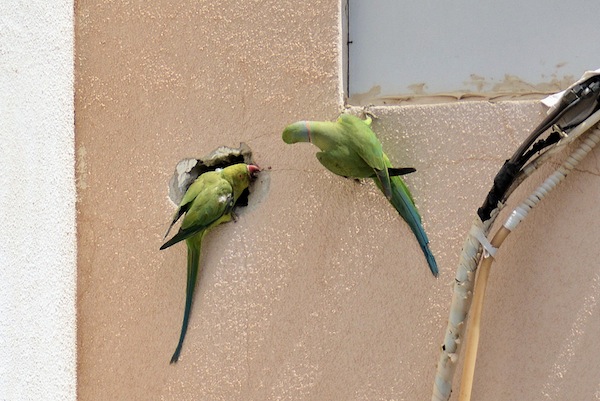
(photos from Ashernet)

A few years ago, the sight of a parrot in the Israeli sky was a rare event but invasive species have arrived, causing agricultural and other damage and threatening native biodiversity. Brought to the Middle East and Europe as pets, escaped or released parrots have established numerous wild populations across the area. ParrotNet – a European and Middle East network of scientists, photo - a monk parrotpractitioners and policymakers dedicated to research on invasive parrots, their impacts and the challenges they present – has concluded that measures to prevent parrots from invading new areas are paramount for limiting future harm. According to lead researcher Dr. Assaf Shwartz of the Technion in Haifa, “Today in Israel there are more than 200 populations of parrot species originating in South America and India…. These populations are growing every year and, today, there are more than 10,000 ring-necked parakeets and monk parakeets in Israel.”

הפסיקה נגד היין מהשטחים

(flickr)

בית המשפט הפדרלי של קנדה קבוע בסוף יולי כי סימון יין שיוצר בהתנחליות שבשטחים הכבושים, בתוך יין תוצרת ישראל אינו מותר. זאת כיוון שמדובר בדברי שקר, הטעייה והולכת שולל של ציבור הצרכנים.

הפסיקה הקשה נגד היין מהשטחים ניתנה בעקבות עתירה של אזרח יהודי מהעיר וויניפג, בשם דיוויד קטנבורג, שהוא פעלי פרו פלסטיני. הוא טען בעתירתו כנגד ממשלת קנדה, שיינות שיוצרו בהתנחלויות שבשטחים אינם יכולים להימכר עם תווית של יין שיוצר במדינת ישראל. לדברי קטנבורג הקהילה הבינלאומית וכן גם קנדה לא מכירות בהתנחלויות שבשטחים, כחלק אינטגרלי ממדינת ישראל. העתירה של קטנבורג הוגשה נגד סוכנות הפיקוח על המזון של קנדה, שבמקור אישרה את מכירת היין מההתנחלויות בשטחים עם התווית מיוצר בישראל.

שופטת בית המשפט הפדרלי, אן מקטביץ, פרסמה את פסק הדין שלה (שמתפרש על פני ארבעים ושלושה עמודים). היא אמרה בין היתר בהחלטתה כי יש מעט מאוד דברים כה מורכבים וסבוכים בהם המדיניות במזרח התיכון. וכן קיומן של ההתנחלויות הישראליות בגדה המערבית. אלה מעלים נושאים פוליטיים מסובכים, רגישים ועמוקים. עם זאת, אחת הדרכים השלוות אשר בה יכולים בני האדם להביע את עמדותיהם, היא דרך קבלת ההחלטות שלהם, כאשר הם רוכשים מוצרים שונים. כדי שיכולו להביע את עמדתם בהקשר זה, על הצרכנים לקבל מידע מדוייק לגבי זהות המוצר שנמצא במחלוקת. עוד קבעה השופטת של בית המשפט הפדרלי כי סימון יינות שיוצרו והוכנסו לתוך בקבוקים בהתנחלויות שבשטחים, כיין שיוצר במדינת ישראל, הוא דבר שקרי, מטעה ומוליך שולל את ציבור הצרכנים. לדבריה בהתנהלות שכזו מפירים את חוקי המקור של מוצרי מזון (כולל יינות) ותרופות. ההחלטה שמאפשרת לסמן יין שיוצר בהתנחלויות הישראליות שבשטחים כיין שיוצר במדינת ישראל, לא נופלת בגדר האפשרי והמתקבל על הדעת. אגב שופטת סירבה לקבוע כיצד כן יש לפרסם מהיכן היין בשטחים הכבושים יוצר. זאת לאור חילוקי הדעות המשמעותיים בכל הנוגע למעמד החוקי של ההתנחלויות הישראליות, בשטחי הגדה המערבית. היא ציינה כי אינה מתכוונת ליישב סוגיה זו בתיק שלפניה.

השופטת מקטביץ שלחה את התביעה של קטנבורג בחזרה לסוכנות הפיקוח על המזון של קנדה, על מנת שתדון בסוגיה מחדש. יצויין כי תחילה סוכנות הפיקוח הקנדית הסכימה לאור פנייתו של קטנבורג, להסיר את הסימון תוצרת ישראל על בקבוקי יין שיוצרו בהתנחלויות בשטחים. לאחר מכן היא חזרה בה ואז הוא עתר לבית המשפט העליון במדינה.

בהתאם לחוק הקנדי מוצרי מזון, כולל יינות אשר נמכרים בקנדה, חייבים לכלול פירוט מלא על מקור המדינה בהם הם יוצרו. כמובן שחל איסור להטעות את הצרכנים המקומיים.

לא ברור בשלב זה כיצד סוכנות הפיקוח על המזון תנהג לאור הפסיקה. לא מן הנמנע שסוגיה סבוכה זו תחזור לשולחנו של בית המשפט הקנדי לאור ערורים צפויים.

המרכז לענייני ישראל היהודים בקנדה פנה רשמית לממשלת קנדה וביקש תגיש עירעור לבית המשפט על החלטת השופטת מקטביץ. לדברי המרכז נפלו מספר טעויות משמעותיות בהחלטת השופטת. זאת כיוון שהדבקת התוויות על מקור היצור של בקבוקי היין מההתנחלויות בשטחים, תואמת את רוח הסכם הסחר החופשי בין קנדה לישראל שנחתם לאחרונה. וכן תואמת את החוק הקנדי והחוק הבינלאומי.

במרכז מציינים כי אם כן יוגש ערעור הם יבקשו מבית המשפט לקבל מעמד של מתערבים בדיון המדובר, על מנת להבטיח שהחוק הקנדי והחוק הבינלאומי יפורשו ויושמו כראוי.